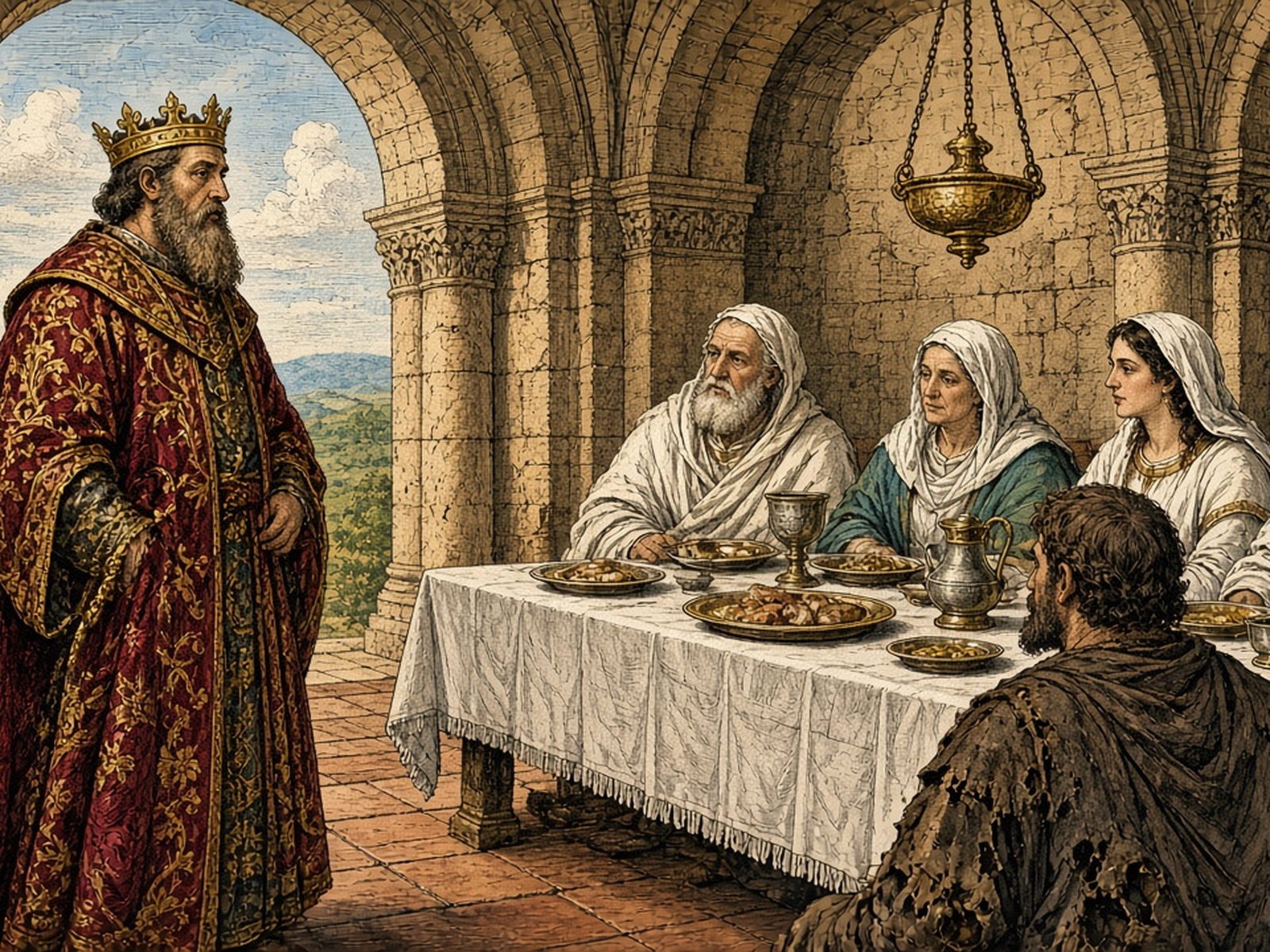
Covered – Sermon on Matthew 22:1-14 for the Twentieth Sunday after Trinity

Matthew 22:1-14

In the name of Jesus. Amen.

Weddings and marriage are all over the Bible. Scripture opens with the marriage of Adam and Eve (Gen. 2:21-25). It closes with the wedding feast of the Lamb (Rev. 19:6-9). And one of the most common pictures of God’s relationship to His people is marriage (Is. 54:5-8; Hos. 2:16-20; Eph. 5:25-32). So when we hear this parable opening with a king giving a wedding feast for his son, it sounds like it’s going to be a really good story.

The king sends out an announcement that he’s prepared the dinner. Oxen and fattened calves have been slaughtered. Remember how the father of the prodigal son had one fattened calf for the feast that welcomed his lost son home (Lk. 15:23)? Well, this king had all the grills and smokers going for this party.

But the parable takes an unexpected turn because the guests don’t show up. Some fancy weddings will have valet parking, but this wedding has chauffeurs that go out to bring the guests in. So, the king is befuddled that no one will come. He sends his servants back out to tell everyone about the feast. “Tell them about the menu and the venue. Tell them it’s all ready.” The servants go again, but this time, they don’t come back. The people who were invited take the servants and beat them, treat them shamefully, and kill them.

The king is done sending his servants. Now, he sends his military, and they level the place, utterly destroying it. The king, his son, and the soon-to-be princess are waiting at the palace to begin the wedding, but there are no guests. The king sends out more servants to find anyone who will to come to the feast—both good and bad (Mt. 22:10).

So, the parable started out good, got messy in the middle, but now it seems like it’s getting better. The reception is filled, the music is playing, the food is served, the dancing has begun. You can imagine the king going around the ballroom with his goblet filled and greeting the guests. But then, he comes to this guy who isn’t clothed in a wedding garment. The king confronts him, “How did you get in here without a wedding garment?” And the man is speechless. So, the king has his servants bind him hand and foot and cast him into the outer darkness where there is weeping and gnashing of teeth—in other words, nothing but sorrow and anger. “For many are called, but few are chosen.”

The parable is a warning because it’s a picture of what has happened. God’s own people rejected and killed the prophets. Even worse, when Christ came, they rejected Him. So, God destroyed them. But the parable is still happening, even right now. God’s invitation to come be a guest at His feast is still being extended throughout the world.

Dear saints, we are the ones who were in the roads and gathered from all sorts of different places to be at this banquet. You have been brought into the feast to celebrate the wedding of God’s Son. Now, the question is: are you worthy to be there? Do you have the right clothes, or are you at the king’s feast without the wedding garment? Is the king going to see you and cast you out?

There’s no question that this king has a strict dress code. But is it reasonable for him to be so hard-nosed about what people are wearing? Remember where these guests came from. They were just out wandering around the roads and doing who knows what. Why should they be expected to have the right clothing for such a fancy feast?

It’s true that you can’t just show up to a wedding. It takes time to get ready—especially when the wedding is in the palace. You can imagine the people wandering along the roads hearing the invitation. The servants come up to them and say, “I’m here to bring you to the palace for the royal wedding.” They would probably say, “I can’t go like this, all dusty and dirty in these old rags.” But the servants would reply, “Don’t worry about that. The king has plenty of extravagant robes. We’ll find one just for you.”

This was how it was done back then. If you went to the palace, the king would provide the right clothing for you to be there. If you were going to go to the palace, the king would deck you in fancy new clothes that would have been way out of your price range. If you were going to see the king, the king had to make you ready. This is how it was then, and this is how it is for us now.

If you or I are going to appear before God in the splendor of His holiness, He has to make us ready. He must provide the robe and give us what is needed. And He does this in holy Baptism. Galatians 3:27 says, “As many of you as were baptized into Christ have put on Christ.”

Einar, that brings me to you. Today, Christ has joined you to Himself in those waters. Our eyes could only see water being poured on your head. But our ears heard Jesus joining His Word and promise to that water. Scripture promises that God saw you receive the righteousness of Christ (2 Co. 5:21). Einar and all you saints, Ephesians 5 says that Jesus has given Himself unto death so that He might sanctify you, having cleansed you by the washing of water with the Word, so that He might present you to Himself in splendor, without spot or wrinkle or any such thing, that you might be holy and without blemish (Eph. 5:25-27). In other words, you have been brought into the wedding banquet of the King of kings, and you have been covered in the most precious and expensive garment of Christ’s righteousness. That garment is free of charge to you, but it is fully paid for by the Blood of Christ.

That covering isn’t a new idea. God has been covering His people ever since the Fall into sin. After Adam and Eve ate the fruit, they knew they were naked, so they tried to cover themselves with fig leaves when God showed up (Gen. 3:7). God had something better. God Himself slaughtered an animal to show that He would accept the death of another in place of the sinner. From that animal, God made garments of skins that clothed and covered their nakedness and shame (Gen. 3:21).

Dear saints, you are covered. In those waters, Christ has joined Einar to Himself, and He has joined you to Himself. The promise from Galatians 3, that those who are Baptized into Christ have put on Christ, that isn’t wishful thinking. You are covered and you remain covered not by adding your own works or your own righteousness to dazzle up the garment. You remain covered by faith. Philippians 3 puts it this way, you are found in Christ, not having a righteousness of your own that comes from the law, but that which comes through faith in Christ. It is the righteousness that comes from God that depends on faith (Php. 3:9).

Don’t be that man without the wedding garment. He insisted on keeping his own dirty, stinky, stained, ragged clothes. He did not want the covering the king had provided. In other words, he didn’t have faith in the king’s provision. Don’t do that.

God has covered you. The garment is His own precious Son, and it remains yours by faith. Amen.

The peace of God, which surpasses all understanding, will guard your hearts and minds in Christ Jesus (Php. 4:7). Amen.
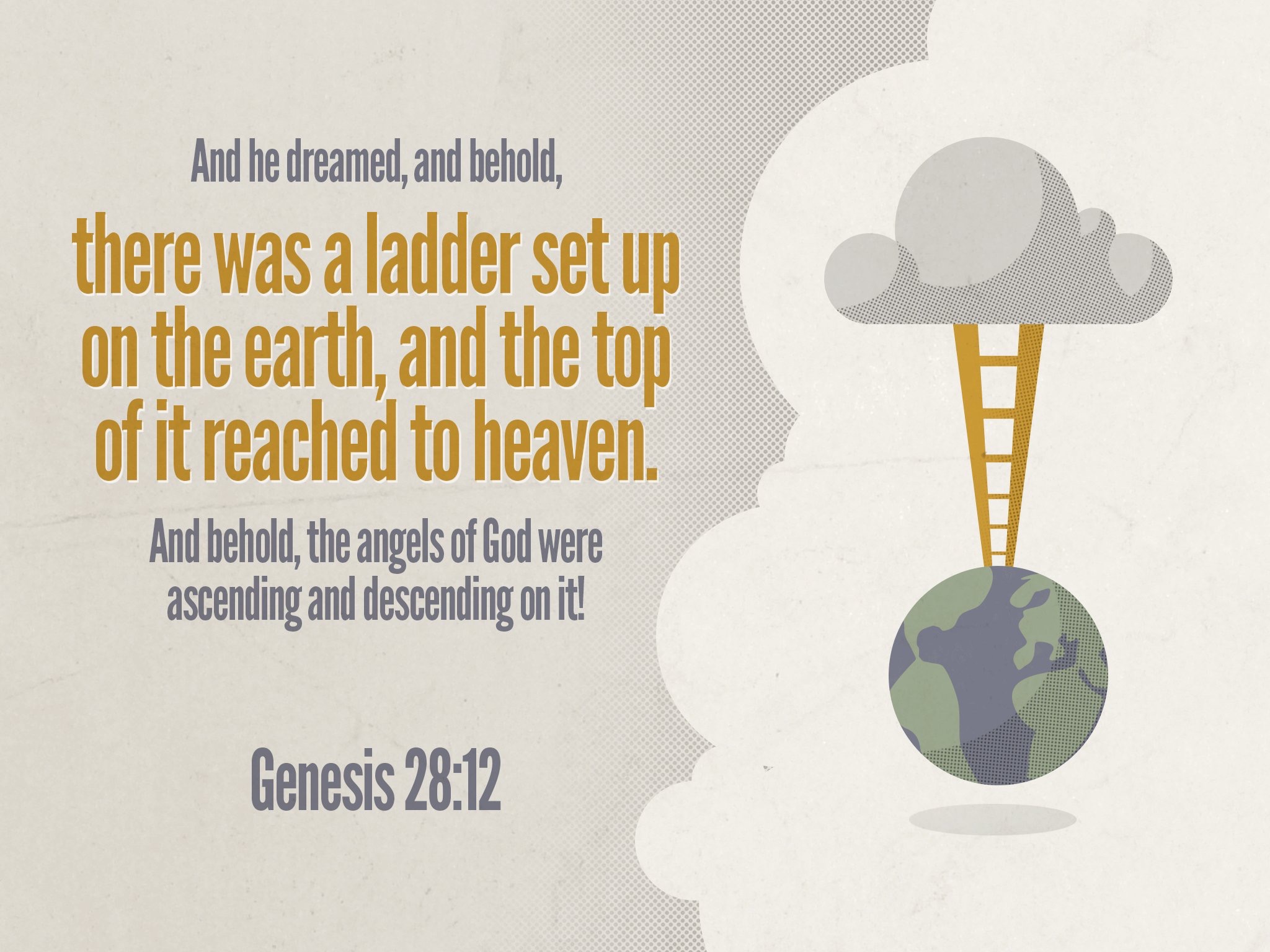

The Ladder Remains – Sermon on Genesis 28:10-17 for the Nineteenth Sunday after Trinity

Genesis 28:10-17

In the name of Jesus. Amen.

There are more stars above this building than anyone could count. But if you were to go outside right now, you wouldn’t see them because the sun and clouds hide them. Even at night, you can’t see all of them because of the ‘light pollution’ from the city lights. Those distant bits of God’s creation don’t go anywhere just because the clouds cover them, or because the sun drowns them out, or because the city lights hide them. The stars don’t actually go anywhere. Nobody goes out at noon and says, “Well, I guess the stars are gone.” You know better.

Sadly, we don’t always know better when it comes to God’s presence and help. When a new suffering enters your life and your prayers seem to get no higher than the ceiling, it’s easy to conclude that God either stopped paying attention or abandoned you and those you love. That’s where Jacob was the night he laid his head down on that rock. To better understand his mindset, you have to know how Jacob got here. Many of you know the story, but just to recap it:

Abraham had received the promise that the Messiah and Savior would be born from his descendants. Abraham passed that blessing on to his son, Isaac. Isaac and his wife, Rebekah, had twin sons. Esau was the older of the two and was Isaac’s favorite (Gen. 25:27) because he was a hunter and gatherer—a man’s man. Jacob was the younger twin and his mother’s favorite (Gen. 25:28). Because Esau was the older brother, he was the one who, generally speaking, should have gotten the inheritance and blessing.

One day, Jacob was home cooking a pot of stew. Esau had just come in from the field and was exhausted. Esau asked Jacob for a cup of the stew, but Jacob wanted to make sure that he would get something in return. He asked Esau for his birthright in exchange for that bit of soup. Esau agreed and despised his birthright (Gen. 25:29-34).

Later, when Isaac was blind and thought he was about to die, he told Esau to prepare a meal so Isaac could bless him. Rebekah heard about it and told Jacob to impersonate Esau to get the blessing from Isaac. Rebekah and Jacob decided to lie and trick blind Isaac into blessing Jacob before Esau could finish preparing the meal (see Gen. 27). When Esau finally got back, he learned that Isaac had already passed the blessing on to Jacob. So, Esau decided to kill Jacob once their father died. Rebekah heard about the murder plot and sent Jacob to her family, who lived about 450 miles northeast, and told him to find a wife there. The spot where he lies in our text is about 50 miles into that journey.

Just to add a bit more color to all of this: This text doesn’t explicitly say how old Jacob is. But from the rest of Genesis and events dated to Jacob’s life, we can calculate that Jacob is 77 years old. This is his first time being away from his parents. (Keep that in mind, you high schoolers. You don’t need to be in a hurry to leave your parents’ house at 18.) Jacob had all this swirling in his mind. “I need to stay alive and find a wife so the blessing can pass on from me.”

Jacob would have thought that the whole situation was backwards. Here he is in exile, fleeing out of the land connected to the blessing. He has a rock for a pillow while Esau is back home with his family and in his own bed. Jacob had to be wondering if the words of blessing really going to be his. Would God honor the promise that had been passed to him? Had God left him?

That night, Jacob is not a holy man on a pilgrimage. He’s a lonely man with a guilty conscience, a brother who wants him dead, and nothing to show for himself except words that he’s not sure God meant.

In the midst of all of that, God lets Jacob see what had been there all along. Notice how Moses writes this so the image pops into our head. Behold, there was a ladder set up on earth and reaching heaven. Behold, the angels of God are ascending and descending on that ladder. Behold, Yahweh was there. The text printed in the bulletin makes it sound like Yahweh is standing above the ladder. And that’s a legitimate translation. But the Hebrew can also be translated that Yahweh stood beside Jacob. Either way, God is not far off. But today, take it this way: Yahweh is standing right beside Jacob as he sees this vision and hears this promise.

“I am Yahweh, the God of your fathers. I will give this land to you and to your offspring. The Savior will be one of your descendants, and in Him all the families of the earth will be blessed. I am with you and will keep you wherever you go. You’re leaving this land now, but I will bring you back. I will not leave you until I have done everything I have promised you” (Gen. 28:13-15). God is promising that Jacob’s lying and cheating and circumstances have not changed or negated the promises God had given him.

 Jacob wakes up and says, “Surely Yahweh is in this place, and I did not know it” (Gen. 28:16). He doesn’t say, “God has arrived,” or, “I finally got heaven to notice.” It’s, “Surely Yahweh is in this place, and I did not know it.” Heaven had been touching earth the entire time. Jacob just couldn’t see it.

And Jacob isn’t talking about God’s ‘general’ presence here. Jacob knew that God is present everywhere. What he didn’t know was that God was present with him in a particular way—a gracious way. God was there to bless Jacob as he lay among those rocks. Even when the dream ended, Jacob knew God’s presence remained. The light of day did not change the promise God gave in the night. Jacob awoke and named the place Bethel (which means ‘house of God’ [Gen. 28:19]). That place was holy and awesome, not because he slept there, but because it was the gate of heaven, where Yahweh was present with His promise.

That ladder wasn’t something that was just for Jacob that one night. This gracious presence of Yahweh is also for you. In John 1, Jesus calls His first disciples. Specifically, Christ calls Nathanael and promises him, “Truly, truly, I say to you, you will see heaven opened, and the angels of God ascending and descending on the Son of Man” (Jn. 1:51).

Dear saints, that ladder is Christ, your Savior. He is the connection between heaven and earth. Christ is the gracious presence of God with man. This is why the company of angels sings on the night of His birth, “Glory to God in the highest, and on earth peace among those with whom He is pleased” (Lk. 2:14).

The traffic of heaven and the gracious presence of God reaches the lowest place. Here, it comes to a lonely man with his head on a rock, but it goes even lower. It moves toward a lowly manger, to a cross, and to you, even if you feel ignored by God.

In the same way that clouds, sunlight, and light pollution can hide the stars, your suffering, sin, and doubt might obscure the gracious presence of God. But know that the ladder doesn’t wobble and God’s promises don’t disappear. Christ, your Savior, stands there beside you. He comes to you whenever you hear His Word. And He promises, “All authority in heaven and on earth has been given to Me…. And behold, I am with you always, to the end of the age” (Mt. 28:18, 20).

This very sanctuary is for you what Bethel was for Jacob. There at the Font, God connects His Word to water and claims sinners for Himself. There from the altar, God announces His absolution to us, paralyzed sinners. From this table, Christ serves His Body and Blood to us and forgives our sins. And always, Christ promises that He is present here as we gather together (Mt. 18:20).

And the ladder remains in places that look like anything but the gate of heaven. In the hospital room, in the dining room with the empty chair, at the gravesides of our loved ones, God’s gracious presence remains, even if our eyes cannot see it. You have died, and your life is hidden with Christ in God. So set your minds on things that are above, not on things that are on earth (Col. 3:2-3).

Christ, the Ladder between heaven and earth, remains. He will not leave you until He has done what He has promised you (Gen. 28:15). He remains through the resurrection of the dead and into the life of the world to come. Amen.

The peace of God, which surpasses all understanding, will guard your hearts and minds in Christ Jesus (Php. 4:7). Amen.

No Half-Hearted Savior – Sermon on Matthew 22:34-46 for the Eighteenth Sunday after Trinity

Matthew 22:34-46

In the name of Jesus. Amen.

You heard it twice today, “You shall love the Lord your God with all your heart and with all your soul and with all your mind” (Mt. 22:37; cf. Dt. 6:5). You might hear “heart, soul, and mind” and think Jesus is giving you a checklist. And you might hear the “all” before each of those as a gauge to measure how much is in each tank. So, you might check the ‘love tank’ of your soul to see if it’s full or if it’s running on fumes. Or, you might think it would be beneficial to siphon some fuel from your ‘heart tank’ to make up for the deficiency in your ‘mind tank.’

That way of thinking can send you down a rabbit trail and end up missing the point Jesus is making. For one thing, when Jesus talks about your heart, soul, and mind, He’s not talking about different ingredients that make up who you are. God didn’t take one part heart, one part soul, and one part mind, mix it together, and poof—there you are. That would leave out your body. When God created Adam, the first part He fashioned was Adam’s body; then, He breathed the breath of life into Adam (Gen. 2:7). God made a body first. The love He commands here is an action that has to be done with a body.

The Bible will regularly use each of these terms—heart, soul, and mind—to talk about you as a whole. Let me walk through each of these, but we’ll spend the most time on the heart.

When we talk about someone’s heart today, it’s usually the center of emotions. But that isn’t the way the Bible talks about the heart. In both the Old and New Testament, the heart is the center of who you are. It’s the place where you understand things. The Scripture does say that the heart has emotion, but there’s also thinking. Proverbs will talk about the heart of a man planning his way (Pr. 16:9). When people grumble after Jesus absolves the man lowered from the roof before healing him, Jesus asks them, “Why do you think evil in your hearts?” (Mt. 9:4). After the shepherds visit newborn Jesus, Mary treasures up all these things, “pondering them in her heart” (Lk. 2:19). You can think of the heart as the center of who you are, the fountain of what you love and what you understand (Heb. 4:12).

Your soul is not a spare part added to your heart. Your soul is your breath and what makes you alive (Ps. 146:4; Gen. 2:7; 35:18; 1 Kgs. 17:21-22; Lk. 8:55; Jn. 19:30; Act. 7:59). Scripturally speaking, your mind doesn’t equal your brain. Your mind is where you think, but your mind also resides in the heart. In a sense, all three—heart, soul, and mind—are all of you. Your whole self.

But also know that your heart, soul, and mind don’t just sort of hang out inside of you. They move your body. Without the body, love can’t act. Don’t let the first and great command be something no one can see. You don’t keep the first and great command by feeling or thinking something about or toward God. That’s why Jesus doesn’t leave things there.

The lawyer asked for one command. Jesus gave him two. “And a second is like it: You shall love your neighbor as yourself” (Mt. 22:39). This isn’t ust a bonus command or additional hobby for people who have finished loving God. The second is like it. The love that loves God with all the heart, all the soul, and all the mind doesn’t stay there. It spills out and loves the neighbor. The mouth speaks. The hands serve. That’s how your love for God becomes something that can actually be seen.

You love God by loving the neighbor God has given you, and you do that loving with a body. The second is like the first because the first was never meant to be invisible. Love of God that never results in love of your neighbor is a false love that does not love God with the whole heart, soul, and mind. A person who withholds love from the neighbor he can see is not loving the God he cannot see (1 Jn. 4:20). The two directions of love—love toward God and love toward neighbor—hang together. On these two, Jesus says, depend all the Law and the Prophets (Mt. 22:40).

That’s why you can’t hear these words without being convicted. You know the shape and direction of this love. If the love of God is something that only stays up in your head and never gets to your hands and out to your neighbor, that’s a problem. That is sin. We have a word for that—half-hearted. The heart never put the body to work. That leads to your neighbor only getting a meager portion of love from you. Half a conversation. Half a patience. Half a mercy. 

The Law doesn’t ask you to feel warmly about God in private and then do your best toward people. The Law demands all of you, aimed at God, and landing on the person God puts next to you through what your body does. You haven’t done that, not even on your best day. Repent.

Repent and remember what God does with these two great commands. He doesn’t love you from a distance. He doesn’t just think nice things about you while He sits up in heaven. No, the Son of God became your neighbor. He took on flesh and dwelt among us (Jn. 1:14). He took a body so He could do the love and not only think it. The One who demands, “Love your neighbor,” is the God who left His throne, took a body, and became your Neighbor.

Jesus wasn’t half-hearted when He loved you. He loved you with His whole heart, whole soul, and whole mind. That whole self took a body so He could love. Christ set His face to go to Jerusalem (Lk. 9:51) knowing what was waiting there. He went anyway.

Jesus’ mind was whole. He did not scramble while these lawyers tried to test Him. He pointed them to Himself as David’s Son and David’s Lord. The Messiah stood in the flesh before them. But they refused to believe and had no answer (Mt. 22:42-45).

Jesus’ soul was whole. On the night He is betrayed, He does not desperately cling to His life. He gives it to the disciples and His Church throughout all generations saying, “This is My body. This is My blood.” A half-souled man would have been arranging an exit. Jesus doesn’t.

Christ’s heart was whole, even when He asked in the garden, “My Father, if it be possible, let this cup pass from Me” (Mt. 26:39). And when the Father made it clear that it wasn’t possible, Christ does not waver. He prayed, “Not as I will, but as You will.” Then, Christ, your Neighbor, went all the way to the cross for you and for all who have not loved either Him or each other.

That is the love you could not see, made visible. God’s love for you didn’t remain a mood He had for you up in heaven. Out of His love for you, God came down. His love for you is revealed in a body in the ditch of your sin, hands that touch what is unclean, feet that do not turn aside, a face set to go to Jerusalem and to the cross to save you (Lk. 9:51; Is. 50:7). God loved you by becoming the neighbor His command describes, and He did it with all of Himself in a body.

Because He did that, you are not left to manufacture a sham kind of love out of a divided heart, a love that stays inside and never acts. No, you now draw strength from Him. Christ did not save a slice or portion of you. Jesus took a body, and He still has it. He used His whole body to save your whole body. And He gives His body to you today, so He will raise your whole body on the Last Day.

He saves you—heart, soul, mind, eyes, fingers, knees, elbows. He forgives the eyes that have looked where they should not. He has mercy on the fingers that tried to cling to what they should have given to others. He cleanses the knees that have bowed to other things. He restores the elbows that preferred to rest rather than do the work of love. He redeemed all of that. And He will raise all of that. His plan is to have you, all of you, forever.

Dear saints, now you live a life that is shaped by the love of God who has neighbored you. You love Him because He first loved you by coming near in a body (1 Jn. 4:19).

Loving the Lord your God with your whole heart, soul, and mind and your neighbor as yourself is His will for you. No, you won’t do it perfectly. The Law will still accuse you of what is half-done. But you are not left to try to climb your way back to God. You have been redeemed and saved by His great love for you.

Dear saints, you do not have a half-hearted Savior. When God became your neighbor, He was resolute. Heart, soul, mind, and body, all of it, for you. From that strength, love God. From that strength, love the neighbor He has given you with the body He has redeemed. He will keep the whole of you—eyes, fingers, knees, elbows, heart, soul, and mind—until you arrive at the resurrection and the life of the world to come. Amen.

The peace of God, which surpasses all understanding, will guard your hearts and minds in Christ Jesus (Php. 4:7). Amen.