In the name of Jesus. Amen.
We will get into this text from Isaiah a bit, but right off the bat, two things need to be addressed. The first is that second-to-last line of the Athanasian Creed we just confessed. In your bulletin, it’s on p. 6. It’s the line that reads: “Those who have done good will enter eternal life, and those who have done evil will go into everlasting fire.” That can sound like we’re confessing that salvation is based on works. But that line (as well as the line before it) is basically quoting what Jesus says in John 5. Jesus says that the hour is coming when all who are in the tombs will hear His voice. Then, our Lord says, “Those who have done good to the resurrection of life, and those who have done evil to the resurrection of judgment” (Jn. 5:28-29). So, we should ask ourselves, “Since this is what we confess in the Athanasian Creed, are we wrong when we say that we are saved by grace alone through faith alone?” The answer is a resounding, “No!”
The tension arises because of how we define ‘good.’ Because we are sinners, we grade goodness on a curve. When a one-year-old child takes her first tedious, wobbly steps, her parents praise her. They don’t expect her to glide across the room like at 27.78 mph like Usain Bolt. Scripture tells us that God’s standard for goodness is perfection and holiness (Mt. 5:48; 1 Pet. 1:15-16). So, how do we get this perfection? The Bible is clear that it is only through faith.
The Bible defines what works aren’t good. Romans 14:23 says, “Whatever does not proceed from faith is sin.” And Hebrews 11:6 says, “Without faith it is impossible to please [God].” By faith you are pleasing to God because God counts that faith as righteousness (Gen. 15:6; Hab. 2:4; Ro. 4:3ff). By faith, God takes away all your sin and adds to you the perfect obedience and every good work of Jesus. By faith, you have done good and will enter eternal life. Romans 4:5says, “To the one who does not work but believes in Him who justifies the ungodly, his faith is counted as righteousness” (cf. Ro. 9:30-32; 1 Co. 1:30; Php. 3:9; Gal. 2:16).
So, that’s the first thing. Yes, the Bible speaks about a judgment of those who have done good and those who have done evil. And the Bible teaches that goodness only comes through faith in the crucified and risen Jesus Christ.
The second thing I want to address is the history of Trinity Sunday. Holy Trinity Sunday exists because the laity—the average Christians in Alexandria, Greece, Rome, and England—wanted to have a festival to celebrate the Trinity. The clergy resisted, arguing that every Sunday was already dedicated to the worship of God the Father, Son, and Holy Spirit. But the laity were right. Let me just throw out one caveat before I go further. I’m summarizing several hundred years of Church history here. Don’t picture this as something that happened at a congregational annual meeting or at the AFLC Annual Conference.
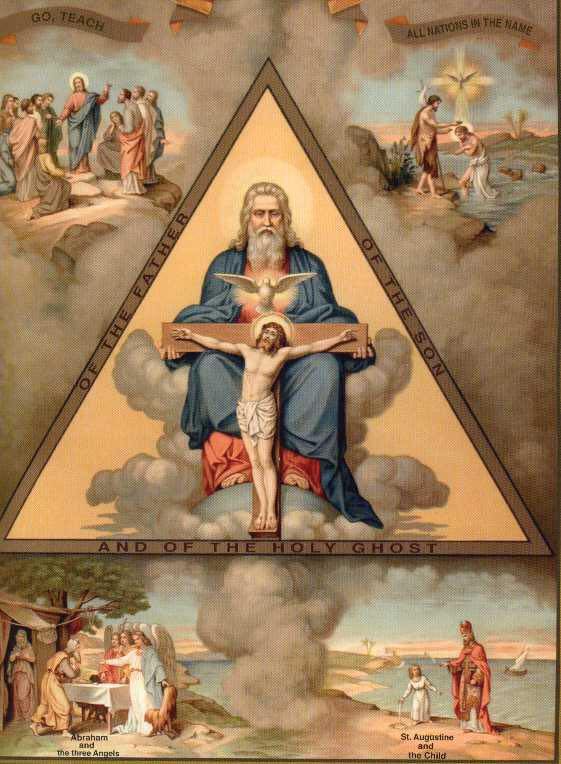
The clergy only saw the Trinity as a doctrine, and the Church didn’t have feasts for doctrine. The Church doesn’t have an “Original Sin Sunday.” But the laity rightly kept pushing because the Trinity isn’t just a doctrine. It’s a Person (or Persons, plural). If we only see the Trinity as a doctrine to be learned, we’re missing something very important. The Trinity is who God is—Father, Son, and Holy Spirit. Today, we celebrate that we worship one God in three Persons and three Persons in one God.
Now, to this Isaiah text. I’ve preached on it in the past, and if you want, I can give you those sermons later. Just to quickly summarize, Isaiah has this vision of the holy, holy, holy God sitting on the throne. Isaiah is terrified because he knows he’s a sinner. God sends a seraph to deliver forgiveness exactly to the location that Isaiah felt his sin—to his lips. There are weeks’, if not months’, worth of sermons on those first seven verses. But I want to limit our focus today on Isaiah 6:8.
This is a text you might have memorized. But don’t let your familiarity with it make you miss the wonder here. Listen carefully. Isaiah writes, “I heard the voice,” singular, one voice. “I heard the voice of the Lord,” again, singular, one Lord. “I heard the voice of the Lord saying, ‘Whom shall I send,’” singular, one Sender. But that voice of the Lord rephrases the question, “Who will go for Us?”—plural. Multiple. More than one.
Do you hear what is happening there? The Lord is having a conversation, but this conversation isn’t with the seraphim. They’re too busy worshipping and calling out, “Holy, holy, holy.” God is speaking within Himself. The One God in three Persons—Father, Son, and Holy Spirit—is having fellowship and communicating within the Trinity. And this text from Isaiah isn’t the first time this happens.
On the sixth day of creation God said, “Let Us make man in Our image, after Our likeness” (Gen. 1:26f). After the Fall, God says, “Behold, the man has become like one of Us in knowing good and evil” (Gen. 3:22). At the Tower of Babel, God says, “Let Us go down and there confuse their language” (Gen. 11:7). Scripture also clearly teaches that God is one: “Hear, O Israel: The Lord our God, the Lord is one” (Dt. 6:4). In the first Commandment, God says, “You shall have no other gods before Me,” singular (Ex. 20:3).
The Old Testament makes clear that there is a plurality and singularity in God. The key to unlocking this mystery is found best in the New Testament. God is one in essence, but also three distinct Persons—Father, Son, and Holy Spirit. Those three Persons have always existed in perfect relationship with one another. You know this from Sunday School and Confirmation, but let it play out in your mind today.
Before the world existed, before the Fall into sin, before God created mankind—in fact before anything was created—your triune God was already planning your salvation. Scripture says that Jesus is the Lamb who was slain before the foundation of the world (1 Pet. 1:19-20). Jesus teaches that you who believe will inherit the kingdom that was prepared for you from before the foundation of the world (Mt. 25:34). The book of Revelation says that your name was written in the Book of Life before anything was created (Rev. 13:8; 17:8). Ephesians says that your Triune God chose you to be holy and blameless in Christ from before the foundation of the world (Eph. 1:4). So, let this be clear in your mind: All three Persons of the Trinity—Father, Son, and Holy Spirit—have eternally been conversing about you and your salvation.
Dear saints, this is the wonder of the God we worship. He is not just an idea or some principle. He is personal. In the Scriptures, in the Absolution, in your Baptism, at His Table, the Triune God says “I” to you. He says, “I have loved you with an everlasting love” (Jer. 31:3). He comforts you, “I, I am He who blots out your transgressions for My own sake” (Is. 43:25). He promises, “I am with you always, to the end of the age”(Mt. 28:20). And because He is personal, you get to answer. You get to pray, “You are my God” (Jn. 20:28; Ps. 31:14, 63:1, 88:1). You get to say, “You have redeemed me” (Ps. 31:5). You get to cry out, “You are my Refuge and my Strength” (Ps. 18:2; 46:1) Salvation is God’s work, but is notjust a one-way transaction. It is real fellowship with the living God who has always been in conversation within Himself and who now invites you into that conversation.
In that conversation, God calls you to have a part and input through prayer. Here in Isaiah, the Trinity speaks about the mission of bringing salvation to the lost by asking, “Whom shall I send, and who will go for Us?” (Is. 6:8). And Isaiah was brought into that conversation, so he can respond, “Here am I! Send me.”
Dear saints, you do not go about in this world as a nameless servant. You go out as one who is known by God Himself. The Father who has always spoken to the Son now speaks to you as His own dear child. The Son who has always answered the Father unites you to Himself so that you belong to Him. The Spirit who has always shared in their fellowship now dwells in you and teaches you to cry out, “Abba, Father” (Ro. 8:15). This is personal. This is the God who thinks of you, who acts for you, and who feels compassion toward you. He is not far off. He speaks, and you can answer.
You have all of this because of my favorite line in the Athanasian Creed. It’s near the bottom of p. 5 of your bulletin and the last non-bold. It rightly confesses that Jesus is both God and Man but still One Christ, “one, that is to say, not by changing the Godhead into flesh but by taking on the humanity into God.” Ponder that today and every day.
In the incarnation of the eternal Son of God, God took on humanity into God. Part of who God is now is that He has a human body just like yours. The holy, eternal, all-knowing, omnipresent God lifted humanity unto Himself by becoming flesh and dying, rising, and ascending into heaven.
Dear saints, this is why we have Trinity Sunday. We are not celebrating an abstract doctrine. We are celebrating the living, personal God—who is Father, Son, and Holy Spirit—who loved you enough to send the Son for your redemption, and who now speaks to you so that you can answer Him.
Do not settle for knowing about the Trinity. Know the Triune God who speaks. The Father who sent the Son is your Father. The Son who was sent for you has made you His own. The Spirit who proceeds from them both (Jn. 14:26; 16:7; Gal. 4:6) dwells in you and teaches you to speak with God in prayer. This is not just some doctrine that we talk about on Trinity Sunday. This is the daily wonder of your life in Christ.
Cleansed by His Blood and sent by His Spirit, you belong to the personal God who has always been in conversation—and who has now included you in it. Amen.
The peace of God, which surpasses all understanding, will guard your hearts and minds in Christ Jesus (Php. 4:7). Amen.


You must be logged in to post a comment.