Luke 16:19–31
19 “There was a rich man who was clothed in purple and fine linen and who feasted sumptuously every day. 20 And at his gate was laid a poor man named Lazarus, covered with sores, 21 who desired to be fed with what fell from the rich man’s table. Moreover, even the dogs came and licked his sores. 22 The poor man died and was carried by the angels to Abraham’s side. The rich man also died and was buried, 23 and in Hades, being in torment, he lifted up his eyes and saw Abraham far off and Lazarus at his side. 24 And he called out, ‘Father Abraham, have mercy on me, and send Lazarus to dip the end of his finger in water and cool my tongue, for I am in anguish in this flame.’ 25 But Abraham said, ‘Child, remember that you in your lifetime received your good things, and Lazarus in like manner bad things; but now he is comforted here, and you are in anguish. 26 And besides all this, between us and you a great chasm has been fixed, in order that those who would pass from here to you may not be able, and none may cross from there to us.’ 27 And he said, ‘Then I beg you, father, to send him to my father’s house— 28 for I have five brothers—so that he may warn them, lest they also come into this place of torment.’ 29 But Abraham said, ‘They have Moses and the Prophets; let them hear them.’ 30 And he said, ‘No, father Abraham, but if someone goes to them from the dead, they will repent.’ 31 He said to him, ‘If they do not hear Moses and the Prophets, neither will they be convinced if someone should rise from the dead.’”
In the name of Jesus. Amen.
We’re all familiar with the phrase, “Don’t judge a book by its cover.” Well, the same could be said about characters in a parable. Jesus tells this parable with two main characters. On the one hand there is a rich man who is clothed in royal purple linens and ate the best food and on the other hand is the beggar Lazarus who was poor and had dogs licking his sores. The two men die. The rich man ends up tormented in Hades while Lazarus is comforted in heaven. The only thing these two men have in common is that they both die, so the differences between the two couldn’t be more stark. But we run into a danger if we only focus on the different economic statuses of these two. Does the rich man end up in hell because he got to enjoy blessings during his earthly life and Lazarus end up in heaven because he didn’t? Nope!
In the parable, Abraham says to the suffering rich man, “Remember that you in your lifetime received your good things, and Lazarus bad things; but now he is comforted here, and you are in anguish.” With this parable, is Jesus trying to teach us that blessings in this life mean torment for eternity? Are people saved because of their poor status in this life? Na ah.
So, we have to dig a little further to find the real difference between these two. And if we pay attention to the whole parable, the difference is as clear as the air in this sanctuary.
Nothing in the parable says the rich man is an evil, greedy glutton. There is no indication that he is a jerk who fires people all the time and is always looking for a way to maximize his profits without any consideration for others. The parable doesn’t say that. Jesus doesn’t say that that the rich man is selfish or uncharitable.
And, on the same note, nothing in the parable says that poor Lazarus was humble and virtuous. The text just says that he is poor. There are plenty of causes of poverty. Some people are poor because of an addiction. And, yes, of course, sometimes people are poor because of things outside of their control like sickness, disease, or disability. But none of those things earn eternal life for a person.
 Now in the parable, Jesus does say that Lazarus is there at the man’s gate begging and desiring to be fed with what fell from the rich man’s table. Absolutely, I’ll give you that. Maybe, the rich man should be helping more and being more generous. But, why do you think Lazarus chooses to beg at this man’s gate? Could it be that Lazarus knows he has a better chance to receive something at that gate than if he went to a different gate? And let’s be brutally honest here. If you had a Lazarus camped outside your house begging day after day wouldn’t you find a way to make them move on? How long before you’d be embarrassed about that poor person asking for money when visitors came to your house?
The main point is simply this: Don’t be deceived into thinking that the reason the rich man ends up in hell and poor Lazarus in heaven is economic status. Don’t ignore your sin of coveting by thinking, “That rich jerk got what he deserved.” Being rich, having blessings, and enjoying the good things God has given you is not a sin. Whatever you have is a gift from God, and God wants you to have it. That is why God gave the 7thCommandment, “Thou shalt not steal.” God gave that commandment to protect the blessings that He has given to you.
Yes, of course, some people get rich because they are evil and wicked and greedy. But being rich is not in and of itself a sin. Don’t fall into the trap – which is so common today – don’t fall into the trap of condemning the rich simply because they are rich and praising the poor simply because they are poor. Remember, Abraham was one of, if not the, wealthiest man in the world in his day. And where does he end up in the parable? In heaven.
Now, I’ve spent a significant amount of time on this today because we are all quick to make decisions about a person by looking only at the outward aspects of individuals. The social unrest and problems we are currently seeing in our society and country are exacerbated (and please note I’m saying ‘exacerbated’) because we will look at a person outwardly – their wealth, their poverty, their skin color, their job – we look at those external things and decide what that person is worth and how we should interact with them. That needs to stop.
How we treat someone should not depend on our perception of that person. No one’s virtue or worth or value is based on their economic status, their race, their occupation, or anything like that.
Listen carefully. Everything has a price – even people. All of us are slaves to sin. In John 8:34, Jesus says, “Everyone who practices sin is a slave to sin,” and Romans 3:23 says, “All have sinned.”  So, put two and two together and that means everyone is a slave to sin. But you and every person that you will ever meet, every person that has been or ever will be, every individual has been bought from slavery to sin. Every individual has been deemed and valued by God to be worth the blood of His own Son, Jesus. So, whether someone is rich or poor; whether someone is white, black, yellow, or brown; whether someone is a police officer or a rioter; whether someone is a capitalist or a Marxist; whether someone is conservative, liberal, Republican, or Democrat, remember God has paid the blood of Jesus to redeem that person from his or her slavery to sin. Amen?
I’ve taken this angle on the parable to make that point, and it is an important point for all of us to remember. But that is not the most important point for us today – not even close.
The most important point is to see the real difference between the rich man and Lazarus. The real difference is only revealed after they have both died. The rich man is over there in hell and Lazarus is over there in heaven. The rich man asks Abraham to have Lazarus raised from the dead to warn his five brothers. And Abraham says, “They have Moses and the Prophets, let them hear them.” In other words, Abraham says, “Listen rich dude, your brothers have the Bible. They don’t need someone to rise from the dead to warn them about the pain and torment you are suffering.”
And here is where the difference, the real difference between the rich man and Lazarus, comes out. The rich man says, “No, father Abraham, but if someone goes to them from the dead, they will repent.” In other words, the rich man is saying, “The active, effective, powerful, living, life-giving, life-creating Word of God isn’t good enough.”
The rich man rejected the Scriptures. He did it during his earthly life, and he continues to reject the Scriptures in eternal damnation. Even in hell, he has no remorse or repentance. By rejecting the Scriptures, the rich man had rejected and continued to reject the Savior who is revealed in the Scriptures.
The rich man had a lot of things in his earthly life, but the one thing he didn’t have was Jesus. So, please reconsider, who was more blessed in their earthly life? Was it the rich man or Lazarus? When Abraham says that all the five brothers need is the Bible, by default, what does that mean that Lazarus had in his poor, miserable life? Lazarus had the Word of God. Lazarus had true riches because he has faith if Christ. It doesn’t matter what things he did or didn’t have on earth because Lazarus had Jesus.
That is the real difference between these two.
Dear saints, you have the Scriptures. You have the true, eternal treasure that cannot be taken from you. If you have more than that (and all of us do), we can, of course, be generous with those things because we already have what is most important. We have Jesus.
In light of that, because you have Jesus, dear saints, go and be different. In a world full of fear because of pandemic, racism, riots, and anarchy, be different. Have no fear. No one and nothing can take from you what is most important.
So, live without fear. Live generously. Live with outrageous love, gratuitous generosity, and reckless compassion for those around you. Because neither death nor life, nor angels nor rulers, nor things present nor things to come, nor powers, nor height nor depth, nor anything else in all creation will be able to separate you from God’s love for you in Christ Jesus your Lord (Ro. 8:38-39). Amen.
The peace of God, which surpasses all understanding, will guard your hearts and minds in Christ Jesus. Amen.
 5 When he had entered Capernaum, a centurion came forward to him, appealing to him, 6 “Lord, my servant is lying paralyzed at home, suffering terribly.” 7 And he said to him, “I will come and heal him.” 8 But the centurion replied, “Lord, I am not worthy to have you come under my roof, but only say the word, and my servant will be healed. 9 For I too am a man under authority, with soldiers under me. And I say to one, ‘Go,’ and he goes, and to another, ‘Come,’ and he comes, and to my servant, ‘Do this,’ and he does it.” 10 When Jesus heard this, he marveled and said to those who followed him, “Truly, I tell you, with no one in Israel have I found such faith. 11 I tell you, many will come from east and west and recline at table with Abraham, Isaac, and Jacob in the kingdom of heaven, 12 while the sons of the kingdom will be thrown into the outer darkness. In that place there will be weeping and gnashing of teeth.” 13 And to the centurion Jesus said, “Go; let it be done for you as you have believed.” And the servant was healed at that very moment.
 “Centurion” was his title and meant he was a commander over one-hundred soldiers. Centurions wore impressive armor including a helmet with all the feathers sticking out of the top, a shiny breastplate, a metal skirt, and a huge shield. Like a leper, a centurion’s command was also obeyed, but not to avoid becoming one of them. A centurion could say, “Go,” and the soldier would go. “Destroy,” and they would destroy. “Kill,” and they would kill.
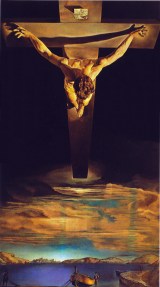 Repent, but do not despair. Jesus, God in the flesh, comes down from the mountain in order to save us. He is a God of mercy and grace. He comes to make the unworthy worthy and the unholy sacred. Jesus willingly approaches the untouchable leper to touch and heal. And Christ has compassion upon a centurion who appeared to have everything, but in reality, had nothing.
 I just have to run faster than you.” Well, guess what. When the bear of God’s Law is finished eating the guy who is slower to obey than you, it picks up your scent and resumes its pursuit of you because its appetite is never satisfied by eating up sinners.
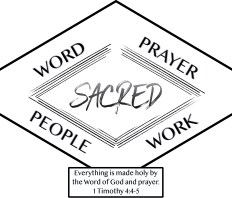 There’s a better way to understand these verses, and to get at that understanding, I’m going to connect this text to our theme for the year – “Sacred.” In Lev. 19:2, God speaks to His people, Israel, and says, “You shall be holy, for I the Lord your God am holy.” And Peter repeats those words for us Christians in 1 Pet. 1:16. In English, this sounds like a command because of the word ‘shall.’ But in both Hebrew and Greek it isn’t a command/imperative. A better translation for both is, “You will be holy.”
 likeness of sinful flesh and for sin, he condemned sin in the flesh, in order that the righteous requirement of the law might be fulfilled in us, who walk not according to the flesh but according to the Spirit.”
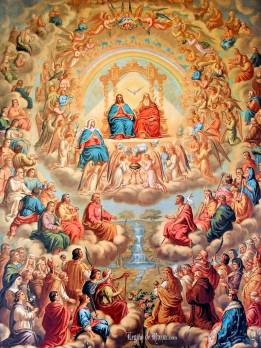 9 After this I looked, and behold, a great multitude that no one could number, from every nation, from all tribes and peoples and languages, standing before the throne and before the Lamb, clothed in white robes, with palm branches in their hands, 10 and crying out with a loud voice,
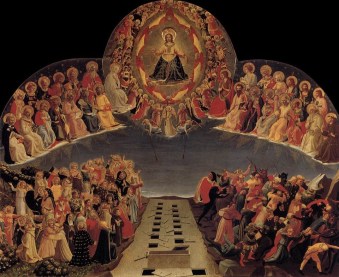 While death may come suddenly and abruptly here, those who die in the faith are not surprise arrivals in heaven. The company in heaven is not startled or shocked by those who show up at the doors of glory. The gates are open, and the believers who arrive there have been anticipated and are welcomed into the great multitude to be with the Lamb who shepherds them. Their arrival into glory is no shock to the residents of heaven. It is perfectly ordinary and on time.
 Because of this, we can have joy in the midst of sorrow. Here and now, as we are gathered together in God’s house and are invited to God’s table, we come to what is described in Hebrews 12(:22-24). This very morning in a small church on the north end of East Grand Forks, MN, we have come, “to Mount Zion and to the city of the living God, the heavenly Jerusalem, and to innumerable angels in festal gathering, and to the assembly of the firstborn who are enrolled in heaven, and to God, the judge of all, and to the spirits of the righteous made perfect, and to Jesus, the mediator of a new covenant.”
 She prays because she remembers that the God of Israel promised to deliver His people from the devil, which is why she addresses Jesus as the Son of David – to remind Him of His promises. And she remembers that she doesn’t deserve Jesus’ help because of her sins, so her prayer is, “Have mercy on me.”
 Boone, and all of you, be bold in your prayers. Even when it seems that God is distant and ignoring you, He hears you. He loves you. Jesus has died and risen for you and is even now interceding for you before His Father in heaven (1 Jn. 2:1).
 But Satan comes along and puts a question into the mind of the woman. “Did God actually say?” This is the one attack of the devil. He always is trying to get us to doubt the Word and promise of God. “Did God actually say, you should not eat of any tree in the garden?” And notice that the woman adds to God’s promise. She says, “We may eat of the fruit of the trees in the garden, but God said, ‘You shall not eat of the fruit of the tree that is in the middle of the garden, neither shall you touch it, less you die.’” God had never said anything about not touching the tree of the knowledge of good and evil (at least, it isn’t recorded for us). Satan is attacking God’s Word, but Adam and the woman have not fallen yet. The serpent sees his opening and tells an outright lie, “You will not surely die! For God knows that when you eat of it your eyes will be opened, and you will be like God, knowing good and evil.”
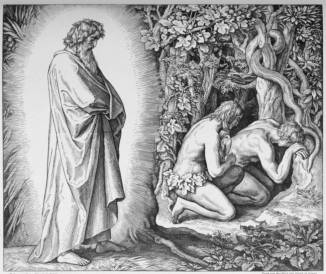 But even as God does this, we will see the horrific consequences that sin and evil has brought into God’s good creation. God calls to Adam, “Where are you?” God still wants to have fellowship with Adam and the woman even though they have sinned, broken His commandment, and lost their faith. But rather than confessing and repenting of his sin, Adam dodges the opportunity saying, “I hid from You because I was naked and afraid.” So, God gives Adam a second chance to repent, “Who told you that you were naked? Have you eaten of the tree of which I commanded you not to eat?”
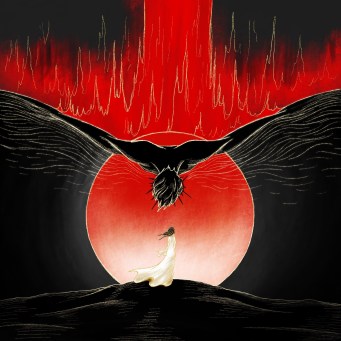 gives her the name Eve. She wasn’t called this at any point before in Scripture. Adam gives her the name ‘Eve’ which means ‘life-giver.’ Here’s how we know faith is restored. Eve was already going to be the mother of everyone who would be born. But Adam, the father of faith, changes her name to Eve because she is the mother of all who would believe in the promised Seed who would crush the serpent’s head.
 Imagine Matthew in this storm. Remember, Matthew – unlike Andrew and Peter and James and John – Matthew wasn’t a fisherman. He was a tax collector when Jesus called him to be a disciple (Mk. 2:14). Typically, he had hands stained from handling coins all day not clammy, saltwater-drenched hands. Matthew was used to sitting in a tax booth not on the rail of a boat bailing water so that it doesn’t sink. Matthew had seen Jesus rebuke demons, rebuke sickness, and rebuke the Pharisees and religious elite. But now, in the middle of a storm that threatened Matthew’s life, the Man who had called him saying, “Follow Me,”lay peacefully sleeping and undisturbed in the back of the boat on a cushion (Mk. 4:38).
 f that storm, in the middle of the wind and the saves and terror, Jesus asked the disciples, “Why are you afraid, O you of little faith?” This question from our Lord’s lips confronts us today. What are you afraid of? The devil may be behind the things you fear. Satan may want you to enter “emergency mode,” “crisis mode,” “God doesn’t care and is sleeping mode.” The devil wants nothing more than to rob you of the peace and security that comes from being a child of God. So repent. The devil is very cunning and dangerous, but he is also totally and completely predictable.
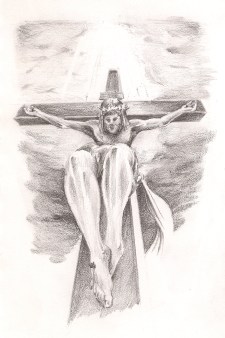 If you want to know what God thinks about you, you need look no further than the cross. While you were still weak, at the right time, Christ died for you (Ro. 5:6,8). If you are going through a storm of sickness, a storm of family strife, or whatever it might be, look at it through the lens of Christ crucified and risen for you. And know that God is in control and He will never leave you nor forsake you.
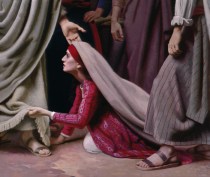 20 And behold, a woman who had suffered from a discharge of blood for twelve years came up behind him and touched the fringe of his garment, 21 for she said to herself, “If I only touch his garment, I will be made well.” 22 Jesus turned, and seeing her he said, “Take heart, daughter; your faith has made you well.” And instantly the woman was made well.
 He says to the mourners, “Go away, for the girl is not dead but sleeping.” And the mourners laugh, mocking Jesus and His words.
 He will raise you from the dead when He returns in glory. Even if you don’t get the things you want now, Christ will give you everything on the Last Day.
 Pastorsamwise
You must be logged in to post a comment.