Matthew 22:34-46
34 But when the Pharisees heard that he had silenced the Sadducees, they gathered together. 35 And one of them, a lawyer, asked him a question to test him. 36 “Teacher, which is the great commandment in the Law?” 37 And he said to him, “You shall love the Lord your God with all your heart and with all your soul and with all your mind. 38 This is the great and first commandment. 39 And a second is like it: You shall love your neighbor as yourself. 40 On these two commandments depend all the Law and the Prophets.”
41 Now while the Pharisees were gathered together, Jesus asked them a question, 42 saying, “What do you think about the Christ? Whose son is he?” They said to him, “The son of David.” 43 He said to them, “How is it then that David, in the Spirit, calls him Lord, saying,
44 “The Lord said to my Lord,
‘Sit at my right hand,
until I put your enemies under your feet’?
45 “If then David calls him Lord, how is he his son?” 46 And no one was able to answer him a word, nor from that day did anyone dare to ask him any more questions.
In the name of Jesus. Amen.
You’ve maybe heard the acronym about the Bible: “Basic Instructions Before Leaving Earth.” Sure, it’s cute, but honestly, it’s horrible because it turns God’s holy and precious Word into a manual of what we must do. If the Bible is about what we need to do and not what God has done for us in Christ Jesus, we’re sunk because we simply cannot do what God commands us to do even if we wanted to, which we don’t.
That is why, when you read the Bible (which I encourage you to do), it is extremely helpful to look for two things – Law and Gospel. Look for God’s commands and His promises. Look for the threats and the blessings. Look for the instruction and for the forgiveness of sins. This Gospel text is a great place to practice this and see how both Law and Gospel depend on each other.
The text has two parts. First, the question the Pharisees ask Jesus along with His answer which is Law. Second, the question or riddle that Jesus gives to the Pharisees which is all Gospel. The text takes place on Holy Tuesday, merely three days before Jesus is crucified. And this day, this Tuesday, was the last day of Jesus’ public teaching. After Jesus silences the Pharisees here, His teaching is only directed to the disciples.
In order to trip Jesus up and get Him in trouble, the religious leaders, the Pharisees and Sadducees, had asked Him several questions. First, He had been asked by the Pharisees about paying taxes to Caesar. Then, the Sadducees asked Him a question about marriage and the resurrection, and He answers it in a way that dumbfounded the Sadducees. And here, in our text, we get the third question.
“Teacher, which is the great commandment in the Law?” And Jesus responds, “You shall love the Lord your God with all your heart and with all your soul and with all your mind. This is the great and first commandment. And a second is like it: You shall love your neighbor as yourself. On these two commandments depend all the Law and the Prophets.”
For centuries, the rabbis had been talking, debating, and arguing about this question. They didn’t know how to answer it. But Jesus rattles off an answer quick as you please. If you want a summary of the all Commandments and condense them down into two statements, it is to love God and love your neighbor – on these two commandments depend (or ‘hang’) all the Law and the prophets. If you want, you can boil the Law down even further to one word, love. Paul says in Ro. 13:10, “Love is the fulfilling of the Law.”
A lot could be said here about the Law, but I’m going to keep it to six simple points.
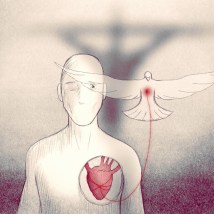 First, love is a beautiful summary of the Law, but that one word, love, does not replace the Law. Many people will say that since we have these two great commandments to love God and love our neighbor that we don’t need the rest of the Law. But that is false. Just because you think you are motivated by love does not mean that you are doing the right thing. We are so fallen that sometimes we try to pit love against the Commandments. Love is never an excuse to sin or an excuse to overlook sin. Instead, the Commandments define the shape of love, which is the second point about the Law.
Love takes shape according to the Commandments. Love is more than a feeling (thank you Boston). Love gives. Love serves. Love dies – greater love has no one than this, that one lays down his life for his friends (Jn. 15:13). If you want to love your neighbor, here is what it looks like: honor your father and mother; don’t murder; don’t commit adultery; don’t steal; don’t bear false witness; don’t covet. If you want to love God, don’t have other gods, keep His name holy, and keep the Sabbath holy. It doesn’t matter if what you do is motivated by love; if it violates or falls outside of these Commands, it is not love. In fact, we could go further and say that, when your actions fall outside of the Ten Commandments, they are motivated by selfishness and hatred toward both God and neighbor.
Third, love is defined by the Commandments, but it also finds and meets your neighbor’s need. What help and service can you give to your neighbor according to the Commandments? If your neighbor is hungry, feed him. If your neighbor is lonely, hang out with him or visit her. If your neighbor is trapped in sin, exhort them and encourage them to repent and ask God for mercy and forgiveness. If your neighbor is not a Christian and suffering spiritually, invite them to church.
Fourth, we love God by loving our neighbor. This is so important. 1 John 4:20 says, “If anyone says, ‘I love God,’ and hates his brother, he is a liar; for he who does not love his brother whom he has seen cannot love God whom he has not seen.” If you want to demonstrate your love for God, you do that by loving your neighbor according to the Commandments and your neighbor’s need. And this starts with those closest to you. Love your spouse first because that is the closest neighbor God has given you. Then, love your children, then your brothers and sisters in Christ, then your friends and coworkers, and so on and so forth.
Fifth, the command to love shows us our sin. There is no time in your life that you can say that you have loved God and neighbor enough. According to the Law, all of us are guilty lawbreakers and sinners. We constantly need to hear the Law tell us that we are sinners so that we are always repentant.
Sixth, and finally on the Law, the Law always shows us our sin, but beware of the temptation to not attempt good works because you are going to fail. When Jesus says, “Be perfect as your heavenly Father is perfect” (Mt. 5:48), don’t just throw up your hands thinking, “Well, that’s impossible so I’m not even going to try.” Get after it. Work. Try. Attempt. And, yes, fail. Then pray. Ask God for forgiveness and mercy. Pray for strength to try again. Pray for wisdom to see your neighbor’s need and how to love them knowing that you are dependent on God’s Law to shape your love for Him and your neighbor.
Now, the Gospel. Jesus silences the Pharisees with His answer, but now He is going to ask them a question. “What do you think about the Christ? Whose son is he?”
They answer correctly. In 2 Sam. 7, God had promised David to raise up one of David’s sons who would sit on his throne forever. There God promised that David’s offspring would be the Messiah, the one to crush the devil’s head, and the one to deliver God’s people. And the Pharisees know it. But Jesus asks a second question based on Ps. 110:1, which is one of the most quoted Old Testament verses in the New Testament, “How is it then that David, in the Spirit, calls him Lord, saying, ‘The Lord said to my Lord, Sit at my right hand, until I put your enemies under your feet’? If then David calls him Lord, how is he his son?”
The Pharisees cannot figure out the riddle from Scripture. How can the Messiah be David’s Son and David’s Lord? The Pharisees were unable to answer this because they didn’t believe that the Messiah would be both God and man. They figured the Messiah would be a man who would get things right and save them.
 But, Christian, you know the answer. In fact, you have been taught this and have believed it for so long that you hardly think about it too much. But it is the most amazing thing. Jesus is man, born of His mother. And Jesus is God, begotten of His Father before all worlds. Jesus is man so that He can die, and He is God so that His death can be an atoning sacrifice for our sins.
Because of Christ, the Law has been fulfilled. Yes, it is impossible for you to keep the two great Commandments, but Jesus has done it for you. He has taken on your flesh and blood to deliver you from sin, death, and the devil and give to you everlasting life. This is the Gospel.
Yes, the Law to love God and neighbor is important; on that depend all the Scriptures. But the Gospel is importanter [sic.]. Christian, the Gospel is how and why you will be able to stand before God on the Last Day. Jesus has died for you and put all of your enemies under His feet triumphing over them on the cross (Eph. 1:21-23). On this mercy and grace of God in Christ Jesus you depend. Amen.
The peace of God, which surpasses all understanding, will guard your hearts and minds in Christ Jesus. Amen.
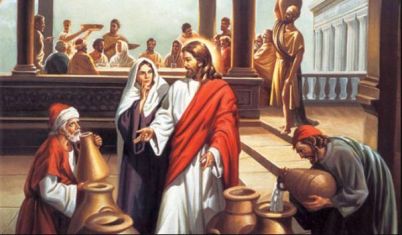 6 Now there were six stone water jars there for the Jewish rites of purification, each holding twenty or thirty gallons. 7 Jesus said to the servants, “Fill the jars with water.”And they filled them up to the brim. 8 And he said to them, “Now draw some out and take it to the master of the feast.”So they took it. 9 When the master of the feast tasted the water now become wine, and did not know where it came from (though the servants who had drawn the water knew), the master of the feast called the bridegroom 10 and said to him, “Everyone serves the good wine first, and when people have become drunk, then the poor wine. But you have kept the good wine until now.” 11 This, the first of his signs, Jesus did at Cana in Galilee, and manifested his glory. And his disciples believed in him.
 Jesus tells the servants to fill the jars with water, and they fill them up to the brim. And, at Jesus’ command, they take some of it to the master of the feast. The master tastes it, and it isn’t water anymore. It is wine. The master didn’t know. The guests didn’t know. Only Jesus, Mary, the servants, and the disciples know that this had been water miraculously turned into wine.
 But, dear saint, that is precisely the point. God is willing to give His gifts and mercy anyway. This isn’t a license to go on and sin because God will forgive you anyway. In fact, you are to abhor what is evil and hold to fast to what is good. Love one another. Outdo one another in showing honor (Ro. 12:9-11). And do all of that as you remember that God gives better than you deserve or appreciate.
 This miracle, on the other hand, is odd. It’s dirty. Maybe, you even find it disgusting. Jesus takes a deaf man who has a speech impediment off to the side. He sticks His fingers into wax-filled ears. God in the flesh spits (apparently, Jesus wasn’t taught how to give a proper wet-Willy). Christ literally seizes, not just ‘touches,’ the man’s tongue. And then, Jesus looks up to heaven. Sighs. And says, “Ephphatha,” which means,“Be opened.”
 Jesus had come to be the Lamb of God who takes away the sin of the world, not to be the audiologist who takes away the deafness of the world. Jesus had come to give eternal life through His death and resurrection, not to give a voice to the voiceless.
 Yes, Jesus sighs and acts. He gets involved with us even though it hurts Him. He cannot help Himself. In His love and mercy, He gets bound up in the mess we make and that others have made for us. He gets entangled in our sin. In fact, He becomes sin so that we might become the righteousness of God (2 Cor. 5:21).
 In the name of the Father and of the Son and of the Holy Spirit. Amen.
 The point of this parable at the twenty-eight-year-old’s funeral was that this famous rabbi had done enough good works to go to heaven early. In other words, be good, do good, and get rewarded. Santa Claus anyone?
 And, with the Gospel, there is no room for despair. God’s love has been poured out for you to save you. In Christ, God has won your salvation on the cross. On the cross, Jesus bore the heat of the day, the heat of God’s wrath. And you, believer, get His wages.
 Pastorsamwise
You must be logged in to post a comment.