Guilt, Anger, and Forgiveness – Sermon on Luke 2:41-52 for the First Sunday after Epiphany

Listen here.

Luke 2:41-52

41 Now his parents went to Jerusalem every year at the Feast of the Passover. 42 And when he was twelve years old, they went up according to custom. 43 And when the feast was ended, as they were returning, the boy Jesus stayed behind in Jerusalem. His parents did not know it, 44 but supposing him to be in the group they went a day’s journey, but then they began to search for him among their relatives and acquaintances, 45and when they did not find him, they returned to Jerusalem, searching for him. 46 After three days they found him in the temple, sitting among the teachers, listening to them and asking them questions. 47 And all who heard him were amazed at his understanding and his answers. 48 And when his parents saw him, they were astonished. And his mother said to him, “Son, why have you treated us so? Behold, your father and I have been searching for you in great distress.” 49 And he said to them, “Why were you looking for me? Did you not know that I must be in my Father’s house?” 50 And they did not understand the saying that he spoke to them. 51 And he went down with them and came to Nazareth and was submissive to them. And his mother treasured up all these things in her heart. 52 And Jesus increased in wisdom and in stature and in favor with God and man.

In the name of Jesus. Amen.

I will be making some comments about what has gone on and what is going on in our country, but to do so, I’m going to lay some groundwork from this text first.

One of the most remarkable things we see in this text is the fact that God the Father put His own dear Son into the care of very fallible parents. Now, God didn’t have a choice in that. Anyone God would choose to be the parents of the Savior of the world would be fallen, sinful, people. But here we see what is probably the worst case of child neglect in all of the Scriptures.

Imagine taking your family on a long road trip – let’s say you’ve driven to Houston, Texas (I don’t know why Houston, but it’s my analogy, and I get to pick). It’s time to return home. You get everything packed up and start driving. As you travel down the road, you pray for safety and begin to have a conversation with your spouse. Your kids are in the back quietly reading, staring out the window, watching a movie, or playing on their devices. After a couple of hours, you ask your twelve-year-old a question, but there is no answer. So, you ask one of the other kids, and get a response. You don’t think it’s really a big deal that your twelve-year-old didn’t answer, so you don’t turn around to see why he is silent. Eventually, you stop for gas and snacks. The kids go to the bathroom, and you get back on the road. You try to engage with your twelve-year-old again, and still no answer. Finally, you get to the hotel in Kansas where you are planning on staying and check in. As everyone gets settled in the room, you realize your twelve-year-old isn’t there. So, you go check the lobby, the pool, and the car. Still no twelve-year-old. You ask the other kids, and they inform you that the twelve-year-old never got in the car before you left Houston.

You finally get back to Houston and find your kid in the church you attended. He’s sitting and politely listening to a Bible study. Are you going to get after your twelve-year-old for treating you badly? The whole drive back to Texas, are you going to yell at your other kids for not telling you one of their siblings wasn’t in the car? If I’m being totally honest, I might.

Well, that’s the modern equivalent of what happened in this text. Joseph and Mary completely dropped the ball, failed as parents, and are guilty of serious neglect. We can’t go soft on Joseph and Mary here. They had a serious lapse in judgment. They left the big city with their friends and family while their twelve-year-old Son stayed. They didn’t think much of it at first. They figured He must be with the group, but He wasn’t. So, back they travel to Jerusalem, search for two more days, and finally, on the third day, they find Jesus listening to the teachers and learning from them.

And hear again what Mary does. She speaks to her perfect, sinless Son in a stern tone, “Son, why have you treated us this way? Your dad and I have been worried sick about you and searching for you.” Don’t skip over that. I have little doubt that Mary felt her guilt and sin. She should have known better. She knew that Jesus was God’s miraculous Son, born to set people free from sin. He was the Messiah and Savior of the world. She was chosen by God to protect and raise the long-awaited Messiah, and she had failed. She knew her guilt. But notice what that guilt and shame does to her. Instead of owning up to it, confessing it, and repenting, she projects her guilt on to Jesus.

We all have this fight or flight instinct when our guilt is hunting us down. Unfortunately, we most often chose to fight, but it’s never a fight we can win. The best we can do is drag others down with us, but we do it anyway. The best option would be to simply say, “I’m sorry; I was wrong.” But we don’t. We attack and we try to circle the wagons around us. Repent.

All of this brings me to the events in our nation’s capitol this past week.

First of all, it was wrong. It is a shameful thing that the world was watching that happen in the greatest, most blessed nation in the history of the world. It should not have been and we are already seeing the impact on our culture. And there are a lot of questions. Who were the people who did this, and why were they doing it? But I’m not going to get into that because it doesn’t matter for the purposes of this sermon. I will simply say that we need to let the process work. As information is gathered, that will all be sorted out and those who have broken the law should be prosecuted and punished.

As Christians, we should be united in saying that what happened was wrong and we should have similar feelings about it as we did when the planes crashed into the World Trade Center on 9/11.

There has been a lot of rhetoric surrounding the storming of the Capitol. Some will say that the right is to blame, and others will point the finger back at the left and how they cheered on the various protestors over the last six months. Both sides have valid points. But here’s the deal. All of that needs to stop because it doesn’t help the situation. And as followers of Jesus, we need to be the first to shut our mouths when it comes to blaming “them” – whoever “them” is.

Jesus is clear about this. In Luke 13[:1-5], Jesus gets asked about a time when Pontius Pilate killed some Galileans while they were offering their sacrifices. The people bringing this question to Jesus are looking for Jesus to speak out against the evil of Pilate. But Jesus doesn’t have it. He responds, “Do you think that these Galileans were worse sinners… because they suffered in this way? No, I tell you; but unless you repent, you will all likewise perish.” Then, Jesus even goes further and adds, “Or those eighteen on whom the tower in Siloam fell and killed them: do you think that they were worse offenders than all the others who lived in Jerusalem? No, I tell you; but unless you repent, you will all likewise perish.”

In other words, whenever there is injustice and tragedy, your Savior calls you as an individual to repent. Whether the injustice comes from the authorities whom God has placed in those positions to keep and promote peace, or whether it is some natural disaster, whatever the case may be, the problems you see in this world should cause you and I to individually repent.

Back to Mary. In light of her pain, grief, and guilt, she blames Jesus for all of her feelings of distress. She says, “Why have You treated us so?” In other words, Mary is saying, “Jesus, you’ve made us feel bad.” And we all fall into the same trap of projecting our guilt away from ourselves. Repent.

We don’t get a free pass for our sinful feelings. We chose to feel the way we feel. We are not animals. We chose our reactions. Yes, we can be provoked and prodded, but that does not excuse us from our sinful actions and reactions. We indulge ourselves in our anger and choose to take vengeance for ourselves, while God says, “Vengeance is Mine. I will repay” (Dt. 32:35; Ro. 12:19; Heb. 10:30). But we aren’t content to wait for God’s action, so we take it up ourselves. And this is pride which is in violation of God’s Commands.

But now watch how Jesus responds. Jesus has to address this accusation from His mother. Mary has accused Jesus of breaking the 4th Commandment by not honoring His father and mother, so He cannot be silent. But watch what Jesus does. He does rebuke Mary and her anger toward Him, but He does it in the kindest way. He doesn’t say, “Hold on there, mom. Back up. You’re the one who is supposed to be watching out for Me.” Instead, He says, “Why were you looking for Me? Did you not know that I must be in My Father’s house?” 

In this rebuke, Jesus isn’t defending His honor; instead, He’s defending His work. He has to be sinless to be the Savior and die for the sins of the world.

So, Mary stands rebuked by God in the flesh, and thanks be to God she accepts it – to her absolute credit. She might have been tempted to snap back at Jesus, “Listen you tween, what do you mean by that?” But she doesn’t. She submits to the rebuke in humility. And notice that even though neither Mary nor Joseph fully understand what Jesus is saying (see v. 50), yet still, she submits to His correction.

Here’s the point. Jesus is your Savior, and He will rebuke you when you do wrong and have guilt, but He does it kindly and gently so that you repent and return to Him for His mercy and forgiveness. May we, when we are rebuked by Christ also accept that rebuke, repent, and receive His forgiveness and delight in His presence. And when we are wrongly accused of sin, may we follow in Jesus’ steps and not put up our fists to defend our honor. Instead, let us be calm, measured, and offer correction and forgiveness.

After this, Jesus returned to Galilee with His fallible parents and lived in submission to them. Dear saints, this shows us that God works in and through families by shedding His light of mercy and forgiveness in and through them. Parents, don’t fall into the trap of thinking that your failures and shortcomings disqualify you from being a good parent. One of the best things you can do for your kids is confess your failures, receive forgiveness from them and from Christ, and teach them that God’s grace and mercy is the most important thing in the world. And as you do that, love your spouse, hug your kids, share with them the forgiveness of Christ. That will do more for this country and the world than anything else you can do. 

Dear saints, there appears to be difficult days ahead of us. If you want to start changing the world, pour yourself into your family and those that God puts into your life. Because it isn’t great power that holds evil in check. Don’t be conformed to this world in thinking that way. Instead, be transformed by God’s Word which renews your mind (Ro. 12:2) recognizing that it is the small, everyday deeds of ordinary folk that keep the darkness at bay.

And above all, live in the free gift of forgiveness that Christ has given you. In the midst of this fallen world, keep singing the songs of Zion. May our Savior return quickly and deliver us from our exile and captivity. Amen.

The peace of God, which surpasses all understanding, will guard your hearts and minds in Christ Jesus. Amen.

God Makes Room – Sermon on Luke 2:1-20 for Christmas Eve 2020

Listen here.

Luke 2:1-20

1 In those days a decree went out from Caesar Augustus that all the world should be registered. 2 This was the first registration when Quirinius was governor of Syria. 3 And all went to be registered, each to his own town. 4 And Joseph also went up from Galilee, from the town of Nazareth, to Judea, to the city of David, which is called Bethlehem, because he was of the house and lineage of David, 5 to be registered with Mary, his betrothed, who was with child. 6 And while they were there, the time came for her to give birth. 7 And she gave birth to her firstborn son and wrapped him in swaddling cloths and laid him in a manger, because there was no place for them in the inn.

8 And in the same region there were shepherds out in the field, keeping watch over their flock by night. 9And an angel of the Lord appeared to them, and the glory of the Lord shone around them, and they were filled with great fear. 10 And the angel said to them, “Fear not, for behold, I bring you good news of great joy that will be for all the people. 11 For unto you is born this day in the city of David a Savior, who is Christ the Lord. 12And this will be a sign for you: you will find a baby wrapped in swaddling cloths and lying in a manger.” 13 And suddenly there was with the angel a multitude of the heavenly host praising God and saying, 

14 “Glory to God in the highest, 
and on earth peace among men, with whom he is pleased!”

15 When the angels went away from them into heaven, the shepherds said to one another, “Let us go over to Bethlehem and see this thing that has happened, which the Lord has made known to us.” 16 And they went with haste and found Mary and Joseph, and the baby lying in a manger. 17 And when they saw it, they made known the saying that had been told them concerning this child. 18 And all who heard it wondered at what the shepherds told them.

19 But Mary treasured up all these things, pondering them in her heart. 20 And the shepherds returned, glorifying and praising God for all they had heard and seen, as it had been told them.

In the name of Jesus. Amen.

Merry Christmas!

The first twenty verses of Luke 2 are extremely well-known. Some of you might be able to recite them word for word, and many of you can probably recite them with a little help here and there. Sure, you might need a little help remembering that Quirinius was governor of Syria. (It’s a hard name to remember.) And it is good that you remember this passage. These verses record for us the most significant event in human history. The only other event that would be tied with the birth of Christ would be His death and resurrection.

But one of the problems with our familiarity with this text is just that – we are familiar with it. With that familiarity comes certain ideas that aren’t part of the text. And those things can get ingrained in our minds. Some of the beauty and brilliance of this event fades away when some common misconceptions about the event overshadow the reality. Well, tonight, I’d like to take this magnificent gem of a text and get it cleaned and polished to remove the haze of one of those misconceptions. We’re mainly going to focus on one verse of the text. And I hope and pray that you are blessed. 

The birth of Jesus takes up one verse and is simply recorded for us in v. 7, “And [Mary] gave birth to her firstborn Son and wrapped Him in swaddling cloths and laid him in a manger, because there was no place for them in the inn.”

First let’s lay out the misconception. Unfortunately, we have gotten the idea that Tom Bodett for Motel 6 didn’t leave the light on for Joseph and Mary. (I really hope most of you are old enough to get that reference; if you don’t, you didn’t listen to enough Twins games on the radio in the mid ‘90’s.) All the familiar English translations use the same word there, ‘inn,’ which gives an idea of a hotel. So, we get the idea that, by the time Joseph gets the very pregnant Mary to Bethlehem, it’s late and all the hotels were booked because so many people were there for the census. And it isn’t too hard to imagine that being the case. Anyone who has traveled with a very pregnant lady knows you have to stop for bathroom breaks – a lot of bathroom breaks. The picture in our minds is that Joseph and Mary check at all the hotels, find no rooms available, and end up staying in a stable or barn.

The problem with this is that the word that gets translated as ‘inn’ doesn’t refer to a hotel. In fact, Bethlehem was so small that the little town probably didn’t even have a hotel. Now, the word that gets translated as ‘inn’ here only occurs two other times in the New Testament. The other two times this word gets used are once by Mark and also later at the end of the Gospel of Luke. And both of those times is in the context of Jesus telling His disciples to follow a particular man to his house and say to him, “The Teacher says, ‘Where is My guest room (not ‘inn’ but ‘guest room’ – same word), where I may eat the Passover with My disciples?” (Mk. 14:14, Lk. 22:11). And Jesus didn’t institute the Lord’s Supper in a hotel conference room. Also, Luke knows the typical word for an ‘inn’ or ‘hotel’; he uses it in the Parable of the Good Samaritan (Lk. 10:34), but it’s a very different word. If Luke had meant to say there were no rooms in the hotels of Bethlehem, he would have, but he doesn’t.

So, we should understand that Luke isn’t talking about hotels. Instead, when Luke says there was no room for Joseph and Mary in the ‘guest room,’ he’s telling us that the couple had arrived at a home – probably the home of one of Joseph’s relatives – but other members of Joseph’s extended family had lodged there and that there was no longer any place for them in the guest room. In fact, it might be even worse. Maybe, when Joseph and Mary get there, the pious, religious relatives learn that Mary is pregnant out of wedlock and they aren’t willing to make a place in the guest room for her even while she is in labor. So, Joseph and Mary only have one option for the birth of the Child and that was the part of the house where the animals were kept. And, just so you know, it was typical back then for houses to have a place for their animals in a lower part of the house.

Now, don’t go home and throw away your nativity sets. Please don’t. They’re good. But it would be good when you look at a Nativity set to tweak your thinking just a little bit. Add this picture to it: Joseph and Mary aren’t out in a pasture away from everything else. Instead, they are inside a full house where relatives are likely talking, eating, drinking, and laughing – just like at a family reunion. And Mary is off to the side, giving birth, wrapping Jesus in swaddling cloths, and laying Him in a feeding trough.

The Messiah, the One whom all of God’s people were waiting for, is finally born, but there is no place for Him to lay His head except for that manger.

So, play this out a little: When the company of angles come to proclaim the greatest news in all of history, they announce the birth of Jesus to the shepherds. But the shepherds aren’t the first to know about Jesus’ birth. Joseph’s family would have already known. Joseph and Mary probably tried to give an explanation to the family, but they didn’t believe that Mary was miraculously pregnant with Jesus. And, so, they did not make room for the birth and arrival of the Son of God.

Now, this is nothing new. Because of our sin, all humanity is opposed to God’s presence, and in our sin, we have no place for God. That is what we see when Adam and Eve fall into sin. They hear God walking in the garden in the cool of the day but try to hide themselves (Gen. 3:8). It’s what happens after God speaks to His people on Mt. Sinai; they hear His voice and ask Moses to tell God to not talk to them anymore (Ex. 20:18-21, Dt. 18:16). It’s why the scribes and Pharisees reject Jesus even though He repeatedly proves that He is God (see esp. Mt. 26:59-66). It still happens today when people use any and every excuse to not be where Jesus is present with His gifts. In his Gospel (and you will hear these verses in a few minutes), John says it more bluntly than Luke. “He came to His own, and His own did not receive Him” (Jn. 1:11).

In the end, we see the sad reality that sinners have no place for the presence of God.

Now, please, don’t finish my sermon for me. This isn’t meant to be a guilt trip. I’m not going to give you a sales pitch appealing to you, “Please, make room for Jesus in your heart.”

Just because God took on flesh and was a helpless Infant, don’t get the impression that Jesus is a fickle, desperate god who is just waiting around for you to make room for Him. Even when He is rejected, when He is pushed out, even when the very people He came to save have no place for Him, He doesn’t twiddle His thumbs and wait for you to make room for Him. Instead, God in His great love for you makes room for Himself.

Don’t let the humility of Jesus’ birth lead you to diminish His power. Even as a little Infant, Jesus is the eternal Son of God, King of kings, Lord of lords. Rather let the humble birth of powerful Jesus lead you to recognize His great love and mercy for you.

Jesus knew what He was coming to and wasn’t surprised that there was no place for Him. But He came anyway. He came to make a room in eternity for those who did not make room for His birth. He knew that the infant hands, feet, and body that Mary swaddled up to keep Him from getting cold would be the same hands, feet, and body that would be nailed to the cross. And He did all of this voluntarily and out of love for you so that He could make an eternal place for you with Him in heaven.

That is the moral of this reading, the whole blessed idea of Christmas, and, in fact, the teaching of all Scripture. God doesn’t wait for you to make room for Him. If you don’t make room for Him, He just nestles in anyway. Whenever He comes, He comes to you to bring you His love, mercy, and forgiveness. Jesus made room in His heart for you. All of your life and salvation is not about how open you are to God rather on how He is open to you. And the the birth of your Savior shows, proves, demonstrates, and manifests how open He is to you.

And Christmas then is the time when we do nothing but watch our God come in the flesh and simply say, “Thank you.”

One more thing and then I’ll stop. Luke is a historian. He is detailed and precise. He mentions all the details about it being the first census when Quirinius was governor, etc. which helps prove the factuality of his Gospel. And Luke does this in all his writings. But notice how Luke is fairly vague in v. 7. He simply and briefly records the fact that Jesus was born and laid in a manger because there was no place in the guest room, and he leaves it at that. Luke doesn’t name names or give addresses. He doesn’t criticize, scorn, or belittle Joseph’s relatives for their rejection of Jesus. He doesn’t throw them under the bus. He simply says, there wasn’t room.

Here’s the point: It isn’t a stretch of the imagination at all to think that the very people who refused to make a place for Jesus when He was born became Christians by the time Luke wrote his Gospel. So, Luke covers their sin and doesn’t call it out. Jesus does the same for you.

Because of what Christ has done by coming to earth, being born in such a humble manner, by giving His life on the cross, and by rising again for you, your sins are removed from you as far as the east is from the west.

And God be praised. You are here tonight. You have rightly made room in your celebration tonight for the birth of the Savior who has made room for you.

People loved by God: Merry Christmas! Amen.[1]

The peace of God, which surpasses all understanding, will guard your hearts and minds in Christ Jesus. Amen.


[1] I am thankful for a sermon by Pr. Jared Melius for the direction of this sermon.

Comfort Doubled – Sermon on Isaiah 40:1-8 for the Third Sunday of Advent

Listen here.

Isaiah 40:1-8

1 Comfort, comfort my people, says your God. 
2  Speak tenderly to Jerusalem, 
and cry to her 
     that her warfare is ended, 
that her iniquity is pardoned, 
     that she has received from the Lord’s hand 
double for all her sins. 

3   A voice cries: 
     “In the wilderness prepare the way of the Lord; 
make straight in the desert a highway for our God. 
4   Every valley shall be lifted up, 
and every mountain and hill be made low; 
     the uneven ground shall become level, 
and the rough places a plain. 
5   And the glory of the Lord shall be revealed, 
and all flesh shall see it together, 
for the mouth of the Lord has spoken.” 
6   A voice says, “Cry!” 
And I said, “What shall I cry?” 
     All flesh is grass, 
and all its beauty is like the flower of the field. 
7   The grass withers, the flower fades 
when the breath of the Lord blows on it; 
surely the people are grass. 
8   The grass withers, the flower fades, 
but the word of our God will stand forever.

In the name of Jesus. Amen.

I titled this sermon “Comfort Doubled,” but it maybe should have been “Infinite Comfort” because the whole text is dripping with comfort. Dear saints, whenever God comes, He comes to comfort you. Listen to what He says in v. 1 again, “Comfort, comfort my people, says your God.” These words are akin to what Jesus, who came not to call the righteous but sinners (Mt. 9:13), says in Mt. 11:28, “Come to Me, all who labor and heavy laden, and I will give you rest.” To any and all who are troubled, afflicted, and uncomfortable, God says, “Here is a double dose – two shots of comfort.”

Who gets this comfort? God’s people – whenever they are troubled. That means you. You are those for whom Christ was born. You are those whom God has claimed as His Own. You are the people for whom Christ has died. God says so Himself. He is the One who calls you, “My people,” and He is not ashamed to call Himself, “Your God.” If you play the first verse of this text backwards, God says to you, “I am your God. You are My people. And I give to you comfort on top of comfort.”

The context in which these verses were originally written helps us see just how comforting these words from God are. God has Isaiah tell Jerusalem that her warfare is ended, but when Isaiah writes these words Jerusalem isn’t even at war. Eventually, Babylon will come and besiege Jerusalem, and God’s people will be taken into exile. But even before any of that has happened, God comforts His people with the promise that her warfare will end.

Dear saints, God’s anger is but for a moment, and His favor is for a lifetime. Weeping may tarry for the night, but joy comes with the morning (Ps. 30:5). And before the suffering begins God preaches comfort to His people.

This is in line with God’s character, and we see this repeatedly in Scripture. Isaiah experienced this when God called Him to be a prophet. Isaiah saw God’s holiness and was terrified because he recognized his sinful lips. But God sent the seraph with a flaming coal to take away Isaiah’s guilt and atone for his sin (Is. 6:1-7). 

Remember how the shepherds saw the glory of God (Is. 40:5) and were terrified? But the angel assured and calmed them saying that God’s appearance in the birth of Jesus was “good news of great joy that would be for all people” (Lk. 2:10).

And even think to our Gospel lesson. John the Baptizer was sitting in a dank, dark prison cell, likely knowing that he would soon be executed. In that dark moment, John sent some of his disciples to confirm that Jesus was indeed the coming Messiah. And Jesus sends them back to John with those beautiful words of reassurance, “The blind receive their sight and the lame walk, lepers are cleansed and the deaf hear, and the dead are raised up, and the poor have good news preached to them. And blessed is the one who is not offended by me” (Mt. 11:4-6). All of these are fulfillments of what the coming Messiah would do (Is. 29:18; 35:5-6). John’s disciples return to John to reassure him with Jesus’ words. And after John’s disciples leave, Jesus goes on to talk to the crowd about John, and I think there is comfort for you in how Jesus speaks of John.

Think of this. After John’s disciples leave, Jesus affirms the fact that John was the prophet who was going to prepare the way of the Messiah. And Christ confirms to this large crowd that there is no one born of women who is greater than John the Baptizer. Now, here’s why you should find this comforting:

When you are in the lowest moments in life, when you have doubts and grow weak, you would be pleasantly surprised to know who was defending you even though you might not know it. While John sits alone in prison, Jesus is in front of that large crowd gushing John’s praise. Remember that. Remember that especially when you get down on yourself for your shortcomings. Know that God doesn’t think of you in low terms even though you might. You are God’s beloved child. And do not forget what Jesus says, “Whoever acknowledges me before men, I will acknowledge before My Father and before the angels” (Mt. 10:32; Lk. 12:8). Dear saints be comforted. In any and every time of suffering, God brings His comforting words to you.

Ok. Back to our text from Isaiah. That final line of v. 2 may still make you scratch your head a little bit. This talk of receiving “from the Lord’s hand double for all her sins.” What is that all about? 

Be careful with what you do with that verse in your mind. Unfortunately, we are often tempted to add a word to that sentence. We read it and add, “she has received double punishment for her sins.” 

Why do we do that? Well, we all know what Scripture says, “The wages of sin is death” (Ro. 6:23). So, it is natural to think of punishment whenever we think of receiving something for our sins. But that can’t be what God means when He says His people have received double for all her sins. You wouldn’t speak tenderly and tell someone, “Your warfare is ended. Your iniquity is pardoned. And it’s ok. I’ve punished you twice for your sins.” That doesn’t fit the context.

Again, what is God giving here? Comfort. A reminder of punishment isn’t comforting. God has given double comfort. Christ came giving double for your sins.  First, He took them away which brings comfort, and second, He gave you His righteousness which brings even more comfort. 

You see, God doesn’t want you to receive any of His wrath or judgment. He doesn’t want you to pay for any of your sin.

Be comforted. Christ has come. Jesus has ended your warfare and pardoned you. You receive double from God for all your sins because your sin is already punished – not on you but on Christ. And in return, you are given Jesus’ righteousness, holiness, innocence, and good works.

This is how God’s accounting works; here is how God manages the debt of your sin. Jesus doesn’t just simply get you out of debt; He gives you an increase. In other words, imagine you stole $1,000 worth of stuff from God. Instead of simply forgiving the debt and calling it even, God gives you $1,000 more (Pr. David Petersen). That is how your God is for you.

Here is your hope, Christian. You have God’s comfort in all things. 

There is nothing sure or lasting or certain in this world. Not the trees, not the mountains, not the grass or the flowers. Only this: the Word of your God stands forever. You can be sure of that. And by that Word you are forgiven, you are justified, you are sanctified, you are glorified, you are comforted, all in Jesus, and all for Jesus‘ sake.

Heaven is on your side. Your warfare is ended. Your iniquity pardoned. And no one, not even God Himself, will charge you for your sins because His Word of comfort stands forever.

You heard it at the beginning of our service, but it bears repeating. “Rejoice in the Lord always; again, I will say, rejoice” (Php. 4:4). Rejoice, rejoice, Emmanuel, God with you, shall come to you. Amen.

The peace of God, which surpasses all understanding, will guard your hearts and minds in Christ Jesus. Amen.

Forgiven Forgivers – Sermon on Matthew 18:21-35

Listen here.

Matthew 18:21-35

21 Then Peter came up and said to him, “Lord, how often will my brother sin against me, and I forgive him? As many as seven times?” 22 Jesus said to him, “I do not say to you seven times, but seventy-seven times.

23 “Therefore the kingdom of heaven may be compared to a king who wished to settle accounts with his servants. 24 When he began to settle, one was brought to him who owed him ten thousand talents. 25 And since he could not pay, his master ordered him to be sold, with his wife and children and all that he had, and payment to be made. 26 So the servant fell on his knees, imploring him, ‘Have patience with me, and I will pay you everything.’ 27 And out of pity for him, the master of that servant released him and forgave him the debt. 28But when that same servant went out, he found one of his fellow servants who owed him a hundred denarii, and seizing him, he began to choke him, saying, ‘Pay what you owe.’ 29 So his fellow servant fell down and pleaded with him, ‘Have patience with me, and I will pay you.’ 30 He refused and went and put him in prison until he should pay the debt. 31 When his fellow servants saw what had taken place, they were greatly distressed, and they went and reported to their master all that had taken place. 32 Then his master summoned him and said to him, ‘You wicked servant! I forgave you all that debt because you pleaded with me. 33 And should not you have had mercy on your fellow servant, as I had mercy on you?’ 34 And in anger his master delivered him to the jailers, until he should pay all his debt. 35 So also my heavenly Father will do to every one of you, if you do not forgive your brother from your heart.”

In the name of Jesus. Amen.

We need to start with some context before we dive in to what Jesus says here. Earlier in Mt. 18, Jesus makes it clear that His disciples will always struggle against sin in this life. Christ says, “If your right hand or right eye causes you to sin, cut it off and pluck it out” (Mt. 18:8-9). Then, Jesus goes on to establish a process for restoring and forgiving those who have sinned against you by talking to them privately, bringing one or two witnesses, declaring it to the church, and finally expelling them from the congregation if they still refuse to repent (Mt. 18:15-17). I would be negligent if I didn’t mention that this process is always intended to restore the sinner back into fellowship. Finally, right before this text, Jesus promises that when sins are loosed from sinners in the Church, they are loosed in heaven (Mt. 18:18).

Now, we get to Peter’s question which immediately follows all of that. “How often will my brother sin against me, and I forgive him? As many as seven times?” Peter was being generous. Most rabbis in Jesus’ day had a three-strikes-and-you’re-out approach to this question, and Peter more than doubles it. The essence of Peter’s question is, “How much do I have to put up with? When do I get to quit being taken advantage of?” Peter wants practical advice from Jesus, but Jesus doesn’t give any. Instead, Jesus says that we are to forgive as often as sinners repent. 

There is some debate as to whether the phrase Jesus uses here means ‘seventy-seven’ or ‘seventy times seven.’ Either way, the point Jesus is making doesn’t mean we count to seventy-seven or four-hundred-ninety, “I forgive you’s.” Jesus doesn’t want us counting the sins of our neighbor. Christ wants us to keep on forgiving even as we are forgiven. Those forgiven by God are to be forgivers. The parable Jesus tells illustrates this innumerable forgiveness.

The king in the parable wants balanced books, clean accounts. And he’s completely happy to forgive enormous debts rather than demand payment. Settled accounts is the goal, and erasing debt is the quickest way to get there. In the parable, when the king forgives this ten-thousand talent debt (equivalent to two-hundred-thousand years’ salary), Jesus shows that the kingdom of heaven is not like any earthly kingdom.

The kingdom of heaven is established and sustained only by God’s generosity and His ongoing, ridiculous, extravagant forgiveness. No one is a citizen of the kingdom of heaven without the forgiveness of Christ, the King of kings. And if you are not shaped by this forgiveness, if this forgiveness doesn’t change you and you still hold back forgiving others, you are not truly citizens of the kingdom of heaven. Instead, God will hand you over to the devil. Those forgiven by God are to be forgivers of those who have sinned against them. According to Jesus, God the Father will deliver you straight to eternal hell if you do not forgive your brother from your heart (v. 33).

This text should make us squirm, and I know that many of you don’t particularly like this parable. It causes the Law to shine clearly on our hearts so that we recognize that forgiveness doesn’t flow out of us as well as it should. We are more likely to hold a grudge, demand repayment, and want those who have sinned against us to be punished. Even though God promises, “Vengeance is Mine, I will repay” (Ro. 12:19; Dt. 32:35), we desperately want to have a part in that vengeance. We don’t want to be a doormat. We don’t want to be taken advantage of. We want justice for the sins committed against us. So, when Jesus says that God will deliver us to hell if we do not forgive others from our heart, we should be bothered, we should be agitated, and we should be afraid.

If the final verse of this text – and several other verses like it (Mt. 6:15; Mk. 11:25-26; Eph. 4:32; Col. 3:13; Jam. 2:13; 1 Jn. 3:10) – if this teaching doesn’t bother you, repent. It should. The only people who think that they don’t need to forgive are those who do not value or do not believe they have Christ’s forgiveness. In other words, if you refuse to forgive others, you will not be forgiven.

This teaching from Jesus is hard and bothers you. It doesn’t bother you because you think Jesus is being ridiculous. It bothers you because you actually want to forgive. You want to be like God – in a good way. You want to forgive others as He has forgiven you, but you aren’t quite there. So, you feel conflicted and convicted.

Please know that if you struggle with this, it is not a sign of doubt. It is a sign of faith. It shows that you do indeed love the forgiveness of Christ. You love His word. You want His forgiveness and you want to be defined by that forgiveness. The whole reason that you are bothered is that you recognize that you do not fully live up to Christ’s calling. The fact that you are bothered is evidence that you still need forgiveness. You areforgiven, but you are not yet without sin so you need ongoing forgiveness.

Take heart! If you recogniae this, it means that the Holy Spirit continues to work on you forgiving your sins – even your sins of unforgiveness. Live in that forgiveness and continue to strive to forgive. Try to let go. Try to stop obsessing about getting back. Quit daydreaming about vengeance. End your passive aggressive remarks. Put the sins committed against you into God’s hands because all sins are ultimately committed against Him (Gen. 39:9; Ps. 51:4).

Remember that Jesus died for the sins of the world (1 Jn. 2:2) and that God Himself wants to forgive all sinners (1 Tim. 2:4). You also want what God wants. You love what God loves. You trust what He says so you want to be reconciled to your enemies and those who hurt you. You want them to be saved, and you work at forgiving as you have been forgiven.

Of course, our old nature doesn’t want to forgive. On this side of glory, faith is always a struggle against our sinful flesh. Our good works and our forgiveness of others is always going to be imperfect, but it is still real and it is still good.

But know this: Your struggle to forgive and to live like Christ is a sign that His Word is true and that your sins are forgiven. He is the one who taught you to pray that you would forgive the trespasses of others as you have been forgiven, and Christ will answer that prayer.

All of that being said, Jesus doesn’t get into all the exact specifics of what this looks like exactly. There are nuances of forgiveness that aren’t dealt with here. Jesus isn’t saying that a person who steals your bicycle shouldn’t give it back or pay and be punished for his theft. Jesus isn’t saying that a child who hits her sibling shouldn’t have consequences when she repents.

There are consequences for sin on this side of glory. Those consequences are godly punishments, and they do not negate forgiveness but should be understood as merciful penalties and helpful tools for curbing further sins.

For example (and this is very important): When someone steals and cheats but repents and asks for your forgiveness, you forgive them and don’t hold a grudge against them. But that doesn’t mean you are required to put them in a position where they can repeat their sin. If a drunk driver crashes into you and paralyzes you, you don’t have to send them a bottle of wine when they ask for forgiveness. You forgive them, but you can still, as a Christian, have them prosecuted and even seek restitution from them. In fact, that might be the most loving thing you do for them.

Finally, as we heard in our Old Testament lesson (Mic. 6:6-8), God isn’t pleased with our offerings no matter how great and costly they are. We cannot even begin to make repayment on the debt we owe Him. Instead, God has shown what is good and what He requires: Do justice. Love mercy. And walk humbly with your God.

In the end, that humility comes when we remember the overarching principle and defining character of Christ’s Kingdom. What defines Jesus’ kingdom is the fact that He does not remember our sins and iniquities (Jer. 31:34). All our transgressions have been set down upon Jesus. He settles your account by His forgiveness. We can stand in this mercy and grace and have hope. For with Christ there is forgiveness that He may be feared (Ps. 130:4). Amen.[1]

The peace of God, which surpasses all understanding, will guard your hearts and minds in Christ Jesus. Amen.


[1] This sermon is an adaptation of a sermon by Rev. David H. Petersen of Redeemer Lutheran Church Ft. Wayne, ID.

The Eyes of Prayer – Sermon on Luke 18:9-14 for the Eleventh Sunday after Trinity

Listen here.

Luke 18:9-14

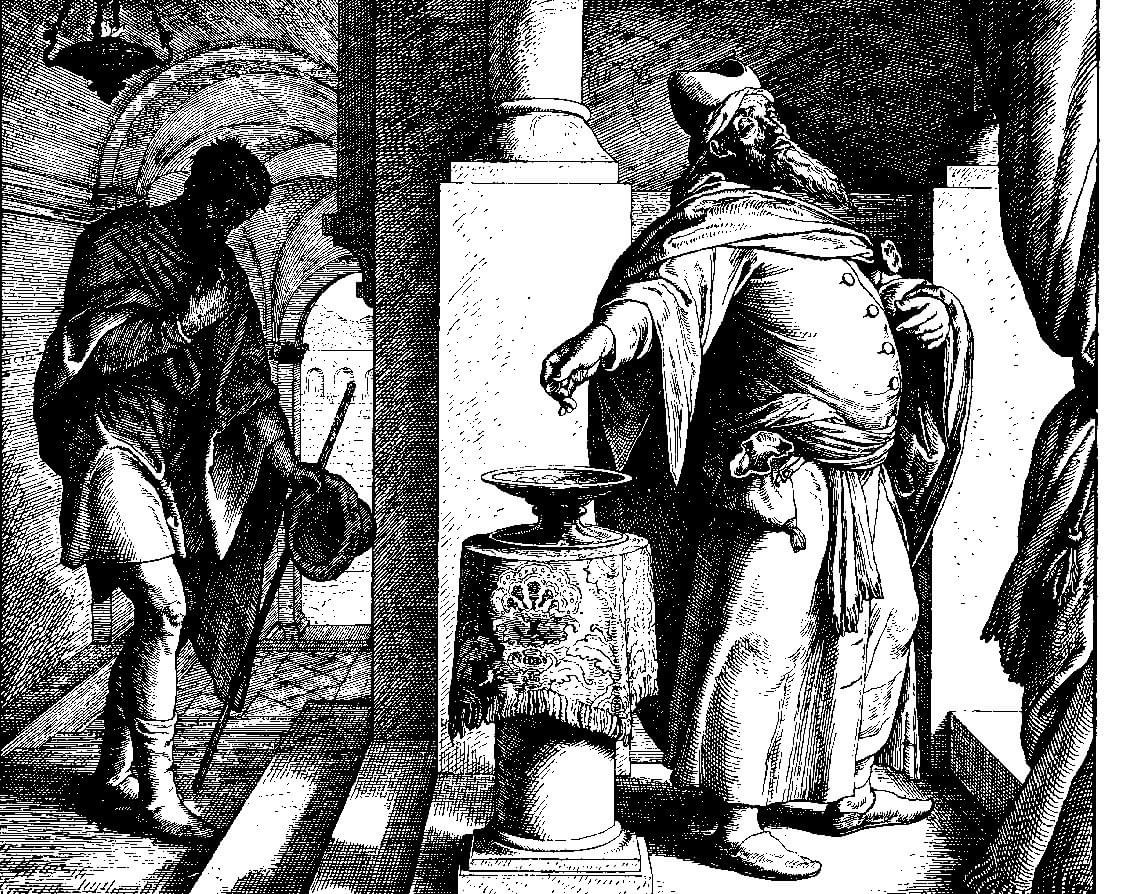
9 He also told this parable to some who trusted in themselves that they were righteous, and treated others with contempt: Luke 18_9-14 - Pharisee and Tax Collector10 “Two men went up into the temple to pray, one a Pharisee and the other a tax collector. 11 The Pharisee, standing by himself, prayed thus: ‘God, I thank you that I am not like other men, extortioners, unjust, adulterers, or even like this tax collector. 12 I fast twice a week; I give tithes of all that I get.’ 13 But the tax collector, standing far off, would not even lift up his eyes to heaven, but beat his breast, saying, ‘God, be merciful to me, a sinner!’ 14 I tell you, this man went down to his house justified, rather than the other. For everyone who exalts himself will be humbled, but the one who humbles himself will be exalted.”

In the name of Jesus. Amen.

When we pray, we are taught to fold our hands, bow our heads, and close our eyes. Even though this isn’t commanded anywhere in Scripture, it is a good idea for a few reasons. One, it helps keep you from being distracted by, looking at, or fiddling with the stuff around you. Two, it focuses your attention on what you are praying. And three, it is a unique posture to place your body in which makes it a special or holy posture. You don’t typically fold your hands unless you are either praying or getting arrested. (I like to watch clips from the show Live PD, and I find it hilarious how often police officers from all over the country will tell the criminal with bags of drugs, an illegal gun, and two felony warrants, “Place your hands behind your back and interlock your fingers like you’re praying at church.”) Anyway…

I titled this sermon “The Eyes of Prayer” not to make the point that you should close your eyes when you pray – even though, again, it is a good practice. Instead, I hope this sermon encourages you to look only two places when you pray – one is your unworthiness and the other is God’s great mercy toward you.

Just like two weeks ago with the parable of the unjust steward and the merciful master, getting some context for this parable is helpful. Luke 18 opens with the parable of the persistent widow. She keeps crying out to the unrighteous judge asking for justice. The unrighteous judge finally gives her justice but only so she won’t beat him down with her constant asking (v. 2-5). The introduction to that parable says that Jesus, “told them a parable to the effect that they ought always to pray and not lose heart” (v. 1). Jesus teaches what the parable means (v. 6-8) by basically saying that if an unrighteous person will grant justice when he is continually asked, how much more will God, who is just, grant justice when His elect, beloved children cry out to Him. In fact, God will answer their cries quickly.

Now, as we turn to this parable which follows that one, we see how quickly and mercifully God answers the prayers of His elect.

A Pharisee and a tax collector go up to the Temple to pray. The Pharisee assumes a posture that we would recognize as prayer. He stands off by himself. He is likely looking up in thankfulness to God, but his eyes are also scanning the other worshipers in the Temple, and those eyes look down on the sinners who are there.

Now, we need to be careful about our animosity toward the Pharisee because he is simply doing what you and I do all the time. Remember, Jesus repeatedly warns against becoming like the Pharisees (Mt. 16:6-12; Mk. 8:15; Lk. 12:1), and Jesus wouldn’t give these warnings unless it is actually easy to become like them. Why is it easy? Why are we in danger of becoming like Pharisees?

When we look at the sins of our neighbor, much of what we see confirms that our good behavior is beneficial to us which too often leads us to pride. The stuff that God calls us to do in the Ten Commandments is really good stuff, and your life is much better if you live according to them. Think about it. When people commit adultery, do their lives get worse or better? Of course, they get worse. When people steal, they are more likely have their things stolen. If you deal drugs, your odds of getting shot, robbed, or thrown in prison are much higher.

The reality is that God didn’t just come up with a set of ten arbitrary rules. Instead, the Ten Commandments are written into the fabric of God’s creation. When you go against the natural laws of God and creation, it isn’t going to go well for you or for those around you.

And just a little side note here: Christians, we need to stand firm on the truths of the Commandments – especially that it is good to live in obedience to them. It is not loving to condone or promote people’s sins. When there is sin, we should speak of it as sin. We need to show how it hurts the individual committing that sin and how it harms those around the person committing that sin. But when you do that, the world is likely going to throw Jesus’ words in your face about the speck in your neighbor’s eye and log in your own eye (Mt. 7:3-5). But don’t let them take those verses out of context. Remember, Jesus wants to remove both the log in your eye and the speck in your neighbor’s eye by His mercy through the Gospel that Jesus has won through His death and resurrection. In other words, when you point out someone’s sin, always do it in a way that points them to the freedom from sin and forgiveness of sin that comes only through Jesus. Amen?

So, back to the Pharisee and his eyes of prayer. He is looking around at his life and the lives of others. The problem is that everywhere the Pharisee looks are places where he can’t find Jesus. The Pharisee won’t find Christ by looking at his good life, and he won’t find Jesus by looking at the sins of his neighbor. All he sees is his goodness which leads him to pride and going home not justified.

pharisee-tax-collectorThe tax collector’s eyes of prayer are much different. He doesn’t look to heaven, and he doesn’t look at the sinners around him. He stands far off from the others, likely with his face to the floor, tears flowing down his cheeks, and beating his chest. He looks two places – at himself where there is no hope and to God where the only hope lies.

The tax collector’s eyes of prayer are eyes of faith. Incredible faith! Our translation records his prayer as, “God be merciful to me, a sinner!” This is weak on two points. First, it is not just ‘a sinner’; he says, ‘thesinner.’ His eyes don’t notice anyone else’s sins – only his own. Second, the translation of his prayer, ‘be merciful,’ falls short here.

Throughout the Gospels, many people call to Jesus, “Lord, have mercy,” or in Greek, “Kyrie eleison,” which is why we sing the Kyrie after the Confession of Sin. The ten lepers call out, “Kyrie eleison” (Lk. 17:13). Two blind men early in Jesus ministry and blind Bartimeaus just before Palm Sunday cry out to Jesus, “Kyrie eleison” (Mt. 9:27; Mk. 10:47). The Canaanite woman cries out to Jesus, “Kyrie eleison,” on behalf of her demon possessed daughter (Mt. 15:22). All of those are excellent prayers. They are asking Jesus to do exactly what He has come to do. But what the tax collector in this parable prays is something similar but importantly different. The tax collector prays to God (lit.), “Be propitiated to me, the sinner.”

The noun ‘propitiation’ and the verb ‘propitiate’ have never been commonly used in English, but it is an extremely important word and concept. To propitiate means to make an atoning sacrifice. And the tax collector prays that God would be made the atoning sacrifice for him. In the Greek translation of the Old Testament, this word was also used for the mercy seat on the ark of the covenant. The place where the high priest would sprinkle the blood on the Day of Atonement and where God promised to meet with His people (Ex. 25:22; Lev. 16) was called by the same word.

Jesus is that place where God makes the atoning sacrifice. 1 John 2:2 says, “[Jesus] is the propitiation for our sins, and not for ours only but also for the sins of the whole world.” Jesus is your Great High Priest who makes the propitiating sacrifice of Himself. Hebrews 2:17 says, “[Christ] had to be made like His brothers in every respect, so that he might become a merciful and faithful high priest in the service of God, to make propitiation for the sins of the people.”

When the tax collector prays, “God, be propitiated to me, the sinner,” he is praying that God would be reconciled to him by the blood of Jesus. And that is why the tax collector, who is the far greater sinner, goes home justified rather than the well-behaved Pharisee. He looks to God in faith and asks God to be exactly who God has promised to be – a merciful, forgiving God.

Hear again what we sang before the sermon:

Trinity 11 Luke 18_9-14 - Pharisee and Tax CollectorWhen in the hour of deepest need
we know not where to look for aid;
when days and nights of anxious thought
no help or counsel yet have brought.

Then is our comfort – this alone –
that we may meet before Your throne.
To you, O faithful God, we cry
for rescue in our misery.

Dear saints, may your eyes of prayer be focused on God’s infinite mercy toward you despite your unworthiness. Know that God is always more ready to hear your prayers than you are to pray. God always gives more and better than you desire or deserve. He pours down His abundant mercy upon you. He forgives you of all the sins – every last one of those sins – that prick your conscience. He does all of this because of what Jesus has done for you. Christ has propitiated and reconciled you to God.

May our eyes of prayer be on our unworthiness and, even better, on God’s faithfulness and mercy to us because of what Christ has done. Amen.

The peace of God, which surpasses all understanding, will guard your hearts and minds in Christ Jesus. Amen.
The Merciful Master – Sermon on Luke 16:1-13 for the Ninth Sunday after Trinity

Listen here.

Luke 16:1-13

1 He also said to the disciples, “There was a rich man who had a manager, and charges were brought to him that this man was wasting his possessions. 2 And he called him and said to him, ‘What is this that I hear about you? Turn in the account of your management, for you can no longer be manager.’ 3 And the manager said to himself, ‘What shall I do, since my master is taking the management away from me? I am not strong enough to dig, and I am ashamed to beg. 4 I have decided what to do, so that when I am removed from management, people may receive me into their houses.’ 5 So, summoning his master’s debtors one by one, he said to the first, ‘How much do you owe my master?’ 6 He said, ‘A hundred measures of oil.’ He said to him, ‘Take your bill, and sit down quickly and write fifty.’ 7 Then he said to another, ‘And how much do you owe?’ He said, ‘A hundred measures of wheat.’ He said to him, ‘Take your bill, and write eighty.’ 8 The master commended the dishonest manager for his shrewdness. For the sons of this world are more shrewd in dealing with their own generation than the sons of light. 9 And I tell you, make friends for yourselves by means of unrighteous wealth, so that when it fails they may receive you into the eternal dwellings.

10 “One who is faithful in a very little is also faithful in much, and one who is dishonest in a very little is also dishonest in much. 11 If then you have not been faithful in the unrighteous wealth, who will entrust to you the true riches? 12 And if you have not been faithful in that which is another’s, who will give you that which is your own? 13 No servant can serve two masters, for either he will hate the one and love the other, or he will be devoted to the one and despise the other. You cannot serve God and money.”

In the name of Jesus. Amen.

Today, we are going to start with three questions to help us wrap our minds around this difficult parable: First, what is the rich master commending his manager for? Second, what is the context of the parable? And, third, where does the parable end?

First question first. What is the rich master praising the wasteful, dishonest manager for? It isn’t for his dishonesty when the manager illegally lowers the bills of the debtors. Instead, the master praises the manager’s shrewdness. And this is actually in line with God’s character.

Think back to Jacob. Jacob was certainly dishonest (in fact, ‘Jacob’ means ‘deceiver’ or ‘cheater’), but Jacob was also an extremely shrewd man who took advantage of all sorts of situations to benefit himself – which is what shrewd means. When Jacob’s exhausted brother Esau came in from the field, Jacob shrewdly took advantage of the situation by selling Esau a bit of soup at the cost of Esau’s birthright. When Jacob’s father Isaac was old and blind, Jacob shrewdly took advantage of the situation by dressing up like Esau and receiving their father’s blessing. When Jacob’s father-in-law Laban was distracted, Jacob shrewdly fled with his wives and children to move back to Canaan.

While we might think that God would want to disassociate Himself with as shrewd a man as Jacob, God doesn’t. God calls Himself the God of Abraham, the God of Isaac, and the God of Jacob. In fact, twenty-three times in Scripture God calls Himself ‘the God of Jacob.’ God isn’t ashamed to be associated with the shrewd. So, again, the rich master doesn’t praise the dishonesty of the manager; he praises his shrewdness.

To the second question: What is the context of the parable? Well the first verse gives us a little bit of the context. Jesus tells this parable to the disciples. Jesus isn’t giving this parable to the masses, but only to those who have left everything to follow Him. Unbelievers might take this parable to mean that Jesus doesn’t mind if you are a scoundrel who only does things for your own benefit. That’s not the point of the parable! This parable is told to believers so that they would shrewdly know to expect, count, and bank on God’s mercy and grace.

Also, the context of this parable is all of Luke 15. In the opening of Luke 15, the Pharisees and scribes are grumbling that Jesus is receiving and eating with sinners. So, Jesus tells them the parable of the Lost Sheep, the Lost Coin, and the Prodigal Son. Notice, please, I said ‘the parable’ not ‘the parables.’ The three are, in my opinion, best understood as one parable and taken together as a single unit.

Also, each of them is terribly named. Instead of the name ‘the Lost Sheep,’ it should be called the ‘the Good Shepherd.’ Instead of the name ‘the Lost Coin,’ it should be called ‘the Persnickety Woman.’ Instead of the calling it ‘the Prodigal Son,’ it should be called ‘the Wasteful Father.’ The sheep, the coin, and the younger son are not the focal point of the parable, and they are damaged when we make them the center. Instead, it’s the goodness of the shepherd, the persistence of the woman, and the mercy of the father that should draw our attention. The same is true of this parable before us, the central point of the parable is not the dishonesty and shrewdness of the manager but the mercy of the master.

Think back for just a moment to the misnamed parable of the Prodigal Son: The father mercifully gives his younger son his share of the inheritance early, and that little brat wastefully squanders it (Lk. 15:13). We need to realize that inheritance included money, but it mainly included land. The merciful father had to sell off at least one-third of his land to give that little imp his inheritance. That means the kid frittered away several generations worth of blood, toil, and sweat while ruining his family’s name and reputation in the community. And when the funds run out, the little churl saunters back home to beg for a job from his father so he doesn’t have to eat pig slop. But the father won’t have it, not because he wants the kid eating swine slop, but because he wants his son back. The father mercifully runs to him, embraces him, dresses him up in the best cloths, and throws a party because he has welcomed his son back into the family.

That’s the context of this parable which is tied to that one. The mercy of the father there and the mercy of the master in this parable are meant to be seen together. In other words, with this parable Jesus is saying to the disciples, “Listen guys, God’s mercy really is something you can bank on. Check this out…”

Finally, and briefly, the third question to help us understand the parable: Where does it end? It’s probably best to see the parable ending with Jesus saying, “The master commended the dishonest manager for his shrewdness.” Which means that the next sentence (the second half of v. 8) is the beginning of the lesson that Jesus wants to teach us. “The sons of this world are more shrewd in dealing with their own generation than the sons of light.”

So now, with all of that in mind, let’s quickly consider the parable:

The rich man finds out that his manager is wasting his possessions, so the rich man fires the manager on the spot, but throws him a bone of mercy. The rich man could have tossed his manager straight into prison. But, instead, the merciful master sends the manager back to his office to collect the books before he turns them in. The fired manager realizes he’s in a bad spot. He’s too weak to dig and too ashamed to beg. So, the manager formulates a plan. The rich man’s debtors have no idea that the manager has been canned, so he has a small window of opportunity. He calls the debtors in “one by one” (v. 5) and lowers each person’s debt. It is interesting to note that he reduces each debt an equal amount of denarii which shows how hastily his plan was formulated. The reduction of fifty measures of oil and reduction of twenty measures of wheat both equal 500 denarii (or days’ wages).

Two other things are important here. Notice, that the manager has each debtor take the pen and write with their own hand and in their own penmanship the reduced amount (more on that in a minute). The other important thing is that the debtors go along with the reduction in their bills which indicates their suspicions aren’t raised. The manager likely told them that he had convinced the master to reduce their debts. The debtors know the master, and he isn’t a hard, unforgiving man. Instead, he has a reputation of being merciful.

So, the manager arranges the books, saunters back to headquarters, and walks straight into the master’s office blowing on the wet ink of the newly reduced debts with a wry smile on his face. The master can see that the books have been changed and realizes that the debtors know about it. He hears the whole town out in the streets singing his praises for the merciful reduction of their debts.

Luke 16 1-9 - Riojas the Shrewd ManagerThe master had every right to reinstate the debts, but he doesn’t want his reputation of being merciful to be tainted. The master would rather eat the loss than have his mercy put into doubt. So, the merciful master praises and commends the dishonest manager for his shrewdness.

By cutting the large bills of the master’s debtors, the shrewd manager went ‘all in’ on the mercy of the master, and it paid off. The manager is forever associated with the master’s mercy and the debtors will always deal kindly with him so he won’t have to dig or beg.

Again, the merciful master praises the manager for his shrewdness. The manager knew which way to fall, and he fell on the mercy of the master.

Here’s the point, dear saints. You too can always fall on the mercy of your Heavenly Father, the truest Merciful Master of all. But too often we are hesitant to do so.

God repeatedly gives you opportunities to reveal His goodness and mercy to others, but you’ve blown it. God puts you in the midst of your family with parents, siblings, cousins, and in-laws who fight, hold grudges, and speak the worst about each other. God puts you there so that you can imitate Him and be merciful and forgiving like He is, but you’ve blown those opportunities.

God puts you among children and grandchildren who aren’t grateful. Instead, they are rude, selfish, and self-absorbed. God gives you all sorts of opportunities to show unconditional love while making God your Father look good. But you’ve blown it.

God places you in a workplace or classroom where you are treated unfairly, taken advantage of, bullied, and receive all sorts of nasty behavior. God wants you to act shrewdly and do what no one else would – turn the other cheek and return all that evil for kindness and love. But you’ve blown it. Dear saints, we have all failed to use what our Merciful Master has given us to serve our neighbor because we don’t trust His mercy. Repent.

Repent, but also rejoice because you have a Savior who is just like the shrewd manager (minus the dishonesty). Jesus is the supreme Shrewd Savior, the Ultimate Trickster who took advantage of every situation to save you from sin and hell.

Satan was hungry, but not for a bowl of soup. The devil wanted to swallow all of humanity in his jaws. But Jesus, the Shrewd Savior inserted Himself into those jaws with all your sin laid upon Him (Is. 53:6). When Jesus died on that cross, all of your sins died with Him. While Satan and his minions celebrated the death and burial of Christ, Jesus strolled out of the tomb on the third day bursting the jaws of death and giving you an eternal victory.

Jesus even dealt shrewdly with God and His wrath against sinners. Christ went to the cross, covering Himself with all your sins. He managed your debt not just by reducing it, He eliminated it.

Dear saints of God, your Shrewd Savior doesn’t ask you how much oil you owe, He anoints your head with the oil of His mercy (Ps. 23:5). He doesn’t check to see how much wheat you owe. Instead, He gives you Himself as the Bread of Life (Jn. 6:51).

Christ does all of this because He is your Merciful Master and Shrewd Savior. Put your trust there, in His mercy. Amen.

The peace of God, which surpasses all understanding, will guard your hearts and minds in Christ Jesus. Amen.

Lost & Found – Sermon on Luke 15:1-10 for the Third Sunday after Trinity

Listen here.

Luke 15:1-10

1 Now the tax collectors and sinners were all drawing near to hear him. 2 And the Pharisees and the scribes grumbled, saying, “This man receives sinners and eats with them.”

3 So he told them this parable: 4 “What man of you, having a hundred sheep, if he has lost one of them, does not leave the ninety-nine in the open country, and go after the one that is lost, until he finds it? 5 And when he has found it, he lays it on his shoulders, rejoicing. 6 And when he comes home, he calls together his friends and his neighbors, saying to them, ‘Rejoice with me, for I have found my sheep that was lost.’ 7 Just so, I tell you, there will be more joy in heaven over one sinner who repents than over ninety-nine righteous persons who need no repentance.

8 “Or what woman, having ten silver coins, if she loses one coin, does not light a lamp and sweep the house and seek diligently until she finds it? 9 And when she has found it, she calls together her friends and neighbors, saying, ‘Rejoice with me, for I have found the coin that I had lost.’ 10 Just so, I tell you, there is joy before the angels of God over one sinner who repents.”

In the name of Jesus. Amen.

Our text shows one scene and that is Jesus sitting with the lowlifes, the riff-raff, the notorious sinners. Not only is Jesus sitting and talking with them, He is eating with them. In the Jewish mind, eating with someone was like putting a rubber stamp with big, red letters “APPROVED” upon their behavior and life. Our text reveals this one scene, but there are two very different reactions to it.

The first reaction is from the Pharisees and scribes. So just imagine the worst of the worst – the burn-outs, the promiscuous, the hoodlums, the rioters, you name it – Jesus is right in there with them. He’s not even shy about it. The scribes and Pharisees see this, and they are triggered. They grumble and murmur. That’s the first reaction.

The second reaction is not something that we see. It isn’t part of Luke’s narration which is only the first three verses. But we know this second reaction is going on because of the parables. The reaction is in heaven. The angels look down on this same scene, and they throw a party. When heaven sees Jesus receiving lost sinners, it sees God keeping His Word and promise. Heaven looks down and sees the holy, eternal, almighty Son of God in the flesh eating with the most despicable people you could imagine, and heaven rejoices.

Now, it is easy to get mad at the scribes and Pharisees. Our tendency is to point the finger at them and say, “They shouldn’t be so hard-nosed. They think they are so good and holy and better than everyone. They should understand no one’s perfect.”

Repent. As soon as you say that, you’ve become just like them. Because when Jesus tells these parables to the scribes and Pharisees, heaven continues to rejoice because He is still doing what God always does. He is seeking after His lost sheep, and in this case the lost sheep are the scribes and Pharisees. Jesus wants to save them as well. He wants to rescue them, bind them up, bring them into the fold, and be their Shepherd. With these two parables Jesus is doing that very seeking.

Now, these parables make sense, but only to a certain point. After that, they become extremely odd. A shepherd certainly might leave 99 sheep to search for the one that is lost. The shepherd has a connection to the sheep and doesn’t want it to die. Even thinking strictly in a business sense, a 1% loss isn’t a huge deal, but it hurts. We’ve probably all looked for something longer than is reasonable. But there comes a point where you have to just cut your losses and move on. Spending all the time and effort just isn’t worth it.

Notice the language Jesus uses in the parable. The shepherd goes after the one that is lost “until he finds it.” That’s a good translation. This is an exhaustive, continual, unending search. The shepherd doesn’t go out for a while, return to make sure the other 99 are cared for, and head back out again. No. The shepherd doesn’t stop, doesn’t rest, doesn’t take a break until he finds that one lost, wandering sheep.

And when he finds the silly animal, the hard work really begins. The shepherd hefts that sheep up onto his shoulders. But he isn’t grunting and complaining, “Dumb sheep.” No! The shepherd is rejoicing while he lugs the 60-pound, wooly, hairy beast back home. Can you imagine how hot that would be around your neck? And instead of collapsing in exhaustion, putting up his feet in his recliner, and complaining to his buddies about the stupid animal, he invites the whole town over for a party that he’s going to have to do more work to prepare.

Think about that. What is it going to take to have a party? Food. What do shepherds serve for food? Sheep.

The same thing is true in the parable of the lost coin. The woman loses one coin and begins her search. To put this in perspective, imagine you had a bunch of errands to run. Your first stop is the bank to get ten $5 bills to send out in birthday cards. You head over to Target to get the cards. You make a trip the Sam’s Club, then run to Hugo’s, and finally buy stamps at the post office. When you get back home, you realize that you only have 9 $5’s. It doesn’t make any sense because you used your debit card at all the other stops. It’s not in your purse or wallet and not in your car. You must have lost that $5 somewhere in your running around. It’s frustrating, but it doesn’t make a lick of sense to drive all around town to go and find a single $5 bill. Once you’ve driven a handful of miles from your home, the IRS says that you’ve spent more in mileage than it’s worth, and someone has probably already found it and put it in their wallet. It makes a lot more sense to just get another $5 later. But not to the woman in this parable.

She lights a lamp. And, you have to understand, this is a costly endeavor. We take light for granted today. In Jesus’ day, you didn’t just light a lamp whenever the sun went down. When it gets dark, you go to bed. The phrase “burning the midnight oil” is economically costly. The olive oil used in those lamps was expensive. Every minute of light is money out the window. Why didn’t she just wait until the morning and start her search again? But she doesn’t do that. She burns that oil and sweeps the house, again, “until she finds” that one lost coin.

And, just like the shepherd, what does she do when she finds it? She throws a party. And her party, just like the shepherd’s party, is going to cost her. That party is going to cost more than the value of the coin that had been lost.

Here is the point: When God seeks after lost sinners, He is spending and sacrificing more than what the prize is worth. It cost God the Father more than you or I are worth to redeem you and me. But God spares no expense to find you lost sinners. Jesus goes to the cross and suffers in your place. He goes to death and the grave. Jesus pays the heavy price for you.

It’s easy to say, “Well, this is what God does. Should we really be surprised at this?” Yes, we should! That’s the point!

Jesus drives it home in the third parable which we didn’t read today. God goes after lost children who tell Him to drop dead, which is what the younger son basically says when he asks for his inheritance.

Today, please, please, please don’t see these parables about others. Many people online and on social media have taken the parable about the lost sheep and turned it to mean things it doesn’t mean. The parables are about you who are lost and Christ who finds you.

After both of these parables, Jesus says, “There is joy in heaven over one sinner who repents.” That word ‘repents’ is in a specific form. It is a present active participle, and if you aren’t a grammar nut like I, I’ll explain it. A participle sounds like a verb but doesn’t function as a verb. In English, you can put ‘ing’ after it. You could translate Jesus here as saying, “There is joy in heaven over one repenting sinner.”

The fact that this is in the present tense is important because it means that this repenting is continual. No matter how many times you wander from the 99, no matter how many times you get lost in a dusty crack in the floor, no matter how many times you say to God, “I wish you were dead,” all of heaven rejoices with Jesus, the Good Shepherd, who finds you, with God who is like the persnickety woman, when your heavenly Father restores you.

With these parables, Jesus is redefining repentance. Too often, we think that repentance is the least we can do to earn God’s forgiveness. We think repentance is our trump card that we play and say to God, “Here is my repentance. You have to be good to me now because of this repentance.” That’s not how repentance works.

Instead, Jesus pictures repentance in these parables as being found. What did the sheep contribute to its being found? All it did was wander off and get lost. Same with the coin. All it did was lay in a dark crack gathering dust. But both are found and restored. And the restoration of both is cause for rejoicing.

Again, Jesus says, “There will be more joy in heaven over one sinner who is repenting than over ninety-nine righteous persons who need no repentance.” You know what? There aren’t ninety-nine who need no repentance. But there is One who needs no repentance.

Remember how the multitude of angels came down the night Jesus was born and rejoiced? Do you hear what Jesus is saying when He says, “There is more joy in heaven over one sinner who is repenting than over ninety-nine righteous persons who need no repentance”? Jesus is saying that heaven rejoices more over you when Jesus finds you than if ninety-nine Jesuses came who needed no repentance. Jesus finding a lost sinner causes heaven to rejoice more than it did at the birth of Jesus because you are the fruit of Jesus’ labor.

Dear sinner, there is joy in heaven over you. You lost have been found. You have been brought to repentance, back into the fold, by your Shepherd, Jesus Christ. Amen.

The peace of God, which surpasses all understanding, will guard your hearts and minds in Christ Jesus. Amen.

I Have Other Sheep – Sermon on John 10:11-16 for the 3rd Sunday of Easter

Listen here.

John 10:11-16

11 “I am the good shepherd. The good shepherd lays down his life for the sheep. 12 He who is a hired hand and not a shepherd, who does not own the sheep, sees the wolf coming and leaves the sheep and flees, and the wolf snatches them and scatters them. 13 He flees because he is a hired hand and cares nothing for the sheep. 14 I am the good shepherd. I know my own and my own know me, 15 just as the Father knows me and I know the Father; and I lay down my life for the sheep. 16 And I have other sheep that are not of this fold. I must bring them also, and they will listen to my voice. So there will be one flock, one shepherd.”

Alleluia, Christ is risen!
He is risen indeed. Alleluia!

In the name of Jesus. Amen.

Many Christians live in fear. They fear that, even though they are Christians today, they won’t ultimately make it to heaven. They have fears that somehow they are fooling themselves, that the demons will get to them, that they will fall away if persecuted, or that they’re simply going to blow it. One of the saddest things is that the source of these fears often comes from pastors, evangelists, and Christian books and radio with pious-sounding questions like, “Sure, Jesus is your Savior, but is He your Lord?” or “How is your commitment to or relationship with Jesus?” I remember several times wondering if I was really a Christian based on questions and statements like those.

I want you to notice that all those fears and doubts come when the focus is moved from Jesus to the individual. Luther once said, “When I look at myself, I don’t see how I can be saved. But when I look at Christ, I don’t see how I can be lost.”

In this Gospel text, Jesus would have us look away from ourselves and fix our eyes on Him, and in Christ we find our Good Shepherd. Listen carefully to Jesus again, “I have other sheep that are not of this fold. I must bring them also, and they will listen to my voice.”

Did you catch it? Jesus says that He has – present tense – He has these sheep even before He brings them. Jesus has these sheep, and then He brings them. Just in case you think Jesus misspoke, simply go back a few verses to John 10:3-4 where Jesus, again talking about Himself as the Good Shepherd says, “The sheep hear [their Shepherd’s] voice and He calls them out. When He has brought out all His own, He goes before them, and the sheep follow Him, for they know His voice.” In other words, the sheep of the Shepherd know His voice when He calls because He is their Shepherd. They are not true sheep because they first hear His voice and then follow. Instead, they hear and follow because they are already His sheep. When Jesus calls through the voice of the Scriptures, He is calling to those who are His own. They know His voice because He already has them as His sheep.

Jesus has His sheep because the Father has given them to Jesus. Listen to how Jesus prays in John 17:6, “I have manifested Your name to the people whom you gave Me out of the world. Yours they were, and You gave them to me, and they have kept Your word.”

Or listen to what Jesus says in John 6:37a, “All that the Father gives Me will come to Me.” The Father has these sheep, gives them to Jesus, and they follow Him and keep His word. But back to our text here, Jesus says, “I have other sheep that are not of this fold. I must bring them also, and they will listen to my voice.”

Remember from last week’s sermon text after Thomas’ doubts are quieted, Jesus says, “Have you believed because you have seen Me? Blessed are those who have not seen and yet have believed” (Jn. 20:29)? Dear Christian, Jesus was speaking of you there. You have not seen Him, and yet through the Holy Spirit working through the Word, you have heard Jesus’ voice and have believed. Well, when Jesus speaks of bringing in other sheep here, He again is speaking of you. You – each of you, individually – were on His mind when He spoke those words nearly two-thousand years ago. Before you heard His voice and believed, He already had you as His sheep.

Before you ever committed a single sin, before you ever did a good work, before you came to church, before any of that, Jesus had you. Your sins weren’t an obstacle, and your good works weren’t the reason He chose you. He already had you as His sheep. He says – present tense – “I have other sheep.”

As God promised in our Old Testament text (Ezk. 34:11-16) which you just heard, “As a shepherd seeks out his flock … so will I seek out My sheep. I will rescue them from all places where they have been scattered…. I will bring them out from the peoples and gather them from the countries…. I will feed them with good pasture…. I Myself will be the shepherd of My sheep, and I Myself will make them lie down…. I will seek the lost, and I will bring back the strayed, and I will bind up the injured, and I will strengthen the weak.”

Now, of course, it is important that we remember that we are sheep who are prone to wander. We need to know the Good Shepherd. We need to listen to the voice of the Good Shepherd. And we need to follow the Good Shepherd. All of those things are part of this text – they are. The sheep don’t go off and listen to the voice of the false shepherds, and they don’t follow in the footsteps of the wolves or play in their dens. They follow Jesus.

But remember what comes previous to all of those things: Jesus, the Good Shepherd, has the sheep. “I have other sheep,” says Jesus.

So, with all of that, does it sound like it is your commitment that will get you to heaven, or is it Jesus’ commitment to you? Jesus’. Who is in control; who is driving, you or Jesus? Jesus is. Who is more interested in your eternal life, you or Jesus? Jesus is. And that is good. He is the Shepherd who goes and seeks after His sheep. In fact, He is the Shepherd who lays down His life for you, His sheep. You have been redeemed and rescued from death.

The 23rd Psalm is, of course, a very fitting text to consider in light of all this, but instead today consider for just a minute these verses Psalm 49[:14-15], “Like sheep they are appointed for Sheol,” (think of Sheol as the grave), “Like sheep they are appointed for [the grave]. Like sheep death shall be their shepherd…. Their form shall be consumed in Sheol, with no place to dwell. But God will ransom my soul from the power of Sheol, for He will receive me.”

Because Jesus has you as His sheep, He came to shepherd you, to seek you out, to find you, and to bring you safely to be with Him. He knows where to find you. He knows how to comfort and quiet you. He knows how to bring you into His fold.

Jesus, your Good Shepherd, became a sheep just like you. He is the Lamb who was slain and went to the grave. But He is risen and victorious. Because He became like you, He knows how to shepherd you. He knows your fears, your struggles, your temptations, and your foes. He has defeated them all. He has gone to the cross for you and died for you. Jesus has come through death to be with you, He will always abide with you, and He will not leave you. He has you as His sheep. And He will bring you safely to your eternal glory with Him.

Alleluia, Christ is risen!
He is risen indeed. Alleluia!

Amen.

The peace of God, which surpasses all understanding, will guard your hearts and minds in Christ Jesus. Amen.

Faithful & Just – Sermon on 1 John 1:5-10 for Ash Wednesday

Listen here.

The Scripture readings for tonight were Jonah 3:1-10; 1 John 1:5-10; and Matthew 6:16-21.

In the name of Jesus. Amen.

I don’t remember exactly how old I was, but I was definitely old enough to know better. It was a cold, wet, Spring day. A friend from church, my sister, and myself were probably driving our parents crazy, so our parents dropped us off at the Williston Recreational Center to burn off some energy. The Rec. Center had two basketball courts, a few racquetball courts, and a hockey arena that still had the boards up but no ice. When we paid the fee and signed our names in, the employee told us that the empty hockey rink was off limits to the public that particular day, so we went to the basketball courts to play horse and lightning. But it didn’t take long before we got bored and decided we needed a little more excitement. So, of course, we went to the forbidden hockey arena.

I don’t remember exactly how we got past the front desk unnoticed, but we did. And we proceeded to have a grand time playing inside the boards. But not for long. I remember seeing the employee approaching the glass windows and door that separated the hockey arena from the lobby, and he didn’t look happy. I warned my friend and sister that we had been caught and were about to get in trouble. But my sister had a plan. She insisted that if we closed our eyes, the employee couldn’t see us. She said that it worked once for her friend. Now, I’m three years older than she is, so, again, I should have known better. But I did it. I closed my eyes as tight as I could and assumed the fetal position against the boards. I can only imagine how foolish we looked to that employee. Even as he hollered at us for being in there, I didn’t open my eyes until he tapped my shoulder.

Dear people of God, “If we say we have no sin,” (Notice that this is present tense. No matter how long you’ve been a Christian, not matter how much you’ve improved, no matter how much good you do, you still have sin.) “if we say we have no sin we deceive only ourselves,” and we look like a foolish child cowering with our eyes closed. We cannot flee from or escape the watchful eye of the God who created us. He knows your actions. He knows the words that come out of your mouth. He knows the thoughts of your mind. And He knows the hypocrisy of your heart. If we say we have no sin, the truth is not in us.

Repent because there is another way. Repent because that is the only way!

Scripture is clear that our God is merciful and gracious, slow to anger and abounding in steadfast love and faithfulness. This is one of if not the most common descriptions of God. In fact, this is how God Himself defines who He is (Ex. 34:6). Repentance of Ninevah by John Martin c 1840When Jonah preached to the sinners of Nineveh in our Old Testament lesson (Jon. 3:1-10), they repented from their evil, violent ways. And for them, it was as crazy an idea as closing their eyes to enable invisibility mode. The king says in his proclamation, “Who knows? God may turn aside from His fierce anger, so that we may not perish.” In other words, “Let’s try repenting. It might work.” Dear saints, we do not have to wonder how God will respond to humble, contrite sinners. Our Epistle Lesson (1 Jn. 1:5-10) says, “If we confess our sins, God is faithful and just to forgive our sins and to cleanse us from all unrighteousness.”
Make sure you catch all of the words there in v. 9. The text doesn’t just say “If you confess your sins, God will forgive and cleanse.” No. The text says that God is faithful and just to forgive. We would expect to hear different words there – words like merciful, gracious, kind, generous, or even lenient. But that is not what Scripture says. God is faithful and just to forgive you of your sins and cleanse you from all unrighteousness.

Dear saints, God’s forgiveness delivered to you is right and just. That’s saying it in a positive way. And it is true in a negative way (or the opposite way): God would be unjust to withhold forgiveness from you who confess your sins. Your sin, your shame, your unrighteousness, your guilt was all laid upon Jesus on the cross. He has taken all of it and endured the punishment that you deserve. For God to give you any of His anger or displeasure because of your sin would not be right or just. He would be removed from the bench, disbarred, and thrown into prison if He didn’t forgive you.

Dear Christian, be comforted. God faithfully and justly and willingly and delightfully forgives you all your sins because of what Jesus has done for you. Amen.

The peace of God, which surpasses all understanding, will guard your hearts and minds in Christ Jesus. Amen.

Holy Deliverance – Sermon on Luke 18:31-43 for Quinquagesima

Listen here.

Luke 18:31-43

31 And taking the twelve, he said to them, “See, we are going up to Jerusalem, and everything that is written about the Son of Man by the prophets will be accomplished. 32 For he will be delivered over to the Gentiles and will be mocked and shamefully treated and spit upon. 33 And after flogging him, they will kill him, and on the third day he will rise.” 34 But they understood none of these things. This saying was hidden from them, and they did not grasp what was said.

Jesus Heals Bartimeaus35 As he drew near to Jericho, a blind man was sitting by the roadside begging. 36 And hearing a crowd going by, he inquired what this meant. 37 They told him, “Jesus of Nazareth is passing by.” 38 And he cried out, “Jesus, Son of David, have mercy on me!” 39 And those who were in front rebuked him, telling him to be silent. But he cried out all the more, “Son of David, have mercy on me!” 40 And Jesus stopped and commanded him to be brought to him. And when he came near, he asked him, 41 “What do you want me to do for you?” He said, “Lord, let me recover my sight.” 42 And Jesus said to him, “Recover your sight; your faith has made you well.” 43 And immediately he recovered his sight and followed him, glorifying God. And all the people, when they saw it, gave praise to God.

In the name of Jesus. Amen.

Christ is on His way to Jerusalem. He plainly says that He is going there to fulfill everything that was written about Him in the Scriptures. He is going there to be delivered to the Gentiles, mocked, shamefully treated, spit upon, flogged, and killed. But on the third day He will rise. Jesus says this plainly and clearly. But notice how carefully Luke records the reaction of the disciples. They understood none of these things. The saying was hidden from them. And they did not grasp what was said. That’s the long, emphatic way to say, “They didn’t get it.” The text then notes that Jesus’ journey to Jerusalem takes Him through Jericho where a crowd was waiting to meet Him.

Now, Christ’s name in Greek is Ἰησοῦς and it gets brought into English as ‘Jesus.’ But if you said Jesus’ name in Hebrew it would be יְהוֹשׁוּעַ, and when that gets brought into English it is ‘Joshua.’ If I asked you what city most goes with the name Joshua, I would bet you would say Jericho. It was Joshua who “fit [sic.] the battle of Jericho.” When Joshua went to Jericho, it was to destroy and kill. Joshua and the Battle of JerichoJoshua lead God’s people marching around those thick, fortified walls for six days, and on the seventh day, the people shouted and “the walls came a-tumbilin’ down.” Afterward, they burned the fallen rubble and reduced the city to ashes.

But Joshua wasn’t done yet. He stood over the smoke and ruins of that city and pronounced a curse, “Cursed before the Lord be the man who rises up and rebuilds this city, Jericho. At the cost of his firstborn shall he lay its foundation and at the cost of his youngest son shall he set up its gates” (Josh. 6:26). Those ruins were to be a perpetual sign of God’s displeasure with the wicked inhabitants of that city. But about 500 years later, a man named Hiel, began to rebuild Jericho. And you don’t have to guess what happened. The foundation of the city was laid, and his firstborn died. And when the gates were raised, his youngest son died (1 Kgs. 16:34). It should serve as a warning to us not to mess around with what is cursed by God.

We need to remember that, as blessed as our country is, we live in a modern-day Jericho. Most people do not believe in God. Today, sins that would have caused our parents to blush with shame are celebrated. People worship their bank accounts, their careers, and their livelihood. In our land, nearly one million babies are sacrificed in abortions every year. But, while that should cause us to weep and mourn, how many more are sacrificed spiritually?

Kids are programmed by parents to aim for success in this life by getting good grades, playing hard in sports, and finding a good job. None of those things are evil by themselves. But how often are those things promoted to the neglect of teaching those children the fear and love of God? What good is any of that if those same children end up in hell? Yes, parents, give your children those good things, but make sure are secondary to faith in Jesus, the true, merciful God. No, you may not be trying to rebuild Jericho, but too often Christian parents are raising their children on cursed foundations that are protected only by cursed gates.

Repent. Repent, and know that if you are feeling the curse of your sins that the New Joshua draws near to Jericho.

The first Joshua came to curse and destroy the sinful city of Jericho, but Jesus, the new Joshua, comes to bless. Joshua came to hurt, but Jesus comes to heal. Joshua came to march around Jericho, but Jesus came to walk straight through it. Jesus came to rescue from the ruins and curse of sin and bring His holy deliverance into His heavenly kingdom. That holy deliverance will come as His own body is wrecked and the curse of our sin is laid upon Him.

So, the Lamb of God travels through Jericho. It would make sense if Jesus went through the city quickly passing by beggars on the street. Jesus is marching to do something bigger than to simply help a miserable beggar. And that is exactly what seems to be in the minds of some who are walking with Jesus. They tell one of those beggars to sit down and leave Jesus alone. But even though His eyes focused on the cross, Jesus doesn’t pass by this blind man. Jesus stands still, and He stands still to deliver holy mercy.

It is as though Jesus can’t help Himself. He never ignores cries for mercy because He is mercy embodied. Jesus stands still and tells them to bring the blind beggar to Him. And notice how Jesus treats the blind man with dignity and respect. Jesus knows he can’t see, but He goes to the blind man’s level and gives him something for his ears. He asks, “What do you want Me to do for you?” The blind man answers, “Lord, let me recover my sight.” And Jesus delivers him from his blindness.

This morning, Jesus passes through your Jericho. Christ has heard your cries for mercy too. In fact, this same scene played out today just as it does every Sunday you gather here. We beggars come into the presence of Jesus, and we cry for mercy. Jesus doesn’t turn away. Instead, He hears you. He stops and stands still. You confessed your sins, you cried out for mercy, and Christ answered you by absolving you.

Notice what Jesus does not say to the blind man. Jesus does not say, “I have made you well and restored your sight.” Instead, Jesus says, “Your faith has made you well,” or better, “Your faith has (lit.) saved you.” Yes, it was Jesus who saved him, but Jesus points the man to his God-given faith.

Remember, dear saints, that your salvation was won and purchased by Jesus on the cross some two-thousand years ago, but your salvation is not distributed there. Thank the good Lord that it isn’t distributed there because you and I weren’t there. Even if we were to go to Jerusalem today, we couldn’t be at the foot of the cross because there isn’t anything there anymore. Salvation Won and DeliveredOn the cross, Jesus did everything for your salvation. On the cross, Jesus won the victory over sin, death, and the devil. But God delivers what Jesus did on the cross to you here and now. God delivers the mercy, grace, life, and salvation of Jesus through the preaching of His Word (Ro. 10:17), through your Baptism (Ro. 6:3-11), and through the Lord’s Supper (Lk. 22:14-20). God brings His holy deliverance to you through all those things, and as you receive those gifts of God through faith, you are saved.

Finally, notice the blind man’s response. He follows Jesus. The blind man leaves his Jericho home and follows Jesus to Jerusalem. As we begin Lent this Wednesday, let us do the same as we follow Jesus by listening to His Word. Let us abandon our cursed state and follow Jesus to Jerusalem this Lent. He leads, and we follow with grateful hearts. Let Jesus lead you to Jerusalem, to the cross, and to the empty tomb on Easter. Amen.

The peace of God, which surpasses all understanding, will guard your hearts and minds in Christ Jesus. Amen.