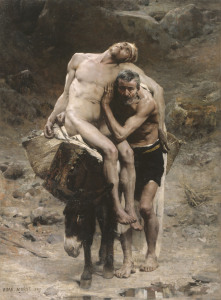
The Move – Sermon on Luke 10:23-37 for the Thirteenth Sunday after Trinity

Aimé Morot (1850-1913). “Le bon Samaritain”, 1880. Huile sur toile. Musée des Beaux-Arts de la Ville de Paris, Petit Palais.

Luke 10:23-37

23 Then turning to the disciples he said privately, “Blessed are the eyes that see what you see! 24 For I tell you that many prophets and kings desired to see what you see, and did not see it, and to hear what you hear, and did not hear it.”

25 And behold, a lawyer stood up to put him to the test, saying, “Teacher, what shall I do to inherit eternal life?” 26 He said to him, “What is written in the Law? How do you read it?” 27 And he answered, “You shall love the Lord your God with all your heart and with all your soul and with all your strength and with all your mind, and your neighbor as yourself.” 28 And he said to him, “You have answered correctly; do this, and you will live.”

29 But he, desiring to justify himself, said to Jesus, “And who is my neighbor?” 30 Jesus replied, “A man was going down from Jerusalem to Jericho, and he fell among robbers, who stripped him and beat him and departed, leaving him half dead. 31 Now by chance a priest was going down that road, and when he saw him he passed by on the other side. 32So likewise a Levite, when he came to the place and saw him, passed by on the other side. 33 But a Samaritan, as he journeyed, came to where he was, and when he saw him, he had compassion. 34 He went to him and bound up his wounds, pouring on oil and wine. Then he set him on his own animal and brought him to an inn and took care of him. 35And the next day he took out two denarii and gave them to the innkeeper, saying, ‘Take care of him, and whatever more you spend, I will repay you when I come back.’ 36 Which of these three, do you think, proved to be a neighbor to the man who fell among the robbers?” 37 He said, “The one who showed him mercy.” And Jesus said to him, “You go, and do likewise.”

In the name of Jesus. Amen.

Jesus didn’t say that the priest and Levite only passed by the half-dead man in the ditch. Christ added the fact that they passed by, “on the other side,” to even further distance them from him. They moved away. Both intentionally and deliberately ‘un-neighbored’ the guy. You’ve heard me say this before, but it’s worth repeating. The reason our English word ‘neighbor’ is spelled so weird is that it comes from the word ‘nigh’ as in ‘near’ and the word for ‘dweller.’ The same thing is true for the Greek word that gets translated ‘neighbor.’ The word means near, but it refers to an individual, so it means ‘close by person.’

In the parable, the priest and Levite aren’t dealing with a gray area. “I wonder if he really needs help?” There are times you might see a person begging for money on the street, and you don’t know that person. You don’t know if giving them money is just going to aid an addiction or be a type of soft theft where they take your money and use it for something different than you intended when you gave it. In this parable, there’s no ambiguity. The situation is black and white. It’s simple. He’s been robbed, stripped, beaten, and left dying in the ditch. If he doesn’t get help, he’s going to die. So, why do the priest and Levite not only pass by, but pass by “on the other side”?

They are trying to quiet their conscience. The more distance they can put between them and this guy in the ditch, the easier it is for them to not think about him. They make a move. They move away from the guy’s need toward their own comfort. Now, this is a parable, so we can’t ask them what they thought was more important than the guy’s need. Maybe it was their schedule. Maybe it was the fact that they knew it would cost them time and money to help the guy. Maybe they just wanted to be left alone so they could have some ‘me time.’ It doesn’t matter. They move away from need of their neighbor toward their own comfort and pass by on the other side.

Then comes the Samaritan. He sees the guy, and he also makes a move. But his move is in the complete opposite direction. He moves away from his comfort toward the guy’s need. And I’m sure he would have preferred comfort. The Samaritan has things going on. He’s got a schedule to keep and a family to feed. His time is limited and valuable. He has all the same reasons and excuses the priest and Levite have. But the Samaritan sees the man, and he moves toward the need.

Jesus makes it clear that the Samaritan has compassion. The way Jesus says it is that his guts were wrenched. The Samaritan went to the man; bound up his wounds; poured on the medicine of oil and wine that he had with him; he set the guy on his own animal; brought the man to the inn; cared for him through the night; gives the innkeeper two denarii (imagine a few hundred bucks); asks the innkeeper to take care of him; and promises to return and pay off any additional expenses. That’s nine things the Samaritan does. Nine ways he moves away from his own comfort toward the guy’s need. It’s absolutely beautiful and noble. Who doesn’t want to be as generous and loving as the Samaritan?

Primarily, this parable shows us a tiny fraction of what Christ has done for you. Jesus, the eternal Son of God, made the ultimate move away from comfort and toward you in your need. Though Jesus was in the form of God, He did not count equality with God a thing to be grasped. He emptied Himself by taking the form of a servant by being born in the likeness of men. And being found in human form, He humbled Himself by becoming obedient to the point of death – even death on a cross (Php. 2:6-8).

He did all that because you needed it. The eternal Son of God made the move from His comfort toward your need. And for that, God be praised! That’s the main point of the parable. But I want to spend the rest of this sermon focusing on what Jesus says before the parable.

After the lawyer correctly summarizes the whole Law with “Love the Lord your God with your soul, strength, and mind. And love your neighbor as yourself.” Jesus says, “Do this and you will live.”

Now, when Jesus said that, I do think it was partly to show the lawyer that he was the guy left for dead in the ditch because the Law robbed and stripped him of any self-righteousness (Gal. 3:19). But, at the same time, when Jesus says, “Do this and you will live,” He is being completely straightforward. Christian, do the Law. Do God’s will. The Law is how God created you to live. The Law is how Jesus wants you to live. It isn’t how you’re saved, but it is how Jesus wants you, believer, to live (Gal. 3:21-22). Jesus wants to motivate you to also be one who moves away from comfort and toward need.

This world is full of needs, but I’m going to focus on one very specific need today because it’s a need that everyone can meet, everyone can fulfill. And that is the need of speaking the truth in a broken and fallen world and that loves lies. The martyrdom and assassination of Charlie Kirk this week is a reminder of the lengths that the demonic forces will go to silence the truth.

Christian, do not be afraid to stand on the truth. Yes, speaking the truth can come with a cost. You might offend others. You might be ridiculed and called all sorts of names. You might lose your job or friends. But, dear saints, do not let that silence you. Silence in the face of lies is nothing other than bowing at the pagan altar of comfort.

Charlie was an amazing example of someone who loved others in a way that led him to move away from comfort toward need. He intentionally went to places to talk with people who suppress truth. He would shine the light of the truth in that darkness with logic and rhetoric that few have. But his example should teach us one simple lesson: the Truth always wins.

Jesus taught us that the devil is a liar and the father of lies (Jn. 8:44). That means wherever there is falsehood, the devil and his demonic forces are at work. Dear saints, don’t give an inch to what is false. Stand on the truth. Speak the truth and know that you are not alone. God doesn’t give many people a sphere of influence as large as Charlie had, but the numbers of people you can reach don’t matter.

Even though most of us (myself included) don’t have the rhetorical and debating skills that Charlie had, those are skills that can be nurtured and strengthened. So, strengthen yours. We’ve seen how one person can influence millions of people. That’s great; for that, God be praised. But imagine what God will do through thousands of people with smaller spheres of influence use that influence to speak the truth to the people around them. You don’t need a larger audience or bigger microphone. You can simply speak to the precious lives that God has placed around you.

And as you shine the light of truth, know that, ultimately, it doesn’t matter if you win people over. That might not happen. But it’s also not your job. That task solely belongs to the Holy Spirit who alone can – and does – change hearts. Leave the results to Him. The only thing that matters that you are faithful (1 Co. 4:2-5).

Our Christian faith requires us to love our enemies and pray for those who curse and persecute us. It does not require us to stand silently in the midst of chaos, evil, savagery, and violence. That would only be a move toward comfort. Dear saints, move toward need. This world needs to hear that sin is bad, and there is forgiveness for sin because of the death and resurrection of Christ. They need to hear that life is precious from womb to tomb; that a man and a woman should get married before they do things that create children; that God created people in His image with gifts and talents that should be nurtured, strengthened, and used for the benefit of others; that criminals should be justly punished; that men are men and women are women; and all sorts of other things. Saying those things in a loving way can be difficult, but it is the loving thing to do.

So, spread the name and light of Jesus every opportunity you have and everywhere you go. With your words and actions, point others to the beautiful, the good, the orderly, the unchanging, and the unending. Because, ultimately, all of that points people to the love of God that comes only through Christ.

As you do that, remember that light has no fellowship with darkness (2 Co. 6:14). Yes, absolutely, strive to rescue others from the darkness. But, if they love the darkness rather than the light (Jn. 3:19-20), shake the dust from your feet (Lk. 9:5).

Dear saints, Jesus is your Good Samaritan who moved from comfort toward your need. You, go and do likewise (Lk. 10:37). Move away from comfort and toward the needs of your neighbor – especially toward those who have believed the devil’s lies. And as you make that move, live in the Light that will never know dusk. Amen.

The peace of God, which surpasses all understanding, will guard your hearts and minds in Christ Jesus (Php. 4:7). Amen.

Dirty Work – Sermon on Ezekiel 34:11-16 for the Third Sunday of Easter

Ezekiel 34:11-16

11 “For thus says the Lord God: Behold, I, I myself will search for my sheep and will seek them out. 12 As a shepherd seeks out his flock when he is among his sheep that have been scattered, so will I seek out my sheep, and I will rescue them from all places where they have been scattered on a day of clouds and thick darkness. 13 And I will bring them out from the peoples and gather them from the countries, and will bring them into their own land. And I will feed them on the mountains of Israel, by the ravines, and in all the inhabited places of the country. 14 I will feed them with good pasture, and on the mountain heights of Israel shall be their grazing land. There they shall lie down in good grazing land, and on rich pasture they shall feed on the mountains of Israel. 15 I myself will be the shepherd of my sheep, and I myself will make them lie down, declares the Lord God. 16 I will seek the lost, and I will bring back the strayed, and I will bind up the injured, and I will strengthen the weak, and the fat and the strong I will destroy. I will feed them in justice.

Alleluia! Christ is risen! 
He is risen indeed! Alleluia!

In the name of Jesus. Amen.

One of the most common metaphors that the Bible uses for how we relate to God is the relationship between a shepherd and his sheep. It’s not the most common image, but it’s toward the top. It’s probably merciful that God didn’t make it the most common one because it isn’t overly complimentary. Sheep aren’t strong or fast or smart or impressive animals. Sheep are needy and, honestly, stupid. They get themselves into all kinds of dirty, sticky messes. The imagery isn’t meant to be flattering, but we don’t need to be flattered. God be praised that He doesn’t expect us to be anything more than His sheep.

When you’re the sheep, the image is very comforting. That’s why Psalm 23 is so popular. When you’re the Shepherd, it’s a lot of work – in fact a lot of dirty work. That’s why this text from Ezekiel 34 isn’t as well-known as Psalm 23. The context of this passage is that God is speaking against the shepherds (i.e. the rulers and religious leaders) whom He had called to shepherd His people. He is speaking against them because they hadn’t been faithful (Ezk. 34:1-10).

These shepherds failed to do what God called them to do. They had been feeding themselves instead of the sheep. They had fattened themselves by devouring the sheep. They had not strengthened the weak; they had not healed the sick; they had not bound up the injured, brought back the strayed, or sought the lost. Because of these failures, God’s sheep had been scattered over the face of the earth. God’s sheep had become food for the wild beasts, wandered all over the mountains, and were scattered with no one to search or seek them.

So right before our text starts, God says to those shepherds, “I am against you and will require My sheep from your hand.” God says that He’s going to put a stop to their neglect and lack of care for the sheep. He Himself will rescue them.

One of the classic children’s stories that I enjoy is “The Little Red Hen.” You remember how it goes. The little red hen finds some wheat seed and asks her friends, the dog, the cat, the duck, and the pig a series of questions. “Who will help me plant the seed, water the seed, harvest the wheat, grind the grain, bake the bread?” To each question, there’s the rhythmic reply, “’Not I,’ said the dog, ’Not I,’ said the cat, ’Not I,’ said the duck, ’Not I,’ said the pig.” So, the determined hen says, “Then I will do it myself.” Then, when the bread is finally out of the oven, the little red hen asks, “Who’s going to help me eat the bread?” And of course, the dog, the cat, the duck, and the pig are all eager and ready to eat, but she says, “No, you didn’t help me plant, water, harvest, grind, or bake. I will eat it myself.” And she did.

This passage has a similar tone to it. The shepherds had not done their job, and so God says, “Ok. I will do it Myself.” And He does. He did exactly what we needed as His sheep.

God says that He, Himself, seeks us, rescues us from all the places we’ve been scattered on a day of clouds and thick darkness. He brings us out from the peoples, gathers us from the countries, brings us into our own land, and feeds us with good pasture. He makes us lie down, seeks us when we’re lost, brings us back when we’re strayed, binds us up when we are injured, strengthens us when we are weak. He does all the dirty work that sheep need from their shepherd. God’s frustration here is not directed at the sheep – it’s directed to the shepherds. God willingly does all of these things out of His love, care, and compassion for you, His sheep.

When Jesus calls Himself the Good Shepherd in our Gospel reading today (Jn. 10:11-16), He says that He is that Shepherd. His work of seeking us lost ones, bringing back us strayed ones, binding up our injuries, and strengthening our weaknesses – all of this happens as He lays down His life for us. That is how He is your Good Shepherd.

You are His sheep. He cares for you and does all the dirty work of being your Good Shepherd. Christ does all of this dirty work for the joy set before Him (Heb. 12:2) of having you as His sheep. Your Good Shepherd fully knows that you need to be fed, found, brought back, bound up, and strengthened. In other words, He knows you are His sheep who need His care.

But don’t miss the fact that, as your Good Shepherd, He knows what tasks and responsibilities you can handle. So, He calls you to be His under-shepherds. Just because you are an under-shepherd doesn’t mean you are no longer His sheep. You are always a sheep. But He, as the Good Shepherd, entrusts the care of His sheep to you. Can you imagine a parent saying about their kid, “That’s God’s child, not mine”? Of course not! A parent recognizes, “That’s my child that God has given and entrusted to me.”

Dear saints, every relationship you have is a calling from God to care for His beloved sheep. Be faithful in those callings whether you are a parent, a worker, a student, a friend, a sibling, whatever. You are an under-shepherd.

In our Gospel reading, Jesus calls us hired hands (Jn. 10:12-13). Jesus doesn’t say that all the hired hands are cowards who run away at the sight of the wolf simply because they are hired hands. He says that the ones who flee do so because they don’t care about the sheep. Christ has given you callings and wants you to have the same care for His sheep that He has entrusted to you. Again, the context of this passage from Ezekiel is clear that God intends that His under-shepherds be faithful in doing the dirty work of caring for His sheep. So, be a good under-shepherd.

Dear saints, you have been called to follow Christ’s example (1 Pet. 2:21). Imitate and follow Him. Your Good Shepherd has joined you to His cause of bringing back the strayed to the Shepherd and Overseer of souls (1 Pet. 2:25). Jesus is the Shepherd who clears the path before you, His sheep. Christ is also the janitor who cleans up after you when you fail as His under-shepherd.

Dear saints, you are called to do the dirty work of being shepherds, caring for God’s flock, and ministering to all the different needs of God’s sheep. You are to bind up the injured, bring back the strayed, and strengthen the weak.

I want to close with these verses from 1 Pet. 5:2-4 where the Holy Spirit says to all of us, “Shepherd the flock of God that is among you, exercising oversight, not under compulsion, but willingly, as God would have you; not for shameful gain, but eagerly; not domineering over those in your charge, but being examples to the flock.” And listen to the conclusion, “And when the chief Shepherd appears, you will receive the unfading crown of glory.” 

God be praised that Christ Himself is our Good Shepherd who both leads us and follows after us as He cares for all His sheep. Amen.

Alleluia! Christ is risen! 
He is risen indeed! Alleluia!

The peace of God, which surpasses all understanding, will guard your hearts and minds in Christ Jesus. Amen.

Pleased – Sermon on Luke 2:1-20 for Christmas Eve 2024

Luke 2:1–20

1 In those days a decree went out from Caesar Augustus that all the world should be registered. 2 This was the first registration when Quirinius was governor of Syria. 3 And all went to be registered, each to his own town. 4 And Joseph also went up from Galilee, from the town of Nazareth, to Judea, to the city of David, which is called Bethlehem, because he was of the house and lineage of David, 5 to be registered with Mary, his betrothed, who was with child. 6 And while they were there, the time came for her to give birth. 7 And she gave birth to her firstborn son and wrapped him in swaddling cloths and laid him in a manger, because there was no place for them in the inn. 

8 And in the same region there were shepherds out in the field, keeping watch over their flock by night. 9 And an angel of the Lord appeared to them, and the glory of the Lord shone around them, and they were filled with great fear. 10 And the angel said to them, “Fear not, for behold, I bring you good news of great joy that will be for all the people. 11 For unto you is born this day in the city of David a Savior, who is Christ the Lord. 12 And this will be a sign for you: you will find a baby wrapped in swaddling cloths and lying in a manger.” 13 And suddenly there was with the angel a multitude of the heavenly host praising God and saying, 

14 “Glory to God in the highest, 
and on earth peace among men, with whom he is pleased!” 

15 When the angels went away from them into heaven, the shepherds said to one another, “Let us go over to Bethlehem and see this thing that has happened, which the Lord has made known to us.” 16 And they went with haste and found Mary and Joseph, and the baby lying in a manger. 17 And when they saw it, they made known the saying that had been told them concerning this child. 18 And all who heard it wondered at what the shepherds told them. 19 But Mary treasured up all these things, pondering them in her heart. 20 And the shepherds returned, glorifying and praising God for all they had heard and seen, as it had been told them.

Grace, mercy, and peace is yours this night from God our Father and from our Lord, Jesus Christ. Amen.

The one thing you should learn from Christmas is that God’s greatest, most earnest desire and purpose is to be with you. That’s the “true meaning of Christmas.” Hollywood will give all sorts of other answers about what the “true meaning of Christmas” is – hope, joy, giving, family togetherness, whatever. To one degree or another, those are only related to God’s desire to be with you. Each of those things is only on the fringe of the purpose of Christmas. The birth of Jesus proves that God doesn’t want to be far away or disconnected from you. He wants to be with you. Each day. Every day. God wants to be with you, as close as possible – even within your own heart (2 Co. 1:22).

I say that because of how Luke records the event. The actual birth of Jesus only takes up a tiny fraction of the reading from Luke 2:1-20. In the first five verses, Luke tells us about the census that Caesar Augustus decreed. All the details in those verses – about Augusts, the fact that it was the first registration while Quirinius was governor in Syria, the fact that Joseph was from Nazareth but had to go to Bethlehem, etc. – all of that seems to be there because Luke wants you to know that what he records has been carefully researched. He’s paid attention to the details. He wants you to know that he got all of this exactly right.

Then, Luke simply records Christ’s birth. It is while Joseph and Mary are in Bethlehem that the time came for her to give birth. She gave birth, wrapped the Infant Jesus in swaddling cloths, and laid Him in the only place available – a manger – because there was no other place for them to be, except in that stable.

It’s remarkable, the way God inspired Luke to write this. The most important thing that has ever happened or will ever happen in all of history – the birth of Jesus – is simply stated. “She gave birth.” That’s it. The thing that gets the most focus, and what we will focus on tonight, is the announcement Jesus’ birth, which starts at v. 8.

Some shepherds are nearby watching over their flocks that night. It was an otherwise normal night for these shepherds. We don’t know how many shepherds there are, but we do know the number of angels that appear to them. At first, it’s one. One angel appears, but that angel isn’t the only thing that appears. The “glory of the Lord” also shines around the shepherds. And because of this, the shepherds are afraid. They are filled with a great (the word in Greek is μέγας), a mega fear. Why?

The source of their fear wasn’t that single angel. No, they are afraid because the glory of the Lord was shining around them. That’s the closest reference to their fear. Why would they be so afraid of God’s glory shining around them? Well, they’re afraid because even though God’s glory is a beautiful and wonderful thing, but it is only wonderful if sin isn’t part of the equation. When there is sin, we can’t stand in God’s presence. In Scripture, sinners are always terrified when they find themselves in God’s presence (Ex. 20:18; Jdg. 13:22; Is. 6:5).

Now, I’ll admit that the text doesn’t mention sin. God didn’t inspire Luke to tell us that the shepherds were filled with mega fear because they remembered that they were sinners. Sure enough. But Luke didn’t need to tell us they were afraid on account of their sin because he records what the angel tells them.

“Fear not, for behold, I bring you good news of great (there’s that word μέγας again). Good news of mega joy that will be for all people. For unto you is born this day in the city of David a Savior, who is Christ the Lord” (Lk. 2:10). 

This angel gives two reasons for the shepherds to not be afraid – the two “for” statements. The first because the angel gives to not be afraid is, “Because I bring you good news of great joy that will be for all people.” The source of this great joy is now (present tense) for these shepherds, but it’s not for the shepherds alone.

The angel makes it clear that this great joy that will be (future tense) for all people. That includes you! The good news was given to those five or ten or however many shepherds then, but the good news of mega joy continues to be given throughout the millennia. What the angel said then still echoes to all mankind, even right now, even as you are hearing it.

The second reason the angel tells them to not be afraid is, “Unto you is born this day a Savior, who is Christ the Lord.” Remember that the shepherds fear because God’s glorious presence makes them keenly aware of their sin, but the angel is quick to announce to them that there is a Savior from sin. So, let’s shorten the entire message from the angel. “Don’t be afraid; you have a Savior. He’s just been born.”

That proclamation is the solution to the shepherds’ fear. For the shepherds, the message was that very night that their Savior is born. For you here tonight, you also have nothing to fear because your Savior was born, about 2,021 years ago.

Every one of you here has a Savior. Maybe, you have believed that as long as you can remember. God be praised! Maybe, you used to believe that, but don’t believe it anymore. Maybe, you’ve never believed it. Your belief or unbelief doesn’t change the fact that your Savior is born, and I’m here tonight to tell you to believe it. Believe it because that’s how it benefits you.

Next, this one angel gives the shepherds a sign as proof that their Savior is born. They’ll find a Baby swaddled up and lying in a manger. And at the end of the text (Lk. 2:16-17), the shepherds find exactly that. There, swaddled up in a feeding trough, was the Savior of the whole world. What the angel announced to those shepherds and what that angel is announcing to you now is true. The sign proves it.

We need to go back, though, to what happens just after the shepherds hear this good news of mega joy. Right after the angel’s announcement, there appears with that one angel a huge army of the heavenly host.

The text doesn’t say that they this angel army came, arranged themselves into a choir, and began to sing. Instead, this army of angels appeared to the shepherds. From this, we are to understand that that massive troop of angels was there in that field the whole time. They just weren’t visible to the shepherds for a period, but now they are. This angelic host was present because they wanted to be there and listen to that one angel announce to the shepherds this good news of mega joy.

Angels aren’t like God. God is everywhere all the time. But angels aren’t; they aren’t omnipresent. But it is true that there are angels all around us even though we can’t see them. The Bible has all sorts of examples of angels being around people, but those people can’t see them (Num. 22:31; 1 Kg. 6:17). The night of Jesus’ birth, that angelic army choir wanted to watch as all humanity receives her King.

That angel army sings, “Glory to God in the highest, and on earth peace among men, with whom He is pleased!”

This song reveals that God is pleased with all mankind. The Greek word there for ‘pleased’ is εὐδοκία. It’s two words combined together. The first part is εὐ, which means ‘good,’ and δοκία, which means ‘thinking.’ In other words, the birth of Jesus proves that God is thinking good toward all humanity – every man, every woman, every boy, every girl. You. Everyone. God is pleased with you, and you can know this because He has sent a Savior to become one of you. That is your peace. Your peace is that you have the goodwill, the good-thinking of God in heaven.

Now, I don’t know all of you here tonight. I don’t know if all of you believe this or not. But I’m here tonight to tell you from God’s Word, from the mouth of God Himself, this message: The eternal, almighty, holy, all-powerful, all-knowing God has come to dwell among you in your flesh and blood to save you from your sin. You can believe it without a doubt.

God thinks good things about you. Even though you have sinned against Him and others whom He loves, God isn’t disappointed with you. God should be. Without a doubt He should be, but He isn’t. He isn’t shaking His head and regretting that He created you. No! He is pleased with you. He loves you. That’s why He comes to save you.

Jesus, God in the flesh, your Savior, has come to you, and that is why the angel choir sings.

Again, each one of you here tonight, if you know anything, know this: God doesn’t want to be far away or disconnected from you. He wants to be with you. Each day. Every day.

Your Savior is born. He is born to shed His blood, to redeem, to ransom, and to rescue you from your sin. God is pleased to save you, to remove your sin and my sin. He has come to remove your guilt and my guilt. That is why and how you can know that God is pleased with you. Amen.

The peace of God, which surpasses all understanding, will guard your hearts and minds in Christ Jesus. Amen.

The Fruit of Liberty – Sermon on Isaiah 11:1-5; Romans 1:1-7; and Luke 4:16-21 for Midweek Advent 3

Isaiah 11:1-5; Romans 1:1-7; and Luke 4:16-21

In the name of Jesus. Amen.

Our text from Isaiah 11 tonight (Is. 11:1-5) refers to a shoot, a root, and fruit that will come from a branch rising from an unexpected place – the stump of Jesse. Then, the verses that come immediately after this text (Is. 11:6-10) talk about predators lying down with things that are normally their prey, but none will be hurt or destroyed. Instead, that root of Jesse will be a glorious resting place for all nations. Now, if that portion of Isaiah makes it sound like creation will be restored, you’re hearing it right. All creation will be restored. A harvest of the fruit of liberty will spring from the stump of Jesse.

Our Epistle reading (Ro. 1:1-7) talks about this same Shoot, Jesus, being descended from David. It says that He was declared to be the Son of God in power by His resurrection (Ro. 1:3-4). So, in our reading from Is. 11, we have a picture of hope rising from barrenness, and in our reading from Ro. 1, we have a picture of power from an ancient, kingly line. Now, it might not seem like it at first, but these two pictures are completely compatible.

Many of you know this, but in case you don’t: the Jesse mentioned here in Isaiah was the father of King David. Jesse only does two things in the Bible. In 1 Sam. 16:1-11, Jesse is there when David is anointed to be king after Saul, and he is briefly mentioned in 1 Sam. 17:17-20 when he sends David to see how the fighting is going against the Philistines. David, Jesse’s son, far eclipses his father in the Bible.

That’s why that reading from Isaiah mentions the stump of Jesse and not the stump of David. Isaiah is prophesying that there will be a new David – One who is like David but who will far surpass even what David did. That One is Jesus, who will come and make all things new. The Spirit of God will rest upon Him. The Spirit of wisdom and understanding, the Spirit of counsel and might, the Spirit of knowledge and fear of Yahweh. This Jesus will be a new and greater King, greater even than David was.

King Jesus will judge the poor “with righteousness” (Is. 11:4a). Normally, when we hear about judging, it means to condemn, but here it means that King Jesus will come to make things right for the poor. King Jesus will, “decide with equity for the meek of the earth” (Is. 11:4b). Unlike the ‘equity’ we hear about today, the kind of equity Isaiah speaks about is a good thing. For the meek and powerless – King Jesus will use His power to make things right.

To summarize what Isaiah is saying in that passage: King Jesus is going to do a whole lot more than simply make the world a little bit better. He is going to defeat death and all violence. He will put an end to suffering. He will restore everything to the way it was in the unshattered bliss of the Garden of Eden.

In Luke 2, we see just how far King Jesus will go to rescue the poor. The Son of God was born not like the son of a powerful general in a mansion, or like a prince in a palace. He was born into the family of a poor carpenter in the tiny village of Bethlehem. He will preach, teach, heal, and die. But from the darkness and gloom of His grave, King Jesus will powerfully rise again (Ro. 1:4).

Now, we’re going to change gears a little bit because we have to consider the Gospel reading (Lk. 4:16-21). One Sabbath, Jesus comes to His hometown of Nazareth, where He had been raised as a Child, and He enters the synagogue. Back in those days, they used a lectionary like we do in church. Certain passages of Scripture were read at different times during the year. That day, the reading was from the prophet Isaiah, and it was Jesus’ turn to read. So, the attendant hands Jesus the scroll.

The way Luke records this, it seems like the attendant had unrolled that scroll to the reading for that day, but Jesus turned the page (I know that’s not how it works with a scroll, but you get the idea), and Jesus reads from a different passage. What He reads is mostly from Isaiah 61:1-2, which was understood to be about the Messiah. The themes of what Jesus reads are very similar to our text from Isaiah 11 tonight, but they are different.

Now, if you read Is. 61:1-2, you’ll see that Jesus does something very interesting. He reads, “The Spirit of Yahweh God is upon Me.” Remember that’s what happened at Jesus’ Baptism. The Holy Spirit descended like a dove and rested upon Him (Mt. 3:16; Jn. 1:33). He continues, “Because [Yahweh] has anointed Me.” The Hebrew word there is the where get our word ‘Messiah,’ and in Greek it would be ‘Christ.’ They both mean ‘anointed one.’ For what purpose did God anoint Jesus?

Jesus keeps reading, “To proclaim good news to the poor. He has sent Me to proclaim liberty to the captives and recovering of sight to the blind.” That part about the blind is actually from Is. 42:7 which is a few inches above what He was already reading. Then, Jesus goes back to Is. 61, “To set at liberty those who are oppressed, to proclaim the year of Yahweh’s favor.”

Then, with the reading finished, Jesus rolls up the scroll, hands it back to the attendant, and sits down, which is how they would preach in those days. (When I get older and more frail, we’ll remember this and get a preaching chair for me.) The eyes of everyone in the synagogue were fixed on Him. They’re holding their breath to hear what He will preach. But before we consider what He preached, we need to realize something.

This likely took place about one year into Jesus’ ministry. The people had heard that He had been Baptized in the Jordan. They knew that He had turned water into wine, cleansed the Temple, and had done many miracles. They hoped that He would do some of those miracles now, here in His hometown (Lk. 4:23). But Jesus doesn’t. He just sits and preaches this message: “Today this Scripture has been fulfilled in your hearing.”

There’s more interaction that takes place between the congregation and Jesus that we didn’t hear tonight. But, when Jesus is done preaching, the people drive Him out of the synagogue, out of the town, out to a cliff, and are ready to toss Him over the edge to kill Him. Now, I know I’ve preached some bad sermons in my fifteen years here, but no one has tried to throw me off a cliff afterward – not yet. Maybe, it’s just because we don’t have cliffs in this part of the world. Why do these people want to kill Jesus for His sermon?

Without a doubt, part of the reason was they recognized that Jesus was claiming to be the Messiah. But I think there was more to it than that. It was more personal. When Luke says that Jesus “began to say to them, ‘Today this Scripture has been fulfilled in your hearing’” (Lk. 4:21), that’s Luke’s shorthand way of saying he’s summarizing Jesus’ sermon. So, if it was true that the Scripture was fulfilled and good news was being proclaimed to the poor, liberty was being proclaimed to the captives, the recovering of sight was being proclaimed to the blind, and liberty being given to those who are oppressed, do you see what Jesus is calling His hearers through His sermon? He’s saying that they are the poor; they are the captive; they are the blind and the oppressed. They don’t like hearing that, so they want to get rid of Jesus.

Let’s take all of this and apply it to us. First, as we share the Gospel with others, we should be ready for the proclamation that Jesus is the Savior for the poor, captive, blind, meek, and oppressed, we should be ready for that to be rejected simply because all sinners, including us, don’t want to hear that they are those things. If you walked up to a stranger and said, “Jesus forgives you all of your sins,” yes, you are sharing the Gospel with them, but they’re probably going to be offended. They’ll probably respond, “Listen, I’m a good person. Why are you calling me a sinner? Get away from me.”

It’s better to let Christ’s light and love shine through you by being kind, gentle, and merciful and be ready to share why you are those things. Tell them, “God has been kind, loving, and forgiving to me.” With people you know better, just be patient. Eventually, they’ll tell you about their sins, even though they probably won’t use the word ‘sin.’ They’ll talk about their failures, shortcomings, or mistakes. And be ready to share how Christ covers all of those for you.

And as we wrap up this Advent series, that leads to the second way this text applies to us. When God advents (i.e. when He comes), He comes to restore you (Gen. 3:9). They day is soon coming when Christ will return to judge the living and the dead. Until then, you be humble. Be quick to repent. Be quick to believe all that God says to you. When God calls you a sinner, believe Him. When God says that He is faithful and just to forgive sinners and to cleanse them from all unrighteousness (1 Jn. 1:9), believe that too.

Dear saints, the abundant fruit of liberty, forgiveness, and life comes from a place where we would not expect it to come. From the stump of Jesse, from that seemingly dead root, God caused Jesus to sprout, grow, blossom, and bear fruit. Through Jesus, and through Him alone, you have good news. You have liberty. And you have the Lord’s favor. All of that is yours because Jesus has come and defeated sin and death by His cross and resurrection. And He is coming again to bring you to the fullness of His salvation and to eternal life. Amen.

The peace of God, which surpasses all understanding, will guard your hearts and minds in Christ Jesus. Amen.

Dominion – Sermon on Isaiah 9:2-7; 1 John 2:7-14; & Matthew 4:12-17 for Midweek Advent 2

Isaiah 9:2-7; 1 John 2:7-14; and Matthew 4:12-17

In the name of Jesus. Amen.

When Isaiah tells us that “the people who walked in darkness have seen a great light,” what is the darkness he is referring to? The context of tonight’s passage from Isaiah 9 is the same as last week’s from Isaiah 7. Judah is being attacked by the armies of Syria and Israel, but instead of being firm in faith that God will deliver (Is. 7:9b), King Ahaz is buying help from the evil Assyrian empire (2 Kgs. 16:5-8). In other words, the days were definitely dark because of the enemies they faced.

But because of how the Holy Spirit inspired Matthew to mark the fulfillment of that Isaiah passage in our Gospel reading (Mt. 4:12-17), we know that this darkness is referring to a greater darkness than what covered Judah about 2,700 years ago. The darkness God is promising to deliver His people from is the darkness of sin and death. The light that shines even through that deep darkness is the light Christ brought when He began His ministry calling people to, “Repent for the kingdom of God is at hand” (Mt. 4:17).

Isaiah here was inspired by God to write about something that would happen 700 years later as though the hour of light and redemption had already come. Isaiah spoke as though he was standing before Jesus’ manger, “For to us a Child is born, to us a Son is given.” 

A Child, a Son, who will defeat the blackest darkness, becomes a humble, lowly Infant born and laid in a manger.

We love underdog stories. Whether it’s Rudolph the red-nosed reindeer getting the lead spot on Santa’s sleigh, Cinderella or Ariel marrying the handsome prince, Charlie getting the title to Wonka’s chocolate factory, the Mighty Ducks beating the Hawks, Kevin Malone repeatedly booby-trapping the Wet Bandits, or two hobbits destroying the Ring of Power. Even though those are all very different stories, they have the common theme: the outcast(s) overcome their sorrow, pain, and deficiencies to come out on top. The reason those stories captivate us is that they are echoes of the reality of our redemption and salvation that come through the Child who is born and the Son who is given.

This Child and Son Isaiah foretold is born and given for and to you. The Christ-child belongs to you. You are His, and He is yours. Your life depends on Him.

Unlike other under-dogs, He was powerful even from His birth, though it didn’t look like it. Our translation read, “The government shall be upon His shoulder.” I used to misunderstand this phrase. The summer between 3rd and 4th grade, my family drove out to visit my aunt and uncle who were stationed at an Air Force base near Washington D.C. We got to visit the Capitol, White House, and Supreme Court; we saw the Pentagon and the FBI headquarters. All of them are big, impressive buildings where I knew powerful people were making important decisions. After that trip, I would hear these verses from Isaiah and imagine those buildings actually situated on Jesus’ shoulder. Because of that, Jesus was big in my mind, not an infant.

“The government will be on [this Child’s] shoulder.” Each of us probably has a slightly different opinion of the ‘government.’ According to current polls, the government isn’t viewed favorably. Depending on which branch of government people are asked about, the government only has between a 20-40% favorably rating. (That isn’t intended to offene politicians here; it just is what it is.) Because of those different opinions of ‘government,’ probably a better translation of that word for us today would be ‘authority’ or ‘dominion.’ The authority and dominion of all the earth shall be upon this Child’s shoulder. Imagine that. All the authority and all the dominion of all the world (Mt. 28:18) – past, present, and future – is on the shoulder of the Infant in the manger.

The shoulders of the Christ-Child will also bear the entire weight of the world’s sin. He will bear that load to the cross, replacing the darkness of sin and death with His magnificent light. By His coming, spiritual oppression, slavery to sin, wrath, punishment, and judgment are ended, once and for all bringing a perfect and everlasting salvation.

Who is this Child? Isaiah gives us four names: Wonderful Counselor, Mighty God, Everlasting Father, Prince of Peace. Each of these names is worthy of a library of sermons, but let’s briefly consider each one:

First, Wonderful Counselor. In this Child, the wonder of all wonders has taken place. In the eternal council of God, a Savior for humanity has taken on flesh to be born. This wonderful, unfathomable, wise counsel of God saves us. Even before the infant Jesus can open His lips, He is full of wonders and counsel.

Second, Mighty God. The Child in the manger is none other than God Himself. God became a Child. That is the greatest thing that could ever be said. Because of Jesus, a human being of flesh and blood is where God dwells among you. The Baby is your God, your Strength, and your Might.

Third, Everlasting Father. This might be the strangest name for a child. The fatherly love of God is demonstrated in this Child who desires to bring God’s love earth. Yes, this name demonstrates the unity between the Father and the Son (Jn. 14:9; Col. 1:15; Heb. 1:3), but even better than that is the fact that this name reveals that the Son of God takes all the love of His Father in heaven and delivers that love down to you here on earth.

Fourth, Prince of Peace. When this Child is born and this Son is given, peace is secured between you and God as well as between you and others. When you have conflict and strife with others, remember how God has become your brother out of His love for you. In a world filled with violence, the Prince of Peace brings His perfect peace that surpasses all understanding.

After giving these four names, Isaiah goes on to tell us about what kind of kingdom and dominion Jesus will have. His kingdom and dominion will continually increase until it fills all creation (2 Pet. 3:13). It doesn’t matter how great, mighty, and powerful this world appears. It is nothing compared to the dominion of justice and righteousness that Christ brings to you.

Jesus doesn’t fight and advance His dominion with weapons. He conquers and expands His dominion through words. His preaching is the iron rod which shatters the nations and the double-edged sword (Heb. 4:12) that converts hearts. And His dominion will last forever. He guarantees it. “The zeal of the Lord of hosts will do this.”

Dear saints, God brings His plans to completion either with us or despite us, and He desires for you to be with Him. Children of God, your sins are forgiven for His name’s sake. Because of Him, you know Him who is from the beginning. Through Him, you overcome the darkness of the evil one. In Him, you know the Father and are made strong because His Word abides in you (1 Jn. 2:12-14).

For you, this Child – who is your Wonderful Counselor, your Mighty God, your Everlasting Father, your Prince of Peace – is given and born. Isaiah foretold it, and you live in its fullness. Amen.

The peace of God, which surpasses all understanding, will guard your hearts and minds in Christ Jesus. Amen.

Christ’s Suffering as Payment & Sacrifice for Sin

The Scripture readings for tonight’s service are
Psalm 103:1-5, 8-14; Isaiah 53:10-12; Galatians 3:10-14; and John. 3:13-21.

In the name of Jesus. Amen.

To a certain degree, everyone has the wrong belief that if they have done something wrong they can make up for it. Some believe that happens through Karma. If enough bad things happen to them, it will eventually be paid back in good things happening to them and will all balance out. Some believe they can make up for bad things through luck. If a black cat crosses your path, you spill salt, walk under a ladder, or break a mirror; you just have to find a four-leaf clover, a heads-up penny, or some other nonsense. Yes, even Christians fall into this wrong belief. When we feel the guilt of our sin, we think that if we do enough good works, pray the right prayers, redouble our efforts, or simply resolve to do better, then God will have no choice but wink, smile at us, and ignore our sins.

This type of thinking and belief is totally wrong! Across the board, it’s wrong. All of those false beliefs attempt to deal with the brokenness that sin brings to creation. And they all fail to bring relief. Because of sin, we are polluted and need cleansing. Because of our sin, we are out of step with creation. Because of our sin, we are banished from God’s holy presence. We can’t just climb a ladder up to heaven, no matter how well we think it’s constructed. We can’t wash away the defilement that clings to us. We can’t approach God in His holiness. We need something that those false beliefs can never give. What we actually need is atonement. 

Atonement is one of those $3 theological words, so we need to define it. The way I will often teach my Confirmation students its meaning is to break down how it is spelled and change how it is pronounced – at-one-ment. To atone something means to cleanse it from the pollution of sin. But atonement doesn’t stop there. Atonement makes a person holy. And with this cleansing and infusion of holiness, atonement gives a person beneficial access to God’s presence (Dr. Kleinig).

This is why Christianity is completely different from any other religion. Christianity teaches that God Himself, and God alone, atones for the sins of the world (1 Jn. 2:1-2) through Jesus’ suffering and death. A good way to understand Jn. 3:16 is, “For God loved the world so that He sacrificed His only-begotten Son that whoever believes in Him should not perish but have eternal life.” We need this because at the end of Jn. 3, Scripture says, “Whoever believes in the Son has,” present tense, “has eternal life; whoever [rejects],” more literal understanding, “whoever rejects the Son shall not see life, but the wrath of God remains on him” (Jn. 3:36). Because we are born sinners, we stand under God’s holy and righteous wrath.

Now, God’s holy presence is both life-giving and death-dealing. It sanctifies and blesses everything that is clean, but it annihilates everything that is unclean and unholy. Since human impurity is incompatible with God’s holiness, getting close to the holy God is dangerous.

Think of gasoline and fire. The two cannot exist together. As soon as the two come into contact, the gasoline is completely burned up and consumed. Think of God’s holiness as the fire and, because of our sin, we are more combustible than gasoline. This is why we need God Himself to atone us.

Scripture records several instances where unclean, polluted sinners are instantly consumed in God’s holy presence – Aaron’s sons, Nadab and Abihu, when they offered unauthorized fire before God (Lev. 10:1-2); the clan of Korah, when they thought they could change the worship practices that God had given (Num: 16:1-36); or Uzzah, when he reached out and touched the Ark of the Covenant which was forbidden (2 Sam. 6:6-7). 

So, to be in God’s holy presence, we need to be changed, and that change can only happen because of what Jesus has done as He suffered on the cross. He changes us. He doesn’t change God. Christ changes us so that we are cleansed from the pollution of sin, that we are granted forgiveness and mercy, and that we can safely enter God’s holy presence.

Each of our Scripture readings tonight talk about this change. Our Psalm tonight (Ps. 103) remembers that God forgives your iniquity, heals the pollution of your diseases, and redeems your life from the pit. But God doesn’t just stop there. Because you are cleansed and can come into God’s holy presence, He crowns you with steadfast love and mercy, and satisfies you with good so your youth is renewed like the eagle’s (Ps. 103:3-5).

Our Old Testament reading (Is. 53:10-12) says that it was God’s will to crush Jesus in your place. Jesus’ suffering and death makes an offering for guilt. Christ bears your iniquities and makes you accounted as righteous. And that text makes it clear that, even though Jesus will die in the place of sinners, He will have His days prolonged and see you whom He has made to be children of God.

The Epistle reading (Gal. 3:10-14) says that Jesus redeemed you from the curse of the law by becoming a curse for you as He suffered and hung on the tree of the cross. Christ did this so that the blessing God gave to Abraham might be given to you who are cleansed through faith in Christ like your father Abraham was (Ro. 4:16).

And our Gospel reading (Jn. 3:13-21) says that, in Jesus, God came into the world not to condemn you, but in order that you might be saved and atoned through Jesus’ work.

Jesus’ suffering has bought and purchased you so that you belong to God. He came, not to be served but to serve, and to give His life as a ransom price for you (Mk. 10:45). 

Dear saints, your price has been paid. On the cross, Jesus cried out, “It is finished” (Jn. 19:30). But Jesus continues grant you access to God. 1 Jn. 2:1-2 says, “If anyone does sin, [you] have an advocate with the Father, Jesus Christ the righteous. He is,” present tense – meaning He is and remains, “the propitiation,” (i.e. the one who makes atonement), “for not just your sins but also for the sins of the whole world.”

All the benefits of His suffering and death are continually delivered to you because He is your advocate with your heavenly Father, now and forever. Amen.

The peace of God, which surpasses all understanding, will guard your hearts and minds in Christ Jesus. Amen.

A Great and Mighty Wonder – Sermon on Luke 2:1-20 for Christmas Eve 2023

Luke 2:1–20

1 In those days a decree went out from Caesar Augustus that all the world should be registered. 2 This was the first registration when Quirinius was governor of Syria. 3 And all went to be registered, each to his own town. 4 And Joseph also went up from Galilee, from the town of Nazareth, to Judea, to the city of David, which is called Bethlehem, because he was of the house and lineage of David, 5 to be registered with Mary, his betrothed, who was with child. 6 And while they were there, the time came for her to give birth. 7 And she gave birth to her firstborn son and wrapped him in swaddling cloths and laid him in a manger, because there was no place for them in the inn. 

8 And in the same region there were shepherds out in the field, keeping watch over their flock by night. 9 And an angel of the Lord appeared to them, and the glory of the Lord shone around them, and they were filled with great fear. 10 And the angel said to them, “Fear not, for behold, I bring you good news of great joy that will be for all the people. 11 For unto you is born this day in the city of David a Savior, who is Christ the Lord. 12 And this will be a sign for you: you will find a baby wrapped in swaddling cloths and lying in a manger.” 13 And suddenly there was with the angel a multitude of the heavenly host praising God and saying, 

14 “Glory to God in the highest, 

and on earth peace among those with whom he is pleased!” 

15 When the angels went away from them into heaven, the shepherds said to one another, “Let us go over to Bethlehem and see this thing that has happened, which the Lord has made known to us.” 16 And they went with haste and found Mary and Joseph, and the baby lying in a manger. 17 And when they saw it, they made known the saying that had been told them concerning this child. 18 And all who heard it wondered at what the shepherds told them. 19 But Mary treasured up all these things, pondering them in her heart. 20 And the shepherds returned, glorifying and praising God for all they had heard and seen, as it had been told them.

In the name of Jesus. Amen.

Life is often repetitive and mundane. It fills up with schedules, to-do lists, and errands. You make plans to get everything done as efficiently as possible. You get up, get ready, and get yourself to work or to school or to that appointment. You do what is required of you. Then, you go to bed and sleep only so you can get up tomorrow and do it all over again.

In your efforts to be efficient, organized, and keep it all together, you get into a grove – or, sometimes, a rut. Like a horse pulling a carriage, you put blinders on yourself so you can focus squarely on the next task at work, planning the week’s meals, finishing that big assignment, whatever it is that needs to get done. 

But from time to time, something wonderful happens. Your professor cancels the final. Your adult kid surprises you by coming home. The doctor tells you that the cancer is gone, and you don’t need any further treatments. These wonderful things pull us out of our monotonous lives. And those wonderful things remain wonderful. Five minutes after it happens, it’s still wonderful. If an hour passes, it’s still just as amazing as when it happened. A week, a month, a year, later still has zero effect on the wonder of the thing. Sure, the memory of exactly how it happened might fade, but the wonder stays.

When Sarah and I were dating, I remember meeting her grandma, Hazel. I don’t remember the context of our conversation, but she told me a story of when her kids were young. The family was having serious financial troubles. Hazel didn’t know how she should put supper on the table. There was no food in the house and no money to buy anything. She bumped into one her friends that afternoon who stopped her and asked, “Have you come down from cloud 9 yet?” Hazel didn’t have any idea what her friend was referring to, so her friend told her she had won a drawing at the local grocery store. The prize was a used car that was full of groceries. Suddenly, supper was covered – as well as the next several days of meals. She packed up her kids and picked up the prize. And Hazel told how my father-in-law rode home in the back seat of that car eating cookies and chips that were part of the prize.

When Hazel told that story to me, her voice was excited and filled with wonder. I could see the tears of joy welling up in her eyes. It didn’t matter at all that the food was long gone and the car in the junk yard because it had happened decades before. The wonder of that event hadn’t faded one bit. Hazel would retell that story to me many more times. It wasn’t as though she had forgotten that she had already told the story to me. She just loved telling it, and every time she shared that memory, the joy and wonder the whole thing was still as fresh as though it had happened yesterday because time is irrelevant to the wonder of a thing.

Now, you can probably see where I’m going with this. Jesus was born two-thousand-twenty-some years ago. But the wonder of God entering creation and taking on a human body is still as wonderful and amazing as it was when it happened.

Now, the devil wants to steal that wonder and awe because it was by the birth of Jesus that Satan’s head was crushed (Gen. 3:15). For the Son of God to die and rise again for the forgiveness of your sin, He first had to be born. But Satan thinks you’re stupid. He wants you to adopt an apathetic attitude toward Jesus’ birth and Christmas for the simple reason that it happened a long time ago. He wants to put all sorts of convoluted ideas about the meaning of Christmas into your head so you start to think, “Why should I be happy or joyful about something that happened in the distant past?” If that is the case for you tonight, or any night, you can tell the devil that he’s stupid for thinking you’re that stupid.

Once, a manger had something in it that was bigger than the whole world (C.S. Lewis). The Creator of the universe, who made all things by simply speaking, squeezed Himself into the 8 lb. (give or take) body of an infant boy, and yet He wasn’t cramped. Or more accurately, God became a baby – who couldn’t feed Himself or even lift His own head. And He did this for you.

Tonight, in an effort to regain some sense of the great and mighty wonder of Christmas, put yourself into the account Luke has given us (Lk. 2:1-20). Imagine it from the perspective of Joseph and Mary. Imagine being there among the animals. Jesus has just been born, so they wrap Him up and put Him in the manger because there was simply nowhere else to put Him.

Every parent should have a sense of awe and amazement when a child is born because every birth is a divine gift and miracle. But Joseph and Mary both knew that this particular birth was especially unique. Mary had been told by the angel Gabriel that, though she was a virgin, she would conceive the Son of God (Lk. 1:35). Joseph was also told that the Child in Mary’s womb was the fulfillment of the prophecy we heard from Isaiah 7. Joseph was told that this Child is Immanuel which means “God with us” and that His name was to be Jesus because Yahweh had come to save His people from their sins (Mt. 1:18-25). They knew all of this, so that song, “Mary Did You Know?” the answer to the title of that song is, “Yes.” Maybe she didn’t know all the details about some of the specific questions that song asks, but by and large, the answers to the questions in that song are a resounding, “Yes. Mary knew.”

And yet, the way the Scriptures record the moment of the birth of Jesus, we get left with the impression that it wasn’t any more wondrous than the birth of any other child. In fact, Jesus’ birth was probably a bit of a letdown. Here in Lk. 2, the actual birth of Jesus gets only a verse and a half of ink (v. 6b-7), “the time came for [Mary] to give birth. And she gave birth to her firstborn Son, wrapped Him swaddling cloths, and laid him in a manger.” In Mt. 1:25, Jesus’ birth is even more understated; it’s just, “[Mary] gave birth to a Son.” It’s as though we are to imagine Joseph and Mary looking at this Child, whom they know is God in the flesh, but they look around at the animals and their surroundings and say to each other, “Huh. There’s no glowing. No halo over His head. He’s supposed to be God, but He’s just a baby. So this is it?”

But then, shortly after, some shepherds arrive, and one of them pokes his head from around the corner and asks, “Excuse me. I know this is a barn, but does there happen to be a baby in here?” Joseph or Mary (you can pick which one responds) says, “Well, um, yes there is.” 

The shepherd responds, “I really don’t mean to bother you, but is that baby swaddled?” 

“Yeah. That’s kind of what you do with babies.” 

“Was He just born today?” 

“That’s right, just a few hours ago.” 

“Sorry. I just have one more question. It’s a bit dark in there, and I just have to know – is the baby lying in that manger there?” 

“How did you know?” 

And the shepherds just bow down to the ground and worshipped.

You have probably gotten so used to hearing Lk. 2 on this night each year. It’s good to hear and read it again and again. But it’s so wonderful. Take your time considering all of it. Slow down, look at the details, and meditate on the fact that God became flesh and blood for you.

Imagine it from the angles’ perspective. Imagine how confused the angels must have been that night. They had gotten a break from their regular patrol and angelic duties and sent to this field where the shepherds are. Those angels look up, and there is God on the throne of all creation. So, they sing, “Glory to God in the highest.” But then they look down into that manger and see God is there too. So, they keep singing, “And on earth peace among men with whom He is pleased.”

Luke tells us that those shepherds made known the saying that had been told them concerning this Child and, “all who heard it wondered at what the shepherds told them.” That includes Joseph and Mary. They heard about the angel who announced it, and they heard about the song that the multitude of the heavenly host sang. And they were filled with wonder.

Dear friends, it doesn’t matter how old the story of the birth of God is, Christmas is wonderful. Treasure this great and mighty wonder. Jesus has come, and He has come for you. Tonight and always, ponder in your heart that unto you is born a Savior who is Christ the Lord. Merry Christmas! Amen.

The peace of God, which surpasses all understanding, will guard your hearts and minds in Christ Jesus. Amen.

The Name of Yahweh – Sermon on Exodus 34:1-10 and Philippians 2:5-11 for Midweek Advent 2

Exodus 34:1-10 & Philippians 2:5-11

In the name of Jesus. Amen.

Last week, we considered how God appeared to Moses at the burning bush with a veiled power and enticing grace. Tonight, we are going to consider a little more on who Yahweh is based on His name. Yahweh means “I Am who I Am” or “I Will Be who I Will Be.” The Hebrew language makes it difficult to know if we should translate this as a present or future tense in English. Either way is legitimate.

Now, way back at the end of Genesis 4, after Seth becomes a father, we are told, “At that time, people began to call on the name of Yahweh” (Gen. 4:26). And throughout the rest of Genesis, people will use ‘Yahweh’ as God’s name. Last week, we heard from Ex. 3:13-15 that Yahweh is the name God gives to Moses so he can verify that is the ‘real deal’ and has come to lead God’s people out of slavery in Egypt. God’s people know Him by that name, but throughout the book of Exodus, Yahweh reveals what kind of God He is in several instances where He talks about His name. Tonight’s reading from Ex. 34:1-10 is the climax. But it is good to also consider those earlier passages so we can see who Yahweh is. And that’s what we’ll do tonight.

Back in Ex. 3:13-15 when God gives that name to Moses, you could almost see it as a slap in the face, as though God is saying, “Listen, Moses, you can’t pin Me down. I’ll be whatever I want to be.” And there is a sense of that. God is free and has the prerogative to be whatever He wants to be. But there is also a sense there that God is about to make Himself known as Yahweh. It’s almost like God is saying, “Moses, I’m about to show you what Yahweh means. I’ll make clear to you, to My people, and to the world who I am.” To Moses in Ex. 3, Yahweh shows that He is the God who remembers His promises to Abraham, Isaac, and Jacob, and He is coming to rescue His people from Egypt.

The next time God speaks His name in this prominent way is in Ex. 6:2-8 which is after Moses has arrived in Egypt and everything has ‘gone south.’ Moses gets to Egypt and tells the elders of Israel that Yahweh is going to lead them out of Egypt (Ex. 4:29-31), and the people believed and worshipped. So far, so good. But then, Moses and Aaron go to Pharaoh and tell him, “Yahweh says, ‘Let My people go,’” but Pharaoh responds, “Who is Yahweh that I should obey His voice? I don’t know Yahweh, and I will not let the people go” (Ex. 5:2). Those were dangerous words for Pharaoh to speak. Instead of letting the people go, Pharaoh makes the Israelites’ slavery more burdensome (Ex. 5:6-19). Now, they have to gather their own straw to make bricks and keep producing the same number of bricks each day. After hearing this, the Israelite leaders leave Pharaoh’s chambers and turn to Moses saying, “Yahweh is going to judge you because you have made us a stench in Pharaoh’s nostrils” (Ex. 5:21).

But God reassures Moses (to paraphrase Ex. 6:2-8), “I am Yahweh who appeared to Abraham, Isaac, and Jacob, but I didn’t show them what Yahweh means. But now, I’m going to enter history and show My people what Yahweh means. I’m going to bring them out of their slavery with a mighty hand and outstretched arm. I’m going to bring them into the land of Canaan. I’m Yahweh.” Notice, though, God isn’t really saying anything new – not yet. Yahweh just keeps repeating His promises, “I am coming to deliver all of My promises to you.”

The next statement that reveals Yahweh’s identity comes after God delivers His people out of Egypt in Ex. 20:2-6 where Yahweh gives the Ten Commandments. Yahweh tells His people at Sinai, “I am Yahweh, your God who brought you out of the land of Egypt, out of the house of slavery. Have no other gods before Me.” In other words, God says, “Trust Me to be your God, and see how it goes for you.” He goes on to say, “I, Yahweh, your God am a jealous God, visiting the iniquity of the fathers on the children to the third and the fourth generation of those who hate me, but showing steadfast love to thousands of those who love me and keep my commandments.”

Now, up to this point in Exodus, who have been the enemies of Yahweh? Pharaoh and his taskmasters. They have had their iniquities visited upon them. And Yahweh has shown His steadfast love to His people. But the people’s grumbling has been growing along the journey, and their wickedness is about to be on full display.

But before we get to the epitome of that wickedness, Yahweh further defines who He is. Yahweh gives His people instructions to build the Tabernacle. He tells them all the things that they have to do to make this tent. Then, In Ex. 29:45-46, Yahweh says about the Tabernacle, “I will dwell among the people of Israel and will be their God. And they shall know that I am Yahweh their God who brought them out of the land of Egypt that I might dwell among them. I am Yahweh their God.” Here, Yahweh says that He is a God who wants to dwell among His people.

So, to quickly recap who Yahweh has shown Himself to be through Exodus: Yahweh is the God of Abraham, Isaac, and Jacob. He has been faithful to His people and delivered them from slavery. Yahweh is the God who fought for His people with a mighty hand and outstretched arm. Yahweh is their God who visits the iniquity of the fathers on the children to the third and fourth generation, but He shows steadfast love and mercy to thousands of those who love Him and keep His commandments. And Yahweh is the God who desires to dwell among His people.

But then, we get to the episode of the golden calf (Ex. 32) where God’s own people show themselves to be His enemies who don’t love Him and keep His commandments. They reject Him and His kingship and replace Him with a god their own hands have made. They ascribe to this golden calf the very things Yahweh has done for them. Now, the enemy of God’s people isn’t external. It isn’t Pharaoh or taskmasters. It isn’t hunger, thirst, or other nations. Yahweh has already shown Himself to be powerful enough to overcome those external threats. What will this mighty, powerful Yahweh do now that the enemy of His people is His people? 

First, Yahweh tells Moses, “Get away from this people so I can destroy them.” But Moses prays to Yahweh to have mercy on the people (Ex. 32:11-14), and God does. And that brings us to our text (Ex. 34:1-10). God passes before Moses and defines Yahweh, “Yahweh a God merciful and gracious, slow to anger, and abounding in steadfast love and faithfulness, keeping steadfast love for thousands, forgiving iniquity and transgression and sin.” Yahweh is the God of power and forgiveness, mercy, grace, and faithfulness.

Throughout the Genesis, there are plenty of places where Yahweh is patient with His people and clearly forgives them. But this is the first time in Scripture where God is said to forgive sin. And notice who it is that declares that Yahweh forgives sin – it’s Yahweh Himself. Forgiveness defines Yahweh. He says so in the face of the sin of His very Own people.

And, yes, Yahweh is also the God who, “will by no means clear the guilty, visiting the iniquity of the fathers on the children and the children’s children, to the third and the fourth generation.” Yahweh is just. He will not tolerate those who repeatedly and continually rebel against Him. But even before that, Yahweh declares what defines Him – mercy, grace, love, faithfulness, and forgiveness.

And notice how Moses responds. He bows his head, worships, and prays, “If now I have found favor in Your sight, O Lord, please let the Lord go in the midst of us, for it is a stiff-necked people, and pardon our iniquity and our sin, and take us for Your inheritance” (Ex. 34:9).

Dear saints, Yahweh has answered that prayer. He has come to pardon your iniquity and sin. Jesus, Yahweh in the flesh, has come to claim you as His inheritance. John 1:16-18 says that from Christ’s fullness you receive grace on top of grace. Jesus – the Savior of the world who has come, died, and risen again for you – He has made God known. At His name every knee will bow in heaven and on earth and under the earth, and every tongue will confess that Jesus Christ is Yahweh (Php. 2:10-11)

‘Jesus’ means ‘Yahweh saves.’ He is a God merciful and gracious, slow to anger, and abounding in steadfast love and faithfulness, keeping steadfast love for thousands, forgiving your iniquity and transgression and sin. This is who your God is. Amen.

The peace of God, which surpasses all understanding, will guard your hearts and minds in Christ Jesus. Amen.

Old Man, New Man – Sermon on Ephesians 4:17-28 for the Nineteenth Sunday after Trinity

Ephesians 4:17–28

17 Now this I say and testify in the Lord, that you must no longer walk as the Gentiles do, in the futility of their minds. 18 They are darkened in their understanding, alienated from the life of God because of the ignorance that is in them, due to their hardness of heart. 19 They have become callous and have given themselves up to sensuality, greedy to practice every kind of impurity. 20 But that is not the way you learned Christ!— 21 assuming that you have heard about him and were taught in him, as the truth is in Jesus, 22 to put off your old self, which belongs to your former manner of life and is corrupt through deceitful desires, 23 and to be renewed in the spirit of your minds, 24 and to put on the new self, created after the likeness of God in true righteousness and holiness. 

25 Therefore, having put away falsehood, let each one of you speak the truth with his neighbor, for we are members one of another. 26 Be angry and do not sin; do not let the sun go down on your anger, 27 and give no opportunity to the devil. 28 Let the thief no longer steal, but rather let him labor, doing honest work with his own hands, so that he may have something to share with anyone in need.

In the name of Jesus. Amen.

The first four verses of this text are intense. Paul tells the Christians at his former congregation in Ephesus that they are to no longer walk like the Gentiles. Then, his description of the Gentiles is where things liven up. They have futile minds and a darkened understanding. They are alienated from the life of God. They are ignorant, hard-hearted, callous, licentious, and pursue every kind of impurity. Paul isn’t beat around the bush. He is blunt and to the point, not an ounce of “Minnesota Nice” in this description. It’s no wonder that we repeatedly see in the book of Acts that, when Paul goes and preaches in a new place, he gets chased out of the city, beaten with rods, arrested, or pummeled with rocks. 

But, now, this needs to be abundantly clear. When Paul is speaking about the Gentiles in this text, he’s referring to unbelievers, people who aren’t Christians. These Gentiles are not identified either by their blood or ancestry, rather they are identified by what they do. Their actions, their darkened understanding, their futile minds, and their sins have alienated them from God.  Back in Eph. 2:3, Paul says that all mankind was just like this in their unbelief. Paul even described himself in a similar way when he was a persecutor of the church before he was converted (Gal. 1:13-14). Inspired by the Holy Spirit, Paul is diagnosing the disease in all of us – sin. Left to ourselves, this cancer of idolatry will destroy all of us sons of Adam and daughters of Eve. And there is nothing you or I can do to rescue ourselves from this alienation. There must be a transformation. There must be a complete, radical change.

That change comes only through learning Christ. Christ Himself is the school, the teacher, and the lesson. Through learning Christ, which is nothing more than hearing His life-giving Word and believing in Him as the Savior of sinners, something wonderful happens.

Look again at v. 22-24. Our translation can give a wrong impression. The way it is worded might make it sound like we are commanded to do several things: put off the old self (the word there is ‘man’), be renewed in the spirit of your minds, and put on the new self (again, the word there is ‘man’). It might sound like those are commands – things we must do. There are a lot of sermons floating around on the internet that say this putting off and putting on is our work, and those sermons give tips, steps, and instructions on how to do it. That is notwhat those verses are saying. These are not things we have to do; these are things that have happened toyou, Christian!

The grammar is clear. What Paul is saying there is that you have put off the old man. The renewing of your mind happened when you believed and ‘learned’ Christ. You have put on the new man who has been created according to God’s likeness in true righteousness and holiness. What Paul is saying here is similar to what the Holy Spirit inspired him to say in Gal. 3:27, “As many of you as were Baptized into Christ have put on Christ.” Jesus is the New Man, the New Adam, the Second Adam (1 Co. 15:45), who is the likeness of God in true righteousness and holiness, and you have put on Christ through faith. Now, when God looks at you, Christian, He doesn’t see your sin. No, He sees Jesus’ righteousness and holiness.

In short, what these verses are saying is that you are to be and remain who God has made you to be by His grace through faith. This is not and cannot be a result of works lest you should boast (Eph. 2:8-9). God has done this to you and for you, believer. This is all so beautiful.

Only after this is firmly established – the fact that by God’s grace given through the working of the Holy Spirit, your old man has been replaced by your new man – only then does Paul go on to give a series of commands. They come in v. 25-28, and each of them could be their own sermon, but I’ll be brief. But, again, notice the introduction to these commands: “Therefore, having [already] put away falsehood…” do these three things:

The first command is that each one of you speak truth with your neighbor. A Christian loves the truth and hates what is false. Christians tell the truth even when it is tough, even when it isn’t nice. The easiest way to be nice all the time is simply to never speak. But God wants you to speak; He wants you to speak the truth in love. Sometimes, this means saying uncomfortable things. Christians call sin ‘sin’ because it is the loving thing to do. Don’t let your fear of what others might think about you stop you from speaking the truth – either about their sin or, even more importantly, about Jesus, the Savior from sin. How many moments and opportunities to share the Gospel have passed you by because you were afraid to simply speak the truth? Even as a pastor, I can say I’ve let too many go. Lord, have mercy upon me, the sinner.

The second command is, “Be angry and do not sin; do not let the sun go down on your anger, and give no opportunity to the devil.” Remember that Jesus says that being angry with your neighbor is the same as murder (Mt. 5:21-22), and many places in Scripture anger is right up there at the top of the list of harmful sins (2 Cor. 12:2; Gal. 5:20; Col. 3:8; etc.). In fact, just a couple verses after our text, Paul says, “Let all bitterness and wrath and anger… be put way from you” (Eph. 4:31). He doesn’t just say, “Don’t let the sun go down on your anger.” He says get rid of it – all of it. So, how are we to understand this?

Get rid of your anger quickly. Getting rid of anger doesn’t mean that you are a pushover. Christians aren’t weak people; remember we speak the truth even when it is hard. But part of our strength is to not give in to our anger, to not be frustrated, irritated, or whatever other synonyms you might replace with the word ‘anger.’ It’s easy to get mad. Toddlers get mad and throw temper-tantrums because they don’t have the strength and discipline to overcome their emotions. Putting away anger takes strength, work, and discipline. Christians are strong people who stay calm even in the face of evil. They control their temper. Remember, Jesus used His strength to patently endure beating, mocking, insults, and even an unjust execution.

The third command is, “Let the thief no longer steal, rather let him labor, doing honest work with his own hands, so that he may have something to share with anyone in need.” Christians who have put off the old man and put on the new man don’t steal. And don’t be quick to fool yourself into thinking that you’ve never stolen. Sure, maybe you’ve never taken something from someone’s house, robbed a bank, or shoplifted. If you haven’t done that, that’s good, but be honest, you’ve stolen.

Have you ever done a job on the side and asked the person to pay you in cash so you don’t have to report it as income? Yes, that’s stealing. Romans 13:7 says that we are to pay our taxes, and Jesus says to render unto Caesar what is Caesar’s (Mt. 22:21). Have you found out something you own is about to break so you quickly sold it? You probably aren’t going to get arrested or sued for that, but that is another form of stealing. Have you ever slacked off at work? That’s stealing too.

Christians are to work. We don’t avoid working, and God cares about the motivation we have for working. The reason we work is so we can be generous and have something to give. Our motivation to work is so that we can give to others who have needs. Christians are conduits of God’s own giving. Work so you can give. This doesn’t come naturally, but it is something God can, and does, cultivate in us.

Dear saints, you stand before God righteous, holy, and blameless. Live that way. Continue to be truth-tellers, beat back your anger, and be generous. God has put off your old man and put on the new Man, Christ. And this God now invites you to His table where He will put in you His Body and Blood given and shed for the forgiveness of all your sins. And when you go from here, be what God has made you to be. Amen.

The peace of God, which surpasses all understanding, will guard your hearts and minds in Christ Jesus. Amen.

The Holy Spirit’s Work – Sermon on Genesis 11:1-9; Acts 2:1-21; and John 14:23-31 for the Day of Pentecost

Genesis 11:1-9; Acts 2:1-21; & John 14:23-31

23 Jesus answered him, “If anyone loves me, he will keep my word, and my Father will love him, and we will come to him and make our home with him. 24 Whoever does not love me does not keep my words. And the word that you hear is not mine but the Father’s who sent me.

25 “These things I have spoken to you while I am still with you. 26 But the Helper, the Holy Spirit, whom the Father will send in my name, he will teach you all things and bring to your remembrance all that I have said to you.

27 “Peace I leave with you; my peace I give to you. Not as the world gives do I give to you. Let not your hearts be troubled, neither let them be afraid. 28 You heard me say to you, ‘I am going away, and I will come to you.’ If you loved me, you would have rejoiced, because I am going to the Father, for the Father is greater than I. 29 And now I have told you before it takes place, so that when it does take place you may believe. 30 I will no longer talk much with you, for the ruler of this world is coming. He has no claim on me, 31 but I do as the Father has commanded me, so that the world may know that I love the Father. Rise, let us go from here.”

Before I officially begin the sermon, I’d just like to ‘let you in’ a little bit on sermon preparation. There are times when preaching is similar to athletic events. For example, in competitive diving, your final score is dependent on two factors: degree of difficulty and execution. Certain dives that score only 7’s and 8’s on execution but have a high degree of difficulty will get that competitor a higher score than another competitor who scores 9’s and 10’s on a dive with a lower degree of difficulty. What I’m attempting to do in today’s sermon is, in my estimation, a high degree of difficulty. I know my execution of today’s sermon will probably only score 7’s, but I hope and pray the payoff will be worth it. I’ll need your assistance though with an attentive ear, so help a preacher out.

In the name of Jesus. Amen.

To help us get a better handle on Jesus’ remarkable teaching about the Holy Spirit in this Gospel lesson, we need to make some observations from our Old Testament (Gen. 11:1-9) and Epistle lessons (Act. 2:1-21). First, from the Old Testament lesson:

There is a theory about what the people of Babel were doing that dates back to several centuries before Jesus was born. Please know that this isn’t drawn directly from Scripture, but it does help us understand what was going on a little better. Babel wasn’t just a bunch of people who decided to live together in a big tower. Instead, the mighty man, Nimrod (Gen. 10:8-10), has gathered people and said that together they could make a name for themselves and be greater than God who had judged the world with the flood just two generations prior. In other words, they want to be their own little ‘g’ god. They figured they could build a tower so high that the true God could not drown them again. God had already promised that He would never repeat that kind of judgment, but they didn’t trust God’s promise. Instead, they are going to try and make themselves safe from God’s wrath.

Again, the Holy Spirit didn’t inspire this theory, but it is still a very good theory. First, it clearly explains what the people were trying to accomplish. They weren’t trying to build a tower to get closer to God; rather, they were trying to establish an earthly, man-made peace by shielding themselves from God and His anger over their sin. This theory also explains why God saw their plan with such hostility and put a swift end to their work. But notice how God put an end to their work. He didn’t destroy the tower with a tornado or earthquake. Instead, God came down (I love how that phrase is used twice [v. 5, 7]). God had to come down to see this great tower which was going to have its top in the heavens. And God confused their languages so that they dispersed over the face of the earth. Now, God did this as a curse, but He also did it so they wouldn’t continue to live in their sin. Even God’s punishment turns into a blessing.

Now, when we come to the day of Pentecost and giving of the Holy Spirit in the Epistle lesson, God doesn’t quite undo the curse of Babel. He doesn’t reunite all the languages of the earth and make all mankind into one nation again. Instead, God had gathered His people together to celebrate the feast of Pentecost which is also called the Feast of Weeks. God’s people had come to Jerusalem, our text says, from every nation under heaven (Act. 2:5). They would have been daily listening to God’s Word in the Temple, and the Temple had strict rules that the Bible was only read in Hebrew. It didn’t matter if some, or even, most of the people didn’t even understand Hebrew, that’s just how it was.

But then on the day of Pentecost, the Holy Spirit was poured out on the disciples. Back in Act. 1:15, we are told that the number of faithful believers was only about 120. The Holy Spirit arrived with the sound of a mighty, rushing wind, and the people from all over the world who were visiting Jerusalem for the feast were brought even closer together. They heard that sound which made them gather in one place. But the sound of the wind was not the most important thing they heard that day. The most important thing they heard is the disciples speaking the mighty works of God in their own languages (Act. 2:11).

Here’s the interesting part: for these visitors to be able to get around in Jerusalem, they would have had to be able to communicate in at least one of four languages: Hebrew, Greek, Aramaic, or Latin. But here’s the beautiful thing, the Holy Spirit didn’t limit the number of languages that proclaimed those mighty works of God. Those 120 believers were filled by the Holy Spirit in such a way that they were able to speak in every language that existed even though it would only have been necessary for Him to have the Gospel preached in only four languages. In other words, the Holy Spirit sanctifies and makes holy every language on earth to carry the Gospel of Jesus’ death and resurrection to every nation on the day of Pentecost. Now, keep all of that tucked in the back of your mind as we move to this Gospel lesson.

The night Jesus was betrayed and arrested He taught His disciples a lot of things about the Holy Spirit; chapters 14-16 of John’s Gospel is probably the fullest, clearest teaching we have about the Holy Spirit. But, basically, all of this teaching boils down to the fact that the Holy Spirit’s work is to point us sinners to Jesus (Jn. 15:26). Whenever you hear Jesus proclaimed as the Savior of sinners, you can know without a doubt that the Holy Spirit is actively working in your life.

Specifically in this text, Jesus says that the Holy Spirit will teach the disciples all things and bring to their remembrance all that Jesus has said to them (Jn. 14:26). Then, notice the first word Jesus says after that is ‘peace.’ “Peace I leave with you; my peace I give to you.” And please notice that Jesus, the eternal Son of God, gives His own peace. This means your situation, Christian, is that there is nothing to disturb your relation to God. On the cross, Jesus has won and established this peace between you and God by His death and resurrection.

The only way for this peace to be undone, you would have to do two things. First, you would need to create a time machine and travel 2,000 years back in history and go to Mt. Calvary when Jesus hung on the cross. And that would be the easy part. Second, you would have to somehow pry Jesus off of the cross and undo God’s plan of salvation that He had prepared before the foundation of the world (1 Pet. 1:19-20). So, according to Jesus, the Holy Spirit’s job is to continually proclaim to you the message of the peace that Christ has won.

Jesus goes on to say, “Not as the world gives do I give to you.” The question I have there is this: Is Jesus talking about the motivation of giving (the ‘how’ the world gives), or is He talking about the content of what He gives verses the content of what the world gives? In other words, when we sinful people give something, we always have wrong motivations. We often give and have some expectation of getting something in return. Think of the phrase, “I’ll scratch your back and you scratch mine.” The false notions of karma and luck are also related to this. Deep down, that’s always the motivation behind the world’s giving.

Or is Jesus saying that the peace He gives is different than the peace the world gives. So many times, the world will offer all sorts of ideas that they think will bring peace to this fallen, broken world. Politicians, celebrities, beauty pageant contestants, musicians, etc. all do this. But none of their policies or ideas will bring peace because they are not able to bring true peace. The only thing that can bring true peace is the atoning blood of Jesus. Now, the Holy Spirit is the one who reminds and points you to Christ’s peace which surpasses all understanding (Php. 4:7).

Over the last week, we have heard a lot of talk about how to solve the evil of mass shootings in our country. I’m not going to preach on that because mass shootings are not the problem – they are only a symptom of a spiritual and moral problem. Even if you got a giant gun magnet and got rid of every gun in the world, evil people would figure out a way to kill and harm others. A lot of politicians are saying things like, “We need to come together and fix this.” The problem is that when sinners work together, it is generally in service to evil. Babel in our Old Testament lesson is just one example, but Scripture is filled with more. Any attempt to bring about a unity that isn’t centered around the forgiveness of sins in Christ is going to turn evil quickly.

The Holy Spirit brings something better. He unites people from every tribe under heaven in the faith. He brings us together to hear the Gospel, receive forgiveness for all our sins, and places us in the Church. And that same Holy Spirit leads you to this altar, to this table, to receive the true Body and Blood of your Savior Jesus Christ. Through this meal, the Holy Spirit strengthens and empowers you to be His instrument in this dark, evil world.

Again, Jesus says, “Not as the world gives do I give to you.” All the world has to offer you is trouble and tribulation. Jesus says, “I have said these things to you, that in me you may have peace. In the world you will have tribulation. But take heart; I have overcome the world” (Jn. 16:33).

So come; receive what Christ freely gives. Let the Holy Spirit do His work in you so that He may also do His work through you as you go back out into a world full of evil. And you can do that work and navigate all that evil with confidence because the Holy Spirit will continually point you to your true peace which Christ has won for you. Amen.

The peace of God, which surpasses all understanding, will guard your hearts and minds in Christ Jesus. Amen.