The Mirror – Sermon on James 1:22-27 for the Sixth Sunday of Easter

Listen here.

James 1:22–27 

22 But be doers of the word, and not hearers only, deceiving yourselves. 23 For if anyone is a hearer of the word and not a doer, he is like a man who looks intently at his natural face in a mirror. 24 For he looks at himself and goes away and at once forgets what he was like. 25 But the one who looks into the perfect law, the law of liberty, and perseveres, being no hearer who forgets but a doer who acts, he will be blessed in his doing. 

26 If anyone thinks he is religious and does not bridle his tongue but deceives his heart, this person’s religion is worthless. 27 Religion that is pure and undefiled before God the Father is this: to visit orphans and widows in their affliction, and to keep oneself unstained from the world.

Alleluia! Christ is risen!
He is risen indeed! Alleluia!

In the name of Jesus. Amen.

Today, we’re going to start by going back to the basics. On Wednesday, our confirmation students had their last lesson for the year which was a review of the two main teachings of the Bible – Law and Gospel. As your pastor, Law and Gospel is what you have called me to do. I’m constantly evaluating if a passage is teaching Law, Gospel, or both. In my conversations with you, I try to determine where and when to apply Law or Gospel. While I’m writing sermons, I try to find the right balance of Law and Gospel. But it’s been a while since we’ve gone back and specifically defined what Law and Gospel are. So, it’s time to do it again, and I apologize if this seems elementary to you.

Basically, the Law is what God requires of you. The Law tells you that if you do not do what it demands or if you do what it forbids, you deserve nothing but God’s wrath and punishment. The Gospel, on the other hand, tells you what God has done for you. Specifically, the Gospel tells you that God has removed His anger, wrath, and punishment from you because of what Christ has done by His death and resurrection. Properly distinguishing Law and Gospel is what makes a theologian, and as a Christian there is enough for you to consider there for your entire life.

But let’s go a little further. The first Lutherans give a nice summary about how the Law actually has three “uses.” In other words, the Law is a tool that does three things. These “uses” are pictured 1) as a curb, 2) as a mirror, and 3) as a guide.

The Law is used as a curb to keep both Christians and non-Christians from committing sin. Think of when you are driving and take a corner too sharply. Your tire hits the curb which bounces you back onto the road. It’s good that the curb does that, but you don’t want to hit the curb too often because it’s bad for your tires. The Law is like that too. When you do wrong and get punished, it hurts and isn’t pleasant, but it gets you back on the path. This is why Christians support appropriate punishment when laws are broken. A thief can repent of his sins and be forgiven before God, but that doesn’t mean he should escape jail time or not have to restore what has been stolen. Those punishments help preserve order in society. So, that’s the first use of the Law – a curb. And it’s important to remember that this first use of the Law is for both believers and unbelievers.

I’m going to wait for a moment on the second “use” of the Law and skip to the third “use” of the Law is as a guide. This “use” of the Law is only for Christians. Christians are fully forgiven for the sake of Christ. We are free from the accusations of the Law (Ro. 3:196:14). But that doesn’t mean that we throw out the Law. No, Christians still need the Law to guide us as to how we live in love toward God and our neighbor. The Law guides us in our love and shows us how to love.

So, back to the second “use” of the Law. The second “use” of the Law is as a crystal-clear mirror which exposes our sin and drives us to Jesus who takes away the sin of the world (Jn. 1:29). The Law is used as a mirror for sinners which means that it is for both Christians and non-Christians. Those who are not Christians need to have their sin exposed by the perfect reflection of the Law so that they repent and believe in Christ. And Christians need this too. As long as we live in this fallen, broken world, Christians will still be sinners. We are forgiven and righteous before God, but our old, sinful nature still clings to us. So, we need the mirror of the Law to expose that sin and run back to Christ. And the end of Romans 7[:14-25] makes that very clear.

So, with all of that in mind, we can now turn our attention to our text here from James. This text, at first glance, sounds like all Law – all Law and no Gospel. We are, according to this text, to be doers of the Word and not hearers only. If we only hear the Word and do not do it, we deceive ourselves, and our religion is worthless. This should convict us because it is Law. Too often we fall into the trap of wrongly thinking that our sins don’t really matter before God, that His forgiveness means that He gives us a wink and a nod when we sin. This text should blast that idea out of your head. That is not the case. Repent. If that is your attitude toward sin, you are a hearer and not a doer. You are deceiving yourself, and your religion is worthless.

But, at the same time, this text isn’t only Law. Notice how these verses from James start. “Be doers of the Word… if anyone is a hearer of the Word and not a doer.” Notice James’ vocabulary. It would have been one thing if James had said, “Be doers of the Law and not hearers only… if anyone is a hearer of the Law and not a doer….” If that is what the text said, we should abandon the Lutheran understanding of salvation and call Lutheran doctrine heresy. But James doesn’t say that. He doesn’t use the word ‘law’; he uses the word ‘word.’ The Holy Spirit inspired James to call us Christians to be doers of the Word which includes both Law andGospel. Notice how James continues:

“If anyone is a hearer of the Word and not a doer, he is like a man who looks intently at his face in a mirror. He looks at himself and goes away and forgets what he was like.” Notice how James, again inspired by the Holy Spirit, now uses a synonym for the Word to conclude his analogy about the mirror. “But the one who looks into the perfect law, the law of liberty, and perseveres, being no hearer who forgets but a doer who acts, he will be blessed in his doing.” There, James equates “the Word” with the “perfect law, the law of liberty.” The two are synonymous.

And, to top it off, the Greek word that gets translated as ‘perfect’ there is very important. The root is τελος which means ‘end, completion, or goal.’ The root can be used as several different parts of speech. Possibly, the most famous use of this root is just before Christ dies on the cross and cries out, “Τετέλεσται” or “It is finished” (Jn. 19:30). And just so you know: in the ESV’s translation of the New Testament, of the 34 times the word ‘perfect’ shows up, 31 of them have τελος as the root.

So, when James talks here about the perfect law, the τελος law, the law of liberty – which again is the Scriptures, the Word, both Law and Gospel – James is talking not just about the Law and what God demands of you. James is also talking about the Gospel which is what Christ has done for you.

It would be legitimate to translate the phrase there in v. 25 “the perfect law” as “the completed law.” Jesus perfectly kept the Law for you, in your place. Christ said, “Do not think I have come to abolish the Law or the Prophets,” in other words the Scriptures, “I have not come to abolish them but fulfill them” (Mt. 5:17). This τελος law of liberty declares that Christ’s perfect obedience is credited to your account through faith (Ro. 4:2-5). This law of liberty invites you to look into the mirror of the Scriptures and see yourself as God sees you – both as a sinner and also as righteous and blameless before Him through faith in Christ.

In other words, it isn’t just the Law that serves as a mirror exposing your sin. The Gospel is a mirror too. See in that mirror of the Gospel what Christ has made you. He says in that law of liberty that He has removed your sins from you as far as the east is from the west (Ps. 103:12). He has redeemed you. He has justified you. He has made you holy. You are a Christian. You are God’s perfect and blameless child. God declares that you are righteous. Don’t just hear that. Live it!

Christian, your religion, isn’t worthless. It is of infinite, eternal worth. Do the Word, the perfected, completed law of liberty, which is a mirror that reflects the fact that you are a child of God, at peace with God, and righteous before God – all for the sake of Christ. See that reflection of yourself in the mirror of God’s Word.

Today is Mothers’ Day, and we rejoice in the gift that mothers are for us. Everyone here has a mother, and it is good and right in the sight of God to honor your mother. Call her. Thank her for what she has done for you. And, if necessary, forgive her for any of her failures.

And, you Christian moms, see yourself as God sees you. You care for those that God has given to you. You feed, clothe, protect, defend, encourage, and comfort the children God has given you. And whenever you do that, you are being the very hands and feet of God on this earth. Do you always do it perfectly and with a willing and happy heart? Probably not. But you are still serving your children and home. And when you recognize how you fall short, repent, and know that because of Christ’s forgiveness you stand before God pure and undefiled. You are a forgiven, redeemed, righteous Christian woman, you are that excellent wife in Proverbs 31[:10-31] by God’s declaration (Mt. 25:34-40).

Dear saints, continue to live as doers of the Word and not hearers only. Live in repentance. Live in the faith and perfection that God has given you for the sake of Christ. Look into the perfect, completed law, and God will keep you unstained from the world.

Alleluia! Christ is risen!
He is risen indeed! Alleluia!

Amen.

The peace of God, which surpasses all understanding, will guard your hearts and minds in Christ Jesus. Amen.

The Canaanite School of Beggary – Sermon on Matthew 15:21-28 for the Second Sunday in Lent

Listen here.

Matthew 15:21-28

21 And Jesus went away from there and withdrew to the district of Tyre and Sidon. 22 And behold, a Canaanite woman from that region came out and was crying, “Have mercy on me, O Lord, Son of David; my daughter is severely oppressed by a demon.” 23 But he did not answer her a word. And his disciples came and begged him, saying, “Send her away, for she is crying out after us.” 24 He answered, “I was sent only to the lost sheep of the house of Israel.” 25 But she came and knelt before him, saying, “Lord, help me.” 26 And he answered, “It is not right to take the children’s bread and throw it to the dogs.” 27 She said, “Yes, Lord, yet even the dogs eat the crumbs that fall from their masters’ table.” 28 Then Jesus answered her, “O woman, great is your faith! Be it done for you as you desire.” And her daughter was healed instantly.

In the name of Jesus. Amen.

No one likes being insulted. I remember playing kickball in 7th grade and kicking a home run. One of the 8th grade girls on the other team complained to her teammates about not getting me out. I can still hear her saying, “Come on guys, we can’t even get string bean out!” It hurt, but, in her defense, calling me ‘string bean’ was probably accurate. I think I had just reached 6’ 2”, probably weighed all of 120 lbs. when soaking wet, and was as coordinated as a linguini noodle. And if I remember right, it wasn’t a home run because it was some high, majestic kick that cleared a fence. The ball probably made it to the outfield and they tried to throw it at me a couple times, but I was too skinny of a target. Back then, I was basically two dimensional.

Insulting words can hurt from certain people’s lips, but there are times words can feel insulting and we should not be offended because those words are simply true. A prime example of this is when God Himself doles out insults in Scripture. Jesus said that He came to call not the righteous, but sinners (Mt. 9:13). Yes, Jesus came for everyone, so Jesus is calling all of us ‘sinners.’ Jesus says that He came to seek and save the lost (Lk. 19:10), that means you and I are the ‘lost.’ When you read Ro. 3[:10b-18] there is a whole series of insults for all people. Here’s a few for you: no one understands, no one seeks for God, together they have become worthless, no one does good, their throat is an open grave, the venom of asps is under their lips, their mouth is full of curses and bitterness, their feet are swift to shed blood, in their paths are ruin and misery, the way of peace they have not known, there is no fear of God before their eyes.

In our text today, we have this Canaanite woman whose daughter is severely oppressed by a demon; she gets ignored, rejected, and even insulted by Jesus. But then Christ holds her up before us as an example of great faith because she continues to beg and pray to Jesus – the only One who can help her. In fact, she is only one of two people in all the Gospels whose faith is praised by Jesus. The other person whose faith is praised by Jesus is the Gentile centurion who had a sick servant (Mt. 8:5-13). Not even the disciples, who were personally called by Jesus, get praised for their faith. Because she has great faith, she has something to teach us. As Christians and disciples of Jesus, we should always learn from Christ, and here today, Jesus tells us to be learners and disciples of this Canaanite woman.

So, settle down class. Let’s all learn from our guest lecturer visiting us from the Canaanite School of Beggary.

This Canaanite woman comes to Jesus asking for mercy because, again, her daughter was severely oppressed by a demon. She is going to the right place – to Jesus – and asking Him to do exactly what He came to do. 1 John 3:8 says, “The reason the Son of God appeared was to destroy the works of the devil.” But what does Jesus do? “He did not answer her a word.”

According to this woman’s experience Jesus is completely ignoring her. But rather than letting her experience discourage her so that she goes away, she keeps crying out. She cries out so much that the disciples become embarrassed and tell Jesus to send her away. Not only is her experience with Jesus harsh, but this foreign Rabbi’s disciples are actually praying against her. And notice that still Jesus doesn’t address her. He answers the disciples. “I was sent only to the lost sheep of Israel.”

So now, this woman is not only fighting against her experience, she is also fighting against the disciples’ prayers and Jesus’ own words. When Jesus says that He’s only sent for Israel, it is reasonable to think that Jesus is saying that He was not sent for her. But she fights against what reason would say and stubbornly clings to her hope in Jesus. She kneels before Jesus and gives Him a command, “Lord, help me.” Finally, Jesus gives her some attention, but it’s devastating. He replies, “It is not right to take the children’s bread and throw it to the dogs.” And that is as insulting as it sounds.

I think it’s safe to say that if most people heard Jesus say this to them, they’d be looking for another god. But this woman knows there is no other help for her, so look what she does. She takes the insult, holds on to it for dear life and says, “Yes, Lord.” Then our translation, the ESV, does something weird here (so do all English translations); they translate the next word as ‘yet.’ Some other translations will use the word ‘but.’ (I think I understand why all the English translations use ‘yet’ or ‘but’ as their translation.) But the word there means ‘for.’ It’s one of the most common words in the New Testament, and of the 1,009 times it’s used in the New Testament this is the only place the ESV translates it as ‘yet.’ The problem with using ‘yet’ or ‘but’ is that it sounds like she is disagreeing with Jesus. She isn’t disagreeing with Jesus. Instead, she agrees with him. She confesses that she is a dog. “Yes, Lord, for even the dogs eat the crumbs that fall from their masters’ table.”

Basically, she is saying, “Ok, Jesus. You call me a dog? Then a dog is what I am. I don’t need the bread You give to Your children. You’re correct. It isn’t right to give Your children’s bread to a dog like me. Treat me like a dog and I’ll be more than content to get the crumbs that dogs get. The crumbs that the children drop without realizing it are enough for me.”

I think the first lesson we learn in the Canaanite School of Beggars is that we can be bold in our prayers. 

I love what Luther says when he preached on this text. (I included this quote in your bulletin insert.) “When we feel in our conscience that God reproaches us as sinners and judges us unworthy of the kingdom of heaven, then we experience hell and think that we are eternally lost. Whoever has this woman’s ingenuity should catch God in His own judgment and say, ‘Yes. Lord, it is true. I am a sinner and unworthy of Your grace. Nevertheless, You have promised forgiveness to sinners.’”

Dear saints, have the ingenuity of this woman. When God’s Law comes to you and says, “You are lost,” we take God at His Word and cry to Him. “Yes, God. I’m lost. Find me.” When God’s Law says, “You’re a sinner,” we say, “Yes, God. I’m a sinner. Save me” (Mt. 9:13). When God says, “You’re dead,” we cry to Him “Raise me.” And we can be bold when we pray these things. God has promised to do these things for the lost, the sinner, and the dead in sin. So we can take those promises, hold them in front of God’s face, and demand that He be true to His Word.

We actually had a little debate about this in our family this past week. I ran through this idea during our Bible time, and my family had a consensus that we should add a ‘please’ to these prayers. I’m glad my family has manners, but there might be times when we get frustrated with God because He appears to be continually denying our prayers for things He has promised to give us. In this text, it appears that Jesus isn’t going to answer this woman’s prayer.

Now, this whole event with might have lasted an hour or it might have been as short as fifteen minutes. But there is no denying that Jesus puts this woman through the ringer. In our lives, there may be times where it might seem that God is denying our prayers for days or weeks or years. Don’t stop praying. Grab God’s promises and hold them in front of His face like this Canaanite woman did. That’s faith, and Jesus praises that faith.

When the disciples ask Jesus to teach them how to pray, Jesus gives them the Lord’s Prayer. There isn’t one, “Please,” in that prayer. All the petitions of the Lord’s Prayer are imperatives – they’re commands. “Make Your name holy. Bring Your kingdom. Do Your will. Give us our daily bread.” Even the petition, “Forgive us our trespasses,” is a command. “Don’t lead us into temptation. Deliver us from evil.” Every last one of them is a command addressed to your Heavenly Father. Dear saints, be bold when you pray. Hold God to His promises. Like Jacob in our Old Testament lesson (Gen. 32:22-32), don’t let God go until He blesses you. According to Jesus, that is great faith.

Also, you can be consistent and constant in your prayers. After being bold in our prayers, I think that’s the other important lesson we should learn from the Canaanite School of Beggary. God wants you to annoy Him with your prayers. In fact, Jesus teaches two parables to this effect. The first one is in Luke 11[:5-8]. The parable is about a guy who knocks at his neighbor’s door at midnight asking for some bread to give to a guest who has just showed up. And because the guy keeps knocking the neighbor will get out of his bed, get dressed, and find some bread to give to him.

The other parable is Lk. 18[:1-7] where a widow keeps going to a judge to ask for justice. And the judge gets so tired of her asking, he finally gives her what she wants so she doesn’t beat him down with her continual requests.

This text is those two parables played out in real life. She keeps going to Jesus until He gives her what she needs.

Dear saints, like this Canaanite woman, you can take God’s insults because we are all beggars before God. And even when God seems indifferent, when He seems distant, and even when He insults you, you can keep asking boldly. You can do all this because God has sent His Son Jesus to die and rise again for you.

Because Jesus has done this, He has taken us beggars and made us His children. God is your Father, and He won’t let His reputation as your Father be tarnished. He will answer your prayers. It is His good pleasure to give you the kingdom (Lk. 12:32). He will remember His mercy and steadfast love for you. Amen.

The peace of God, which surpasses all understanding, will guard your hearts and minds in Christ Jesus. Amen.

Forgiven Forgivers – Sermon on Matthew 18:21-35

Listen here.

Matthew 18:21-35

21 Then Peter came up and said to him, “Lord, how often will my brother sin against me, and I forgive him? As many as seven times?” 22 Jesus said to him, “I do not say to you seven times, but seventy-seven times.

23 “Therefore the kingdom of heaven may be compared to a king who wished to settle accounts with his servants. 24 When he began to settle, one was brought to him who owed him ten thousand talents. 25 And since he could not pay, his master ordered him to be sold, with his wife and children and all that he had, and payment to be made. 26 So the servant fell on his knees, imploring him, ‘Have patience with me, and I will pay you everything.’ 27 And out of pity for him, the master of that servant released him and forgave him the debt. 28But when that same servant went out, he found one of his fellow servants who owed him a hundred denarii, and seizing him, he began to choke him, saying, ‘Pay what you owe.’ 29 So his fellow servant fell down and pleaded with him, ‘Have patience with me, and I will pay you.’ 30 He refused and went and put him in prison until he should pay the debt. 31 When his fellow servants saw what had taken place, they were greatly distressed, and they went and reported to their master all that had taken place. 32 Then his master summoned him and said to him, ‘You wicked servant! I forgave you all that debt because you pleaded with me. 33 And should not you have had mercy on your fellow servant, as I had mercy on you?’ 34 And in anger his master delivered him to the jailers, until he should pay all his debt. 35 So also my heavenly Father will do to every one of you, if you do not forgive your brother from your heart.”

In the name of Jesus. Amen.

We need to start with some context before we dive in to what Jesus says here. Earlier in Mt. 18, Jesus makes it clear that His disciples will always struggle against sin in this life. Christ says, “If your right hand or right eye causes you to sin, cut it off and pluck it out” (Mt. 18:8-9). Then, Jesus goes on to establish a process for restoring and forgiving those who have sinned against you by talking to them privately, bringing one or two witnesses, declaring it to the church, and finally expelling them from the congregation if they still refuse to repent (Mt. 18:15-17). I would be negligent if I didn’t mention that this process is always intended to restore the sinner back into fellowship. Finally, right before this text, Jesus promises that when sins are loosed from sinners in the Church, they are loosed in heaven (Mt. 18:18).

Now, we get to Peter’s question which immediately follows all of that. “How often will my brother sin against me, and I forgive him? As many as seven times?” Peter was being generous. Most rabbis in Jesus’ day had a three-strikes-and-you’re-out approach to this question, and Peter more than doubles it. The essence of Peter’s question is, “How much do I have to put up with? When do I get to quit being taken advantage of?” Peter wants practical advice from Jesus, but Jesus doesn’t give any. Instead, Jesus says that we are to forgive as often as sinners repent. 

There is some debate as to whether the phrase Jesus uses here means ‘seventy-seven’ or ‘seventy times seven.’ Either way, the point Jesus is making doesn’t mean we count to seventy-seven or four-hundred-ninety, “I forgive you’s.” Jesus doesn’t want us counting the sins of our neighbor. Christ wants us to keep on forgiving even as we are forgiven. Those forgiven by God are to be forgivers. The parable Jesus tells illustrates this innumerable forgiveness.

The king in the parable wants balanced books, clean accounts. And he’s completely happy to forgive enormous debts rather than demand payment. Settled accounts is the goal, and erasing debt is the quickest way to get there. In the parable, when the king forgives this ten-thousand talent debt (equivalent to two-hundred-thousand years’ salary), Jesus shows that the kingdom of heaven is not like any earthly kingdom.

The kingdom of heaven is established and sustained only by God’s generosity and His ongoing, ridiculous, extravagant forgiveness. No one is a citizen of the kingdom of heaven without the forgiveness of Christ, the King of kings. And if you are not shaped by this forgiveness, if this forgiveness doesn’t change you and you still hold back forgiving others, you are not truly citizens of the kingdom of heaven. Instead, God will hand you over to the devil. Those forgiven by God are to be forgivers of those who have sinned against them. According to Jesus, God the Father will deliver you straight to eternal hell if you do not forgive your brother from your heart (v. 33).

This text should make us squirm, and I know that many of you don’t particularly like this parable. It causes the Law to shine clearly on our hearts so that we recognize that forgiveness doesn’t flow out of us as well as it should. We are more likely to hold a grudge, demand repayment, and want those who have sinned against us to be punished. Even though God promises, “Vengeance is Mine, I will repay” (Ro. 12:19Dt. 32:35), we desperately want to have a part in that vengeance. We don’t want to be a doormat. We don’t want to be taken advantage of. We want justice for the sins committed against us. So, when Jesus says that God will deliver us to hell if we do not forgive others from our heart, we should be bothered, we should be agitated, and we should be afraid.

If the final verse of this text – and several other verses like it (Mt. 6:15Mk. 11:25-26Eph. 4:32Col. 3:13Jam. 2:131 Jn. 3:10) – if this teaching doesn’t bother you, repent. It should. The only people who think that they don’t need to forgive are those who do not value or do not believe they have Christ’s forgiveness. In other words, if you refuse to forgive others, you will not be forgiven.

This teaching from Jesus is hard and bothers you. It doesn’t bother you because you think Jesus is being ridiculous. It bothers you because you actually want to forgive. You want to be like God – in a good way. You want to forgive others as He has forgiven you, but you aren’t quite there. So, you feel conflicted and convicted.

Please know that if you struggle with this, it is not a sign of doubt. It is a sign of faith. It shows that you do indeed love the forgiveness of Christ. You love His word. You want His forgiveness and you want to be defined by that forgiveness. The whole reason that you are bothered is that you recognize that you do not fully live up to Christ’s calling. The fact that you are bothered is evidence that you still need forgiveness. You areforgiven, but you are not yet without sin so you need ongoing forgiveness.

Take heart! If you recogniae this, it means that the Holy Spirit continues to work on you forgiving your sins – even your sins of unforgiveness. Live in that forgiveness and continue to strive to forgive. Try to let go. Try to stop obsessing about getting back. Quit daydreaming about vengeance. End your passive aggressive remarks. Put the sins committed against you into God’s hands because all sins are ultimately committed against Him (Gen. 39:9Ps. 51:4).

Remember that Jesus died for the sins of the world (1 Jn. 2:2) and that God Himself wants to forgive all sinners (1 Tim. 2:4). You also want what God wants. You love what God loves. You trust what He says so you want to be reconciled to your enemies and those who hurt you. You want them to be saved, and you work at forgiving as you have been forgiven.

Of course, our old nature doesn’t want to forgive. On this side of glory, faith is always a struggle against our sinful flesh. Our good works and our forgiveness of others is always going to be imperfect, but it is still real and it is still good.

But know this: Your struggle to forgive and to live like Christ is a sign that His Word is true and that your sins are forgiven. He is the one who taught you to pray that you would forgive the trespasses of others as you have been forgiven, and Christ will answer that prayer.

All of that being said, Jesus doesn’t get into all the exact specifics of what this looks like exactly. There are nuances of forgiveness that aren’t dealt with here. Jesus isn’t saying that a person who steals your bicycle shouldn’t give it back or pay and be punished for his theft. Jesus isn’t saying that a child who hits her sibling shouldn’t have consequences when she repents.

There are consequences for sin on this side of glory. Those consequences are godly punishments, and they do not negate forgiveness but should be understood as merciful penalties and helpful tools for curbing further sins.

For example (and this is very important): When someone steals and cheats but repents and asks for your forgiveness, you forgive them and don’t hold a grudge against them. But that doesn’t mean you are required to put them in a position where they can repeat their sin. If a drunk driver crashes into you and paralyzes you, you don’t have to send them a bottle of wine when they ask for forgiveness. You forgive them, but you can still, as a Christian, have them prosecuted and even seek restitution from them. In fact, that might be the most loving thing you do for them.

Finally, as we heard in our Old Testament lesson (Mic. 6:6-8), God isn’t pleased with our offerings no matter how great and costly they are. We cannot even begin to make repayment on the debt we owe Him. Instead, God has shown what is good and what He requires: Do justice. Love mercy. And walk humbly with your God.

In the end, that humility comes when we remember the overarching principle and defining character of Christ’s Kingdom. What defines Jesus’ kingdom is the fact that He does not remember our sins and iniquities (Jer. 31:34). All our transgressions have been set down upon Jesus. He settles your account by His forgiveness. We can stand in this mercy and grace and have hope. For with Christ there is forgiveness that He may be feared (Ps. 130:4). Amen.[1]

The peace of God, which surpasses all understanding, will guard your hearts and minds in Christ Jesus. Amen.


[1] This sermon is an adaptation of a sermon by Rev. David H. Petersen of Redeemer Lutheran Church Ft. Wayne, ID.

Anger, Law, & Righteousness – Sermon on Matthew 5:20-26 for the Sixth Sunday after Trinity

Listen here.

Matthew 5:20-26

20 “For I tell you, unless your righteousness exceeds that of the scribes and Pharisees, you will never enter the kingdom of heaven.

21 “You have heard that it was said to those of old, ‘You shall not murder; and whoever murders will be liable to judgment.’ 22 But I say to you that everyone who is angry with his brother will be liable to judgment; whoever insults his brother will be liable to the council; and whoever says, ‘You fool!’ will be liable to the hell of fire. 23 So if you are offering your gift at the altar and there remember that your brother has something against you, 24 leave your gift there before the altar and go. First be reconciled to your brother, and then come and offer your gift. 25 Come to terms quickly with your accuser while you are going with him to court, lest your accuser hand you over to the judge, and the judge to the guard, and you be put in prison. 26 Truly, I say to you, you will never get out until you have paid the last penny.”

In the name of Jesus. Amen.

Why did You have to pick the scribes and Pharisees, Jesus? Why does our righteousness have to exceed theirs to enter the kingdom of heaven? Why couldn’t You pick the righteousness of the sinners and tax collectors that You were eating with?

The scribes and Pharisees were the good guys. They had dedicated their lives to keeping God’s law. They made up extra commandments – more than six-hundred of them. When you looked at them, you would see good and holy people who would put our lives and good works to shame. Their lives were the supreme example of the outward keeping of God’s Law. But that’s exactly where the problem lies, and that is precisely what Jesus is getting at.

The scribes and Pharisees understood the Commandments to be attainable, keep-able, obey-able. They looked at the Commandments and saw them simply on the external. They would look at a particular Commandment and think, “I’ve done that. I’ve honored God in that way.”

In some ways they had. They hadn’t murdered anyone. They kept their bodies pure from adultery. They hadn’t stolen what was someone else’s. They had an external righteousness and life, but with that external righteousness came the most dangerous thing – pride. They figured they had done well and that God should be pleased with them. But here Jesus sits at the top of the mountain (Mt. 5:1) and preaches that their external works are not enough.

Jesus shows the righteousness that is required – a righteousness that exceeds the external righteousness of the Pharisees. And here, Jesus starts with the 5th Commandment about murder. He will go on to several of the other Commandments in the verses that follow, which you can read later today and this week for your homework. But Jesus probably starts with the 5th Commandment because, of all the Commandments, this one probably seems easiest for us to keep. Most of us can say, “I’ve never killed anybody, so I’m good concerning this Commandment.” But Jesus says, “Easy there partner. Not so fast. You have heard that it was said to those of old, ‘You shall not murder; and whoever murders will be liable to judgment.’ But I say to you that everyone who is angry with his brother will be liable to judgment; whoever insults his brother will be liable to the council; and whoever says, ‘You fool!’ will be liable to the hell of fire.”

Jesus says that there is more to the Law than you realize. It isn’t enough to keep your hands from taking someone’s life. Jesus teaches that the 5th Commandment has instructions for our lips and what we say, for our minds and what we think, even for our hearts, what we feel. If you call your neighbor a ‘fool,’ if you have insulted him or her, if you’ve been angry with anyone, you’ve broken the 5th Commandment and have guilty blood on your soul. And with all the anger in our culture and society, it is a good time for us to consider this topic of anger so that we have a right mindset about it.

The Scriptures do teach us that there is a godly use of anger. Psalm 4:4 and Ephesians 4:26 both say, “Be angry and do not sin,” which means that it is possible to be angry without sinning. And Jesus is our example. He cleansed the temple, taught against the Pharisees’ hypocrisy, and endured the disciples’ repeated unbelief. All of those things did make Him angry, and the Scriptures certainly use that terminology. Jesus was angry at times, but without sin.

To understand this, it is important to make a distinction. Some will try to say, “Hate the sin, but love the sinner.” But you run into problems with that phrase when you come across verses like Psalm 11:5b which says, “[The Lord’s] … soul hates the wicked and the one who loves violence.” So, a better distinction is the difference between the anger of office and the anger of the person. I’ll explain.

Anger of office has to do with your vocation or your station in life and your calling. Think of a judge in a courtroom. To be a judge is to have an office of anger – to sentence someone to jail or give them a fine is an act of anger. But the most common example of the office of anger is what we see in parents. Parents are called to sit in an office of anger at times. When their children break the 4th Commandment to honor their parents, it is the parent’s God-given duty to be angry and discipline their children.

Parents are supposed to punish their kids when they do things that put their kids or other people in danger. If your kid runs into the street without looking for cars, you have to punish them by not letting them be outside by themselves or by restricting where they can go on their bike. That punishment is serving in an office of anger, but all of this is an anger of office not of person. In other words, you aren’t punishing your kids because you don’t like them or are angry with them; you are punishing your kids because you love them, want to protect them, and desire that they grow up to be responsible people.

In fact, disciplining your kids is one of the most loving things you can do. Listen to a few Scriptures here: Proverbs 12:1, says, “Whoever loves discipline loves knowledge, but he who hates reproof is stupid.” Or Hebrews 12:6 which says, “For the Lord disciplines the one he loves, and chastises every son whom he receives.” Good parents will follow the example of their heavenly Father in disciplining their children. And in Revelation 3:19, Jesus says, “Those whom I love, I reprove and discipline.” Even though discipline is unpleasant at the time for the one being disciplined, later “it yields the peaceful fruit of righteousness to those who have been trained by it” (Heb. 12:11).

As our culture continues to wander farther and farther from God and seeks to be free from His authority, we see other God-ordained institutions of authority are being rejected as well. As this takes place, the biblical concept of discipline and love is dangerously fading and absent, and we are seeing the evil fruits of that. Sinful and evil actions are spoken of as good and right, and anyone who calls out that sin and evil is labeled ‘intolerant,’ ‘unenlightened,’ and ‘old-fashioned.’ But we cannot give up or retreat.

We must continue to love our neighbor by calling sin ‘sin’ and evil ‘evil.’ And we must do so in loving ways that show how that sin hurts the person committing that sin and how it harms their neighbor. We need to do this in a way that encourages repentance and faith in Christ who cleanses us from every sin through His death and resurrection.

Back to the example of the office of parent, if your kids keep repeatedly breaking your rules, it can be hard to separate the anger of the office as parent and anger toward the person of your child. But, do you get the idea? I hope you do. And I hope that as you parent your children, you are able to discipline them in a way that is not being angry toward the person of your child and instead having a righteous anger of office as parent.

In this text, Jesus is talking about the anger of a person, not about the anger of office. When someone speaks poorly against us or sins against us, we get angry toward that person and our heart gets hardened toward that neighbor. When we get angry toward another person, we try to wiggle our way out of our obligation to love that person, wrongly thinking that we are exempt from the command to love them as our neighbor because we think they are our enemies. It happens to all of us, and we all need to repent because Jesus goes on, just a few verses after this text, He says, “You have heard that it was said, ‘You shall love your neighbor and hate your enemy.’ But I say to you, love your enemies and pray for those who persecute you so that you may be sons of your Father who is in heaven” (Mt. 5:43-45). Jesus does not authorize you to be angry with the people who sin against you. Instead, He has told and explicitly commanded you to love them, pray for them, do good to them, and serve them.

When Jesus talks about a righteousness that exceeds that of the scribes and Pharisees, He isn’t talking about an external keeping of the Law. Jesus demands that everything you think, say, do, and feel conforms to God’s Commandments. To have a heart completely free of anger, lust, greed, rebellion, bitterness, strife, and idolatry. A heart that is full of love for God and your neighbor. This is the righteousness that exceeds the righteousness of the scribes and Pharisees. And this means that when the Law speaks to you, you do not go to a place of pride. Instead, the Law speaks to you and you fall into despair because you know that without this exceeding righteousness, you will never enter the kingdom of heaven.

We cannot attain to this righteousness. We cannot achieve it. And the more we try – which we should – the more we know we fail and feel in our hearts our own great sinfulness and the wrath of God that we deserve. We cannot achieve this righteousness that Jesus says is required. We have to look for this righteousness outside of ourselves.

This righteousness is not found in good works and obedience to the Law. It is Jesus’ righteousness and His perfect obedience to the Law and His heavenly Father which is given to us as a gift. Christian, Scripture says that you are in Christ who “has become [for you] wisdom from God, righteousness and sanctification and redemption” (1 Cor. 1:30).

Dear saints, there is one person in the entire history of the world who could stand under the judgment of the Law and not be condemned by it – Jesus, your Lord and Savior. Yet, Jesus, who kept the Law perfectly and filled up the Law, He Himself bore the curse and condemnation of the Law, and suffered for sins He did not commit so that He could give you His righteousness and the reward it deserved. For our sake God made Jesus who knew no sin to be sin, so that in Him we might become the righteousness of God (2 Cor. 5:21). Your anger, your insults, your lust, your disobedience, your theft, your lying, your idolatry – Jesus became all of that. He took all of that upon Himself and suffered for your sins so He could give to you His keeping of the Law, His perfect obedience to God.

Through faith in Christ, you have the righteousness that exceeds the righteousness of the scribes and Pharisees. You have the perfection and righteousness that defines God’s only Son. Your sins have been erased, and you are now in Christ. All of God’s commands are fulfilled for you.

Jesus has brought you out of your slavery to the Law. You have been united to Christ’s death and resurrection. Sin no longer has dominion over you. So, consider yourselves dead to sin and alive to God in Christ Jesus (Ro. 6:11). Amen.

The peace of God, which surpasses all understanding, will guard your hearts and minds in Christ Jesus. Amen.

Genuine – Sermon on Romans 12:6-16 for the Second Sunday after Epiphany

Listen here.

Romans 12:6-16

6 Having gifts that differ according to the grace given to us, let us use them: if prophecy, in proportion to our faith; 7 if service, in our serving; the one who teaches, in his teaching; 8 the one who exhorts, in his exhortation; the one who contributes, in generosity; the one who leads, with zeal; the one who does acts of mercy, with cheerfulness.Romans 12_2 - Christian Calling

9 Let love be genuine. Abhor what is evil; hold fast to what is good. 10 Love one another with brotherly affection. Outdo one another in showing honor. 11 Do not be slothful in zeal, be fervent in spirit, serve the Lord. 12 Rejoice in hope, be patient in tribulation, be constant in prayer. 13 Contribute to the needs of the saints and seek to show hospitality. 14 Bless those who persecute you; bless and do not curse them. 15 Rejoice with those who rejoice, weep with those who weep. 16 Live in harmony with one another. Do not be haughty, but associate with the lowly. Never be wise in your own sight.

In the name of Jesus. Amen.

How do you know if someone is really a Christian? I mean reeeeally a Christian. Well, according to the ESV’s heading on this text (which the translation we are using), this is it. The ESV adds its own title to v. 9 and following “Marks of the True Christian.”

In fact, do this: Take out one of the pew Bibles and turn to Romans 12. The ESV has this text falling under two headings. The first comes before v. 3 and is “Gifts of Grace” which is used for v. 3-8. I think that is an accurate heading for those verses. But then you get to v. 9 and all the way to the end of the chapter, all of that falls under the heading “Marks of the True Christian.” Those headings are not part of the Scriptures. The translators and editors of the various translations added them. Sometimes, they are fine introductions to what is going to come. But I would encourage you to ignore them more often than not because they influence the way you read the text.

From the heading there before v. 9 and the way the ESV reads here, I counted twenty-two commands/imperatives that follow in the translation. Twenty-two things that Christians are commanded to do if they, at least according to that heading, are true Christians. With that understanding, it would be easy for a sermon on this text to turn into a stern lecture on what you should be doing; how you are not doing it; and how you would be blessed if you actually got around to doing it. But here’s the problem.

First, there is no Gospel in the translation of those verses. And, second, if true Christians have genuine love; abhor evil; hold fast to the good; love with brotherly affection; outdo one another in showing honor; are never slothful in zeal; fervent in spirit; serve the Lord; rejoice in hope, etc. If these are the marks of the true Christian and you take an honest assessment of yourself, how are you doing so far?

Speaking for myself, I would have to conclude that I’m not a true Christian because I’m missing a lot of those marks most of the time. And, when I don’t have those marks but still confess that I am a Christian, I need to find some comfort for myself. So, the easiest thing for me to do is to start comparing myself to others. I look at myself, and then I look at you and you and you. Then, I figure, “Well, at least I’m better than that person at obeying these ‘Christian’ laws.”

You have maybe heard the joke about when Sven and Ole were out walking in the forest and see a bear. Ole bends down and starts tightening his shoelaces, and Sven says, “Ole, you don’t think you can outrun a bear, do you?” And Ole responds, “I don’t have to run faster than the bear, Sven. Angry BearI just have to run faster than you.” Well, guess what. When the bear of God’s Law is finished eating the guy who is slower to obey than you, it picks up your scent and resumes its pursuit of you because its appetite is never satisfied by eating up sinners.

Lord, have mercy. If our response to our failures and shortcomings is to compare ourselves to others, we are not doing what this text wants to inspire in us. We are not showing brotherly affection. We are not associating with the lowly. Instead, we are being haughty and wise in our own sight. Lord, have mercy. Comparing ourselves to others is not what the Holy Spirit intended when He inspired these words of Scripture. Only Jesus can satisfy the Law’s appetite. And, God be praised, by His death and resurrection He has done exactly that.

In reality, there are only four commands in this text. Three of them are in v. 14: Bless those who persecute you, bless and do not curse them. And one at the very end in v. 16: Never be wise in your own sight.

In reality, to be a Christian is not to keep twenty-some commands. Instead, Paul here is holding up a picture of what genuine love looks like (similar to how he does in 1 Cor. 13). Listen to this translation of v. 9-12. “Love is genuine/without hypocrisy, abhorring the evil and clinging to the good. [Genuine love] is showing brotherly affection for one another, in honor leading the way for one another, in zeal not [being] lazy, in the Spirit fervent, serving the Lord, rejoicing in hope, enduring persecution, holding fast to prayer.”

These verses are, in fact, perfectly describing Christ. Remember, that God is love (1 Jn. 4:8, 16), and that means that Jesus is love embodied. And, yes, as Christians – which means ‘little Christs’ – we should be like Christ. But because we are sinners, we fail to live up to God’s Law. God’s Law always accuses us.

Sacred LogoThere’s a better way to understand these verses, and to get at that understanding, I’m going to connect this text to our theme for the year – “Sacred.” In Lev. 19:2, God speaks to His people, Israel, and says, “You shall be holy, for I the Lord your God am holy.” And Peter repeats those words for us Christians in 1 Pet. 1:16. In English, this sounds like a command because of the word ‘shall.’ But in both Hebrew and Greek it isn’t a command/imperative. A better translation for both is, “You will be holy.”

When the original people (both Old and New Testament) heard that, they would hear three things at the same time. First, it is an unfinished action – something like, “You will become holy.” Second, and closely related, it can be a future promise, “You will be holy.” And third, it is a soft command/imperative, “You are called to be holy.”

Yes, God wants our behavior to be consistent with His holiness. God is your heavenly Father, and He wants you to be chips off the old block. But it is also a process that God has begun in your Baptism, and He will be faithful to bring it to completion (Php. 1:6). God will continue to make and shape you after the image of Christ.

Dear saints, the genuine love that is pictured here is what God has called you to be. When you don’t measure up to your sacred calling as Christians, when you don’t have the marks of a true Christian, run in faith to Christ. Romans 8:3-4 says, “For God has done what the law, weakened by the flesh, could not do. By sending his own Son in the Romans 8_1-4 - Walk according to the Spirit Law weakened by the fleshlikeness of sinful flesh and for sin, he condemned sin in the flesh, in order that the righteous requirement of the law might be fulfilled in us, who walk not according to the flesh but according to the Spirit.”
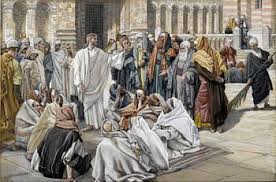

In the arms of Jesus’ love and mercy, you will find forgiveness for your failure and love despite your lack. Receive what God gives to you. He gives you Jesus. Because He has died and risen again, Jesus delivers the very mercy and forgiveness that you need.

“Are you really a Christian?” Well, do you trust in Christ for the forgiveness of your sins? That is the mark you need. Yes, you fail in your calling. But faith in Christ, and faith alone by grace alone, makes you a genuine child of God. Amen.

The peace of God, which surpasses all understanding, will guard your hearts and minds in Christ Jesus. Amen.

Dependence – Sermon on Matthew 22:34-46 for the Eighteenth Sunday after Trinity

Listen here.

Matthew 22:34-46

34 But when the Pharisees heard that he had silenced the Sadducees, they gathered together. 35 And one of them, a lawyer, asked him a question to test him. 36 “Teacher, which is the great commandment in the Law?” 37 And he said to him, “You shall love the Lord your God with all your heart and with all your soul and with all your mind. 38 This is the great and first commandment. 39 And a second is like it: You shall love your neighbor as yourself. 40 On these two commandments depend all the Law and the Prophets.”

41 Now while the Pharisees were gathered together, Jesus asked them a question, 42 saying, “What do you think about the Christ? Whose son is he?” They said to him, “The son of David.” 43 He said to them, “How is it then that David, in the Spirit, calls him Lord, saying,Jesus and the religious leaders in the Temple

44 “The Lord said to my Lord,
‘Sit at my right hand,
until I put your enemies under your feet’?

45 “If then David calls him Lord, how is he his son?” 46 And no one was able to answer him a word, nor from that day did anyone dare to ask him any more questions.

In the name of Jesus. Amen.

You’ve maybe heard the acronym about the Bible: “Basic Instructions Before Leaving Earth.” Sure, it’s cute, but honestly, it’s horrible because it turns God’s holy and precious Word into a manual of what we must do. If the Bible is about what we need to do and not what God has done for us in Christ Jesus, we’re sunk because we simply cannot do what God commands us to do even if we wanted to, which we don’t.

That is why, when you read the Bible (which I encourage you to do), it is extremely helpful to look for two things – Law and Gospel. Look for God’s commands and His promises. Look for the threats and the blessings. Look for the instruction and for the forgiveness of sins. This Gospel text is a great place to practice this and see how both Law and Gospel depend on each other.

The text has two parts. First, the question the Pharisees ask Jesus along with His answer which is Law. Second, the question or riddle that Jesus gives to the Pharisees which is all Gospel. The text takes place on Holy Tuesday, merely three days before Jesus is crucified. And this day, this Tuesday, was the last day of Jesus’ public teaching. After Jesus silences the Pharisees here, His teaching is only directed to the disciples.

In order to trip Jesus up and get Him in trouble, the religious leaders, the Pharisees and Sadducees, had asked Him several questions. First, He had been asked by the Pharisees about paying taxes to Caesar. Then, the Sadducees asked Him a question about marriage and the resurrection, and He answers it in a way that dumbfounded the Sadducees. And here, in our text, we get the third question.

“Teacher, which is the great commandment in the Law?” And Jesus responds, “You shall love the Lord your God with all your heart and with all your soul and with all your mind. This is the great and first commandment. And a second is like it: You shall love your neighbor as yourself. On these two commandments depend all the Law and the Prophets.”

For centuries, the rabbis had been talking, debating, and arguing about this question. They didn’t know how to answer it. But Jesus rattles off an answer quick as you please. If you want a summary of the all Commandments and condense them down into two statements, it is to love God and love your neighbor – on these two commandments depend (or ‘hang’) all the Law and the prophets. If you want, you can boil the Law down even further to one word, love. Paul says in Ro. 13:10, “Love is the fulfilling of the Law.”

A lot could be said here about the Law, but I’m going to keep it to six simple points.

Holy Spirit open eyes new heartsFirst, love is a beautiful summary of the Law, but that one word, love, does not replace the Law. Many people will say that since we have these two great commandments to love God and love our neighbor that we don’t need the rest of the Law. But that is false. Just because you think you are motivated by love does not mean that you are doing the right thing. We are so fallen that sometimes we try to pit love against the Commandments. Love is never an excuse to sin or an excuse to overlook sin. Instead, the Commandments define the shape of love, which is the second point about the Law.

Love takes shape according to the Commandments. Love is more than a feeling (thank you Boston). Love gives. Love serves. Love dies – greater love has no one than this, that one lays down his life for his friends (Jn. 15:13). If you want to love your neighbor, here is what it looks like: honor your father and mother; don’t murder; don’t commit adultery; don’t steal; don’t bear false witness; don’t covet. If you want to love God, don’t have other gods, keep His name holy, and keep the Sabbath holy. It doesn’t matter if what you do is motivated by love; if it violates or falls outside of these Commands, it is not love. In fact, we could go further and say that, when your actions fall outside of the Ten Commandments, they are motivated by selfishness and hatred toward both God and neighbor.

Third, love is defined by the Commandments, but it also finds and meets your neighbor’s need. What help and service can you give to your neighbor according to the Commandments? If your neighbor is hungry, feed him. If your neighbor is lonely, hang out with him or visit her. If your neighbor is trapped in sin, exhort them and encourage them to repent and ask God for mercy and forgiveness. If your neighbor is not a Christian and suffering spiritually, invite them to church.

Fourth, we love God by loving our neighbor. This is so important. 1 John 4:20 says, “If anyone says, ‘I love God,’ and hates his brother, he is a liar; for he who does not love his brother whom he has seen cannot love God whom he has not seen.” If you want to demonstrate your love for God, you do that by loving your neighbor according to the Commandments and your neighbor’s need. And this starts with those closest to you. Love your spouse first because that is the closest neighbor God has given you. Then, love your children, then your brothers and sisters in Christ, then your friends and coworkers, and so on and so forth.

Fifth, the command to love shows us our sin. There is no time in your life that you can say that you have loved God and neighbor enough. According to the Law, all of us are guilty lawbreakers and sinners. We constantly need to hear the Law tell us that we are sinners so that we are always repentant.

Sixth, and finally on the Law, the Law always shows us our sin, but beware of the temptation to not attempt good works because you are going to fail. When Jesus says, “Be perfect as your heavenly Father is perfect” (Mt. 5:48), don’t just throw up your hands thinking, “Well, that’s impossible so I’m not even going to try.” Get after it. Work. Try. Attempt. And, yes, fail. Then pray. Ask God for forgiveness and mercy. Pray for strength to try again. Pray for wisdom to see your neighbor’s need and how to love them knowing that you are dependent on God’s Law to shape your love for Him and your neighbor.

Now, the Gospel. Jesus silences the Pharisees with His answer, but now He is going to ask them a question. “What do you think about the Christ? Whose son is he?”

They answer correctly. In 2 Sam. 7, God had promised David to raise up one of David’s sons who would sit on his throne forever. There God promised that David’s offspring would be the Messiah, the one to crush the devil’s head, and the one to deliver God’s people. And the Pharisees know it. But Jesus asks a second question based on Ps. 110:1, which is one of the most quoted Old Testament verses in the New Testament, “How is it then that David, in the Spirit, calls him Lord, saying, ‘The Lord said to my Lord, Sit at my right hand, until I put your enemies under your feet’? If then David calls him Lord, how is he his son?”

The Pharisees cannot figure out the riddle from Scripture. How can the Messiah be David’s Son and David’s Lord? The Pharisees were unable to answer this because they didn’t believe that the Messiah would be both God and man. They figured the Messiah would be a man who would get things right and save them.

incarnation of JesusBut, Christian, you know the answer. In fact, you have been taught this and have believed it for so long that you hardly think about it too much. But it is the most amazing thing. Jesus is man, born of His mother. And Jesus is God, begotten of His Father before all worlds. Jesus is man so that He can die, and He is God so that His death can be an atoning sacrifice for our sins.

Because of Christ, the Law has been fulfilled. Yes, it is impossible for you to keep the two great Commandments, but Jesus has done it for you. He has taken on your flesh and blood to deliver you from sin, death, and the devil and give to you everlasting life. This is the Gospel.

Yes, the Law to love God and neighbor is important; on that depend all the Scriptures. But the Gospel is importanter [sic.]. Christian, the Gospel is how and why you will be able to stand before God on the Last Day. Jesus has died for you and put all of your enemies under His feet triumphing over them on the cross (Eph. 1:21-23). On this mercy and grace of God in Christ Jesus you depend. Amen.

The peace of God, which surpasses all understanding, will guard your hearts and minds in Christ Jesus. Amen.

Manage – Sermon on Luke 16:1-13 for the Ninth Sunday after Trinity

Listen here.

Luke 16:1-13

He also said to the disciples, “There was a rich man who had a manager, and charges were brought to him that this man was wasting his possessions. And he called him and said to him, ‘What is this that I hear about you? Turn in the account of your management, for you can no longer be manager.’ And the manager said to himself, ‘What shall I do, since my master is taking the management away from me? I am not strong enough to dig, and I am ashamed to beg. I have decided what to do, so that when I am removed from management, people may receive me into their houses.’ So, summoning his master’s debtors one by one, he said to the first, ‘How much do you owe my master?’ He said, ‘A hundred measures of oil.’ He said to him, ‘Take your bill, and sit down quickly and write fifty.’ Then he said to another, ‘And how much do you owe?’ He said, ‘A hundred measures of wheat.’ He said to him, ‘Take your bill, and write eighty.’ The master commended the dishonest manager for his shrewdness. For the sons of this world are more shrewd in dealing with their own generation than the sons of light. And I tell you, make friends for yourselves by means of unrighteous wealth, so that when it fails they may receive you into the eternal dwellings.

10 “One who is faithful in a very little is also faithful in much, and one who is dishonest in a very little is also dishonest in much. 11 If then you have not been faithful in the unrighteous wealth, who will entrust to you the true riches? 12 And if you have not been faithful in that which is another’s, who will give you that which is your own? 13 No servant can serve two masters, for either he will hate the one and love the other, or he will be devoted to the one and despise the other. You cannot serve God and money.”

In the name of Jesus. Amen.

No getting around it. This parable is one of the most difficult texts in the Gospels and all of Scripture. A lot of pastor friends of mine were joking about how this text is the reason churches have associate pastors and interns so the ‘regular’ pastor can be protected from having to preach on this text. Unfortunately for me – and, maybe, you – I don’t have that luxury. Just so you know. I’m purposefully skipping Jesus’ words in v. 9. I’ve heard a few explanations and interpretations of v. 9 that may be right, but I’m not entirely convinced by any of them. So, I’m not preaching on it.

So, since the parable is already difficult to preach, I’m going to double down. I’ll deal with the parable first, and then I’ll preach about money, stewardship, and tithing. A double-whammy.

First, the parable. A rich man, who owns a lot of land and leases it out to farmers, has a manager who keeps the books, and the manager is a crook. He cooks the books and is swindling his boss, the rich man. When the manager is confronted by his boss, he has no response because he’s been caught red-handed. So, the rich man fires him, but the rich man is also generous. He doesn’t have the guy thrown straight into prison. Instead, the rich man is gracious and lets the manager head back to his office to get the books and turn them in for the last time.

On the way to his office, the manager is worried about his future well-being. He realizes that he’s too weak for manual labor and too proud to beg. But he recognizes that he has a window of opportunity which is only open until he turns in the books. So, the manager secretly calls in his master’s debtors and decreases their debts in order to make friends with them. It is interesting to note that the fifty measures of oil and the twenty measures of wheat are both roughly equal to the same amount of money – about five-hundred denarii (or 500 days’ wages).

H-63 Trinity 9 (Lu 16.1-9)This reduction was, of course, not legally binding. The rich man could have simply said, “Hang on everyone. I fired that guy before he lowered your debt. You still owe the original amount.” But that isn’t the character of the rich man. Instead, the whole town is singing the praises of the rich man because he is so generous. And the rich man isn’t willing to harm his reputation as a merciful guy. So, what does the rich man do in the parable? He tells the fired, scoundrel of a manager, “Dude, you’re shrewd. You knew I’d rather be known as a merciful person rather than hold on to my wealth. And by your shrewdness, you’ve helped yourself.”

That’s the key to understanding the parable. The rich man in Jesus’ parable doesn’t praise the sinfulness of the fired manager. Instead, he praises how shrewd the manager was. The manager put all his eggs in one basket – the basket of the rich man’s generosity and mercy. And it paid off. By betting on the mercy of the rich man, the manager made himself some friends before everything was taken from him.

And notice that Jesus wishes we were more daring with what we have been given. In the last half of v. 8, Jesus says, “The sons of this world are more shrewd in dealing with their own generation than the sons of light.”Christian, you have been given mercy, forgiveness, salvation, eternal life, eternal hope, eternal joy, eternal peace, eternal love – all things that cannot be taken from you. But you still are careful about sharing those things with others. Repent!

Why are you so careful about sharing God’s love for you with others? Don’t be ashamed! Christian, you have Jesus, and you have the Gospel. You have God’s unfailing, unending love. You have been entrusted with the power of God for salvation to everyone who believes (Ro. 1:16).

Stop being afraid of losing friends if you share the Gospel with them. God has given you the perfect righteousness and perfect obedience of Christ. Be faithful with what God has given you for your life and salvation. Be willing to give it away. Be faithful in your stewardship of the Gospel. That’s the parable.

Now, we move on to stewardship because, notice what Jesus says (v. 12), “If you have not been faithful in that which is another’s, who will give you that which is your own?”

If you aren’t faithful with the grace you have been freely given in Jesus Christ, why would God trust you with lesser things, things like money? God is right to not trust you with money if you cannot be trusted with the Gospel. This is a shift in gears here, but stick with me.

God often deals with sin and idols by using those sins and idols to be their own punishment. In Daniel, some pagans planned on getting Daniel thrown into the lion’s den and killed for disobeying the king and praying to God. But they are the ones who end up being eaten by the lions (Dan. 6). Or do you remember the book of Esther? The wicked Haman plans on killing faithful, God-fearing Mordecai by hanging him on a pole, but then Haman ends up being executed on that very instrument of death. This happens with unbelievers, but it also happens with believers. David’s sin of lust plagues him the rest of his life after he commits adultery with Bathsheba. The same thing happens with the most common idol in the world – money.

There have been studies on income and happiness, and a correlation has been found about how much you make and how happy you are. The interesting thing is that once you make a certain amount, happiness actually decreases. What do you think the amount is where happiness starts to decrease? It’s probably lower than you think – somewhere around $70,000. If you have little money but think that just a bit more will make you happier, money is your idol, and you will always be discontent with how much you have. But if you idolize money when you have lots of it, you still aren’t happy and spend all your time trying to hold on to it.

GreedNow, Jesus is absolutely clear, “You cannot serve God and money.”It can’t be done. If you trust in money, you do not trust God. So, repent of your love of money.
One of the best ways to protect yourself against idolizing money is to be generous – recklessly generous. Remember, everything you have – your life, your house, your clothes, your food, your finances, your money – everything is a gift from God. As Creator of everything, it all belongs to God.

You are merely a manager, a steward of what God, the Rich Man, has given and entrusted to you. And God is extremely loose and permissive in how much freedom you have in managing what is entrusted to you. God is actually pleased when you use the things that He has given you to manage and you take those things and use them to care for your family. God is even pleased when you enjoy things that might even be considered frivolous – like expensive coffee, or a gourmet steak and lobster dinner. God is pleased to give those things to you especially when you recognize that He is the One who has given it to you.

But God doesn’t want you to hoard everything He has given you to pamper yourself. He wants to use you and your management to provide for others as well. So, ask yourself, “What is the most important thing God wants to provide for others?” Yes, people need food and water and clothing. But the most important thing God wants people to have is the Gospel. The Gospel which provides for others not just in this life but for all eternity.

So, I would encourage you. Take a look at your finances. Yes, look at how you spend your money, but more importantly look at how much you give away – and where are you giving that money. Are you providing for people’s temporal needs by giving to the food shelf, the homeless shelter, etc.? Good. But you should be shrewd enough to give more to provide for people’s eternal needs. First, you should be giving to this congregation to make sure that both you and your brothers and sisters will be fed with the Gospel. Then, you should be giving to missionaries who call people to repentance and faith in Christ. Then, give to those other places as well.

I hope you know that what you give in the offering plate does go out from here too. As a congregation, we tithe 10% of what you give in the offering plate to provide for missionaries, the promotion of the Gospel, and to agencies in our community that provide temporal needs to others in our community.

If all this talk about tithing and money makes you squirm because you realize that you have not been a faithful manager of what God has given you, repent. Repent and amend your ways. And if you hear this and think to yourself, “I’m glad pastor is finally telling other people to give the way that I give.” Or if you’re thinking, “I wish so-and-so was here to hear this.” You repent too because this is law. And the law should always make us squirm. Your bank ledger isn’t what matters when it comes to your salvation.

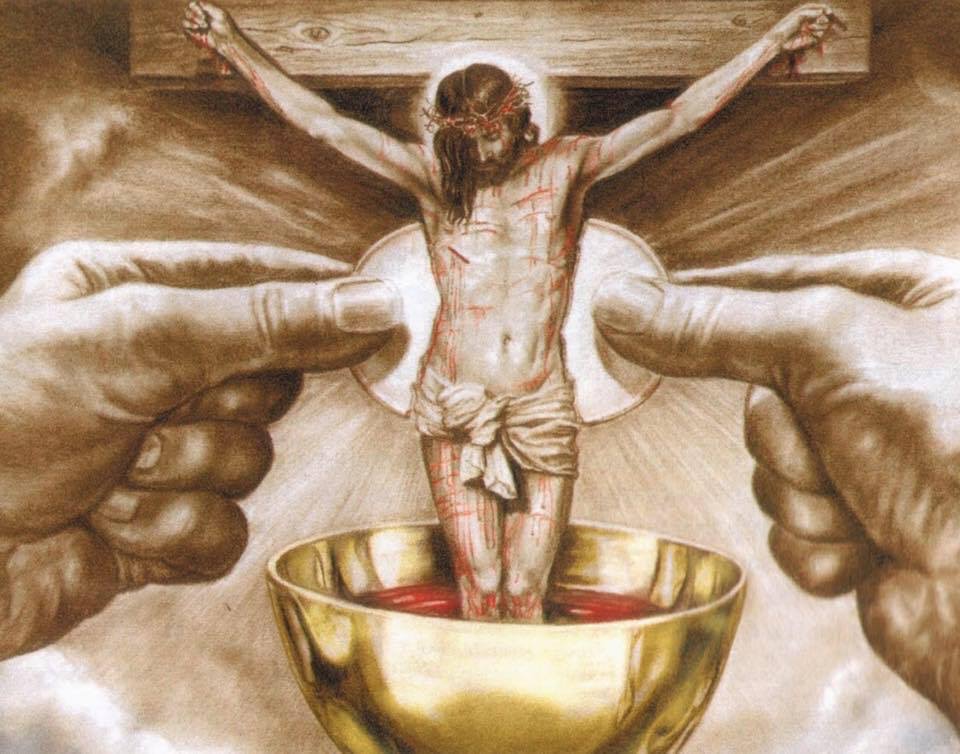
Cross and CommunionThe only thing that matters for your salvation is what Christ has done and completed for you upon the cross. Even when you are stingy and fail to be generous with what God has given to you, God was not. He gave what was most valuable to Him for your salvation. God, in His mercy, gave Jesus to die upon the cross for you. Don’t trust in your stewardship of what God has given you. Instead, trust in Christ’s giving of Himself completely for you and for others. Amen.

The peace of God, which surpasses all understanding, will guard your hearts and minds in Christ Jesus. Amen.

The Council of the Lord – Sermon on Jeremiah 23:16-29 for the Eighth Sunday after Trinity

Listen here.

Jeremiah 23:16-29

16 Thus says the Lord of hosts: “Do not listen to the words of the prophets who prophesy to you, filling you with vain hopes. They speak visions of their own minds, not from the mouth of the Lord. 17 They say continually to those who despise the word of the Lord, ‘It shall be well with you’; and to everyone who stubbornly follows his own heart, they say, ‘No disaster shall come upon you.’”

18 For who among them has stood in the council of the Lord
to see and to hear his word,
or who has paid attention to his word and listened?

19 Behold, the storm of the Lord!
Wrath has gone forth,

a whirling tempest;
it will burst upon the head of the wicked.

20 The anger of the Lord will not turn back
until he has executed and accomplished
the intents of his heart.

In the latter days you will understand it clearly.

21 “I did not send the prophets,
yet they ran;

I did not speak to them,
yet they prophesied.

22 But if they had stood in my council,
then they would have proclaimed my words to my people,

and they would have turned them from their evil way,
and from the evil of their deeds.

23 “Am I a God at hand, declares the Lord, and not a God far away? 24 Can a man hide himself in secret places so that I cannot see him? declares the Lord. Do I not fill heaven and earth? declares the Lord. 25 I have heard what the prophets have said who prophesy lies in my name, saying, ‘I have dreamed, I have dreamed!’ 26 How long shall there be lies in the heart of the prophets who prophesy lies, and who prophesy the deceit of their own heart, 27 who think to make my people forget my name by their dreams that they tell one another, even as their fathers forgot my name for Baal? 28 Let the prophet who has a dream tell the dream, but let him who has my word speak my word faithfully. What has straw in common with wheat? declares the Lord. 29 Is not my word like fire, declares the Lord, and like a hammer that breaks the rock in pieces?”

In the name of Jesus. Amen.

I was talking to a few other pastors about this text and mentioned that I was having a hard time with an introduction for my sermon. One of them suggested that I start by saying, “I had a dream from God the other night…” He was joking of course, but it provided an introduction.

In this text, we heard about a very important theme in the Scriptures, and that is the theme of the council of the Lordor sometimes called the heavenly council. And it is important to differentiate here that this is the council with a ‘c’ which means a group of people who come together to consult, deliberate, and make decisions. We are not talking about counsel with an ‘s’ which is giving advice.

Through His faithful prophet Jeremiah, God is warning the people against listening to the false prophets who are not preaching faithfully. If you are following along in our chronological Bible reading plan, you started Jeremiah a few days ago and know about the evil in Jeremiah’s day. If you aren’t following that plan (or aren’t caught up), here’s a brief summary.

Jeremiah was living and preaching to God’s people just before and through the time when the kingdom of Judah fell and was taken captive into Babylon. The kings were sacrificing their sons to pagan gods and abandoning the worship of God. Even though God was sending faithful prophets like Jeremiah and others, the people would not listen. And the kings would kill the faithful prophets who were calling the people to repentance.

The false prophets would tell people who despised the word of God, “Everything will be fine,” and to sinners they would say, “Don’t worry about punishment, God doesn’t mind.” Well, God did mind, and punishment was coming. And yet those false prophets ran and spoke false messages to the people claiming that God had sent them even though they had not stood in the council of the Lord.

Picture it like this – this council of God is like a heavenly throne room or courtroom where important matters are discussed. This picture about the council of God appears all over the Bible.

The council of God began back in creation. In the very beginning, there was a conversation between the Father, Son, and Holy Spirit. Creation of Adam.jpgOut of that conversation came creation, and most importantly, out of that conversation came the creation of humanity. We get to hear that conversation in Gen. 1:26 where the Triune God says, “Let Us make man in Our image, after Our likeness.” It was so, and it was good – very good.

After Adam and Eve were created, they become part of that heavenly conversation. God would come walking and talking with them in the cool of the day, and they would hear God’s Word and speak back to God. But there was another voice in that conversation – a voice of discord, violence, and evil. Satan, the devil, had been part of that council of God and had rebelled against the Lord. The devil comes to Adam and Eve and speaks to them about faithlessness, evil, and death. From that conversation, Adam and Eve fall.

After the Fall, the topic of discussion in the council of God changes. The council is no longer focused on the creation of mankind. But, thank God that, in His mercy, the conversation doesn’t change to destroying us. Instead, the conversation is now about the redemption and salvation of mankind. The conversation is about the death of Jesus. And Adam and Eve get to hear this when God says to the devil that the Seed of the woman would crush his head (Gen. 3:15).

Now, we can’t hear this council of God with the ears that God has given us, so God sent His faithful prophets to declare what is being discussed in the heavenly council. Amos 3:7 says, “The Lord God does nothing without revealing His secret to His servants the prophets.” And from the text here before us, God says of the false prophets, “I did not send the prophets, yet they ran; I did not speak to them, yet they prophesied. But if they had stood in My council, they would have proclaimed My words to My people, and they would have turned the from their evil way, and from the evil of their deeds” (Jer. 23:21-22). This was the job of the prophets. Prophets are those who stand in God’s council and bring God’s Words to God’s people. Words of Law and words of Gospel.

When you were growing up, did you ever get sent out of the room so your parents could have a conversation? They might have done this to figure out how to punish you and your siblings for something you had done wrong. Or they might have done this to plan a vacation or get a puppy or some other good. Whatever the reason was, they were having an important conversation that would impact you. But you weren’t invited into the conversation – at least not initially.

But then your parents call you into the conversation. They would tell you what they were talking about and send you to announce it to your siblings. “We’re getting a puppy,” or, “We’re going to Disneyland.” And you get to be their spokesperson and proclaim it. That’s what the all the faithful prophets of Scripture did.

Sometimes, the prophets were to bring news of judgment and destruction. “There won’t be rain,” or, “The Babylonians are going to come and destroy our capitol.” Sometimes, the prophets were to proclaim news of Gospel and deliverance, “A remnant will be saved. God will send a Savior who will bear our griefs, carry our sorrows, and with His wounds we will be healed.”

Heavenly CouncilOne of the most amazing things is that God even gives His prophets a seat and a voice in this council. You remember when God was going to destroy Sodom and Gomorrah, and Abraham speaks up and gets God to agree to not destroy the cities if ten righteous people are found there (Gen. 18:22-33). Or, when God is going to destroy the Israelites for making the golden calf, Moses speaks up in the council and says, “God, if You go down and destroy them, the Egyptians will say that You only brought them out of slavery to destroy them.” And God relents of the disaster He had said He would bring on the people (Gen. 32:1-14).

This idea of the council of God is important for us to understand the Old Testament, but it even comes into the New Testament. Probably the most important glimpse of the council of God we get in the New Testament is in Luke’s account of the Transfiguration (Lk. 9:28-36). You remember that Peter, James, and John are there. They see Jesus’ face change and His clothes shine like the sun. Moses and Elijah appear with Jesus and are talking with Him. There is the council of God on earth, and Luke says that they are talking about Jesus’ ‘departure’ (lit.His ‘exodus’) which He was about to accomplish at Jerusalem.

In other words, they were talking about Jesus’ death and resurrection. They were talking about Jesus’ redemption of creation and mankind. When Peter later recalls being at the Transfiguration and overhearing that council of God, he concludes that having the Bible is even better, “We have the prophetic word more fully confirmed…. No prophecy of Scripture come from someone’s own interpretation or was produced by the will of man, but men spoke from God as they were carried along by the Holy Spirit” (2 Pet. 1:16-21).

What this means, dear saints, is that when you hear the words of Scripture, you are hearing the council of God. You are hearing God’s call to repent of your sins, and you are hearing about God delivering you from sin, death, and the devil through Jesus’ death and resurrection. This is important for us to always remember. God is constantly calling us to repentance and faith through His Word.

Over the last week, there has been a lot of chatter in our country about politics and guns and all sorts of things because of the evil and wickedness in El Paso and Dayton. Those conversations are important and necessary. But there is something you won’t hear in the media, and that is a call to repentance and faith after evil has struck those parts of our country.

In Luke 13:1-5, some people were with Jesus and asked Him what He thought about some Galileans who had been killed by Pilate. The people thought that Jesus should speak out against the leaders in government, but Jesus has a different take. He says, “Do you think that those Galileans were worse sinners because they suffered in this way? No, I tell you; but unless you repent, you will all likewise perish.”And Jesus mentions another event when the tower of Siloam fell and killed eighteen people. Jesus says the same thing, “Unless you repent, you will all likewise perish.”

Dear saints, according to Jesus and according to the council of God, when you see evil in the world – whether it is the evil acts of the wicked or the evil brokenness of creation – know that God is calling you to repent. He is calling you to repent and trust in His mercy won and given through faith in Christ Jesus.

Council of GodNow, Jesus has ascended to the right hand of the Father. Today, your Savior is talking with the Father, your Creator, and with the Holy Spirit, your Sanctifier. And do you know what they are talking about? They are talking about you and the cross. They are talking about how Jesus won your salvation there. How His blood shed there made a place in heaven for you forever. And the Holy Spirit is there, translating your prayers and interceding for you with groanings too deep for words (Ro. 8:26). The Holy Spirit whispers into your ear that you are an adopted child of God and heir with Christ. And you respond by crying, “Abba, Father” (Ro. 8:12-17).

And know that, whenever you hear the Scriptures, God is inviting you into that conversation, into that council where He calls you Himself through Jesus’ sacrifice. This is what the council of God is always about. This is God’s focus and intention, that you turn from your sins and that you trust in His Son, your Savior, Jesus Christ.

As we hear the Scriptures, may we heed God’s council. May we repent of our sins and believe in Christ. Amen.[1]

The peace of God, which surpasses all understanding, will guard your hearts and minds in Christ Jesus. Amen.

[1] I am thankful for an interview that Pr. Bryan Wolfmueller did with Pr. Warren Graff on the heavenly council for portions of this sermon. https://wolfmueller.co/table-scraps-heavenly-council-with-warren-graff/

Your Savior & the Law – Sermon on Matthew 5:17-26 for the Sixth Sunday after Trinity

Listen here.

Matthew 5:17-26

17 “Do not think that I have come to abolish the Law or the Prophets; I have not come to abolish them but to fulfill them. 18 For truly, I say to you, until heaven and earth pass away, not an iota, not a dot, will pass from the Law until all is accomplished. Jesus Preaches the Sermon on the Mount19 Therefore whoever relaxes one of the least of these commandments and teaches others to do the same will be called least in the kingdom of heaven, but whoever does them and teaches them will be called great in the kingdom of heaven. 20 For I tell you, unless your righteousness exceeds that of the scribes and Pharisees, you will never enter the kingdom of heaven.

21 “You have heard that it was said to those of old, ‘You shall not murder; and whoever murders will be liable to judgment.’ 22 But I say to you that everyone who is angry with his brother will be liable to judgment; whoever insults his brother will be liable to the council; and whoever says, ‘You fool!’ will be liable to the hell of fire. 23 So if you are offering your gift at the altar and there remember that your brother has something against you, 24 leave your gift there before the altar and go. First be reconciled to your brother, and then come and offer your gift. 25 Come to terms quickly with your accuser while you are going with him to court, lest your accuser hand you over to the judge, and the judge to the guard, and you be put in prison. 26 Truly, I say to you, you will never get out until you have paid the last penny.”

In the name of Jesus. Amen.

Three weeks ago, we heard the three great parables of Luke 15 – the lost sheep, the lost coin, and the prodigal son. And, I hope you remember, the reason Jesus told those parables was that the scribes and Pharisees grumbled when they saw Jesus eating with scoundrels and said, “This man receives sinners and eats with them” (Lk. 15:1). Jesus was attracting and associating with shadowy characters and the known sinners of society. So, there in Luke 15, the scribes and Pharisees are thinking that Jesus is either removing the demands of the Commandments or, at least, lowering the bar of what the Law demands. They figure Jesus is some sort of liberal universalist who says that people can live however they want and still get in to heaven. In their minds, Jesus is, by His actions, saying that God doesn’t really care about sin.

Now, we don’t know for sure, but it is very possible that Jesus told the parables in Luke 15 about three years after He preached the words of our text today. Today’s text comes from the Sermon on the Mount which was very early in Jesus’ ministry. I mention this chronology for one reason. This sermon of Jesus, the Sermon on the Mount, was preached to great crowds that were following Him (Mt. 4:25-5:1). So from the very beginning of His ministry Jesus, your Savior, made it clear that He was not coming to abolish the Law. Those throngs of people heard Jesus very adamantly and very clearly say, “Do not think I have come to abolish the Law or the Prophets; I have not come to do away with them but to fulfill them.” He says that not the littlest part of the Commandments will pass away. He warns against relaxing any of the Commandments or teaching others that the Law is not important. According to your Savior’s clear teaching, the Law stands.

We always need to remember that Jesus’ death on the cross takes away the guilt of the Law, but it does not remove the Law’s requirements. Let me say that again because it is important. Jesus’ death on the cross takes away the guilt of the Law, but it does not remove the requirements of the Law. And we need to remember that the Law always points its finger directly at you and at me.

Jesus goes on in this text and afterward to spell out the requirements of God’s Commands. According to Jesus, the holy Son of God, murder is committed without guns, knives, axes, forceps, vacuums, and syringes. Bloody handsSure, you aren’t Lady Macbeth yelling at the blood of Duncan to wash off your hands, but you are guilty of murder before God. You have been angry with others. You have called others, “Fool.” You have held grudges. You have refused to ask your neighbor for forgiveness. And Jesus goes on to the other Commandments as well – lust is adultery and fornication, gossip is perjury, etc.

But you say, “Pastor, you can’t be serious to compare my anger to murder, or my lust to actually having an affair, or my gossip to perjury.” Well, your issue is not with me. I’m just the messenger. Your issue is with God’s holy and perfect Law. You can argue the morality of your sinful actions all you want, but those two tablets of stone only point at you and declare, “You are the sinner.”

Repent. Remember, Jesus says, “Unless your righteousness exceeds that of the scribes and Pharisees, you will never enter the kingdom of heaven.”And, honestly, our righteousness doesn’t measure up to the low bar of the righteousness of the scribes and Pharisees. You might appear very moral and look good outwardly, but the Law is like an x-ray or MRI that exposes every sinful thought and feeling which is just as damnable as the outward action. Unless you keep the Law perfectly as Jesus did, you will never enter the kingdom of heaven.

Repent, but do not lose heart. There is a righteousness that exceeds the outward, visible righteousness of the scribes and Pharisees, and it is the righteousness of Jesus Christ who did indeed fulfill the Law for you. And through His death and resurrection, His righteousness now belongs to you.

As our Epistle text (Ro. 6:1-11) said, you have been united by your Baptism to Jesus’ death. In your Baptism, you were buried with Jesus into death. If Christ doesn’t return first, you will most surely die. But do not fear. Just as Jesus’ death didn’t last, neither will yours.Because you have been united to Jesus’ death, you can know without doubt that your death will not last. In Baptism you have died with Christ and been set free from sin. Your body of sin has been brought to nothing, and you are no longer enslaved to sin. Christian, you must consider yourself dead to sin and alive to God in Christ Jesus.

And still in this life you need the Law. You need to hear the accusations of God’s Commandments so that your sin is exposed, and you are left with nowhere to flee except to God for His mercy. And God, in His mercy, freely and fully forgives you for the sake of Jesus. Christian, you are free from the Law; Paul will go on to say that very thing in Romans 7:6.

When it comes to your salvation, the Law has nothing to say to you because the Law is not the way to eternal life and peace with God. But that does not mean your Savior says do not need to listen to the Law any more. I’d like to close with an analogy from a faithful pastor[1] that, I think, is very helpful to express how you relate to the Law as a Christian who is fully saved by Christ’s grace but still has a sinful nature.

Imagine that your heart is like a big mansion with all sorts of rooms, hallways, and secret passages. There are certain rooms where the Law must be allowed and given full access; however, there are other rooms where the Law should never be allowed.

Small Catechism - Ten Commandments Cross IconThe Law should never be allowed to access into your ‘How do I stand before God?’ room, your ‘Am I good enough to go to heaven?’ room, your ‘Does God love me?’ room, your ‘Does God think I am a good person?’ room, or your ‘assurance of salvation’ room. The Law should never be allowed to enter those rooms because Jesus has made you as good and as righteous and as perfect as He is.

But the Law is like a three-year-old boy who is always trying to get into the rooms where he isn’t allowed. So, you have to lock those doors and childproof those knobs to keep the Law from entering them.

But don’t think that you can deny the Law access into the other rooms of your heart. No, the Law must have full access to those other rooms. The ‘how I parent my children’ room, the ‘how I am at work’ room, the ‘how I treat my spouse’ room, the ‘how I live as a citizen of my city, state, and country’ room, etc. In those rooms, the Law must have full, complete, and even unsupervised access so you are convicted of your sin.

The Law is right when it declares that you have failed your neighbor and sinned. However, that does not, and it never will, determine your standing before God. Jesus does. Your Savior determines your standing before God.

Always remember that you don’t have to make yourself right with God. Christ has done that. Before you ever thought to get things right with God and even before you took your first breath, God loved you and sent Jesus to make you right with Himself. And through faith in Him, you have His perfect, complete righteousness.Amen.

The peace of God, which surpasses all understanding, will guard your hearts and minds in Christ Jesus. Amen.

[1] Analogy from Pr. Jared Melius that can be found here: http://wolfmueller.co/law-not-go-sermon-preached-pr-jared-melius/.

Where Is Your Sting? – Sermon on 1 Corinthians 15:51-57 for the Resurrection of Our Lord

Listen here.

1 Corinthians 15:51-57

51 Behold! I tell you a mystery. We shall not all sleep, but we shall all be changed, 52 in a moment, in the twinkling of an eye, at the last trumpet. For the trumpet will sound, and the dead will be raised imperishable, and we shall be changed. 53 For this perishable body must put on the imperishable, and this mortal body must put on immortality. 54 When the perishable puts on the imperishable, and the mortal puts on immortality, then shall come to pass the saying that is written:

“Death is swallowed up in victory.”
55 “O death, where is your victory?
O death, where is your sting?”

56 The sting of death is sin, and the power of sin is the law. 57 But thanks be to God, who gives us the victory through our Lord Jesus Christ.

Alleluia! Christ is risen!
He is risen indeed! Alleluia!

In the name of Jesus. Amen.

“O death, where is your victory? O death, where is your sting?” Too often we think of death in wrong ways. We think that death is a state or a category or a condition. But v. 55 of that Epistle Lesson says that death is an enemy, a person who can be talked to and, most importantly, an enemy who can be questioned.

Imagine encountering death. When you or someone you love dies and you cross paths with death, you need to only ask death one simple question: “O death, where is your sting?”

Death might try to answer you with a pale, menacing, frightening voice, “My sting is your sin. I sting because you sin. If you didn’t have sin, I would have no sting. But I sting everyone because all have sinned. I am the wages and payment of sin (Ro. 6:23). And I will sting you because your sin is my sting.”

But you can simply respond, “I know all of that, death. I know that my sin has put me under your thumb. I know that the Bible says, ‘The wages of sin is death.’ So, what you say is true. But, death, I didn’t ask you, ‘What is your sting?’ I asked you, ‘Where is your sting?’ So, death, where is it, where is your sting?”

And death might smile and respond, “You simple Christian, have you forgotten how powerful my sting is? It is more powerful than the most poisonous snake or spider or jellyfish. My sting is the most powerful sting imaginable. My sting burns forever because the power of my sting is fueled by the Law. Yes, God’s eternal Law that abides forever, and you have broken that Law over and over.”

But you can look back at death and say, “I know my sin is no small sting. I know my sin is against the God who created me and loves me. I know the penalty of my sin is everlasting death, and I feel it in my conscience. I also know that the Law is not ever going to go away. I know that God’s Commandments are eternal. In fact, the Law was what made me scared of you. Because of the good and righteous Law, I know what you can do to me. I know that your sting is my sin, and I know that the power behind that sting is the Law. But, death, you still have not answered my question. Where is your sting?”

At this point, death is uncomfortable and a little fidgety, but he musters as much gusto as possible and says, “Well, you are face-to-face with me, aren’t you?”

“Yes, I am, but the sting of death is not death. The sting of death is sin. So, I ask you again, ‘Death, where is your sting?’”

Finally, death hangs his head. “I have used it, and I have lost it. But I’ll get it back again.”

Jesus Coming out of the TombAnd you can smile in his face, “Yes, death, you used your sting, didn’t you? You should have used your sting on me. The sting would have stuck on me. But you didn’t. Instead, death, you used your sting on my Savior, my God, and my Lord. You used your sting on Jesus, didn’t you? You had Jesus pinned tightly on the cross, and you stuck Him with your stinger and buried it into Him. Death, you were a fool that day. You stung God Himself. You stung Jesus who is the Resurrection and the Life (Jn. 11:25). But when you went to the tomb to find your stinger and get it back, Jesus wasn’t there. And guess what, death, Christ has taken my sin as He hung on the cross. And, death, you will not ever get your sting back. Never. That empty tomb means that your sting is lost forever. Death, I don’t fear you any longer.”

And having no other answer, death now turns around and walks away from you.

Dear saints, this is why we celebrate every Easter and every Sunday. Every Sunday, we celebrate what Christ has done in absorbing the sting of death so that death no longer has his sting.

And the day is coming when Christ will return. On that day, the trumpet will sound, and the dead will be raised imperishable. The day is coming when your perishable body will put on the imperishable and your mortal body will put on immortality.

Yes, death can and does buzz around now for a while. But death is like a bee that has used its stinger and soon dies.

Dear saints, “Death is swallowed up in victory.” Yes, the sting of death is sin, and the power of sin is the Law. But thanks be to God, who gives us the victory through our Lord Jesus Christ. So now, Christian, you need have no fear of death. Jesus has conquered the bitter tyrant of death. And He has connected you to that victory. You do not need to fear and watch out for death hiding behind a corner to pounce on you. Instead, Christian, you continue to look for the resurrection of the dead, and the life of the world to come.

Because Christ is risen, death is overthrown. Christ is risen and life reigns. Christ is risen, and dear saint, you are safely anchored in Christ who has given you the victory, now and forever.

Alleluia! Christ is risen!
He is risen indeed! Alleluia!

Amen.

The peace of God, which surpasses all understanding, will guard your hearts and minds in Christ Jesus. Amen.