Silenced – Sermon on Matthew 22:34-46 for the Eighteenth Sunday after Trinity

Matthew 22:34-46

34 But when the Pharisees heard that he had silenced the Sadducees, they gathered together. 35 And one of them, a lawyer, asked him a question to test him. 36 “Teacher, which is the great commandment in the Law?” 37 And he said to him, “You shall love the Lord your God with all your heart and with all your soul and with all your mind. 38 This is the great and first commandment. 39 And a second is like it: You shall love your neighbor as yourself. 40 On these two commandments depend all the Law and the Prophets.”

41 Now while the Pharisees were gathered together, Jesus asked them a question, 42 saying, “What do you think about the Christ? Whose son is he?” They said to him, “The son of David.” 43 He said to them, “How is it then that David, in the Spirit, calls him Lord, saying,

44 “ ‘The Lord said to my Lord, 
“Sit at my right hand, 
until I put your enemies under your feet” ’?

45 If then David calls him Lord, how is he his son?” 46 And no one was able to answer him a word, nor from that day did anyone dare to ask him any more questions.

In the name of Jesus. Amen.

Arrogance was behind that question, “What is the great commandment in the Law?” We know this was arrogant because the lawyer is asking this question in order to test Jesus. This text is at the end of a conversation Jesus has been having with the religious leaders. If you look back to the beginning in Mt. 22:15, you’ll see that the religious leaders are trying to entangle Jesus in His words. The Pharisees had debated which command was the greatest for centuries, but they couldn’t come up with an answer because picking one would imply that something God commanded isn’t important. Or, at least, not as important. And, of course, that can’t be true. Every word that comes from the mouth of God matters because He is the One whose powerful voice spoke all things into existence.

Imagine a student who is studying to be a heart surgeon. I don’t actually know how heart surgeons are trained, but I see them getting something similar to a recipe. It’s got a list of all utensils and ingredients needed followed by instructions on how to use them. Imagine a student seeing that recipe. Step 1: Scrub up. Step 2: Make the incision. Step 3: Find this artery. And so on, going through the whole process. If one of those students asked which step is the most important, how would the instructor reply? I imagine the instructor saying, “They’re all important! Do everything correctly – from scrubbing up to closing. You have to get it all exactly right. Don’t leave anything out, or you’ll kill your patient!”

Basically, that is what Jesus says here. Everything God has commanded is important. All the Commands are good, right, and true. That’s what Jesus communicates when He summarizes God’s Law as, “Love the Lord your God with all your heart and with all your soul and with all your mind. And love your neighbor as yourself”(Mt. 22:37-39). Everything command of God is important, and everything He requires falls into two categories of either loving God or loving neighbor. In Ro. 13:10, the Law is summarized even further, “Love is the fulfilling of the Law.”

But sadly, this summary the Law is twisted. The devil has used countless false teachers say that the word ‘love’ is God’s only command. And when they do that, those false teachers utterly corrupt love. Yes, the command to love summarizesGod’s Law, but it doesn’t replace God’s commands. Today, to combat that devilish twisting, I want to make six points about God’s Law. I’ve done this before, but it’s been seven years since I last did it. So, it’s worth reviewing again.

First, while the command to love summarizes the Law, the word ‘love’ doesn’t replace the Law. We sinners will do all sorts of things that go against what God has commanded in the name of love. But you don’t get to steal food from a store because you love your children and want to feed them. Instead, loving your children requires you to keep the Command against stealing by getting a job to buy food for them. Committing adultery is not suddenly ok just because you love someone. That leads to the second point.

Second, the Law defines how to love your neighbor. There’s a 4th Command love that honors parents. There’s an 8th Command love that does not bear false witness and tells the truth. In each Command, God is telling us, “Here is how you love Me and love your neighbor.”

The third point about the Law is closely related to that. While the Law shapes how you love your neighbor, the needs of your neighbor also shape your love for them. The 7th Command about stealing will take one shape if you are an employee. It looks like working hard, not wasting time, and doing good work. But if you own a business, the 7th Command takes a different shape. It means that you are generous and pay a fair wage that rewards the work and skills of your employees. Same with the 4th Command to honor parents. When you are a child, honoring parents means obeying them. When you’re an adult, honoring parents means respecting them.

Fourth, you show love for God by showing love for your neighbor. 1 Jn. 4:20 says, “If anyone says, ‘I love God,’ and hates his brother, he is a liar; for he who does not love his brother whom he has seen cannot love God whom he has not seen.” If you want to demonstrate love for God, you do that by loving your neighbor, according to the commandments and according to your neighbor’s need.

And with this fourth point we see that there is an order to your love. You are to love the people God has placed closest to you first, then love everyone else. 1 Tim. 5:8 says that a person needs to provide for all his relatives, but especially the members of his household. And Gal. 6:10 says, “As we have opportunity, let us do good to everyone, and especially to those who are of the household of faith.” So, it is loving to give to the Feed My Starving Children offerings, but it is not loving for you to put your entire paycheck in there and not be able to feed your family or to let your brothers and sisters in Christ go hungry while you feed people you haven’t met.

Fifth, and this is the most important one: The Law always accuses. There’s no time in your life where you can say that you have kept God’s Law perfectly. As long as you have a pulse, you can’t check off the boxes to love God and your neighbor because you still have strength. Those boxes are always on your to-do list. And you and I are sinners and always fall short when it comes to the command to love. So, the life of a Christian is always filled with repentance and receiving the forgiveness that comes only through Christ.

Finally, the sixth point: Even though the Law always shows you that you are a sinner, don’t fall into the temptation of giving up in your attempt to keep God’s Law. Christian, even though you are going to fail to love perfectly, you need to strive to do it. Pray for strength and wisdom. Pray that God would open your eyes and ears to your neighbors’ needs. Then, be God’s hands and feet to meet those needs.

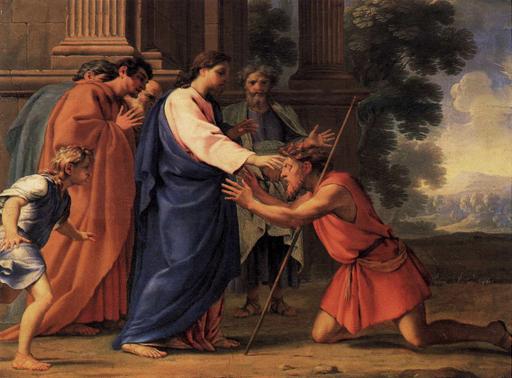
Changing gears and getting back to Mt. 22. We know that the Law is not the only word God has spoken to you. God also speaks His comforting words of Gospel. After Jesus summarized the Law, He turns the tables. Now, He has a question for the religious leaders about the Gospel. “What do you think about the Christ? Whose Son is He?”To their credit, these Pharisees know their Bible. They know that in 2 Sam. 7, God promised that the Christ would come through King David’s lineage, and He would reign as King forever and ever.

But Jesus wants to draw them further into the Gospel and into a further knowledge of the identity of the Christ by asking, “If the Christ is David’s son, how can David also call him, ‘Lord’?” (Ps. 110:1). The Pharisees can’t figure out this riddle because they figured the Christ was going to be a man who would set things right and save them. They didn’t understand that the Christ would be fully God and fully Man. But Jesus wasn’t trying to trick them. There He was, the Christ, standing right before them. The God-Man and Messiah, talking with them, calling them to Himself. Sadly, their only response was silent ignorance.

Dear saints, this question from Jesus silences you too, but in a very different way. You aren’t silenced into the shame of the Pharisees; instead, you are silenced in a holy wonder. Your silence is an awe that realizes that, to save you from the condemnation of the Law, God has located Himself in the body of Jesus. Because of Jesus’ birth, part of God’s nature is that He now has a human body. He took on that body so He could suffer for you, shed His blood for you, die for you, rise again for you, and rule as King until all your enemies are placed under His nail-scarred feet. Your Christ, your Savior, and your God has united Himself to you.

Lucy, today, we rejoice with you that you are Baptized. You are now clothed with Christ (Gal. 3:27) and joined to Him in His death and resurrection (Ro. 6:3-4). Remain in Him. Lucy and all you Baptized saints, we will never fully understand the unity that we have with God because of our Baptism. And yet, we, in silent wonder, can bask in the glory that God Himself has loved us in this way.

God came to you. He took on your flesh. He lived a perfect life and died an atoning death. Now, He is risen and rules as the Lord of all creation. Your Savior from sin is David’s Son and David’s Lord. He is your Lord and King, and yet He is your brother Who now invites you to His royal banquet to receive His Body and Blood for the forgiveness of all your sin and failure to love God and neighbor. Come and receive Him. Amen.

The peace of God, which surpasses all understanding, will guard your hearts and minds in Christ Jesus (Php. 4:7). Amen.
The Move – Sermon on Luke 10:23-37 for the Thirteenth Sunday after Trinity

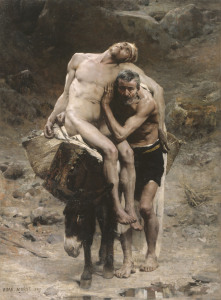
Aimé Morot (1850-1913). “Le bon Samaritain”, 1880. Huile sur toile. Musée des Beaux-Arts de la Ville de Paris, Petit Palais.

Luke 10:23-37

23 Then turning to the disciples he said privately, “Blessed are the eyes that see what you see! 24 For I tell you that many prophets and kings desired to see what you see, and did not see it, and to hear what you hear, and did not hear it.”

25 And behold, a lawyer stood up to put him to the test, saying, “Teacher, what shall I do to inherit eternal life?” 26 He said to him, “What is written in the Law? How do you read it?” 27 And he answered, “You shall love the Lord your God with all your heart and with all your soul and with all your strength and with all your mind, and your neighbor as yourself.” 28 And he said to him, “You have answered correctly; do this, and you will live.”

29 But he, desiring to justify himself, said to Jesus, “And who is my neighbor?” 30 Jesus replied, “A man was going down from Jerusalem to Jericho, and he fell among robbers, who stripped him and beat him and departed, leaving him half dead. 31 Now by chance a priest was going down that road, and when he saw him he passed by on the other side. 32So likewise a Levite, when he came to the place and saw him, passed by on the other side. 33 But a Samaritan, as he journeyed, came to where he was, and when he saw him, he had compassion. 34 He went to him and bound up his wounds, pouring on oil and wine. Then he set him on his own animal and brought him to an inn and took care of him. 35And the next day he took out two denarii and gave them to the innkeeper, saying, ‘Take care of him, and whatever more you spend, I will repay you when I come back.’ 36 Which of these three, do you think, proved to be a neighbor to the man who fell among the robbers?” 37 He said, “The one who showed him mercy.” And Jesus said to him, “You go, and do likewise.”

In the name of Jesus. Amen.

Jesus didn’t say that the priest and Levite only passed by the half-dead man in the ditch. Christ added the fact that they passed by, “on the other side,” to even further distance them from him. They moved away. Both intentionally and deliberately ‘un-neighbored’ the guy. You’ve heard me say this before, but it’s worth repeating. The reason our English word ‘neighbor’ is spelled so weird is that it comes from the word ‘nigh’ as in ‘near’ and the word for ‘dweller.’ The same thing is true for the Greek word that gets translated ‘neighbor.’ The word means near, but it refers to an individual, so it means ‘close by person.’

In the parable, the priest and Levite aren’t dealing with a gray area. “I wonder if he really needs help?” There are times you might see a person begging for money on the street, and you don’t know that person. You don’t know if giving them money is just going to aid an addiction or be a type of soft theft where they take your money and use it for something different than you intended when you gave it. In this parable, there’s no ambiguity. The situation is black and white. It’s simple. He’s been robbed, stripped, beaten, and left dying in the ditch. If he doesn’t get help, he’s going to die. So, why do the priest and Levite not only pass by, but pass by “on the other side”?

They are trying to quiet their conscience. The more distance they can put between them and this guy in the ditch, the easier it is for them to not think about him. They make a move. They move away from the guy’s need toward their own comfort. Now, this is a parable, so we can’t ask them what they thought was more important than the guy’s need. Maybe it was their schedule. Maybe it was the fact that they knew it would cost them time and money to help the guy. Maybe they just wanted to be left alone so they could have some ‘me time.’ It doesn’t matter. They move away from need of their neighbor toward their own comfort and pass by on the other side.

Then comes the Samaritan. He sees the guy, and he also makes a move. But his move is in the complete opposite direction. He moves away from his comfort toward the guy’s need. And I’m sure he would have preferred comfort. The Samaritan has things going on. He’s got a schedule to keep and a family to feed. His time is limited and valuable. He has all the same reasons and excuses the priest and Levite have. But the Samaritan sees the man, and he moves toward the need.

Jesus makes it clear that the Samaritan has compassion. The way Jesus says it is that his guts were wrenched. The Samaritan went to the man; bound up his wounds; poured on the medicine of oil and wine that he had with him; he set the guy on his own animal; brought the man to the inn; cared for him through the night; gives the innkeeper two denarii (imagine a few hundred bucks); asks the innkeeper to take care of him; and promises to return and pay off any additional expenses. That’s nine things the Samaritan does. Nine ways he moves away from his own comfort toward the guy’s need. It’s absolutely beautiful and noble. Who doesn’t want to be as generous and loving as the Samaritan?

Primarily, this parable shows us a tiny fraction of what Christ has done for you. Jesus, the eternal Son of God, made the ultimate move away from comfort and toward you in your need. Though Jesus was in the form of God, He did not count equality with God a thing to be grasped. He emptied Himself by taking the form of a servant by being born in the likeness of men. And being found in human form, He humbled Himself by becoming obedient to the point of death – even death on a cross (Php. 2:6-8).

He did all that because you needed it. The eternal Son of God made the move from His comfort toward your need. And for that, God be praised! That’s the main point of the parable. But I want to spend the rest of this sermon focusing on what Jesus says before the parable.

After the lawyer correctly summarizes the whole Law with “Love the Lord your God with your soul, strength, and mind. And love your neighbor as yourself.” Jesus says, “Do this and you will live.”

Now, when Jesus said that, I do think it was partly to show the lawyer that he was the guy left for dead in the ditch because the Law robbed and stripped him of any self-righteousness (Gal. 3:19). But, at the same time, when Jesus says, “Do this and you will live,” He is being completely straightforward. Christian, do the Law. Do God’s will. The Law is how God created you to live. The Law is how Jesus wants you to live. It isn’t how you’re saved, but it is how Jesus wants you, believer, to live (Gal. 3:21-22). Jesus wants to motivate you to also be one who moves away from comfort and toward need.

This world is full of needs, but I’m going to focus on one very specific need today because it’s a need that everyone can meet, everyone can fulfill. And that is the need of speaking the truth in a broken and fallen world and that loves lies. The martyrdom and assassination of Charlie Kirk this week is a reminder of the lengths that the demonic forces will go to silence the truth.

Christian, do not be afraid to stand on the truth. Yes, speaking the truth can come with a cost. You might offend others. You might be ridiculed and called all sorts of names. You might lose your job or friends. But, dear saints, do not let that silence you. Silence in the face of lies is nothing other than bowing at the pagan altar of comfort.

Charlie was an amazing example of someone who loved others in a way that led him to move away from comfort toward need. He intentionally went to places to talk with people who suppress truth. He would shine the light of the truth in that darkness with logic and rhetoric that few have. But his example should teach us one simple lesson: the Truth always wins.

Jesus taught us that the devil is a liar and the father of lies (Jn. 8:44). That means wherever there is falsehood, the devil and his demonic forces are at work. Dear saints, don’t give an inch to what is false. Stand on the truth. Speak the truth and know that you are not alone. God doesn’t give many people a sphere of influence as large as Charlie had, but the numbers of people you can reach don’t matter.

Even though most of us (myself included) don’t have the rhetorical and debating skills that Charlie had, those are skills that can be nurtured and strengthened. So, strengthen yours. We’ve seen how one person can influence millions of people. That’s great; for that, God be praised. But imagine what God will do through thousands of people with smaller spheres of influence use that influence to speak the truth to the people around them. You don’t need a larger audience or bigger microphone. You can simply speak to the precious lives that God has placed around you.

And as you shine the light of truth, know that, ultimately, it doesn’t matter if you win people over. That might not happen. But it’s also not your job. That task solely belongs to the Holy Spirit who alone can – and does – change hearts. Leave the results to Him. The only thing that matters that you are faithful (1 Co. 4:2-5).

Our Christian faith requires us to love our enemies and pray for those who curse and persecute us. It does not require us to stand silently in the midst of chaos, evil, savagery, and violence. That would only be a move toward comfort. Dear saints, move toward need. This world needs to hear that sin is bad, and there is forgiveness for sin because of the death and resurrection of Christ. They need to hear that life is precious from womb to tomb; that a man and a woman should get married before they do things that create children; that God created people in His image with gifts and talents that should be nurtured, strengthened, and used for the benefit of others; that criminals should be justly punished; that men are men and women are women; and all sorts of other things. Saying those things in a loving way can be difficult, but it is the loving thing to do.

So, spread the name and light of Jesus every opportunity you have and everywhere you go. With your words and actions, point others to the beautiful, the good, the orderly, the unchanging, and the unending. Because, ultimately, all of that points people to the love of God that comes only through Christ.

As you do that, remember that light has no fellowship with darkness (2 Co. 6:14). Yes, absolutely, strive to rescue others from the darkness. But, if they love the darkness rather than the light (Jn. 3:19-20), shake the dust from your feet (Lk. 9:5).

Dear saints, Jesus is your Good Samaritan who moved from comfort toward your need. You, go and do likewise (Lk. 10:37). Move away from comfort and toward the needs of your neighbor – especially toward those who have believed the devil’s lies. And as you make that move, live in the Light that will never know dusk. Amen.

The peace of God, which surpasses all understanding, will guard your hearts and minds in Christ Jesus (Php. 4:7). Amen.
The Medicine – Sermon for Maundy Thursday

The Scripture readings for tonight’s service are Exodus 12:1-141 Corinthians 11:23-32; and John 13:1-1534-35.

In the name of Jesus. Amen.

When a doctor gives you a prescription for medicine, it doesn’t really matter if you understand how the medicine works. It doesn’t matter if you understand how that medicine is made. You don’t need to know exactly what that medicine does in your body. The only thing that matters is that the doctor who says, “Take this. It will heal you,” is right and that you actually take it.

Tonight, your Savior, Jesus Christ, the Great Physician, has a prescription for you, and it is the medicine of immortality.

So, we have to ask, “Is Jesus’ Word trustworthy?” Yes; absolutely yes! The power of Jesus’ Word is seen when He created everything (Jn. 1:3). In the beginning, God spoke, “Let there be light,” and there was light (Gen. 1:3). The power of Jesus’ Word is on full display throughout His life. When Jesus says something, it happens – always. When He speaks to paralytics, “Take up your bed and walk,” that powerful Word heals limbs that didn’t work (Mk. 2:11-12Jn. 5:8-9), and it happens. When Jesus says to the wind and waves, “Peace, be still,” (Mk. 4:39), it happens. When Jesus hands the disciples five loaves of bread and two fish to the disciples and says, “Use this to feed thousands of people,”(Lk. 9:16), it happens. When Lazarus has been dead in his tomb for four days and Jesus tells him, “Lazarus, come out,” (Jn. 11:43-44), he does. There’s no question that Jesus’ Word is powerful and does exactly what Jesus says.

So, when Jesus says to you tonight, “Take eat; take drink. This is for you for the forgiveness of sin,” does His Word have the power to forgive? Yes. When Jesus says, “This is My Body; this is My Blood,” does His Word have the power to make the bread and wine His Body and Blood? Yes. Do we have to understand how it works? No. Not at all. If Jesus wanted us to understand the how, He would’ve told us. But He didn’t, so we simply believe His Word.

Sure, it seems strange that eating and drinking the elements of Communion would do something spiritual like forgiving sin. Most of the things we eat are for physical benefits. We eat to fuel our body and give it the nutrients, vitamins, and minerals it needs. But eating food and having it do something spiritual sounds strange. But it shouldn’t. Remember how sin and death entered the world? Through eating the forbidden fruit. That eating was the sin that brought about both physical and spiritual sickness, death, and separation from God that has spread like a virus to all humanity (Ro. 5:12). God had warned Adam that would happen (Gen. 2:17), and God’s Word proved true (Gen. 3:6-7). So, when Jesus, the Son of God, promises that this meal will forgive sin (Mt. 26:28), His Word is also trustworthy and true.

A quick disclaimer before I go on here: I’m not a doctor, so what I’m about to say isn’t intended to be medical advice. Talk to your own healthcare professional.

When you get an ear infection, a doctor will prescribe an antibiotic to target and kill the bad bacteria. But those antibiotics will also kill the good bacteria in your gut that you need to properly digest food. When a doctor prescribes an antibiotic, he might also advise you to take a probiotic to keep all the biotics [sic.] in your body in balance. So, when you have a bacterial infection, you might end up taking two things – a prescription of antibiotics and a supplement of probiotics. Again, that’s not medical advice; talk to your healthcare provider.

Tonight, your Great Physician gives you one medicine, but it does two things. First, it fights off and rids you of the infection of sin through forgiveness. And second, it bestows, grants, and gives life. This one medicine of Jesus’ Body and Blood does both.

Listen to what Jesus says about this medicine in John 6. Jesus says that He is the living bread that comes down from heaven, so that you may eat of it and not die (Jn. 6:50). Christ says that when you eat this bread, you will live forever(Jn. 6:51). Jesus says that whoever eats His flesh and drinks His blood has eternal life (Jn. 6:54) because His flesh is true food, and His blood is true drink (Jn. 6:55). Christ says that by this eating and drinking, you abide in Him and He abides in you (Jn. 6:56).

In other words, this medicine kills your sin through forgiveness, and it nourishes and strengthens you so you love others in the same way as Jesus did. One of the prayers we use to thank God for what He gives in Communion highlights this. It goes, “We give thanks to You, Almighty God, that You have refreshed us through this gracious gift, and we ask that in Your mercy You would strengthen us through [this meal] in faith toward You and in fervent love toward one another.”

Holy Communion strengthens your love for others because it joins you to Jesus and Him to you. And this joining of you and Jesus results in love for others. And the love that Jesus has for His disciples, which is beautifully demonstrated in our Gospel reading (Jn. 13:1-1534-35) is a humble, sacrificial, self-giving kind of love. Think of it. The One who had shaped Adam from the soil (Gen. 2:7) now stoops to wash the soil from the feet Adam’s sons (Jn. 13:5). The One who powerfully yet intricately placed all the galaxies, stars, and planets into orbit now kneels with a water basin and a rag. The medicine of the Lord’s Supper pours that kind of love into you and strengthens you to give that same love to others. And by you having that same kind of love, Jesus says that all people will know that you are His disciples (Jn. 13:35). 

So, whenever you feel your sin, come. Receive this medicine. Whenever your love grows cold, come. Receive this medicine. 

Medicine always has a cost, and so does this medicine. But Jesus, your Great Physician, foots the bill. He absorbs the entire cost. Christ fully pays for it so you can receive it gratis. Tomorrow, you’ll hear Jesus cry out on the cross, “My God, my God, why have You forsaken Me?” (Mk. 14:34). That was the cost, and it is completely covered by Jesus.

Dear saints, you have a Great Physician who heals, who forgives, who strengthens, who increases your love, and who gives you the medicine you need to lead you unto life everlasting. Amen.

The peace of God, which surpasses all understanding, will guard your hearts and minds in Christ Jesus. Amen.

Gift & Assignment – Sermon on 2 Peter 1:2-11 for Ash Wednesday

2 Peter 1:2–11

2 May grace and peace be multiplied to you in the knowledge of God and of Jesus our Lord. 

3 His divine power has granted to us all things that pertain to life and godliness, through the knowledge of him who called us to his own glory and excellence, 4 by which he has granted to us his precious and very great promises, so that through them you may become partakers of the divine nature, having escaped from the corruption that is in the world because of sinful desire. 5 For this very reason, make every effort to supplement your faith with virtue, and virtue with knowledge, 6 and knowledge with self-control, and self-control with steadfastness, and steadfastness with godliness, 7 and godliness with brotherly affection, and brotherly affection with love. 8 For if these qualities are yours and are increasing, they keep you from being ineffective or unfruitful in the knowledge of our Lord Jesus Christ. 9 For whoever lacks these qualities is so nearsighted that he is blind, having forgotten that he was cleansed from his former sins. 10 Therefore, brothers, be all the more diligent to confirm your calling and election, for if you practice these qualities you will never fall. 11 For in this way there will be richly provided for you an entrance into the eternal kingdom of our Lord and Savior Jesus Christ.

Pause – Sermon on Luke 18:31-43 for Quinquagesima Sunday

Luke 18:31–43

31 And taking the twelve, he said to them, “See, we are going up to Jerusalem, and everything that is written about the Son of Man by the prophets will be accomplished. 32 For he will be delivered over to the Gentiles and will be mocked and shamefully treated and spit upon. 33 And after flogging him, they will kill him, and on the third day he will rise.” 34 But they understood none of these things. This saying was hidden from them, and they did not grasp what was said. 

35 As he drew near to Jericho, a blind man was sitting by the roadside begging. 36 And hearing a crowd going by, he inquired what this meant. 37 They told him, “Jesus of Nazareth is passing by.” 38 And he cried out, “Jesus, Son of David, have mercy on me!” 39 And those who were in front rebuked him, telling him to be silent. But he cried out all the more, “Son of David, have mercy on me!” 40 And Jesus stopped and commanded him to be brought to him. And when he came near, he asked him, 41 “What do you want me to do for you?” He said, “Lord, let me recover my sight.” 42 And Jesus said to him, “Recover your sight; your faith has made you well.” 43 And immediately he recovered his sight and followed him, glorifying God. And all the people, when they saw it, gave praise to God.

In the name of Jesus. Amen.

Generally, when we let our imagination go wild, we like to be the heroes. Boys imagine hitting a grand slam in Game 7 bottom of the 9th two outs down by three, or they imagine they are the receiver who dives to catch the hail Mary as time expires to win the Super Bowl. Girls imagine they are Cinderella dancing the night away with Prince Charming, and getting engaged after he returns her glass slipper. Even when it comes to Bible stories, we like to imagine that we are Joshua toppling the walls of Jericho or David slaying Goliath or Elijah defeating the prophets of Baal.

In the two parts of today’s text – the Passion prediction and the healing of the blind man – the only hero is clearly Jesus, and He fully embodies the perfect love that was described in our Epistle reading (1 Co. 13:1-13). This is the third time Jesus explains to the disciples that He is going to Jerusalem to be betrayed, mocked, shamefully treated, spit upon, flogged, crucified, and raised from the dead. But the disciples don’t understand Jesus, the saying is hidden from them, and they could not grasp what Jesus said.

Still, Jesus’ love is on full display. Jesus is patient with and kind toward them. He is not irritated or resentful at their thick skulls. Jesus is going to Jerusalem and will endure all these things because His love does not insist on its own way. Instead, Christ submits to His Father’s will in perfect obedience.

By going to the cross, Jesus will bear all things. All the burdens, all the sins, all the transgressions, all the iniquities, all the wrongdoings, all the evil, all the brokenness of this fallen world – Jesus will bear all of it in His body (1 Pet. 2:24). He does it all for you. Jesus’ journey from His throne in heaven, down into your flesh. His fasting and temptation in the wilderness. His path through the lands of Israel with no place to lay His head (Lk. 9:58). His teaching, healing, casting out demons, forgiving, and restoring. His triumphal entry. His betrayal. His suffering. His death. His burial. His three day rest in the tomb. His resurrection. His ascension. And His continual rule and authority over all things is a journey of love for you.

Jesus’ entire work is directed outward. He didn’t need to do any of that to benefit Himself, and He doesn’t do it for His own, personal gain. He does it because He loves you. And this love of Jesus wasn’t based on your loveliness. It was based on the fact that the God the Father loves you and wanted to rescue you. So, Jesus, God the Son, loved you and did everything necessary to save you.

God hated seeing what sin and death had brought to His creation, so He did something about it by undoing sin and death by the death and resurrection of Jesus. Christ lived the life we were unable to live. He obeyed the whole will and Law of God that we were unable to obey. He took up His cross, endured punishment that you and I deserved, and gave up His dying breath. All of this is done for you.

Jesus does all of this with full knowledge. None of it surprised Him. Christ knew exactly what is going to happen to Him. And still, He goes and does all of this to love you with His perfect, pure love. 

Back in Lk. 9:51, we are told that Jesus had “set His face to go to Jerusalem.” In other words, Jesus is determined to do this loving thing for you. He was focused on redeeming creation, on getting there, and accomplishing it. He goes toward Jerusalem in love.

Day after day, Jesus gets closer to His goal until He arrives in the city of Jericho, which is about fifteen miles from Jerusalem. He’s close – about a day’s journey from the city. But Jesus isn’t in a rush. Sometimes, when you have to do things that you know are going to be unpleasant and painful, you just want to get it over with and put in your rearview mirror. Again, Jesus doesn’t do that. Instead, He paused along His way through Jericho.

Christ hears the blind man’s cry, “Son of David have mercy on me.” Jesus doesn’t say, “I’ve got more important things to do. I’m going to have mercy on you when I get to Jerusalem and go to the cross.” No. Our Lord stops.

The cry for mercy from any corner of His creation gets Jesus’ full attention. He commands that the blind man be brought to Him. Jesus asks him, “What do you want Me to do for you?” “Lord, let me recover my sight.” And in love, Jesus gives the man the mercy he desired. “Recover your sight; your faith has made you well.”

Jesus’ mission to be the Savior of all creation does not stop Him from pausing to give His mercy to the individual He meets along the way. He pauses and heals him.

Dear saints, Lent begins on Wednesday, and Lent is a good time for us to pause and consider all that God has done for us. Today, pause and ponder whom you are most like in this text. Again, we’re not the hero; we’re not Jesus. Instead, sometimes, we’re like the disciples who do not understand or grasp what God is doing for us and saying to us. Sometimes, even though God has plainly and clearly spoken, we are blind and don’t understand what God is doing.

Sometimes, we are broken like the blind man. Even though the blind man could not see with his physical eyes, he understands who Jesus is and what He has come to do. Despite his physical blindness, he has faith that Jesus can and will restore what is broken. So, when Jesus is present, he cries out for mercy. And Jesus gives him the mercy, restoration, and healing that he needed. Maybe, like the blind man, you look foolish to the world how you relentlessly call out to Jesus for His mercy.

Whom are you more like? It probably depends on the day, maybe even the moment.  Whether you don’t have any clue of what God is up to like the disciples or whether all you can do is cry out for mercy, the thing to do is follow Jesus.

Notice that even though the disciples don’t get all the things that God had said through Jesus and through the Scriptures, even though they are blind in their hearts and minds – what do they do? They go with Jesus. They follow Him to Jerusalem and the cross. The blind man, even though he could not see anything until Jesus gave him the sight he desperately wanted, what did he do? He followed too.

Whether you understand what God is up to or not, the conclusion is the same. Follow Jesus. Follow Him to the cross. No matter where you are in your journey through life, no matter how much you understand what God is doing, no matter how much you need from God, no matter how much God has already given you, follow Jesus to the cross.

Stay the course. And as you go with Christ, He will give you ample reasons to glorify God and give Him praise. Amen.

The peace of God, which surpasses all understanding, will guard your hearts and minds in Christ Jesus. Amen.

Nigh-Liver – Sermon on Luke 10:23-37 for the Thirteenth Sunday after Trinity

Luke 10:23–37

23 Then turning to the disciples he said privately, “Blessed are the eyes that see what you see! 24 For I tell you that many prophets and kings desired to see what you see, and did not see it, and to hear what you hear, and did not hear it.”

25 And behold, a lawyer stood up to put him to the test, saying, “Teacher, what shall I do to inherit eternal life?” 26 He said to him, “What is written in the Law? How do you read it?” 27 And he answered, “You shall love the Lord your God with all your heart and with all your soul and with all your strength and with all your mind, and your neighbor as yourself.” 28 And he said to him, “You have answered correctly; do this, and you will live.”

29 But he, desiring to justify himself, said to Jesus, “And who is my neighbor?” 30 Jesus replied, “A man was going down from Jerusalem to Jericho, and he fell among robbers, who stripped him and beat him and departed, leaving him half dead. 31 Now by chance a priest was going down that road, and when he saw him he passed by on the other side. 32So likewise a Levite, when he came to the place and saw him, passed by on the other side. 33 But a Samaritan, as he journeyed, came to where he was, and when he saw him, he had compassion. 34 He went to him and bound up his wounds, pouring on oil and wine. Then he set him on his own animal and brought him to an inn and took care of him. 35And the next day he took out two denarii and gave them to the innkeeper, saying, ‘Take care of him, and whatever more you spend, I will repay you when I come back.’ 36 Which of these three, do you think, proved to be a neighbor to the man who fell among the robbers?” 37 He said, “The one who showed him mercy.” And Jesus said to him, “You go, and do likewise.”

In the name of Jesus. Amen.

You need the right tool for the right job. If you need to fix your glasses, a hammer isn’t going to help you. Sure, you might need to insert a pointy piece of metal hardware into the frame of your glasses, but it’s going to be a screw and not a nail. In fact, when you’re trying to fix a pair of glasses, it isn’t even enough to have a screwdriver. You need the right kind of screwdriver – one that is tiny and difficult for my not-so-dexterous hands to manipulate. That’s why, for me, the right tool for fixing my glasses isn’t a tiny screwdriver; it’s an optician.

The lawyer who comes to Jesus is undertaking a worthy task – desiring to have eternal life, but he is using the wrong tool. Not only does he not have the right tool in his tool chest, he doesn’t even understand of what kind of tool he needs. He thinks salvation is something he can do and achieve for himself. That’s why his question is, “Teacher, what shall I do to inherit eternal life?” Jesus gives him perfect, correct instructions for earning eternal life by pointing him only to the Law. Love God perfectly and love your neighbor perfectly. Do this, and you will live (Lk. 10:26-28; see also Ps. 15).

The lawyer’s response to this is interesting. He doesn’t ask, “Who is God?” That would be ridiculous. He also doesn’t ask, “How do I love God?” Instead, he asks, “Why is my neighbor?” That question reveals something. Apparently, the lawyer thinks that already loves God perfectly. It’s only the second part of the equation that befuddles him. He is looking for an ‘out.’ He wants a limit on the extent of the command to love others. But there is no limit on this command. You cannot love God whom you have not seen if you don’t love your neighbor whom you have seen (1 Jn. 4:20).

In the context of this conversation between Jesus and the lawyer, that question is absurd. The word ‘neighbor’ defines itself. In at least Greek, Hebrew, Latin, German, and English, the word for ‘neighbor’ has more to do with location than anything else. In each of those languages (probably in others too), ‘neighbor’ means the person close to you. The English word neighbor is spelled so weird because it comes from two middle-English words smooshed together: nigh – as in ‘near,’ and gebur which means ‘dweller.’ Your neighbor is anyone who dwells near you. Or, to explain the title of the sermon, your neighbor is the one who lives nigh unto you – a nigh-liver.

Now, the lawyer asks the question because he’s trying to get out from under the command to love his neighbor as himself. He wants a limit to the love that is required of him because, presumably, he wants to keep lying to himself about being worthy of inheriting eternal life. But in general, the question, “Who is my neighbor?” is something we Christians should have in our minds constantly – not because we’re looking for information or identification of our neighbor. Rather, we should be asking that question so we recognize all of the targets of love that God places in front of us. Because we don’t get to pick and choose our neighbors. God gives them to us.

In the parable, God ‘neighbors’ the robbed, stripped, beaten, left-half-dead man to three people. God plops this needy guy in the path of the priest and the Levite. However, both of them intentionally and deliberately try to un-neighbor him. They move to the other side of the road to create distance between them and the wretch in the ditch.

Of course, if the situation had been reversed and either the priest or the Levite had been robbed, beaten, and left for dead, they would have desired help from anyone who passed by. Everyone who gets into trouble or danger is glad to receive help from anyone. That’s the most basic meaning of the command, “Love your neighbor as yourself.”

But the third guy, the Samaritan, is an outsider. Jews and Samaritans hated each other. But this Samaritan recognizes that God has neighbored this man to him, and he uses, what appears to be, unlimited resources to care for him. He binds up the man’s wounds and pours on oil and wine. He bears the burden of lifting the man onto his own animal and walking to town and cares for the man overnight. He pays for two more nights so the man can stay in the inn. And on top of that, he sets up an all-expenses paid account for any charges or costs the man would rack up between the time the Samaritan leaves and comes back. 

We misunderstand this parable if we think it is teaching us who our neighbor is. Sure, the lawyer had asked who his neighbor is, but Jesus uses the parable to show what it is to be a neighbor, a nigh-liver. To be a neighbor is to show mercy. The mercy of the Samaritan had no limits. And that is why the Samaritan is such a clear picture of Christ. Jesus proves to be a neighbor. The eternal Son of God descended from His heavenly throne, took on flesh, and dwelt among us in order to neighbor us and shower His mercy upon us.

Everyone gives you an opportunity to show love. But you aren’t called to love everyone the same way. If you try to feed every single person you come across (whether they need it or not) but that comes at the cost of feeding your own children, that’s a problem. 1 Timothy 5:8 says, “If anyone does not provide for his relatives, and especially for members of his household, he has denied the faith and is worse than an unbeliever.”

Other portions of Scripture are helpful in this as well. Galatians 6:10 says, “So then, as we have opportunity, let us do good to everyone, and especially to those who are of the household of faith.” Yes, you are to love everyone whom God puts along your path, but even in that there is a hierarchy. You are to care for those God puts closest to you first. And your closest neighbors are those in your immediate family – your spouse, your parents, your children. After that is the people in this congregation who have been made your brothers and sisters in Christ. Next come the people who live next to you on your block and your coworkers, boss, and friends. Finally, anyone else that God puts along your path and causes to live nigh to you.

When you think of those two great commands, “Love God with all your heart, soul, mind, and strength, and love your neighbor as yourself,” think of a dart board. What is the bullseye? You might think that God should be there, so you aim all your good works toward God. But that is wrong. God doesn’t need to be the center of your target. He doesn’t need anything from you, and you can’t give Him anything (Job 35:7, 41:11). Instead, it’s the people God places closest to you who are the center of your target. Think of God as being underneath the entire target. Christian, you love God by loving the neighbors that He has given you (1 Jn. 4:20).

Dear Banks, that brings me to you. Banks, in Jesus, God has neighbored you. Today, you are Baptized. Today, Jesus has joined you to Himself by placing His name upon you (Mt. 28:19) and clothed you in His righteousness (Gal. 3:27). Banks, you have been born of God; remain in the faith which overcomes the world (1 Jn. 5:4). Banks, God has neighbored you to us and us to you. As your brothers and sisters in Christ, we will share with you the mercy God has given us so that you can be filled with His mercy and share it with others as well.

Banks and all you saints, receive the mercy of Jesus who has neighbored you. He comes to your rescue. He binds up your wounds. He pours on the medicine of immortality. He sets up an all-expenses paid account for you in the inn of the Church. Everything you need is covered and paid for. So, let the mercy He has given you spill over to other nigh-livers that God places in your life. Amen.

The peace of God, which surpasses all understanding, will guard your hearts and minds in Christ Jesus. Amen.

A Covering of Love – Sermon on 1 Peter 4:7-11 for the Easter 7/Sunday after the Ascension

1 Peter 4:7–11

7 The end of all things is at hand; therefore be self-controlled and sober-minded for the sake of your prayers. 8 Above all, keep loving one another earnestly, since love covers a multitude of sins. 9 Show hospitality to one another without grumbling. 10 As each has received a gift, use it to serve one another, as good stewards of God’s varied grace: 11 whoever speaks, as one who speaks oracles of God; whoever serves, as one who serves by the strength that God supplies—in order that in everything God may be glorified through Jesus Christ. To him belong glory and dominion forever and ever. Amen.

Alleluia! Christ is risen!
He is risen indeed! Alleluia!

In the name of Jesus. Amen.

When something is coming to an end, there is often a sense of urgency. The last month of my senior year of high school, my class of twelve got together more often than we did the years prior. At Bible camps, kids will goof off at the campfire, but the last night they will share about their life, reflect more on what they have learned, and talk about how they hope to be different and better when they go back to their regular lives. When a family member is in their last days, every moment, every word, every interaction carries more weight to it. As the end draws near, little things become even more insignificant, and the big things become even bigger.

In this epistle reading, Peter says that the end of all things is at hand. Because Jesus has died, risen, and ascended into heaven, His work as the Savior of mankind is complete. Everything necessary for your salvation, redemption, and restoration has been accomplished. Now, your Savior and Brother sits on the throne of all creation. At any moment, Jesus can return and bring an end to all things. All of this is to say that we are living in the end times. Peter said this nearly 2,000 years ago, so it’s at least as true now as it was then. The end, the completion, the finishing of all things is at hand.

And that has a different ring to it than if Peter had written, “The end of all things is coming soon,” doesn’t it? “Soon” presupposes and anticipates a delay – even if it is only a short delay. But Peter doesn’t talk about Christ’s return as coming soon. It is “at hand.” That gives an extra ‘umph’ of urgency and immediacy. But the fact that the end of all things is “at hand” doesn’t excuse us to be worried and get frantic. Peter here doesn’t allow us to be the Christian version of Chicken Little running around and yelling, “The sky is falling; the sky is falling.” Not even close.

Instead, we are called to be self-controlled and sober-minded. In other words, we are to be in control of all our actions. Yes, of course, this refers to not getting drunk with alcohol. It includes that, but Peter means more than that. This call to be self-controlled and sober-minded is an echo of what Jesus says in Mt. 6:25-34, “Do not be anxious,” because when we are anxious, we do all sorts of ridiculous things. There is a myriad of awful, evil, horrible things going on in the world, but Jesus hasn’t given you permission to worry about it or run around all frantic and anxious.

The danger of anxiety and worry is that it would distract us from our prayers. It’s easy to fall into the trap of thinking that our worry will change what is going to happen. But more often worry distracts us from prayers. Take your worries and anxieties and turn them into prayers (1 Pet. 5:7). In a very real sense, worry is just a form spiritual drunkenness. Worry can distort the truth and the reality that Christ is in control of all things. To be self-controlled and sober-minded here is to let the fact that Jesus is ascended to the throne of all creation, that He has promised to hear your prayers, and that He promises to answer those prayers, let those truths keep you calm, clear-headed, and focused. Don’t get drunk with worry and the cares of this world. Be self-controlled and sober-minded because the end of all things is at hand.

Instead of being worried, Peter gives us three instructions of what we are to do as we live in the time of the end. We are to love, show hospitality, and use our God-given gifts. Each of these instructions could be its own sermon. But today, I want to focus on the first one because Peter says it is the most important of the three. He says, “Above all love one another,” and he tells us why we are to love one another, “because love covers a multitude of sins.”

Now, we have to be clear on a couple things here. First, Peter isn’t equating this love that covers a multitude of sins with forgiveness. Yes, forgiveness is a loving thing that releases sins. God’s love for us, which is manifested in Christ’s death, that love has forgiven and removed our sins from us as far as the east is from the west (Ps. 103:12). Other places in Scripture call us to love others by forgiving their sins, but Peter is doing something different here when he talks about covering a multitude of sins. We are to have a love that makes the sins of others invisible. We are to have a love that hides the sins of others.

That brings us to the second thing that needs to be clear. This does not mean that we don’t call sin what it is – sin. Sin is sin is sin. To say anything different is not loving. It isn’t loving to say that it’s ok for someone to be addicted to drugs because that is just the way God made them. That’s not love. Sin needs to be brought to the surface so it can be repented, confessed, and forgiven. So, what does it mean that love covers a multitude of sins?

It means that when others sin against us – especially our brothers and sisters in Christ – we are called to love them in such a way that overlooks, ignores, buries, and covers those sins. Holding grudges just isn’t worth it. The 8th Commandment and its explanation in the Small Catechism is especially helpful here: “Thou shalt not bear false witness against thy neighbor.” What does this mean? “We should fear and love God so that we do not deceitfully lie about, betray, backbite, nor slander our neighbor, but defend him, speak well of him, and put the most charitable construction on all that he does.”

It is extremely easy for us to put the least charitable construction on the actions of people who sin against us. Someone cuts you off in traffic or budges in front of you, and you assume, “That guy is an idiot,” or, “She’s rude and inconsiderate.” But you know what is just as easy? Maybe it’s slightly more difficult because of our pride – it’s just as easy to put the most charitable construction on their actions. “That person just made a mistake. Maybe, they have something going on in their life that I don’t know about.” The danger for us is that when we are always ascribing the worst motives to others, it’s easy to assume and imagine that they do the same to us. That is a dangerous place to be.

Of course, when someone sins against you and you point it out, that person should repent and ask for forgiveness. That’s how things should work. But what happens when you point out someone’s sin and they say, “I didn’t do anything wrong,” and they don’t ask for forgiveness? What do you do then? Is the relationship over? No. It shouldn’t be. That is where this passage comes in. “Love covers a multitude of sins.” And this is what we are to keep doing. Keep loving one another earnestly and fervently because love covers a multitudeof sins.

This covering up of sin through love is a distinct virtue of Christians that does not exist in the world. But the world will notice when you do this, Christian. They will see it and be drawn to it. This kind of love for one another isn’t always going to be pleasant for you. But it will be attractive to those who aren’t Christians. Having this kind of love that covers sin might be the most important evangelistic work that you do. Repeatedly in the book of Acts, this kind of love between Christians is what attracted others to see what was different about believers. So keep loving one another earnestly, since that love covers a multitude of sins.

Now, I know that was a lot of law. I recognize that. I’ll just point out that this text is full of law, so that’s what I have to preach. But I will close with this: your heavenly Father hasn’t only covered your sin and pretended that it isn’t there. No. Because of Jesus, He has removed it, forgiven it, trampled it under His foot, and cast it into the depths of the sea (Mic. 7:19). Because of that – because your sins are gone, taken away, and forgiven – you can more easily cover the sins of others in Christian love. Amen.

Alleluia! Christ is risen!
He is risen indeed! Alleluia!

The peace of God, which surpasses all understanding, will guard your hearts and minds in Christ Jesus. Amen.

Now & Not Yet – Sermon on 1 John 3:1-3 for the Fourth Sunday of Easter and Confirmation Sunday

1 John 3:1–3

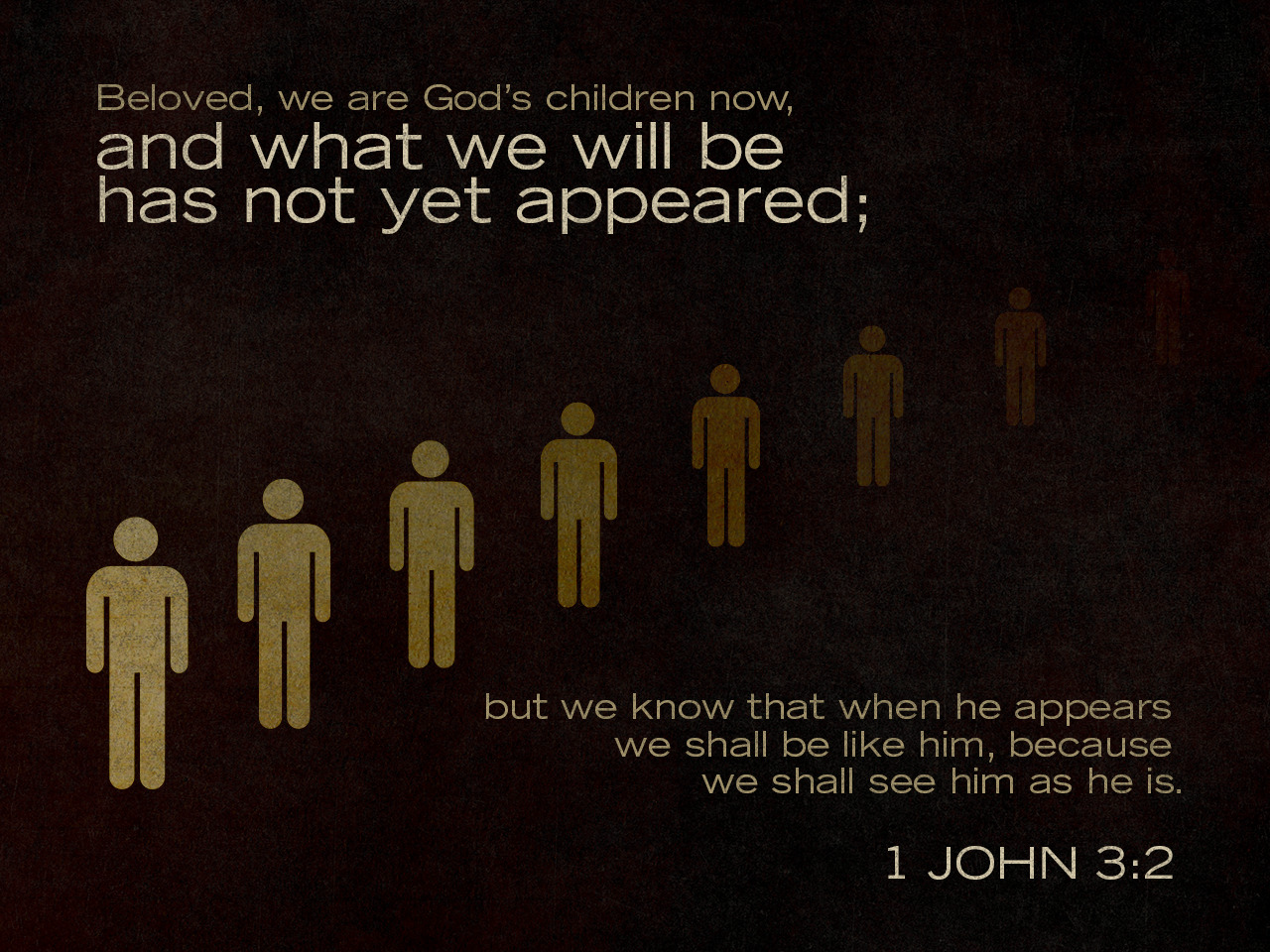
1 See what kind of love the Father has given to us, that we should be called children of God; and so we are. The reason why the world does not know us is that it did not know him. 2 Beloved, we are God’s children now, and what we will be has not yet appeared; but we know that when he appears we shall be like him, because we shall see him as he is. 3 And everyone who thus hopes in him purifies himself as he is pure.

Alleluia! Christ is risen!
He is risen indeed! Alleluia!

In the name of Jesus. Amen.

We live in a noisy world. On any given day, all sorts of things are constantly trying to grab your attention. We get dings and vibrations and taps that let us know who sent a message, what news story is breaking, or who liked that thing you posted. If you have to spend even ten minutes in a waiting room or a restaurant, you’ll find televisions turned to a game or news channel with the constant crawl of information that isn’t important enough, at least at that moment, to be on the main part of the screen. You’re watching the news about what’s going on in the Middle East and get the latest OJ Simpson’s death. Or you’re watching the NBA playoffs and learn about some guy’s hot take on what the Vikings are going to do in the first round of the NFL draft. And on and on it goes.

Now, this isn’t a sermon about how pointless and exhausting this barrage of information is. It’s just an acknowledgement of the conditions in which we live. Our attention is being constantly pulled in a myriad of directions, and all sorts of things shout at you, “Pay attention to me!” Well, this epistle reading (1 Jn. 3:1-3) is calling for your attention. In fact, it’s commanding you to pay attention. So, for the next few minutes, don’t be distracted, don’t be pulled, don’t be thinking about what’s going to happen this afternoon or this week or next summer. Right now, God, through His holy Word, calls you to focus and see. See this.

See the kind of love the Father has given to us. It is the kind of love that calls you, believer, a child of God. It is a love that calls all y’all, Christians, children of God. That is who you are – a child of God. Look around at the believers surrounding you here today, people whom you love and who love you, see that they through faith are also children of God.

See the kind of love that turns sinners and enemies of God into children. See the kind of love that isn’t earned or deserved. See God’s love for you that is demonstrated in that while we were still sinners, Christ died for us (Ro. 5:8). This is the purest kind of love. It’s God’s love that is not based on the lovableness of the individual. It’s a love that is freely given because, in spite of our unloveliness, God determined to seek your highest good and make you His child.

God’s own child, that is what you are, believer. That is what God has called you, and what God says creates reality. Everything in this world – including your own thoughts, opinions, and experiences – will try to convince you otherwise. It will attempt to get you to believe this isn’t true. Don’t listen to any of that. See. Behold. God’s love has made you His child.

Christian, God’s love has given you a new birth. In his Gospel, John says this explicitly. To all who did receive Jesus, those who believe in His name, He gives the right to become children of God (Jn. 1:12), and this right came when you were born again of water and the Spirit (Jn. 3:3, 5-6).

You confirmands, you have this new birth as a child of God. Logan, you received this new birth when you were Baptized on July 3rd, 2011 at Bigwoods Lutheran Church in Bigwoods, MN. Brayden, you were born again as God connected His Word to water on November 16th, 2013 at St. Henry’s in Perham, MN. Maddie, same place, but for you on April 16th, 2011 that was when and where you were born as a child of God. Brady, July 7th, 2013 right there at that font, you became a child of God. And Asher, same font, on November 25th2012, God declared that you are His child. The rest of you here, I’m sorry, but I don’t have your exact information in front of me.

This command to see this kind of love is in the present tense. That means it is a command that you always and continually see this kind of love. That love is to color everything else in your life. Keep holding on to that love because it is the most precious thing you could ever have. That love makes you God’s children now. Right now. What will we children of God be when we grow up? We don’t know, not yet.

John admits that even he doesn’t know exactly what glorious things are in store for us children of God. Think of that. John had seen some glorious things. He saw Jesus’ miracles and transfiguration. John saw the empty tomb. It was so glorious that he kept bragging about the fact that he outran Peter and was the first disciple to see it (Jn. 20:2-5, 8). The evening of Jesus’ resurrection, John had seen Jesus’ resurrected hands, feet, and side (Jn. 20:19-20; Lk. 24:36-43). As best as we can tell, John wrote this epistle after he had seen the vision of recorded in Revelation. That means John had seen Jesus clothed in a robe with a golden sash. He saw Christ’s eyes like a glorious flame of fire. John saw Jesus’ face shining like the sun in full strength (Rev. 1:13-16). And still John says here, “I don’t know what we children of God will grow up to be. I haven’t seen it yet because it hasn’t appeared” (1 Jn. 3:2). “But,” John says, “But we know that when Jesus appears we will be like Him, because we shall see Him as He is.” 

You confirmands and everyone here today, it can be dangerous to look to the past. And it can be troubling to think about the future. If you do look to the past, look at it through the lens of being God’s beloved child. When you consider your present, keep this command and see the constant love God has for you. When you look to the future, have in mind that you, through faith, are a child of God. And keep longing and hoping for that moment when Christ, your Savior, returns knowing that then you will be like Jesus.

That faith, that hope is what makes you pure – pure as Jesus is pure. God wants to orient you to the present reality that you are His child. Because of His love, you have a seat at His table where He gives you His Body to eat and His Blood to drink for the forgiveness of all your sin. You have a seat at His table. Child of God, as you wander through this world, know that you belong among God’s family. Welcome home, children of God. Amen.

Alleluia! Christ is risen!
He is risen indeed! Alleluia!

The peace of God, which surpasses all understanding, will guard your hearts and minds in Christ Jesus. Amen.

Common Union – Sermon for Maundy Thursday

The Scripture readings for tonight’s service are
Exodus 24:3-11; 1 Corinthians 11:23-32; and John 13:1-15, 34-35.

In the name of Jesus. Amen.

On this night, 3,470 years ago, God appointed a feast. God told His people to slaughter a lamb, take its blood, put it on the doorposts of their houses, and live. But the lamb wasn’t only used for its blood. God’s also told them to roast the lamb’s body and eat it. Those Passover lambs doubly provided for God’s people. First, the lambs’ blood marked the doors of God’s people which protected, shielded, and delivered them from the sentence of death. And second, the lambs’ bodies provided the strength and nourishment the people needed for what would happen the next day (Ex. 12:1-14). The morning after that first Passover, God’s people gathered themselves and all that they had and left Egypt to begin their journey to the Promised Land.

On this night, 1,991 years ago, our Lord Jesus celebrated the final Passover feast with His disciples. After that meal was done, Jesus took bread, gave thanks, broke it, and gave it to His disciples saying, “Take, eat; this is My body, which is given for you. This do in remembrance of Me.” Then, He took the cup, blessed it, and gave it to the disciples saying, “Drink of it, all of you; this cup is the new covenant in My blood, which is shed for you for the forgiveness of sins. This do, as often as you drink it, in remembrance of Me.”

By doing this, Jesus put an end to the old covenant that His people had broken and established the New Covenant. In this New Covenant, He forgives your iniquity and remembers your sin no more. And this New Covenant does more than that. Because of this New Covenant, God promises to be your God and make you His people (Jer. 31:31-34; Heb. 8:8-13). Forgiveness and being God’s people. This New Covenant delivers forgiveness through the shedding of Jesus’ blood, but don’t forget that this meal also unites us together as God’s forgiven people.

In 1 Cor. 10:16-17, Scripture says that the Bread and Cup of the Lord’s Supper are, as the ESV translates it, a “participation” in the Body and Blood of Christ. Unfortunately, the way we use “participation” most often these days is simply showing up. In some competitions, simply showing up gets you a participation ribbon. Translating that word as “participation” might give the impression that Jesus does nothing more than show up in the Bread and Cup. I prefer the KJV which uses the word “communion.” The Bread and Cup of the Lord’s Supper is a “communion” in the Body and Blood of Christ. These elements unite us with the Body and Blood of Christ.

Because the Lord’s Supper is, according to Jesus, His true Body and Blood, it first unites us with Him. And second, since this Sacrament unites us with Jesus, it also unites us with one another. It makes us one body (1 Cor. 10:17).

We need this unity, this communion with one another. The first thing that God says about mankind is, “It is not good for the man to be alone” (Gen. 2:18). Man alone is not good. That doesn’t mean that man alone is bad; it’s just not good. To make mankind good, God creates a woman, a companion, a wife, a bride for Adam and this completes him. Then, not only is mankind good like the rest of creation; humanity is elevated above the rest of creation and is very good (Gen. 1:31). We were not created for ourselves to live in isolation. We are created for others.

In the Lord’s Supper, we become a united community, a holy and forgiven people who are bonded together with Jesus and with one another as the body of Christ. And as a body, we love and care for one another because we need each other (1 Cor. 12:12-27).

If one part of your body is hurt, the rest of your body compensates. If you cut one of your fingers, you use your other fingers to do what needs to be done while the injured finger heals. If you break an arm or leg, the other one picks up the slack. When Jesus gives us this new commandment to love one another, He is calling you to do the same thing for the other members, the other parts, of the body of Christ. And the love you have and demonstrate for your brothers and sisters in Christ is evidence to the world that you are truly Jesus’ disciples (Jn. 13:35).

On the same night, 1,991 years ago, when Jesus gave us Holy Communion, He also served His disciples by washing their feet. For several reasons, foot washing isn’t a Sacrament. One of the reasons is that Jesus says that washing was a lesson on how to love one another. He asks if they understand the lesson (Jn. 13:12) and says that what He did was an example of serving others (Jn. 13:14).

By that example, the Creator of all things makes the glory of His love shine by humbly serving His creatures. Jesus is the God of love, and He loves you by giving to you and serving you. This example of foot washing shows that we followers of Jesus are to give and to love and to serve each other as He does. Christ says, “A new commandment I give to you, that you love one another: just as I have loved you, you also are to love one another. By this all people will know that you are my disciples, if you have love for one another” (Jn. 13:34-35).

What does this love look like? Jesus will say a little later, “Greater love has no one than this, that someone lay down his life for his friends” (Jn. 15:13). Laying down your life for someone else can only happen once because you only have one life to lay down. The day may come when you need to lay down your life to save a friend’s life. But until then, lay down your life in the all the other little ways that you can. Lay down your pride and ambition and self-interest and ease and comfort to love and serve your neighbor. Lay down your lives to love and protect those for whom Christ has died because we are a holy communion, God’s blessed, forgiven community.

As you come tonight to receive this Sacrament, this Holy Communion, you receive Christ’s Blood that protects you from death. And you also receive the nourishment and strength that you need to love one another.

So, tonight, come to this altar, this table, at your Savior’s invitation. Come and behold God. Come and eat. Come and drink. Come and be united with Christ and united with one another. Then go. Show the world that you are truly Christ’s disciples by your love for one another as you journey to the Promised Land of His eternal kingdom. Amen.

The peace of God, which surpasses all understanding, will guard your hearts and minds in Christ Jesus. Amen.

Love & Respect – Sermon on Ephesians 5:22-33 for the Second Sunday after Epiphany

Ephesians 5:22–33

22 Wives, submit to your own husbands, as to the Lord. 23 For the husband is the head of the wife even as Christ is the head of the church, his body, and is himself its Savior. 24 Now as the church submits to Christ, so also wives should submit in everything to their husbands. 

25 Husbands, love your wives, as Christ loved the church and gave himself up for her, 26 that he might sanctify her, having cleansed her by the washing of water with the word, 27 so that he might present the church to himself in splendor, without spot or wrinkle or any such thing, that she might be holy and without blemish. 28 In the same way husbands should love their wives as their own bodies. He who loves his wife loves himself. 29 For no one ever hated his own flesh, but nourishes and cherishes it, just as Christ does the church, 30 because we are members of his body. 31 “Therefore a man shall leave his father and mother and hold fast to his wife, and the two shall become one flesh.” 32 This mystery is profound, and I am saying that it refers to Christ and the church. 33 However, let each one of you love his wife as himself, and let the wife see that she respects her husband.