The Word Among Us – Sermon on John 1:14-18 for Midweek Advent 3

John 1:14-18

In the name of Jesus. Amen.

Moses saw some amazing, glorious things during his lifetime. It began when he was an 80-year-old shepherd for his father-in-law. Moses saw and talked with God at the bush that burned but wasn’t consumed (Ex. 3:1-2). When Moses approached the bush, God told him to remove his sandals because he was standing on holy ground (Ex. 3:5), so Moses hid his face because he was afraid to look at God. Rightly so.

Later, as we heard in tonight’s Old Testament reading (Ex. 33:18-34:8), Moses got a lot bolder than he was back at the burning bush. He asked to see God’s glory. God agreed but with a big caveat. “Ok, Moses, I’ll let you see all My goodness and will proclaim My name, Yahweh, before you. But you cannot see My face, for man shall not see Me and live.” In short, God’s presence is dangerous for fallen mankind. God has to hide His glory from sinners. So, God put Moses in the cleft of a rock and shielded Moses with His hand. And God only removed His hand after He had passed by so Moses could see His back.

There in the cleft of the mountain, God revealed Himself. But even better than that, God proclaimed and defined what His name means, “Yahweh, a God merciful and gracious, slow to anger, and abounding in steadfast love and faithfulness.” Moses was the only human on the mountain when he saw God’s glory (Ex. 34:3) because God had something better in mind for how to reveal Himself to His people.

Shortly after God appeared to Moses, God’s people constructed the Tabernacle. God had told them build the Tabernacle so He could dwell among them (Ex. 29:45-46Lev. 26:11-12). God needed to contain His holiness and glory in a way that His people could approach Him without being destroyed. That is why the Tabernacle was constructed the way it was. For God to dwell among His people, the priesthood, the sacrifices, the blood, the incense, and all sorts of offerings were required.

Even with all the safeguards of the Tabernacle, it was only on one day out of the year, the Day of Atonement, that the high priest, and only the high priest, could enter the Holy of Holies where God dwelled. And even then, the high priest would have to change his clothes fourteen times, wash himself almost 10 times, and offer dozens of sacrifices to safely approach the awesome, holy glory of God. That’s the theology of the Tabernacle. Yes, God wanted to dwell with His people, but they needed protection from His holiness and glory so they wouldn’t be consumed.

But now, here in John 1:14, John says, “the Word became Flesh and dwelt among us.” Now, the Greek word translated ‘dwelt’ is skēnē, which literally means ‘tabernacled.’ “The Word became flesh and tabernacled among us.” Because of this fact, we can truthfully sing, “Veiled in flesh the Godhead see; / Hail th’ incarnate Deity, / Pleased as Man with man to dwell; / Jesus, our Immanuel.” And this is the wonder of all wonders.

The Incarnation, the fact that God became one of us, is how God reveals Himself and His glory to us. Yes, God wraps Himself in flesh, but He wraps Himself in a different way than how you use wrapping paper. When you wrap your gifts, you are trying to keep the gift a secret from the person you are giving it to until he or she opens it. Once they tear the wrapping paper off the gift, the gift isn’t a secret anymore. The Incarnation isn’t like that – it isn’t a secret. Instead, it’s a mystery. And the difference between a secret and a mystery is that a secret is no longer a secret once it is revealed. A mystery is different. A mystery remains a mystery even after it is revealed, and the more you think about a mystery the more mysterious it becomes.

The Eternal Word wraps Himself in flesh so He can tabernacle and dwell with you. In Col. 2:9, Scripture says, “In [Christ] the whole fullness of the Deity dwells bodily.” Jesus does this so you can see and behold His glory, glory as of the only Son from the Father. And this Eternal Word who tabernacles with you is full of grace and truth.

Back in our Old Testament reading, God proclaimed that He is the God who abounds “in steadfast love and faithfulness.” Without getting into too much grammar and vocabulary stuff, that is very phrase – ‘steadfast love and faithfulness’ – that John is picking up when he says that Jesus is “full of grace and truth.” But notice the difference here in Jn. 1. Jesus doesn’t just proclaim that He abounds in grace and truth like He did when Moses was safely nestled in the cleft of the rock. No. Now in Christ, God reveals it.

The Eternal Word humbled and emptied Himself by being born in the likeness of men. God came in human form and became obedient to the point of death, even death on a cross (Php. 2:8). And from the fullness of Christ’s grace and truth, you receive grace on top of grace (Jn. 1:16).

Dear saints, Jesus makes God known. He reveals what God thinks of you. He gives you His grace, and on top of that, He gives you more grace, and more grace, and more grace…

I want to close these Advent services pondering that:

In our normal, human lives, growing up and maturing is a gradual shift from dependence to independence. When you’re born you are totally dependent on others doing things for you – feeding, cleaning, clothing, sheltering, protecting, etc. And as you grow, you become more independent. You don’t need others as much because you can do it yourself.

Spiritual growth is the opposite. Growing and maturing in faith is becoming more and more like a child (Mt. 18:3-4). Being a stronger Christian is learning that you are needy, learning that you need to borrow all that you are and all that you have from Jesus. Dependent upon Him, you receive grace upon grace from His fullness. That is how you mature as a believer. You receive from Him more and more.

That is precisely why the Eternal Word became flesh. He did it so He could dwell with you. So He could live for you. So He could die for you. So He could rise again for you. So He could ascend into heaven and rule over all creation for you. So He could forgive you. So He could give you His mercy. So He can give you grace upon grace. And so you could live and reign forever and ever with Him. Amen.

The peace of God, which surpasses all understanding, will guard your hearts and minds in Christ Jesus (Php. 4:7). Amen.


Moved Up – Sermon on Luke 14:1-11 for the Seventeenth Sunday after Trinity

Luke 14:1-11

1 One Sabbath, when he went to dine at the house of a ruler of the Pharisees, they were watching him carefully. 2 And behold, there was a man before him who had dropsy. 3 And Jesus responded to the lawyers and Pharisees, saying, “Is it lawful to heal on the Sabbath, or not?” 4 But they remained silent. Then he took him and healed him and sent him away. 5And he said to them, “Which of you, having a son or an ox that has fallen into a well on a Sabbath day, will not immediately pull him out?” 6 And they could not reply to these things. 

7 Now he told a parable to those who were invited, when he noticed how they chose the places of honor, saying to them, 8 “When you are invited by someone to a wedding feast, do not sit down in a place of honor, lest someone more distinguished than you be invited by him, 9 and he who invited you both will come and say to you, ‘Give your place to this person,’ and then you will begin with shame to take the lowest place. 10 But when you are invited, go and sit in the lowest place, so that when your host comes he may say to you, ‘Friend, move up higher.’ Then you will be honored in the presence of all who sit at table with you. 11 For everyone who exalts himself will be humbled, and he who humbles himself will be exalted.”

In the name of Jesus. Amen.

Everyone is religious. Everyone has a belief in what is good and right and true as opposed to what is evil and wrong and false. And in the end, there aren’t hundreds of religions. There are only two. One is true. The other is false. And we can put a title on each of these religions: the true religion of the Gospel of Jesus Christ, and the false religion of the law.

The true religion of the Gospel is faith in our Lord, Jesus Christ, who is the Way, the Truth, and the Life (Jn. 14:6). This true religion believes that God is merciful. It believes that we are made right with Him because of the cross. It believes God is gracious and forgives us despite our sin against His good and holy Law. The false religion of the law wrongly imagines that we have to reconcile ourselves to God by our own works and efforts. Even though the false, pagan religions of Hinduism, Islam, Buddhism, etc. – those all serve false gods instead of the true God. But they all operate in the same manner and under the same premise. And that premise boils down to this: You need to work yourself out of the messes of this world.

In this Gospel reading, it’s that false religion of the law that Jesus is attacking because that is the religion these Pharisees. They have placed the full weight of their trust in the idea that they can make themselves right with God and the world. But their religion is weaker than a house of cards.

Before we continue, one thing needs to be crystal clear. The Pharisee heresy isn’t exclusive to Pharisees. It’s a heresy that’s in all of us. It’s our default operating system because of our sinful nature. Normally, when we think about our sinful nature, we think of it as the part of us that drives and moves us toward sinful actions. And that is true, our sinful nature certainly does that. But it does more than just that. Our sinful nature also invents our own standards, morals, and commandments that are simpler than God’s standard of total, complete perfection.

This is why the Pharisees invented and added all their extra laws to God’s Commands. For example, the Pharisees took the 3rdCommandment, “Remember the Sabbath day to keep it holy,” and because they believed in their false religion of the law, they figured, “Let’s really get after keeping the Sabbath holy to make God happy with us.” So, they added all sorts of extra rules and regulations. They decided you could only walk 2,000 cubits (or about two-thirds of a mile) on the Sabbath because walking further than that would be considered the work of travel. In a futile effort to please God, Pharisees debated if it was ok to walk in the rain on the Sabbath because if you got rain on your clothes and went inside, that could be considered the work of delivering water. I don’t know anyone who drinks water from rain-soaked clothes. I wonder why they didn’t consider walking in rain on the Sabbath the work of doing laundry.

But they would also come up with all sorts of ways to get around their additional Sabbath laws. So, with the 2,000 cubit limitation on walking, they decided that, if you considered the whole town your home, then you could walk as far as you wanted so long as you stayed in town. They decided that if you walked in the rain on the Sabbath, you could just take off your clothes before you entered your house and leave them outside because then you weren’t delivering water. Can you imagine that? “Honey, I’m home.”

Now, we can laugh at how ridiculous this is because – it is. But we do the same sorts of things. Christ is clear that, when we get angry, it is the same as murder (Mt. 5:21-22). But rather than repent of our anger and receive God’s forgiveness, we do all sorts of mental gymnastics to try to justify our breaking of the 5th Command. But the Pharisee inside each of us also does something even worse. When our conscience still bothers us because of our sin, when it isn’t quieted by our mental justification of that sin, we recruit. We recruit and gather others around us. We tell them about whatever it was that made us angry – usually, in a way to make our anger seem right and just. We do that because we want others to confirm and affirm our sin. But it doesn’t matter if you could get the entire world to agree with you. God doesn’t care about the consensus you build, no matter how large it is. If God says it’s sinful, it’s sinful. Period. End of story.

Now, all of that was to build to this point: Dear saints, God’s view of what is right or wrong, what is good or bad, and what is holy or evil – that’s the only opinion that matters. That is what Jesus is getting at in this text – especially with the parable He tells in v. 8-11.

This parable isn’t like any other parable that Jesus tells. In fact, it is so unique that it won’t appear in most lists of Jesus’ parables that you can find. But Luke clearly calls it a parable in v. 7, so a parable it is. I would guess that the confusion about it being a parable stems from the fact that, at face value, it’s an etiquette lesson of how to be a good guest at a wedding feast. Basically, don’t automatically sit yourself in a place of honor because the host might see someone who is more important than you. Then, the host is going to tell you to sit somewhere else and give the more important person the seat of honor. If that happens, you’ll end up sitting somewhere obscure because all the other good seats are taken. Instead, Jesus says to sit in a low, undesirable place so the host can honor you saying, “Hey, friend. You deserve better. I’m going to move you up here.”

Again, this is just good, wise advice. But this advice is also a parable because there is a deeper theological truth here. Discovering that truth hinges on one thing. In this “etiquette parable” whose opinion matters? The host’s. Only the host’s. It doesn’t matter if everyone else at the wedding feast thought you were the most important person there. If the host tells you another guest gets the seat of honor, it’s his feast. So, the other guy gets it.

Here’s the point. Don’t move yourself up. Instead, be moved up by God. In that parable, the host is God Himself. His opinion of you and your honor – that’s the only thing that matters. So, there are times where you have to tell the little Pharisee inside of you to shut up and stop trying to clamor for honor and recognition and accolades. The opinions of others (and even your own opinions), they don’t matter (1 Co. 4:3-5). And Jesus, the Son of God, clearly tells you what He finds honorable and shameful in the last verse of this reading. “Everyone who exalts himself will be humbled, and he who humbles himself will be exalted” (Lk. 14:11).

If you are trying to exalt yourself and be impressive by your self-chosen good works, it isn’t going to go well for you. God is going to come into the banquet hall and say to you, “No. You don’t get to sit here.” And where will that leave you? Ultimately, it’ll leave you outside and in the darkness (Mt. 22:13). Instead, sit in the lowest seat, and don’t worry if others ask, “What are you doing there? Why are you putting up with that lowly, humiliating spot?” Don’t worry about being in positions that others think are shameful. God the Host is going to come Himself and say, “Friend, why are sitting way down here? Move up higher.”

One of the things Jesus is doing with this parable is He’s giving you God’s perspective on your simple, normal, everyday callings and vocations and works. Don’t ever forget that God is the One who has put you in those vocations and given you those works. Even if they don’t look flashy or impressive to the world, they are exactly the places where God has put you and given you holy work to do. If you stop and think about it, what higher seat is there than the seat God gives you?

To understand this better, imagine two people. The first is a devout monk who has abandoned the world to live a life of holiness. He takes a vow to get up every night at 2 AM and pray for three hours. Every night, this monk deprives himself of sleep; goes into a chapel to burn incense; lies face-down on a stone floor; and earnestly prays. The second person is a mom. At 2 AM, she gets woken up by the cries of her newborn because he’s sick with a stuffed, runny nose and has a full, stinky diaper. Exhausted, she stumbles around the room. She gets her hands into the snot and poop. She cleans and comforts and feeds the child. And she spends hours to finally rock him back to sleep.

Both of them are getting up at 2 AM. Both are doing work instead of sleeping. But which one is more holy, exalted, and honorable – the monk who chose to take that vow? Or the mom who received her child from God Himself? Of course it’s the mom.

Think of Paul in today’s Epistle reading (Eph. 4:1-6). In v. 1, he wrote, “I therefore, a prisoner…” I mean how low can you get? Paul is there in prison – rats running across his feet, muck oozing down the walls, mold in the air. And Paul writes, “I a prisoner for the Lord, urge you to walk in a manner worthy of the calling to which you have been called.” Paul recognized that, even in prison, he’s the Lord’s prisoner. It wasn’t Caesar or a king or a governor. God put him there. And if God, his loving heavenly Father, put him there, what better or more honorable place could there be?

Dear saints, the religion of the Gospel is the only thing that moves you up. You don’t need all the Pharisaical nonsense that vainly tries to get God to clap for you and give you accolades. One, it’s not going to work. And two, God has already given you important, holy works to do. Those works are pleasing to Him; those works show your love for Him by showing love for your neighbor. 

So, walk in a manner worthy of the calling to which you have been called. And you’ve been called God’s friend. God’s saints. God’s holy ones. God’s children. The work God gives you is worthy and holy. So, do that work with all your might.

Dear saints, you have the true religion which is faith that God is the One who moves you up. Not yourself. Not ever yourself. You are moved up, exalted, and honored by the holy and righteous God who calls you, “Friend.” And He calls you, “Friend,” solely because of what Christ has done on the cross for you. Amen.

The peace of God, which surpasses all understanding, will guard your hearts and minds in Christ Jesus (Php. 4:7). Amen.

Live Man Walking – Sermon on Ephesians 2:1-10 for the Eleventh Sunday after Trinity

Ephesians 2:1-10

1 And you were dead in the trespasses and sins 2 in which you once walked, following the course of this world, following the prince of the power of the air, the spirit that is now at work in the sons of disobedience— 3 among whom we all once lived in the passions of our flesh, carrying out the desires of the body and the mind, and were by nature children of wrath, like the rest of mankind. 4 But God, being rich in mercy, because of the great love with which he loved us, 5 even when we were dead in our trespasses, made us alive together with Christ—by grace you have been saved— 6 and raised us up with him and seated us with him in the heavenly places in Christ Jesus, 7 so that in the coming ages he might show the immeasurable riches of his grace in kindness toward us in Christ Jesus. 8 For by grace you have been saved through faith. And this is not your own doing; it is the gift of God, 9 not a result of works, so that no one may boast. 10 For we are his workmanship, created in Christ Jesus for good works, which God prepared beforehand, that we should walk in them.

In the name of Jesus. Amen.

“Dead man walking!” That phrase originated just over 100 years ago. It was called out when a death-row inmate was being marched through the prison halls to the execution chamber. When that phrase was shouted, the inmate was, obviously, still alive, but he was as good as dead. The inevitable was soon to happen, and judgment would be carried out. Imagine how lonely that soon-to-be-executed inmate would feel hearing that phrase, “Dead man walking.” Yes, he is still breathing, still has a beating heart, still alive, and still a part of humanity. But his demise is mere moments away.

Here, in the first three verses of this text, Paul might as well be calling out, “Dead man walking!” about each of us as he describes our former life in sin. Because of our sin, every one of us was marching to our imminent demise. Hopeless, doomed, and lonely.

God created us in such a way that we are connected to each other. We have all blossomed from the root of Adam. Since the poison of sin ran through his veins, it has spread through the entire plant of humanity. And it isn’t just the fact that you and I inherited Adam’s sin and are charged with a crime that he committed. No. We all willingly march straight forward into the deadness and rebellion against God that we have inherited from Adam.

We do not become sinners by sinning. We sin because we are, by nature, sinful and unclean. We sin against God in our every thought, word, and deed. We were born revolting and fighting against every notion that we should submit ourselves to the will of God, against every idea that we should serve our neighbor. In other words, we fight against what God created us to be. That’s a losing proposition. And yes, our life in sin is that broad road that has been traveled by every member of the human race. But it is still a long, lonely road.

But – that word can be so beautiful – “but God, being rich in mercy, because of the great love with which he loved us, even when we were dead in our trespasses, made us alive” (Eph. 2:4-5). God saw our lonely, helpless, hopeless state, and, in His great love for us, He did something about it. God be praised!

The ESV does a very good job with its translation here through v. 5-6; I just want to highlight it a bit further. Notice all the withs in v. 5-6. God, because of the great love with which He loved you, has made you alive together with Christ, raised you with Christ, and seated you with Christ in the heavenly places. God saw your situation, and He has joined you to and with Jesus. Now, you are alive with, raised with, and seated with your Redeemer and Savior who is the Lord and King of all creation.

Your place in heaven is secure because what is true of Christ is now true of you who have become incorporated into and joined with Him. Dear saints, Jesus became what you are, so that He could make you what He Himself is (St. Irenaeus).

Because of Jesus, no longer are you a lost, lonely “dead man walking.” Now, you are a “live man walking.” All this is yours by God’s grace, through God-given faith. It isn’t because you have made the right sacrifices or have done enough good works. It isn’t because of your efforts, your desiring, your deserving, your trying, or even your deciding. Nope! It isn’t because of your actions or work at all.

It’s only because God has worked faith in you so that you now cry out, “God be merciful to me, the sinner” (Lk. 18:13). Through Jesus, God Himself has made you alive with Christ, raised you with Christ, and seated you with Christ. Normally, when Scripture talks about Christ being seated, it adds that He is seated at God’s right hand. Over and over again, it does this (Ps. 110:1Mt. 26:64Mk. 14:6316:19Act. 7:56Ro. 8:34Eph. 1:20Heb. 1:3).

That’s why, when we confess the creed (either Apostles’ or Nicene), we confess that Jesus is “seated at the right hand of God the Father [Almighty].” But notice here in v. 6 that when Paul announces that you are seated with Christ, he doesn’t add the phrase “at God’s right hand.” That is because God’s right hand isn’t so much a place or location. Instead, it is a position of authority and honor.

Christ has been raised from the dead and has ascended into heaven where He is seated at God’s right hand with all power and authority in heaven and on earth. You are seated with Christ in the heavenly places, and yet you remain here on earth – but still in a position of authority because you are seated with Christ. No, you aren’t all-powerful or everywhere-present like Jesus. But, you do have a share in His authority as you live here on earth. Christian, you have risen with and are seated with Christ not in such a way that you are removed from this world. Instead, you are exalted here – in this world, in this life – with the divine honor of being God’s child.

God intentionally leaves you here to exercise that authority in His creation through your good works. That’s why God has prepared those good works for you to walk in. And – this needs to be abundantly clear – the good works that God has prepared for you to walk in are not some secret thing that God hasn’t revealed to you. You don’t have to go around searching for these good works as though they are hidden. These good works are all around you. And you find them in the people that God puts right, smack dab in front of you.

You have been raised from your deadness in sin to be living men who walk in the love for both God and your neighbor that He created you to have. God has made you His ‘workmanship,’ His work of art, shining His light in a dark, evil, lonely world that is following the prince of the power of the air.

God has made you alive, raised, and seated you with Jesus so that in the coming ages He can show you the immeasurable riches of His grace in kindness toward you in Christ Jesus.

I just have to say here that a text as beautiful and full and rich as this one is barely needs anything added to it. You can just read it over and over and it is enough. But let me preach a little more and change gears here:

The shooting this past Wednesday at Annunciation Catholic School in Minneapolis that left two dead and 18 wounded is a sober reminder to us: this world is very, very evil. The devil, the prince of the power of the air, is constantly at work in the sons of disobedience (Eph. 2:2). Satan along with his demonic forces of evil constantly tempt everyone to live out the passions and desires of our flesh, and it often appears to us as though the devil’s reign of evil has no limits. But God doesn’t and won’t let the devil roam unchecked (Job 1:10122:6Mt. 12:29Col. 2:15).

Even though it seems as though we are entering into a new era of martyrdom in our country and that the persecution of Christianity is increasing and inevitable, God has not given Satan free reign. Jesus is still on the throne and the Head of all things (Eph. 1:22). Jesus is still in control – even in this dark age (Eph. 1:21). Whatever the future holds, God’s grace is, and will remain, constant.

God does not change. He knows what He is doing, and He uses martyrdoms, as painful as they are, for good (Ro. 8:28).

God has delivered those two saints, those two young martyrs, to Himself in mercy, and they are free. God has also made them an example to us that some things are more precious and valuable than living. May God, in His mercy, give us all a measure of their spirit.

We were dead, but now we are alive because of God’s grace given to us by faith. Jesus Himself is our risen and living Savior. Even if we die, we live because Jesus lives, and in Him we live too. Amen.

The peace of God, which surpasses all understanding, will guard your hearts and minds in Christ Jesus (Php. 4:7). Amen.
Pause – Sermon on Luke 18:31-43 for Quinquagesima Sunday

Luke 18:31–43

31 And taking the twelve, he said to them, “See, we are going up to Jerusalem, and everything that is written about the Son of Man by the prophets will be accomplished. 32 For he will be delivered over to the Gentiles and will be mocked and shamefully treated and spit upon. 33 And after flogging him, they will kill him, and on the third day he will rise.” 34 But they understood none of these things. This saying was hidden from them, and they did not grasp what was said. 

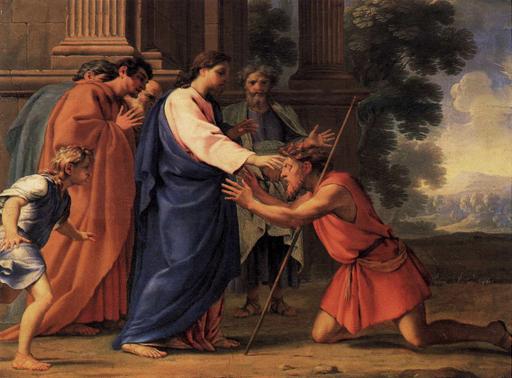
35 As he drew near to Jericho, a blind man was sitting by the roadside begging. 36 And hearing a crowd going by, he inquired what this meant. 37 They told him, “Jesus of Nazareth is passing by.” 38 And he cried out, “Jesus, Son of David, have mercy on me!” 39 And those who were in front rebuked him, telling him to be silent. But he cried out all the more, “Son of David, have mercy on me!” 40 And Jesus stopped and commanded him to be brought to him. And when he came near, he asked him, 41 “What do you want me to do for you?” He said, “Lord, let me recover my sight.” 42 And Jesus said to him, “Recover your sight; your faith has made you well.” 43 And immediately he recovered his sight and followed him, glorifying God. And all the people, when they saw it, gave praise to God.

In the name of Jesus. Amen.

Generally, when we let our imagination go wild, we like to be the heroes. Boys imagine hitting a grand slam in Game 7 bottom of the 9th two outs down by three, or they imagine they are the receiver who dives to catch the hail Mary as time expires to win the Super Bowl. Girls imagine they are Cinderella dancing the night away with Prince Charming, and getting engaged after he returns her glass slipper. Even when it comes to Bible stories, we like to imagine that we are Joshua toppling the walls of Jericho or David slaying Goliath or Elijah defeating the prophets of Baal.

In the two parts of today’s text – the Passion prediction and the healing of the blind man – the only hero is clearly Jesus, and He fully embodies the perfect love that was described in our Epistle reading (1 Co. 13:1-13). This is the third time Jesus explains to the disciples that He is going to Jerusalem to be betrayed, mocked, shamefully treated, spit upon, flogged, crucified, and raised from the dead. But the disciples don’t understand Jesus, the saying is hidden from them, and they could not grasp what Jesus said.

Still, Jesus’ love is on full display. Jesus is patient with and kind toward them. He is not irritated or resentful at their thick skulls. Jesus is going to Jerusalem and will endure all these things because His love does not insist on its own way. Instead, Christ submits to His Father’s will in perfect obedience.

By going to the cross, Jesus will bear all things. All the burdens, all the sins, all the transgressions, all the iniquities, all the wrongdoings, all the evil, all the brokenness of this fallen world – Jesus will bear all of it in His body (1 Pet. 2:24). He does it all for you. Jesus’ journey from His throne in heaven, down into your flesh. His fasting and temptation in the wilderness. His path through the lands of Israel with no place to lay His head (Lk. 9:58). His teaching, healing, casting out demons, forgiving, and restoring. His triumphal entry. His betrayal. His suffering. His death. His burial. His three day rest in the tomb. His resurrection. His ascension. And His continual rule and authority over all things is a journey of love for you.

Jesus’ entire work is directed outward. He didn’t need to do any of that to benefit Himself, and He doesn’t do it for His own, personal gain. He does it because He loves you. And this love of Jesus wasn’t based on your loveliness. It was based on the fact that the God the Father loves you and wanted to rescue you. So, Jesus, God the Son, loved you and did everything necessary to save you.

God hated seeing what sin and death had brought to His creation, so He did something about it by undoing sin and death by the death and resurrection of Jesus. Christ lived the life we were unable to live. He obeyed the whole will and Law of God that we were unable to obey. He took up His cross, endured punishment that you and I deserved, and gave up His dying breath. All of this is done for you.

Jesus does all of this with full knowledge. None of it surprised Him. Christ knew exactly what is going to happen to Him. And still, He goes and does all of this to love you with His perfect, pure love. 

Back in Lk. 9:51, we are told that Jesus had “set His face to go to Jerusalem.” In other words, Jesus is determined to do this loving thing for you. He was focused on redeeming creation, on getting there, and accomplishing it. He goes toward Jerusalem in love.

Day after day, Jesus gets closer to His goal until He arrives in the city of Jericho, which is about fifteen miles from Jerusalem. He’s close – about a day’s journey from the city. But Jesus isn’t in a rush. Sometimes, when you have to do things that you know are going to be unpleasant and painful, you just want to get it over with and put in your rearview mirror. Again, Jesus doesn’t do that. Instead, He paused along His way through Jericho.

Christ hears the blind man’s cry, “Son of David have mercy on me.” Jesus doesn’t say, “I’ve got more important things to do. I’m going to have mercy on you when I get to Jerusalem and go to the cross.” No. Our Lord stops.

The cry for mercy from any corner of His creation gets Jesus’ full attention. He commands that the blind man be brought to Him. Jesus asks him, “What do you want Me to do for you?” “Lord, let me recover my sight.” And in love, Jesus gives the man the mercy he desired. “Recover your sight; your faith has made you well.”

Jesus’ mission to be the Savior of all creation does not stop Him from pausing to give His mercy to the individual He meets along the way. He pauses and heals him.

Dear saints, Lent begins on Wednesday, and Lent is a good time for us to pause and consider all that God has done for us. Today, pause and ponder whom you are most like in this text. Again, we’re not the hero; we’re not Jesus. Instead, sometimes, we’re like the disciples who do not understand or grasp what God is doing for us and saying to us. Sometimes, even though God has plainly and clearly spoken, we are blind and don’t understand what God is doing.

Sometimes, we are broken like the blind man. Even though the blind man could not see with his physical eyes, he understands who Jesus is and what He has come to do. Despite his physical blindness, he has faith that Jesus can and will restore what is broken. So, when Jesus is present, he cries out for mercy. And Jesus gives him the mercy, restoration, and healing that he needed. Maybe, like the blind man, you look foolish to the world how you relentlessly call out to Jesus for His mercy.

Whom are you more like? It probably depends on the day, maybe even the moment.  Whether you don’t have any clue of what God is up to like the disciples or whether all you can do is cry out for mercy, the thing to do is follow Jesus.

Notice that even though the disciples don’t get all the things that God had said through Jesus and through the Scriptures, even though they are blind in their hearts and minds – what do they do? They go with Jesus. They follow Him to Jerusalem and the cross. The blind man, even though he could not see anything until Jesus gave him the sight he desperately wanted, what did he do? He followed too.

Whether you understand what God is up to or not, the conclusion is the same. Follow Jesus. Follow Him to the cross. No matter where you are in your journey through life, no matter how much you understand what God is doing, no matter how much you need from God, no matter how much God has already given you, follow Jesus to the cross.

Stay the course. And as you go with Christ, He will give you ample reasons to glorify God and give Him praise. Amen.

The peace of God, which surpasses all understanding, will guard your hearts and minds in Christ Jesus. Amen.

A Fresh Look – Sermon on Matthew 20:1-16 for Septuagesima Sunday

Matthew 20:1–16

1 “For the kingdom of heaven is like a master of a house who went out early in the morning to hire laborers for his vineyard. 2 After agreeing with the laborers for a denarius a day, he sent them into his vineyard. 3 And going out about the third hour he saw others standing idle in the marketplace, 4 and to them he said, ‘You go into the vineyard too, and whatever is right I will give you.’ 5 So they went. Going out again about the sixth hour and the ninth hour, he did the same. 6 And about the eleventh hour he went out and found others standing. And he said to them, ‘Why do you stand here idle all day?’ 7 They said to him, ‘Because no one has hired us.’ He said to them, ‘You go into the vineyard too.’ 8 And when evening came, the owner of the vineyard said to his foreman, ‘Call the laborers and pay them their wages, beginning with the last, up to the first.’ 9 And when those hired about the eleventh hour came, each of them received a denarius. 10 Now when those hired first came, they thought they would receive more, but each of them also received a denarius. 11 And on receiving it they grumbled at the master of the house, 12 saying, ‘These last worked only one hour, and you have made them equal to us who have borne the burden of the day and the scorching heat.’ 13 But he replied to one of them, ‘Friend, I am doing you no wrong. Did you not agree with me for a denarius? 14 Take what belongs to you and go. I choose to give to this last worker as I give to you. 15 Am I not allowed to do what I choose with what belongs to me? Or do you begrudge my generosity?’ 16 So the last will be first, and the first last.”

In the name of Jesus. Amen.

What is the greatest gift given in this parable?

At first glance, we think that it’s the denarius, that full day’s wage, handed to the workers who showed up last. But that’s the wrong answer. All the workers – those who were hired at the eleventh hour, the ninth hour, the sixth hour, the third hour, and right way at daybreak – they all get the same coin. It looks like the later you come, the greater the gift you receive. We think the only ones who don’t receive a gift are those who worked all day. They simply get what they had agreed to, what they bargained for – an honest day’s wage for an honest day’s work. But the denarius is not the greatest gift in the parable.

The greatest gift is a place in the vineyard. All of these workers – no matter what time of day they were hired – all of them started out in exactly the same place. They were all stuck in the marketplace with no prospects, no future, no income. None of them had anything until the master came to call them into his vineyard.

None of the workers got into the vineyard on their own. All of them knew they needed work to provide for their families. But they had no shot at that until the master called them into his vineyard. Before the master called them, they apparently didn’t even know there was a vineyard or how to get there, otherwise they could have gone to his house, knocked on the door, and asked for work. But that’s not what happens. Instead, the owner comes to them, seeks them, finds them, and promises to give them what they need. It’s the master who brings them all of them in. So, into the vineyard they all go – each at the time of day when the master called – not one moment before, not one moment after.

Back up just a bit and imagine the thought process of the workers hired first. They went to the marketplace because, in that part of the world in Jesus’ day (and still today), people who didn’t have normal, secure, regular jobs, they would gather at a certain spot in the marketplace in hope of being hired. Again, the people who were hired at the beginning of the day had nothing, no money, no job, no prospects. So, as the sun rises and as they march toward the vineyard, they’re excited about the master’s promise of an honest day’s pay for an honest day’s work. That promised denarius motivated them. Throughout the day, all of their work and toil and enduring all the heat and sweat was tolerable because that denarius meant life for each of them and for their families.

The only thing that spoiled it, the only thing made that denarius unappealing, was the fact that others also received the denarius. Seeing others get the same denarius was the only thing that robbed those first workers of their joy in the denarius. To say it bluntly: comparison is the thief or joy.

Imagine a company has two positions open. You apply and are given one of the positions, and you love everything about your new job. You like the environment, your coworkers, and $100,000 per year compensation. But then, you find out that the person hired for the other position – who is doing the same job, working the same hours, and has the same experience as you have – imagine finding out that person makes $101,000. How would that change your perception of your job and salary? If you’re selfish like me, I’m sure your attitude would change. You’d feel cheated. You’d complain. It’d ruin your whole perception of your new job. But here’s the thing: nothing has actually changed. Your paycheck didn’t diminish. The environment around you didn’t get worse. Nothing has been taken from you. You haven’t lost anything. The only thing that has changed is your perception. Someone else has gotten something that you don’t think they deserve. Repent.

Dear saints, God’s grace isn’t only for you. It is certainly given to you, but you aren’t the only one who gets or needs it. Please, please don’t be so foolish as to demand that God give you what you deserve because what you deserve is an eternity in hell. God doesn’t want to give you what you deserve. He wants you to be in His vineyard. And, yes, He has work for you to do there.

Look again at v. 12-15. When the workers hired first grumble about their denarius and all the hard work they did in the scorching heat, the master doesn’t fight or question their claim. He doesn’t diminish the work they have done. Not one bit. The only objection the master against their grumbling is that he’s being completely fair with them. His generosity doesn’t mean they were short-changed. The owner simply says, “If you don’t like my generosity, take what is yours and go. You’re free to leave my vineyard and go back to the marketplace.”

Dear saints, yes, this is a parable about working in God’s kingdom, and I titled this sermon “A Fresh Look” because we all need to be reminded that life in God’s kingdom does require work. God’s call to be a Christian is a call to much work. Jesus says, “If anyone would come after Me, let him deny himself and take up his cross and follow Me” (Mt. 16:24). That calling from your Savior is a call to work. But there is so much joy in your work in God’s kingdom. That’s not to say that all of the work is pleasant and easy.

Dear saints, there are many things in this world that require work, but the work itself is good. There is work, there is labor, there are difficulties involved in all good things. For example, being a parent is work – a lot of work, and even a lot of unpleasant work. Parents have to get up in the middle of the night, change poopy diapers, suck snot out of the noses of the babies. I don’t know anyone who thinks those things are pleasant or anyone who enjoys doing those things. But none of those things mean the baby isn’t a delight or a joy to be around. And there is blessing in doing them. People are happier and more content when they give of themselves and serve others. Yes, the work is its own reward.

Christian, you have been brought into God’s vineyard. A vineyard is a place where there is plenty of work to be done, but the purpose is not to produce grapes. Vineyards exist to produce wine which makes glad the heart of man (Ps. 104:14-15). Life in God’s kingdom is to live where work is done, but that work culminates in joy and feasting. The whole point of your work and labor and toil in God’s kingdom is to join God in producing joy.

Dear saints, you’re going to leave here and head back to your labor, back to your work, back to the heat and sweat and toil of your God-given vocations. But before you do, God invites you to His table to feast. Come and enjoy a foretaste of the feast to come. Come and receive the joy of receiving Christ’s Body and Blood given and shed for you for the forgiveness of all your sin. Come to the feast. Then, go. God still has vineyard work for you to do. Amen.

The peace of God, which surpasses all understanding, will guard your hearts and minds in Christ Jesus. Amen.

Location – Sermon on Luke 18:9-14 for the Eleventh Sunday after Trinity

Luke 18:9–14

9 He also told this parable to some who trusted in themselves that they were righteous, and treated others with contempt: 10 “Two men went up into the temple to pray, one a Pharisee and the other a tax collector. 11 The Pharisee, standing by himself, prayed thus: ‘God, I thank you that I am not like other men, extortioners, unjust, adulterers, or even like this tax collector. 12 I fast twice a week; I give tithes of all that I get.’ 13 But the tax collector, standing far off, would not even lift up his eyes to heaven, but beat his breast, saying, ‘God, be merciful to me, a sinner!’ 14 I tell you, this man went down to his house justified, rather than the other. For everyone who exalts himself will be humbled, but the one who humbles himself will be exalted.”

In the name of Jesus. Amen.

Most of you are familiar with the phrase, “The three most important factors in real estate are – location, location, location.” A house here in East Grand Forks would probably be triple the cost if you moved it to Los Angeles County. For some reason, want to live there. I’ll gladly take winter.

A similar thing could be said about sin. The three most important factors about sin are – location, location, location. To be clear, I’m not talking about where sin is committed geographically. Speaking a lie to a massive crowd of people is just as damning as lying to yourself in your own mind without ever moving your lips. By referring to sin’s location here, I’m talking about where the sin resides. Sin has a place. Either sin is on you, or sin is on Jesus, the Lamb of God who takes away the sin of the world (Jn. 1:29).

We have this wrong tendency to think of sin as something abstract and floating around somewhere. There is no sin outside of the one who is committing it. Sin starts in the heart. Jesus says, “Out of the heart come evil thoughts, murder, adultery, sexual immorality, theft, false witness, slander” (Mt. 15:19). A sinner isn’t simply a person who commits sins. All people, besides Jesus, commit sin. Being a sinner means to be a person who is outside of God’s fellowship, outside the kingdom of God, someone who belongs with the demons. That is why we need Jesus to be the Savior of sinners. He changes the location of the sin. He removes it from the sinner as far as the east is from the west (Ps. 103:12).

Now, with that in mind, let’s consider the parable, which is about as straightforward as it gets. We’re told that the audience is people who are sinners with sin residing in them but still trusted in themselves and their own righteousness while treating others with contempt. Jesus also gives a clear conclusion to the parable, “Everyone who exalts himself will be humbled, but the one who humbles himself will be exalted.” But to get a fuller sense of what Jesus is teaching here we need to set the picture of what is going on in the parable. The people who originally heard this would have been familiar with what goes on in the Temple, but we probably aren’t.

Two men went up into the Temple, which is God’s house (1 Kgs. 8:13, 27), and they go for a specific purpose – to pray and worship. In English, we typically think of prayer as an individual thing. Sure, we will pray the Lord’s Prayer and say grace before a meal with others. But normally we think of prayer as an individual thing and worship as a corporate, communal thing. But the people in Jesus’ day had one word for both prayer and worship. These two men go to the place of worship at the same time. What kind of service are they attending?

They would have been at the Temple for the atonement offering, which was the only service that took place every day in the Temple, and it occurred twice each day – once at dawn and again at three in the afternoon. The service would begin by the altar for sacrifice. An unblemished lamb was slaughtered, and its blood was sprinkled on the altar following a precise ritual.

This sacrifice was a reminder of how God covered the sin, nakedness, and shame of Adam and his wife by providing garments of animal skins after they fell into sin (Gen. 3:21). It showed that God would accept the death of another in place of the sinner. As the atonement lamb was sacrificed, certain prayers were offered with the sound of silver trumpets and cymbals. The people would sing a Psalm. A priest would go into the Holy Place where he would offer incense, praying that the sacrifice would be pleasing to God. Then, when the priest entered the Holy Place with that incense, the people would offer their private prayers to God.

But the Pharisee’s prayer directly contradicted everything that was happening around him in the Temple. He thanks God that he is acceptable because of who he is and who he is not, what he has not done and what he has done. His prayer in that context would be like coming here on Good Friday and praying, “God, I’m sure glad I’m not like all these sinners around me who need Jesus to die for their sins.” It’s utterly blasphemous.

But the tax collector’s prayer harmonizes with the service in at least two very specific ways. First, when the tax collector prays, “God be merciful to me, a sinner,” he isn’t using the normal word for ‘mercy.’ Many times in the Gospels, we hear people with sickness, disease, or other affliction cry to Jesus, “Have mercy” (Mt. 15:22, 20:31; Lk. 18:38-39). That’s always a good prayer to ask God for blessings you haven’t earned and the relief that you don’t deserve. But the tax collector’s prayer uses a different word. We could translate his prayer as, “God, atone me. God, reconcile me. God, make me what I should be.” That’s the first way his prayer harmonizes with the service. He is praying that the atonement that is taking place there in the Temple and the sacrifice being offered would do what God had promised it would do and remove his sin from him (Lev. 4:35).

Second, his prayer harmonizes with the service because this tax collector recognizes that he is the sinner who needs atonement. He needs to be reconciled. He needs to have his sin, his shame, his guilt removed. Again, that’s precisely what that service was pointing to. That is what the tax collector looked to, and that is why he went down to his house justified.

Now, there is a danger in this parable. We know that the really good, moral Pharisee did not go home justified, but this sinful tax collector did. The danger that can arise for us then is to think that everything about the Pharisee is bad. Be careful with that. It is good and right to not be extortioners, unjust, adulterers. It is good to fast and give tithes. That is all good stuff. There is another side to the coin of the Pharisee’s prayer. We might be tempted to pray, “God, I thank You that I am not like other men, self-righteous, pretentious, holier-than-thou types, or even like this Pharisee. I’ve given You my heart, dedicated my life to You, and made You my Lord.” Do you see what that does? It locates our eyes off of Jesus – the One who atones for our sin (1 Jn. 2:2).

The location of your sin matches where you look. If you look to yourself, your sin is on you. If you look to Christ, your sin is gone, defeated, eternally removed.

Let me close with an analogy: Imagine you had to cross some terrifying span. Far below at the bottom of that span are all the things you fear most – snakes, rats, lava, rough seas, or sharks. You fill in whatever is scariest. But there is a bridge that spans that gap. What would you look to for confidence in crossing that gap? You’d look to the bridge. You’d see if it was well-built, sturdy, and strong. You wouldn’t look inward to see if you have enough confidence in the bridge. And you build confidence in the bridge by looking at the bridge.

So, dear saints, where are you looking? Are you looking toward things you have done – either good works or your own humility? If so, you should have no confidence whatsoever.

Look to Jesus. His sacrifice, His blood, His death, His resurrection is enough. Looking there, you go to your house justified by God’s sure and certain declaration. Amen.

The peace of God, which surpasses all understanding, will guard your hearts and minds in Christ Jesus. Amen.

The Gift of Time – Sermon on Luke 16:1-13 for the Ninth Sunday after Trinity

Luke 16:1–13

1 He also said to the disciples, “There was a rich man who had a manager, and charges were brought to him that this man was wasting his possessions. 2 And he called him and said to him, ‘What is this that I hear about you? Turn in the account of your management, for you can no longer be manager.’ 3 And the manager said to himself, ‘What shall I do, since my master is taking the management away from me? I am not strong enough to dig, and I am ashamed to beg. 4 I have decided what to do, so that when I am removed from management, people may receive me into their houses.’ 5 So, summoning his master’s debtors one by one, he said to the first, ‘How much do you owe my master?’ 6 He said, ‘A hundred measures of oil.’ He said to him, ‘Take your bill, and sit down quickly and write fifty.’ 7 Then he said to another, ‘And how much do you owe?’ He said, ‘A hundred measures of wheat.’ He said to him, ‘Take your bill, and write eighty.’8 The master commended the dishonest manager for his shrewdness. For the sons of this world are more shrewd in dealing with their own generation than the sons of light. 9 And I tell you, make friends for yourselves by means of unrighteous wealth, so that when it fails they may receive you into the eternal dwellings.

10 “One who is faithful in a very little is also faithful in much, and one who is dishonest in a very little is also dishonest in much. 11 If then you have not been faithful in the unrighteous wealth, who will entrust to you the true riches? 12 And if you have not been faithful in that which is another’s, who will give you that which is your own? 13 No servant can serve two masters, for either he will hate the one and love the other, or he will be devoted to the one and despise the other. You cannot serve God and money.”

In the name of Jesus. Amen.

The scam was over. His gig had been discovered. The pink slip was coming because this manager’s Ponzi scheme had been reported to his boss. Now, the rich man was going to cut ties with his crooked manager. But rather than sitting around and stewing about how everything had gone wrong, instead of denying the charges, fighting the accusations, or making excuses, the manager gets busy. His paychecks had dried up, but the manager recognized that he had something much more valuable than his salary. He had time, and he was going to use that time to his advantage.

This scoundrel manager scrambles to make sure that he’ll still have a bite to eat and a place to stay now that the gravy train had made its last stop. He calls in all the people who owed the rich man a debt. We only get to hear two of the conversations, but all of them get called in, and you can imagine those debtors were nervous and afraid as they are brought into the office one by one. No one likes calls from the debt collector.

The manager knows their fear, and he uses it to his advantage. He asks all of the debtors, “How much do you owe? Ufda. Yes, I can see why you’re worried about that. Well, I have some good news for you. I’m going to make things easier. Take that debt, and lower it.” And all these debtors leave the office with a lighter burden, feeling better about their own future, and extremely grateful toward this soon-to-be jobless manager. And he will go home at the end of the day with no job and no prospects but a lot of new friends. Of course, those friends were gotten by deception and cheating, but they had become his friends.

Now, this is probably Jesus’ most confusing parable. It’s one of only a couple times that Jesus holds up someone who does bad things as an example. Another one comes later in Luke 18:1-8 where Jesus tells the parable of the unrighteous judge who grants justice to the widow who keeps badgering him for justice. In that parable, Jesus teaches that bad people will sometimes do the right thing. But here, Jesus teaches that bad people do bad things and sometimes get good results – at least for themselves.

To help make sense of it, let’s try an analogy. If I said, “Barry Bonds hit a lot of home runs,” what would you think of that statement? Honestly, it doesn’t matter what you think because it’s true. Bonds stands alone at the top of list of all baseball players in history for hitting the most home runs. It’s undeniable. Of course, the reason he hit a lot of his home runs is that he cheated by taking steroids, but he still hit more baseballs over the fence than anyone else. But that doesn’t, necessarily, mean that other players who hit lots of home runs are cheaters. Managers will still encourage their players to hit the ball far and hard even though some do it by cheating. Jesus wants you, Christian, to be shrewd. That doesn’t mean He want you to cheat. But He does want you to be shrewd in ways that invest in the kingdom of God.

We still probably wonder, “Why wouldn’t Jesus use a different parable with a character who is more respectable to teach us to be shrewd?” Honestly, I don’t know the answer. From the rest of the Gospels, it’s clear that Jesus isn’t in favor of theft and cheating. He doesn’t approve of this guy’s stealing and dishonesty (see Mt. 5:17-37). The manager is a crook, thief, and scoundrel. But Jesus does want us Christians to imitate and emulate this manager’s shrewdness. Simply stated, it all boils down to these three ways he is shrewd: One, the manager recognizes who he is. Two, the manager recognizes he temporarily has at his disposal things that will not last or endure. And three, he knows how to use things that are slipping away to secure a future for himself. Let’s dissect each of those.

First, Jesus wants us to be shrewd like the manager and rightly recognize who we are. When the manager heard that his pink slip was coming, he recognizes that he’s about to lose all of his income and that there’s no one to blame except himself. But more importantly, he recognizes that he either can’t or won’t do certain things. He isn’t strong enough to work in construction, and he’s too ashamed to stand on a corner holding a cardboard sign with a sad story which will move people in such a way that they give him money. The guy is brutally honest with himself about himself and his situation.

Jesus wants us to have that same shrewdness. Christ wants us to recognize who we are as sinners. We do this here every week with our confession of sins. We confess that we are, by nature, sinful and unclean and have sinned in thought, word, and deed. We confess that we need to flee to God’s infinite mercy which He freely gives for the sake of Christ’s death and resurrection. It is good and right that we do that here and receive Jesus’ forgiveness which He gives to all of us through the absolution (Jn. 20:23). And it is good to confess our sins each and every day and hear God’s sure, certain promise of forgiveness and mercy.

Second, Jesus wants us to be shrewd like the manager by recognizing what does not last. The manager’s career was fleeting. He’s in the process of being fired, and because his career doesn’t last, his income isn’t a stable fixture either. The only thing he has is time, but that won’t last either. Eventually, the rich man will send guards to bring the paperwork back to the headquarters. So, the manager acts quickly. He sees that every second is a gift, so he uses every precious second. This manager shrewdly recognizes that time is a lot more valuable than money.

Dear saints, time is always short because time is always a gift. We take time for granted, but we strive for money. This is backwards. If you found a $200 recurring charge on your bank account had no idea what that $200 was going toward, you would investigate. But how much time do we waste each day or week or month and barely even notice?

Your income of time doesn’t and can’t increase. The amount of time everyone has is the same. You can’t save time to use later in your retirement. Still, time flies away, and we think little about it. The gift that you always have the same amount of is time. So, what are you doing with it? In the parable, the rich man realizes how intelligent and shrewd this manager was in his use of the gift of time. The manager used his time to secure a future for himself by treating the time he had as something incredibly precious. Jesus wants us to do the same. Which leads us to the third way Jesus wants us to be shrewd like the manager and that is to use things that are fleeting – especially the gift of time – to our advantage.

You don’t have any guaranteed time. None at all. Every second you are breathing in and out is a gift. What are you doing with that gift? Are you investing your time in things that last like hearing God’s Word, growing in your faith, training your children, and building up your brothers and sisters in Christ? Stop acting that you are in charge of your life. Be reconciled to God now. If you have accounts to settle, if you have something to confess to God or to someone else, now is the time to do that. If you have something important to do, today is the day for that very thing. The only things that will last are what God says will last. Everything else will fail.

Jesus wants us children of light to make friends for ourselves by means of ‘unrighteous wealth,’ in other words, Jesus wants us to make friends by means of things that will not last, by means of things that will fade away. A time will come when you have to speak to the Master and explain what you have done with the temporary gifts that He has given to you.

Dear saints, as you see everything else fail and fade, also see that the cross is not going away. Jesus’ hands are still wounded for you. Christ’s blood has still paid for all of your life. God’s will for you in Christ Jesus is that you be reconciled to God. Jesus is the same today, yesterday, and forever (Heb. 13:8). Time doesn’t touch Jesus, so your time with Him cannot touch you. Invest in Him. Put your time in Him, not in things that fail.

You, child of God, be shrewd. Pour yourself in lasting things. Confess, forgive, love, and receive the promises of God knowing the time is precious. Invest in what lasts, and you will reap a rich and lasting reward because Christ and His kingdom will never fail. Amen.

The peace of God, which surpasses all understanding, will guard your hearts and minds in Christ Jesus. Amen.

Learning – Sermon on Luke 6:36-42 for the Fourth Sunday after Trinity

Luke 6:36–42

36 “Be merciful, even as your Father is merciful.

37 “Judge not, and you will not be judged; condemn not, and you will not be condemned; forgive, and you will be forgiven; 38 give, and it will be given to you. Good measure, pressed down, shaken together, running over, will be put into your lap. For with the measure you use it will be measured back to you.”

39 He also told them a parable: “Can a blind man lead a blind man? Will they not both fall into a pit? 40 A disciple is not above his teacher, but everyone when he is fully trained will be like his teacher. 41 Why do you see the speck that is in your brother’s eye, but do not notice the log that is in your own eye? 42 How can you say to your brother, ‘Brother, let me take out the speck that is in your eye,’ when you yourself do not see the log that is in your own eye? You hypocrite, first take the log out of your own eye, and then you will see clearly to take out the speck that is in your brother’s eye.”

In the name of Jesus. Amen.

Certain words and phrases get used so often that we easily forget what they actually mean. In Christian circles, one of those words is ‘disciple.’ What does ‘disciple’ mean? Honestly, it can mean a lot of things. Maybe you hear that word and think of the twelve guys Jesus called to follow Him. That’s good. They were the twelve disciples. It also isn’t wrong to understand ‘disciple’ as an alternate term for ‘Christian.’ Totally legit. There are all sorts of books, podcasts, videos, and ministries today that talk about Christian ‘discipleship’ and they basically use that term to refer to a journey of spiritual growth. Sure, that’s fine too. But what is a disciple?

The Greek word that gets translated as ‘disciple’ simply means ‘one who learns from another,’ so let’s shorten that to this – a disciple is a ‘learner.’ So, when Jesus says in Jn. 8:31, “If you abide in My Word, you are truly My disciples,” He is telling us to keep learning from Him as we read, hear, and confess the Scriptures. When Jesus says in Jn. 13:35, “By this all people will know that you are My disciples, if you have love for one another,” He is saying the world will have evidence that we have learned and are learning from Him by our love for one another (1 Jn. 2:3, 3:23).

Well, today Jesus gives us a hint at how long our training as His disciples and learners will be. He says to us, “A disciple/learner is not above his teacher, but everyone when he is fully trained will be like his teacher”(Lk. 6:40). Your education and learning from Jesus will last until you are like Him. So, don’t worry about throwing a graduation party. God Himself will throw one for you in the Resurrection and the life of the world to come. 

This Gospel reading is from what is called Jesus’ “Sermon on the Plain,” and He teaches some hard and difficult lessons for us learners, disciples, and Christians. These lessons are all intended to make us like Him. “Be merciful even as your Father is merciful. Judge not. Condemn not. And give abundantly.” But before we get into these lessons, I’d like to briefly point out that Jesus has been teaching us those same lessons today through His Word in our liturgy even though you might not realize it.

There’s a great analogy for this in the movie “The Karate Kid,” which is about a high school-aged boy, Daniel, who moved to a new town where he has no friends. He’s an outsider who keeps getting beat up by a bunch bullies. He asks Mr. Miyagi, the handyman for his apartment complex, to teach him karate so he can defend himself. So, Mr. Miyagi tells him to show up early. Daniel arrives, and Miyagi has him wax all of his vintage cars with a certain technique – “Wax on. Wax off. Breathe in through nose, out through mouth. Wax on. Wax off.” Daniel spends the whole day waxing those cars, and Miyagi tells him to come back the next day and has Daniel, “Sand the floor,” with specific motions and breathing. Again, it takes Daniel the whole day to sand the floor. The next day, it was, “Paint the fence.” The fourth day, “Paint the house.” Daniel finishes after sunset and is fed up. He yells that he quits and starts to storm off in anger and frustration because he been worked to the bone but hasn’t learned any karate.

Miyagi calls him back and tells Daniel, “Show me wax on, wax off. Show me sand the floor,” and the other moves. Then Miyagi, without any warning, starts throwing punches at Daniel, and each of those moves are different ways to block the punches. Finally, Miyagi goes berserk throwing all these punches and kicks at Daniel, and he blocks all of them using the moves he instinctively learned doing those tasks. Miyagi stops and bows. Daniel suddenly realizes that he’d been learning karate the whole time he was waxing, sanding, and painting. Our liturgy is doing the same thing Miyagi was doing for Daniel – it teaches us the major lessons we need to train our spiritual instincts as learners and disciples of Jesus.

Today, Jesus teaches us, “Be merciful, even as your Father is merciful. Judge not. Condemn not.” We come here each Sunday and confess our sins then sing, “O God the Father in heaven; O God the Son, Redeemer of the world; O God the Holy Ghost, true Comforter, have mercy upon us.” And then, we hear the absolution. That is training us to be merciful, even as our Father is merciful. It might feel like we’re just mindlessly reciting or singing the same words week after week, but we are learning how God is merciful to us so we can be merciful to others.

Even if we are just going through the motions without much thought or sincerity, God is still teaching us how merciful He is by proclaiming His forgiveness. The liturgy is training us so when people sin against us and hurt us and then offer insincere, half-hearted apologies, we remember how God has forgiven us even when we were insincere and didn’t feel particularly guilty. 

The liturgy trains our spiritual instincts beyond the lessons Jesus teaches in this text. We hear God’s Word and learn to say it back to Him and to the world when we confess our faith using the Creeds. The liturgy teaches us how to pray in good times and in bad times. Our liturgy and hymns teach us who God is and how He is toward us to strengthen our faith toward Him and our love toward one another. When our service closes with the benediction and doxology, we are reminded that we have been in God’s gracious presence, and He dismisses us with His abundant blessings as we go from this place singing His praise.

Yes, of course, there are going to be weeks where we might simply be going through the words and actions of the liturgy. That’s going to happen. But I would strongly encourage you to do your best each week to slow down, pay attention, think about what you are doing, and consider why we are doing what we are doing. God, through His Word in our liturgy, is working on you to prepare you for the spiritual battles you face throughout your life.

I could go on and on about the different things Jesus uses in the liturgy to teach us, but I want to close with one more from today’s text. In this text, Jesus teaches us, “Give abundantly.” We bring our tithes and offerings to God, we put them into the plate, and God showers the gifts of His Word and teaching on us. He gives us His mercy and grace. He gives us a family of brothers and sisters in Christ. He gives us His full attention as we pray and ask for His help and His blessing. God gives and gives and gives so that our lap is overflowing.

Dear saints, you cannot out-give God. Because of what Jesus has done for you, because He has suffered, shed His blood, and died for you, you have received abundant, overflowing, eternal treasures. God has done that for you throughout your entire life. He has done it today. And, if Christ tarries, He will be here to do that again for you next week as well. God’s giving knows no end. Because of God’s mercy freely given to you, you also can be merciful and giving toward others. God even invites you to test Him in this. In Malachi 3:6-12, God says, “Bring in the full tithe and watch what I will do. I will open the windows of heaven for you and pour down for you a blessing until there is no more need.”

Dear saints, you have had a forest of logs removed from your eye by the grace of God given because of Christ. May Christ continually teach us this through His Word, and may we be humble enough to continually learn from Him as we are made to be merciful and giving like He is. Amen.

The peace of God, which surpasses all understanding, will guard your hearts and minds in Christ Jesus. Amen.

Now & Not Yet – Sermon on 1 John 3:1-3 for the Fourth Sunday of Easter and Confirmation Sunday

1 John 3:1–3

1 See what kind of love the Father has given to us, that we should be called children of God; and so we are. The reason why the world does not know us is that it did not know him. 2 Beloved, we are God’s children now, and what we will be has not yet appeared; but we know that when he appears we shall be like him, because we shall see him as he is. 3 And everyone who thus hopes in him purifies himself as he is pure.

Alleluia! Christ is risen!
He is risen indeed! Alleluia!

In the name of Jesus. Amen.

We live in a noisy world. On any given day, all sorts of things are constantly trying to grab your attention. We get dings and vibrations and taps that let us know who sent a message, what news story is breaking, or who liked that thing you posted. If you have to spend even ten minutes in a waiting room or a restaurant, you’ll find televisions turned to a game or news channel with the constant crawl of information that isn’t important enough, at least at that moment, to be on the main part of the screen. You’re watching the news about what’s going on in the Middle East and get the latest OJ Simpson’s death. Or you’re watching the NBA playoffs and learn about some guy’s hot take on what the Vikings are going to do in the first round of the NFL draft. And on and on it goes.

Now, this isn’t a sermon about how pointless and exhausting this barrage of information is. It’s just an acknowledgement of the conditions in which we live. Our attention is being constantly pulled in a myriad of directions, and all sorts of things shout at you, “Pay attention to me!” Well, this epistle reading (1 Jn. 3:1-3) is calling for your attention. In fact, it’s commanding you to pay attention. So, for the next few minutes, don’t be distracted, don’t be pulled, don’t be thinking about what’s going to happen this afternoon or this week or next summer. Right now, God, through His holy Word, calls you to focus and see. See this.

See the kind of love the Father has given to us. It is the kind of love that calls you, believer, a child of God. It is a love that calls all y’all, Christians, children of God. That is who you are – a child of God. Look around at the believers surrounding you here today, people whom you love and who love you, see that they through faith are also children of God.

See the kind of love that turns sinners and enemies of God into children. See the kind of love that isn’t earned or deserved. See God’s love for you that is demonstrated in that while we were still sinners, Christ died for us (Ro. 5:8). This is the purest kind of love. It’s God’s love that is not based on the lovableness of the individual. It’s a love that is freely given because, in spite of our unloveliness, God determined to seek your highest good and make you His child.

God’s own child, that is what you are, believer. That is what God has called you, and what God says creates reality. Everything in this world – including your own thoughts, opinions, and experiences – will try to convince you otherwise. It will attempt to get you to believe this isn’t true. Don’t listen to any of that. See. Behold. God’s love has made you His child.

Christian, God’s love has given you a new birth. In his Gospel, John says this explicitly. To all who did receive Jesus, those who believe in His name, He gives the right to become children of God (Jn. 1:12), and this right came when you were born again of water and the Spirit (Jn. 3:3, 5-6).

You confirmands, you have this new birth as a child of God. Logan, you received this new birth when you were Baptized on July 3rd, 2011 at Bigwoods Lutheran Church in Bigwoods, MN. Brayden, you were born again as God connected His Word to water on November 16th, 2013 at St. Henry’s in Perham, MN. Maddie, same place, but for you on April 16th, 2011 that was when and where you were born as a child of God. Brady, July 7th, 2013 right there at that font, you became a child of God. And Asher, same font, on November 25th2012, God declared that you are His child. The rest of you here, I’m sorry, but I don’t have your exact information in front of me.

This command to see this kind of love is in the present tense. That means it is a command that you always and continually see this kind of love. That love is to color everything else in your life. Keep holding on to that love because it is the most precious thing you could ever have. That love makes you God’s children now. Right now. What will we children of God be when we grow up? We don’t know, not yet.

John admits that even he doesn’t know exactly what glorious things are in store for us children of God. Think of that. John had seen some glorious things. He saw Jesus’ miracles and transfiguration. John saw the empty tomb. It was so glorious that he kept bragging about the fact that he outran Peter and was the first disciple to see it (Jn. 20:2-5, 8). The evening of Jesus’ resurrection, John had seen Jesus’ resurrected hands, feet, and side (Jn. 20:19-20; Lk. 24:36-43). As best as we can tell, John wrote this epistle after he had seen the vision of recorded in Revelation. That means John had seen Jesus clothed in a robe with a golden sash. He saw Christ’s eyes like a glorious flame of fire. John saw Jesus’ face shining like the sun in full strength (Rev. 1:13-16). And still John says here, “I don’t know what we children of God will grow up to be. I haven’t seen it yet because it hasn’t appeared” (1 Jn. 3:2). “But,” John says, “But we know that when Jesus appears we will be like Him, because we shall see Him as He is.” 

You confirmands and everyone here today, it can be dangerous to look to the past. And it can be troubling to think about the future. If you do look to the past, look at it through the lens of being God’s beloved child. When you consider your present, keep this command and see the constant love God has for you. When you look to the future, have in mind that you, through faith, are a child of God. And keep longing and hoping for that moment when Christ, your Savior, returns knowing that then you will be like Jesus.

That faith, that hope is what makes you pure – pure as Jesus is pure. God wants to orient you to the present reality that you are His child. Because of His love, you have a seat at His table where He gives you His Body to eat and His Blood to drink for the forgiveness of all your sin. You have a seat at His table. Child of God, as you wander through this world, know that you belong among God’s family. Welcome home, children of God. Amen.

Alleluia! Christ is risen!
He is risen indeed! Alleluia!

The peace of God, which surpasses all understanding, will guard your hearts and minds in Christ Jesus. Amen.

The Fight – Sermon on Matthew 4:1-11 for the First Sunday of Lent

Matthew 4:1–11

1 Then Jesus was led up by the Spirit into the wilderness to be tempted by the devil. 2 And after fasting forty days and forty nights, he was hungry. 3 And the tempter came and said to him, “If you are the Son of God, command these stones to become loaves of bread.” 4 But he answered, “It is written,

“‘Man shall not live by bread alone, 
but by every word that comes from the mouth of God.’”

5 Then the devil took him to the holy city and set him on the pinnacle of the temple 6 and said to him, “If you are the Son of God, throw yourself down, for it is written, 

“‘He will command his angels concerning you,’ 

and 

“‘On their hands they will bear you up, 
lest you strike your foot against a stone.’” 

7 Jesus said to him, “Again it is written, ‘You shall not put the Lord your God to the test.’” 8 Again, the devil took him to a very high mountain and showed him all the kingdoms of the world and their glory. 9 And he said to him, “All these I will give you, if you will fall down and worship me.” 10 Then Jesus said to him, “Be gone, Satan! For it is written,

“‘You shall worship the Lord your God 
and him only shall you serve.’”

11 Then the devil left him, and behold, angels came and were ministering to him.

In the name of Jesus. Amen.

Our Old Testament and Gospel readings today both record the devil coming to tempt. The first temptation was in the perfection of Eden and was aimed at Eve and Adam. The second was aimed at Jesus who was alone in the wilderness. In the Garden, Satan succeeded, and in the wilderness, he failed – and failed miserably. Now, in the past, we’ve considered how both of those temptations are similar and follow the pattern that the devil uses with us.

The devil is a one trick pony who tries to get Eve, Adam, Jesus, and you to doubt God’s Word. In the Garden, the devil asks, “Did God really say?” And when he is in the wilderness with Jesus, the devil starts his temptations with, “If you are the Son of God…” Remember, at Jesus’ Baptism, God the Father clearly said, “This is My beloved Son,” so the devil is trying to cast doubt on God’s Word again. He does the same thing In the temptations he throws at you. Now, this is extremely helpful to know and helps us fight against sin. But there is a very important difference between the temptations Satan lobs at Adam, Eve, and Jesus and the temptations he hurls at you. The difference, mainly, lies in the devil’s goal. Think through this for a minute.

In the Garden, the devil only needed to get Adam and Eve to sin once. One sin would rip all of humanity them from perfection and holiness and plunge them into fallenness and corruption. One sin and Satan figured he could stop working and retire to Arizona or Florida. But he was wrong. God completely upended the devil’s plan and promised to send the Seed of the woman to crush Satan’s head (Gen. 3:15). So, with his plans thwarted, the devil had to continue to tempt all people while he waited for that Savior to be born.

When Jesus entered creation, the devil again saw his chance for an early retirement. Here was that long-promised Seed of the woman. If he could just get Christ to commit one sin, then Jesus couldn’t be the Savior of all humanity. So, the devil waited until he thought the moment was ripe. After Jesus had fasted for forty days and nights, the devil came with these three temptations that he aimed at the second Adam (Ro. 5:14; 1 Cor. 15:45).

Do you see the difference? In the Garden with Adam and Eve but especially in the wilderness with Jesus, all it would take is one sin and the devil’s goal would be accomplished. Now, it wasn’t possible for Jesus to sin; He’s God and God cannot sin. But, hypothetically, if Jesus had sinned, there would be no Savior and no reconciliation with God. No mercy. No grace. No forgiveness. But, dear saints, that is not Satan’s goal when he tempts you. The devil’s goal is not to get you to sin once. No, he has to keep coming after you.

Because Jesus did not sin, the devil needs to continually tempt you – day after day, moment after moment. He can’t leave you alone; he has to keep pestering and tempting you. Even though you were born into the sin of your first parents, Jesus has rescued you by His perfect obedience. Now through faith, the devil does not own you; Jesus does. Christ has lived perfectly and has been tempted in every way as you are, but He did it without sin (Heb. 4:15). Jesus kept the Commandments in your place and credits His obedience to you through faith.

The day is coming when the devil will no longer be able to tempt you, but that day is not yet. So, the devil continues to work on you with his temptations, and you have to fight with all the resources God has given to you. Eph. 6:10-18 details the armor that God has provided for you – the belt of truth, the breastplate of righteousness, the shoes of the Gospel of peace, the shield of faith, the helmet of salvation, and the sword of the Spirit which is the Word of God. And remember when you read that passage, you are called to take up that armor and pray. Stand protected and call in the heavenly reinforcements to fight for you. God will send His holy angels to fight back against the devil on your behalf.

This is just an aside, but that is another difference between Jesus’ temptation and yours. Our Lord faced those temptations completely on His own. The angels only came to minister to Him after He resists the temptations and wins. You always have the holy angels assisting you in every moment and temptation. 

Today, you should recognize that the devil is going to be after you constantly to try to get you to fall into temptation and sin to draw you away from Jesus. But even knowing this offers a key strategy to help you in the fight.

Adam and Eve’s fall was instant. But because you are saved and bought by the blood of Jesus, the devil is going to try, little by little, to get you to slowly slip away from the faith. For example, the devil isn’t going to tempt you to blaspheme God; he knows better than that. You aren’t going to just curse God. But the serpent will tempt you to skip church or your family devotions. Satan is going to work, little by little, to harden your conscience toward sin. And this means, dear saints, you need to be actively working to soften your conscience. This is difficult, painful work, but it is work you need to do. Here’s how you go about that.

We’ll use the 5th Commandment as an example. The 5th Commandment, “Thou shalt not kill,” and the Small Catechism’s explanation, “We should fear and love God so that we do our neighbor no bodily harm nor cause him any suffering but help and befriend him in every need.” Now imagine your conscience has a 5thCommandment thermometer. There are degrees by which the 5th Commandment is broken. Genocide would be way up at the boiling point. A little below that would be mass murder, then murder, then hitting and physically harming your neighbor. Way down at the bottom would be anger because when Jesus explains the 5th Commandment, He equates anger with murder (Mt. 5:21-22). But anger doesn’t physically harm others like murdering or even hitting them does. Let me be clear, both are sin; both need repentance and forgiveness because they both break the 5th Commandment.

Now think about where your conscience registers guilt because of your thoughts, words, and deeds somewhere on that 5th Commandment thermometer. Maybe you don’t think twice about being angry in your heart because you figure everyone does it and that guy really was a jerk. But you wouldn’t go grab a baseball bat and hit him. So, the devil isn’t going to tempt you to do that sort of thing. Instead, what the devil is going to do is try to raise the temperature of your conscience just a bit. He’s going to try to get you to break the 5thCommandment with more anger or holding on to that grudge a little harder. Once the temperature of your conscience acclimates to that level of sin, Satan can graduate you to the baseball bat.

What you need to do, dear saints, is stop excusing your anger. Recognize and confess it for the sin that it is. Let go of that anger and continually soften your conscience to the working of the Holy Spirit. Think through all of the Commandments like this. Recognize where your conscience registers sin and take that sin to Jesus. Confess it for the sin that it is and hand it over to the Lamb of God who takes away that sin and nails it to the cross.

And know this. The softer your conscience becomes, the more you will feel your sin. Real sanctification and actually growing in holiness is going to make you feel more and more sinful and cry out like Paul does in Ro. 7:24, “Wretched man that I am! Who will deliver me from this body of death?” The one who will rescue you is your great high priest. He can sympathize with your weakness because He was tempted in every way as you are, yet without sin (Heb. 4:14). He invites you now to come with confidence, right here, to His throne of grace. Here you will find mercy and grace freely given to you in Jesus’ Body and Blood which will continue to strengthen you for the fight against the devil’s temptations. And as you fight, remember that God is faithful and will not let you be tempted beyond what you can bear. He has promised to provide the way of escape (1 Cor. 10:13). Amen.

The peace of God, which surpasses all understanding, will guard your hearts and minds in Christ Jesus. Amen.