
Where – Sermon on John 6:1-15 for the Fourth Sunday of Lent

John 5:1-15

1 After this Jesus went away to the other side of the Sea of Galilee, which is the Sea of Tiberias. 2 And a large crowd was following him, because they saw the signs that he was doing on the sick. 3 Jesus went up on the mountain, and there he sat down with his disciples. 4 Now the Passover, the feast of the Jews, was at hand. 5 Lifting up his eyes, then, and seeing that a large crowd was coming toward him, Jesus said to Philip, “Where are we to buy bread, so that these people may eat?” 6He said this to test him, for he himself knew what he would do. 7 Philip answered him, “Two hundred denarii worth of bread would not be enough for each of them to get a little.” 8 One of his disciples, Andrew, Simon Peter’s brother, said to him, 9 “There is a boy here who has five barley loaves and two fish, but what are they for so many?” 10 Jesus said, “Have the people sit down.” Now there was much grass in the place. So the men sat down, about five thousand in number. 11Jesus then took the loaves, and when he had given thanks, he distributed them to those who were seated. So also the fish, as much as they wanted. 12 And when they had eaten their fill, he told his disciples, “Gather up the leftover fragments, that nothing may be lost.” 13 So they gathered them up and filled twelve baskets with fragments from the five barley loaves left by those who had eaten. 14 When the people saw the sign that he had done, they said, “This is indeed the Prophet who is to come into the world!” 

15 Perceiving then that they were about to come and take him by force to make him king, Jesus withdrew again to the mountain by himself.

In the name of Jesus. Amen.

Maybe you’re like me and hate tests. I thought one of the greatest benefits of finishing my schooling was that I wouldn’t have to take any more tests. Ha! Kids, I’m sorry to burst your bubble, but if you think that the end of school means the end of tests, you’re wrong. Life is full of tests. Sure, those tests aren’t turned in to be corrected with a red pen, recorded in a book, and reflected on a report card. But there are plenty of tests throughout your life.

Specifically, God gives tests. Like it or not, God regularly gives you tests. 1 Peter 4:12 says that you should not be surprised when fiery trials come to test you. Next week, we’ll consider Gen. 22:1-14 where God tells Abraham to take his beloved son, Isaac, and offer him as a burnt offering. When Heb. 11:17 comments on that event, it says that God was testing Abraham.

Listen to these verses from James 1 because they beautifully and clearly tell us what God is doing when He gives us these tests. “Count it all joy, my brothers, when you meet trials of various kinds, for you know that the testing of your faith produces steadfastness. And let steadfastness have its full effect, that you may be perfect and complete, lacking in nothing” (Jam. 1:2-4). James goes on to say later in that chapter, “Blessed is the man who remains steadfast under trial, for when he has stood the test he will receive the crown of life, which God has promised to those who love him” (Jas. 1:12).

So, Scripture is clear that, when God gives these tests, it’s never to see if we can pass the test. God is not testing us because He needs to find out information. God isn’t up in heaven thinking, “I wonder if he’s a good enough Christian,” or, “I wonder if she really trusts Me. I’d better give a test.” No! God is not sitting up in the clouds trying to figure out if a student has learned enough. God knows everything, and He doesn’t need to put your scores in a grade book.

Instead, God tests us to produce endurance and steadfastness in us. God’s testing molds and shapes us. Those tests move us toward completion. They bring about endurance, character, and hope (Ro. 5:3-5). In other words, the tests God gives are for your benefit. Through those tests, God is stretching you and strengthening your faith.

Here in John 6, Jesus tests Philip by asking, “Where are we to buy bread, so these thousands of people may eat?” (Jn. 6:6). Again, Jesus isn’t testing Philip because it’s been a while since He recorded a score under Philip’s name. Jesus isn’t using this test to set up Philip for failure. Instead, Jesus is testing Philip to bring something about for Philip. Jesus wants to produce something in him, to work in him. When Jesus wants to do something in a person and produce something in a person, He does it perfectly.

It would be verydangerous for us to think that Jesus is trying to get Philip to fail and fall into sin. Instead, Jesus tests Philip to bring something about in Philip. And it’s clear and simple to see what Jesus wants to produce in Philip, “Hey Philip, where are we going to buy bread for these folks?” And Philip responds, “Money will not help in this situation.” That’s the thing Jesus wanted to produce in Philip. Jesus wanted Philip to know that money cannot feed this crowd. Jesus wanted Philip to know that money isn’t always the solution.

Imagine a normal day where Jesus is sitting in a house or by an evening fire or on the shore of the Sea of Galilee – it’s just Him and the disciples – and He asks Philip, “Hey Philip, do you think money can solve every problem?” Philip is no fool. He’d probably start imagining all sorts of hypothetical situations. “Money won’t help someone who’s falling down a cliff. Money wouldn’t help someone who fell out of the boat and was drowning.” I’m sure Philip would have said, “No. Money isn’t always the answer.” But Jesus isn’t asking Philip about a hypothetical situation. Jesus is asking it in real time with a real throng of hungry people surrounding them.

Generally, hunger issolved by money. To put it more accurately, generally God satisfies hunger through His gift of money. God gives you money. Then, you take your money, you go to the market, you buy food, you cook the food, and you eat it. But God hasn’t limited Himself to feeding people through money. God can make food fall down from the sky and feed millions of people (Num. 1:45-46) for forty years (Ex. 16:2-21; Josh. 5:12). If God wants to feed people that way. It isn’t a problem at all. Philip knew this, and you know this too.

Still, money can be a powerful idol. How often do find yourself in a situation, and the first thought you have is, “If I just had a little more money this wouldn’t be a problem”? Be honest! It’s probably a regular occurrence.

Thinking about money isn’t necessarily sinful. We do need to think about money because God has given it to us to be good stewards of it. But we’re too often greedy for money. We’re tempted to trust it as though it’s the solution to our problems. And for that, we repent. 

Repent, and know this: Money can never help you if God Himself does not supply it. Money is useless by itself. The only reason money has ever benefited you because Jesus gave it as a tool. 

So, in Philip’s case here, Jesus asks Philip about money to knock the idol of money out of Philip’s hand. But Jesus doesn’t leave Philip with empty hands, does He? No. Jesus empties Philip’s hands so He can put bread and fish into Philip’s hands. Philip and the disciples receive the bread and fish from Jesus’ hands and distribute it (Mt. 14:19; Lk. 9:16). The picture we have is that the disciples just keep handing out what Jesus gives them. They distribute more and more of what first came from the hand of Jesus.

The whole text makes it abundantly clear that money didn’t feed this crowd, but who did? Where did the provision come from? Jesus. Jesus is the answer. Jesus gives. Jesus distributes. Jesus provides, and not only does Jesus provide enough for the crowd; He provides enough for each of the disciples. Philip and the other disciples distribute what Jesus provided, but they still weren’t done. Jesus sends them back out into the crowd to gather up the leftovers. Leftovers? Yes. Twelve baskets worth. A basket for each disciple. Why not thirteen? Why isn’t there a basket for Jesus? At this point in the sermon, you can probably guess. Jesus doesn’t need money to provide, and He doesn’t need a basket of food.

Dear saints, when you are tested in times of need, where should you look? Our Old Testament reading (Is. 49:8-13) has the answers. Where you cry, God answers. Where you need help, God saves. Where you need certainty, God keeps you. Where you are imprisoned, God frees. Where you face darkness, God brings light. Where you hunger, God feeds. Where there is hard terrain, God makes straight. Where you face affliction, God comforts and has compassion.

So, sing for joy. The Lord has comforted His people. He has compassion on His afflicted. Amen.

The peace of God, which surpasses all understanding, will guard your hearts and minds in Christ Jesus. Amen.

Successful Steward – Sermon on 1 Corinthians 4:1-5 for the Third Sunday of Advent

1 Corinthians 4:1–5

1 This is how one should regard us, as servants of Christ and stewards of the mysteries of God. 2 Moreover, it is required of stewards that they be found faithful. 3 But with me it is a very small thing that I should be judged by you or by any human court. In fact, I do not even judge myself. 4 For I am not aware of anything against myself, but I am not thereby acquitted. It is the Lord who judges me. 5 Therefore do not pronounce judgment before the time, before the Lord comes, who will bring to light the things now hidden in darkness and will disclose the purposes of the heart. Then each one will receive his commendation from God.

In the name of Jesus. Amen.

In these days leading up to Christmas, gifts are probably taking a lot of your time, energy, and mental space. Maybe, you’re still looking for that perfect present that evens out the number of gifts and the amount you’ve spent on each individual. You might be struggling to find a spot to hide everything until you can get it all wrapped, or you’re closely following the tracking information so you can intercept the packages before they are discovered on your front step.

In this season of giving gifts, it’s good to remember that everything you have is a gift. Just two verses after this reading (1 Cor. 4:7), Paul rhetorically asks, “What do you have that you did not receive?” Everything we possess has been graciously given to us by our God and Father (Jn. 3:27). Our houses and vehicles, our food and clothing, our families and jobs are all good gifts freely given by the hand of God. He has given you your time, your talents, your body, your energy, and strength. Don’t fool yourself into thinking that you have earned anything you have. God has given it. The epistle of James says, “Every good and every perfect gift is from above coming down from the Father of lights” (Jam. 1:17).

Because everything you have is a gift, that means you are a steward or manager of those gifts. It all belongs to God, and God wants and expects you to use everything He has given you to love Him by loving your neighbor (Mk. 12:28-31). Stewards know that what they have will all eventually be returned to their Owner, and on the Last Day, you will give an account to God for how you have used those gifts (Heb. 4:13). The issue that Paul is dealing with here is about being a successful steward.

Here, Paul is specifically talking about his stewardship of his office, his vocation, of being an apostle. God made Paul a steward of the mysteries of God. That means that Paul is to preach God’s Word and write the sacred, Holy Spirit-inspired Scriptures. He recognizes that he needs to be faithful in that. But this text extends far beyond just Paul.

All stewards are required to be faithful with what they are given. Paul writes, “It is required of stewards that they be found faithful” (1 Cor. 4:2). In other words, faithfulness is the one standard by which stewards are judged. And there is great comfort in this. Stewards aren’t judged by numbers or growth or success or fame. Faithfulness is the one, and only, standard by which a stewards’ success will be determined. And the only One who can and does judge by that standard is God, the Giver of the good gifts that we have.

As Paul writes about himself here, he says, “with me it is a very small thing that I should be judged by you or by any human court” (v. 3a). It doesn’t matter how they judge him. And it doesn’t matter what anyone else thinks. In fact, Paul says that it doesn’t even matter what his own estimation is; he says, “I do not even judge myself” (v. 3b). The only thing that matters is what the Lord God judges (v. 4). In God’s timing, He will bring to light the things that are now hidden in darkness and disclose the purposes and intentions of the heart. Then, and only then, will each one receive his commendation and praise from God (v. 5).

Dear saints, there is such freedom for you here. It can be incredibly easy to get discouraged in life. We make our plans, and they don’t pan out. We struggle through our tasks at work and don’t seem to make any progress. We do our best to teach our kids and train them how they should act, but they keep disobeying. We try to provide financially for ourselves and our families, but we always seem to be behind. In all those moments, we start judging ourselves and our work by metrics that – honestly, in the end – don’t really matter.

Now, that does not mean that we shouldn’t use those metrics to improve and do better as stewards. I’m not saying that. We should always strive to be better stewards of what God has given us.

What I am saying, though, is this: At the end of the day, at the completion of a task, when we consider how well we’ve done at anything, the question we should ask is, “Have I been faithful?” In other words, “Did I do what God has given me to do? Did I use the resources and means that God provided in the best way I could?” If the answer to that is, “Yes,” then that is enough. But remember that your estimation doesn’t matter. Only God’s does.

This standard of success for stewards applies to all areas of your life. It applies to your schooling, your marriage, your career, your time, talents, and treasures because, again, all of it is a gift from God. Some of you think far worse of yourself than you really are. And, yes, some of you think far better of yourself than you actually are. The day will come when God will reveal all sorts of hidden obstacles and struggles – as well as blessings and gifts – that we didn’t have any idea were there. And then, He will be the Judge who commends or condemns. So, don’t you go jump the gun. Don’t bother with rating or grading yourself. God will take care of it when He comes.

Another pastor put it well when he said that this text gives us a “blessed uncertainty” as it concerns our success, our failure, our progress, or our lack of progress. And there are at least two reasons God wants you to have this uncertainty.

First, God wants you to be uncertain about your success because if you were confident in either direction – either how well or how poorly you had done – that becomes a distraction to you remaining faithful. If you’re always looking around to see how well or how poorly you’re doing, you’re probably not paying enough attention to what you are actually doing. God wants you to be focused on the thing He has given you to do. All you have to do is to be faithful.

Second, and more importantly, God wants you to be uncertain about your success because He wants you to be certain of only one thing – just one thing. And that is the certainty of your position in Christ alone. God wants you to be certain that you are justified because Christ Jesus has died for you. Through faith in Him, your sins are not and will not be counted against you. You have a future and a hope in Christ that is immovable. Keep your focus and attention on that because, again, that is certain.

Dear saints, the Lord, and the Lord Jesus Christ alone, judges you. And, through faith, you already know what that judgment is. You heard it in the Absolution. Jesus Himself says, “I entirely forgive you all of your sins because I have died for them.” Rejoice in that, my fellow stewards of God’s gifts. Amen.

The peace of God, which surpasses all understanding, will guard your hearts and minds in Christ Jesus. Amen.

The Gift of Time – Sermon on Luke 16:1-13 for the Ninth Sunday after Trinity

Luke 16:1–13

1 He also said to the disciples, “There was a rich man who had a manager, and charges were brought to him that this man was wasting his possessions. 2 And he called him and said to him, ‘What is this that I hear about you? Turn in the account of your management, for you can no longer be manager.’ 3 And the manager said to himself, ‘What shall I do, since my master is taking the management away from me? I am not strong enough to dig, and I am ashamed to beg. 4 I have decided what to do, so that when I am removed from management, people may receive me into their houses.’ 5 So, summoning his master’s debtors one by one, he said to the first, ‘How much do you owe my master?’ 6 He said, ‘A hundred measures of oil.’ He said to him, ‘Take your bill, and sit down quickly and write fifty.’ 7 Then he said to another, ‘And how much do you owe?’ He said, ‘A hundred measures of wheat.’ He said to him, ‘Take your bill, and write eighty.’8 The master commended the dishonest manager for his shrewdness. For the sons of this world are more shrewd in dealing with their own generation than the sons of light. 9 And I tell you, make friends for yourselves by means of unrighteous wealth, so that when it fails they may receive you into the eternal dwellings.

10 “One who is faithful in a very little is also faithful in much, and one who is dishonest in a very little is also dishonest in much. 11 If then you have not been faithful in the unrighteous wealth, who will entrust to you the true riches? 12 And if you have not been faithful in that which is another’s, who will give you that which is your own? 13 No servant can serve two masters, for either he will hate the one and love the other, or he will be devoted to the one and despise the other. You cannot serve God and money.”

In the name of Jesus. Amen.

The scam was over. His gig had been discovered. The pink slip was coming because this manager’s Ponzi scheme had been reported to his boss. Now, the rich man was going to cut ties with his crooked manager. But rather than sitting around and stewing about how everything had gone wrong, instead of denying the charges, fighting the accusations, or making excuses, the manager gets busy. His paychecks had dried up, but the manager recognized that he had something much more valuable than his salary. He had time, and he was going to use that time to his advantage.

This scoundrel manager scrambles to make sure that he’ll still have a bite to eat and a place to stay now that the gravy train had made its last stop. He calls in all the people who owed the rich man a debt. We only get to hear two of the conversations, but all of them get called in, and you can imagine those debtors were nervous and afraid as they are brought into the office one by one. No one likes calls from the debt collector.

The manager knows their fear, and he uses it to his advantage. He asks all of the debtors, “How much do you owe? Ufda. Yes, I can see why you’re worried about that. Well, I have some good news for you. I’m going to make things easier. Take that debt, and lower it.” And all these debtors leave the office with a lighter burden, feeling better about their own future, and extremely grateful toward this soon-to-be jobless manager. And he will go home at the end of the day with no job and no prospects but a lot of new friends. Of course, those friends were gotten by deception and cheating, but they had become his friends.

Now, this is probably Jesus’ most confusing parable. It’s one of only a couple times that Jesus holds up someone who does bad things as an example. Another one comes later in Luke 18:1-8 where Jesus tells the parable of the unrighteous judge who grants justice to the widow who keeps badgering him for justice. In that parable, Jesus teaches that bad people will sometimes do the right thing. But here, Jesus teaches that bad people do bad things and sometimes get good results – at least for themselves.

To help make sense of it, let’s try an analogy. If I said, “Barry Bonds hit a lot of home runs,” what would you think of that statement? Honestly, it doesn’t matter what you think because it’s true. Bonds stands alone at the top of list of all baseball players in history for hitting the most home runs. It’s undeniable. Of course, the reason he hit a lot of his home runs is that he cheated by taking steroids, but he still hit more baseballs over the fence than anyone else. But that doesn’t, necessarily, mean that other players who hit lots of home runs are cheaters. Managers will still encourage their players to hit the ball far and hard even though some do it by cheating. Jesus wants you, Christian, to be shrewd. That doesn’t mean He want you to cheat. But He does want you to be shrewd in ways that invest in the kingdom of God.

We still probably wonder, “Why wouldn’t Jesus use a different parable with a character who is more respectable to teach us to be shrewd?” Honestly, I don’t know the answer. From the rest of the Gospels, it’s clear that Jesus isn’t in favor of theft and cheating. He doesn’t approve of this guy’s stealing and dishonesty (see Mt. 5:17-37). The manager is a crook, thief, and scoundrel. But Jesus does want us Christians to imitate and emulate this manager’s shrewdness. Simply stated, it all boils down to these three ways he is shrewd: One, the manager recognizes who he is. Two, the manager recognizes he temporarily has at his disposal things that will not last or endure. And three, he knows how to use things that are slipping away to secure a future for himself. Let’s dissect each of those.

First, Jesus wants us to be shrewd like the manager and rightly recognize who we are. When the manager heard that his pink slip was coming, he recognizes that he’s about to lose all of his income and that there’s no one to blame except himself. But more importantly, he recognizes that he either can’t or won’t do certain things. He isn’t strong enough to work in construction, and he’s too ashamed to stand on a corner holding a cardboard sign with a sad story which will move people in such a way that they give him money. The guy is brutally honest with himself about himself and his situation.

Jesus wants us to have that same shrewdness. Christ wants us to recognize who we are as sinners. We do this here every week with our confession of sins. We confess that we are, by nature, sinful and unclean and have sinned in thought, word, and deed. We confess that we need to flee to God’s infinite mercy which He freely gives for the sake of Christ’s death and resurrection. It is good and right that we do that here and receive Jesus’ forgiveness which He gives to all of us through the absolution (Jn. 20:23). And it is good to confess our sins each and every day and hear God’s sure, certain promise of forgiveness and mercy.

Second, Jesus wants us to be shrewd like the manager by recognizing what does not last. The manager’s career was fleeting. He’s in the process of being fired, and because his career doesn’t last, his income isn’t a stable fixture either. The only thing he has is time, but that won’t last either. Eventually, the rich man will send guards to bring the paperwork back to the headquarters. So, the manager acts quickly. He sees that every second is a gift, so he uses every precious second. This manager shrewdly recognizes that time is a lot more valuable than money.

Dear saints, time is always short because time is always a gift. We take time for granted, but we strive for money. This is backwards. If you found a $200 recurring charge on your bank account had no idea what that $200 was going toward, you would investigate. But how much time do we waste each day or week or month and barely even notice?

Your income of time doesn’t and can’t increase. The amount of time everyone has is the same. You can’t save time to use later in your retirement. Still, time flies away, and we think little about it. The gift that you always have the same amount of is time. So, what are you doing with it? In the parable, the rich man realizes how intelligent and shrewd this manager was in his use of the gift of time. The manager used his time to secure a future for himself by treating the time he had as something incredibly precious. Jesus wants us to do the same. Which leads us to the third way Jesus wants us to be shrewd like the manager and that is to use things that are fleeting – especially the gift of time – to our advantage.

You don’t have any guaranteed time. None at all. Every second you are breathing in and out is a gift. What are you doing with that gift? Are you investing your time in things that last like hearing God’s Word, growing in your faith, training your children, and building up your brothers and sisters in Christ? Stop acting that you are in charge of your life. Be reconciled to God now. If you have accounts to settle, if you have something to confess to God or to someone else, now is the time to do that. If you have something important to do, today is the day for that very thing. The only things that will last are what God says will last. Everything else will fail.

Jesus wants us children of light to make friends for ourselves by means of ‘unrighteous wealth,’ in other words, Jesus wants us to make friends by means of things that will not last, by means of things that will fade away. A time will come when you have to speak to the Master and explain what you have done with the temporary gifts that He has given to you.

Dear saints, as you see everything else fail and fade, also see that the cross is not going away. Jesus’ hands are still wounded for you. Christ’s blood has still paid for all of your life. God’s will for you in Christ Jesus is that you be reconciled to God. Jesus is the same today, yesterday, and forever (Heb. 13:8). Time doesn’t touch Jesus, so your time with Him cannot touch you. Invest in Him. Put your time in Him, not in things that fail.

You, child of God, be shrewd. Pour yourself in lasting things. Confess, forgive, love, and receive the promises of God knowing the time is precious. Invest in what lasts, and you will reap a rich and lasting reward because Christ and His kingdom will never fail. Amen.

The peace of God, which surpasses all understanding, will guard your hearts and minds in Christ Jesus. Amen.

Thanks & Blessing – Sermon on John 6:1-15 for the Fourth Sunday of Lent

John 6:1–15

1 After this Jesus went away to the other side of the Sea of Galilee, which is the Sea of Tiberias. 2 And a large crowd was following him, because they saw the signs that he was doing on the sick. 3 Jesus went up on the mountain, and there he sat down with his disciples. 4 Now the Passover, the feast of the Jews, was at hand. 5 Lifting up his eyes, then, and seeing that a large crowd was coming toward him, Jesus said to Philip, “Where are we to buy bread, so that these people may eat?” 6He said this to test him, for he himself knew what he would do. 7 Philip answered him, “Two hundred denarii worth of bread would not be enough for each of them to get a little.” 8 One of his disciples, Andrew, Simon Peter’s brother, said to him, 9 “There is a boy here who has five barley loaves and two fish, but what are they for so many?” 10 Jesus said, “Have the people sit down.” Now there was much grass in the place. So the men sat down, about five thousand in number. 11Jesus then took the loaves, and when he had given thanks, he distributed them to those who were seated. So also the fish, as much as they wanted. 12 And when they had eaten their fill, he told his disciples, “Gather up the leftover fragments, that nothing may be lost.” 13 So they gathered them up and filled twelve baskets with fragments from the five barley loaves left by those who had eaten. 14 When the people saw the sign that he had done, they said, “This is indeed the Prophet who is to come into the world!” 

15 Perceiving then that they were about to come and take him by force to make him king, Jesus withdrew again to the mountain by himself.

In the name of Jesus. Amen.

I have a fresh appreciation for this miracle. Last Friday, I was one of the volunteers at Sacred Heart’s Fish Fry. For about three hours, I stood along the buffet line making sure there was bread, coleslaw, tartar sauce, butter, sour cream, and lemons for people who then waited for fried fish and a baked potato. When something on the line got low, I was ready to swap out the tray or bowl and have a full one ready so the line would keep moving. I one of 64 people working that night, and in those three hours we served 1,316 people their supper.

Now, think about that. Sixty-four people, who have been organized to do particular tasks, fed just over 1,300 people in about three hours. Here, Jesus and his twelve disciples serve 5,000 men plus women and children (Mt. 14:21). In all likelihood, this was a crowd of twenty to thirty-thousand people who are fed by thirteen men doling out five barley loaves and two fish that was brought by a boy. Every person in that crowd ate as much as they wanted. And, when it was all over, the disciples gathered up twelve baskets full of leftovers.

This is easily the ‘biggest’ miracle of Jesus recorded for us in the Gospels, which might be the reason all four Gospels tell us about it. The only other miracle that even comes close would be Jesus turning water into wine at the wedding in Cana (Jn. 2:1-11). Sure, there are times when Jesus will heal many sick people who are brought to Him, but those were still one at a time miracles (Mt. 4:23-25; 8:16; Mk. 1:33-34; Lk. 4:40). This one miracle provided for tens of thousands of people all at once.

It’s no wonder, then, that the people reacted the way they did. Here is a Man who can feed people bread without needing soil or seed or rain or the right weather conditions or combines or grain elevators or flour mills or factories or bakers or truck drivers or grocers. Jesus can feed people fish without boats or bait or poles or nets or processing plants or even water. Jesus is not a politician who spouts empty promises but never delivers. He just delivers. This is the kind of guy who everyone wants to be king. So, they planned to take Jesus by force and chain Him to a throne because, sure, they were full now, but they’d be hungry again later.

Notice what everyone in this account is focused on. Phillip looks at their checkbook balance and says, “Two-hundred denarii? That’s not nearly enough.” Andrew looks at the boy’s snack and says, “This isn’t going to do it.” And the crowds – even after they are fed – they know they would be hungry again. The food Jesus provided that evening wasn’t going to be there for them tomorrow. So, they think, “If this Jesus guy can feed us like this in the wilderness, imagine what He can do if He’s the king with advisors and soldiers and tax revenue.”

We sinful creatures always seem to be fixated on our lack and desire to get more than what we have. But even when we get more, we aren’t satisfied. In his book Mere Christianity, C.S. Lewis says that the fact that we have desires means that satisfaction for those desires exists. Behind every desire – even sinful, evil desires – there is something good that is trying to be filled. The drug addict is trying to find the end of his pain or escape from sorrow. The sexually promiscuous are trying to find the good gift of companionship that God gives in marriage but fail to find it apart from marriage. Here, the crowds are doing the same thing. They want the gift of food but not in the way Jesus wants to give it.

You cannot force a gift to be given. Doing that is an attempt to twist gifts into wages, and that never works. All the things we long for and all desires we have are only filled by what God will give in the perfection of the New Creation. Because this world has fallen into sin, this world does not have the satisfaction of the desires we are seeking to fill. So, if you have unfulfilled desires, recognize you are made for another world. Stop looking to created things to fulfill your desires. Repent and instead, look to the Creator, and trust His promise to fulfill those desires. Then, be content with the good gifts God gives you in this life even as they seem to disappear.

In His infinite wisdom, God lets us see how things are used and depleted, but He doesn’t always let us always see how He supplies. None of the four Gospels tell us how the bread and fish are multiplied to feed this massive crowd. I doubt those loaves and fish grew into a massive pile that the disciples kept handing out – I think the Gospel writers would have included that. I like the suggestion that the disciples walk around with baskets of food, and each person reaches in to take some. While it appears to each individual that they are decreasing the amount of food in the basket, when the next person reaches in, there is still more. No matter how many people reach in and take, there is always more food in the basket.

Dear saints, your needs for food, house, clothing, money, health, etc. are things you can see and feel. But God doesn’t have to show you how He provides to meet those needs. He promises to meet them. So, trust His promises. You can see and feel hunger, but you can’t see the God who feeds you. You can see and feel sickness, but you can’t see the Great Physician who heals you. You can see and feel war and chaos, but you can’t see the Prince of Peace who has all authority in heaven and earth and governs all things from His throne at God’s right hand. But God supplies each of those things in ways you cannot see or understand. There are thousands of miracles that happen in your daily life. You’ve just gotten numb to seeing them because you experience them so often.

The fact that you work (in whatever job you have) and food gets to your pantry, cupboards, fridge, freezer, oven, and table is a miracle. When that food goes into your body and keeps you healthy, and when you do get sick but put nutrients, vitamins, or medicines into your body and recover, that is a miracle too. All those things – work, money, food, house, health – they are all good, miraculous gifts from God’s gracious hand. And what God gives He blesses. 

Here, we are told that Jesus gives thanks for the food before it is distributed to the crowd. In Confirmation class we recently went through the texts that recount Jesus giving the Lord’s Supper (Mt. 26:26-28; Mk. 14:22-24; Lk. 22:19-20; and 1 Cor. 11:23-25). In those texts, the Gospel writers use two phrases interchangeably. Jesus giving thanks for something is the same as Jesus blessing it. So, when you pause and take a moment to pray for your food, God is blessing that food to be a blessing for you. 1 Tim. 4:4-5 says that everything created by God is good, and nothing is to be rejected if it is received with thanksgiving because it is made holy by the Word of God and prayer. Receive with thanks the things that God gives and watch how it is blessed.

I’ll close with this: Jesus did not let the crowds take Him by force and make Him king that day, but He did allow them to take Him by force when a band of soldiers came and arrested Him. They forced Him to stand trial before Pilate and Herod. He wasn’t chained to a throne; instead, He was nailed to a cross where He shed His blood and gave His for you. Thanks be to God. Receive that gift with thanks and faith and watch how God blesses it. He blesses it and multiplies it to make you a blessing to others so that you can point them to Jesus, the One can and does fill their desires with the gift of Himself. Amen.

The peace of God, which surpasses all understanding, will guard your hearts and minds in Christ Jesus. Amen.

The Steward – Sermon on Luke 16:1-13 for the Ninth Sunday after Trinity

Luke 16:1–13

1 He also said to the disciples, “There was a rich man who had a manager, and charges were brought to him that this man was wasting his possessions. 2 And he called him and said to him, ‘What is this that I hear about you? Turn in the account of your management, for you can no longer be manager.’ 3 And the manager said to himself, ‘What shall I do, since my master is taking the management away from me? I am not strong enough to dig, and I am ashamed to beg. 4 I have decided what to do, so that when I am removed from management, people may receive me into their houses.’ 5 So, summoning his master’s debtors one by one, he said to the first, ‘How much do you owe my master?’ 6 He said, ‘A hundred measures of oil.’ He said to him, ‘Take your bill, and sit down quickly and write fifty.’ 7 Then he said to another, ‘And how much do you owe?’ He said, ‘A hundred measures of wheat.’ He said to him, ‘Take your bill, and write eighty.’8 The master commended the dishonest manager for his shrewdness. For the sons of this world are more shrewd in dealing with their own generation than the sons of light. 9 And I tell you, make friends for yourselves by means of unrighteous wealth, so that when it fails they may receive you into the eternal dwellings.

10 “One who is faithful in a very little is also faithful in much, and one who is dishonest in a very little is also dishonest in much. 11 If then you have not been faithful in the unrighteous wealth, who will entrust to you the true riches? 12 And if you have not been faithful in that which is another’s, who will give you that which is your own? 13 No servant can serve two masters, for either he will hate the one and love the other, or he will be devoted to the one and despise the other. You cannot serve God and money.”

In the name of Jesus. Amen.

Psalm 24 opens by saying, “The earth is the Lord’s and the fullness thereof, the world and those who dwell therein, for He has founded it upon the seas and established it upon the rivers.” Simply stated, everything and everyone belongs to God because He created it all. There is nothing you can see, hear, feel, taste, smell, or experience that isn’t God’s. It all belongs to Him.

The only reason we think the stuff we have belongs to us, and the only reason we imagine the people in our lives are ‘my husband, my wife, my kids, my parents, my friends’ is that God is so deeply generous. He is a giver. 1 John repeatedly says, “God is love” (1 Jn. 4:8, 16). In other words, if God ceased to be loving and generous, He would no longer be God. That is why you have everything and everyone you have. God loves you, and He loves to give you good gifts.

Let’s take that one step further because this isn’t true only for Christians. It’s true for everybody. Everyone is the recipient of God’s generosity. From the body they have, to the clothes they wear, to the food they eat, to the house they live in, to the people in their lives – everyone received all of it from God’s loving, generous, giving hand. The remarkable thing about all of this is that most people never have and never will acknowledge God’s provision, generosity, and love. But that doesn’t stop God from giving it.

Now, with that understanding, we can go to the parable. It’s a difficult parable because it’s one of those parables where Jesus uses the actions of a bad, sinful character to make His main point. A rich man had a manager working for him. This manager was a steward of the rich man’s accounts; he was in charge of the books. This manager was crooked enough that he had to be fired. But instead of putting him in chains to be escorted straight to prison, the rich man is generous. He tells the manager to go back to the office, assemble the books, and turn them over. In other words, the rich man, even though he has fired the steward, gives the steward the gift of time. To properly understand the lesson Jesus is teaching with the parable, our main concern is to understand what the steward does with that the rich man’s generosity.

The manager calls in the rich man’s debtors one by one, and you can imagine that they are all terrified of this meeting. They aren’t just getting a phone call from a debt collector; they get brought into his office. Each of them knows they owe these debts, so they’re afraid. And their fear plays right into the manager’s hand.

I imagine the interactions go something like this. A debtor enters the room, and the manager says, “My boss wants to know: what is your plan for this debt you have?” And you can imagine the debtor saying, “Yes. I know. I’ll try to shift things around a bit. Would it work if I got half of it to you by the end of the month and get the other half next month? I’ll do my best to get everything taken care of as soon as possible.” And the manager pretends to be compassionate and says, “Here, let’s just make this a little easier. I’ll talk the rich man down. Write a new debt here, and we’ll just call it good. Let me take some of that stress off of you.” How those conversations actually went we don’t know, but it is clear that the manager knows how to use these people and their stress to his advantage. His plan is to take care of them now so they will take care of him later – let him stay in their vacation houses after he’s left out on the street.

Is it unrighteous? Yup. Absolutely. He’s cancelling debts he has no authority over any longer. Or, to put it another way, he’s giving away someone else’s money. But here’s why it is so shrewd – the rich man, the manager’s former boss, is such a generous person that he isn’t going to reinstate those debts. The rich man is going to hear the whole town singing his praises for having lowered their debts, and if he were to reinstate them – which, by the way, he would have had every right to do – his reputation of being generous would be tarnished. The rich man would rather eat those losses than have his mercy and generosity doubted. The manager knows this about his former boss, and he bets everything on it in the hope his connection to the reduced debts will make people generous toward him later. That is what Jesus is commending.

Christ is saying with this parable that you can bet everything you have on God’s love, mercy, and generosity. Our Lord concludes the parable by saying, “Make friends for yourselves by means of unrighteous wealth, so that when (not ‘if’ but ‘when’) it fails they may receive you into the eternal dwellings.”

Now, this is one of the most difficult things that Christ said. We know from everything else Jesus says that the unrighteous wealth can’t refer to things that you get in an unrighteous way like this manager did. Jesus clearly teaches against cheating and stealing. So, I think the best understanding of what Jesus means by ‘unrighteous wealth’ is just the stuff that God gives you that doesn’t deliver you God’s mercy and forgiveness – i.e. what we would refer to as ‘1st Article gifts.’ That is all the created blessings that God the Father Almighty, Maker of heaven and earth gives to you. Yes, your money, but also your house, your job, your relationships, your time, your talents, etc. Use those things to make friends for yourself, but not just any kind of friends. Jesus here refers to the kind of friends who receive you into the eternal dwellings.

I think that is an important clue to understand what Jesus is saying here. You can give your stuff away and gain a lot of friends. But the way you get friends to dwell with for eternity is for them to become Christians. In short, Jesus is encouraging us to be as shrewd as this scoundrel of a manager and use our 1st Article gifts to promote the preaching of the Gospel.

So, what does that look like? Well, there are billions of possibilities. So, I can’t tell you exactly what to do in every situation. But I’ll try a few.

It might mean you learn that your neighbor or coworker likes a certain food that you enjoy making. So, you invite that person over to prepare your grandma’s special recipe. You invest in that relationship and invite that person to come with you to church so they can hear the Gospel and believe.

It might mean that you use your talents to make things that you can donate to an auction that supports the Women’s Pregnancy Center or Riverside so a mom who is in a bad situation can get help that will also point her to the Gospel and so Christian children can be built up through their education to be lights in the communities they will eventually live in.

And, even more simply, return a portion of God’s money that He has given and entrusted to you by putting it into the offering plate to support the preaching of the Gospel and the ministry of God’s Word that takes place here. It isn’t as though God wants you to fill the offering plate apart from Him. Instead, it is that God Himself wants to fill the offering plate through you, so you become generous, giving, and loving like He is.

And know that the unrighteous wealth Jesus talks about here isn’t just about money. It’s about all the 1stArticle gifts that God gives to you. Be a shrewd steward of everything God gives to you – your time, your talents, and your treasures – to make friends for eternity. By doing that, you become more and more conformed to the image of your giving and generous God.

As children of God and stewards of God’s gifts, be imitators of God by being merciful, loving, kind, giving, and generous. And the reason you can be generous with your 1st Article gifts is that God has given you His 2nd and 3rd Article gifts along with your 1st Article gifts. You have the true riches. You have God’s love, mercy, forgiveness, and holiness freely given to you because of what Christ has done for you by dying and rising again. Those things will never fade, fail, or diminish. They are yours, Christian, now and for all eternity. Amen.

The peace of God, which surpasses all understanding, will guard your hearts and minds in Christ Jesus. Amen.

To Your God Belongs All – Sermon on Deuteronomy 10:12-21 for the Eighteenth Sunday after Trinity

Deuteronomy 10:12-21

12 “And now, Israel, what does the Lord your God require of you, but to fear the Lord your God, to walk in all his ways, to love him, to serve the Lord your God with all your heart and with all your soul, 13 and to keep the commandments and statutes of the Lord, which I am commanding you today for your good? 14 Behold, to the Lord your God belong heaven and the heaven of heavens, the earth with all that is in it. 15 Yet the Lord set his heart in love on your fathers and chose their offspring after them, you above all peoples, as you are this day. 16 Circumcise therefore the foreskin of your heart, and be no longer stubborn. 17 For the Lord your God is God of gods and Lord of lords, the great, the mighty, and the awesome God, who is not partial and takes no bribe. 18 He executes justice for the fatherless and the widow, and loves the sojourner, giving him food and clothing. 19 Love the sojourner, therefore, for you were sojourners in the land of Egypt. 20 You shall fear the Lord your God. You shall serve him and hold fast to him, and by his name you shall swear. 21 He is your praise. He is your God, who has done for you these great and terrifying things that your eyes have seen.”

In the name of Jesus. Amen.

Don’t put the cart before the horse. When we hear this text, it is very easy to focus on all the things we are called to do because the text opens with the question: “What does the Lord your God require of you?” Then all these directives come. Fear God. Walk in His ways. Love Him. Serve Him with all your heart and with all your soul. Keep His commandments and statutes. Don’t be stubborn. Love the sojourner. Hold fast to Him. There is a lot to do there – so much, in fact, that we recognize that we have not even begun to do what God requires of us. Right away we find that we have a lot of repenting to do, and repent we should. But, again, don’t put the cart before the horse.

Notice who wants you to do all these things – the Lord your God. Six times in this text, that is God’s title – the Lord your God. And just to make sure you get it drilled into your head, you are reminded in the final verse that He is your God (v. 21).

Know, dear saints, this God of gods and Lord of lords – the One who owns heaven and the heaven of heavens, the earth with all that is in it – He is your God. He has chosen you. He could have chosen anyone, but He chose you. He did not choose you because you were bigger, stronger, smarter, more obedient, or more faithful than others. He has not chosen you because of anything you have thought, said, or done. You belong to God. You, dear saints, according to 1 Pet. 2:9, are His chosen people, His royal priesthood, His holy nation, and a people for His own possession. You are these things because the Lord God of heaven and earth has chosen you and set His heart in love on you (v. 15). He is your God because He has called you out of darkness into His marvelous light. And the Lord your God has done all of this because of what Jesus has done for you.

Jesus, your Savior, lived a perfect life. He was perfectly obedient to God. He took all your sin to the cross (1 Pet. 2:24) where God poured out all His wrath upon your sin, and not one bit of that wrath is left for you. Jesus paid it all, and He paid it all for you. Your sin had left a crimson stain, but Jesus has washed you white as snow. To God belongs heaven and the heaven of heavens, the earth and all that is in it, and Jesus has restored you to your proper place – your proper place before God and your proper place in His creation. That’s the horse that pulls the cart, and now we can turn to the cart.

As this text lays out all the things the Lord your God requires of you, it is nothing more than a call for you to be like Him and follow after His image. In other words, if we boil down all these things God calls us to be, it is a call for us to be the stewards He has created us to be.[1]

So, think back to the creation. God created Adam and Eve in His image and blessed His image-bearers saying, “Be fruitful and multiply and fill the earth and subdue it, and have dominion over the fish of the sea and over the birds of the heavens and over every living thing that moves on the earth.” Because of our sinful nature, we hear those instructions “have dominion” and “subdue” and think that we get to call all the shots and beat creation into submission so that it conforms to our will. But that wasn’t the case originally. Because Adam and Eve were created in God’s image and perfectly reflected the will and heart of the God who created and owns all things, they were simply stewards of everything God created.

As Genesis 2 closes, Adam and Eve were doing exactly what God had created them to do. They were perfectly stewarding God’s creation. They were receiving from God all that He wanted to give to them. God had created the entire universe to bless mankind, the crown of His creation. God designed them to have open hands that received all the blessings they needed for life. But then, in Genesis 3, the serpent comes slithering into the picture. He lies and convinces them that God was holding out on them and not giving them everything He had to give. After hearing this lie, Eve begins to look at things differently. Watch what her hands do. Instead of having an open hand to receive all of God’s blessings, her hand turns over to take. Both Adam and Eve take and eat. This taking betrays their identity. Instead of being stewards, they wrongly thought they were the owners, but there had been no transfer of ownership.

The creature cannot be the Creator, and the steward cannot be the Owner. Adam and Eve’s attempt to change their identity ends up destroying the perfect relationship that existed between Creator, steward, and creation. Because of that, life became hard. All creation, which God designed to be a blessing that supported life, will cause them pain and suffering. Now their work, will be filled with sweat, toil, pain, and, ultimately, death.

The interesting thing in all of this, though, is that God did not remove them from their calling and duty of being stewards. And this is where you come into the story. You, as God’s creature, are still a steward of God’s creation. Even though you daily and regularly fail in this role, it is still yours. Even though your hands turn over to reach out and take what is not yours, Jesus has come to redeem you and forgive you of all your sins. On the cross, your debt was paid. The empty tomb on Easter is the receipt (Ro. 4:25).

This means, dear saints, that you are a new creation; the old has passed away and the new has come. And now, God has entrusted you with being a steward of the Gospel which is the message of reconciliation (2 Cor. 5:17-20). With an open hand, you receive God’s forgiveness and mercy, and that open hand allows that forgiveness and mercy to also flow to others. And it is those same open hands that freely receive and freely give all of God’s other gifts too. And one of the ways that you continue in your role as a steward is by giving to the work of God’s church.

On the back of your Scripture insert, I’ve included two passages about Christian stewardship (1 Cor. 16:2 and 2 Cor. 9:6-8) and four points to consider about how to give.[2] I would encourage each of you to read through those texts and points as you consider how you steward what God has given to you. In the Old Testament, the stewardship of tithing was set at a certain amount, 10%. Now I want to be clear: there is no New Testament command on what percentage you should give to the work of God’s kingdom. Let that be between you and God. But I do want to highlight one thing from those verses.

2 Cor. 9:6 says, “Whoever sows sparingly will also reap sparingly, and whoever sows bountifully will also reap bountifully.” If you plant one tomato plant, you can only expect so many tomatoes. If you plant ten, fifty, or one hundred plants, well, you’ll get a lot more. The text goes on to tie that analogy to what you give to the church. And the interesting thing about this is what the Old Testament has to say about where those tithes end up.

Just a few chapters after our text, God talks about what was to be done with the tithes. In Dt. 14:22-26, God says that the tithes given to Him are given back to the one who brought that tithe, and it is given back as a feast. God tells His people to bring the tithe of their crops, their wine, their oil, and their herds to the Temple.[3]If the trip to the Temple was too far to bring all of it, they should sell those things and turn them into money. Then, they would go to Jerusalem and purchase whatever things they wanted to eat. Then, they would offer their tithe and eat it before God with rejoicing.

Dear saints, the gifts, offerings, and tithes you give to God are returned back to you as gifts from the Lord your God. Those gifts bless you as you come here and receive God’s mercy, and they also bless your neighbor who needs to receive that mercy and love. The offerings and gifts that you have placed on the Lord’s table will be used by God to continue to further His kingdom.

And now, Jesus, your God, invites you to come and receive a priceless treasure that could never be bought with money. He invites you to come to His table and receive His Body and blood given and shed for the forgiveness of all your sin. Come into the presence of the Lord your God. Receive and rejoice. Amen.

The peace of God, which surpasses all understanding, will guard your hearts and minds in Christ Jesus. Amen.
Christian Stewardship

1 Corinthians 16:2 

On the first day of every week, each of you is to put something aside and store it up, as he may prosper, so that there will be no collecting when I come. 

2 Corinthians 9:6–8 

The point is this: whoever sows sparingly will also reap sparingly, and whoever sows bountifully will also reap bountifully. Each one must give as he has decided in his heart, not reluctantly or under compulsion, for God loves a cheerful giver. And God is able to make all grace abound to you, so that having all sufficiency in all things at all times, you may abound in every good work.

From these two texts, we see that Christians are to give…

  1. …voluntarily & cheerfully. Giving should not be done under compulsion or grudgingly. Giving is God’s gracious call to join Him in His work.
  2. …of our first-fruits. Giving should be from the first-fruits of our labor. Our giving is what we do on the first day of the week before our other expenses are due.
  3. …proportionately. Giving is not to be an arbitrary set dollar amount each week. Instead, it is to be in accordance with ‘how we have prospered’ each week. In other words, setting aside a certain proportion (percentage) of our income for God’s work through the Church.
  4. …faithfully. We have God’s promise that He will take care of all our needs in this body and life. As we give, we are trusting God to keep that promise.

[1] The following five paragraphs are an adaptation of chapter 2 of the book Stewardship: For the Care of Souls by Pr. Nathan Meador and Pr. Heath R. Curtis.

[2] I’ve included those below under the title “Christian Stewardship.”

[3] The text says to bring the tithe to “the place that He will choose, to make His name dwell there.” I am simply condensing that because the Temple is where God chose to make His name dwell (2 Chron. 6:16-20).

No Conflict – Sermon on Luke 10:23-37 for the Thirteenth Sunday after Trinity

Listen here.

Today, at Christ the King, we had our first Stewardship Sunday. This sermon is slightly shorter for that reason. The presentation/catechesis on Biblical Stewardship will be available later.

Luke 10:23-37

23 Then turning to the disciples he said privately, “Blessed are the eyes that see what you see! 24 For I tell you that many prophets and kings desired to see what you see, and did not see it, and to hear what you hear, and did not hear it.”

25 And behold, a lawyer stood up to put him to the test, saying, “Teacher, what shall I do to inherit eternal life?” 26 He said to him, “What is written in the Law? How do you read it?” 27 And he answered, “You shall love the Lord your God with all your heart and with all your soul and with all your strength and with all your mind, and your neighbor as yourself.” 28 And he said to him, “You have answered correctly; do this, and you will live.” 29 But he, desiring to justify himself, said to Jesus, “And who is my neighbor?”

30 Jesus replied, “A man was going down from Jerusalem to Jericho, and he fell among robbers, who stripped him and beat him and departed, leaving him half dead. 31 Now by chance a priest was going down that road, and when he saw him he passed by on the other side. 32 So likewise a Levite, when he came to the place and saw him, passed by on the other side. 33 But a Samaritan, as he journeyed, came to where he was, and when he saw him, he had compassion. 34 He went to him and bound up his wounds, pouring on oil and wine. Then he set him on his own animal and brought him to an inn and took care of him. 35 And the next day he took out two denarii and gave them to the innkeeper, saying, ‘Take care of him, and whatever more you spend, I will repay you when I come back.’ 36 Which of these three, do you think, proved to be a neighbor to the man who fell among the robbers?” 37 He said, “The one who showed him mercy.” And Jesus said to him, “You go, and do likewise.”

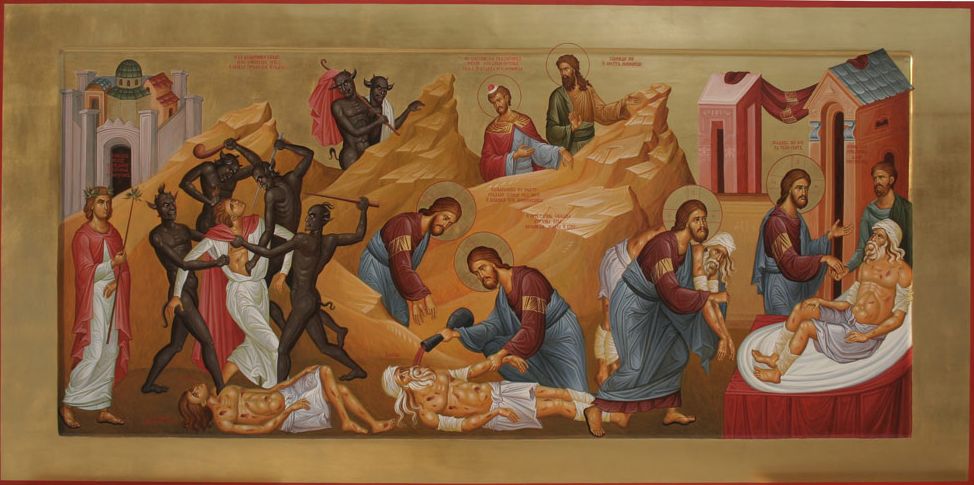
Jesus Good Samaritan Icon

In the name of Jesus. Amen.

Too often, when we hear the summary of the Law, “Love the Lord with all your heart, soul, mind, and strength. And love your neighbor as yourself,” we see it as setting up an order of operations. First, love God; then second, love neighbor so long as it doesn’t conflict with loving God. That is the attitude the priest and the Levite had in the parable.

According the laws of Moses, they needed to protect themselves from becoming unclean. If they helped the man in the ditch, they might defile themselves by touching a dead person and not be able to do their priestly functions. They are essentially saying to themselves, “I feel bad for this poor guy. I will pray for him. But if I go over there and help him, I won’t be able to do the sacrifices or declare people clean and free from sin. And I have been called by God to be faithful in those works. So, if I go help this guy, I might become unable to do those things, I will be unfaithful to God.”

The priest and Levite were convinced that they couldn’t help their neighbor because they had a higher obligation to love God. Too often, we think the same way.

We avoid people who are addicted to drugs or alcohol because Scripture tells us to avoid the appearance of evil (1 Thess. 5:22), and we don’t want to tarnish our reputation as a good Christian by being around people who have vices. When people are cruel and angry because they have been absolutely broken, we avoid them because they bring out the worst in ourselves. However, we should be going out of our way to love and befriend them and earn their trust. But we don’t do that because we think we have a higher duty to God to keep ourselves righteous so we try to maintain a safe distance from people who might make us to become unrighteous and jaded.

But one of the things Jesus shows us in the parable of the Good Samaritan is this misunderstanding between loving God and loving our neighbor. This parable is a nice explanation of what we are told in 1 John 4:20 which says, “If anyone says, ‘I love God,’ and hates his brother, he is a liar; for he who does not love his brother whom he has seen cannot love God whom he has not seen.” Love of God and love of neighbor are never in conflict with each other. God wants us to show our love for Him by loving our neighbor.

We have called today “Stewardship Sunday,” and we have had a lot of focus on what God’s Word has to say about our tithes and offerings. And this text has something to say about our giving to the church as well. Just as loving our neighbor does not conflict with loving God, loving God does not conflict with loving our neighbor either.

I might be wrong on this, but I would venture to guess that the prevailing attitude about giving to the church is seen as fulfilling the first of the two great commandments – to love God. And very often, we think giving to the church is not seen as fulfilling the second – to love our neighbor. At least, this is a common accusation of the world against the church, and I don’t think we are immune to those accusations.

Maybe, you have seen different threads on social media that pop up from time to time which basically say, “If money is the root of all evil, why do they keep asking for it in church?” Never mind the fact that they aren’t quoting Scripture correctly. The verse (1 Tim. 6:10), says, “The love of money is the root of all kinds of evils…”

But also, the world will say that Christians are hypocrites because giving to the church means they don’t care about the hungry and poor. They’ll say that Christians are so busy loving God by giving money to the church that they are refusing to love their neighbor. But there is no conflict between the two.

Scripture says that all have sinned and fallen short of the glory of God. Every neighbor you come into contact with is a sinner. And what do sinners need most? Even if they are naked and starving, sinners’ greatest need to hear the Gospel. They need to hear the Word preached. They need the Sacraments. They need to be pointed to Jesus Christ, the Lamb of God who takes away the sin of the world. In other words, they need the Church.

So, Christian, see what you are doing when you give to the church. You are doing exactly what the Good Samaritan did in the parable. You are providing for the continual care of those whom Christ has redeemed. Remember, the Good Samaritan gave the innkeeper money to care for the robbed man and promised to return and pay off any expenses that weren’t covered by his initial two denarii.

After the parable concluded, Jesus asked the lawyer, “Who proved to be a neighbor to the man who fell among the robbers?”And the lawyer rightly responded, “The one who showed him mercy.” And Jesus said, “You go, and do likewise.”

Have mercy and compassion on your neighbor by making sure that they have the blessing of seeing what you see and hearing what you hear. Make sure they have a place where they can go to hear of Jesus. Where they can have their wounds bound up by Christ’s absolution. Where they can have the oil and wine of the Sacraments poured on their sinful scars. Where they can recover in the inn of the church.

Christian, you go, and do likewise. Do this, but don’t ever draw strength and assurance by how well you have loved your neighbor. Instead, draw strength to love your neighbor by how God Himself has loved and cared for you.

Good Samaritan Jesus IconBecause, first and foremost, the parable of the Good Samaritan is a picture of what Jesus has done for you. Jesus, and Jesus alone, is the Good Samaritan who has compassion. He left His throne in the glory of heaven to become your neighbor. He risks His own safety while scoundrels and robbers are roaming about. He stops to give you aid. He pours on you oil and wine. He gives up His own comfort and convenience to bring you to the inn of the holy Christian Church. And Jesus sets up an all-expenses-paid stay there promising to return. Jesus is the one who has and continues to show you mercy. Amen.

The peace of God, which surpasses all understanding, will guard your hearts and minds in Christ Jesus. Amen.


Additional thoughts on the text that were removed from the sermon:

You can’t do something to gain an inheritance. All Scripture shows that God’s people do not inherit eternal life by doing something. As our Epistle Text (Gal. 3:15-22) said, the inheritance of eternal life has always and will always come through the promise of God. The lawyer knew this. He knew exactly what he must do to have eternal life. Love God perfectly and love his neighbor perfectly which is exactly how Jesus Himself sums up the Law (Mt. 22:34-40). Jesus tells the lawyer, “Bingo! Do this, and you will live.”But Jesus might just as well have said, “Yup. Go to hell.”

And the lawyer gets it. He sees how he is stuck in his sin. The Law has exposed him for the wretched sinner that he is. The Law has left him scared and confused because he doesn’t know the Gospel. He wants an out and clamors for a loophole. He asks, “Well, who is my neighbor? Whom should I love?”

But every Sunday school student knows the answer. “Who is my neighbor?” Everyone. “Whom should I love?” Everyone and without fail. But Jesus doesn’t tell the parable to answer the question, “Who is my neighbor?” Jesus tells the parable to change the question to get the answer He wants. The point of the parable is not to teach us to love everyone. Scripture teaches that all over the place but here, not in this parable.

Instead, Jesus tells the parable because He wants to show the lawyer and you hope. Jesus wants to show you what God mercifully does for you. He wants your eyes to see and your ears to hear the Gospel.

Manage – Sermon on Luke 16:1-13 for the Ninth Sunday after Trinity

Listen here.

Luke 16:1-13

He also said to the disciples, “There was a rich man who had a manager, and charges were brought to him that this man was wasting his possessions. And he called him and said to him, ‘What is this that I hear about you? Turn in the account of your management, for you can no longer be manager.’ And the manager said to himself, ‘What shall I do, since my master is taking the management away from me? I am not strong enough to dig, and I am ashamed to beg. I have decided what to do, so that when I am removed from management, people may receive me into their houses.’ So, summoning his master’s debtors one by one, he said to the first, ‘How much do you owe my master?’ He said, ‘A hundred measures of oil.’ He said to him, ‘Take your bill, and sit down quickly and write fifty.’ Then he said to another, ‘And how much do you owe?’ He said, ‘A hundred measures of wheat.’ He said to him, ‘Take your bill, and write eighty.’ The master commended the dishonest manager for his shrewdness. For the sons of this world are more shrewd in dealing with their own generation than the sons of light. And I tell you, make friends for yourselves by means of unrighteous wealth, so that when it fails they may receive you into the eternal dwellings.

10 “One who is faithful in a very little is also faithful in much, and one who is dishonest in a very little is also dishonest in much. 11 If then you have not been faithful in the unrighteous wealth, who will entrust to you the true riches? 12 And if you have not been faithful in that which is another’s, who will give you that which is your own? 13 No servant can serve two masters, for either he will hate the one and love the other, or he will be devoted to the one and despise the other. You cannot serve God and money.”

In the name of Jesus. Amen.

No getting around it. This parable is one of the most difficult texts in the Gospels and all of Scripture. A lot of pastor friends of mine were joking about how this text is the reason churches have associate pastors and interns so the ‘regular’ pastor can be protected from having to preach on this text. Unfortunately for me – and, maybe, you – I don’t have that luxury. Just so you know. I’m purposefully skipping Jesus’ words in v. 9. I’ve heard a few explanations and interpretations of v. 9 that may be right, but I’m not entirely convinced by any of them. So, I’m not preaching on it.

So, since the parable is already difficult to preach, I’m going to double down. I’ll deal with the parable first, and then I’ll preach about money, stewardship, and tithing. A double-whammy.

First, the parable. A rich man, who owns a lot of land and leases it out to farmers, has a manager who keeps the books, and the manager is a crook. He cooks the books and is swindling his boss, the rich man. When the manager is confronted by his boss, he has no response because he’s been caught red-handed. So, the rich man fires him, but the rich man is also generous. He doesn’t have the guy thrown straight into prison. Instead, the rich man is gracious and lets the manager head back to his office to get the books and turn them in for the last time.

On the way to his office, the manager is worried about his future well-being. He realizes that he’s too weak for manual labor and too proud to beg. But he recognizes that he has a window of opportunity which is only open until he turns in the books. So, the manager secretly calls in his master’s debtors and decreases their debts in order to make friends with them. It is interesting to note that the fifty measures of oil and the twenty measures of wheat are both roughly equal to the same amount of money – about five-hundred denarii (or 500 days’ wages).

H-63 Trinity 9 (Lu 16.1-9)This reduction was, of course, not legally binding. The rich man could have simply said, “Hang on everyone. I fired that guy before he lowered your debt. You still owe the original amount.” But that isn’t the character of the rich man. Instead, the whole town is singing the praises of the rich man because he is so generous. And the rich man isn’t willing to harm his reputation as a merciful guy. So, what does the rich man do in the parable? He tells the fired, scoundrel of a manager, “Dude, you’re shrewd. You knew I’d rather be known as a merciful person rather than hold on to my wealth. And by your shrewdness, you’ve helped yourself.”

That’s the key to understanding the parable. The rich man in Jesus’ parable doesn’t praise the sinfulness of the fired manager. Instead, he praises how shrewd the manager was. The manager put all his eggs in one basket – the basket of the rich man’s generosity and mercy. And it paid off. By betting on the mercy of the rich man, the manager made himself some friends before everything was taken from him.

And notice that Jesus wishes we were more daring with what we have been given. In the last half of v. 8, Jesus says, “The sons of this world are more shrewd in dealing with their own generation than the sons of light.”Christian, you have been given mercy, forgiveness, salvation, eternal life, eternal hope, eternal joy, eternal peace, eternal love – all things that cannot be taken from you. But you still are careful about sharing those things with others. Repent!

Why are you so careful about sharing God’s love for you with others? Don’t be ashamed! Christian, you have Jesus, and you have the Gospel. You have God’s unfailing, unending love. You have been entrusted with the power of God for salvation to everyone who believes (Ro. 1:16).

Stop being afraid of losing friends if you share the Gospel with them. God has given you the perfect righteousness and perfect obedience of Christ. Be faithful with what God has given you for your life and salvation. Be willing to give it away. Be faithful in your stewardship of the Gospel. That’s the parable.

Now, we move on to stewardship because, notice what Jesus says (v. 12), “If you have not been faithful in that which is another’s, who will give you that which is your own?”

If you aren’t faithful with the grace you have been freely given in Jesus Christ, why would God trust you with lesser things, things like money? God is right to not trust you with money if you cannot be trusted with the Gospel. This is a shift in gears here, but stick with me.

God often deals with sin and idols by using those sins and idols to be their own punishment. In Daniel, some pagans planned on getting Daniel thrown into the lion’s den and killed for disobeying the king and praying to God. But they are the ones who end up being eaten by the lions (Dan. 6). Or do you remember the book of Esther? The wicked Haman plans on killing faithful, God-fearing Mordecai by hanging him on a pole, but then Haman ends up being executed on that very instrument of death. This happens with unbelievers, but it also happens with believers. David’s sin of lust plagues him the rest of his life after he commits adultery with Bathsheba. The same thing happens with the most common idol in the world – money.

There have been studies on income and happiness, and a correlation has been found about how much you make and how happy you are. The interesting thing is that once you make a certain amount, happiness actually decreases. What do you think the amount is where happiness starts to decrease? It’s probably lower than you think – somewhere around $70,000. If you have little money but think that just a bit more will make you happier, money is your idol, and you will always be discontent with how much you have. But if you idolize money when you have lots of it, you still aren’t happy and spend all your time trying to hold on to it.

GreedNow, Jesus is absolutely clear, “You cannot serve God and money.”It can’t be done. If you trust in money, you do not trust God. So, repent of your love of money.
One of the best ways to protect yourself against idolizing money is to be generous – recklessly generous. Remember, everything you have – your life, your house, your clothes, your food, your finances, your money – everything is a gift from God. As Creator of everything, it all belongs to God.

You are merely a manager, a steward of what God, the Rich Man, has given and entrusted to you. And God is extremely loose and permissive in how much freedom you have in managing what is entrusted to you. God is actually pleased when you use the things that He has given you to manage and you take those things and use them to care for your family. God is even pleased when you enjoy things that might even be considered frivolous – like expensive coffee, or a gourmet steak and lobster dinner. God is pleased to give those things to you especially when you recognize that He is the One who has given it to you.

But God doesn’t want you to hoard everything He has given you to pamper yourself. He wants to use you and your management to provide for others as well. So, ask yourself, “What is the most important thing God wants to provide for others?” Yes, people need food and water and clothing. But the most important thing God wants people to have is the Gospel. The Gospel which provides for others not just in this life but for all eternity.

So, I would encourage you. Take a look at your finances. Yes, look at how you spend your money, but more importantly look at how much you give away – and where are you giving that money. Are you providing for people’s temporal needs by giving to the food shelf, the homeless shelter, etc.? Good. But you should be shrewd enough to give more to provide for people’s eternal needs. First, you should be giving to this congregation to make sure that both you and your brothers and sisters will be fed with the Gospel. Then, you should be giving to missionaries who call people to repentance and faith in Christ. Then, give to those other places as well.

I hope you know that what you give in the offering plate does go out from here too. As a congregation, we tithe 10% of what you give in the offering plate to provide for missionaries, the promotion of the Gospel, and to agencies in our community that provide temporal needs to others in our community.

If all this talk about tithing and money makes you squirm because you realize that you have not been a faithful manager of what God has given you, repent. Repent and amend your ways. And if you hear this and think to yourself, “I’m glad pastor is finally telling other people to give the way that I give.” Or if you’re thinking, “I wish so-and-so was here to hear this.” You repent too because this is law. And the law should always make us squirm. Your bank ledger isn’t what matters when it comes to your salvation.

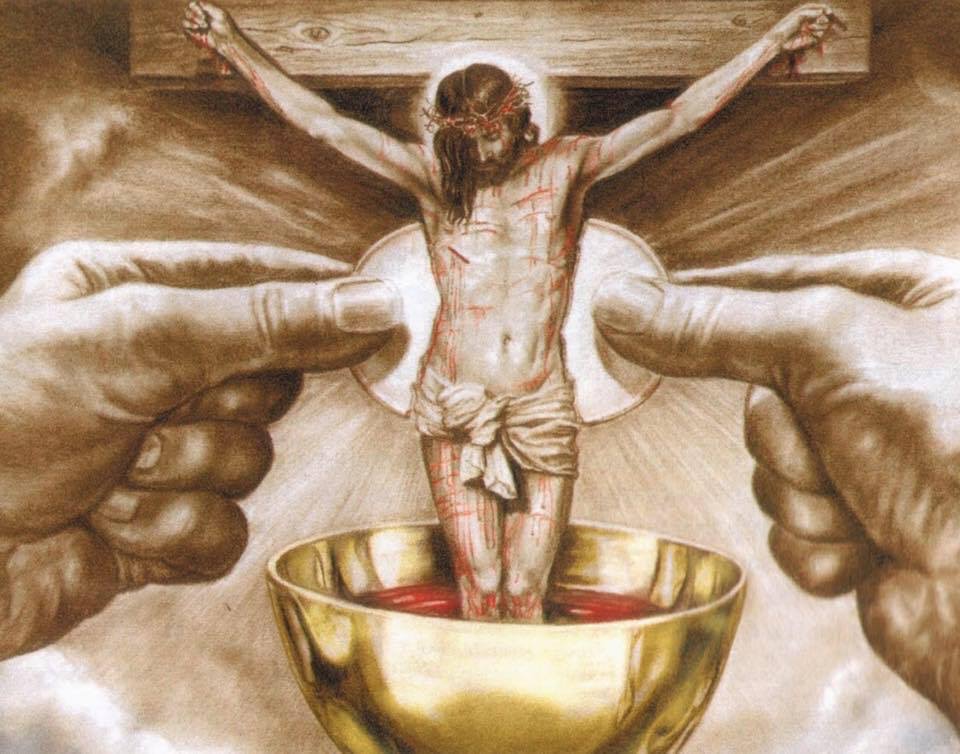
Cross and CommunionThe only thing that matters for your salvation is what Christ has done and completed for you upon the cross. Even when you are stingy and fail to be generous with what God has given to you, God was not. He gave what was most valuable to Him for your salvation. God, in His mercy, gave Jesus to die upon the cross for you. Don’t trust in your stewardship of what God has given you. Instead, trust in Christ’s giving of Himself completely for you and for others. Amen.

The peace of God, which surpasses all understanding, will guard your hearts and minds in Christ Jesus. Amen.

The Gift of a Name – Sermon on Luke 16:19-31 for the First Sunday after Trinity

Listen here.

Luke 16:19-31

19 “There was a rich man who was clothed in purple and fine linen and who feasted sumptuously every day. 20 And at his gate was laid a poor man named Lazarus, covered with sores, 21 who desired to be fed with what fell from the rich man’s table. Moreover, even the dogs came and licked his sores. Lazarus and the Rich Man Graphic22 The poor man died and was carried by the angels to Abraham’s side. The rich man also died and was buried, 23 and in Hades, being in torment, he lifted up his eyes and saw Abraham far off and Lazarus at his side. 24 And he called out, ‘Father Abraham, have mercy on me, and send Lazarus to dip the end of his finger in water and cool my tongue, for I am in anguish in this flame.’ 25 But Abraham said, ‘Child, remember that you in your lifetime received your good things, and Lazarus in like manner bad things; but now he is comforted here, and you are in anguish. 26 And besides all this, between us and you a great chasm has been fixed, in order that those who would pass from here to you may not be able, and none may cross from there to us.’ 27 And he said, ‘Then I beg you, father, to send him to my father’s house— 28 for I have five brothers—so that he may warn them, lest they also come into this place of torment.’ 29 But Abraham said, ‘They have Moses and the Prophets; let them hear them.’ 30 And he said, ‘No, father Abraham, but if someone goes to them from the dead, they will repent.’ 31 He said to him, ‘If they do not hear Moses and the Prophets, neither will they be convinced if someone should rise from the dead.’”

In the name of Jesus. Amen.

Being rich is not a sin. Money can, of course, be very dangerous to faith in Christ. Jesus plainly teaches that it is difficult for the rich to enter the kingdom of heaven (Mt. 19:23-24). But the rich man does not go to hell because he was wealthy. Instead, the rich man goes to hell because he does not love God.

GreedEven though the parable doesn’t explicitly say it, we know the rich man does not love God. As our Epistle text (1 Jn. 4:16-21) says, “he who does not love his brother whom he has seen cannot love God whom he has not seen…. Whoever loves God must also love his brother” (1 Jn. 20-21). The rich man’s lack of love for Lazarus makes his lack of love for God as plain as the nose on your face.

We can go even farther and say that the rich man is put to shame by the dogs. By licking his wounds, those dogs are more compassionate toward Lazarus than the rich man who can’t even be bothered to send one of his servants to give Lazarus a crumb from his table. Again, it is not a sin to be rich – not at all. But you cannot be saved and live as unlovingly and hard-heartedly as the rich man in this parable.

The Scriptural command to love your neighbor as yourself (Lev. 19:18; Mt. 22:39) is something that everyone, even pagans, know they should do. Everyone has the duty to love and serve their neighbor – but Christians especially have this duty.

God has given you abundant blessings so that you can use your wealth to help and be generous to others. Too often when we hear exhortations to assist the poor and needy – and I include myself in this rebuke – we over-generalize and turn the poor into a category or a nameless group of people that are difficult to identify. And once we have done that, we come up with all sorts of excuses to get out of helping our neighbor.

We know we can’t feed and clothe everybody so we don’t even start. Or we think to ourselves, “Jesus said that we will always have the poor among us (Mt. 26:11), so what good can I do?” But by doing this, we make the poor merely a concept, a demographic, or an abstraction. Once we have done this, we easily dismiss God’s call to help them.

So, don’t fall into the trap. Christian, God has called you to help your neighbor, and don’t forget that your neighbor has a name. In this parable, the rich man had a poor person put into his life by God, and that poor man had a name – Lazarus. And without question, the rich man knew who Lazarus was.

As the rich man was in torment, he doesn’t say, “Abraham, can you send that guy next to you to give me a drop of water?” No. The rich man sees Lazarus’ face, knows his name, and begs, “Send Lazarus.” And more than that, the rich man has five brothers who also knew Lazarus by name. The rich man knows that, if Lazarus could go to his brothers, they would recognize Lazarus, and they would know that he had risen from the dead to warn them about his torments in hell. From those two details, we know that Lazarus was a familiar family acquaintance for the rich man and his brothers.

Here’s the point: God hasn’t commanded you to feed and provide for the whole world. You aren’t God, and, quite frankly, you can’t do that. God hasn’t called you to provide for everyone, but God has called you to provide for Lazarus. God has put you into relationships with people who have a name. And God has called you to provide for them.

Crying to GodSo, when your conscience is pricked and you feel guilt for your lack of love, first repent. Repent of your lack of love. Then, make a list of the people God has placed in your life to help, to care for, and to love starting with the people closest to you.

Take out a piece of paper and draw a circle in the middle and write down the names of your family members who live with you in that circle. God has called you to care for them first. Be faithful in your care for them. Then draw another circle around the first and list your family members who need help – maybe a grandparent or an aged parent or aunt, uncle, or cousin. Those are the first two groups of neighbors God has called you to serve and care for. 1 Timothy 5:8 says, “[I]f anyone does not provide for his relatives, and especially for members of his household, he has denied the faith and is worse than an unbeliever.”

Then draw another circle around the first two, and write down the names of the people from our congregation that need your care and support. After your family, your fellow believers, your brothers and sisters in Christ are the closest neighbors that God has put into your life to care for. Galatians 6:10 says, “[A]s we have opportunity, let us do good to everyone, and especially to those who are of the household of faith.” Your brothers and sisters in Christ need your love and care. They need you to contribute to this congregation so that they can hear the Gospel and receive God’s gifts in His Word and Sacraments. They need you to help them when they fall into hard times. So be faithful in your giving to our congregation, and God will bless those efforts. Proverbs 19:17 says, “Whoever is generous to the poor lends to the Lord, and he will repay him for his deed.”

If you still have more to give, draw another circle. Write the names of your neighbors, coworkers, and friends who also have needs. And be faithful in helping them. Then you can draw another circle and write the names of others you know who need help. Or you can write the names of organizations that help those in need – the Women’s Pregnancy Center, Northlands Rescue Mission, the food shelf, etc. Get their newsletters or go to the websites and read the names and stories of the individuals who have been helped by those efforts as well. You get the idea?

With all those names, you might be overwhelmed. So, pray for wisdom. Ask God to give you the wisdom to know when you are equipped to help and when you are not. And remember that the closer to the middle of the circle those names are, God has called you to help those individuals first. And trust that God knows how to order your life and the lives of others as well.

Now, maybe you are a Lazarus. You might be the one who needs to be cared for, and if you aren’t now, you may be in the future. If that is the case, you might wonder, “How can I show love for my neighbor? How can I provide for others when I am in need?” The answer is surprisingly simple.

In Jesus’ day, beggars were seen as offering service to God be being needy. The generous cannot be generous if there is no one to be generous to. God may call you into His service by being the one who needs to receive the generosity of others who have the means to give. So, if you have needs, let us know.

Baptism 2And never forget, Christian, that you have been given a name. Through the waters of your Baptism, God gave you your name. He has adopted you into His family. You are His child and part of the household of Jesus. The love you fail to show to those God has placed in your life is forgiven and covered by the blood of Jesus, your Savior. And God does not forget to pour out His love, mercy, forgiveness, and provision for you.
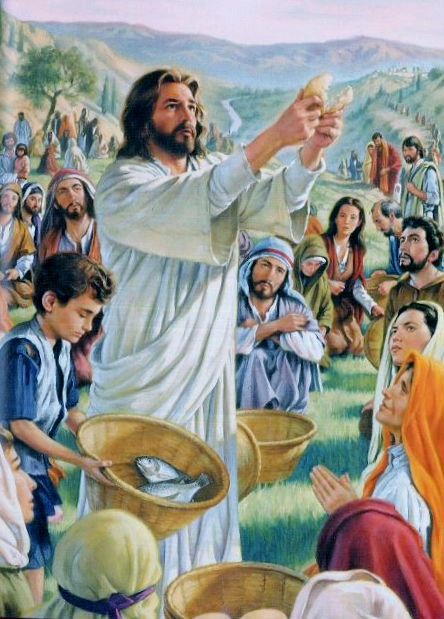
This is what the Scriptures teach. The Scriptures point you to Jesus, your Savior. It is the same Scriptures that this parable says the rich man’s brothers should look to so that they do not come to the place of eternal torment that the rich man did. Those very Scriptures all point you to the Jesus who shed His blood, died, and rose again for you.

Sinner, you are not some nameless, faceless person to God. He knows you by name. He has called you by that name, and you are His (Is. 43:1). And, dear saints, your name is written in the Lamb’s Book of Life (Rev. 3:5; 13:8). Amen.

The peace of God, which surpasses all understanding, will guard your hearts and minds in Christ Jesus. Amen.

That Nothing May Perish – Sermon on John 6:1-15 for the Fourth Sunday in Lent

Listen here.

John 6:1-15

After this Jesus went away to the other side of the Sea of Galilee, which is the Sea of Tiberias. And a large crowd was following him, because they saw the signs that he was doing on the sick. Jesus went up on the mountain, and there he sat down with his disciples. Now the Passover, the feast of the Jews, was at hand.

Lifting up his eyes, then, and seeing that a large crowd was coming toward him, Jesus said to Philip, “Where are we to buy bread, so that these people may eat?” He said this to test him, for he himself knew what he would do. Philip answered him, “Two hundred denarii worth of bread would not be enough for each of them to get a little.” One of his disciples, Andrew, Simon Peter’s brother, said to him, “There is a boy here who has five barley loaves and two fish, but what are they for so many?” Jesus Feeds the 500010 Jesus said, “Have the people sit down.”Now there was much grass in the place. So the men sat down, about five thousand in number. 11 Jesus then took the loaves, and when he had given thanks, he distributed them to those who were seated. So also the fish, as much as they wanted. 12 And when they had eaten their fill, he told his disciples, “Gather up the leftover fragments, that nothing may be lost.” 13 So they gathered them up and filled twelve baskets with fragments from the five barley loaves left by those who had eaten. 14 When the people saw the sign that he had done, they said, “This is indeed the Prophet who is to come into the world!”

15 Perceiving then that they were about to come and take him by force to make him king, Jesus withdrew again to the mountain by himself.

In the name of the Father and of the Son and of the Holy Spirit. Amen.

In the feeding of the 5,000, Jesus does what He was already doing and is always doing everywhere throughout the entire world – providing food. The only difference in this instance is that Jesus does it in a way that is not normal. This is not to undermine the miraculous nature of what Jesus does here. Feeding this massive crowd with five loaves and two fish is, absolutely, a miracle and reveals that Jesus is God in the flesh. But don’t lose sight of the fact that the food you ate yesterday was also a gracious gift of God miraculously provided for you. You have just grown used to God delivering your food to you through your paycheck or your parents, then through a restaurant or grocery store, your fridge, and your stove.

Jesus multiplies the snack of a boy and feeds the masses. Everyone in the crowd reclined (v. 10 ἀναπίπτω means ‘to recline at table’ not just ‘sit’) like kings and emperors on the grass in the wilderness. They had as much food as they wanted set before them by their servers, the disciples. Even the gluttons had their fill, and there is still more leftover. God’s gracious and miraculous provision at work through Jesus is certainly the main focus of this event.

Now, I’ve preached on Jesus feeding the 5,000 eight times since I’ve been your pastor – this is the ninth. And there are two aspects of this event that I normally don’t spend too much time on for certain reasons. But the two are, I think, related. And today is the day to focus some time on them. The two aspects are the generosity of the boy and the twelve baskets leftover.

The text doesn’t spell it out for us, but I think there is no question that this boy offers his food, his five loaves and two small fish – everything he has – to Jesus and the disciples. When the Gospels show how Jesus interacted with children, there is almost no question that Jesus would have rebuked the disciples for taking this boy’s snack. And Jesus has set this whole situation up. Remember, Jesus first asks Phillip where they would buy bread for the crowds, but it was a test, “[Jesus] knew what He would do” (v. 6).

Jesus and a ChildImagine a husband and wife are discussing their serious financial troubles and debt – the car needs expensive repairs, they are behind on their mortgage, and their credit cards are already maxed. They discuss all of this privately in whispers so they don’t scare their children. But suddenly, they are startled to see their young daughter in the room. The daughter holds out a handful of coins from her piggy bank and offers it to them saying, “Here, I want to help.” That handful of change, of course, won’t put a dent in their debt. That daughter doesn’t understand the complexities of the problem, so she imagines that her parents’ problem is easily fixed by her small offering. But it is moments like this that show a beautiful childlike faith which Jesus often praises, “Whoever does not receive the kingdom of God like a child shall not enter it” (Mk. 10:15).

Again, Jesus asked Phillip about how to get bread as a test. Phillip scoffs at the thought of buying enough bread for everyone to get a little. And this boy offers his snack to Andrew who mentions the food to Jesus, but even Andrew balks at the idea that it will suffice. But the boy’s offer is genuine. He is no less trusting than the widow who gives her last two pennies in the Temple (Lk. 21:1-4). This boy gives not knowing what Jesus will do with his gift, but trusting that Jesus will use it for good. And, of course, Jesus does.

As the crowd unbuckles their belts, Jesus sends the disciples out once again saying, “Gather up the leftover fragments.”Christ here is not worried about waste. If He was worried about waste, Jesus wouldn’t have even given as much as everyone wanted. He could have provided only what was needed. But Jesus says, “Gather up the leftover fragments, that nothing may perish.”Our translation only says ‘lost,’ but it is the same word Jesus uses in John 3:16. In God’s infinite love, He sent His only-begotten so that whoever believes in Him should not perish(same word) but have everlasting life. In other words, every last bit of this boy’s gift, multiplied by Jesus is useful for Jesus’ sake in Christ’s kingdom. Nothing of the boy’s gift and Jesus’ multiplication of it perishes.

Dear saints, here is the point today. Don’t think that what you do is ever lost or left to perish. God has called you to good works, and those works are holy and useful for the furthering of God’s kingdom. Christian, God has given each of you different vocations, different callings. I use the term ‘vocation’ frequently, but it is good to have a quick summary of this term again.

Your vocation is not simply your job or career. Instead, your vocation is your God-given calling in every situation according to God’s ordering of the world. You have vocations in your family – father, mother, son, daughter, sibling, cousin, etc. You have vocations in the state – citizen, voter, neighbor, driver, doctor, patient, fellow grocery shopper, etc. And you have vocations in the church – member, deacon, trustee, president of the congregation, listener, etc.

It is good and right to be asking yourself, “Who has God put in my life right now to serve, and how am I to serve that person in light of the Ten Commandments?” Right now, I, as your pastor, have been called by God to preach, and you have been called by God to listen. The service will end, and you will be called by God to be a fellow Christian and have opportunities to pray for your brothers and sisters in Christ. You will go out to your vehicles, and you will have the vocation to be a good driver or good passenger. You will go have lunch and there will be vocations there – good cook, good eater, good customer, etc. In each of these instances, God is calling you to good works that serve your neighbor.

And do not think that any of those works you do is unimportant. God places you in each situation with a unique relationship to your neighbor to be God’s hands and feet to serve your neighbor. In each of these vocations, God is calling you to holy work. Romans 12:1 says, “I appeal to you therefore, brothers, by the mercies of God, to present your bodies as a living sacrifice, holy and acceptable to God, which is your spiritual worship.”

Jesus takes what you offer in each of those vocations and uses it for the furthering of God’s kingdom. We are always tempted to minimize what we do in our vocations as though it doesn’t matter is insignificant. “Well, I’m just changing a diaper.” “God doesn’t care how I empty the dishwasher and fold the laundry.” “What I put in the offering plate doesn’t help as much as what so-and-so puts in because they can put in a lot more.” No, everything you do is used by God, and Jesus makes sure none of your works perish, Christian. God takes what you do, multiplies it, and uses it for the good of your neighbor and for God’s kingdom. Nothing you do, Christian, will ever perish because it is holy work rendered to your neighbor in service to God.

The disciples failed Jesus’ test here. They were left staring at their lack while this boy puts them to shame as he offers what he had. Yet, there is no recorded rebuke of Phillip or Andrew. Their lack of faith is forgiven and covered by Christ’s mercy just as your sins are covered. Cross and CommunionRemember, Jesus came to seek and to save you, the lost (lit.‘perishing’ Lk. 19:10), again, the same word in Jn. 3:16and v. 12. Jesus saves you, body and soul. And Jesus saves your works. Through His death and resurrection, Jesus provides more than we could imagine.

And now, to strengthen you for service in His kingdom, Christ feeds you with His Body and gives you to drink His Blood so that you are satisfied and ready to go from here to serve God by serving your neighbor. Amen.

The peace of God, which surpasses all understanding, will guard your hearts and minds in Christ Jesus. Amen.