John 6:1-15
1 After this Jesus went away to the other side of the Sea of Galilee, which is the Sea of Tiberias. 2 And a large crowd was following him, because they saw the signs that he was doing on the sick. 3 Jesus went up on the mountain, and there he sat down with his disciples. 4 Now the Passover, the feast of the Jews, was at hand.
5 Lifting up his eyes, then, and seeing that a large crowd was coming toward him, Jesus said to Philip, “Where are we to buy bread, so that these people may eat?” 6 He said this to test him, for he himself knew what he would do. 7 Philip answered him, “Two hundred denarii worth of bread would not be enough for each of them to get a little.” 8 One of his disciples, Andrew, Simon Peter’s brother, said to him, 9 “There is a boy here who has five barley loaves and two fish, but what are they for so many?”  10 Jesus said, “Have the people sit down.”Now there was much grass in the place. So the men sat down, about five thousand in number. 11 Jesus then took the loaves, and when he had given thanks, he distributed them to those who were seated. So also the fish, as much as they wanted. 12 And when they had eaten their fill, he told his disciples, “Gather up the leftover fragments, that nothing may be lost.” 13 So they gathered them up and filled twelve baskets with fragments from the five barley loaves left by those who had eaten. 14 When the people saw the sign that he had done, they said, “This is indeed the Prophet who is to come into the world!”
15 Perceiving then that they were about to come and take him by force to make him king, Jesus withdrew again to the mountain by himself.
In the name of the Father and of the Son and of the Holy Spirit. Amen.
In the feeding of the 5,000, Jesus does what He was already doing and is always doing everywhere throughout the entire world – providing food. The only difference in this instance is that Jesus does it in a way that is not normal. This is not to undermine the miraculous nature of what Jesus does here. Feeding this massive crowd with five loaves and two fish is, absolutely, a miracle and reveals that Jesus is God in the flesh. But don’t lose sight of the fact that the food you ate yesterday was also a gracious gift of God miraculously provided for you. You have just grown used to God delivering your food to you through your paycheck or your parents, then through a restaurant or grocery store, your fridge, and your stove.
Jesus multiplies the snack of a boy and feeds the masses. Everyone in the crowd reclined (v. 10 ἀναπίπτω means ‘to recline at table’ not just ‘sit’) like kings and emperors on the grass in the wilderness. They had as much food as they wanted set before them by their servers, the disciples. Even the gluttons had their fill, and there is still more leftover. God’s gracious and miraculous provision at work through Jesus is certainly the main focus of this event.
Now, I’ve preached on Jesus feeding the 5,000 eight times since I’ve been your pastor – this is the ninth. And there are two aspects of this event that I normally don’t spend too much time on for certain reasons. But the two are, I think, related. And today is the day to focus some time on them. The two aspects are the generosity of the boy and the twelve baskets leftover.
The text doesn’t spell it out for us, but I think there is no question that this boy offers his food, his five loaves and two small fish – everything he has – to Jesus and the disciples. When the Gospels show how Jesus interacted with children, there is almost no question that Jesus would have rebuked the disciples for taking this boy’s snack. And Jesus has set this whole situation up. Remember, Jesus first asks Phillip where they would buy bread for the crowds, but it was a test, “[Jesus] knew what He would do” (v. 6).
 Imagine a husband and wife are discussing their serious financial troubles and debt – the car needs expensive repairs, they are behind on their mortgage, and their credit cards are already maxed. They discuss all of this privately in whispers so they don’t scare their children. But suddenly, they are startled to see their young daughter in the room. The daughter holds out a handful of coins from her piggy bank and offers it to them saying, “Here, I want to help.” That handful of change, of course, won’t put a dent in their debt. That daughter doesn’t understand the complexities of the problem, so she imagines that her parents’ problem is easily fixed by her small offering. But it is moments like this that show a beautiful childlike faith which Jesus often praises, “Whoever does not receive the kingdom of God like a child shall not enter it” (Mk. 10:15).
Again, Jesus asked Phillip about how to get bread as a test. Phillip scoffs at the thought of buying enough bread for everyone to get a little. And this boy offers his snack to Andrew who mentions the food to Jesus, but even Andrew balks at the idea that it will suffice. But the boy’s offer is genuine. He is no less trusting than the widow who gives her last two pennies in the Temple (Lk. 21:1-4). This boy gives not knowing what Jesus will do with his gift, but trusting that Jesus will use it for good. And, of course, Jesus does.
As the crowd unbuckles their belts, Jesus sends the disciples out once again saying, “Gather up the leftover fragments.”Christ here is not worried about waste. If He was worried about waste, Jesus wouldn’t have even given as much as everyone wanted. He could have provided only what was needed. But Jesus says, “Gather up the leftover fragments, that nothing may perish.”Our translation only says ‘lost,’ but it is the same word Jesus uses in John 3:16. In God’s infinite love, He sent His only-begotten so that whoever believes in Him should not perish(same word) but have everlasting life. In other words, every last bit of this boy’s gift, multiplied by Jesus is useful for Jesus’ sake in Christ’s kingdom. Nothing of the boy’s gift and Jesus’ multiplication of it perishes.
Dear saints, here is the point today. Don’t think that what you do is ever lost or left to perish. God has called you to good works, and those works are holy and useful for the furthering of God’s kingdom. Christian, God has given each of you different vocations, different callings. I use the term ‘vocation’ frequently, but it is good to have a quick summary of this term again.
Your vocation is not simply your job or career. Instead, your vocation is your God-given calling in every situation according to God’s ordering of the world. You have vocations in your family – father, mother, son, daughter, sibling, cousin, etc. You have vocations in the state – citizen, voter, neighbor, driver, doctor, patient, fellow grocery shopper, etc. And you have vocations in the church – member, deacon, trustee, president of the congregation, listener, etc.
It is good and right to be asking yourself, “Who has God put in my life right now to serve, and how am I to serve that person in light of the Ten Commandments?” Right now, I, as your pastor, have been called by God to preach, and you have been called by God to listen. The service will end, and you will be called by God to be a fellow Christian and have opportunities to pray for your brothers and sisters in Christ. You will go out to your vehicles, and you will have the vocation to be a good driver or good passenger. You will go have lunch and there will be vocations there – good cook, good eater, good customer, etc. In each of these instances, God is calling you to good works that serve your neighbor.
And do not think that any of those works you do is unimportant. God places you in each situation with a unique relationship to your neighbor to be God’s hands and feet to serve your neighbor. In each of these vocations, God is calling you to holy work. Romans 12:1 says, “I appeal to you therefore, brothers, by the mercies of God, to present your bodies as a living sacrifice, holy and acceptable to God, which is your spiritual worship.”
Jesus takes what you offer in each of those vocations and uses it for the furthering of God’s kingdom. We are always tempted to minimize what we do in our vocations as though it doesn’t matter is insignificant. “Well, I’m just changing a diaper.” “God doesn’t care how I empty the dishwasher and fold the laundry.” “What I put in the offering plate doesn’t help as much as what so-and-so puts in because they can put in a lot more.” No, everything you do is used by God, and Jesus makes sure none of your works perish, Christian. God takes what you do, multiplies it, and uses it for the good of your neighbor and for God’s kingdom. Nothing you do, Christian, will ever perish because it is holy work rendered to your neighbor in service to God.
The disciples failed Jesus’ test here. They were left staring at their lack while this boy puts them to shame as he offers what he had. Yet, there is no recorded rebuke of Phillip or Andrew. Their lack of faith is forgiven and covered by Christ’s mercy just as your sins are covered. 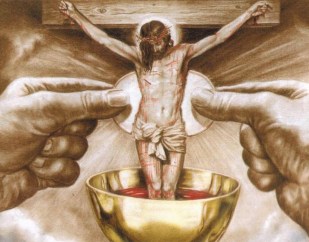 Remember, Jesus came to seek and to save you, the lost (lit.‘perishing’ Lk. 19:10), again, the same word in Jn. 3:16and v. 12. Jesus saves you, body and soul. And Jesus saves your works. Through His death and resurrection, Jesus provides more than we could imagine.
And now, to strengthen you for service in His kingdom, Christ feeds you with His Body and gives you to drink His Blood so that you are satisfied and ready to go from here to serve God by serving your neighbor. Amen.
The peace of God, which surpasses all understanding, will guard your hearts and minds in Christ Jesus. Amen.
 12 And when they had eaten their fill, he told his disciples, “Gather up the leftover fragments, that nothing may be lost.” 13 So they gathered them up and filled twelve baskets with fragments from the five barley loaves left by those who had eaten. 14 When the people saw the sign that he had done, they said, “This is indeed the Prophet who is to come into the world!”
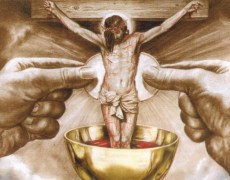 Jesus came to have His back torn by a whip and His forehead sliced open by the crown of thorns. Jesus came to have His body broken. Jesus came to have His hands and feet nailed to the cross, His side run through with a spear. Jesus came to give you every last drop of His forgiving blood. Jesus came to give you eternal mercy, forgiveness, and life.

You must be logged in to post a comment.