Silenced – Sermon on Matthew 22:34-46 for the Eighteenth Sunday after Trinity

Matthew 22:34-46

34 But when the Pharisees heard that he had silenced the Sadducees, they gathered together. 35 And one of them, a lawyer, asked him a question to test him. 36 “Teacher, which is the great commandment in the Law?” 37 And he said to him, “You shall love the Lord your God with all your heart and with all your soul and with all your mind. 38 This is the great and first commandment. 39 And a second is like it: You shall love your neighbor as yourself. 40 On these two commandments depend all the Law and the Prophets.”

41 Now while the Pharisees were gathered together, Jesus asked them a question, 42 saying, “What do you think about the Christ? Whose son is he?” They said to him, “The son of David.” 43 He said to them, “How is it then that David, in the Spirit, calls him Lord, saying,

44 “ ‘The Lord said to my Lord, 
“Sit at my right hand, 
until I put your enemies under your feet” ’?

45 If then David calls him Lord, how is he his son?” 46 And no one was able to answer him a word, nor from that day did anyone dare to ask him any more questions.

In the name of Jesus. Amen.

Arrogance was behind that question, “What is the great commandment in the Law?” We know this was arrogant because the lawyer is asking this question in order to test Jesus. This text is at the end of a conversation Jesus has been having with the religious leaders. If you look back to the beginning in Mt. 22:15, you’ll see that the religious leaders are trying to entangle Jesus in His words. The Pharisees had debated which command was the greatest for centuries, but they couldn’t come up with an answer because picking one would imply that something God commanded isn’t important. Or, at least, not as important. And, of course, that can’t be true. Every word that comes from the mouth of God matters because He is the One whose powerful voice spoke all things into existence.

Imagine a student who is studying to be a heart surgeon. I don’t actually know how heart surgeons are trained, but I see them getting something similar to a recipe. It’s got a list of all utensils and ingredients needed followed by instructions on how to use them. Imagine a student seeing that recipe. Step 1: Scrub up. Step 2: Make the incision. Step 3: Find this artery. And so on, going through the whole process. If one of those students asked which step is the most important, how would the instructor reply? I imagine the instructor saying, “They’re all important! Do everything correctly – from scrubbing up to closing. You have to get it all exactly right. Don’t leave anything out, or you’ll kill your patient!”

Basically, that is what Jesus says here. Everything God has commanded is important. All the Commands are good, right, and true. That’s what Jesus communicates when He summarizes God’s Law as, “Love the Lord your God with all your heart and with all your soul and with all your mind. And love your neighbor as yourself”(Mt. 22:37-39). Everything command of God is important, and everything He requires falls into two categories of either loving God or loving neighbor. In Ro. 13:10, the Law is summarized even further, “Love is the fulfilling of the Law.”

But sadly, this summary the Law is twisted. The devil has used countless false teachers say that the word ‘love’ is God’s only command. And when they do that, those false teachers utterly corrupt love. Yes, the command to love summarizesGod’s Law, but it doesn’t replace God’s commands. Today, to combat that devilish twisting, I want to make six points about God’s Law. I’ve done this before, but it’s been seven years since I last did it. So, it’s worth reviewing again.

First, while the command to love summarizes the Law, the word ‘love’ doesn’t replace the Law. We sinners will do all sorts of things that go against what God has commanded in the name of love. But you don’t get to steal food from a store because you love your children and want to feed them. Instead, loving your children requires you to keep the Command against stealing by getting a job to buy food for them. Committing adultery is not suddenly ok just because you love someone. That leads to the second point.

Second, the Law defines how to love your neighbor. There’s a 4th Command love that honors parents. There’s an 8th Command love that does not bear false witness and tells the truth. In each Command, God is telling us, “Here is how you love Me and love your neighbor.”

The third point about the Law is closely related to that. While the Law shapes how you love your neighbor, the needs of your neighbor also shape your love for them. The 7th Command about stealing will take one shape if you are an employee. It looks like working hard, not wasting time, and doing good work. But if you own a business, the 7th Command takes a different shape. It means that you are generous and pay a fair wage that rewards the work and skills of your employees. Same with the 4th Command to honor parents. When you are a child, honoring parents means obeying them. When you’re an adult, honoring parents means respecting them.

Fourth, you show love for God by showing love for your neighbor. 1 Jn. 4:20 says, “If anyone says, ‘I love God,’ and hates his brother, he is a liar; for he who does not love his brother whom he has seen cannot love God whom he has not seen.” If you want to demonstrate love for God, you do that by loving your neighbor, according to the commandments and according to your neighbor’s need.

And with this fourth point we see that there is an order to your love. You are to love the people God has placed closest to you first, then love everyone else. 1 Tim. 5:8 says that a person needs to provide for all his relatives, but especially the members of his household. And Gal. 6:10 says, “As we have opportunity, let us do good to everyone, and especially to those who are of the household of faith.” So, it is loving to give to the Feed My Starving Children offerings, but it is not loving for you to put your entire paycheck in there and not be able to feed your family or to let your brothers and sisters in Christ go hungry while you feed people you haven’t met.

Fifth, and this is the most important one: The Law always accuses. There’s no time in your life where you can say that you have kept God’s Law perfectly. As long as you have a pulse, you can’t check off the boxes to love God and your neighbor because you still have strength. Those boxes are always on your to-do list. And you and I are sinners and always fall short when it comes to the command to love. So, the life of a Christian is always filled with repentance and receiving the forgiveness that comes only through Christ.

Finally, the sixth point: Even though the Law always shows you that you are a sinner, don’t fall into the temptation of giving up in your attempt to keep God’s Law. Christian, even though you are going to fail to love perfectly, you need to strive to do it. Pray for strength and wisdom. Pray that God would open your eyes and ears to your neighbors’ needs. Then, be God’s hands and feet to meet those needs.

Changing gears and getting back to Mt. 22. We know that the Law is not the only word God has spoken to you. God also speaks His comforting words of Gospel. After Jesus summarized the Law, He turns the tables. Now, He has a question for the religious leaders about the Gospel. “What do you think about the Christ? Whose Son is He?”To their credit, these Pharisees know their Bible. They know that in 2 Sam. 7, God promised that the Christ would come through King David’s lineage, and He would reign as King forever and ever.

But Jesus wants to draw them further into the Gospel and into a further knowledge of the identity of the Christ by asking, “If the Christ is David’s son, how can David also call him, ‘Lord’?” (Ps. 110:1). The Pharisees can’t figure out this riddle because they figured the Christ was going to be a man who would set things right and save them. They didn’t understand that the Christ would be fully God and fully Man. But Jesus wasn’t trying to trick them. There He was, the Christ, standing right before them. The God-Man and Messiah, talking with them, calling them to Himself. Sadly, their only response was silent ignorance.

Dear saints, this question from Jesus silences you too, but in a very different way. You aren’t silenced into the shame of the Pharisees; instead, you are silenced in a holy wonder. Your silence is an awe that realizes that, to save you from the condemnation of the Law, God has located Himself in the body of Jesus. Because of Jesus’ birth, part of God’s nature is that He now has a human body. He took on that body so He could suffer for you, shed His blood for you, die for you, rise again for you, and rule as King until all your enemies are placed under His nail-scarred feet. Your Christ, your Savior, and your God has united Himself to you.

Lucy, today, we rejoice with you that you are Baptized. You are now clothed with Christ (Gal. 3:27) and joined to Him in His death and resurrection (Ro. 6:3-4). Remain in Him. Lucy and all you Baptized saints, we will never fully understand the unity that we have with God because of our Baptism. And yet, we, in silent wonder, can bask in the glory that God Himself has loved us in this way.

God came to you. He took on your flesh. He lived a perfect life and died an atoning death. Now, He is risen and rules as the Lord of all creation. Your Savior from sin is David’s Son and David’s Lord. He is your Lord and King, and yet He is your brother Who now invites you to His royal banquet to receive His Body and Blood for the forgiveness of all your sin and failure to love God and neighbor. Come and receive Him. Amen.

The peace of God, which surpasses all understanding, will guard your hearts and minds in Christ Jesus (Php. 4:7). Amen.

Depend – Sermon on Matthew 22:34-46 for the Eighteenth Sunday after Trinity

Matthew 22:34–46

34 But when the Pharisees heard that he had silenced the Sadducees, they gathered together. 35 And one of them, a lawyer, asked him a question to test him. 36 “Teacher, which is the great commandment in the Law?” 37 And he said to him, “You shall love the Lord your God with all your heart and with all your soul and with all your mind. 38 This is the great and first commandment. 39 And a second is like it: You shall love your neighbor as yourself. 40 On these two commandments depend all the Law and the Prophets.”

41 Now while the Pharisees were gathered together, Jesus asked them a question, 42 saying, “What do you think about the Christ? Whose son is he?” They said to him, “The son of David.” 43 He said to them, “How is it then that David, in the Spirit, calls him Lord, saying,

44 “‘The Lord said to my Lord, 
“Sit at my right hand, 
until I put your enemies under your feet” ’?

45 If then David calls him Lord, how is he his son?” 46 And no one was able to answer him a word, nor from that day did anyone dare to ask him any more questions.

In the name of Jesus. Amen.

This Gospel reading takes place on Holy Tuesday. In other words, it is just a few days before Jesus will be crucified, and what we heard is Jesus’ last public teaching until He preaches the seven last words from the cross. The Pharisees and Sadducees are asking our Lord three questions to try to entangle Him in His words (Mt. 22:15). They want Jesus to say something they can use against Him and kill Him. The first two questions they asked were about paying taxes and the resurrection. But Jesus answers both questions so skillfully that they can’t find a way to accuse Him.

Our text begins with their third and final trick question that comes from a sleezy lawyer. “Teacher, what is the great commandment in the Law?” It seems as though the intent of this question is to get Jesus to put one of the Commandments above the others, and when He does that, they will say that He teaches that the other nine aren’t as important. But they end up looking like fools. It was Jesus’ finger that carved those words into the stone tablets and His voice that spoke them on Mt. Sinai. Jesus is the Author of the Commandments, and they are all important.

So, Jesus answers the question, “The great Commandment is this: love God with everything you’ve got and love your neighbor as yourself. On these two commandments depend all the Law and the Prophets.” In other words, Jesus is saying, “All the Commandments matter. All of them are the greatest. They all demand that you love God and love your neighbor. All the Commandments depend on these two.” Jesus is clear here, and Scripture is clear elsewhere that what the Commandments require of us is to love. Love is the fulfilling of the Law (Ro. 13:10b). In every situation, you are to love God and love your neighbor. And it is important to spend some time on this because there is a lot of unnecessary confusion about what love looks like. A pastor friend of mine (Pr. Bryan Wolfmueller) put together a list that helps to define and shape what love looks like. And this list is biblical and, I think, very helpful.

First, love is shaped by the Ten Commandments. Love does not mean that there are no other Commandments. No, the Commandments define what love is. Love depends on the Commandments. If you are fornicating and committing adultery, you cannot presume to say that it’s ok because, “We love each other.” Adultery is always unloving.

Second, love is shaped by our vocation or our station in life. Everyone has several vocations, so I’ll use myself as an example here. Some of my vocations are husband, father, pastor, a child of my parents, a friend, etc. In each of those vocations, I am called to love. But what that love looks like depends on those different vocations. For example, part of my love as a father includes providing for my family. So, I earn a living so my wife can go and buy socks for our kids. As a pastor, my love looks different. It looks like faithfully preaching and teaching God’s Word to you, the flock that God has entrusted into my care. My vocation as a pastor does not require me to buy socks for all of you. Pastors are not called to provide socks for their congregations. But that, then, leads us to the third thing that shapes our love.

Our love is also shaped by the needs of our neighbor. If one of you, who aren’t part of my family, needs socks and can’t get them for yourself, my love for you would be to give you socks. Even if the only reason I know you and your need socks is that I’m your pastor, I’m not giving you socks because I’m your pastor. I’m giving you socks because I am your brother in Christ. And if I needed socks, I would want one of you to give me socks if you have the means and resources to provide them. In that instance, I’m loving you as I would love myself. (I think this is the most I’ve ever used the word ‘socks’ in a sermon, but I’m done now.)

That leads us to the fourth thing that shapes our love which is the gifts God has given us. God gives us stuff, skills, and talents so we can use them to love and serve our neighbor. If God has made you successful and given you a lot of money, use those resources to love your neighbor. If God has given you the talent of being good at cooking, you love your neighbor by cooking. If God has given you good mind for math, you can love your neighbor as an engineer or an accountant. The beautiful thing about this one is that the gifts God gives you can help you love your neighbor across different vocations. A person who is good at math can be a good accountant. He can earn a good living and provide for his family and, at the same time, love and serve his clients who need someone to keep their books.

Just briefly here, our neighbor’s need might mean that we have to love our neighbor in a way that we aren’t gifted. Imagine a meteor hit the church during this service. We don’t have an ER doctor here, but we do have an optometrist, a medical student, nurses, and EMTs who are gifted in knowing how the body works and how to heal. They should be the ones who go to the people who are most injured and help them. And if more people are injured, those of us who aren’t gifted in that way are called to do the best we can even though that kind of love is usually reserved for doctors and nurses. Our neighbor’s need trumps how we are gifted. Especially in an emergency, we love and serve others based on their needs rather than our love depending on our gifts. And when the ambulances get here, we who don’t know as much about first aid should step aside and let the professionals use their gifts to serve the people in need.

So, the first four things that shape our love are: 1) the Ten Commandments; 2) our vocation; 3) our neighbor’s need; and 4) our gifts. All of that is fairly obvious and reasonable. But there is another thing that shapes our love, and this last one is one that our culture fights against (for several reasons). But this one is also important to consider. The fifth thing that shapes our love is our neighbor’s sin, and this is where things can get tricky and difficult. But this is also where Jesus’ summary of the Ten Commandments – love God with everything and love your neighbor as yourself – is helpful. And God gives you wisdom to help navigate this.

Imagine you know someone who is addicted to fentanyl, your calling is still crystal clear: you are called to love that person. But now what is that love going to look like? Is it loving to just step aside and let them keep killing themselves by using that fentanyl? No, it isn’t. Their sin against themselves might even mean that you need to break one of the Commandments in order to love them. You might need to steal their fentanyl even though stealing is sin and a violation against the 7th Commandment.

Now, please recognize that the Ten Commandments are still the primary thing that shapes and defines our love. But because of your neighbor’s sin, you break the 7th Commandment about stealing in order for you to keep the 5th Commandment which calls you to do your neighbor no bodily harm, but help and defend him in every need. This is why knowing the Commandments is so important. And, again, your vocation still plays into this too. You aren’t called to travel to San Francisco, Seattle, or Portland and steal fentanyl from all the addicts in those places.

Our neighbor’s sin can hinder the ways we love them. Parents, when your children are breaking the 4thCommandment and not obeying you, your love for them looks like disciplining them; it isn’t what you want to do, but you are called to do it (Pro. 22:15; 23:13; Heb. 12:11). If you have abusive parents, you are still called to keep the 4th Commandment and honor them, but their sin could mean you have to disobey them if they demand you do something contrary to God’s Word. If your cousin, Stacy, is getting married, your love normally looks like going to her wedding and celebrating with her. But if she is breaking the 6th Commandment by trying to be married to another woman, your love for her means not going to the wedding because that would embolden her in her sin against the 6th Commandment. Yes, this is hard and difficult. Yes, this is uncomfortable. Yes, it is even confusing. You are always called to love, but sin can put constraints on love.

And that brings us to the second part of our text which is the question Jesus asks the people who are trying to trip Him up. Jesus turns the discussion to the identity of the Messiah. The Savior is David’s Ancestor and also David’s Lord. The way this is possible is that Jesus is the fully Divine, eternal Son of God and fully human. Christ is God and Man.

Your Savior’s love for you was fully shaped by the Ten Commandments, which Jesus kept perfectly. His vocation was to be the Messiah and shed His blood and bear the punishment for the sins of all humanity because that was our need. He was gifted with everything necessary to be the Savior. And He navigated our sin in such a way that He perfectly loved God by loving us and bearing our sin to the cross. Now, He is risen and lives and reigns on the throne of all creation for eternity. 

Your eternal life totally depends upon what Jesus, the Son of God and Son of David, has done. God be praised that He has done all things well (Mk. 7:37). Amen.

The peace of God, which surpasses all understanding, will guard your hearts and minds in Christ Jesus. Amen.

To Your God Belongs All – Sermon on Deuteronomy 10:12-21 for the Eighteenth Sunday after Trinity

Deuteronomy 10:12-21

12 “And now, Israel, what does the Lord your God require of you, but to fear the Lord your God, to walk in all his ways, to love him, to serve the Lord your God with all your heart and with all your soul, 13 and to keep the commandments and statutes of the Lord, which I am commanding you today for your good? 14 Behold, to the Lord your God belong heaven and the heaven of heavens, the earth with all that is in it. 15 Yet the Lord set his heart in love on your fathers and chose their offspring after them, you above all peoples, as you are this day. 16 Circumcise therefore the foreskin of your heart, and be no longer stubborn. 17 For the Lord your God is God of gods and Lord of lords, the great, the mighty, and the awesome God, who is not partial and takes no bribe. 18 He executes justice for the fatherless and the widow, and loves the sojourner, giving him food and clothing. 19 Love the sojourner, therefore, for you were sojourners in the land of Egypt. 20 You shall fear the Lord your God. You shall serve him and hold fast to him, and by his name you shall swear. 21 He is your praise. He is your God, who has done for you these great and terrifying things that your eyes have seen.”

In the name of Jesus. Amen.

Don’t put the cart before the horse. When we hear this text, it is very easy to focus on all the things we are called to do because the text opens with the question: “What does the Lord your God require of you?” Then all these directives come. Fear God. Walk in His ways. Love Him. Serve Him with all your heart and with all your soul. Keep His commandments and statutes. Don’t be stubborn. Love the sojourner. Hold fast to Him. There is a lot to do there – so much, in fact, that we recognize that we have not even begun to do what God requires of us. Right away we find that we have a lot of repenting to do, and repent we should. But, again, don’t put the cart before the horse.

Notice who wants you to do all these things – the Lord your God. Six times in this text, that is God’s title – the Lord your God. And just to make sure you get it drilled into your head, you are reminded in the final verse that He is your God (v. 21).

Know, dear saints, this God of gods and Lord of lords – the One who owns heaven and the heaven of heavens, the earth with all that is in it – He is your God. He has chosen you. He could have chosen anyone, but He chose you. He did not choose you because you were bigger, stronger, smarter, more obedient, or more faithful than others. He has not chosen you because of anything you have thought, said, or done. You belong to God. You, dear saints, according to 1 Pet. 2:9, are His chosen people, His royal priesthood, His holy nation, and a people for His own possession. You are these things because the Lord God of heaven and earth has chosen you and set His heart in love on you (v. 15). He is your God because He has called you out of darkness into His marvelous light. And the Lord your God has done all of this because of what Jesus has done for you.

Jesus, your Savior, lived a perfect life. He was perfectly obedient to God. He took all your sin to the cross (1 Pet. 2:24) where God poured out all His wrath upon your sin, and not one bit of that wrath is left for you. Jesus paid it all, and He paid it all for you. Your sin had left a crimson stain, but Jesus has washed you white as snow. To God belongs heaven and the heaven of heavens, the earth and all that is in it, and Jesus has restored you to your proper place – your proper place before God and your proper place in His creation. That’s the horse that pulls the cart, and now we can turn to the cart.

As this text lays out all the things the Lord your God requires of you, it is nothing more than a call for you to be like Him and follow after His image. In other words, if we boil down all these things God calls us to be, it is a call for us to be the stewards He has created us to be.[1]

So, think back to the creation. God created Adam and Eve in His image and blessed His image-bearers saying, “Be fruitful and multiply and fill the earth and subdue it, and have dominion over the fish of the sea and over the birds of the heavens and over every living thing that moves on the earth.” Because of our sinful nature, we hear those instructions “have dominion” and “subdue” and think that we get to call all the shots and beat creation into submission so that it conforms to our will. But that wasn’t the case originally. Because Adam and Eve were created in God’s image and perfectly reflected the will and heart of the God who created and owns all things, they were simply stewards of everything God created.

As Genesis 2 closes, Adam and Eve were doing exactly what God had created them to do. They were perfectly stewarding God’s creation. They were receiving from God all that He wanted to give to them. God had created the entire universe to bless mankind, the crown of His creation. God designed them to have open hands that received all the blessings they needed for life. But then, in Genesis 3, the serpent comes slithering into the picture. He lies and convinces them that God was holding out on them and not giving them everything He had to give. After hearing this lie, Eve begins to look at things differently. Watch what her hands do. Instead of having an open hand to receive all of God’s blessings, her hand turns over to take. Both Adam and Eve take and eat. This taking betrays their identity. Instead of being stewards, they wrongly thought they were the owners, but there had been no transfer of ownership.

The creature cannot be the Creator, and the steward cannot be the Owner. Adam and Eve’s attempt to change their identity ends up destroying the perfect relationship that existed between Creator, steward, and creation. Because of that, life became hard. All creation, which God designed to be a blessing that supported life, will cause them pain and suffering. Now their work, will be filled with sweat, toil, pain, and, ultimately, death.

The interesting thing in all of this, though, is that God did not remove them from their calling and duty of being stewards. And this is where you come into the story. You, as God’s creature, are still a steward of God’s creation. Even though you daily and regularly fail in this role, it is still yours. Even though your hands turn over to reach out and take what is not yours, Jesus has come to redeem you and forgive you of all your sins. On the cross, your debt was paid. The empty tomb on Easter is the receipt (Ro. 4:25).

This means, dear saints, that you are a new creation; the old has passed away and the new has come. And now, God has entrusted you with being a steward of the Gospel which is the message of reconciliation (2 Cor. 5:17-20). With an open hand, you receive God’s forgiveness and mercy, and that open hand allows that forgiveness and mercy to also flow to others. And it is those same open hands that freely receive and freely give all of God’s other gifts too. And one of the ways that you continue in your role as a steward is by giving to the work of God’s church.

On the back of your Scripture insert, I’ve included two passages about Christian stewardship (1 Cor. 16:2 and 2 Cor. 9:6-8) and four points to consider about how to give.[2] I would encourage each of you to read through those texts and points as you consider how you steward what God has given to you. In the Old Testament, the stewardship of tithing was set at a certain amount, 10%. Now I want to be clear: there is no New Testament command on what percentage you should give to the work of God’s kingdom. Let that be between you and God. But I do want to highlight one thing from those verses.

2 Cor. 9:6 says, “Whoever sows sparingly will also reap sparingly, and whoever sows bountifully will also reap bountifully.” If you plant one tomato plant, you can only expect so many tomatoes. If you plant ten, fifty, or one hundred plants, well, you’ll get a lot more. The text goes on to tie that analogy to what you give to the church. And the interesting thing about this is what the Old Testament has to say about where those tithes end up.

Just a few chapters after our text, God talks about what was to be done with the tithes. In Dt. 14:22-26, God says that the tithes given to Him are given back to the one who brought that tithe, and it is given back as a feast. God tells His people to bring the tithe of their crops, their wine, their oil, and their herds to the Temple.[3]If the trip to the Temple was too far to bring all of it, they should sell those things and turn them into money. Then, they would go to Jerusalem and purchase whatever things they wanted to eat. Then, they would offer their tithe and eat it before God with rejoicing.

Dear saints, the gifts, offerings, and tithes you give to God are returned back to you as gifts from the Lord your God. Those gifts bless you as you come here and receive God’s mercy, and they also bless your neighbor who needs to receive that mercy and love. The offerings and gifts that you have placed on the Lord’s table will be used by God to continue to further His kingdom.

And now, Jesus, your God, invites you to come and receive a priceless treasure that could never be bought with money. He invites you to come to His table and receive His Body and blood given and shed for the forgiveness of all your sin. Come into the presence of the Lord your God. Receive and rejoice. Amen.

The peace of God, which surpasses all understanding, will guard your hearts and minds in Christ Jesus. Amen.

Christian Stewardship

1 Corinthians 16:2 

On the first day of every week, each of you is to put something aside and store it up, as he may prosper, so that there will be no collecting when I come. 

2 Corinthians 9:6–8 

The point is this: whoever sows sparingly will also reap sparingly, and whoever sows bountifully will also reap bountifully. Each one must give as he has decided in his heart, not reluctantly or under compulsion, for God loves a cheerful giver. And God is able to make all grace abound to you, so that having all sufficiency in all things at all times, you may abound in every good work.

From these two texts, we see that Christians are to give…

  1. …voluntarily & cheerfully. Giving should not be done under compulsion or grudgingly. Giving is God’s gracious call to join Him in His work.
  2. …of our first-fruits. Giving should be from the first-fruits of our labor. Our giving is what we do on the first day of the week before our other expenses are due.
  3. …proportionately. Giving is not to be an arbitrary set dollar amount each week. Instead, it is to be in accordance with ‘how we have prospered’ each week. In other words, setting aside a certain proportion (percentage) of our income for God’s work through the Church.
  4. …faithfully. We have God’s promise that He will take care of all our needs in this body and life. As we give, we are trusting God to keep that promise.

[1] The following five paragraphs are an adaptation of chapter 2 of the book Stewardship: For the Care of Souls by Pr. Nathan Meador and Pr. Heath R. Curtis.

[2] I’ve included those below under the title “Christian Stewardship.”

[3] The text says to bring the tithe to “the place that He will choose, to make His name dwell there.” I am simply condensing that because the Temple is where God chose to make His name dwell (2 Chron. 6:16-20).

Fear, Love, & Trust – Sermon on Matthew 22:34-46 for the Eighteenth Sunday after Trinity

Matthew 22:34-46

34 But when the Pharisees heard that he had silenced the Sadducees, they gathered together. 35 And one of them, a lawyer, asked him a question to test him. 36 “Teacher, which is the great commandment in the Law?” 37 And he said to him, “You shall love the Lord your God with all your heart and with all your soul and with all your mind. 38 This is the great and first commandment. 39 And a second is like it: You shall love your neighbor as yourself. 40 On these two commandments depend all the Law and the Prophets.”

41 Now while the Pharisees were gathered together, Jesus asked them a question, 42 saying, “What do you think about the Christ? Whose son is he?” They said to him, “The son of David.” 43 He said to them, “How is it then that David, in the Spirit, calls him Lord, saying,

44 “The Lord said to my Lord, 

       ‘Sit at my right hand, 
until I put your enemies under your feet’?

45 “If then David calls him Lord, how is he his son?” 46 And no one was able to answer him a word, nor from that day did anyone dare to ask him any more questions.

In the name of Jesus. Amen.

Well, here they go again. Those tricksy Pharisees. Trying to catch Jesus, trying to get our Lord to say something that would get Him in trouble. Last week, it was at a banquet watching to see what Jesus would do with a sick man (Lk. 14:1-11). This week, it’s with a test question. “Teacher, which is the great commandment in the Law?”

To be honest, there isn’t really anything wrong with the lawyer’s question as it is. (More on that in a bit.) But the motive behind the question was sinful. The Pharisees wanted to catch Jesus pitting one part of God’s Word against another. It’s impossible to know exactly what they had planned to do with Jesus’ response. Maybe, they figured Jesus would say that the 1st Commandment, “Thou shalt have no other gods before Me,” was the greatest. Then, they could falsely accuse Him of teaching that profaning God’s name, dishonoring parents, murder, stealing, or lying wasn’t a big deal. Whatever their plans and thoughts were, they were trying to make Jesus look like a fool with this question about the Law.

They miscalculated. Badly.

They didn’t realize with Whom they were speaking. Jesus is the Author of the Ten Commandments. He carved them into stone tablets and declared them to Moses and all the people of Israel (Jn. 1:18). Trying to trick Jesus with a question about the Ten Commandments is like trying to trick Herman Melville with a question about Moby Dick, Mark Twain with a question about Huck Finn, C.S. Lewis with a question about Aslan, George Lucas with a question about Luke Skywalker, or Dr. Seuss with a question about the Cat in the Hat. (Hopefully, one of those combinations works for you.)

Jesus, the Author of the Law, will not let one part of His perfect will – which is expressed in the Commandments – be pitted against the rest. The Commandments are not in competition with each other. To love God with the whole heart, whole soul, and whole mind is the first and great commandment. And notice how Jesus continues. He says there is another commandment, a second commandment, that is like the first and great commandment. Love your neighbor as yourself.

Now, it is interesting in Mark’s account of this same encounter with the Pharisees Jesus says there’s no other commandment – singular – greater than these – plural (Mk. 8:31). In other words, perfect love of God and perfect love of your neighbor go together. The two are inseparably tied together and are really one commandment. On these hang all the Law and the Prophets. Love for God is demonstrated by love for the neighbor. 1 John 4:20 says, “If anyone says, ‘I love God,’ and hates his brother, he is a liar; for he who does not love his brother whom he has seen cannot love God whom he has not seen.” In other words, when you love your neighbor, you are loving God who has commanded you to love your neighbor.

Some people today will say that since Jesus distills the Commandments down to, “Love God, and love your neighbor,” that we don’t need the Commandments or any other teaching about God’s Law. Basically, they will say, “We just have to love each other.” Be careful with that. The reality is that we need the Commandments, we need the Law, to teach us what love looks like.

If you want to love God, love your neighbor, and here is what that looks like: Loving God is obeying His command to honor your father and mother by serving, obeying, and respecting them. Loving God is obeying His command to not murder your neighbor or cause him any suffering. Loving God is obeying His command to not commit adultery – which means, husbands, live a chaste life for your wife, and wives, live a chaste life for your husband. Love is not stealing, rather helping your neighbor improve and protect his property. Love is not bearing false witness and putting the most charitable construction on all that your neighbor does.

Honestly, it doesn’t matter if you think what you are doing is motivated by love; if your thoughts, words, or actions fall outside of these Commands, it is not love. In fact, we could go a step farther and say that, whenever your actions fall outside of the Ten Commandments, they are selfish and sinful actions motivated by hatred toward both God and neighbor.

Dear saints, all of this is to say, we all have a lot of reasons to repent. We do not fear, love, and trust in God above all things, and we do not love our neighbor as ourselves. We let our fear of things other than God dictate how we act. We let our love of things that are not God distract us from the God who loves us. We let our trust in things other than God draw us away from God. Again, dear saints, repent. The Law always accuses us and shows how we fail in our obligation to love God and neighbor.

Now, I said earlier that there isn’t anything wrong with the lawyer’s question about what is the greatest Command. But that question, by itself is incomplete because the Law leaves us hanging out to dry under God’s wrath and punishment. At best, the Law can only curb and deter people from sin, but that’s as far as it can go. The Law is good because it tells us what we must do, but the Law is limited because it can only reveal what we have failed to do. The Law is never helpful in saving us unless we also know the One who hung upon the cross for all our sins of failing to love God and neighbor.

That is why Jesus asks His question about the Christ. Just like in last week’s Gospel lesson, Jesus turns the tables and asks the Pharisees a question, “The Messiah, whose son is he?” And the Pharisees were right when they answered, “David’s son.” God had promised that a son of David would sit on David’s throne forever (1 Sam. 7). But David also wrote in Psalm 110:1, which is the verse that Jesus quotes, that this Son of David is also David’s Lord. So, Jesus’ question is, “How can the Messiah, David’s son, also be David’s Lord?”because a father would never call his descendent, “Lord.”

Here, Jesus is teaching the Pharisees and you that the Messiah is both God and man. Here’s why that is so important:

Because the Messiah is God, He has kept the Law perfectly. And because He is man, that keeping of the Law is for you. Jesus perfectly loved God and your neighbor in your place. And through faith, that perfect keeping of the Law is credited to you (2 Cor. 5:21).

The easiest example of this is the 4th Commandment. The Law says, “Honor thy father and mother. Love God by loving your parents as yourself.” And you are left saying, “God, I haven’t done that. I need Your help.” If the Jesus had not come to earth as a Man, God would have to say, “Well, I’m God. I don’t have a father or mother, so I can’t help you. You have to do that yourself.” But God did become a Man. Jesus had a mom and a dad. He did love and honor them perfectly. So, He can and does help you by reckoning His obedience and keeping the Commandment to your account. And this applies to each and every one of the Commandments.

Jesus, the eternal, righteous Son of God, became a Man, perfectly loved God and neighbor, died, and rose again. Through this, He has brought the Law to perfection. This might be too simplistic of an explanation, but it might help shape our thinking.

In His answer to the lawyer’s question, Jesus shows us that the Law has a divine aspect and a physical aspect – love God (divine) and love neighbor (physical). God be praised, that He has given you a Savior who is also divine and physical – God and Man. So, now, when you hear the Law and what it requires of you, you realize that you are lost and deserve God’s wrath and judgment in both body and soul. So, you cry out, “God I’m lost. I deserve punishment and death, could You take that punishment and die for me?” And because the Son of God has taken up your flesh, Jesus says, “Sure. I already have.”

Dear saints, Jesus has perfectly loved God and neighbor for you. All of His perfection and righteousness – His perfect fear, love, and trust in God – is given to you through faith. And to strengthen that faith, your Savior is here now to give you His Body and Blood for the forgiveness of all your sins. For that, God be praised. Amen.

The peace of God, which surpasses all understanding, will guard your hearts and minds in Christ Jesus. Amen.

Sustained – Sermon on 1 Corinthians 1:1-9 for the Eighteenth Sunday after Trinity

Listen here.

1 Corinthians 1:1-9

1 Paul, called by the will of God to be an apostle of Christ Jesus, and our brother Sosthenes, 

2 To the church of God that is in Corinth, to those sanctified in Christ Jesus, called to be saints together with all those who in every place call upon the name of our Lord Jesus Christ, both their Lord and ours: 

3 Grace to you and peace from God our Father and the Lord Jesus Christ. 

4 I give thanks to my God always for you because of the grace of God that was given you in Christ Jesus, 5 that in every way you were enriched in him in all speech and all knowledge— 6 even as the testimony about Christ was confirmed among you— 7 so that you are not lacking in any gift, as you wait for the revealing of our Lord Jesus Christ, 8 who will sustain you to the end, guiltless in the day of our Lord Jesus Christ. 9 God is faithful, by whom you were called into the fellowship of his Son, Jesus Christ our Lord.

Grace to you and peace from God our Father and the Lord Jesus Christ. Amen.

This opening to 1 Corinthians is full of stunning praise. Paul mentions that the believers in Corinth were being sanctified and made holy in Christ Jesus which is why Paul calls them saints. They, like you, are calling on the name of their Lord Jesus Christ and confessing that Jesus is their Savior. After mentioning that, Paul begins to give thanks for these Christians. Listen to all the things Paul thanks God for. He thanks God that the Corinthian Christians have God’s grace given through Christ. He says that they are not lacking in any spiritual gift. Paul is thankful that God will sustain them in their fellowship with all believers until the day Christ returns. Again, it’s an amazing greeting.

Listening to the opening of this letter, you might think that Corinth was the perfect congregation who had it all together. This introduction makes it sound like they figured Christianity out and had no problems. Maybe we should model what we do here at Christ the King by what was going on in Corinth. But then, in the verses that follow, we see that not everything in the church at Corinth was so great.

There were divisions in the church (1 Cor. 1:10-11). Some of the Christians in the congregation were saying, “I follow Paul,” some said, “I follow Apollos,” some, “I follow Peter,” and some piously bragged, “I follow Christ,” figuring no one could beat that.

As you keep reading this letter, you find out about all sorts of problems in the church of Corinth. You learn that a man was boasting about fornicating with his father’s wife (1 Cor. 5:1). The members of the church were suing each other in court (1 Cor. 6:1-8). Paul has to address the fact that marriages and families breaking apart because of immorality among these believers (1 Cor. 7). And it didn’t stop there. The congregation was having trouble at Communion. People were trying to get to the front of the line so that others weren’t able to receive the Sacrament, and some were even getting drunk in the church at the altar (1 Cor. 11:21).

Even their abundant spiritual gifts were becoming a problem because these gifts were making their worship services chaotic each week (1 Cor. 14:26-33). Whenever anyone had a thought enter their head during the service, they would stand up and interrupt the liturgy or the sermon to say it, and a lot of the time what was being said was in a foreign language that most didn’t understand. And maybe most troubling, some of the members there didn’t believe in the resurrection of the dead, and some didn’t even believe that Jesus rose on Easter (1 Cor. 15)!

Considering all these things, we might judge that this wasn’t even a Christian congregation. With everything that was wrong in the Corinthian church, you’d think Paul would simply start his letter by laying into them, but he doesn’t. Instead, Paul says, “I give thanks to my God always for you because of the grace of God that was given you in Christ Jesus.” And the fact that Paul starts this way should make us consider how we look at things within the church.

There are two ways we can look at things. With our physical eyes, we can look around, see how things are outwardly, gauge, and evaluate. And we should do this with our eyes. With our eyes, we can see a lot of good things. We can see the beauty of the fall colors and acknowledge the creativity of God. We can see all the beets on the road and know that the harvest is coming in much better than last year. With our eyes, we can see and know there are a lot of bad and evil things. We can see the riots and looting and division that is going on in our nation. We can see how politicians can’t agree on how to rule and recognize that all of this is bad for our country. 

But our physical eyes have limitations. Our physical eyes cannot see how things are spiritually. You cannot look an individual or a congregation and see how they are doing spiritually. A church could have hundreds or even thousands of people attending each week with seven pastors and dozens of staff while running all sorts of programs and have seemingly unlimited funding, but none of that means the church is doing well spiritually. And maybe most importantly, you cannot even look at yourself and see how things are spiritually. You could have the entire Bible memorized, be reading the Scriptures every day, going to church every week, and giving 30% of your income to the church and still be on the road straight to hell if you don’t have faith in Christ. Because we cannot gauge how things are spiritually with our physical eyes, God has given us spiritual eyes.

Spiritual eyes understand the world, not through what we see, but through what we hear. Spiritual eyes see things as Jesus sees them. And it is when we stop looking at everything in a merely physical way and learn to look at everything through the cross of Christ, then we will be upheld and sustained. That is why later in this chapter Paul says, “Jews demand signs and Greeks seek wisdom, but we preach Christ crucified, a stumbling block to Jews and folly to Gentiles” (1 Cor. 1:22). In fact, when we consider everything in light of Jesus’ cross instead of what we can see with our physical eyes, we are comforted. Because of Christ’s cross, we have the comfort that God will sustain us guiltless, completely guiltless, in the day of our Lord Jesus Christ.

Because of the cross, when God looks at us, He sees us differently. It is easy to look at ourselves and see that we do not keep the two great commandments that Jesus talks about in our Gospel lesson (Mt. 22:34-46). We do not love God with all our heart, soul, mind, and strength nor our neighbor as ourselves. Because we can see that, it makes us wonder what God, who is everywhere and knows and everything, sees.  But when you have faith that Christ has died and risen again for you, God looks at you through the lens of the cross. When Jesus died on the cross for you, He took all of your guilt, all of your sin, all of your shame, all of your sorrow. Because of the cross, God does not see you, believer, in your sin. Jesus is the Lamb of God who takes away the sin of the world (Jn. 1:29). Christian, you are clothed with Christ, as Galatians 3:27 says, “As many of you as were baptized into Christ have put on Christ.” This is foundational to our faith and can sustain us in our weakest moments.

Also, when we believe and trust that God sees us through the cross of Jesus, we see God differently. In this world full of evil and trouble, we are tempted to think that God is angry and frustrated and distant from us. If your impression of God is based on what you see in the news, you will probably think that God is just waiting for the right time to smite you. But that is not where we should look to see what God thinks of us. Remember at the Last Supper, Phillip asks Jesus to show him and all the disciples the Father. And Jesus says, “Have I been with you so long, and you still do not know Me, Philip? Whoever has seen Me has seen the Father” (Jn. 14:8-9). If you want to know what God thinks of you look to Jesus and to His chief work of the cross. Because of the cross, we see that God has come to rescue and save us. We see that God has died and shed His blood for us. We see that God loves us. We see that nothing can separate us from His love. The crucifixion stands as the irrefutable proof of God’s love for you.

And Scripture also opens our spiritual eyes to see that this Good News, this Gospel, the cross of Jesus, isn’t just for us, but it is for all the other sinners in the world as well. The Gospel changes how we see our neighbor because Jesus was on the cross for them too. Jesus died for the sins of the world. God desires that all sinners repent and believe and be saved and come to the knowledge of the truth (1 Tim. 2:4). Everyone you meet is loved and precious because everyone you meet is someone for whom Christ has died and shed His blood. 

Dear saints, when it comes to your spiritual life, it is dangerous to trust what you see with your eyes. Satan loves to throw all sorts of things in front of you that will make you doubt God’s love for you. The devil will try to point you to every flaw and failure so that you do not trust what God promises.

Dear saints don’t fall for the trap. Trust what you hear in God’s Word and view everything through God’s promises. If God promises it, believe it without fail. Faith always relies on God’s promise, and without His promise there can be no faith. No matter what happens, this fact remains. God loves you, and He has sent Jesus to die and rise again for you. what Jesus has done, God will sustain you blameless until the coming of your Lord. This is not a presumption, dream, or speculation. It is God’s sure and certain promise to you. So be confident, be upheld, be sustained in what Christ has done for you. Amen.

The peace of God, which surpasses all understanding, will guard your hearts and minds in Christ Jesus. Amen.

Dependence – Sermon on Matthew 22:34-46 for the Eighteenth Sunday after Trinity

Listen here.

Matthew 22:34-46

34 But when the Pharisees heard that he had silenced the Sadducees, they gathered together. 35 And one of them, a lawyer, asked him a question to test him. 36 “Teacher, which is the great commandment in the Law?” 37 And he said to him, “You shall love the Lord your God with all your heart and with all your soul and with all your mind. 38 This is the great and first commandment. 39 And a second is like it: You shall love your neighbor as yourself. 40 On these two commandments depend all the Law and the Prophets.”

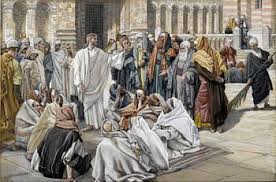
41 Now while the Pharisees were gathered together, Jesus asked them a question, 42 saying, “What do you think about the Christ? Whose son is he?” They said to him, “The son of David.” 43 He said to them, “How is it then that David, in the Spirit, calls him Lord, saying,Jesus and the religious leaders in the Temple

44 “The Lord said to my Lord,
‘Sit at my right hand,
until I put your enemies under your feet’?

45 “If then David calls him Lord, how is he his son?” 46 And no one was able to answer him a word, nor from that day did anyone dare to ask him any more questions.

In the name of Jesus. Amen.

You’ve maybe heard the acronym about the Bible: “Basic Instructions Before Leaving Earth.” Sure, it’s cute, but honestly, it’s horrible because it turns God’s holy and precious Word into a manual of what we must do. If the Bible is about what we need to do and not what God has done for us in Christ Jesus, we’re sunk because we simply cannot do what God commands us to do even if we wanted to, which we don’t.

That is why, when you read the Bible (which I encourage you to do), it is extremely helpful to look for two things – Law and Gospel. Look for God’s commands and His promises. Look for the threats and the blessings. Look for the instruction and for the forgiveness of sins. This Gospel text is a great place to practice this and see how both Law and Gospel depend on each other.

The text has two parts. First, the question the Pharisees ask Jesus along with His answer which is Law. Second, the question or riddle that Jesus gives to the Pharisees which is all Gospel. The text takes place on Holy Tuesday, merely three days before Jesus is crucified. And this day, this Tuesday, was the last day of Jesus’ public teaching. After Jesus silences the Pharisees here, His teaching is only directed to the disciples.

In order to trip Jesus up and get Him in trouble, the religious leaders, the Pharisees and Sadducees, had asked Him several questions. First, He had been asked by the Pharisees about paying taxes to Caesar. Then, the Sadducees asked Him a question about marriage and the resurrection, and He answers it in a way that dumbfounded the Sadducees. And here, in our text, we get the third question.

“Teacher, which is the great commandment in the Law?” And Jesus responds, “You shall love the Lord your God with all your heart and with all your soul and with all your mind. This is the great and first commandment. And a second is like it: You shall love your neighbor as yourself. On these two commandments depend all the Law and the Prophets.”

For centuries, the rabbis had been talking, debating, and arguing about this question. They didn’t know how to answer it. But Jesus rattles off an answer quick as you please. If you want a summary of the all Commandments and condense them down into two statements, it is to love God and love your neighbor – on these two commandments depend (or ‘hang’) all the Law and the prophets. If you want, you can boil the Law down even further to one word, love. Paul says in Ro. 13:10, “Love is the fulfilling of the Law.”

A lot could be said here about the Law, but I’m going to keep it to six simple points.

Holy Spirit open eyes new heartsFirst, love is a beautiful summary of the Law, but that one word, love, does not replace the Law. Many people will say that since we have these two great commandments to love God and love our neighbor that we don’t need the rest of the Law. But that is false. Just because you think you are motivated by love does not mean that you are doing the right thing. We are so fallen that sometimes we try to pit love against the Commandments. Love is never an excuse to sin or an excuse to overlook sin. Instead, the Commandments define the shape of love, which is the second point about the Law.

Love takes shape according to the Commandments. Love is more than a feeling (thank you Boston). Love gives. Love serves. Love dies – greater love has no one than this, that one lays down his life for his friends (Jn. 15:13). If you want to love your neighbor, here is what it looks like: honor your father and mother; don’t murder; don’t commit adultery; don’t steal; don’t bear false witness; don’t covet. If you want to love God, don’t have other gods, keep His name holy, and keep the Sabbath holy. It doesn’t matter if what you do is motivated by love; if it violates or falls outside of these Commands, it is not love. In fact, we could go further and say that, when your actions fall outside of the Ten Commandments, they are motivated by selfishness and hatred toward both God and neighbor.

Third, love is defined by the Commandments, but it also finds and meets your neighbor’s need. What help and service can you give to your neighbor according to the Commandments? If your neighbor is hungry, feed him. If your neighbor is lonely, hang out with him or visit her. If your neighbor is trapped in sin, exhort them and encourage them to repent and ask God for mercy and forgiveness. If your neighbor is not a Christian and suffering spiritually, invite them to church.

Fourth, we love God by loving our neighbor. This is so important. 1 John 4:20 says, “If anyone says, ‘I love God,’ and hates his brother, he is a liar; for he who does not love his brother whom he has seen cannot love God whom he has not seen.” If you want to demonstrate your love for God, you do that by loving your neighbor according to the Commandments and your neighbor’s need. And this starts with those closest to you. Love your spouse first because that is the closest neighbor God has given you. Then, love your children, then your brothers and sisters in Christ, then your friends and coworkers, and so on and so forth.

Fifth, the command to love shows us our sin. There is no time in your life that you can say that you have loved God and neighbor enough. According to the Law, all of us are guilty lawbreakers and sinners. We constantly need to hear the Law tell us that we are sinners so that we are always repentant.

Sixth, and finally on the Law, the Law always shows us our sin, but beware of the temptation to not attempt good works because you are going to fail. When Jesus says, “Be perfect as your heavenly Father is perfect” (Mt. 5:48), don’t just throw up your hands thinking, “Well, that’s impossible so I’m not even going to try.” Get after it. Work. Try. Attempt. And, yes, fail. Then pray. Ask God for forgiveness and mercy. Pray for strength to try again. Pray for wisdom to see your neighbor’s need and how to love them knowing that you are dependent on God’s Law to shape your love for Him and your neighbor.

Now, the Gospel. Jesus silences the Pharisees with His answer, but now He is going to ask them a question. “What do you think about the Christ? Whose son is he?”

They answer correctly. In 2 Sam. 7, God had promised David to raise up one of David’s sons who would sit on his throne forever. There God promised that David’s offspring would be the Messiah, the one to crush the devil’s head, and the one to deliver God’s people. And the Pharisees know it. But Jesus asks a second question based on Ps. 110:1, which is one of the most quoted Old Testament verses in the New Testament, “How is it then that David, in the Spirit, calls him Lord, saying, ‘The Lord said to my Lord, Sit at my right hand, until I put your enemies under your feet’? If then David calls him Lord, how is he his son?”

The Pharisees cannot figure out the riddle from Scripture. How can the Messiah be David’s Son and David’s Lord? The Pharisees were unable to answer this because they didn’t believe that the Messiah would be both God and man. They figured the Messiah would be a man who would get things right and save them.

incarnation of JesusBut, Christian, you know the answer. In fact, you have been taught this and have believed it for so long that you hardly think about it too much. But it is the most amazing thing. Jesus is man, born of His mother. And Jesus is God, begotten of His Father before all worlds. Jesus is man so that He can die, and He is God so that His death can be an atoning sacrifice for our sins.

Because of Christ, the Law has been fulfilled. Yes, it is impossible for you to keep the two great Commandments, but Jesus has done it for you. He has taken on your flesh and blood to deliver you from sin, death, and the devil and give to you everlasting life. This is the Gospel.

Yes, the Law to love God and neighbor is important; on that depend all the Scriptures. But the Gospel is importanter [sic.]. Christian, the Gospel is how and why you will be able to stand before God on the Last Day. Jesus has died for you and put all of your enemies under His feet triumphing over them on the cross (Eph. 1:21-23). On this mercy and grace of God in Christ Jesus you depend. Amen.

The peace of God, which surpasses all understanding, will guard your hearts and minds in Christ Jesus. Amen.

From Commandment to Creed – Sermon on Matthew 22:34-46 for the Eighteenth Sunday after Trinity

Listen here.

Matthew 22:34-46

34 But when the Pharisees heard that he had silenced the Sadducees, they gathered together. 35 And one of them, a lawyer, asked him a question to test him. 36 “Teacher, which is the great commandment in the Law?” 37 And he said to him, “You shall love the Lord your God with all your heart and with all your soul and with all your mind. 38 This is the great and first commandment. 39 And a second is like it: You shall love your neighbor as yourself. 40 On these two commandments depend all the Law and the Prophets.”

41 Now while the Pharisees were gathered together, Jesus asked them a question, 42 saying,“What do you think about the Christ? Whose son is he?”They said to him, “The son of David.” 43 He said to them, “How is it then that David, in the Spirit, calls him Lord, saying,

Psalm 110_1 Footstool44 “The Lord said to my Lord,
‘Sit at my right hand,
until I put your enemies under your feet’?

45 “If then David calls him Lord, how is he his son?” 46 And no one was able to answer him a word, nor from that day did anyone dare to ask him any more questions.

In the name Jesus. Amen.

This Gospel text drops us right into the middle of a conversation that Jesus had in the Temple on the Tuesday of Holy Week with the very people who want to destroy Him. The Pharisees and Sadducees are all trying to trap Jesus and entangle Him in His words. Their purpose is to make either the crowds or the authorities (they don’t care which) turn against Him so they can kill Him and be rid of Him and His preaching.

The first two questions they put to Jesus are about paying taxes and about the resurrection. Both of these questions are designed to take one part of God’s Word and make it contradict another part. And both questions appear to have no good answer. The leaders think that no matter how Jesus answers their question, they will have Him. But they are wrong. Jesus answers both questions leaving them dumbfounded.

Our text begins with the third question. One of the Pharisees, a lawyer, asked Jesus a question, again to test and to trap Jesus in His words.“Teacher, which is the great commandment in the Law?” The purpose of this question is to figure out which Commandment Jesus thinks is most important so that they can find a commandment set against it.

But again, this is absolutely foolish because Jesus knows there is no contradiction in the Law. He is the one who wrote the Law.

Jesus answers, “You shall love the Lord your God with all your heart and with all your soul and with all your mind. This is the great and first commandment.And the second is like it: you shall love your neighbor as yourself. On these two commandments depend all the Law and prophets.”

Now, it is interesting in Mark’s account of this same event, the same questioning, that Jesus says there’s no other commandment (singular) greater than these (plural). Perfect love of God and perfect love of your neighbor go together. It is one commandment. The two are inseparably tied together. Love for God is demonstrated by love for the neighbor.

1 John 4_20-21 Love God and Neighbor


1 John 4:20 
says, “If anyone says, ‘I love God,’ and hates his brother, he is a liar; for he who does not love his brother whom he has seen cannot love God whom he has not seen.”And Jesus says in Matthew 25(:40) that the acts of love that you do toward your neighbor you do toward God. “As you did to the least of these, you did also to Me.”In other words, when you love your neighbor, you are loving God.

So, think about that for a moment. When you are helping, supporting, encouraging your spouse, you are serving both God and your spouse. You are loving both God and neighbor. When you feed your kids, when you obey your parents, when you do your homework, you are serving your neighbor and thereby serving God. Telling the truth, living a caste life, returning a lost wallet or purse instead of stealing, being content with what you have instead of coveting – all of these actions are service to God and your neighbor. Whoever is your neighbor, whoever God puts in your life at any given moment, that is the one whom God wants you to love. And when you love that neighbor, whoever it may be, you are loving God.

While that is so very beautiful, if we stop to think about it, this command to love God and neighbor demands everything of us. And we realize how fallen and sinful we are. This command shows us our desperate need for God to come and rescue us.

With His answer, with His preaching of the Law to love both God and neighbor, Jesus cuts down these people who are trying to trap Him, and He cuts you and I down as well because our sin is exposed. We do not love enough. We never have, and we never will.

But notice Jesus doesn’t take the conversation in that direction. He doesn’t ask them, “How are you doing with loving God and your neighbor?” Jesus doesn’t continue to have a conversation about the Law.

Instead, Jesus moves away from questions about the Law to the Creed. The Law is good and important. It shows us the nature and will of God, but the Law always shows us our sin. The Law tells us what we must do, but it always tells us what we have failed to do.

But the Creed shows us how God is toward us. The Creed isn’t about what we must do, it is the Gospel. It is what God has done for us. In the Creed, we confess that God is the Father who created us sent His Son who redeemed us and gives us the Holy Spirit who sanctifies us and makes us holy.

So, Jesus moves away from the Law to the Creed. He asks them, “The Messiah, whose son is he?”And they were right when they say, “David’s son.”God had promised to send David a son who would sit on David’s throne forever (1 Sam. 7). But David also wrote in Psalm 110:1, which is the verse that Jesus quotes, that this Son is also David’s Lord. So, Jesus’ question is, “How can the Messiah, David’s son, also be David’s Lord?”because a father would never call his descendent, “Lord.”

Now stay with me here: The reason Jesus asks this is that He is teaching the Pharisees, the crowds, and you that the Messiah is both God and man.

Because the Messiah is both God and man, He has kept the Law for you. Jesus perfectly loved God and your neighbor for you. And through faith, Jesus declares that what He has done perfectly, you have done as well (2 Cor. 5:21).

The Law says, “Honor thy father and mother. Love them as yourself.” And you are left saying, “God, I haven’t done that. I need Your help.” If it weren’t for the Creed, if the Messiah weren’t man, God would have to say, “Well, I’m God. I don’t have a father or mother, so I can’t help you. You have to do that yourself.” But God did become a man. Jesus had a mom and a dad. He did love and honor them perfectly. So, He can and does help you. And you can apply this to each and every one of the Commandments.

But most importantly, when you hear the law and know that you have sinned, you know that you deserve death. You deserve the eternal wrath and judgment of God. So, you pray, “God I’m lost. I deserve only death, could You die for me?” Because God has taken up your nature, God says, “Sure. I already have.”

Communion Cross with JesusStop playing games with the Law, there is no contradiction in it. Instead, believe. Believe that Christ has come for you. He has given His life for you. God has purchased you with His own blood (Act. 20:28). He has removed the curse of the Law from you because He has perfectly kept the Law for you. And He gives you His perfection, His righteousness, His holiness.

And, now, He invites you to have your faith strengthened. He invites you to receive His perfect Body and His holy Blood in Bread and Wine. He invites you to come and taste that He is good. Amen.

The peace of God, which surpasses all understanding, will guard your hearts and minds in Christ Jesus. Amen.