In the name of Jesus. Amen.
Two people can use the exact same words and mean opposite things. For example, if someone says, “I want space,” you need to know who is talking. A person stuck in a crowd might yell, “I want space!” They want others to clear out so they can be alone and breathe. A newlywed looking to buy a house might tell the realtor the same thing, “I want space!” She means room for kids, and for large family Christmas gatherings. The first person wants space from others. The second wants space for others.
The lawyer in this text wants space in all the wrong ways. He wants space from the Law’s accusations. And to stay free of those accusations, he wants space between himself and his neighbor.
Luke tells us why the lawyer asks what he asks. That is unusual, and it’s important. A lot of people come to Jesus because they are desperate. This man is not. He stands up to test Jesus, to trip and discredit Him. “Teacher, what shall I do to inherit eternal life?” (Lk. 10:25). Part of that is right. Eternal life is an inheritance that belongs to the children of the eternal God. The problem is the first half, “What shall I do?” You do not do anything to inherit. An inheritance is given.
The lawyer wrongly thinks the Law is a ladder. He imagines that if he can climb high enough on that ladder, he can reach God. But eternal life doesn’t come that way (Gal. 3:18, 21). The Law is good. It tells you how God made creation to work. It shows you that you need mercy. What it cannot do is get a sinner to heaven. That only comes by promise to those who believe (Gal. 3:22).
So Jesus answers a Law question with the Law. “What is written in the Law? How do you read it?” (Lk. 10:26). The lawyer does well with his response. He stitches Deuteronomy 6 and Leviticus 19 together, the same way Jesus does (Mt. 22:37-40). Love God with everything you are, and love your neighbor as yourself (Dt. 6:5; Lev. 19:18). And Jesus confirms his answer, “Correct! Do this, and you will live”(Lk. 10:28).
The problem isn’t the answer. The problem is the man. He can’t do it. So he looks for a smaller law. A kind of law that puts limits on God’s command. A kind of law that leaves enough space so he can set up his ladder and climb.
That’s the lawyer’s second question, which sounds holy but is not. Desiring to justify himself, the lawyer asks, “And who is my neighbor?” (Lk. 10:29). He is not asking for more people to love. He is asking who he can skip. If Jesus would put a limit on the extent of the lawyer’s love, he can stand inside that circle and call himself righteous. He wants space between himself and God’s command to love. But even the context of the passage the lawyer just quoted will not give him that space.
Our Old Testament reading (Lev. 19:9-18) is the home of that verse. There, God does not allow His people to harvest the field all the way to the fence. They had to leave a strip. Do not pick the vineyard clean. The fallen fruit is from their land, but God says it belongs to the poor and the sojourner (Lev. 19:9-10). Then God gives commands about people who are closer. Do not oppress your neighbor. Do not hold a hired man’s wages overnight. Do not hate your brother in your heart. Do not take vengeance or bear a grudge. “You shall love your neighbor as yourself: I am the Lord” (Lev. 19:18). In short, the stranger has a claim on the edge of your field. Your brother has a claim on the inside of your heart. God’s Law demands love for the near neighbor and for the one you would prefer to keep at a distance.
There is an order to that love. God has not dumped every neighbor on you at once. He has put some people closer—the people in your house, in this congregation, the worker whose paycheck sits in your hand. Those are the first neighbors you are called to love. And that is good. A father who lets his own children go hungry so he can feed other children he will never meet is not a better Christian. He is missing the people God has set right in front of him (1 Tim. 5:8; Gal. 6:10).
But that order is not a fence. It does not let you un-neighbor the person God puts in front of you. The lawyer wants a fence. Leviticus doesn’t give him one. Neither does Jesus. That’s why Christ tells the parable.
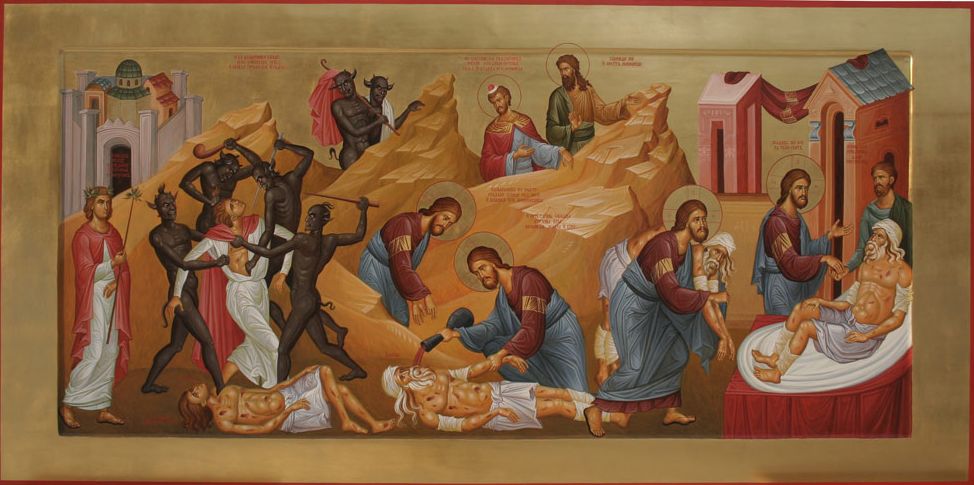
A man is traveling from Jerusalem to Jericho. He falls among robbers who strip him, beat him, and leave him half-dead in the ditch (Lk. 10:30). A priest sees him and swerves to the other side. A Levite does the same. God puts a needy man at the feet of these holy men, but they make space. A few feet was all the justification they needed to avoid helping him that afternoon. Then a Samaritan stops. He binds up the man’s wounds, pours on oil and wine, sets the man on his own animal, brings him to an inn, and opens a limitless tab. He promises the innkeeper, “Whatever more you spend, I will repay you when I come back” (Lk. 10:35).
Jesus will not answer the lawyer on the lawyer’s terms. He does not give the lawyer a list of who counts as a neighbor and who doesn’t. He asks which of the three became a neighbor to the man who fell among the robbers. That question shines a spotlight on the lawyer’s desire to create space from the Law’s demand to love.
Notice that the lawyer refuses to answer in the simplest way by saying, “The Samaritan.” He won’t admit that the Samaritan did the right thing. He won’t even say Samaritan and mercy in the same sentence. Instead, he says, “The one who showed him mercy” (Lk. 10:37). He will name the deed but not the man. He still wants space from the neighbor Jesus just set in front of him.
Dear saints, whenever you hear this parable, consider which character represents you. You are not first the hero Samaritan or even the priest or Levite. You are the man in the ditch. The Law can walk past you and refuse to help you, and the Law would still be just and correct to do that. The Law is good, but it can only tell you what love looks like. The Law cannot put you on its animal.
Jesus does. He is the Good Samaritan. He was despised and rejected (Is. 53:3) like a Samaritan. But He is the One who stops. He comes all the way down from heaven, all the way over to the ditch where you lie—the ditch that the Law cannot get you out of. He puts Himself in the road with you. He binds what you cannot bind. He pays what you cannot count. He does not want space from sinners. Instead, He makes space for you in His kingdom. The Church is the inn. His Word and Sacraments are the medicine of oil and wine. He pays your bill. You are not here because you guessed the neighbor-question correctly. You are here because Jesus would not pass by you on the other side.
So, when Jesus says, “You go, and do likewise” (Lk. 10:37), He isn’t giving you another ladder to climb. Apart from Him it would be. In Him, it is the shape of a life that has already been paid for. Love the people God has placed closest to you. And when the road gives you a neighbor you did not choose, do not step to the other side. Do not make space from him. God has given you space for him.
Yes, it’ll cost you to love that neighbor. But know that because Jesus has rescued you from the ditch, whatever that love costs you is already covered by Christ’s account. Amen.
The peace of God, which surpasses all understanding, will guard your hearts and minds in Christ Jesus (Php. 4:7). Amen.


You must be logged in to post a comment.