In the name of Jesus. Amen.
“Be careful what you ask for because… you just might get it.” Habakkuk asked God to do something about the sin and violence that surrounded him. God did.
This reading from the end of Habakkuk makes more sense if you know what came before it. Thankfully, summarizing the book of Habakkuk is easy because it’s only three chapters long. The first two chapters are two complaints from Habakkuk (Hab. 1:2-4, 12-2:1) and two responses from God (Hab. 1:5-11, 2:2-20). The book concludes with Habakkuk’s psalm of praise (Hab. 3), which you just heard.
The book starts with Habakkuk praying and asking God to act. He had looked around at his land and countrymen and all he could see was violence, injustice, and sin. He cried out, “God, how long am I going to cry to You, and yet You won’t hear? How many times am I going to point out all the violence, but You don’t do anything? All I can see is sin, destruction, contention, and strife. The wicked surround the righteous. But You just keep twiddling Your thumbs” (Hab. 1:2-4).
God answered, but not in the way Habakkuk expected. God didn’t say that He would start a revival or send a spiritual awakening. Instead, God answered, “I’ll send Babylon, that bitter and hasty nation, with all their military might” (Hab. 1:6a). Then, God talks about how dreaded, fearsome, and violent Babylon is (Hab. 1:7-9). He highlights their pride and arrogance, how Babylon isn’t afraid of anything, and how they laugh at the kingdoms and castles they have demolished (Hab. 1:9-10). God even mentions that they are so prideful that they worship their own might as a god (Hab. 1:11). Babylon—a ruthless, pagan people—is going to be God’s answer for the sin and idolatry of His own people.
Habakkuk isn’t too keen on God’s plan. In his mind, that cure was far worse than the disease. He tries to get God to pump the brakes on His plan, but Habakkuk does it in an extremely arrogant way. He basically tells God, “This plan is no good. You’re too holy to use Babylon like that. I’m going to stand on my mountain of right and wait for You to change Your mind” (Hab. 1:12-2:1).
The majority of chapter 2 is God telling Habakkuk to wait, to trust Him, and to remember that the righteous shall live by faith (Hab. 2:4). He has it all under control, and He’ll deal with Babylon’s sins in His time. That leads to this final chapter, which is Habakkuk’s psalm of trust.
In a way, the whole book is about how God formed and shaped Habakkuk. He began as a man who thinks God is snoozing on the job and who arrogantly tells God, “You don’t know what you’re doing.” But Habakkuk ends up with this bold, confident trust in God’s plan. In a lot of ways, the book of Habakkuk parallels the book of Job. It’s like a bite-sized version—just without the boils and round after round of friends giving bad advice and offering sham comfort.
With that in mind, look again at v. 17 of our text. Habakkuk goes through this list of things that could fail. The fig tree, the vines, the olive trees, fields, flocks, and herds. To our modern ears, sure, that all sounds bad. To the people of Habakkuk’s day, it sounded like the end of the world.
That list of things that could fail crescendos. It doesn’t start out so bad. Figs were generally considered a delicacy, almost like a candy bar. They were nice to have around, but you can live without figs. No fruit on the vines means no grapes and wine. Wine was part of feasting, and it was mixed into ordinary drink. It was more common than figs, so more people would miss it, but you can live without wine. Olives are where things start to get more serious. They used olive oil to bake many things and to light lamps at night. Losing olives would almost be equivalent to your power going out. The flocks and herds at the end were the sources of transportation, work, clothing, and food.
Today, we have ways to adapt if these types of things disappear. The people of Habakkuk’s day didn’t. This isn’t just empty shelves at the grocery store. This is no planes, trains, or trucks coming with product from somewhere else. On top of that, there is no production from the fields. This isn’t just power lines being down and waiting hours or days for the electrical grid to be restored. This is the very plants and dams that produce electricity being destroyed.
This scenario Habakkuk imagines isn’t something you adapt to because every alternative is completely blocked. That kind of devastation would take years or even decades to recover from. Notice (this is important), this isn’t actually happening as Habakkuk sings this song. However, it is likely that all of this will happen. Habakkuk knows God’s plan—Babylon is coming. Habakkuk doesn’t know when, but he knows that. They’re ruthless and brutal. So, he looks into the future that he knows is going to be horrible. It isn’t happening yet. But Habakkuk resolves what he will do when all of this takes place.
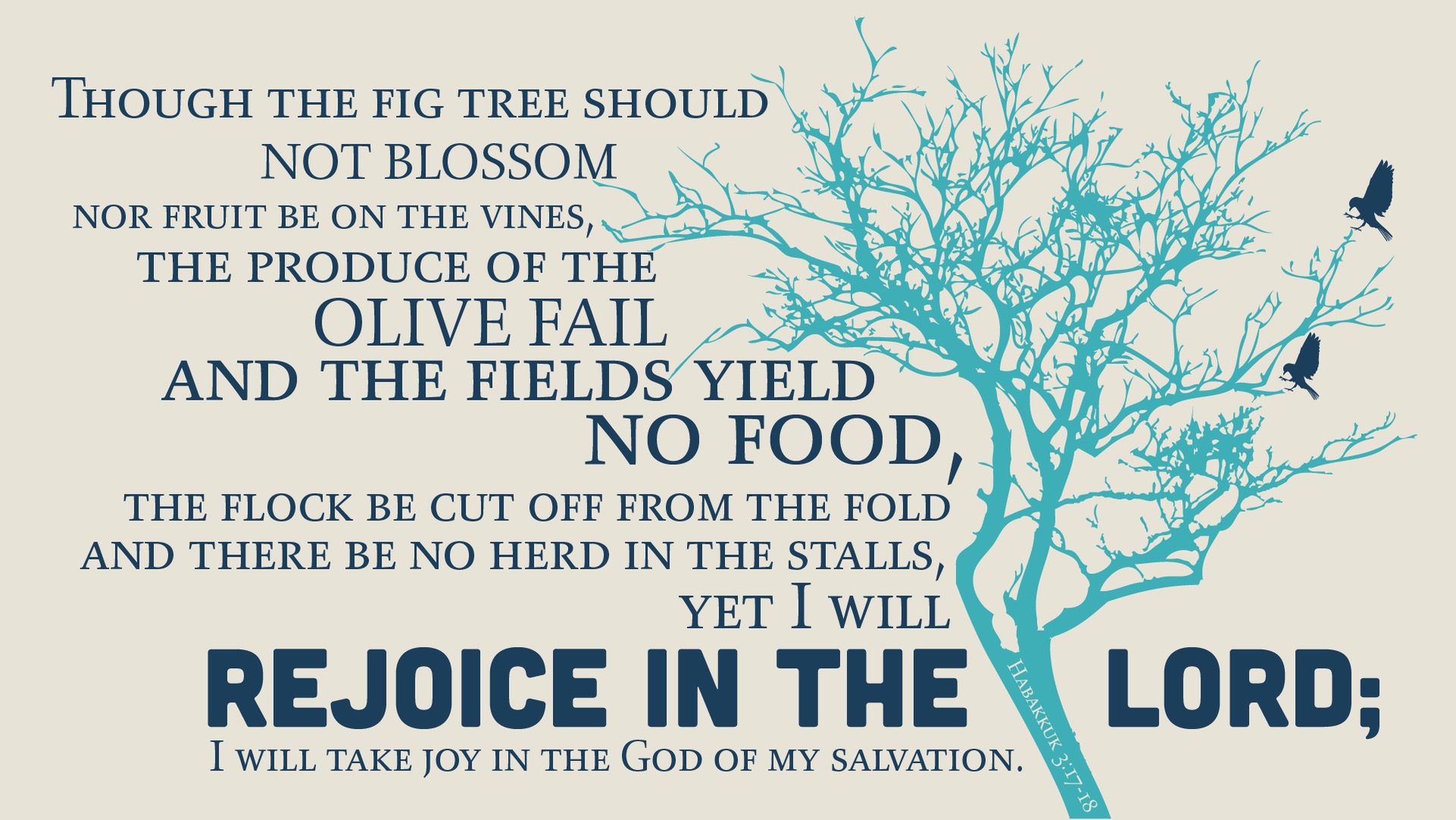
Habakkuk says, “Though all of that should happen, …yet. Yet I will rejoice in the Lord; I will take joy in the God of my salvation” (Hab. 3:17-18). This is defiant joy. And he has this defiant joy because he looks to the past.
Look again at v. 13. When God goes out, He goes out for the salvation of His people. Habakkuk isn’t just mustering up some good feelings. He is remembering and singing about history—specifically the Exodus out of Egypt and the crossing of the Red Sea. He remembers God crushing the head of the wicked and trampling the sea with His horses (Hab. 3:13-15). When they were in Egypt, Israel didn’t have their own horses or a navy. Pharaoh did. But God sent His hosts so the waters became a grave for the enemy and a road for His people.
Habakkuk uses the past as a lens to look at a future that he already knows will be terrible. Babylon is coming, and when it does, the figs may not blossom, the vines and olive trees may fail, the fields may yield no food, and the flocks and herds may disappear. The whole thing fills Habakkuk’s bones with rottenness (Hab. 3:16). Habakkuk doesn’t say that the collapse will be fine. Instead, he says that even if it comes, he already knows that God is at work to save His people. That’s what God has done in the past, and that is what God has promised to do in the future.
Dear saints, the future is out of your hands and full of unknowns. Staring at all those unknowns is the recipe for a life full of worry. Go ahead and glance at the unknowns long enough to name them, but don’t stare at them.
Remember the past. God goes out for the salvation of His people. He has gone out against Pharaoh, and He promises Habakkuk that He’ll take care of Babylon. But most importantly, you can look to the past where God has gone out against the serpent, the enemy of all mankind. When it was time to deal with your greatest enemies—sin, death, and the devil—God didn’t send another evil empire. He sent Christ, His Son. Jesus is the God of your salvation who endured God’s wrath against your sin and went to His death for you. Now, He is risen and ascended to reign on the throne of all creation.
The future is out of your control, but it was never supposed to be in your control. It is in the nail-pierced hands of the God who has already gone out for your salvation. That’s why you can have the same kind of defiant joy that Habakkuk has here. Because of what Christ has done, you don’t have to wait for figs to come back. You can stand in front of barren fields and empty stalls and sing about your God who splits seas. More than that. You can look at the grave—the grave of your loved ones or even your own grave—and declare that your Savior has already defeated it.
Dear saints, your God is your strength right now. Right now, He makes your feet like the deer’s. He makes you tread on your high places (Hab. 3:19). This is not a mood that you feel. It is what Christ is doing for you now, whether you feel it or not.
The future will always be full of things you cannot manage. But you don’t have to wait for your circumstances to get better before you can sing. Christ is your strength right now, and He will never leave you. Sing with Habakkuk now, before trouble comes, and even after it arrives: “Yet I will rejoice in the Lord; I will take joy in the God of my salvation” (Hab. 3:18). Amen.
The peace of God, which surpasses all understanding, will guard your hearts and minds in Christ Jesus (Php. 4:7). Amen.


“Defiant joy” is such a great way to put it. Though I have to admit, feeling that kind of joy when things are falling apart is a lot easier said than done.
Indeed.