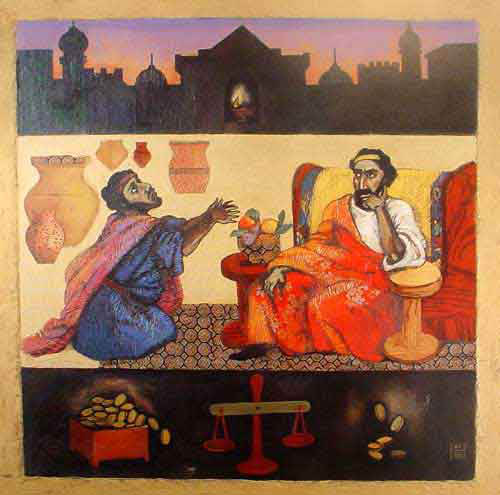
Escape – Sermon on 1 Corinthians 10:6-13 for the Ninth Sunday after Trinity

1 Corinthians 10:6-13

6 Now these things took place as examples for us, that we might not desire evil as they did. 7 Do not be idolaters as some of them were; as it is written, “The people sat down to eat and drink and rose up to play.” 8We must not indulge in sexual immorality as some of them did, and twenty-three thousand fell in a single day. 9 We must not put Christ to the test, as some of them did and were destroyed by serpents, 10 nor grumble, as some of them did and were destroyed by the Destroyer. 11 Now these things happened to them as an example, but they were written down for our instruction, on whom the end of the ages has come. 12 Therefore let anyone who thinks that he stands take heed lest he fall. 13 No temptation has overtaken you that is not common to man. God is faithful, and he will not let you be tempted beyond your ability, but with the temptation he will also provide the way of escape, that you may be able to endure it.

In the name of Jesus. Amen.

When you’re nearing the end of a task or a project, that’s not the time to get lazy, sloppy, or careless. As you get near to the goal, you need to pay close attention to what you’re doing and finish strong and make sure that you are doing things right. You’ve maybe seen replays from football games where a receiver or kick returner makes an amazing play, outruns the defense, and is about to cross the goal line. But he starts celebrating a few inches too soon and drops the ball right before the endzone. That one, careless act erases everything that he did before.

Well, here, Paul says that the end (τέλος, ‘the completion’) of the ages has come (1 Co. 10:11). And remember, he’s saying this to Christians nearly 2,000 years ago. Since it was true way back then then, it’s even truer now. Paul is encouraging us to finish strong and cross the goal line. He says, “Let anyone who thinks that he stands take heed lest he fall,” (1 Co. 10:12). In other words, don’t fall away, don’t fumble the ball, when you are so close to Christ’s return.

Plain as day, Paul tells us exactly what might drag us down and cause us to fall. In the opening verses of 1 Co. 10, he invites us to think about all the ways God’s people sinned, rebelled, and were judged after God had delivered from slavery in Egypt. He reminds us how they fell into idolatry, sexual immorality, and grumbling, causing them to be destroyed. Paul says that those things took place as examples for us.

Even though they had had God’s protection under the cloud, even though they had God’s miraculous deliverance and passed through the sea, even though they were all baptized in the cloud and in the sea, even though they ate the same spiritual food we eat and drink the same spiritual drink we drink – even though they had all those blessings from God, they were overthrown. So, Paul warns us to not be like them. To not be idolatrous, going after our own golden calves, and to not indulge in sexual immorality. To not put Christ to the test and become destroyed.

We need to learn from their example so that we don’t stumble and fall into temptation and sin right before the end of the ages. Christ is returning, and we need to persevere. If you think that you stand on your own, repent. You’re in big trouble and are about to fall (1 Co. 10:12).

Paul concludes here in v. 13, “No temptation has overtaken you that is not common to man. But God is faithful, and he will not let you be tempted beyond your ability. But with the temptation, he will also provide the way of escape, that you may be able to endure it.”

So according to Scripture, we need to learn from from the failures of others, because we are also prone to fall. We face the same temptations they did, but God is – and always will be– faithful to provide the way of escape. Often in ways that we don’t expect.

Everyone faces the same temptations. Now, being tempted is not a sin. But coveting is a sin. That’s why God gives us the final two Commandments about coveting. Coveting is the stealth bomber of sin. It flies under the radar of your conscience. Your conscience usually detects the sins that you commit in an outward way. But the sin of coveting is committed in an inward way.

You might feel guilty about replying to your spouse or someone else in an angry way that is rude and inconsiderate. But you might not be too troubled about feeling anger if you don’t let that anger out. To be clear, both of those are sins need forgiveness. Both need repentance and faith. But the 9th and 10th Commandments about coveting show that God’s Law governs even our inner thoughts, feelings, and emotions. You’ve heard this before, but it’s worth repeating over and over again. Scripture equates coveting with idolatry (Col. 3:5Eph. 5:5).

Coveting is, basically, saying, “God, You messed up. That thing over there should be mine over here.” When we realize that coveting is idolatry and is how we place ourselves above God, then coveting becomes gross and disgusting. Don’t falsely desire what God hasn’t given you. Let God be God.

So, the devil, the world, and our own sinful flesh always tempt us first to covet. They will put things in front of us that we think should be ours. Coveting is the way in which we begin to break any/all of the commandments.

But look closely at verse 13, and you’ll see three comforting truths:

First, the temptations that you face are not unique. Yes, the devil, the world, and our own flesh will individually tailor certain temptations to each of us. But everyone is tempted by the same things. Maybe in different ways, maybe through different processes, but the things that tempt you are the same things that tempt others as well.

Second, God is faithful and will not allow you to be tempted beyond your ability. God knows precisely how much weight, how much pressure, of temptation you can bear. Imagine temptations as ropes or chains that the devil would use in order to pull you toward sin. Satan cannot use ropes or chains that are too strong for you. God simply doesn’t allow it. Those chains of temptation will completely snap at the exact weight that God Himself has determined. But also, realize what that means: 

Whenever you or I sin, we aren’t pulled into that sin by forces stronger than us. No. We just didn’t fight back long or hard enough for those cords to break. In other words, when we sin, we jump headfirst into those pits. So, fight back. Fighting temptation isn’t just a mortal combat for your physical life. It’s an eternal combat for your soul. If you want to see the chains of temptation snap, just read Mt. 4 or Lk. 4 to see how Jesus resists the devil’s temptations.

The third promise that God gives here in v. 13 is that God will provide the way of escape. You have an escape out of temptation. Sometimes, people will misconstrue v. 13 and say things like, “God won’t give you more than you can handle.” On the one hand that’s true, but it’s only half true. And half-truths are often worse than blatant lies. That phrase places all the weight of fighting temptation on you and your own psychological capabilities. That phrase is basically saying, “You just need to be mentally strong enough to handle it.” Well, God gives something much better than that. He gives a way of escape.

Think of Joseph. Joseph gets attacked by his brothers and thrown into a pit, but Joseph can’t handle staying in the pit the rest of his life. So, God gives an escape, and that escape is that he is sold as a servant to Potiphar in Egypt (Gen. 37:2839:1). Later, Joseph can’t handle Potiphar’s wife asking him day after day to fornicate with her. So, God gives Joseph another escape by putting him safely into an Egyptian prison (Gen. 39:7-20).

In Joseph’s life, we see that God causes all things – even things we think are bad or horrible – to work together for good for those who love Him and are called according to His purpose (Ro. 8:28). 

In every temptation, God gives a way of escape. I know that example of Joseph might not be comforting, so think of Paul himself. In 2 Cor. 12:7-10, he talks about having a thorn in his flesh. He prays three times that God would remove that thorn, but God’s response is simply, “My grace is sufficient for you, for My power is made perfect in weakness.”

It may be that your escape from temptation is only going to come through other trials, like it was for Joseph. Or, it may be that your escape from temptation is God’s promise of His continual grace, like it was for Paul. But ultimately, your way of escape is coming because Christ is returning.

Believer, Christ is returning to bring you to the new creation. The end/completion of the ages and the resurrection of the body is the ultimate escape from temptation. So, press on in your fight against temptation and sin.

Rose, that brings me to you. Rose, today you are baptized, not just into Moses, but into the name of the Father, Son, and Holy Spirit. Now, Rose, you bear His name (Mt. 28:19). Persist. Persevere. Fight against the temptations that the devil, world, and your own flesh will throw at you.

And all you dear saints, you fight too. To strengthen you in that fight, Jesus now invites you to His table. Here, He delivers His Body and Blood, given and shed for the forgiveness of all your sin. Here, you receive God’s grace and mercy. Here, you see God’s faithfulness to you. Resist, fight, flee temptation because the end of all things is at hand. Amen.

The peace of God, which surpasses all understanding, will guard your hearts and minds in Christ Jesus. Amen.

Implanted – Sermon on James 1:16-21 for the Fifth Sunday of Easter

James 1:16-21

16 Do not be deceived, my beloved brothers. 17 Every good gift and every perfect gift is from above, coming down from the Father of lights, with whom there is no variation or shadow due to change. 18 Of his own will he brought us forth by the word of truth, that we should be a kind of firstfruits of his creatures. 

19 Know this, my beloved brothers: let every person be quick to hear, slow to speak, slow to anger; 20 for the anger of man does not produce the righteousness of God. 21 Therefore put away all filthiness and rampant wickedness and receive with meekness the implanted word, which is able to save your souls.

Alleluia! Christ is risen! He is risen indeed! Alleluia!

In the name of Jesus. Amen.

Even as we live in a broken and fallen world, God continues to shower His good gifts upon us. Everything good in your life – your family and friends, the air you breathe, the tasty food waiting for us downstairs, the green leaves on the trees, and the cushioned chairs under your posteriors – all of it comes from the Father of lights, the almighty Creator of the universe. And your heavenly Father isn’t stingy. His good gifts started immediately at the beginning of your life, the moment of your conception. He intricately weaved you together in your mother’s womb, and He has and will sustain you all the days of your life with His good gifts (Ps. 139:13-16). And God still gives more.

On top of His good gifts, God gives perfect, complete gifts that also come ‘from above.’ In these verses, James uses language that echoes what Jesus says in Jn. 3. That only those who are born again, or ‘from above,’ (same word) by water and the Spirit will see the kingdom of God. The greatest and perfectest [sic.] gift God has given you is the new, from-above birth that James mentions in v. 18. This new, spiritual birth is yours through faith. “Of [God’s] own will, He brought you forth.” And God didn’t even wait for you to begin living to give you this gift of new birth and salvation. Before God created all things, even before the foundation of the world He had inked your name in the Book of Life (Mt. 25:34Eph. 1:4-52 Tim. 1:9).

Dear saints, you didn’t earn your place in God’s family. God freely gave it. That’s how you were and are and remain saved. It isn’t your work; it’s God’s perfect gift. Period. In your Baptism, God gave you the gift of faith as He implanted His life-giving Word into you. And the Holy Spirit has watered and nurtured that Word so that it would grow, mature, and bear fruit. Micah and SidaLee, today you aren’t earning God’s gift or approval. Instead, you are simply publicly acknowledging the gift you have received from Him as you stand, rooted where God has planted you.

Micah, SidaLee, and all you saints, count on God continuing to give His good and perfect gifts to you. Don’t be deceived into thinking that you can reach out and grab those gifts before God gives them. Our reading starts, “Don’t be deceived.” It’s a good translation, but the word James uses has a nuance to it of following the wrong path.

You would be utterly and sinfully deceived to think that you can snatch God’s good gifts before God gives them. That is the path of filthiness and rampant wickedness where those gifts cease to be gifts. It is the path of darkness that only leads to more darkness. The devil, the world, and your own flesh will try to lure you down that path of darkness to your eternal death. Do not go down that path.

But that is not the path you are on, Christian. Your path is to recognize the good and perfect gifts for what they really are – gifts from your Heavenly Father, your merciful Savior, and your comforting Holy Spirit. Your path is illumined by the true, eternal, inerrant, infallible, Word of God that is a lamp to your feet and a light to your path (Ps. 119:105). And you can know without a doubt that Word will never fail you.

Christ Himself is that Word, and there is no shadow, no shiftiness, no variation in Him. The sun sets, and the moon goes down. But Christ does not. Even though Christ describes this path as narrow and difficult (Mt. 7:13-14), you can confidently and safely run down that path with your eyes fixed your eyes on Christ, the Author and Perfector of your faith (Heb. 12:1-2). That confidence comes because He has implanted His Word in you.

I have to apologize for mixing metaphors about going down a wrong path on the one hand and being planted on the other hand. But it’s what the Holy Spirit inspired James to do. So, I guess, I’ll do it too.

Receive the implanted Word. A tree doesn’t need go off on a journey to find more nourishment to grow taller and bear more fruit. Instead, it stretches wider – both with branches and roots. That stretching enables that tree to receive more and more. And the more it receives, the more fruit it bears.

By God’s will, you were brought forth, planted, and are continually nourished because your God is a giver. With a giver, you can receive or reject, but you can’t make a deal. The giving-God doesn’t play around with negotiations, and you cannot make a deal with Him because you have nothing to offer that isn’t His already.

Be comforted. God doesn’t tire of giving. He just gives more. He would have all of you open your hands wider to keep receiving His good and perfect gifts. And if you are worried that His gifts will get too big and overwhelm you, there is a simple solution: Join God in His giving game.

Because God continues to pour out His gifts and blessings on you, you know that you are free to bless others and join God in giving His gifts away. Your giver-God pours out His good and perfect gifts on you because He has made you His child. With each gift, He nudges you to open your hands wider to both to receive from Him and give to others as well.

So, Micah, SidaLee, all you saints, open your hands wide to receive God’s good and perfect gifts (Ps. 81:10). Always continue to receive the implanted Word which saves your soul and delivers the righteousness of God to you now and always. Amen.

Alleluia! Christ is risen! He is risen indeed! Alleluia!

The peace of God, which surpasses all understanding, will guard your hearts and minds in Christ Jesus. Amen.

Waiting & Receiving – Sermon on Isaiah 40:25-31 for the Fourth Sunday of Easter

Isaiah 40:25-31

25 To whom then will you compare me, 
that I should be like him? says the Holy One. 
26 Lift up your eyes on high and see: 
who created these? 
He who brings out their host by number, 
calling them all by name; 
by the greatness of his might 
and because he is strong in power, 
not one is missing. 

27 Why do you say, O Jacob, 
and speak, O Israel, 
“My way is hidden from the Lord, 
and my right is disregarded by my God”? 
28 Have you not known? Have you not heard? 
The Lord is the everlasting God, 
the Creator of the ends of the earth. 
He does not faint or grow weary; 
his understanding is unsearchable. 
29 He gives power to the faint, 
and to him who has no might he increases strength. 
30 Even youths shall faint and be weary, 
and young men shall fall exhausted; 
31 but they who wait for the Lord shall renew their strength; 
they shall mount up with wings like eagles; 
they shall run and not be weary; 
they shall walk and not faint.

Alleluia! Christ is risen! 
He is risen indeed! Alleluia!

In the name of Jesus. Amen.

One of the greatest spiritual dangers that we all face is that, as we go through difficulties in life, we forget very obvious things – especially the fact that God loves us and is in control of all things. But it’s not as though you’ve actually forgotten it. It’s just that you don’t believe it. You don’t live your life in what you know to be true.

Smack in the middle of this text, God asks a question, and it sounds like He asks it out of frustration. “Why do you say, ‘My way is hidden from the Lord, and my right is disregarded by my God.’?” God doesn’t even wait for an answer. Instead, He addresses His question with a question. “Have you not known? Have you not heard? The Lord is the everlasting God, the Creator of the ends of the earth. He does not faint or grow weary; His understanding is unsearchable.”

Your God doesn’t wear out like you and I do. It’s not as though He needs to go sit in His lazy chair and kick His feet up to take a nap. He never encounters a situation where He isn’t quite sure what to do. We have known and we have heard that God is everlasting, that He is the Creator of the ends of the earth who does not grow faint or weary. We know that God has infinite understanding, that He gives power to the faint and strength to the weak. Our problem is that we don’t live like that is true. We encounter difficulties and live as though God does none of those things.

Dear saints, your God created every single star in the universe. Scientists guess that there are somewhere between 100-400 billion stars in our Milky Way galaxy. They don’t know the exact number, but that’s the estimate. Think about this – even if we took the small end of that estimate – if it only took God one second to name each star, 100 billion seconds is equivalent to 3,171 years, 66 days, 17 hours, and 46 minutes. And that’s just our galaxy.

Scientists estimate that there are between one to two trillion galaxies. Honestly, it wouldn’t surprise me that as we learn how to look farther we found out that the universe is even bigger than that. And it was nothing for God to create all those things. God created all of those things simply by speaking, “Let there be lights in heavens,” (Gen. 1:14) and there they were. Every one of them with a name and carefully placed in its position by your mighty God.

Now, contrast that with how God created you. When God created Adam, He didn’t simply speak. He got down into the mud and dirt and dust. He molded, formed, and shaped you from that dust and breathed into your nostrils the breath of life (Gen. 2:7). He intricately knitted you together in your mother’s womb (Ps. 139:1315).

Beyond that, God saved you by taking on your flesh and blood. He entered into His creation and subjected Himself to the weariness and fatigue that you endure (Jn. 4:6). Christ knew suffering and pain (Is. 53:3). Jesus did all of this to step between you and the wrath of God that you and I deserve because of our sin. He came to die and rise again in order to win you as His own.

In other words, God is much more invested in you than all the rest of creation. He’s more interested in what goes on in your life and what happens with you than with all the stars and galaxies that He calls by name. Again, we know this, but by the way we often live, it sure doesn’t look like it. Instead of waiting upon the Lord and soaring like eagles, we flap around like chickens.

I’m no expert on chickens, but the few times I’ve seen them “in flight” it’s pretty unimpressive. When they do get airborne, it’s usually because they’ve jumped as high as they can. They beat their wings – feathers flying all around. And the best they can do is just to fall less quickly. That’s the picture of us when we aren’t waiting upon the Lord. The best we can do in our own strength is fall a bit slower.

Eagles are completely different. This past Tuesday, Sarah and I just got to watch three eagles soaring in the distance. I don’t know what they were looking at, but for, maybe, five minutes they kept circling round and round. They would swoop down periodically, but then they would ascend on the invisible updrafts. The whole time we watched those eagles, none of them flapped their wings even once. They were just lifted by those updrafts. Those huge birds didn’t need to extend any effort to fly.

Dear saints, that is the picture of those who wait upon the Lord. This waiting on the Lord isn’t simply marking off time and watching the minutes and seconds tick by. This waiting is living in a confident expectation of God’s action on our behalf. This waiting is simply resting in God’s mercy which lifts us up to heaven. Romans 4:5 puts it this way, “To the one who does not work but believes in Him who justifies the ungodly, his faith is counted as righteousness.”

I’ll confess my own weakness in this. I’m not good at waiting. I don’t like doing it. I don’t have the patience I should have. Waiting is difficult, and I suspect this is true for all of us. We wrongly live as though everything around us is dependent upon our work, our effort, our wisdom. We think we have to get everything figured out on our own. It’s exhausting. Waiting might feel like we’re descending or, even, free-falling. But this waiting is waiting in faith where we receive from God, and He lifts us up.

I want to change gears for a minute to talk about this upcoming sabbatical. Dear saints, my prayer for this sabbatical is that all of us would come to a better understanding that this is God’s congregation and that He is more interested in His Word being proclaimed here than we are. I’ll confess that I start to slide into the sinful attitude that certain things are dependent on me and what I do. If that were actually the case, you, dear saints, are in deep trouble.

So, during this sabbatical, I’m going to do my best to rest. In 1 Co. 3:5-7, Paul tells the congregation in Corinth that he and other pastors are nothing. He says, “I planted, Apollos watered, but God gave the growth. So neither he who plants nor he who waters is anything, but only God who gives the growth.” This sabbatical will help all of us remember that.

God loves His church. He loves this congregation. He is more ready to give than we are to receive. So, thank you for the gift of this sabbatical so I can stop, wait, and receive from God for an extended time. I trust that God will use this time to renew and refresh me in ways that will benefit me and in ways that will benefit you.

May God remind all of us that when we are weary and exhausted that He is our strength. He is the One who lifts us up by His mercy and grace. His incomparable love carries us along. He protects and keeps us. He grows His church. He forgives our sins. He makes a place for us in eternal life through His inexhaustible love and work for us in Christ Jesus. May we all wait and receive from Him. Amen.

Alleluia! Christ is risen! 
He is risen indeed! Alleluia!

The peace of God, which surpasses all understanding, will guard your hearts and minds in Christ Jesus. Amen.

Dirty Work – Sermon on Ezekiel 34:11-16 for the Third Sunday of Easter

Ezekiel 34:11-16

11 “For thus says the Lord God: Behold, I, I myself will search for my sheep and will seek them out. 12 As a shepherd seeks out his flock when he is among his sheep that have been scattered, so will I seek out my sheep, and I will rescue them from all places where they have been scattered on a day of clouds and thick darkness. 13 And I will bring them out from the peoples and gather them from the countries, and will bring them into their own land. And I will feed them on the mountains of Israel, by the ravines, and in all the inhabited places of the country. 14 I will feed them with good pasture, and on the mountain heights of Israel shall be their grazing land. There they shall lie down in good grazing land, and on rich pasture they shall feed on the mountains of Israel. 15 I myself will be the shepherd of my sheep, and I myself will make them lie down, declares the Lord God. 16 I will seek the lost, and I will bring back the strayed, and I will bind up the injured, and I will strengthen the weak, and the fat and the strong I will destroy. I will feed them in justice.

Alleluia! Christ is risen! 
He is risen indeed! Alleluia!

In the name of Jesus. Amen.

One of the most common metaphors that the Bible uses for how we relate to God is the relationship between a shepherd and his sheep. It’s not the most common image, but it’s toward the top. It’s probably merciful that God didn’t make it the most common one because it isn’t overly complimentary. Sheep aren’t strong or fast or smart or impressive animals. Sheep are needy and, honestly, stupid. They get themselves into all kinds of dirty, sticky messes. The imagery isn’t meant to be flattering, but we don’t need to be flattered. God be praised that He doesn’t expect us to be anything more than His sheep.

When you’re the sheep, the image is very comforting. That’s why Psalm 23 is so popular. When you’re the Shepherd, it’s a lot of work – in fact a lot of dirty work. That’s why this text from Ezekiel 34 isn’t as well-known as Psalm 23. The context of this passage is that God is speaking against the shepherds (i.e. the rulers and religious leaders) whom He had called to shepherd His people. He is speaking against them because they hadn’t been faithful (Ezk. 34:1-10).

These shepherds failed to do what God called them to do. They had been feeding themselves instead of the sheep. They had fattened themselves by devouring the sheep. They had not strengthened the weak; they had not healed the sick; they had not bound up the injured, brought back the strayed, or sought the lost. Because of these failures, God’s sheep had been scattered over the face of the earth. God’s sheep had become food for the wild beasts, wandered all over the mountains, and were scattered with no one to search or seek them.

So right before our text starts, God says to those shepherds, “I am against you and will require My sheep from your hand.” God says that He’s going to put a stop to their neglect and lack of care for the sheep. He Himself will rescue them.

One of the classic children’s stories that I enjoy is “The Little Red Hen.” You remember how it goes. The little red hen finds some wheat seed and asks her friends, the dog, the cat, the duck, and the pig a series of questions. “Who will help me plant the seed, water the seed, harvest the wheat, grind the grain, bake the bread?” To each question, there’s the rhythmic reply, “’Not I,’ said the dog, ’Not I,’ said the cat, ’Not I,’ said the duck, ’Not I,’ said the pig.” So, the determined hen says, “Then I will do it myself.” Then, when the bread is finally out of the oven, the little red hen asks, “Who’s going to help me eat the bread?” And of course, the dog, the cat, the duck, and the pig are all eager and ready to eat, but she says, “No, you didn’t help me plant, water, harvest, grind, or bake. I will eat it myself.” And she did.

This passage has a similar tone to it. The shepherds had not done their job, and so God says, “Ok. I will do it Myself.” And He does. He did exactly what we needed as His sheep.

God says that He, Himself, seeks us, rescues us from all the places we’ve been scattered on a day of clouds and thick darkness. He brings us out from the peoples, gathers us from the countries, brings us into our own land, and feeds us with good pasture. He makes us lie down, seeks us when we’re lost, brings us back when we’re strayed, binds us up when we are injured, strengthens us when we are weak. He does all the dirty work that sheep need from their shepherd. God’s frustration here is not directed at the sheep – it’s directed to the shepherds. God willingly does all of these things out of His love, care, and compassion for you, His sheep.

When Jesus calls Himself the Good Shepherd in our Gospel reading today (Jn. 10:11-16), He says that He is that Shepherd. His work of seeking us lost ones, bringing back us strayed ones, binding up our injuries, and strengthening our weaknesses – all of this happens as He lays down His life for us. That is how He is your Good Shepherd.

You are His sheep. He cares for you and does all the dirty work of being your Good Shepherd. Christ does all of this dirty work for the joy set before Him (Heb. 12:2) of having you as His sheep. Your Good Shepherd fully knows that you need to be fed, found, brought back, bound up, and strengthened. In other words, He knows you are His sheep who need His care.

But don’t miss the fact that, as your Good Shepherd, He knows what tasks and responsibilities you can handle. So, He calls you to be His under-shepherds. Just because you are an under-shepherd doesn’t mean you are no longer His sheep. You are always a sheep. But He, as the Good Shepherd, entrusts the care of His sheep to you. Can you imagine a parent saying about their kid, “That’s God’s child, not mine”? Of course not! A parent recognizes, “That’s my child that God has given and entrusted to me.”

Dear saints, every relationship you have is a calling from God to care for His beloved sheep. Be faithful in those callings whether you are a parent, a worker, a student, a friend, a sibling, whatever. You are an under-shepherd.

In our Gospel reading, Jesus calls us hired hands (Jn. 10:12-13). Jesus doesn’t say that all the hired hands are cowards who run away at the sight of the wolf simply because they are hired hands. He says that the ones who flee do so because they don’t care about the sheep. Christ has given you callings and wants you to have the same care for His sheep that He has entrusted to you. Again, the context of this passage from Ezekiel is clear that God intends that His under-shepherds be faithful in doing the dirty work of caring for His sheep. So, be a good under-shepherd.

Dear saints, you have been called to follow Christ’s example (1 Pet. 2:21). Imitate and follow Him. Your Good Shepherd has joined you to His cause of bringing back the strayed to the Shepherd and Overseer of souls (1 Pet. 2:25). Jesus is the Shepherd who clears the path before you, His sheep. Christ is also the janitor who cleans up after you when you fail as His under-shepherd.

Dear saints, you are called to do the dirty work of being shepherds, caring for God’s flock, and ministering to all the different needs of God’s sheep. You are to bind up the injured, bring back the strayed, and strengthen the weak.

I want to close with these verses from 1 Pet. 5:2-4 where the Holy Spirit says to all of us, “Shepherd the flock of God that is among you, exercising oversight, not under compulsion, but willingly, as God would have you; not for shameful gain, but eagerly; not domineering over those in your charge, but being examples to the flock.” And listen to the conclusion, “And when the chief Shepherd appears, you will receive the unfading crown of glory.” 

God be praised that Christ Himself is our Good Shepherd who both leads us and follows after us as He cares for all His sheep. Amen.

Alleluia! Christ is risen! 
He is risen indeed! Alleluia!

The peace of God, which surpasses all understanding, will guard your hearts and minds in Christ Jesus. Amen.

Far More – Sermon on John 20:19-31 for the Second Sunday of Easter

John 20:19-31

19 On the evening of that day, the first day of the week, the doors being locked where the disciples were for fear of the Jews, Jesus came and stood among them and said to them, “Peace be with you.” 20 When he had said this, he showed them his hands and his side. Then the disciples were glad when they saw the Lord. 21 Jesus said to them again, “Peace be with you. As the Father has sent me, even so I am sending you.” 22 And when he had said this, he breathed on them and said to them, “Receive the Holy Spirit. 23 If you forgive the sins of any, they are forgiven them; if you withhold forgiveness from any, it is withheld.”

24 Now Thomas, one of the twelve, called the Twin, was not with them when Jesus came. 25 So the other disciples told him, “We have seen the Lord.” But he said to them, “Unless I see in his hands the mark of the nails, and place my finger into the mark of the nails, and place my hand into his side, I will never believe.” 

26 Eight days later, his disciples were inside again, and Thomas was with them. Although the doors were locked, Jesus came and stood among them and said, “Peace be with you.” 27 Then he said to Thomas, “Put your finger here, and see my hands; and put out your hand, and place it in my side. Do not disbelieve, but believe.” 28 Thomas answered him, “My Lord and my God!” 29 Jesus said to him, “Have you believed because you have seen me? Blessed are those who have not seen and yet have believed.”

30 Now Jesus did many other signs in the presence of the disciples, which are not written in this book; 31 but these are written so that you may believe that Jesus is the Christ, the Son of God, and that by believing you may have life in his name.

Alleluia! Christ is risen! 
He is risen indeed! Alleluia!

In the name of Jesus. Amen.

Imagine you were building a house. You wouldn’t start by arranging the furniture or painting interior walls because there aren’t any rooms or walls to paint. You’d begin with the foundation – a foundation that is solid and will stand firm in the midst of wind, rain, snow, and all the other things our northern climate could throw at it because the prettiest walls and nicest furniture won’t save a house from collapsing.

Our faith has a foundation that can withstand all the things that the devil, the world, and our own sinful flesh can and will throw at it. John wrote to give that foundation. He clearly states that he doesn’t record all the signs Jesus did – there were far more. In fact, John says that even if he tried to write everything Jesus did, the whole world wouldn’t be able to contain the books that would be written (Jn. 21:25). But the signs John does record provide a solid foundation for eternal life (Jn. 20:30-31). John says that he chose his signs to reveal Jesus’ identity as the Christ and Son of God. But each of those signs are rightly read and understood only when we consider the ultimate sign – the eighth sign – which is Jesus’ crucifixion and resurrection.

As I was considering what to preach from this text, I thought it would be fun to preach on the last two verses because preaching on them meant skimming through and summarizing the entire Gospel of John with all the signs that it contains. So, here we go.

The first sign John records is Jesus turning water into wine at the wedding in Cana (Jn. 2:1-12), which reveals that Jesus has authority over creation. Jesus uses His authority to provide not just what is good, but what is extravagant and delightful. The sign invites us to see that, In an empty world, Jesus fills our lives with His abundant joy.

The second sign John recorded was Jesus healing the royal official’s son (Jn. 4:46-54). Jesus simply speaks a word while He’s about sixteen miles away from where that boy lay dying, and the child was healed in the same moment. This sign shows Jesus’ boundless authority over both distance and death.

The third sign is when Jesus heals a crippled man who lay by a pool in Jerusalem (Jn. 5:1-14). Because Jesus does this sign on the Sabbath, it reveals that Jesus is the One who brings true rest by making the broken whole. That sign shows that in a world paralyzed by sin and pain, Jesus restores.

We heard the fourth sign a few weeks ago – the feeding of the 5,000 men, plus women and children with five loaves and two fish (Jn. 6:1-13). That sign recalled how God had fed His people in the wilderness with manna, but Jesus says He has come to do far more. The sign shows that He is the very Bread of Life from heaven (Jn. 6:35) who nourishes us for eternity.

The fifth sign immediately follows that when Jesus walks on water (Jn. 6:16-24). As the disciples battle a storm, Jesus walks to them on the sea, and when He gets into the boat, they immediately arrive at their destination. This sign also reveals Jesus’ dominion and authority over creation. But here, Jesus also invokes the divine name – Yahweh, “I am” – on Himself (Jn. 6:20). This sign shows that Jesus is the God who safely brings the troubled to their desired haven (Ps. 107:28-30).

The sixth sign is when Jesus heals a man who had been blind from birth (Jn. 9). This sign confirms Jesus’ claim that He is the Light of the World (John 9:5). Jesus has come to give us more than simple sight. In a dark world, Jesus opens our eyes to the light of His truth.

The seventh sign is Jesus raising Lazarus from the dead (Jn. 11:1-45). Lazarus had been dead four days, but Jesus simply calls him out the grave. This sign reveals that Jesus is the Resurrection and the Life (Jn. 11:25). This sign shows that Jesus is the Author of Life (Act. 3:15).

These seven signs show Jesus is the gracious Creator, the mighty Healer, the generous Provider, and the Lord over death. John chose these seven signs, and again, he admits that he could have written far more. Those seven signs point to the fact that Jesus was sent by God. And yet, do they really prove that Jesus is God’s Son? Other prophets who had been sent by God had done similar signs. Moses had turned water into blood (Ex. 7:14-25). Elijah and Elisha had healed and raised people from the dead (1 Kgs. 17:17-242 Kgs. 4:18-37). Elisha also miraculously fed a crowd with a tiny amount of food and had some left over (2 Kgs. 4:42-44).

However, Jesus is more than a prophet. He’s the Christ and Son of God who brings life to all who believe in Him. When John wrote this Gospel, he wasn’t out to prove that Jesus was a powerful individual. John wants far more than that. He wants you to believe that Jesus is the Christ, the Son of God, and Savior so that you would have life in His name (Jn. 20:31).

That’s why John doesn’t say what all the signs are pointing to until after Jesus’ death and resurrection. Those seven signs point to the most important, eighth sign – Jesus’ dying and rising. On the cross, Jesus’ glory shines brightest (Jn. 12:23-24). He takes your sin and your shame. And the empty tomb is what seals the deal. Christ died and raised Himself to life (Jn. 10:17-18) so you can know that all sickness, sin, death, and fear; all pain, sorrow, and sadness; all trouble, toil, and tribulation will be done away with forever. That’s the solid foundation.

Mary Magdalene sees the risen Jesus and worships (Jn. 20:11-18). The fearful disciples see and rejoice (Jn. 20:19-20). Unbelieving Thomas has his disbelief melt into the declaration, “My Lord and my God!” (Jn. 20:28). Christ’s resurrection proves more than every other sign because it shows that Jesus is where you find far more than temporary blessings. Jesus is where God gives you grace upon grace (Jn. 1:16) and manifests God’s saving love for you (Jn. 1:18).

The signs John writes down to strengthen and encourage your faith weren’t tricks. They aren’t fables or nice stories. They’re evidence. Faith in Christ isn’t a blind leap. John’s signs are rooted in history, witnessed by real people. Their initial doubts actually bolster our faith. Most of the eyewitnesses of Jesus chose to die rather than denying Him and the things He did because Jesus proved that He is the Son of God.

Believe, and have life in Jesus’ name (Jn. 20:31). Jesus has defeated sin, death, and the devil. He is the sure, sturdy foundation on which you can build your entire life. Jesus is the Christ. In a crumbling world, you have a Savior who has come to restore all things and make them new (Rev. 21:5).

You can build your entire life on the foundation of Christ. The cross and resurrection are the sure cornerstone. A life built on that is no flimsy shed. It’s a fortress. Trust Jesus because, in Him and in Him alone, you have life – eternal, abundant life in His almighty name. Amen.

Alleluia! Christ is risen! 
He is risen indeed! Alleluia!

The peace of God, which surpasses all understanding, will guard your hearts and minds in Christ Jesus. Amen.

Living Redeemer – Sermon on Job 19:23-27 & Mark 16:1-8 for the Resurrection of Our Lord

Job 19:23-27 & Mark 16:1-8 

Alleluia! Christ is risen! He is risen indeed! Alleluia!

In the name of Jesus. Amen.

Imagine someone plopped a thousand piece puzzle in front of you – not the box with the picture of the final product, just the thousand pieces. Those pieces sit in front of you, and the person says, “Put it together.” Sure, it would be daunting at first, but you’d start using your brain and logic. Maybe, you’d start searching for the corner and edge pieces. Once they’re sorted out, you start to fit all the boarder together. Then, you’d start looking at the colors. You continue to sort the pieces out, match the ones with the same color, find the right fits. You’d start to see that this matches with this and that matches with that. You’d see how this one piece has blue on one side and green on the other side and, yup, it fits with that one.

So long as you kept at it, there’s nothing that would stop you from eventually solving that puzzle. Sure, it might take really long time, but you’d figure it out. All puzzles are solvable when you have enough determination, information, and time.

Too often, we approach life as though it’s all a big puzzle to be solved, and we don’t have a picture of the final product. But we still think that if we can just figure out this then that will fall in place. We imagine that finishing this thing will make that portion easier. We try arranging the pieces of finances and family, school and career, the busy schedule and the need to rest. Sometimes, it feels like you make progress; sometimes, you’re completely stuck and confounded. A new problem pops up over here, and the pieces doesn’t seem to fit in quite the right way. 

That’s the wrong approach to life. Life is not a puzzle for you to figure out and solve with enough logic and time and effort. Instead, your life is a mystery. Mysteries are different from puzzles. Mysteries are things that you can’t figure out. It doesn’t matter how much information you have, how many details you know, or how much you piece together. Mysteries can’t be solved with logic. We can’t use our reason to get everything to fit nice and neat into a complete picture. With mysteries, you might get periodic glimpses of potential solutions, but final solution always seems to be just beyond your grasp.

When Job was suffering all the horrible things that did, he approached his life as a puzzle. He thought that if he could just get enough information that everything would make sense and fit together. But the information Job needed wasn’t available to him. It was hidden in what was taking place in the heavenly council (Job 1:6-122:1-6Jer. 23:18-22).

When we read the book of Job, we get information that wasn’t available to Job. We have the 30,000 ft. overview of what is happening. We get to know what’s going on behind the curtain. We have a window into all the things that God is doing. The whole time of his suffering, we know why Job had all these crosses placed on him. But Job – he never knows. He never gets told. He just trudges through his pain and suffering. He is simply experiencing a life that is filled with trouble, and all Job can do is slog through it.

Even though we might not suffer the same things Job suffers or to the same degree or for the same reasons that Job suffers, we are like Job. We can only live our lives one moment at a time. You can only go through the experiences of this life by living in them. And you don’t always get to know why certain things happen. You don’t get to know why the one you love died. Why you lost our job. Why your kids are misbehaving. Why your parents are so unreasonable and unbending. You don’t get to know why everything happens. And the book of Job is a great reminder that God doesn’t owe us an answer to the why. God isn’t obligated to show us the picture on the box of a puzzle. He doesn’t need to precisely because He hasn’t given you the responsibility of piecing all the parts of your life neatly together. That’s nor your job. It’s not what God has called you to do.

Instead, God has given you something far, far better. God has given you the assurance that He’s given you a Redeemer, and not just any redeemer. God has given you a living Redeemer who can place all the jagged corners and complex pieces of your broken life into one big, grand masterpiece.

Dear saints, God has given you His promise that, at the last, you will stand upon the earth with your Living Redeemer, Jesus Christ, in the new heavens and earth. You will stand resurrected in the kingdom of God when all sorrow and sighing have been put away for eternity.

That’s God’s promise, and His promise is worth believing. Job had that faith as he was going through all the things that he suffered. God gave Job the faith to know and believe that his Redeemer lives.

Those verses you heard from Job’s lips today (Job 19:23-27) have become so connected to Jesus’ resurrection – probably because of the hymn. And, yes, we’ll sing it near the end of the service. But the fact that these words are so connected to Easter makes it easy to forget that Job spoke those words thousands of years before the eternal Son of God took on flesh.

Even then, Job knew that he had a Redeemer, and that faith was what carried Job through his horrible suffering. But what Job believed back then is even more true now than when Job confessed it.

You have a Redeemer who not only lives, but who died and now lives again and forevermore. You have a Redeemer who marched straight, right into the jaws of death and the grave. And He has come out on the other side alive. Your Living Redeemer is the same Redeemer that Job confessed. That Redeemer was living when Job confessed and trusted and He lives even more assuredly now.

So, when life seems like a puzzle, when it seems like you have to figure all sorts of things out and piece it all together in just the right way, forget about it. Instead, listen to what the angel says to the women on the morning of the resurrection. “Do not be alarmed. You seek Jesus of Nazareth, who was crucified. He has risen” (Mk. 16:6). In other words, “Your Redeemer lives. He is not here. And your Living Redeemer is going before you” (Mk. 16:7). This is still true.

Your Living Redeemer has gone before you to death and the grave. He has also gone before you to the resurrection and life eternal. And your Living Redeemer continues to go before you each and every day of your life.

So, no matter what you go through, no matter what puzzling trials, tribulations, and sufferings you face, Jesus has already gone before you through all of them. Your living Redeemer is the first fruits of the resurrection (1 Co. 15:20). He stepped before you and did what was needed. He bore all of your sins upon His cross. He went to His grave to sanctify your grave. He walked out of that grave alive. And you will too.

Jesus has won and purchased your forgiveness. All your sins – all of your envy, malice, and laziness; all of your unwillingness to help others, all of your attempts to dodge responsibilities, and all of your attempts to make excuses for your failures and the pain you have caused others – all of it is forgiven. All of it can be blotted out.

None of that sin can stand next to your Living Redeemer, but you can. You can stand with Him because all of that sin has been dealt with and laid aside by His perfect forgiveness.

Faith in Jesus, your Living Redeemer doesn’t just give you the picture on the lid of a thousand piece puzzle so you can put it all together yourself. Instead, it makes you see further, beyond the puzzle.

The confusing, dark, and evil complexities of this life, they’re all fading away, because the light is coming. The sun of a new, eternal day is rising. Your Redeemer lives. And at the last, so will you. Amen.

Alleluia! Christ is risen! He is risen indeed! Alleluia!

The peace of God, which surpasses all understanding, will guard your hearts and minds in Christ Jesus. Amen.

No Nonsense – Sermon on Luke 24:1-11 for the Vigil of Easter

The bulletin for tonight’s service can be found here.

Luke 24:1-11

1 But on the first day of the week, at early dawn, they went to the tomb, taking the spices they had prepared. 2 And they found the stone rolled away from the tomb, 3 but when they went in they did not find the body of the Lord Jesus. 4 While they were perplexed about this, behold, two men stood by them in dazzling apparel. 5 And as they were frightened and bowed their faces to the ground, the men said to them, “Why do you seek the living among the dead? 6 He is not here, but has risen. Remember how he told you, while he was still in Galilee, 7 that the Son of Man must be delivered into the hands of sinful men and be crucified and on the third day rise.” 8 And they remembered his words, 9 and returning from the tomb they told all these things to the eleven and to all the rest. 10 Now it was Mary Magdalene and Joanna and Mary the mother of James and the other women with them who told these things to the apostles, 11 but these words seemed to them an idle tale, and they did not believe them.

Alleluia! Christ is risen! 
He is risen indeed! Alleluia!

In the name of Jesus. Amen.

With all the reverence and respect that I can give to them, the angels that appear the morning of the resurrection are a bit sassy. These women had left early, even before the sun had started to peek over the horizon. So, they probably hadn’t gotten themselves ready like they would on any other morning. They just tossed on some clothes and grabbed the bundles of spices as they went out the door to walk through that dewy, morning air. They went intending to finish the job of burying Jesus. But when they arrived at the tomb, they find it. The stone – rolled away. The body of Jesus – gone. So, they stand there totally disheveled and utterly perplexed.

These two angels that stand in front of them look completely different. The angels are clothed in dazzling apparel. They look at these tired women with their bundles, and it’s almost like the angels are thinking, “Oh, for cute. These women with their bundles of spices. What do they think they are going to do here?”

And one of those angels asks his sassy question, “Why do you seek the Living One among the dead? He’s not here. He is risen. Remember what He told you while He was still with you in Galilee? The Son of Man had to be delivered into the hands of sinful men, crucified, and on the third day rise. By the way, ladies, that’s today.” It’s like that angel is saying, “This shouldn’t be too difficult for you. He told you all about this.”

And it’s at that point that these women – Mary and Mary and Mary and Mary (there were lots of Marys) and Joanna and Salome – they remember that Jesus had said that He would rise. Only then did they remember those words of Jesus.

So, they ran back to tell these things to the eleven apostles and all the others who were gathered together. Luke doesn’t record the conversation between the women and the rest, but he makes it very clear (it doesn’t come out in our translation) that there was an ongoing conversation. “As they were speaking about these things to the apostles” (Lk. 24:10). 

Luke only leaves us to imagine what this conversation would have sounded like. But the women probably told them all about the angels and their dazzling apparel and about the other sassy angel who had come down to sit on the stone and dance on the grave of death (Mt. 28:2-3). They would have told them how the angel reminded them what Jesus had said about that dying and rising stuff.

But the words of these disheveled, frantic, crazy women sounded delirious. The apostles figured it was nothing more than an idle tale and a bunch of nonsense. What they had seen on Good Friday was too devastating. They figured the women hadn’t gotten enough sleep and should have set their alarm clocks for a little later.

And that reaction to the women’s report is a huge comfort to us today. They should have believed the whole time, even as Christ hung on the cross. But the fact they initially thought it was all nonsense bolsters our faith.

Because as that day rolled on, Jesus would appear to two of them on the road to Emmaus (Lk. 24:13-32). Jesus would appear to Peter (Lk. 24:34). That evening, Jesus would appear to all of them as they sat locked in the upper room (Jn. 20:19-22). Jesus would eat in front of them and show them His pierced hands and side (Lk. 24:38-43).

The women weren’t spewing a bunch of nonsense. It wasn’t an idle tale. As that day wore on, their disbelief melted away into belief. And that belief would strengthen into boldness. And that boldness would mature into courage.

What first had sounded like an idle tale and a bunch of nonsense to the apostles slowly became an undeniable certainty. Jesus died but lives. And now, because He lives, death would have no hold on them because it had no hold on Jesus. Death was no longer their enemy, because their Savior, their Lord, their Jesus, had defeated death.

As the years passed, almost all of those – who, initially, thought that the Resurrection was just a bunch of nonsense, just an idle tale of tired and confused women – they would, one by one, refuse to deny the fact that Jesus had risen. They would not deny that the One who had died is now living. They would rather give up their own lives because it wasn’t nonsense. Jesus is the Living One who gives everlasting life to all who believe in Him.

Dear saints, the day is coming when all the perplexities of this world and of your life will not be perplexing anymore. In that day, this fact will remain certain, firm, and sure – Jesus is risen. It is no nonsense. Amen.

Alleluia! Christ is risen! 
He is risen indeed! Alleluia!

The peace of God, which surpasses all understanding, will guard your hearts and minds in Christ Jesus. Amen.

Forsaken – Sermon on Mark 15:33-35 for Good Friday

Mark 15:33-35

33 And when the sixth hour had come, there was darkness over the whole land until the ninth hour. 34 And at the ninth hour Jesus cried with a loud voice, “Eloi, Eloi, lema sabachthani?” which means, “My God, my God, why have you forsaken me?” 35 And some of the bystanders hearing it said, “Behold, he is calling Elijah.”

In the name of Jesus. Amen.

On Good Friday, our Lord Jesus Christ suffered in three distinct ways. And it’s helpful to distinguish and contrast them. The three kinds of suffering are 1) physical suffering, 2) suffering the shame, and 3) the suffering of forsakenness.

We know what it is to have physical pain. We’ve all experienced it. Maybe not to the extent that Jesus did, but we’ve all had physical pain. You scrape your knee, get your finger caught in a door, or just sleep or sit wrong. Physical pain is something we naturally try to avoid. The physical pain of the cross was, without a doubt, excruciating for Jesus. But His physical pain was not what won your redemption and salvation. Physical pain was not the price that Jesus had to pay.

If Jesus’ physical pain won your salvation, then you and I have the same capacity to suffer physically as Jesus did. Plenty of people were beaten, whipped, and crucified in Jesus’ day, but their physical suffering didn’t save them.

We also know what it is to experience shame. The shame Jesus endures in His Passion is also horrible. He was spit on. The soldiers placed robes on Him, put a crown of thorns on Him, and bowed down to Him as they mocked, “Hail, King of the Jews.”

He was blindfolded and punched as people asked Him to prophesy, “Who was it that hit you?” People walked by the cross wagging their heads, saying, “You saved others. You don’t seem to be able to do anything now. You trusted in God, where is He now?” That’s the shame of the cross. And yet, the shame Jesus suffered is also not what wins your salvation. Other people have suffered similar shame.

But there’s that third suffering. It’s a hidden suffering, but it is the one that’s most profound of all. We get a glimpse of it in this fourth word of Jesus, “My God, My God, why have You forsaken Me?” That’s the greatest suffering of the cross.

In that moment, Jesus is suffering all the wrath of God over sin. He’s suffering all of God’s anger that you and I deserve. 2 Corinthians 5:21 says that Jesus, who knew no sin, was made to be sin for us, so that in Him we could become the righteousness of God.

In other words, all of the anger, all of the wrath, all of the punishment, and the separation from God that you and I deserve – it all falls on Jesus. He suffers all of that as our sins are laid on Him. In that moment, God is looking down at Jesus, and God does not see the Son whom He loves. Instead, God only sees sin and all the things that He hates and abhors.

In that moment, God the Father forsakes Jesus and pours out all of His wrath onto Christ. This why Isaiah says that Jesus is smitten, stricken by God, and afflicted (Is. 53:4). All of God’s righteous anger falls on Jesus. When Jesus says these words, “My God, My God, why have You forsaken Me?” that is what is taking place.

The most profound word of that prayer from Jesus’ lips is, “Why?”Christ doesn’t pray, “My God, My God, You have forsaken Me.” Instead, it’s, “Why? Why have You forsaken Me?” And this is a real, honest question. Several times throughout His life Jesus denies using His divine knowledge and omnipotence. This is one of those times. For those moments, even the purpose of Jesus’ suffering is hidden from Him.

This wasn’t always the case. When He was nailed to the cross, Jesus knew what He was doing there. That’s why He said, “Father, forgive them.” God can’t forgive without the cross. Jesus knew what He was doing on the cross when He told the thief, “Today you’ll be with Me in paradise.” And in just a few minutes Jesus shows that He knows again why He’s there when He says, “It is finished.”

But here, right in the middle of the crucifixion as Jesus cries out, “Why have You forsaken Me?” He temporarily denies His knowledge of what He is doing there. The point of it all is hidden from Him.

In that moment Jesus has nothing. Nothing to cling to. No hope. No comfort at all. He doesn’t have the comfort of knowing that He’ll be raised on the third day. He doesn’t have the comfort that this is happening for your salvation. In that moment, all Jesus knows is that He’s suffering all of God’s wrath against sin even though He’s done nothing wrong or sinful.

That is the suffering that wins your salvation. That suffering of being forsaken by God that Jesus is enduring here is beyond our comprehension.

We can see the beating and the whip. We can see the crown of thorns. We can see the shame and hear all the mockery. We can see the nails. But what you can’t see is the thing that matters most. The vengeance and wrath of God towards sinners is all poured out on Christ.

That’s the reason. That’s why Jesus goes to the cross. He goes there so that you will never see this wrath. So that you will never know this suffering under God’s righteous judgment. So that you will never know what it is to be forsaken by God. 

Jesus says, “My God, My God, why have You forsaken Me?” so that you never have to.

Dear saints, you will never have to say that because God will not forsake you. He has promised (Heb. 13:5-6). He will not leave you alone in your sin. He doesn’t let your sin and guilt remain because Jesus has taken it and has suffered for it in your place.

That’s the suffering that wins and accomplishes your salvation. It is a suffering that we can’t imagine. And, Christian, because of Jesus, you never will. Jesus is your substitute. He pushes you out of the way of God’s wrath so that wrath hits Him and not you.

“My God, My God, why have You forsaken Me?” As He said that, Jesus didn’t know. But, dear saints, you do. You know the answer. He was forsaken by God so that you will be not only accepted, but also loved as God’s redeemed child for all eternity. Amen.

The peace of God, which surpasses all understanding, will guard your hearts and minds in Christ Jesus. Amen. 

The Medicine – Sermon for Maundy Thursday

The Scripture readings for tonight’s service are Exodus 12:1-141 Corinthians 11:23-32; and John 13:1-1534-35.

In the name of Jesus. Amen.

When a doctor gives you a prescription for medicine, it doesn’t really matter if you understand how the medicine works. It doesn’t matter if you understand how that medicine is made. You don’t need to know exactly what that medicine does in your body. The only thing that matters is that the doctor who says, “Take this. It will heal you,” is right and that you actually take it.

Tonight, your Savior, Jesus Christ, the Great Physician, has a prescription for you, and it is the medicine of immortality.

So, we have to ask, “Is Jesus’ Word trustworthy?” Yes; absolutely yes! The power of Jesus’ Word is seen when He created everything (Jn. 1:3). In the beginning, God spoke, “Let there be light,” and there was light (Gen. 1:3). The power of Jesus’ Word is on full display throughout His life. When Jesus says something, it happens – always. When He speaks to paralytics, “Take up your bed and walk,” that powerful Word heals limbs that didn’t work (Mk. 2:11-12Jn. 5:8-9), and it happens. When Jesus says to the wind and waves, “Peace, be still,” (Mk. 4:39), it happens. When Jesus hands the disciples five loaves of bread and two fish to the disciples and says, “Use this to feed thousands of people,”(Lk. 9:16), it happens. When Lazarus has been dead in his tomb for four days and Jesus tells him, “Lazarus, come out,” (Jn. 11:43-44), he does. There’s no question that Jesus’ Word is powerful and does exactly what Jesus says.

So, when Jesus says to you tonight, “Take eat; take drink. This is for you for the forgiveness of sin,” does His Word have the power to forgive? Yes. When Jesus says, “This is My Body; this is My Blood,” does His Word have the power to make the bread and wine His Body and Blood? Yes. Do we have to understand how it works? No. Not at all. If Jesus wanted us to understand the how, He would’ve told us. But He didn’t, so we simply believe His Word.

Sure, it seems strange that eating and drinking the elements of Communion would do something spiritual like forgiving sin. Most of the things we eat are for physical benefits. We eat to fuel our body and give it the nutrients, vitamins, and minerals it needs. But eating food and having it do something spiritual sounds strange. But it shouldn’t. Remember how sin and death entered the world? Through eating the forbidden fruit. That eating was the sin that brought about both physical and spiritual sickness, death, and separation from God that has spread like a virus to all humanity (Ro. 5:12). God had warned Adam that would happen (Gen. 2:17), and God’s Word proved true (Gen. 3:6-7). So, when Jesus, the Son of God, promises that this meal will forgive sin (Mt. 26:28), His Word is also trustworthy and true.

A quick disclaimer before I go on here: I’m not a doctor, so what I’m about to say isn’t intended to be medical advice. Talk to your own healthcare professional.

When you get an ear infection, a doctor will prescribe an antibiotic to target and kill the bad bacteria. But those antibiotics will also kill the good bacteria in your gut that you need to properly digest food. When a doctor prescribes an antibiotic, he might also advise you to take a probiotic to keep all the biotics [sic.] in your body in balance. So, when you have a bacterial infection, you might end up taking two things – a prescription of antibiotics and a supplement of probiotics. Again, that’s not medical advice; talk to your healthcare provider.

Tonight, your Great Physician gives you one medicine, but it does two things. First, it fights off and rids you of the infection of sin through forgiveness. And second, it bestows, grants, and gives life. This one medicine of Jesus’ Body and Blood does both.

Listen to what Jesus says about this medicine in John 6. Jesus says that He is the living bread that comes down from heaven, so that you may eat of it and not die (Jn. 6:50). Christ says that when you eat this bread, you will live forever(Jn. 6:51). Jesus says that whoever eats His flesh and drinks His blood has eternal life (Jn. 6:54) because His flesh is true food, and His blood is true drink (Jn. 6:55). Christ says that by this eating and drinking, you abide in Him and He abides in you (Jn. 6:56).

In other words, this medicine kills your sin through forgiveness, and it nourishes and strengthens you so you love others in the same way as Jesus did. One of the prayers we use to thank God for what He gives in Communion highlights this. It goes, “We give thanks to You, Almighty God, that You have refreshed us through this gracious gift, and we ask that in Your mercy You would strengthen us through [this meal] in faith toward You and in fervent love toward one another.”

Holy Communion strengthens your love for others because it joins you to Jesus and Him to you. And this joining of you and Jesus results in love for others. And the love that Jesus has for His disciples, which is beautifully demonstrated in our Gospel reading (Jn. 13:1-1534-35) is a humble, sacrificial, self-giving kind of love. Think of it. The One who had shaped Adam from the soil (Gen. 2:7) now stoops to wash the soil from the feet Adam’s sons (Jn. 13:5). The One who powerfully yet intricately placed all the galaxies, stars, and planets into orbit now kneels with a water basin and a rag. The medicine of the Lord’s Supper pours that kind of love into you and strengthens you to give that same love to others. And by you having that same kind of love, Jesus says that all people will know that you are His disciples (Jn. 13:35). 

So, whenever you feel your sin, come. Receive this medicine. Whenever your love grows cold, come. Receive this medicine. 

Medicine always has a cost, and so does this medicine. But Jesus, your Great Physician, foots the bill. He absorbs the entire cost. Christ fully pays for it so you can receive it gratis. Tomorrow, you’ll hear Jesus cry out on the cross, “My God, my God, why have You forsaken Me?” (Mk. 14:34). That was the cost, and it is completely covered by Jesus.

Dear saints, you have a Great Physician who heals, who forgives, who strengthens, who increases your love, and who gives you the medicine you need to lead you unto life everlasting. Amen.

The peace of God, which surpasses all understanding, will guard your hearts and minds in Christ Jesus. Amen.

Follow – Sermon on Matthew 26:1-27:66 for Palm Sunday

Matthew 26:1-27:66 & John 12:12-19

In the name of Jesus. Amen.

Most of you here today have known the story of Jesus’ life for as long as you can remember. For that, God be praised! You know that the Palm Sunday welcome will quickly move to the bitter account of Jesus’ Passion that we just finished reading.

But imagine that you didn’t know. Imagine attending our service and hearing all of this for the first time. Imagine all of it was new. You hear about Jesus being welcomed into Jerusalem with the shouts of, “Hosanna,” as He rides into Jerusalem on a donkey. Then, not even half an hour later, you hear about Jesus’ crucifixion. You might wonder, “What changed? How did this turn around so quickly? Why are the people who were shouting, ‘Hosanna, blessed is he who comes in the name of the Lord,’ now shouting for Jesus to be crucified?”

Hearing all of this for the first time would probably be shocking to you. But, again, you know the story of Jesus’ life. You know how it begins with Jesus being born in Bethlehem. You know how it ends with Jesus’ resurrection and ascension. Jesus knew this too.

As He rode into Jerusalem on that day nearly 2,000 years ago, Jesus knew. He knew that the palm branches that were being waved to welcome Him as the king would be followed by the whip that would be waved across His back. Jesus knew that the shouts of, “Hosanna,” would soon turn to shouts of, “Crucify.” Jesus knew that the jackets across the road would morph into the soldiers, gambling for His clothes. Riding into Jerusalem on a donkey, Jesus knew that He would ride out of Jerusalem lifeless and laid on a bier. We don’t know if Jesus heard the Pharisees saying, “The whole world is going after him.” But Jesus knew that, in a few short days, almost everyone would turn their back on Him. Christ knew that, soon, it would be just a couple of men – Joseph of Arimathea and Nicodemus (Jn. 19:38-40) – and a few women who would lay Him in the tomb.

Jesus knew all of this as He triumphantly went into Jerusalem. He wasn’t surprised by anything that happened the following Thursday or Friday. That was the reason He went into Jerusalem. Christ wasn’t surprised by the change between that Sunday and Friday. He went knowing exactly what was going to happen, knowing exactly what was going to take place, knowing that He would be betrayed, knowing that Judas mark Him as the one the soldiers should arrest, knowing that Peter would deny Him, knowing that His disciples would flee.

Jesus knew all of it. He knew that he would suffer. He knew that He would be mocked. He knew that He would be ridiculed and beaten. He knew that He would be stripped. He knew the crown of thorns would be pressed onto His head and nails driven through His hands and feet. Jesus knew all of this. Christ knew that the reason He was going to Jerusalem was so that He could suffer, die, and rise again for you (Lk. 18:31-33).

Jesus knew that He was going to bear all of humanity’s sins before God, the Judge. Jesus – the perfect, sinless Son of God, who knew no sin – He became sin so that you, through faith, might become the righteousness of God (2 Co. 5:21). And Jesus followed through with His Father’s plan to save you.

Conceivably, we could plead innocent of all the injustices that Jesus faced – the betrayal, the denial, the false accusations, the beating, the whipping, the mocking, the scorning. We weren’t there. We didn’t do those things to Him. We would probably not be convicted of killing of Jesus before any earthly judge and jury. We could honestly say that we weren’t shouting, “Crucify, crucify Him!” We weren’t calling for Barabbas to be released and innocent Jesus be crucified. We weren’t daring God by calling for the guilt Christ’s blood to be upon us and upon our children.

Dear saints, we could say Jesus did not die because of us, but please believe that He dies for us. He goes to the cross on our behalf and in our place. Isaiah says that the Lord laid on Jesus the iniquity of us all (Is. 53:6). That leaves no doubt, no question, we – you and I – are why Jesus is on the cross.

Yet, that isn’t the entire story either, is it? Out of His love for you, Jesus willingly went to the cross. He went for the joy that was set before Him (Heb. 12:2) – the joy of winning you as His own.

The eternal Son of God did not count equality with God a thing to grasp at all costs. Instead, He emptied Himself and took the form of a servant. He was born in the likeness of men. In other words, God Himself was willing to be seen in your flesh and blood. But Jesus went lower. He humbled Himself by becoming obedient to the point of death, even a cursed (Gal. 3:13) cross kind of death (Php. 2:5-8) so that you could be reconciled to Him. Dear saints, have that same mind of Christ.

Even as the whip followed the palm branches; the shouts of, “Crucify,” followed the, “Hosannas”; the gambling for Jesus’ clothes followed the coats laid out on the road; let us also follow Jesus this Holy Week.

Follow Him to the upper room, where He gives His Body and Blood for the forgiveness of sins (Mt. 26:26-28). Follow Him to His trial, where He is falsely accused. Follow Jesus out to the hill of Golgotha, where He is forsaken by God (Mt. 27:46). Follow Jesus as He goes to the tomb, but let’s not stop there either.

Continue to follow Jesus out of the tomb, out of death, out of all that we deserve because of our sins. Follow Jesus, having His mind, having His humble attitude, having received His gracious love and mercy by faith. Follow Him and extend His humble, sacrificial love to others until that great day when every knee shall bow and every tongue confess that Jesus Christ is Lord. Amen.

The peace of God, which surpasses all understanding, will guard your hearts and minds in Christ Jesus. Amen.