The texts for tonight’s service were Exodus 3:1-5; 1 Timothy 4:1-10; and John 15:1-5.
In the name of Jesus. Amen.
For a little over two years, I have been mulling over those words we heard from 1 Timothy 4[:4-5], “Everything created by God is good, and nothing is to be rejected if it is received with thanksgiving, for it is made holy by the Word of God and prayer.” These words have a profound impact on how we, as God’s holy people, go about our daily lives and interact with the world.
Every home, every marriage, every relationship, every gift, every possession, every day, every night, all our work, all our sleep, all our joys, and all our sorrows: everything is made holy and sacred by God’s Word.
Tonight, we are going to begin a year-long journey considering God’s holiness: how that holiness comes to us, and the implications of what it means to live as God’s sacred people. Now, I know that a year sounds like a long time. It probably is. But when I was at a conference in the beginning of October, one of the pastors who was presenting mentioned that people have to hear something eight times before they begin to latch on to it. (For me, it is probably more like sixteen times.)
So, these mid-week Advent services will serve as an introduction to that theme: Sacred. And through this Church year I will repeatedly draw on this idea. Hopefully, by the end of it all, I will have touched on this theme often enough that we will have a better understanding of how God’s holiness is given to us in our Baptism, maintained by His Word, sustained in us through ongoing faith, and changes the way we interact with everyone and everything around us.
Now, it’s tempting for me to throw everything at you all at once, but I’m going to try to resist that temptation and remind myself that I have a whole year. So, tonight, we will begin by briefly considering how our holy God makes us holy.
God alone is holy, and, apart from Him, nothing is ever holy. We fallen, sinful humans can only be holy if we receive God’s holiness. Just as a flashlight has no energy to shine unless it has batteries, our holiness is completely dependent to being connected with the holiness of God. Our holiness is never our achievement; it is always a gift from God. And, yes, God wants to give us this holiness.
 In our Old Testament lesson tonight (Ex. 3:1-5), Moses found himself standing on holy ground when God appeared in a bush. That bush was burning because of God’s holy presence, and Moses’ curiosity was piqued when he noticed that though the bush was aflame it was not consumed; it didn’t burn up. In the same way, when God’s holiness comes to us, it burns but God does not want us to be consumed by the fire of His holiness. Instead, He wants us to be changed by it.
Consider when Isaiah found himself in God’s presence (Is. 6:1-7). Isaiah saw the Lord high and lifted up, seated on the throne, the train of His robe filled the Temple, and the seraphim called out, “Holy, holy, holy is the Lord of hosts.” Isaiah knew this put him in a bad place. He cried out, “Woe is me! For I am undone; for I am a man of unclean lips, and I dwell in the midst of a people of unclean lips; for my eyes have seen the King, the Lord of hosts.” God’s holiness does two things to Isaiah.
First, God’s holiness revealed and unmasked Isaiah’s sin, and it wasn’t only Isaiah’s defilement that troubled him. Isaiah knew that because he lived among other sinners, their sinfulness and defilement had rubbed off on him making him more unclean and unholy. And God’s holiness was a fire that would reduce Isaiah to ashes. But God would not have it be this way.
 So, the second thing God’s holiness does to Isaiah is rub off on him. God sent one of the seraphs to fetch a burning coal, take it to Isaiah, and touch his lips with it and give a word of promise, “Behold, this has touched your lips; your guilt is taken away, and your sin atoned for.”
God didn’t appear in His holiness to undo Isaiah and destroy him. Instead, God brings Isaiah into fellowship with Him as He forgave and reconciled Isaiah to Himself making Isaiah holy and sacred to go and proclaim God’s Word.
Like Isaiah, we do not ever possess God’s holiness as our own. It isn’t something we can bottle up and store for later. We continually receive and borrow holiness from God, and God isn’t stingy in sharing His holiness with us. He happily and readily gives us His holiness through His Word making us sacred.
We heard this in the Gospel lesson (Jn. 15:1-5) where Jesus tells us that He is the Vine and we are the branches. There, Jesus gives us a beautiful picture of the holy lives we lead. As we abide in Him, who is the Vine, we bear sacred fruit. And God the Father prunes us so what we may bear more of that fruit. But Jesus doesn’t stop there. He tells us that already we are clean (it’s the same word Jesus used which was translated ‘pruned’). And what is the instrument that prunes us and makes us clean? It is His Word.
This means that Jesus doesn’t make us holy and then leave us to continue being holy on our own. Instead, He meets us where we are, calls us through His Word, and by that Word He joins us to Himself. As we abide in Jesus’ Word, He does everything for us and gives everything to us. Jesus invites us to safely approach our holy heavenly Father in faith with Him. Apart from Him, we cannot accomplish anything spiritually. But with Jesus, we stand on holy ground before God the Father in the heavenly sanctuary. Jesus brings heaven to earth for us so that we can live heavenly lives with Him here on earth.
God’s will for us as His children is to be holy as He Himself is holy (1 Pet. 1:14-16). The good news is that God doesn’t expect us to generate our own holiness. Jesus continually doles out His holiness upon us through His Word which makes us and all we do sacred.
More on that in the weeks to come. Amen.
The peace of God, which surpasses all understanding, will guard your hearts and minds in Christ Jesus. Amen.
 6 But at midnight there was a cry, ‘Here is the bridegroom! Come out to meet him.’ 7Then all those virgins rose and trimmed their lamps. 8 And the foolish said to the wise, ‘Give us some of your oil, for our lamps are going out.’ 9 But the wise answered, saying, ‘Since there will not be enough for us and for you, go rather to the dealers and buy for yourselves.’ 10 And while they were going to buy, the bridegroom came, and those who were ready went in with him to the marriage feast, and the door was shut. 11 Afterward the other virgins came also, saying, ‘Lord, lord, open to us.’ 12 But he answered, ‘Truly, I say to you, I do not know you.’ 13 Watch therefore, for you know neither the day nor the hour.”
 But thanksgiving, yes it recognizes the goodness of the thing, but it looks past that and sees the goodness of the giver of the thing. This is why Christians can give thanks in all circumstances (1 Th. 5:18). Even in the tough stuff, even in difficult times, in sorrow, and in afflictions that come to us in this broken world, you can know that everything comes to you from the very same hands that were nailed to the cross for you.
 Now, to the parable. Honestly, it is very difficult, and the difficulty mainly lies in the fact that we don’t know enough about Jewish wedding customs in Jesus’ day to know why it was so important that these virgins have lit lamps when the groom arrived.
 28 But when that same servant went out, he found one of his fellow servants who owed him a hundred denarii, and seizing him, he began to choke him, saying, ‘Pay what you owe.’ 29 So his fellow servant fell down and pleaded with him, ‘Have patience with me, and I will pay you.’ 30 He refused and went and put him in prison until he should pay the debt. 31 When his fellow servants saw what had taken place, they were greatly distressed, and they went and reported to their master all that had taken place. 32 Then his master summoned him and said to him, ‘You wicked servant! I forgave you all that debt because you pleaded with me. 33 And should not you have had mercy on your fellow servant, as I had mercy on you?’ 34 And in anger his master delivered him to the jailers, until he should pay all his debt. 35 So also my heavenly Father will do to every one of you, if you do not forgive your brother from your heart.”
 Think about the other night. You were watching that show. Men, that woman wasn’t your wife; she was sitting next to you. But God knew your lusts. Women, that handsome, considerate, compassionate character wasn’t your husband. You know what? That’s lust too.
 Let your ears be attentive to the voice of my pleas for mercy! [W]ith the Lord there is steadfast love, and with him is plentiful redemption. And he will redeem Israel from all his iniquities.”
 However, because we are sinful and corrupt to our core, we have a tendency to turn God’s good gifts into idols. This happens all over in the Scriptures. God has given beautiful trees and precious metals and stones, but people would take those things and make images out of them into false gods and bow down and worship them. In Isaiah 44[:9-20], God mocks the people for the foolishness of idols. God says, “You foolish people will cut down a tree and take some of the wood and make a bonfire to warm yourself and bake bread. Then, you take other parts of that same tree and carve it into an idol, bow down to it, and worship it saying, ‘Deliver me, for you are my god!’” What folly to say to a hunk of wood, “You are my god.”
 There is a quote from C. S. Lewis in your Scripture insert from his book The Problem of Pain, which I’d encourage you to read. Here’s the quote, “God whispers to us in our pleasures, speaks in our conscience, but shouts in our pain; [pain] is His megaphone to rouse a deaf world.” In other words, in His mercy, God gets our attention by allowing pain to bring us back to Him for mercy and grace.
 Second, God will not leave you alone with your idols. Know that, even when you make an idol of God’s good gifts, God wants you to have what He has given you in a way that is better than you deserve or know. Even in those moments when your pain is acute and severe, God is good and is working all things together for good for those who love and trust Him. So, trust Him because He is completely worthy of your trust.
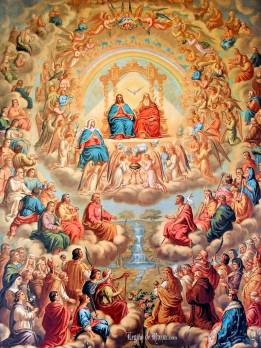 9 After this I looked, and behold, a great multitude that no one could number, from every nation, from all tribes and peoples and languages, standing before the throne and before the Lamb, clothed in white robes, with palm branches in their hands, 10 and crying out with a loud voice,
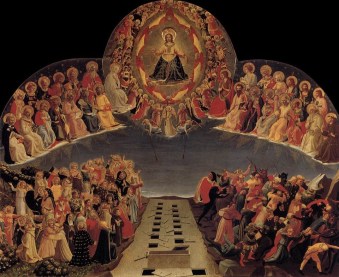 While death may come suddenly and abruptly here, those who die in the faith are not surprise arrivals in heaven. The company in heaven is not startled or shocked by those who show up at the doors of glory. The gates are open, and the believers who arrive there have been anticipated and are welcomed into the great multitude to be with the Lamb who shepherds them. Their arrival into glory is no shock to the residents of heaven. It is perfectly ordinary and on time.
 Because of this, we can have joy in the midst of sorrow. Here and now, as we are gathered together in God’s house and are invited to God’s table, we come to what is described in Hebrews 12(:22-24). This very morning in a small church on the north end of East Grand Forks, MN, we have come, “to Mount Zion and to the city of the living God, the heavenly Jerusalem, and to innumerable angels in festal gathering, and to the assembly of the firstborn who are enrolled in heaven, and to God, the judge of all, and to the spirits of the righteous made perfect, and to Jesus, the mediator of a new covenant.”

 I have to confess, as I was doing my devotions this week, even when I had this sermon running through my mind, I got uncomfortable with some of the punishments God commanded for certain sins. But God does not owe us an explanation for His anger and wrath.
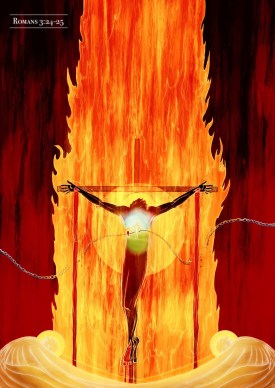 Remember, I told you that this sermon was going to be an explanation of that sentence in v. 25, “This was to show God’s righteousness, because in His divine forbearance He had passed over former sins.” What is it that showed God’s righteousness in giving us mercy? Nothing but Jesus Christ. Nothing but Jesus shedding His blood and dying on the cross. Nothing but Jesus being our propitiation – the atoning sacrifice, the mercy seat, the place where God forgives us and meets with us sinners.
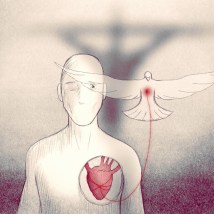 First, love is a beautiful summary of the Law, but that one word, love, does not replace the Law. Many people will say that since we have these two great commandments to love God and love our neighbor that we don’t need the rest of the Law. But that is false. Just because you think you are motivated by love does not mean that you are doing the right thing. We are so fallen that sometimes we try to pit love against the Commandments. Love is never an excuse to sin or an excuse to overlook sin. Instead, the Commandments define the shape of love, which is the second point about the Law.
 But, Christian, you know the answer. In fact, you have been taught this and have believed it for so long that you hardly think about it too much. But it is the most amazing thing. Jesus is man, born of His mother. And Jesus is God, begotten of His Father before all worlds. Jesus is man so that He can die, and He is God so that His death can be an atoning sacrifice for our sins.
 If Menards can have Christmas decorations out already and if the Hallmark Channel can do nonstop Christmas movies in July, then the Church can certainly have Easter in October. In fact, we have to celebrate Easter because this text screams Easter – loud and clear. But always before Easter, there is Good Friday. Before resurrection, there must be death. Good Friday sadness is a prerequisite to Easter joy. We have to see that first.
 Then, Jesus walks past the pallbearers, straight up to the bier, touches it, and says, “Young man, I say to you, arise,” as though He was waking up a sleepy teenager late on a Saturday morning. The boy gets up and begins to speak. I wonder what he said.
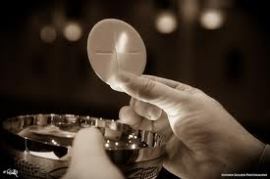 Jesus marches toward your funeral procession, and He does not stop or yield. Jesus does not give way or defer to death. Instead, Jesus defeats death with His death and resurrection, each and every time He meets it. Jesus meets you here today as you plod along in your personal funeral procession and gives you life. Jesus meets you at this altar to give you His living Body and His life-giving Blood.
 17 The seventy-two returned with joy, saying, “Lord, even the demons are subject to us in your name!” 18 And he said to them, “I saw Satan fall like lightning from heaven. 19 Behold, I have given you authority to tread on serpents and scorpions, and over all the power of the enemy, and nothing shall hurt you. 20 Nevertheless, do not rejoice in this, that the spirits are subject to you, but rejoice that your names are written in heaven.”
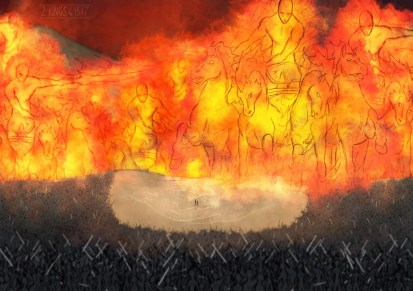 And the young servant sees a huge host of angels with horses and chariots of fire all around Elisha. The Syrian army rushes in toward them. Elisha simply prays that the entire army would be struck with blindness, and they are. Then Elisha leads this blinded army straight into the capitol of Israel where they are all captured. In this account, we see the unfolding of what is said in Ps. 34:7, “The angel of the Lord encamps around those who fear him, and delivers them.”
 Hebrews 12:22-24 says that in church we have “come to Mount Zion and to the city of the living God, the heavenly Jerusalem, and to innumerable angels in festal gathering…” Jesus says that the angels in heaven are joyful over one sinner who repents (Lk. 15:7, 10). As we confessed our sins earlier, a whole host of angels whom we cannot see or hear rejoiced as they heard Christ absolve and free us from our sins. In fact, Heb. 1:14 calls angles ‘liturgizing’ spirits (the ESV translates λειτουργικός as ‘ministering’). Using the liturgy is a way that we connect our worship with the worship of the angels in heaven, which is why we draw the words and order of our liturgy from the words of Scripture.
 down and out of heaven. How was Satan cast down? The text is clear. Satan was cast out by the blood of the Lamb.
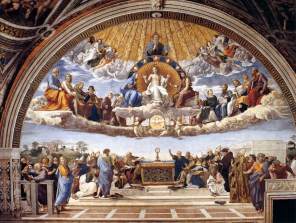 So today, dear saints, come to Jesus’ table and receive His body given for you. Receive His blood which was shed for you for the forgiveness of your sins knowing that neither death nor life, nor angels nor rulers, nor things present nor things to come, nor anything else in all creation, will be able to separate you from the love of God in Christ Jesus your Lord (Ro. 8:38-39).
 Pastorsamwise
You must be logged in to post a comment.