Matthew 20:1-16
1 “For the kingdom of heaven is like a master of a house who went out early in the morning to hire laborers for his vineyard. 2 After agreeing with the laborers for a denarius a day, he sent them into his vineyard. 3 And going out about the third hour he saw others standing idle in the marketplace, 4 and to them he said, ‘You go into the vineyard too, and whatever is right I will give you.’ 5 So they went. Going out again about the sixth hour and the ninth hour, he did the same. 6 And about the eleventh hour he went out and found others standing. And he said to them, ‘Why do you stand here idle all day?’ 7 They said to him, ‘Because no one has hired us.’ He said to them, ‘You go into the vineyard too.’ 8 And when evening came, the owner of the vineyard said to his foreman, ‘Call the laborers and pay them their wages, beginning with the last, up to the first.’ 9 And when those hired about the eleventh hour came, each of them received a denarius. 10 Now when those hired first came, they thought they would receive more, but each of them also received a denarius. 11And on receiving it they grumbled at the master of the house, 12 saying, ‘These last worked only one hour, and you have made them equal to us who have borne the burden of the day and the scorching heat.’ 13 But he replied to one of them, ‘Friend, I am doing you no wrong. Did you not agree with me for a denarius? 14 Take what belongs to you and go. I choose to give to this last worker as I give to you. 15 Am I not allowed to do what I choose with what belongs to me? Or do you begrudge my generosity?’ 16 So the last will be first, and the first last.”
In the name of Jesus. Amen.
To get at the main point of this parable, I’m going to borrow an analogy. Imagine two waitresses working at a small cafe by themselves. Suddenly, a man brings in eighty of his family members to celebrate an occasion, and those two waitresses have to serve this massive, unexpected crowd. One of the waitresses works hard the whole time. She does her best to get all the drinks and orders. She puts in the effort to make sure all the plates are served to the correct spots. She attempts to keep the glasses full of refills. She promptly comes to wipe up a spill. And even though she is flustered, she does all of this with a friendly smile on her face.
The other waitress is angry about the whole ordeal. She’s mad that such a large party didn’t call ahead to let them know they were coming so the restaurant could be properly staffed. She grumbles when extra napkins are requested. She intentionally lets some of the food sit for several minutes after it was prepared so that it isn’t hot when it is delivered to the table. And she interacts with the party as little as possible and pretends not to hear certain requests. This second waitress actually made the evening more difficult for the first, so difficult, in fact, that it would have been easier for the first waitress to do the whole thing herself.
When the party is ready to leave, the man who brought everyone in walks up to both waitresses and hands each of them a handsome 30% tip. Which of the two is going to complain? Right. The first. She would have preferred for the man to give her a 15 or even 10% tip so long as the second waitress got stiffed. She would rather get less if it meant that all her effort was recognized and appreciated.
 Dear saints, welcome to the kingdom of heaven. In the kingdom of heaven, you are never rewarded based on your works or efforts because, if you received what you deserved, you would be sent straight to hell. In the kingdom of heaven, there are no formulas or set, hourly wages. You are given to based solely on the merits of Christ’s work for you. He is the only one who can say that He bore the burden of the day and the scorching heat. His atonement, His mercy, His grace is what you get, nothing less. Because of God’s unmerited, unearned, undeserved, unconditional love freely given to you for the sake of Christ, you are an heir of the kingdom of heaven. God be praised!
That’s the main point of the parable. The sermon could end here, but it won’t. There are other points in the parable. Yes, they are minor points, but I have four that I know will be helpful and comforting to you today. So, I’d like to draw them out a little bit. And these points all come from a small phrase in the parable from v. 6that never jumped out at me before. Notice in that verse that when the master goes out at the eleventh hour, just before the sun begins to set and working day is ending, the master finds more people standing there in the marketplace waiting to be hired and asks them, “Why do you stand here idle all day?” Did you catch it?
“All day.” It means the guys hired at the very end of the day had been there all along. I can’t tell you how many times I’ve studied, taught, and preached on this parable, but I kept missing that phrase. I had figured these guys were lazy. I thought maybe they slept in, maybe they were trying to avoid working during the hot part of the day. But that’s not the case! They were there early in the morning, at dawn, when the master first went out to hire workers. And they were there at the third and the sixth and the ninth hour when he came. Most people would have given up and gone home around the sixth hour (which is noon). But no. When the master asks why they have been standing there idle all day, they say, “Because no one has hired us.”
Here’s the first point we can draw from that: no one who got paid their denarius at the end of the day decided on their own to go work for the master. Every one of them was called and sent only by the initiative of the vineyard owner. No one volunteered themselves for labor when he came, and no one went to knock at his door to ask, “Would you hire me to work in your vineyard?” Nope.  Each of them was called, and each of them was called at the precise time the owner called them. He went and retrieved them.
So, if you are a worker in the Lord’s vineyard, if you have been called into the service of the kingdom of heaven, i.e. if you are a Christian, you were called by God. Period. He came. He gave you work to do. You didn’t seek to work for Him. God called you into His service when it pleased Him. Some, God brings in early and has them work the whole day, but for some reason – a reason known only to God – He brings others in a later, at the third, sixth, ninth, and eleventh hour. If it had pleased the master to hire all of them at dawn, he could have.
Which brings us to second point. if you think that you are one of the early hires, if you have been a Christian your whole life and faithfully carried out your vocations, if you have been tempted at times to grumble for all your hard work or tempted to pat yourself on the back for what you have accomplished, be careful. Remember that it was not you who offered up yourself to work. You were called by the grace of God. “By grace you have been saved through faith. And this is not your own doing; it is the gift of God, not a result of works, so that no one may boast. You are his workmanship, created in Christ Jesus for good works, which God prepared beforehand, that you should walk in them” (Eph. 2:8-10).
Know this. God is pleased with your work. He designed all those works for you, and He laid them all out before you to serve those who needed God’s work offered through your hands. You will be rewarded, and you will be rewarded far better than you deserve.
The third point: Maybe you think that you are one of those who were called to work late. Maybe you are saddened by how much time you wasted pursuing a life of pleasure for yourself. If you think, “How much more good could have I done if I hadn’t been so foolish? If I had been studying Scripture earlier, I could have been of better service.” Dear saint, don’t get discouraged.  God had a reason for bringing you in when He did. Trust His timing. He brought you into His vineyard exactly when He wanted you.
The fourth point is also along those lines, and I know it will be comforting to many of you, so listen up! If you have been praying for someone who is not in God’s vineyard, or if you have been aching for someone who was once in the vineyard but left – maybe it is a friend or relative. If it seems like your prayers and efforts have been wasted, take courage. Don’t stop praying for them. Yes, God calls some early, but some aren’t called into the vineyard until later. Some are called so late that they only arrive in time to get paid which means they do no more than receive their gracious reward. Be comforted. God has His own timing. Keep praying.
One more thing. I know the most common way the different hours that the workers get hired is understood to be a time in each individual’s life. When it is interpreted this way, the workers hired first represent people who have been Christians their entire lives. They were given faith in baptism and continued in that faith until they died. Those who were hired at the third, sixth, and ninth hour are commonly viewed as those who came to faith later in life – as youth, adults, and seniors. And those hired at the eleventh hour are the deathbed converts. That seems to be a legitimate way to understand that detail of the parable, in fact, that is how this sermon has interpreted that detail up to now.
However, remember this parable is about the kingdom of heaven. 1 John 2:18, written almost two-thousand years ago, says that it is the last hour. In the book of Revelation, we get repeated pictures of the saints who have died and entered into glory, and they are still working by praying for us (Rev. 6:9-11). Also, consider Hebrews 11 that uses the faith and deeds of the Old Testament saints to encourage us. Then, Hebrews 12[:1-2] gives us a picture of the great cloud of saints surrounding us and cheering us on to keep walking in faith. And Revelation 14:13 says that those who die in Christ are blessed because they now rest from their labors, but – and this is the point – their deeds follow them.
Considering all of that, none of us can claim to be those who worked through the heat of the day. Rejoice that God is merciful and has and will continue to give to you far better than you deserve. But also, be encouraged because this means that your labor in Christ is never wasted and is valuable work that lives on after you are gone. Think of the labor done by the authors of Scripture – Moses, David, Isaiah, Matthew, John, and Paul– their labor continues to reap results for the kingdom of God today.
 And it isn’t just their work. Your work, done as a Christian, is holy work. Fathers and mothers, the work you do day in and day out will reap results in the lives in your children, grandchildren, and great-great-great-great grandchildren if Christ tarries. But it will also reap results in the lives of others whom you will never meet because you have shined the light of Christ to those you have met, and they will shine that light elsewhere. You Sunday school teachers, you who are praying for and encouraging our youth, you trustees who are caring for our facility, and everyone who is here encouraging another person is offering holy work that will be used by God until Christ returns. Everyone has a story of being impacted by someone else long after that person has entered into glory. So, take heart, and keep working. The labor that God has called you to is fruitful, holy work. It is holy work that God will multiply and expand. For that, God be praised. Amen.
The peace of God, which surpasses all understanding, will guard your hearts and minds in Christ Jesus. Amen.
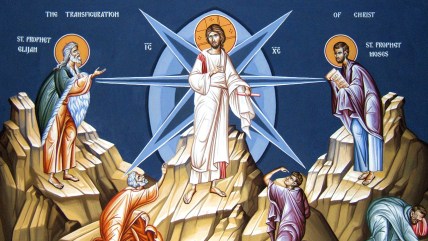
 And from this point, things get a little crazy and awkward. It is almost as though Peter didn’t hear Jesus say that He would rise from the dead because Peter rebukes Jesus – the very one he just confessed is the Son of the living God. Peter says, “Far be it from You, Lord! This shall never happen to You.” It would be easy to sling mud at Peter here for telling God that what He says is going to happen won’t ever happen. But you do it all the time – more on that in a bit.
 But here is where all of this is leading: Jesus comes to Peter, James, and John cowering in their sins and touches them. And notice what He says. He doesn’t continue to rebuke Peter. Jesus doesn’t say, “See I told you so.” Instead, Jesus says, “Rise,” the same word Jesus used when He spoke about His resurrection.“Rise, and have no fear.” Of all the things our Lord could have said, He says, “Rise, and have no fear.” Jesus is resurrecting Peter from his sin.
 5 When he had entered Capernaum, a centurion came forward to him, appealing to him, 6 “Lord, my servant is lying paralyzed at home, suffering terribly.” 7 And he said to him, “I will come and heal him.” 8 But the centurion replied, “Lord, I am not worthy to have you come under my roof, but only say the word, and my servant will be healed. 9 For I too am a man under authority, with soldiers under me. And I say to one, ‘Go,’ and he goes, and to another, ‘Come,’ and he comes, and to my servant, ‘Do this,’ and he does it.” 10 When Jesus heard this, he marveled and said to those who followed him, “Truly, I tell you, with no one in Israel have I found such faith. 11 I tell you, many will come from east and west and recline at table with Abraham, Isaac, and Jacob in the kingdom of heaven, 12 while the sons of the kingdom will be thrown into the outer darkness. In that place there will be weeping and gnashing of teeth.” 13 And to the centurion Jesus said, “Go; let it be done for you as you have believed.” And the servant was healed at that very moment.
 “Centurion” was his title and meant he was a commander over one-hundred soldiers. Centurions wore impressive armor including a helmet with all the feathers sticking out of the top, a shiny breastplate, a metal skirt, and a huge shield. Like a leper, a centurion’s command was also obeyed, but not to avoid becoming one of them. A centurion could say, “Go,” and the soldier would go. “Destroy,” and they would destroy. “Kill,” and they would kill.
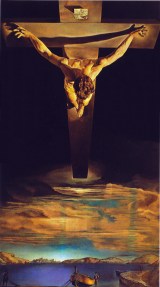 Repent, but do not despair. Jesus, God in the flesh, comes down from the mountain in order to save us. He is a God of mercy and grace. He comes to make the unworthy worthy and the unholy sacred. Jesus willingly approaches the untouchable leper to touch and heal. And Christ has compassion upon a centurion who appeared to have everything, but in reality, had nothing.
 I just have to run faster than you.” Well, guess what. When the bear of God’s Law is finished eating the guy who is slower to obey than you, it picks up your scent and resumes its pursuit of you because its appetite is never satisfied by eating up sinners.
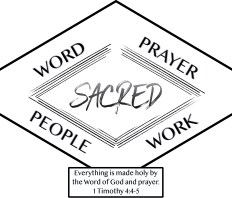 There’s a better way to understand these verses, and to get at that understanding, I’m going to connect this text to our theme for the year – “Sacred.” In Lev. 19:2, God speaks to His people, Israel, and says, “You shall be holy, for I the Lord your God am holy.” And Peter repeats those words for us Christians in 1 Pet. 1:16. In English, this sounds like a command because of the word ‘shall.’ But in both Hebrew and Greek it isn’t a command/imperative. A better translation for both is, “You will be holy.”
 likeness of sinful flesh and for sin, he condemned sin in the flesh, in order that the righteous requirement of the law might be fulfilled in us, who walk not according to the flesh but according to the Spirit.”
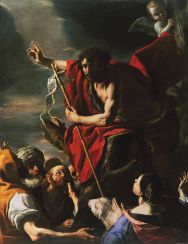 “You brood of vipers! Who warned you to flee from the wrath to come? Bear fruit in keeping with repentance.” The text doesn’t explicitly say it, but it appears as though John refused to baptize at least some of the Pharisees and Sadducees. But why? Why do they get a tongue-lashing and no baptism?
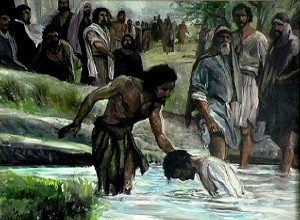 Now we come to our text. John is baptizing all these people. A thief comes confessing his stealing, an adulterer confesses his adultery, a liar confesses her sin, and John absolves and baptizes them. But then to the front of the line comes Jesus, and John knows Him (Lk. 1:39-45). They’re related to each other. John knows what the angel Gabriel told Mary, that this Jesus would be Son of the Most High, that He would reign over the house of God, and that His kingdom would have no end (Lk. 1:26-38). John knows the angel Gabriel told Joseph that Jesus would be the One to save His people from their sins (Mt. 1:18-25). John knows that Jesus is the sinless God in the flesh. And here He is coming to be baptized unto repentance for the forgiveness of sins? This shouldn’t be!
 But also, the same thing that happens to Jesus in his Baptism happens to you in yours. In your Baptism, you are given the gift of the Holy Spirit and are made God’s beloved child. In your Baptism, God intimately joins you to Jesus, and to His death and resurrection (Ro. 6:3-6).
 In your Baptism, God has given you the new birth of water and the Spirit (Jn. 3:5). In your Baptism, God has promised to wash away your sins (Act. 2:38-39), save you (1 Pet. 3:21), make you His child (Mt. 3:17), connect you to Jesus’ death and resurrection (Ro. 6:3-6), clothe you with Christ (Gal. 3:27), and fill you with the Holy Spirit (Tit. 3:5). So now, whenever wash your hands or take a shower, you can remember that God Himself has washed you clean and made you holy and sacred. Whenever you take a drink, you can remember that, in your Baptism, Jesus has given you to drink of the living water that wells up to eternal life (Jn. 4:10, 14).
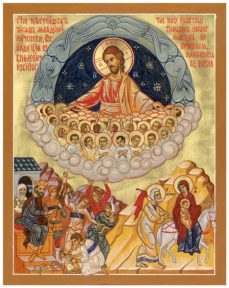 16 Then Herod, when he saw that he had been tricked by the wise men, became furious, and he sent and killed all the male children in Bethlehem and in all that region who were two years old or under, according to the time that he had ascertained from the wise men. 17 Then was fulfilled what was spoken by the prophet Jeremiah:
 The guy who didn’t even want his own children to be king after him hears that someone else has been born to be King of the Jews. Well, Herod isn’t going to let that stand. And when Herod is troubled about this, the rest of Jerusalem is also quaking as they wonder what will happen next.
 In the incarnation, the eternal Son of God shares in the life of every man, woman, and child – born and unborn. We human beings are all taken out of the flesh of Adam which means that we are all part of one another. But even more importantly, by His conception, the eternal Son of God has permeated all of humanity. This is why the devil loves abortion. Satan loves abortion because every unborn child reminds him of the fact that the Son of God came in the flesh, took up residence in His mother’s womb, and defeated him. The fact that your Savior was once a pre-born child is primary the reason Christians oppose abortion.
 Tonight, and all the days of your life, you can celebrate the fact that Jesus is born. God has taken on your flesh to save you. He has come in your likeness, born of a woman, in order to deliver you from your sin.
 Luke tells us that those shepherds, who were minding their own business, suddenly found themselves surrounded by the shining, dazzling glory of the Lord. The surprising, unexpected thing is not the existence of God’s glory. God’s glory shining is something that happens throughout the Scriptures.
 This went on for centuries until the King Solomon finished construction of the Temple. When the Ark of the Covenant was brought into the Temple, the cloud descended into the most Holy Place, and the priests had to leave because God’s glory filled the Temple (1 Kgs. 8:10-11; 2 Chron. 5:13-14). God no longer dwelt in the tent of the Tabernacle; now, He dwelled in the house of the Temple which was where heaven and earth intersected. And still, year after year, the high priest would enter the most holy place be the representative of the people and meet with God behind the smoke made by the incense and the cloud that subdued God’s glory (Ex. 25:21-22).
 He is there so He can grow up and walk among us in the towns and streets of Galilee, Judea, and Jerusalem. He is there so He can be betrayed, arrested, beaten, tried, crucified, loaded up with your sin, die, and rise again.
 29 The next day he saw Jesus coming toward him, and said, “Behold, the Lamb of God, who takes away the sin of the world!”
 God sends the angel of death to go through the land of Egypt. But God’s people were to take a lamb. They were to slaughter that lamb and smear some of the lamb’s blood on the door of their house and eat the rest of the lamb roasted that night. And when the angel would see the blood on the door, he would pass by.
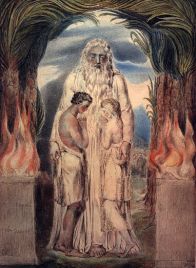 God hung that animal up and stripped the skin from its lifeless body as blood stained the ground. And God wraps that skin around the shameful, sinful bodies of Adam and Eve.
 Dear Lincoln, today you are Baptized. Today, God has given you the new birth of water and the Spirit (Jn. 3:5). Today in your Baptism, you have been joined to Jesus’ death and resurrection (Ro. 6:3-5) and have been clothed with Christ (Gal. 3:27). And Lincoln, Derek, Brittney, and all you saints, that means that today is a day to rejoice. Even as we see the grass wither, the flower fade, and creation crumble, we know that the Word of our God will stand forever. God continues to shower His blessings upon us through that Word. And His Word to us today, and every day of our Christian walk, is the Word of the Gospel which causes us to rejoice.
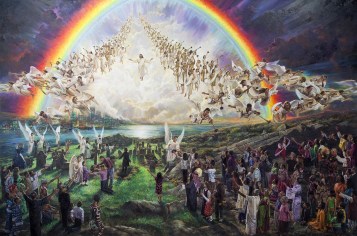 In Advent we are watching and waiting for the coming of our Savior and the end of our exile in this fallen, sinful world. Advent is the Christian life in a nutshell. We watch and we wait for the coming of our Lord. And as we wait, we are reminded that, whatever may happen to us in this veil of tears, the end is a joyful day for you whose citizenship is in heaven. As we wait, we remember that all the cares and sorrows of this world are temporary.

You must be logged in to post a comment.