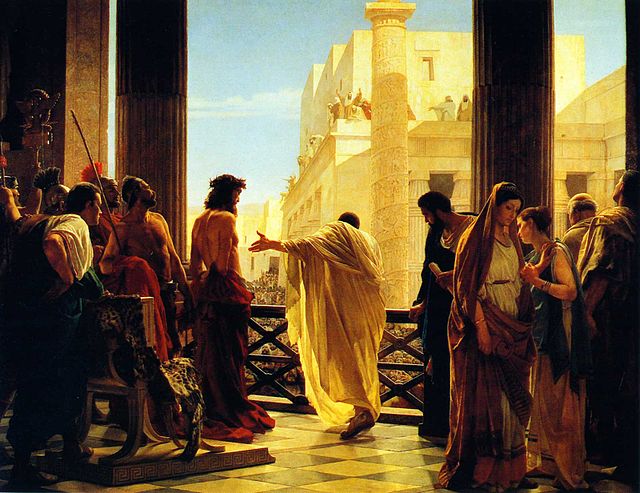
It doesn’t matter how familiar you are with a passage of Scripture, there’s always something more to see, to glean, to meditate on. That’s true for short, familiar passages, but it is certainly true for a long passage like this. While preparing this week, what struck me in a fresh way is what Matthew tells us in Mt. 27:20. The chief priests and elders persuaded the crowd to ask for Barabbas and destroy Jesus.
Of the four Gospels, Matthew is the sharpest on this. They don’t persuade the crowd to just kill, execute, or even crucify Jesus. They want Him destroyed. That’s their desire.
There is utter malice behind this. Jesus looks so weak. He had already been betrayed by Judas. The other eleven disciples fled when He was arrested. Peter denied even knowing Him. Jesus had been mocked, spit upon, beaten, bound, and whipped. And they still call for Jesus to be destroyed. The cruelty of wanting Jesus destroyed is absolutely astounding.
But through all of it, Jesus barely speaks. Jesus talks a lot at the beginning of this reading while He is with the disciples, but once He is arrested, He only speaks three more times before His death here in Matthew’s gospel. All these false accusations are thrown at Him, but He doesn’t respond to any of them. Jesus just stays passive and silent as He is accused. Again, He looks weak.
During His trial before Caiaphas, all sorts of false charges are brought against Jesus, but He simply stands there and receives them. He doesn’t say a word. He only talks when Caiaphas demands, “Tell us if you are the Christ, the Son of God” (Mt. 26:63). But then, Jesus says, “You have said so. But I tell you, from now on you will see the Son of Man seated at the right hand of Power coming on the clouds of heaven.”
It sure doesn’t look like Jesus is seated at the right hand of Power through the rest of His Passion. His silence looks like weakness, but that’s not how we should see it. It is powerful.
Jesus doesn’t speak again until Pilate asks Him, “Are you the King of the Jews?” There, Jesus says,“You have said so.” But again, as the chief priests and elders accuse Jesus before Pilate, Jesus is silent (Mt. 27:12). Even though Pilate asks Jesus to respond to all these accusations, Jesus still gives no answer, not even to a single charge. In His silence, Jesus looks weak and passive.
All of this reminds me of the scapegoat. Do you remember what God had commanded His people to do on the Day of Atonement (Lev. 16)? Each year, there were two goats. One was sacrificed and the blood of that goat allowed the high priest to enter the Holy of Holies. But the other goat, the scapegoat – it had a different purpose. The high priest laid both of his hands on the head of that goat and confessed all the iniquities, all the transgressions, and all the sins of the people. And God said that what happened there was that the high priest was placing all that sin on the goat’s head (Lev. 16:21).
And what do you suppose that goat did during that? It couldn’t object. The goat didn’t say, “Hey, what do you think you’re doing?” The goat remained passive and silent and simply received it. Once all those sins were placed on that goat’s head, it was led into the wilderness carrying all those sins away from the sinners (Lev. 16:22). The scapegoat and all those sins were destroyed, never to be seen again. Yes, the scapegoat was passive, but by it God powerfully removed those sins.
Pilate hears all these accusations and sees how Jesus is silent. He knows these religious leaders want Jesus destroyed for no good reason, but Pilate has an idea. Pilate has the notorious Barabbas in custody who had committed murder and started a riot and insurrection (Mk. 15:7; Lk. 23:18-19). Pilate puts Barabbas and Jesus forward as his nominees to potentially be released. It seems as though Pilate figured Barabbas was such a rotten individual and danger to society that the crowds would rather have Barabbas crucified for their own safety and protection. But the crowd calls out for Barabbas to be released and for Jesus to be crucified.
And that’s what Jesus wants too. So, Jesus stays silent, passive, and powerful.
It was God’s will that Jesus should be on the cross instead of Barabbas. By taking Barabbas’ place on that cross, Jesus also takes your place under God’s wrath against your sins.
God takes all this evil, malice, and injustice and uses it for your eternal good (Ro. 8:28). Jesus’ Passion isn’t a tragedy. It is God’s victory. In fact, this is the victory. Jesus’ silence in all of this isn’t weakness. It’s God’s power because this is God’s plan playing out. This is how God powerfully removes your sins from you as far as the east is from the west (Ps. 103:12). Jesus is crucified and heaven rejoices to see God’s great, powerful love for His creation. This is how God loves the world. This is how God loves you.
Jesus silently takes all those accusations, He is loaded up with all your sins, and He is led into the wilderness of death as He is crucified and destroyed. But death will no power over Him.
Dear saints, welcome to Holy Week. Easter is coming. Amen.
The peace of God, which surpasses all understanding, will guard your hearts and minds in Christ Jesus. Amen.
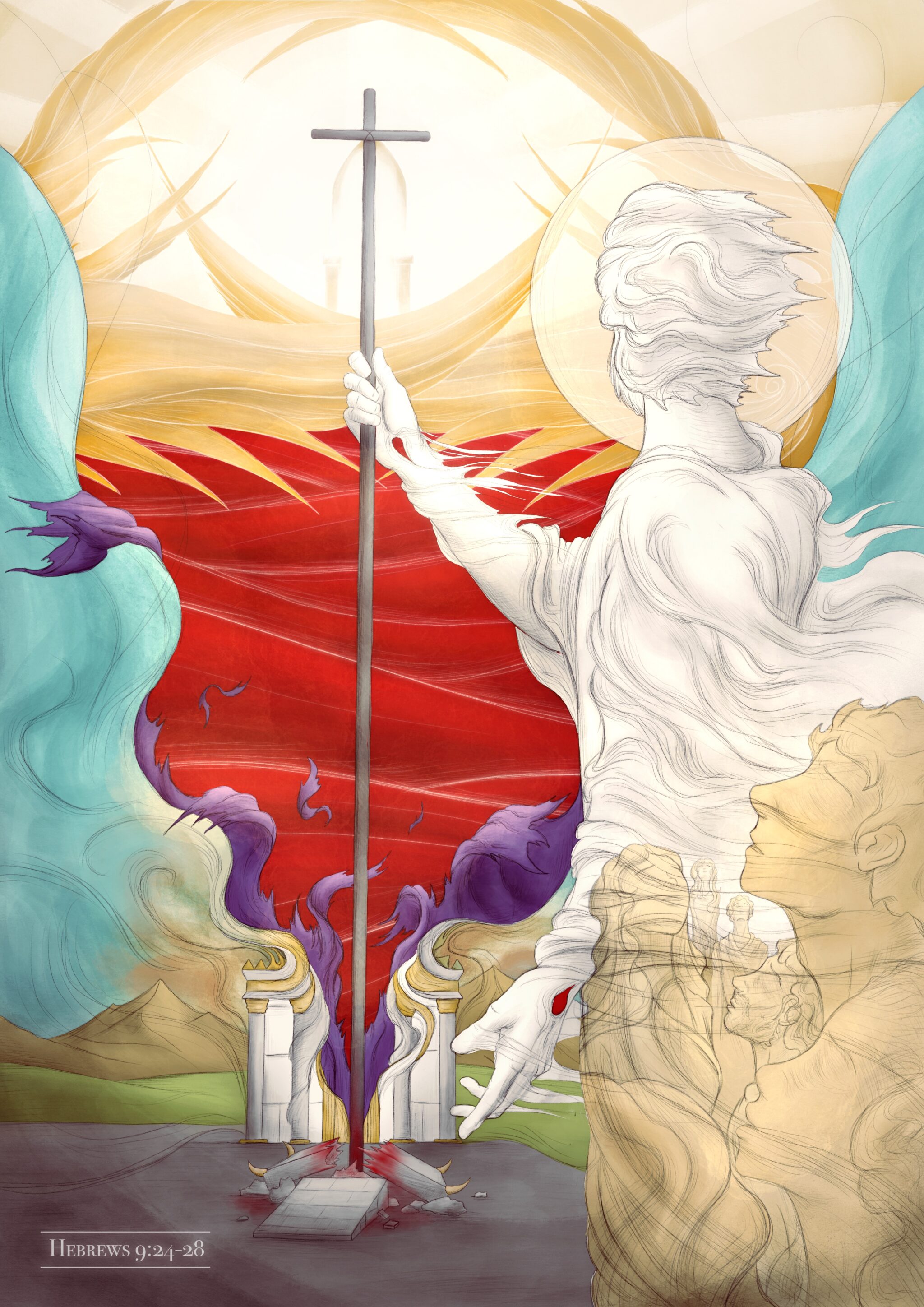
11 But when Christ appeared as a high priest of the good things that have come, then through the greater and more perfect tent (not made with hands, that is, not of this creation) 12 he entered once for all into the holy places, not by means of the blood of goats and calves but by means of his own blood, thus securing an eternal redemption. 13 For if the blood of goats and bulls, and the sprinkling of defiled persons with the ashes of a heifer, sanctify for the purification of the flesh, 14how much more will the blood of Christ, who through the eternal Spirit offered himself without blemish to God, purify our conscience from dead works to serve the living God.
15 Therefore he is the mediator of a new covenant, so that those who are called may receive the promised eternal inheritance, since a death has occurred that redeems them from the transgressions committed under the first covenant.
1 After this Jesus went away to the other side of the Sea of Galilee, which is the Sea of Tiberias. 2 And a large crowd was following him, because they saw the signs that he was doing on the sick. 3 Jesus went up on the mountain, and there he sat down with his disciples. 4 Now the Passover, the feast of the Jews, was at hand. 5 Lifting up his eyes, then, and seeing that a large crowd was coming toward him, Jesus said to Philip, “Where are we to buy bread, so that these people may eat?” 6He said this to test him, for he himself knew what he would do. 7 Philip answered him, “Two hundred denarii worth of bread would not be enough for each of them to get a little.” 8 One of his disciples, Andrew, Simon Peter’s brother, said to him, 9 “There is a boy here who has five barley loaves and two fish, but what are they for so many?” 10 Jesus said, “Have the people sit down.” Now there was much grass in the place. So the men sat down, about five thousand in number. 11Jesus then took the loaves, and when he had given thanks, he distributed them to those who were seated. So also the fish, as much as they wanted. 12 And when they had eaten their fill, he told his disciples, “Gather up the leftover fragments, that nothing may be lost.” 13 So they gathered them up and filled twelve baskets with fragments from the five barley loaves left by those who had eaten. 14 When the people saw the sign that he had done, they said, “This is indeed the Prophet who is to come into the world!”
15 Perceiving then that they were about to come and take him by force to make him king, Jesus withdrew again to the mountain by himself.
In the name of Jesus. Amen.
I have a fresh appreciation for this miracle. Last Friday, I was one of the volunteers at Sacred Heart’s Fish Fry. For about three hours, I stood along the buffet line making sure there was bread, coleslaw, tartar sauce, butter, sour cream, and lemons for people who then waited for fried fish and a baked potato. When something on the line got low, I was ready to swap out the tray or bowl and have a full one ready so the line would keep moving. I one of 64 people working that night, and in those three hours we served 1,316 people their supper.
Now, think about that. Sixty-four people, who have been organized to do particular tasks, fed just over 1,300 people in about three hours. Here, Jesus and his twelve disciples serve 5,000 men plus women and children (Mt. 14:21). In all likelihood, this was a crowd of twenty to thirty-thousand people who are fed by thirteen men doling out five barley loaves and two fish that was brought by a boy. Every person in that crowd ate as much as they wanted. And, when it was all over, the disciples gathered up twelve baskets full of leftovers.
This is easily the ‘biggest’ miracle of Jesus recorded for us in the Gospels, which might be the reason all four Gospels tell us about it. The only other miracle that even comes close would be Jesus turning water into wine at the wedding in Cana (Jn. 2:1-11). Sure, there are times when Jesus will heal many sick people who are brought to Him, but those were still one at a time miracles (Mt. 4:23-25; 8:16; Mk. 1:33-34; Lk. 4:40). This one miracle provided for tens of thousands of people all at once.
It’s no wonder, then, that the people reacted the way they did. Here is a Man who can feed people bread without needing soil or seed or rain or the right weather conditions or combines or grain elevators or flour mills or factories or bakers or truck drivers or grocers. Jesus can feed people fish without boats or bait or poles or nets or processing plants or even water. Jesus is not a politician who spouts empty promises but never delivers. He just delivers. This is the kind of guy who everyone wants to be king. So, they planned to take Jesus by force and chain Him to a throne because, sure, they were full now, but they’d be hungry again later.
Notice what everyone in this account is focused on. Phillip looks at their checkbook balance and says, “Two-hundred denarii? That’s not nearly enough.” Andrew looks at the boy’s snack and says, “This isn’t going to do it.” And the crowds – even after they are fed – they know they would be hungry again. The food Jesus provided that evening wasn’t going to be there for them tomorrow. So, they think, “If this Jesus guy can feed us like this in the wilderness, imagine what He can do if He’s the king with advisors and soldiers and tax revenue.”
We sinful creatures always seem to be fixated on our lack and desire to get more than what we have. But even when we get more, we aren’t satisfied. In his book Mere Christianity, C.S. Lewis says that the fact that we have desires means that satisfaction for those desires exists. Behind every desire – even sinful, evil desires – there is something good that is trying to be filled. The drug addict is trying to find the end of his pain or escape from sorrow. The sexually promiscuous are trying to find the good gift of companionship that God gives in marriage but fail to find it apart from marriage. Here, the crowds are doing the same thing. They want the gift of food but not in the way Jesus wants to give it.
You cannot force a gift to be given. Doing that is an attempt to twist gifts into wages, and that never works. All the things we long for and all desires we have are only filled by what God will give in the perfection of the New Creation. Because this world has fallen into sin, this world does not have the satisfaction of the desires we are seeking to fill. So, if you have unfulfilled desires, recognize you are made for another world. Stop looking to created things to fulfill your desires. Repent and instead, look to the Creator, and trust His promise to fulfill those desires. Then, be content with the good gifts God gives you in this life even as they seem to disappear.
In His infinite wisdom, God lets us see how things are used and depleted, but He doesn’t always let us always see how He supplies. None of the four Gospels tell us how the bread and fish are multiplied to feed this massive crowd. I doubt those loaves and fish grew into a massive pile that the disciples kept handing out – I think the Gospel writers would have included that. I like the suggestion that the disciples walk around with baskets of food, and each person reaches in to take some. While it appears to each individual that they are decreasing the amount of food in the basket, when the next person reaches in, there is still more. No matter how many people reach in and take, there is always more food in the basket.
Dear saints, your needs for food, house, clothing, money, health, etc. are things you can see and feel. But God doesn’t have to show you how He provides to meet those needs. He promises to meet them. So, trust His promises. You can see and feel hunger, but you can’t see the God who feeds you. You can see and feel sickness, but you can’t see the Great Physician who heals you. You can see and feel war and chaos, but you can’t see the Prince of Peace who has all authority in heaven and earth and governs all things from His throne at God’s right hand. But God supplies each of those things in ways you cannot see or understand. There are thousands of miracles that happen in your daily life. You’ve just gotten numb to seeing them because you experience them so often.
The fact that you work (in whatever job you have) and food gets to your pantry, cupboards, fridge, freezer, oven, and table is a miracle. When that food goes into your body and keeps you healthy, and when you do get sick but put nutrients, vitamins, or medicines into your body and recover, that is a miracle too. All those things – work, money, food, house, health – they are all good, miraculous gifts from God’s gracious hand. And what God gives He blesses.
Here, we are told that Jesus gives thanks for the food before it is distributed to the crowd. In Confirmation class we recently went through the texts that recount Jesus giving the Lord’s Supper (Mt. 26:26-28; Mk. 14:22-24; Lk. 22:19-20; and 1 Cor. 11:23-25). In those texts, the Gospel writers use two phrases interchangeably. Jesus giving thanks for something is the same as Jesus blessing it. So, when you pause and take a moment to pray for your food, God is blessing that food to be a blessing for you. 1 Tim. 4:4-5 says that everything created by God is good, and nothing is to be rejected if it is received with thanksgiving because it is made holy by the Word of God and prayer. Receive with thanks the things that God gives and watch how it is blessed.
I’ll close with this: Jesus did not let the crowds take Him by force and make Him king that day, but He did allow them to take Him by force when a band of soldiers came and arrested Him. They forced Him to stand trial before Pilate and Herod. He wasn’t chained to a throne; instead, He was nailed to a cross where He shed His blood and gave His for you. Thanks be to God. Receive that gift with thanks and faith and watch how God blesses it. He blesses it and multiplies it to make you a blessing to others so that you can point them to Jesus, the One can and does fill their desires with the gift of Himself. Amen.
The peace of God, which surpasses all understanding, will guard your hearts and minds in Christ Jesus. Amen.
14 Now he was casting out a demon that was mute. When the demon had gone out, the mute man spoke, and the people marveled. 15 But some of them said, “He casts out demons by Beelzebul, the prince of demons,” 16 while others, to test him, kept seeking from him a sign from heaven. 17 But he, knowing their thoughts, said to them, “Every kingdom divided against itself is laid waste, and a divided household falls. 18 And if Satan also is divided against himself, how will his kingdom stand? For you say that I cast out demons by Beelzebul. 19 And if I cast out demons by Beelzebul, by whom do your sons cast them out? Therefore they will be your judges. 20 But if it is by the finger of God that I cast out demons, then the kingdom of God has come upon you. 21 When a strong man, fully armed, guards his own palace, his goods are safe; 22 but when one stronger than he attacks him and overcomes him, he takes away his armor in which he trusted and divides his spoil. 23 Whoever is not with me is against me, and whoever does not gather with me scatters.
24 “When the unclean spirit has gone out of a person, it passes through waterless places seeking rest, and finding none it says, ‘I will return to my house from which I came.’ 25 And when it comes, it finds the house swept and put in order. 26Then it goes and brings seven other spirits more evil than itself, and they enter and dwell there. And the last state of that person is worse than the first.”
27 As he said these things, a woman in the crowd raised her voice and said to him, “Blessed is the womb that bore you, and the breasts at which you nursed!” 28 But he said, “Blessed rather are those who hear the word of God and keep it!”
In the name of Jesus. Amen.
“Blessed are those who hear the Word of God and keep it.” That is why the demons try to make our Lord mute after He opened the lips of this mute man.
Demons are persistent. They don’t just give up and throw in the towel. Jesus casts out a demon that stopped a man’s lips from declaring God’s praise. But as soon as Jesus loosened that man’s tongue, the demons regrouped because people started wondering if Jesus was the promised Messiah and Son of David (Mt. 12:23), the One whose kingdom and throne would be established forever (2 Sam. 7:12-13; Is. 11:1-10). The demons don’t want people believing that, so they quickly marshaled together. They influenced some of the unbelievers who surrounded Jesus to accuse Jesus of casting out demons only by the power of the prince of demons.
This gives us some insight into the tactics and strategy that demons still use today. Notice, they do notattack the reality of the miracle. They do not try to minimize what happened and say that Jesus is tricking everyone. “Well, Jesus planted that mute guy. They were working together. That guy could actually speak, and Jesus just used him to make it look like He had power over demons.” That’s not what they do. Instead, Satan and the demons flip things upside down by calling evil good and good evil (Is. 5:20). Here they take a good thing, casting out a demon, and call it “evil.”
We see this same demonic relabeling of evil and good all around us today. Today, people will say that if a woman can’t murder her baby in the womb, then that woman, somehow, isn’t equal to a man. That’s demonic. Today, people will say that the rioting and stealing that goes on at various times and places in our country is a good thing because those people are oppressed. That’s demonic too. People will say that having pornographic literature in school libraries for young children is necessary so other children with mental disorders don’t kill themselves. Again, totally, completely demonic. I’m not saying that people who are arguing for those things are demons, but they are being influenced by and are tools of the demons.
The cosmic powers over this present darkness (Eph. 6:12) continue to use these tactics to silence you, Christian. The spiritual forces of evil want to mute you and your tongue so they can be at peace and go about their malicious activities. That’s what they did with the crowds here in this text, and they continue to do that in our culture today.
Again, the accusation that Jesus only has power over demons is because He is in league with the devil is completely irrational, and Jesus highlights that absurdity. But the thing to notice here is that the demons’ goal with this accusation is still the same. They want to silence, they want to mute, they want to make Jesus shut His mouth and stop talking. Jesus has set this man’s lips free, so they can’t silence the man anymore. They acquire a new target and try to silence Jesus. But they couldn’t silence Him either. So, now, they try to silence you, Christian.
Today, demons still want to silence you – especially when it comes to making distinctions between what is right and wrong, what is good and evil, what is righteous and what is sinful.
Dear saints, God’s Word has always made distinctions. In creation, God’s Word made distinctions when He separated light from darkness (Gen. 1:4), when He separated the land from the sea (Gen. 1:9-10), when He made different plants and animals each according to its kind (Gen. 1:11, 21, 24-25), and when He set mankind over it all (Gen. 1:26-27). But remember that in those separations and distinctions that God was putting creation into order. Satan and the demons work to bring disorder and chaos to the places where God has created order. There is no peace when God’s Word is silenced. That is why God was at work through Jesus, the Word who became flesh, to put things back into order and in their proper place.
This fallen world resists the order that God’s Word brings because it is influenced by demons. One of the goals of the evil one is to silence, but God is the God who speaks. Because God speaks, His people also speak. God wants you to speak and confess boldly. And what should you speak and confess?
First, God wants us to speak to Him that we are poor sinners who are by nature, sinful and unclean in thought, word, and deed. God wants us to confess that we need saving. He wants us to confess that Jesus came to bring the redemption we needed through His death and resurrection. As we speak and confess that, God listens and forgives.
Then, God sends us out as those who confess His saving name to others. God wants others to know what you know, to believe what you believe, and to receive what you have received so more lives would be set right and put back into order again. God calls you to speak.
So, how will you respond when the forces of evil throw their accusations at you? Will you remain faithful? Will you be willing, like Elijah was, to be called the troubler of his nation (1 Kgs. 18:17)? Will you confess Jesus before others as Jesus confesses you before His Father in heaven (Mt. 10:32)? I pray that is the case for all of us because there is no peace apart from the peace that God’s Word brings.
Jesus says, “Blessed are those who hear the Word of God and keep it.” Both of those are present tense. It could be translated, “Blessed are those who are continually hearing the Word of God and are continually keeping it.” Blessed are you who hold on to the Word of God and treasure it above all other things in this life. God’s Word not only puts everything into order, it gives life here and now (Jn. 5:24; 1 Tim. 6:12), and it also gives life in the world to come.
Dear saints, hear God’s Word and keep it. Hold on to it. Continually hear and keep keeping it. Because Jesus promises that when you stand trial before anyone – even authorities, kings, and rulers in this world – you do not need to be anxious of what you are to say because the Holy Spirit will teach you in that very hour what you are to say (Lk. 12:11-12).
So, remember that this doesn’t depend on you. It depends on God and His Word. Jesus has set you apart and made you a member of His kingdom. He has made you holy and placed you in His holy family. And He invites you now to find nourishment for your journey through this world because the tasks are beyond your own strength to handle (1 Kgs. 19:7). So, God feeds you now with supernatural food. He gives you His own Body and Blood given and shed for the forgiveness of all your sins. Here, you have what you need to keep keeping God’s Word. And here you receive all the blessings that come with it. Amen.
The peace of God, which surpasses all understanding, will guard your hearts and minds in Christ Jesus. Amen.
21 And Jesus went away from there and withdrew to the district of Tyre and Sidon. 22 And behold, a Canaanite woman from that region came out and was crying, “Have mercy on me, O Lord, Son of David; my daughter is severely oppressed by a demon.” 23 But he did not answer her a word. And his disciples came and begged him, saying, “Send her away, for she is crying out after us.” 24 He answered, “I was sent only to the lost sheep of the house of Israel.” 25 But she came and knelt before him, saying, “Lord, help me.” 26 And he answered, “It is not right to take the children’s bread and throw it to the dogs.” 27 She said, “Yes, Lord, yet even the dogs eat the crumbs that fall from their masters’ table.” 28 Then Jesus answered her, “O woman, great is your faith! Be it done for you as you desire.” And her daughter was healed instantly.
In the name of Jesus. Amen.
I want to start with an analogy that gets regularly used. Imagine two men who want to cross a frozen river with thick ice. One man doesn’t hesitate at all because he believes the ice is strong and stable. So, he gets in his ¾ ton pickup truck and drives straight across no sweat. The other man is terrified and trembling because he doesn’t trust the ice. He lays out as flat as possible to distribute his weight and crawls on his belly inch by inch and makes it to the other side. Both men had faith. The guy in the truck had a strong faith, and the guy wriggling on his belly had a weak faith. Was their success in crossing based on their faith? No. Obviously, one had an easier time than the other but they both succeeded in the goal of crossing.
Now imagine those same two men needing to cross the frozen river, but the ice is less than an inch thick. Again, the first man doesn’t hesitate at all because he believes the ice is fine, but he and his pickup plunge into the frigid river and are swept away. The other man is crawling because he’s worried about the thickness of the ice. But it doesn’t matter how careful he is. That thin ice cracks, and he’s swept away too. Now again, was their failure in crossing based on their faith? No. It was based on the thickness of the ice.
Here’s the point: Faith has an object; faith is in something. You can have a lot of faith, but if that faith is in the wrong thing it doesn’t matter how strong that faith is because the thing you believe isn’t right. The opposite is true too. You can have a tiny, little, weak faith in the right thing and that’s what matters because that thing can support that faith even though it’s weak.
For a long time now, you’ll hear people talk about being a “believer.” Ok, but a believer in what? That term is fine. The Bible uses it, but it needs more context. What is it that you believe? A newer term that seems to be gaining popularity is “a person of faith.” That one drives me nuts – as though faith is the thing that matters. Everyone has faith in something. A “person of faith” has faith in what? Honestly, an atheist is a person of faith. They are. An atheist believes that everything that exists came from nothing or believes that matter is eternal. An atheist believes, contrary to every observable fact, that the order and beauty we see in creation happened by mere chance. An atheist believes he knows enough to conclude that there is no designer or creator. Now that takes a lot of faith, but that faith is based on complete foolishness.
Christian, you can define your faith. The Creeds are excellent summaries of what you believe. The strength of your faith or the amount of your faith doesn’t matter as much because what you believe is solid, right, and true. The stronger your faith is, the better your life will be. Think back to the analogy of the two guys crossing the river: They both get across. The guy who has great faith gets across quickly and easily, but the guy who crawls still gets across.
We do want to grow in and strengthen our faith. Sometimes people will think that when Jesus calls us to have the faith of a child (Mk. 10:14-15) that He’s saying that a weak faith is fine. A child’s faith is not weak. Think about it. An infant can’t do anything on her own. But that infant has faith that simply crying will get her parents to spring into action to fix her problem – her hunger, need for a nap, or messy diaper. Infants actually have a strong faith that trusts the adults will take care of whatever needs that infant has.
Ok. All of that brings us to the text about the Canaanite woman. She is one of only two people in the Gospels who has a faith that gets praised by Jesus, “O woman, great is your faith!” (the other is in Mt. 8:10; Lk. 7:9). So, it’s good for us to consider what is it about this woman’s faith that makes it great enough that Jesus would praise it. Well, let’s consider the text.
The first ingredient of great faith is that it trusts that Jesus is the Savior of all mankind. This woman is an outsider – a Canaanite. She was part of the people that should have been eliminated because of their demonic worship. Psalm 106 talks about the failure of the Israelites to drive out the Canaanites and how that failure led to tolerating the pagan religious practices of the Canaanites. Because of that failure, the people were sacrificing their sons and daughters to the demons (Ps. 106:34-39).
It is no stretch to assume the reason this woman’s daughter was so severely possessed by a demon was because of her own actions and due to her pagan worship. If I’m wrong about that, I’ll apologize to this woman in heaven because we’ll meet her there. Now, despite all of that, this woman trusts that Jesus is herSavior and can help her and her daughter. So, she goes to Him and prays, which leads us to the second ingredient.
The second ingredient of great faith is that it is bold and persistent in prayer. This woman is unflinching. I know that it’s hard to hear how our Lord treats this woman. She cries out, and He ignores her. Jesus dismisses her and acts as though He doesn’t have anything for her. And, finally, Christ insults her by calling her a dog.
By the way, don’t let the way Jesus acts toward her make you think that Jesus is a misogynist or is racist. Look at the end of the account. Because He praises her faith, we know what He thought of all those prayers that came before. He loves this woman and her daughter. But in the middle of it the woman doesn’t know what Jesus thinks of her or her prayer. And despite the way she is treated, she keeps praying. She doesn’t let up. She keeps asking for relief and trusts that Jesus will deal with her according to His grace and mercy.
How many times have you prayed about something and it seems as though God is ignoring you or the situation gets even worse? That is not the time to stop praying. Great faith stays bold and steadfast even when it appears that God doesn’t care. Know that He does care and loves you.
The third and final ingredient of great faith is that it recognizes that God’s crumbs are more than enough. Now, getting rid of that demon was huge for the woman. It’s something she can’t do on her own. But her faith has such a high opinion of Jesus and His power that she recognizes that it’s no big deal for Him to conqueror that demon and expel it from her daughter. This woman recognizes that it is just a crumb for Jesus to completely defeat this demon who has crushed her soul, who has plunged her entire world into chaos and grief and suffering, and who has brought her all this pain and torment. It’s just a crumb. It’s no big deal for Jesus.
Dear saints, it’s nothing for Jesus to take away all your sins. He’s already done all the heavy lifting. So, it’s a simple task for Him now to forgive you, bless you, and grant you eternal life. He gives you better than crumbs. He gives you Himself to cure your soul and bring you unto eternal life with Him. Amen.
The peace of God, which surpasses all understanding, will guard your hearts and minds in Christ Jesus. Amen.
1 Then Jesus was led up by the Spirit into the wilderness to be tempted by the devil. 2 And after fasting forty days and forty nights, he was hungry. 3 And the tempter came and said to him, “If you are the Son of God, command these stones to become loaves of bread.” 4 But he answered, “It is written,
“‘Man shall not live by bread alone, but by every word that comes from the mouth of God.’”
5 Then the devil took him to the holy city and set him on the pinnacle of the temple 6 and said to him, “If you are the Son of God, throw yourself down, for it is written,
“‘He will command his angels concerning you,’
and
“‘On their hands they will bear you up, lest you strike your foot against a stone.’”
7 Jesus said to him, “Again it is written, ‘You shall not put the Lord your God to the test.’” 8 Again, the devil took him to a very high mountain and showed him all the kingdoms of the world and their glory. 9 And he said to him, “All these I will give you, if you will fall down and worship me.” 10 Then Jesus said to him, “Be gone, Satan! For it is written,
“‘You shall worship the Lord your God and him only shall you serve.’”
11 Then the devil left him, and behold, angels came and were ministering to him.
In the name of Jesus. Amen.
Our Old Testament and Gospel readings today both record the devil coming to tempt. The first temptation was in the perfection of Eden and was aimed at Eve and Adam. The second was aimed at Jesus who was alone in the wilderness. In the Garden, Satan succeeded, and in the wilderness, he failed – and failed miserably. Now, in the past, we’ve considered how both of those temptations are similar and follow the pattern that the devil uses with us.
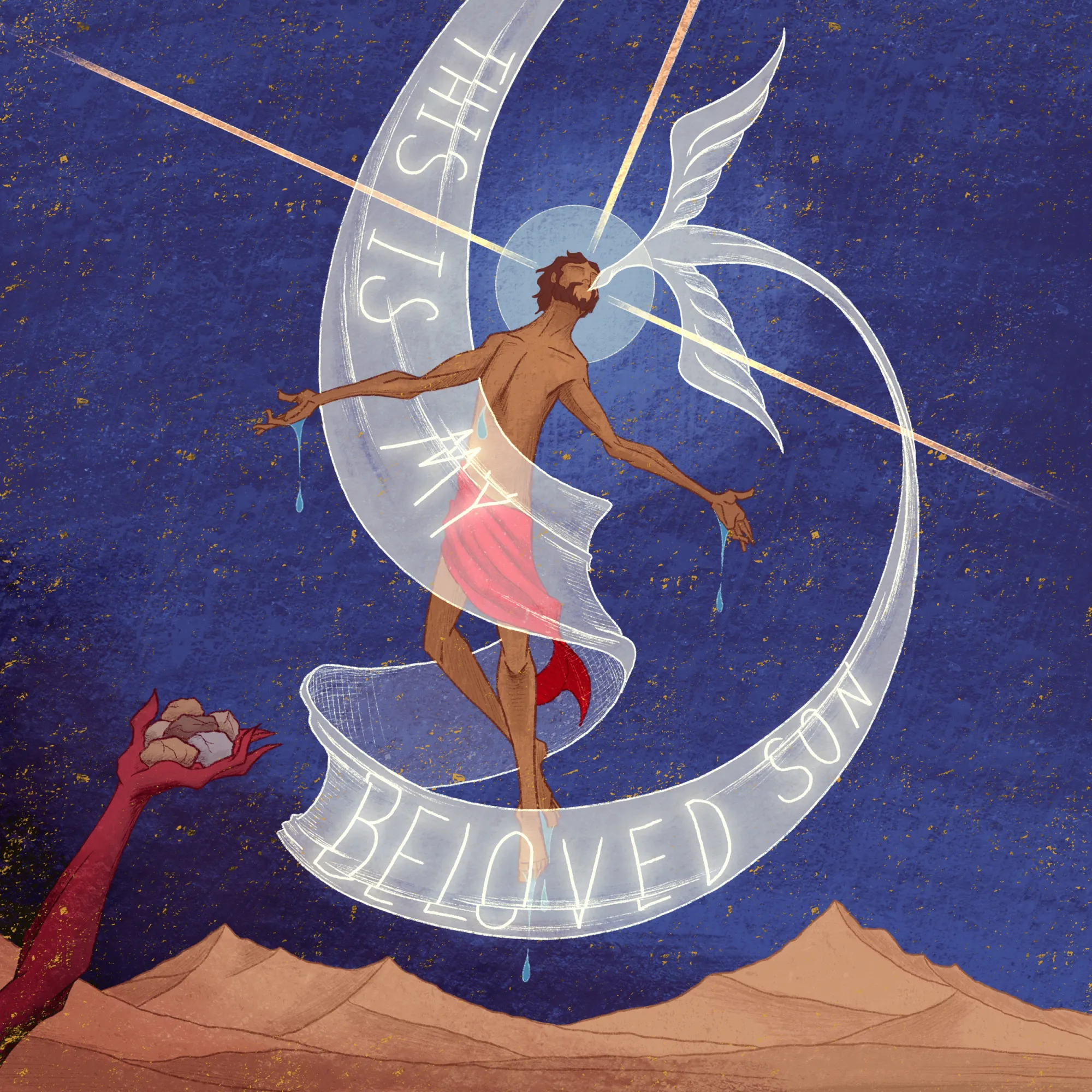
The devil is a one trick pony who tries to get Eve, Adam, Jesus, and you to doubt God’s Word. In the Garden, the devil asks, “Did God really say?” And when he is in the wilderness with Jesus, the devil starts his temptations with, “If you are the Son of God…” Remember, at Jesus’ Baptism, God the Father clearly said, “This is My beloved Son,” so the devil is trying to cast doubt on God’s Word again. He does the same thing In the temptations he throws at you. Now, this is extremely helpful to know and helps us fight against sin. But there is a very important difference between the temptations Satan lobs at Adam, Eve, and Jesus and the temptations he hurls at you. The difference, mainly, lies in the devil’s goal. Think through this for a minute.
In the Garden, the devil only needed to get Adam and Eve to sin once. One sin would rip all of humanity them from perfection and holiness and plunge them into fallenness and corruption. One sin and Satan figured he could stop working and retire to Arizona or Florida. But he was wrong. God completely upended the devil’s plan and promised to send the Seed of the woman to crush Satan’s head (Gen. 3:15). So, with his plans thwarted, the devil had to continue to tempt all people while he waited for that Savior to be born.
When Jesus entered creation, the devil again saw his chance for an early retirement. Here was that long-promised Seed of the woman. If he could just get Christ to commit one sin, then Jesus couldn’t be the Savior of all humanity. So, the devil waited until he thought the moment was ripe. After Jesus had fasted for forty days and nights, the devil came with these three temptations that he aimed at the second Adam (Ro. 5:14; 1 Cor. 15:45).
Do you see the difference? In the Garden with Adam and Eve but especially in the wilderness with Jesus, all it would take is one sin and the devil’s goal would be accomplished. Now, it wasn’t possible for Jesus to sin; He’s God and God cannot sin. But, hypothetically, if Jesus had sinned, there would be no Savior and no reconciliation with God. No mercy. No grace. No forgiveness. But, dear saints, that is not Satan’s goal when he tempts you. The devil’s goal is not to get you to sin once. No, he has to keep coming after you.
Because Jesus did not sin, the devil needs to continually tempt you – day after day, moment after moment. He can’t leave you alone; he has to keep pestering and tempting you. Even though you were born into the sin of your first parents, Jesus has rescued you by His perfect obedience. Now through faith, the devil does not own you; Jesus does. Christ has lived perfectly and has been tempted in every way as you are, but He did it without sin (Heb. 4:15). Jesus kept the Commandments in your place and credits His obedience to you through faith.
The day is coming when the devil will no longer be able to tempt you, but that day is not yet. So, the devil continues to work on you with his temptations, and you have to fight with all the resources God has given to you. Eph. 6:10-18 details the armor that God has provided for you – the belt of truth, the breastplate of righteousness, the shoes of the Gospel of peace, the shield of faith, the helmet of salvation, and the sword of the Spirit which is the Word of God. And remember when you read that passage, you are called to take up that armor and pray. Stand protected and call in the heavenly reinforcements to fight for you. God will send His holy angels to fight back against the devil on your behalf.
This is just an aside, but that is another difference between Jesus’ temptation and yours. Our Lord faced those temptations completely on His own. The angels only came to minister to Him after He resists the temptations and wins. You always have the holy angels assisting you in every moment and temptation.
Today, you should recognize that the devil is going to be after you constantly to try to get you to fall into temptation and sin to draw you away from Jesus. But even knowing this offers a key strategy to help you in the fight.
Adam and Eve’s fall was instant. But because you are saved and bought by the blood of Jesus, the devil is going to try, little by little, to get you to slowly slip away from the faith. For example, the devil isn’t going to tempt you to blaspheme God; he knows better than that. You aren’t going to just curse God. But the serpent will tempt you to skip church or your family devotions. Satan is going to work, little by little, to harden your conscience toward sin. And this means, dear saints, you need to be actively working to soften your conscience. This is difficult, painful work, but it is work you need to do. Here’s how you go about that.
We’ll use the 5th Commandment as an example. The 5th Commandment, “Thou shalt not kill,” and the Small Catechism’s explanation, “We should fear and love God so that we do our neighbor no bodily harm nor cause him any suffering but help and befriend him in every need.” Now imagine your conscience has a 5thCommandment thermometer. There are degrees by which the 5th Commandment is broken. Genocide would be way up at the boiling point. A little below that would be mass murder, then murder, then hitting and physically harming your neighbor. Way down at the bottom would be anger because when Jesus explains the 5th Commandment, He equates anger with murder (Mt. 5:21-22). But anger doesn’t physically harm others like murdering or even hitting them does. Let me be clear, both are sin; both need repentance and forgiveness because they both break the 5th Commandment.
Now think about where your conscience registers guilt because of your thoughts, words, and deeds somewhere on that 5th Commandment thermometer. Maybe you don’t think twice about being angry in your heart because you figure everyone does it and that guy really was a jerk. But you wouldn’t go grab a baseball bat and hit him. So, the devil isn’t going to tempt you to do that sort of thing. Instead, what the devil is going to do is try to raise the temperature of your conscience just a bit. He’s going to try to get you to break the 5thCommandment with more anger or holding on to that grudge a little harder. Once the temperature of your conscience acclimates to that level of sin, Satan can graduate you to the baseball bat.
What you need to do, dear saints, is stop excusing your anger. Recognize and confess it for the sin that it is. Let go of that anger and continually soften your conscience to the working of the Holy Spirit. Think through all of the Commandments like this. Recognize where your conscience registers sin and take that sin to Jesus. Confess it for the sin that it is and hand it over to the Lamb of God who takes away that sin and nails it to the cross.
And know this. The softer your conscience becomes, the more you will feel your sin. Real sanctification and actually growing in holiness is going to make you feel more and more sinful and cry out like Paul does in Ro. 7:24, “Wretched man that I am! Who will deliver me from this body of death?” The one who will rescue you is your great high priest. He can sympathize with your weakness because He was tempted in every way as you are, yet without sin (Heb. 4:14). He invites you now to come with confidence, right here, to His throne of grace. Here you will find mercy and grace freely given to you in Jesus’ Body and Blood which will continue to strengthen you for the fight against the devil’s temptations. And as you fight, remember that God is faithful and will not let you be tempted beyond what you can bear. He has promised to provide the way of escape (1 Cor. 10:13). Amen.
The peace of God, which surpasses all understanding, will guard your hearts and minds in Christ Jesus. Amen.
The Scripture readings for tonight’s Ash Wednesday service are Jonah 3:1-10; 2 Peter 1:2-11; and Matthew 6:16-21.
In the name of Jesus. Amen.
At some point in our lives, we have all broken something that couldn’t be fixed. No amount of glue, duct tape, or tinkering will put it back together. And when that happens – let’s say it was grandma’s antique vase – it doesn’t matter how the vase was broken. Maybe you threw it in a fit of rage, maybe you got a little too fancy with the game of catch in the living room, or maybe you just weren’t paying enough attention and barely bumped it – it doesn’t matter how it was broken because there’s no way to fix it. It doesn’t matter if you were angry or careless or thoughtless. There it lies on the floor, and it can’t be unbroken. All the king’s horses and all the king’s men can’t put Humpty Dumpty together again. The only thing to do is sweep up the pieces and throw it in the trash.
When you think of the things you have broken by your sin – the wrong turns you have taken, the right choices you failed to make, the kind words you didn’t speak, or the wrong words you said – the devil wants to take all of that and give you a sense of hopelessness. He wants you to just stare at the thing you have broken. He likes to hold the guilt of that mess over you, fill you with grief, and constantly remind you of your guilt. He wants to leave you staring at all the shattered pieces lying there on the floor, knowing that it was all your fault.
Tonight, we begin another Lenten season, and Lent is not a time of despair and gloom. At least, it’s not meant to be. Instead, Lent is a time of new beginnings and new hope. “Lent” means “spring.” The Christian religion isn’t one that only tells you about all the things you have broken or all the wrong choices you have made. Neither is Christianity a religion that only says, “God has fixed it. He understands. So, all the mess I’ve left in my wake is no big deal.” No. The Christian religion is far more. Yes, the Christian faith shows you what you’ve broken and how you’ve broken it, but it also shows you what God has done for you in Christ to reconcile you back with God and His creation. That is one of the great benefits of Lent and why it is important.
Lent is a time to put the cross of Christ before your eyes and focus your attention upon it. What Jesus has done for you on the cross gives you the full, complete, total forgiveness of your sins. On the cross, Jesus pays the price for all of your sins and restores you. Because of the cross, God gives you His mercy and grace. You know this, but you also know that the cross can’t unsay the evil and hurtful things you have said. The cross doesn’t undo the pain and harm you have caused yourself and others. The cross doesn’t make everything perfect again – not in this life.
Sinner, because of the cross, you more time. The cross gives you a time of hope when there should only be hopelessness. In Lent, Christ’s work on the cross stands before your eyes. Because of the cross, we should have an urgency. Paul mentions this urgency in 2 Cor. 6:2, “Behold, now is the favorable time; behold, now is the day of salvation.” In Christ and His cross, you and your loved ones still have time. So, what should you do with this time?[1]
First of all [Prayer], Lent is a time to be honest. Remember what the awful sinners of Nineveh did after they heard Jonah preach, “Yet forty days and Nineveh shall be overthrown!” (Jon. 3:4). They had great sin, but they also had time – forty days. And they used that time to repentantly pray. They were honest about their sins. They confessed how they had harmed themselves and others around them. They turned from their evil ways. God saw all this and relented of the disaster He said He would do to them, and He did not do it (Jon. 3:10).
This repentance is a good sorrow and a right sadness about sin. Repentance isn’t a pleasant thing to do. But similar to when a kid falls on his bike and needs to have gravel cleaned from his scrapes and cuts, repentance is going to cleanse so the wounds can heal. The cleansing is going to hurt, but If there’s no cleansing, those wounds might never heal. So, hold out your wounds, endure the pain of the cleansing, and begin to heal.
Second [Fasting], Lent is a time to slow down. Take the quiet moments God gives you – maybe through giving up certain things to free up more time – take those moments and consider how to supplement your faith with virtue, knowledge, self-control, steadfastness, godliness, brotherly affection, and love like Peter said in our Epistle (2 Pet. 1:2-11). And notice that all these things exist only when they flow from faith. In fact, they are impossible to have without faith. When we exercise our faith with these things, the Holy Spirit strengthens our faith.
Third [Almsgiving], Lent is a time to remember where your true treasure lies. The things of this earth are going to become moth-eaten, rust, and stolen from you in an instant. But there is a way to lay up for yourself treasure in heaven where it cannot be touched by any moth, rust, or thief. Yes, there may be broken vases all around you that cannot be fixed no matter how hard you try. But the things you do in this life that support the preaching of the Gospel and the things you do that strengthen your faith and the faith of your family – all of that lays up treasure for you in heaven and draws your heart heavenward as well.
Dear saints, God has reconciled all things to Himself and has made everything right by the cross (Col. 1:20). All the wrong turns, all the times you said too much or too little, and all the things you have broken have a cost to be fixed. The price? It was the holy and precious blood of Christ, and it is a payment that has been fully made on the cross. Jesus has destroyed sin and fixed everything that we, by our sin, have broken. And the day of Christ’s return is coming. Then, and only then, will all creation be put back together. There will be no more shards of vase lying there on the floor. It will all be fixed – fixed to perfection. May that day come soon. Until then, happy Lent. Amen.
The peace of God, which surpasses all understanding, will guard your hearts and minds in Christ Jesus. Amen.
[1] What follows will play off of the ‘textbook’ answer that Lent is a time of “prayer, fasting, and almsgiving.”
3 Strengthen the weak hands, and make firm the feeble knees. 4 Say to those who have an anxious heart, “Be strong; fear not! Behold, your God will come with vengeance, with the recompense of God. He will come and save you.”
5 Then the eyes of the blind shall be opened, and the ears of the deaf unstopped; 6 then shall the lame man leap like a deer, and the tongue of the mute sing for joy. For waters break forth in the wilderness, and streams in the desert; 7 the burning sand shall become a pool, and the thirsty ground springs of water; in the haunt of jackals, where they lie down, the grass shall become reeds and rushes.
In the name of Jesus. Amen.
I promise that we’ll get to this text from Isaiah, but it will be in a roundabout way. When God commanded, “Thou shalt not steal,” He meant it. Stealing is a disruption of God’s creation. When God gives something to someone, that is where He wants it to be. That is why thieves were required to repay the ones they robbed. Throughout the Scriptures, God says that a thief must give back what was stolen, and that repayment comes with interest. If you rob someone of their money or goods but it can be recovered, God says the cost is to pay back double what was stolen (Ex. 22:4, 7). But God set a higher price for other things that were stolen – especially if they could not be recovered. If a thief stole and killed one sheep, he was required to pay back four sheep. For every unrecoverable stolen ox, the repayment was five oxen. And If you stole food, you have to pay that back sevenfold (Pr. 6:31).
The first robbery recorded in the Bible was a theft of food in the Garden of Eden. All of creation belonged to God, and He freely handed it over to the man and woman that He had created in His image. Every plant was nutritious and delicious. And God gave all the plants for food (Gen. 1:29) – except one tree, the Tree of the Knowledge of Good and Evil. That tree, like every other tree, belonged to God. It’s fruit was His, and He said, “You don’t get to eat it.” But that first couple reached out their hands, took God’s fruit, and ate it. They stole food from God.
Now, here’s the problem, how would they repay God sevenfold as the Bible requires? It’s more complex than it might sound. They couldn’t pay with more fruit from that tree. All the fruit that remained on the tree already belonged to God. And to make things worse, they couldn’t put the fruit they had eaten back because it had become part of them. The only way to restore the fruit would be for Adam and Eve to be put back on the tree. But even that repayment was impossible because now they were thieves and sinners. Because it was stolen, that fruit was cursed and infected Adam and Eve with death that was coursing through their veins.
For the seven-fold payment to be made, Adam and all his children, needed a new Adam to offer payment in their place. Jesus entered this world as that new, sinless, and perfect Adam (Ro. 5:14; 1 Cor. 15:45). Only Jesus, perfect God and perfect man, could make repayment for that theft. And that is exactly what He does.
In our Gospel reading (Lk. 18:31-43), we heard how Jesus restored the sight of blind Bartimaeus (Mk. 10:46-52) on the road outside of Jericho. And Jesus did this by taking Bartimaeus’ blindness into Himself (Is. 53:4; Mt. 8:17) while also restoring his sight. That miracle, and all of Jesus’ miracles, show that Christ was removing the venom of sin and death, putting creation back together, and making the payment for that original sin and all subsequent sins. But all of Jesus’ miracles were merely a beginning of the full repayment He was about to make. Bartimaeus’ eyes eventually went blind again when he died. That is why that full, seven-fold repayment for the thievery in Gen. 3 is only made when Jesus is pinned to the cross, sheds His perfect blood, and dies. All of that brings us to this reading from Isaiah.
What is weak is to become strong. What is feeble is to become firm. To you who are anxious and troubled in heart, God says, “Be strong; fear not! Behold, your God will come with vengeance, with the recompense of God.” Normally, when sinners hear about vengeance and recompense, they are afraid and rightly so. But notice what this vengeance and recompense accomplishes – God comes to save you. He pays the debt that you owe. He has avenged your sin upon His only begotten Son. The payment has been made; your sin is atoned for (Is. 6:7).
Throughout Jesus’ ministry, He healed many more blind people besides Bartimaeus. Christ opened the ears of many who were deaf. Our Lord made many lame people walk and loosened all sorts of tongues to sing for joy. Each of those miracles were a display of Jesus’ divine power and authority to fix what sin and death had brought to creation. All of Christ’s miracles showed that He had come to undo the curse of the Fall. And yet, they aren’t the fullness of what Jesus had come to accomplish. They were limited in scope. Here, Isaiah says all the eyes of all the blind shall be opened and all the ears of all the deaf unstopped.
Jesus didn’t just come to open a few eyes and ears. He came to open all of them. When you read through the Gospels, Jesus is doing these miracles almost constantly. But there is no doubt that there were more blind and deaf in Israel and throughout the world that didn’t get the blessing of Jesus’ miraculous touch. In other words, there is more healing, more restoring, more removal of the curse to be done than Christ accomplished through His miracles.
But now that Christ has died and risen again, now that He is seated on the throne of all creation as the New Adam at the Father’s right hand, the curse of sin and death that hangs over all creation has been paid for. Your God has come and saved. And the day is coming when the eyes of all who are in the category of ‘blind’ will be opened. All the ears of the deaf will be unstopped. All the lame shall leap like a deer. And all the mute will sing for joy because the price has been paid. It has been paid by Jesus for you. Whatever parts of the curse still lay upon you have all been taken by Jesus. Christ has redeemed you by becoming a curse for you (Gal. 3:13).
As we move into Lent this year, we are going to consider what the suffering of Christ has accomplished. Out of God’s great love for you, Christ endured all the wrath, judgment, and death you deserved because of your sins. In Christ, God came to save you. Every illness, every malady, every pain, every sorrow you experience had a price, and that price was the precious death of God’s beloved Son.
And as we go on this Lenten journey, we do it remembering the destination – eternal life with God. Take a Bible and open to the end of Isaiah 35. Just after our text, Isaiah speaks of a highway. Listen to how Isaiah describes it. Isaiah 35:8-10, “And a highway shall be there, and it shall be called the Way of Holiness; the unclean shall not pass over it. It shall belong to those who walk on the way; even if they are fools, they shall not go astray. No lion shall be there, nor shall any ravenous beast come up on it; they shall not be found there, but the redeemed shall walk there.” Pause there for a minute.
All of that is to say that God has come to save you, and He has placed you on this highway. When you pass through areas of this highway that are dreadful, don’t worry because Jesus is with you. When you pass through areas of this highway that are delightful, remember, it is only the highway. The highway has its own joys and foretastes of what is to come, but the destination lies ahead. And what is that destination?
Back to Isaiah 35:10, “And the ransomed of the Lord shall return and come to Zion with singing; everlasting joy shall be upon their heads; they shall obtain gladness and joy, and sorrow and sighing shall flee away.” In other words, the point of the highway is the destination. The Resurrection, the new creation, the life of the world to come – that is your destination, believer. Don’t forget that.
Your God has come and saved you. Your journey is secure on God’s highway. How unspeakably great will it be when we arrive at our ultimate destination? Amen.
The peace of God, which surpasses all understanding, will guard your hearts and minds in Christ Jesus. Amen.
19 You gladly put up with fools since you are so wise! 20 In fact, you even put up with anyone who enslaves you or exploits you or takes advantage of you or pushes himself forward or slaps you in the face. 21 To my shame I admit that we were too weak for that!
What anyone else dares to boast about—I am speaking as a fool—I also dare to boast about. 22 Are they Hebrews? So am I. Are they Israelites? So am I. Are they Abraham’s descendants? So am I. 23 Are they servants of Christ? (I am out of my mind to talk like this.) I am more. I have worked much harder, been in prison more frequently, been flogged more severely, and been exposed to death again and again. 24 Five times I received from the Jews the forty lashes minus one. 25Three times I was beaten with rods, once I was stoned, three times I was shipwrecked, I spent a night and a day in the open sea, 26 I have been constantly on the move. I have been in danger from rivers, in danger from bandits, in danger from my own countrymen, in danger from Gentiles; in danger in the city, in danger in the country, in danger at sea; and in danger from false brothers. 27 I have labored and toiled and have often gone without sleep; I have known hunger and thirst and have often gone without food; I have been cold and naked. 28 Besides everything else, I face daily the pressure of my concern for all the churches. 29 Who is weak, and I do not feel weak? Who is led into sin, and I do not inwardly burn?
30 If I must boast, I will boast of the things that show my weakness. 31 The God and Father of the Lord Jesus, who is to be praised forever, knows that I am not lying. 32 In Damascus the governor under King Aretas had the city of the Damascenes guarded in order to arrest me. 33 But I was lowered in a basket from a window in the wall and slipped through his hands.
1 I must go on boasting. Although there is nothing to be gained, I will go on to visions and revelations from the Lord. 2 I know a man in Christ who fourteen years ago was caught up to the third heaven. Whether it was in the body or out of the body I do not know—God knows. 3 And I know that this man—whether in the body or apart from the body I do not know, but God knows— 4 was caught up to paradise. He heard inexpressible things, things that man is not permitted to tell. 5 I will boast about a man like that, but I will not boast about myself, except about my weaknesses. 6 Even if I should choose to boast, I would not be a fool, because I would be speaking the truth. But I refrain, so no one will think more of me than is warranted by what I do or say.
7 To keep me from becoming conceited because of these surpassingly great revelations, there was given me a thorn in my flesh, a messenger of Satan, to torment me. 8 Three times I pleaded with the Lord to take it away from me. 9 But he said to me, “My grace is sufficient for you, for my power is made perfect in weakness.” Therefore I will boast all the more gladly about my weaknesses, so that Christ’s power may rest on me.
In the name of Jesus. Amen.
This is a fairly long text, and Paul boasts about himself quite a bit here, but please notice he acknowledges that. He even calls himself a fool and madman (2 Cor. 11:21, 23) for talking like this. But still, to our northern Minnesota, Midwestern ears, a lot of this text can be a bit off-putting. Paul would probably be more ‘at home’ in a place like New York or New Jersey. But basically, all that bragging is Paul defending status as an apostle. That long list of things he endured – the beatings, lashings, shipwrecks, and dangers – all of that is Paul saying that he learned what Jesus meant when He said, “If anyone would come after Me, let him deny himself and take up his cross and follow Me” (Mt. 16:24).
Then, Paul mentions this vision that he had fourteen years before he wrote this letter, but he does it in a roundabout way. He talks about a man who was caught up into the third heaven. We don’t know what this ‘third heaven’ is other than the fact that Paul calls it ‘paradise.’ While he was there, he heard things that he isn’t allowed to speak about; in other words, the vision was just for him. That isn’t unique. In the book of Revelation, John has a similar experience; he hears the voice of seven thunders, but he isn’t allowed to write what those thunders said (Rev. 10:1-4). Now, it’s clear that the man who had the vision is Paul himself. Notice how in 2 Cor. 12:7, Paul says that he was given a thorn in the flesh to keep him from becoming conceited because of the surpassing greatness of that vision. God knew Paul’s weakness of being prideful, so to limit that pride, God gives Paul this thorn in the flesh to keep him humble.
We don’t know exactly what this thorn is. We can speculate, but we can’t say for sure. The possibility that I gravitate toward is that this thorn in Paul’s flesh was poor vision (see Act. 9:18; Gal. 6:11). But I also will admit that I lean toward that understanding because I can identify with it. I also think Paul is intentional about not saying exactly what this thorn is so that you can take his conclusion about the thorn and apply it to yourself in whatever afflictions and suffering you face. Whatever this thorn in the flesh is, it wasn’t a minor thing for Paul. He pleads and begs with Jesus three times to have it removed. This thorn, Paul’s pleading, Jesus’ response to that pleading, and Paul’s conclusion have a lot to teach us about suffering as a Christian.
The first thing to notice is that this thorn was given to Paul. So, who gave it? Well, we have some clues. That thorn is a messenger (lit. an ἄγγελος)of Satan to harass him. In other words, it is one of the devil’s demons who afflicts and torments Paul with the thorn. The devil’s intention is always to push us toward more pride and greater sin. You especially see it when the devil tempts Adam and Eve by saying, “you’ll be like God,” in the Garden of Eden (Gen. 3:5). Because of this, we might conclude it was the devil who gave this thorn, but hold on just a second. Also notice that this thorn was given in order to limit Paul’s pride and conceit. The devil wouldn’t want to do that. So, who gave Paul this thorn? We’d have to conclude God did, but God does it through the devil.
So, here’s the lesson for us: Both the thorn and the demon are evil – utterly and completely evil – but God takes those evil things and uses them for good. When Ro. 8:28 says that God works all things together for good for those who love him, it is true. Even the work and attacks of the devil can be tools in God’s hand to bring about good. We see a similar thing happen with Job. God allows the devil to afflict Job by destroying all Job’s possessions and even Job’s health (Job. 1:9-12, 2:4-6). There, the devil admits that he can’t touch anything connected with Job unless God permits it. The devil’s intention in tormenting Job with all that suffering is to get Job to curse God. But when you get to the end of the book of Job, you see that Job remains blameless and upright. God uses that affliction of the devil to increase Job’s faith, and on top of that, Job’s three “friends” get brought closer to God as well.
The devil’s intention with both Job’s suffering and Paul’s thorn in the flesh is to destroy faith and increase sin, but God uses the devil’s work to accomplish His purposes. This happens all the time, but the clearest place we see this is in the crucifixion of Jesus. The devil’s fingerprints are all over it! Judas’ betrayal, the crowds who get stirred up by the priests and elders to release the murderer Barabbas instead of Jesus (Mt. 27:20), and the high priest Caiaphas who says that Jesus should die instead of the whole nation perishing (Jn. 11:49-50), there’s no question that all of that was Satan’s work in order to kill Jesus on the cross.
But what actually happened on the cross? Did the devil win by getting Jesus pinned there? Nope! It is on the cross that Jesus crushes that worm’s head. On the cross, Jesus took the record of debt that stood against us and nailed it to the cross which completely disarmed the devil and demons and put them to open shame (Col. 2:14-15). In the crucifixion, Satan thought he was beating God, but God was using the devil’s own strategy and plan to utterly defeat Satan, to deliver you, and to win you back for Himself. God be praised!
Now, let’s draw some practical application from all of this because there are all sorts of lessons to take away from this text (more than I’m going to cover here).
First, God can and does use suffering for your benefit. You don’t have to like suffering; in fact, we long for our suffering to be over. But you can know that God is working in and through your suffering – whatever it is. Scripture doesn’t call you to rejoice because of your suffering, but it does call you to rejoice even in the midst of your suffering (Ro. 5:3-5).
Second, if you are suffering in any way, if you have some thorn, that does not mean that God is angry with you or pitted against you. Remember, Job’s suffering began because God bragged about Job to the devil (Job 1:8, 2:4). And God wasn’t angry with Paul either. It was God’s love for Paul that permitted that fleshly thorn that Paul dealt with for so long.
Third, if you are afflicted by demons, that doesn’t mean you are a bad Christian. Paul had one for fourteen years while he was proclaiming the Gospel, starting new churches, and furthering the kingdom of God. And Jesus tells Paul, “My grace is sufficient for you. I’m going to let that demon do his thing while I give you My grace. This will show My strength is working through you.”
Fourth, unanswered prayers and denied petitions do not mean that God is unhappy with you. Paul begged and pleaded three times, and Jesus said, “No.” Yes, sometimes, Jesus will release you from the things that cause you suffering, but even when He says, “No,” it is for your benefit.
Finally, look at Paul’s reaction to all of this. He doesn’t say, “I asked for this thorn to be removed, but Jesus said, ‘No,’ so I’m going to complain.” No! He says, “Therefore I will boast all the more gladly of my weaknesses, so that the power of Christ may rest upon me. I’ll be content with weaknesses, insults, hardships, persecutions, and calamities. For when I am weak, then I am strong.”
Dear saints, you are right to lament and long for your suffering to come to an end. Jesus came to rescue you from all suffering. But in your suffering, know that God is at work, and you don’t know what kind of fruit God will bring about through that suffering. Christ is right there beside you in every affliction and weakness you have. He is there present with His strength. And He comes now to strengthen you with His all-powerful Body and Blood, given and shed for you for the forgiveness of all your sins. To Him be all the glory, honor, praise, and thanks now and forever. Amen.
The peace of God, which surpasses all understanding, will guard your hearts and minds in Christ Jesus. Amen.
1 “For the kingdom of heaven is like a master of a house who went out early in the morning to hire laborers for his vineyard. 2 After agreeing with the laborers for a denarius a day, he sent them into his vineyard. 3 And going out about the third hour he saw others standing idle in the marketplace, 4 and to them he said, ‘You go into the vineyard too, and whatever is right I will give you.’ 5 So they went. Going out again about the sixth hour and the ninth hour, he did the same. 6 And about the eleventh hour he went out and found others standing. And he said to them, ‘Why do you stand here idle all day?’ 7 They said to him, ‘Because no one has hired us.’ He said to them, ‘You go into the vineyard too.’ 8 And when evening came, the owner of the vineyard said to his foreman, ‘Call the laborers and pay them their wages, beginning with the last, up to the first.’ 9 And when those hired about the eleventh hour came, each of them received a denarius. 10 Now when those hired first came, they thought they would receive more, but each of them also received a denarius. 11 And on receiving it they grumbled at the master of the house, 12 saying, ‘These last worked only one hour, and you have made them equal to us who have borne the burden of the day and the scorching heat.’ 13 But he replied to one of them, ‘Friend, I am doing you no wrong. Did you not agree with me for a denarius? 14 Take what belongs to you and go. I choose to give to this last worker as I give to you. 15 Am I not allowed to do what I choose with what belongs to me? Or do you begrudge my generosity?’ 16 So the last will be first, and the first last.”
In the name of Jesus. Amen.
The Bible refers to Christians as many things. Christians are God’s sons (Ro. 8:14; Gal. 3:26), daughters (2 Cor. 6:18), children (Mt. 6:9; Ro. 8:16; 1 Jn. 3:1), and heirs (Ro. 8:17; Gal. 4:7). All Christians are called the bride of Christ (Eph 5:25-27) and the body of Christ (Ro. 12:4-5; 1 Cor. 12:27). The Bible will refer to you Christians as sheep with Jesus as your Shepherd (Jn. 10:1ff). There are all sorts of other things I could mention, but in this parable, Jesus calls you workers or laborers in God’s vineyard, and that is what we are going to focus on.
In the parable, the vineyard is the kingdom of God or the Church, the master is Jesus, and, Christian, you are in this parable as a worker who was brought into the vineyard by Jesus. Some of you were brought in early and some later, but you were all brought in by the invitation of Christ. You were brought in to the kingdom of God for a purpose.
Christ has called you into His kingdom not just to lounge around and dangle your toes in the pool while you get a tan. No, He has work for you to do. Husbands and fathers; wives and mothers; children; students; employees with a boss or business owners with staff; citizens of cities, states, and countries – all of these are tasks put in front of you as you work for God in His kingdom. There are times when the work Jesus puts in front of you is hard, difficult, and requires more strength than you can muster on your own. There are times when that work is easier. But it doesn’t matter how challenging or easy the work is, it is work in God’s kingdom.
And this parable harkens back to our origins, back to what God created us to be. Remember how it was at the beginning of creation and before the Fall? God creates everything, plants a garden, and puts Adam and Eve there so they could work it and keep it (Gen. 2:15). Those of you who have been attending our adult class Sunday mornings will, hopefully, remember this. Those two responsibilities – to work and to keep the Garden of Eden – are the same duties that God gives to the priests who served in the Tabernacle and Temple (Num. 3:7-8, 8:26, 18:5-6); the Hebrew words are the same. God didn’t just create Adam and Eve to be gardeners, they were guardians of sacred space. So, this parable refers to how God calls you to be guardians of the sacred space of His kingdom.
This vineyard, the kingdom of God, is a blessed place. Yes, there’s work to do. You have tasks and responsibilities to faithfully carry out, and at times you will struggle and even fail in those responsibilities as laborers in the vineyard. But remember, Scripture doesn’t only call you a laborer; again, you are also a child of God. As a laborer in God’s vineyard and as a child of God, you are part of the family business. Now, please know that I’m going to push past the boundaries of the parable a bit here (i.e. this goes a bit past the scope of the parable), but it is still in line with what the Scriptures teach.
In a family business, the children get all sorts of perks, freedom, and leeway that regular employees, who aren’t part of the family, don’t get. Now, I don’t know enough about vineyards to know if they regularly use tractors, but sick with me on this for a minute. Imagine a normal vineyard with a worker who crashes the tractor because he’s being careless or reckless. That guy is probably going to get fired. But if one of the vineyard owner’s own children makes the same mistake, sure he might get a lecture or not be allowed to drive the new tractor that replaces the one he broke, but he’s still going to be in the business because he’s family.
Now, what might that look like for you as a laborer in God’s vineyard? Again, as a Christian, you are working in God’s vineyard no matter what you are doing. You adults – in your job, whatever it is; in your home with your spouse and children; or in your town, state, and country – every responsibility is vineyard work that God gives you to do. You kids – at home, you empty the dishwasher, make your bed, brush your teeth; in your school, whatever subject you are studying or even being a friend to others at recess – all of that is vineyard work.
There are times you are going to mess up in that vineyard work. You’re going to burn the supper. You’re going to bomb the spelling, math, or science test. But you’re family, so there is forgiveness and mercy extended. You’re still going to be in the vineyard. Sure, you’ll have lessons to learn (and, sometimes, those lessons won’t be pleasant). You might be relegated to different tasks that better fit your abilities (see 1 Cor. 12:21-26). But you’re still in the vineyard because you’re family. Ultimately, the only failure is not learning from your mistakes and doing better the next time.
According to the parable, the thing that gets you thrown out of the vineyard is being angry with the master because of his generosity and goodness toward others (Mt. 20:13-15). But now, I have to add this just briefly: None of that is an excuse to be lazy or reckless with your labor in the vineyard. Remember, the better you work in the vineyard, the more you will benefit. So, take your work in the vineyard of God’s kingdom seriously, but also know that your place in the vineyard is safe and secure.
Ok, back inside the boundaries of the parable and to the elephant in the room – the wages.
In the parable, the only place outside of the vineyard is the marketplace. Markets are where goods and money are exchanged. This thing costs so much, and if you don’t have enough, tough cookies. The marketplace operates only in justice. Now don’t get me wrong, justice is a good thing. We need justice, but because we are sinners, justice is a terrifying thing. God be praised that we have a God who is merciful andjust (Ro. 3:26; 1 Jn. 1:9). The marketplace is where the master of the vineyard finds his laborers and calls them out of it. Notice how the master says to the eleventh-hour workers, “Why do you stand here idle all day?” They don’t respond, “Well, we like it here.” No. The marketplace is a terrible place to be as it is presented in this parable. When the master says, “You go into the vineyard too,” they don’t respond, “Aw man, now we have to work.” They willingly and joyfully go into the vineyard.
Again, notice how the judgment in this parable is being tossed out of the vineyard because the grumblers didn’t like the master’s pay scale based on mercy and generosity. Dear saints, we want to remain in the vineyard where we are benefactors of Jesus’ death and resurrection. Because of what Jesus has done, we are in the vineyard where we get better than our sins deserve.
The parable is not just a description of the last day and final judgment. The parable is also about the life of faith. Some of you have said something like this to me, “Pastor, I don’t really like this parable. I’ve been a Christian my whole life and worked in God’s kingdom. And Jesus is saying that all I’ve done as a worker in His kingdom doesn’t really matter because anyone who converts on their deathbed or in a foxhole gets treated the same way I will. I know this is a wrong attitude, but I still don’t like what the parable teaches.”
I’ve done my best to address that in the past, but after studying this week, I’ve got an answer that is better than what I remember sharing in the past. If you look back to the end of Mt. 19, the context of when Jesus tells this parable is also recorded in Lk. 18:18-30. Luke doesn’t record this parable, but Jesus tells this parable in the context of Peter’s little brag and question, “Jesus, we disciples have left our homes and everything and followed you. What are we going to get?” (see Mt. 19:27 & Lk. 18:28). And in Lk. 18:29-30, Jesus promises, “Truly, I say to you, there is no one who has left house or wife or brothers or parents or children, for the sake of the kingdom of God, who will not receive many times more in this time, and in the age to come eternal life.”
Did you catch that? Jesus promises eternal blessings and rewards to you in the life to come, but you also get blessings and rewards in this life for your labor in His kingdom. That’s what Jesus says. And He wouldn’t say it if it weren’t meant to be enticing to you to do the work that He has for you in His kingdom. Plus, consider this: you know what those eleventh-hour workers, who got paid the same denarius as those who worked the whole day, you know they did the next day? They got up and worked a full day in the vineyard. They got more strength, more endurance, more experience, and did what they could for the benefit of the vineyard.
Finally, and I’ll leave you with this: Remember your Christian life is work and labor in the vineyard. Jesus doesn’t tell the parable about the owner of a factory that produces sweatpants or sneakers or frozen French fries. No. It’s about a vineyard. Vineyards exist to produce wine which God gives to make glad the heart of man (Ps. 104:15). The work you do in Christ’s kingdom brings joy, rest, and feasting to you and to those around you. May we all be diligent and faithful and joyful as we live out our faith in the life of the vineyard. Amen.
The peace of God, which surpasses all understanding, will guard your hearts and minds in Christ Jesus. Amen.






 Pastorsamwise
You must be logged in to post a comment.