1 Corinthians 15:51-57
51 Behold! I tell you a mystery. We shall not all sleep, but we shall all be changed, 52 in a moment, in the twinkling of an eye, at the last trumpet. For the trumpet will sound, and the dead will be raised imperishable, and we shall be changed. 53 For this perishable body must put on the imperishable, and this mortal body must put on immortality. 54 When the perishable puts on the imperishable, and the mortal puts on immortality, then shall come to pass the saying that is written:
“Death is swallowed up in victory.”
55 “O death, where is your victory?
O death, where is your sting?”
56 The sting of death is sin, and the power of sin is the law. 57 But thanks be to God, who gives us the victory through our Lord Jesus Christ.
Alleluia! Christ is risen!
He is risen indeed! Alleluia!
In the name of Jesus. Amen.
“O death, where is your victory? O death, where is your sting?” Too often we think of death in wrong ways. We think that death is a state or a category or a condition. But v. 55 of that Epistle Lesson says that death is an enemy, a person who can be talked to and, most importantly, an enemy who can be questioned.
Imagine encountering death. When you or someone you love dies and you cross paths with death, you need to only ask death one simple question: “O death, where is your sting?”
Death might try to answer you with a pale, menacing, frightening voice, “My sting is your sin. I sting because you sin. If you didn’t have sin, I would have no sting. But I sting everyone because all have sinned. I am the wages and payment of sin (Ro. 6:23). And I will sting you because your sin is my sting.”
But you can simply respond, “I know all of that, death. I know that my sin has put me under your thumb. I know that the Bible says, ‘The wages of sin is death.’ So, what you say is true. But, death, I didn’t ask you, ‘What is your sting?’ I asked you, ‘Where is your sting?’ So, death, where is it, where is your sting?”
And death might smile and respond, “You simple Christian, have you forgotten how powerful my sting is? It is more powerful than the most poisonous snake or spider or jellyfish. My sting is the most powerful sting imaginable. My sting burns forever because the power of my sting is fueled by the Law. Yes, God’s eternal Law that abides forever, and you have broken that Law over and over.”
But you can look back at death and say, “I know my sin is no small sting. I know my sin is against the God who created me and loves me. I know the penalty of my sin is everlasting death, and I feel it in my conscience. I also know that the Law is not ever going to go away. I know that God’s Commandments are eternal. In fact, the Law was what made me scared of you. Because of the good and righteous Law, I know what you can do to me. I know that your sting is my sin, and I know that the power behind that sting is the Law. But, death, you still have not answered my question. Where is your sting?”
At this point, death is uncomfortable and a little fidgety, but he musters as much gusto as possible and says, “Well, you are face-to-face with me, aren’t you?”
“Yes, I am, but the sting of death is not death. The sting of death is sin. So, I ask you again, ‘Death, where is your sting?’”
Finally, death hangs his head. “I have used it, and I have lost it. But I’ll get it back again.”
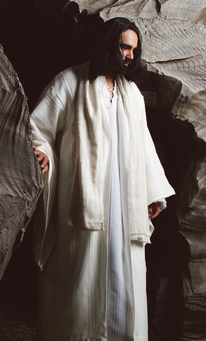 And you can smile in his face, “Yes, death, you used your sting, didn’t you? You should have used your sting on me. The sting would have stuck on me. But you didn’t. Instead, death, you used your sting on my Savior, my God, and my Lord. You used your sting on Jesus, didn’t you? You had Jesus pinned tightly on the cross, and you stuck Him with your stinger and buried it into Him. Death, you were a fool that day. You stung God Himself. You stung Jesus who is the Resurrection and the Life (Jn. 11:25). But when you went to the tomb to find your stinger and get it back, Jesus wasn’t there. And guess what, death, Christ has taken my sin as He hung on the cross. And, death, you will not ever get your sting back. Never. That empty tomb means that your sting is lost forever. Death, I don’t fear you any longer.”
And having no other answer, death now turns around and walks away from you.
Dear saints, this is why we celebrate every Easter and every Sunday. Every Sunday, we celebrate what Christ has done in absorbing the sting of death so that death no longer has his sting.
And the day is coming when Christ will return. On that day, the trumpet will sound, and the dead will be raised imperishable. The day is coming when your perishable body will put on the imperishable and your mortal body will put on immortality.
Yes, death can and does buzz around now for a while. But death is like a bee that has used its stinger and soon dies.
Dear saints, “Death is swallowed up in victory.” Yes, the sting of death is sin, and the power of sin is the Law. But thanks be to God, who gives us the victory through our Lord Jesus Christ. So now, Christian, you need have no fear of death. Jesus has conquered the bitter tyrant of death. And He has connected you to that victory. You do not need to fear and watch out for death hiding behind a corner to pounce on you. Instead, Christian, you continue to look for the resurrection of the dead, and the life of the world to come.
Because Christ is risen, death is overthrown. Christ is risen and life reigns. Christ is risen, and dear saint, you are safely anchored in Christ who has given you the victory, now and forever.
Alleluia! Christ is risen!
He is risen indeed! Alleluia!
Amen.
The peace of God, which surpasses all understanding, will guard your hearts and minds in Christ Jesus. Amen.
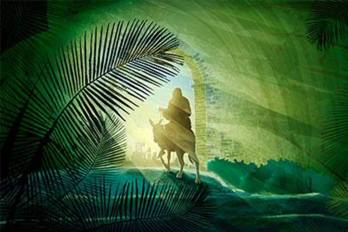 The main focus of Matthew’s Passion account we just heard is the royalty of Jesus. Christ rode into Jerusalem on a royal donkey just like King David and King Solomon (1 Kgs. 1:38) had done. But Matthew doesn’t focus on Jesus’ royal greatness or magnificence. Instead, Matthew focuses on King Jesus’ innocence. Matthew points us to King Jesus “the Innocent.”
 Jesus has arrived in Jerusalem. The Priest has come to the Temple. The Prophet has come to Mt. Zion. The King has come to His city. But most importantly the Lamb of God has come to His altar, where He would in five days breathe His last and pour out His blood for you (Pr. Wolfmueller). This is your Lord’s Passion, done and completed for you. Amen.
 Or my favorite, the boy standing in the middle of the room with his eyes closed tight. (To my great shame, I learned closing your eyes doesn’t make you invisible when I was in fourth grade.) Silly kids.
 Jesus stood in the middle of people who have been looking for a reason to kill Him for almost His entire ministry (Mk. 3:6). Today, Christ declares Himself to be no less than Almighty God. When He declares Himself to be the great I Am, Jesus announces that He is the One who is Lord over all things, and the One who always was, always is, and always will be, the One who spoke to Moses from the burning bush, the One who led their ancestors through the Red Sea on dry ground, the One whom Isaiah saw in the Temple.
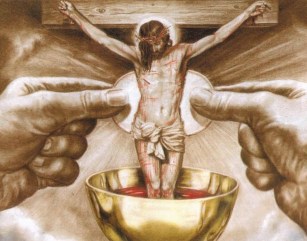 All of that is hidden so that you do not have to face it. It is hidden so that you do not need to hide.
 10 Jesus said, “Have the people sit down.”Now there was much grass in the place. So the men sat down, about five thousand in number. 11 Jesus then took the loaves, and when he had given thanks, he distributed them to those who were seated. So also the fish, as much as they wanted. 12 And when they had eaten their fill, he told his disciples, “Gather up the leftover fragments, that nothing may be lost.” 13 So they gathered them up and filled twelve baskets with fragments from the five barley loaves left by those who had eaten. 14 When the people saw the sign that he had done, they said, “This is indeed the Prophet who is to come into the world!”
 Imagine a husband and wife are discussing their serious financial troubles and debt – the car needs expensive repairs, they are behind on their mortgage, and their credit cards are already maxed. They discuss all of this privately in whispers so they don’t scare their children. But suddenly, they are startled to see their young daughter in the room. The daughter holds out a handful of coins from her piggy bank and offers it to them saying, “Here, I want to help.” That handful of change, of course, won’t put a dent in their debt. That daughter doesn’t understand the complexities of the problem, so she imagines that her parents’ problem is easily fixed by her small offering. But it is moments like this that show a beautiful childlike faith which Jesus often praises, “Whoever does not receive the kingdom of God like a child shall not enter it” (Mk. 10:15).
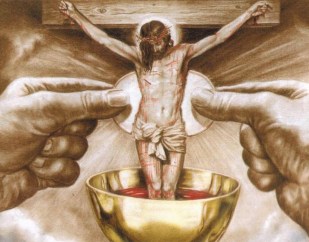 Remember, Jesus came to seek and to save you, the lost (lit.‘perishing’ Lk. 19:10), again, the same word in Jn. 3:16and v. 12. Jesus saves you, body and soul. And Jesus saves your works. Through His death and resurrection, Jesus provides more than we could imagine.
 She prays because she remembers that the God of Israel promised to deliver His people from the devil, which is why she addresses Jesus as the Son of David – to remind Him of His promises. And she remembers that she doesn’t deserve Jesus’ help because of her sins, so her prayer is, “Have mercy on me.”
 Boone, and all of you, be bold in your prayers. Even when it seems that God is distant and ignoring you, He hears you. He loves you. Jesus has died and risen for you and is even now interceding for you before His Father in heaven (1 Jn. 2:1).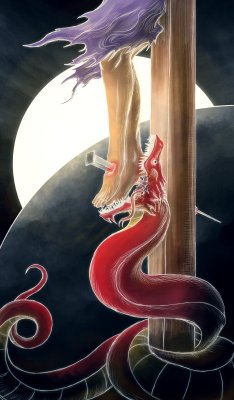
 But Satan comes along and puts a question into the mind of the woman. “Did God actually say?” This is the one attack of the devil. He always is trying to get us to doubt the Word and promise of God. “Did God actually say, you should not eat of any tree in the garden?” And notice that the woman adds to God’s promise. She says, “We may eat of the fruit of the trees in the garden, but God said, ‘You shall not eat of the fruit of the tree that is in the middle of the garden, neither shall you touch it, less you die.’” God had never said anything about not touching the tree of the knowledge of good and evil (at least, it isn’t recorded for us). Satan is attacking God’s Word, but Adam and the woman have not fallen yet. The serpent sees his opening and tells an outright lie, “You will not surely die! For God knows that when you eat of it your eyes will be opened, and you will be like God, knowing good and evil.”
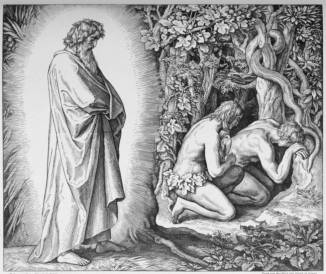 But even as God does this, we will see the horrific consequences that sin and evil has brought into God’s good creation. God calls to Adam, “Where are you?” God still wants to have fellowship with Adam and the woman even though they have sinned, broken His commandment, and lost their faith. But rather than confessing and repenting of his sin, Adam dodges the opportunity saying, “I hid from You because I was naked and afraid.” So, God gives Adam a second chance to repent, “Who told you that you were naked? Have you eaten of the tree of which I commanded you not to eat?”
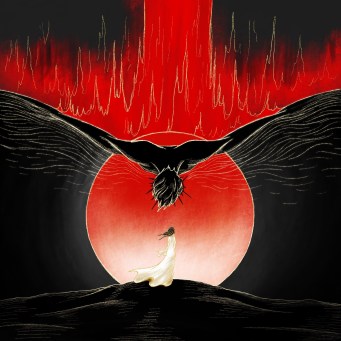 gives her the name Eve. She wasn’t called this at any point before in Scripture. Adam gives her the name ‘Eve’ which means ‘life-giver.’ Here’s how we know faith is restored. Eve was already going to be the mother of everyone who would be born. But Adam, the father of faith, changes her name to Eve because she is the mother of all who would believe in the promised Seed who would crush the serpent’s head.
 But today, I want to focus on one phrase from this text about love; it is the first phrase from v. 7, “Love bears all things.” Remember, that the second great commandment is to “love your neighbor as yourself” (Mt. 22:39). Paul writes in Gal. 6:2, “Bear one another’s burdens, and so fulfill the law of Christ.” One aspect of love is to bear another’s burdens. And there is no way to make bearing others’ burdens less burdensome.
 Which brings me back to where we started about looking for ways to make life easier. Too often, we try to make our own lives easier by avoiding the Scriptural command to bear one another’s burdens. But this is unloving, and it is, in fact, sinful. I can think of three tricks we commonly use to avoid bearing the burdens of others, but I am sure there are more (if you know more, let me know after the service).
 We heard about love in action in our Gospel lesson (Lk. 18:31-43). Jesus encountered blind Bartimeaus (Mk. 10:46). Bartimaeus cries out to Jesus, “Have mercy on me!” Jesus pauses on His important trek up to Jerusalem, where He is going to save the whole world. He stops to listen to Bartimeaus asking him, “What do you want me to do for you?”Bartimeaus says that he wants to receive his sight. And Jesus doesn’t start talking about Himself and the problems He is about to face even though Jesus’ burden is going to be much more than blindness. And Jesus doesn’t give advice – and if anyone is in a position to give advice it’s Jesus. Jesus simply says, “Receive your sight, your faith has made you well.”By doing this, please note, Jesus recognizes that Bartimaeus’ blindness is bad.
 Pastorsamwise
You must be logged in to post a comment.