Luke 7:11-17
11 Soon afterward he went to a town called Nain, and his disciples and a great crowd went with him. 12 As he drew near to the gate of the town, behold, a man who had died was being carried out, the only son of his mother, and she was a widow, and a considerable crowd from the town was with her. 13 And when the Lord saw her, he had compassion on her and said to her, “Do not weep.” 14 Then he came up and touched the bier, and the bearers stood still. And he said, “Young man, I say to you, arise.” 15 And the dead man sat up and began to speak, and Jesus gave him to his mother. 16 Fear seized them all, and they glorified God, saying, “A great prophet has arisen among us!” and “God has visited his people!” 17 And this report about him spread through the whole of Judea and all the surrounding country.
Alleluia! Christ is risen!
He is risen indeed. Alleluia!
In the name of Jesus. Amen.
 If Menards can have Christmas decorations out already and if the Hallmark Channel can do nonstop Christmas movies in July, then the Church can certainly have Easter in October. In fact, we have to celebrate Easter because this text screams Easter – loud and clear. But always before Easter, there is Good Friday. Before resurrection, there must be death. Good Friday sadness is a prerequisite to Easter joy. We have to see that first.
Yes, Easter joy is the climax of this text, but Good Friday sadness gets more words. Yes, the young son of this woman is raised, but Luke spends much more time telling us about the sad estate of his mother. She was a widow, but now she is really alone. This son of hers that has died is her only-begotten (μονογενής same word used in Jn. 3:16) son. A great crowd follows her sharing in her grief. Jesus sees her and speaks to her first. This woman is drowning in Good Friday grief. But Jesus He won’t allow it.
Jesus isn’t very good at funerals. He always ruins them. Remember when Jairus’ little girl died (Mt. 9:18-26; Mk. 5:22-43; Lk. 8:41-56), Jesus sees all the mourners weeping and wailing and tells them, “Go away, for the girl is not dead but sleeping,” and everyone laughs at Him. But then Jesus goes into the house, takes the girl by the hand, and says, “Little girl, get up” (Mk. 541:). And she does. Or, remember when Lazarus died. Jesus came when Lazarus’ corpse would have been ripe and stinky. Then, Christ tells them to roll the stone away from the entrance of the tomb and says, “Lazarus, come out” (Jn. 11:43). And out He comes. Finally, remember Jesus’ own funeral. Our Lord didn’t behave properly then either. Jesus leaves before His funeral is finished. He didn’t stick around in the grave long enough to have a proper burial.
Well, here in this text, Jesus ruins another funeral. Jesus is leading a great crowd. And as they reach the city of Nain, they meet another crowd who were going out of the city to bury the boy. These two throngs of people meet at the gate. Imagine this. One crowd is leaving the city and following death, and another crowd is entering the city lead by the Life of the world (Jn. 11:25, 14:6). And these two crowds get mixed up together in this bottle neck.
Proper etiquette and manners would dictate that Jesus and His crowd would step aside and allow the funeral procession to pass by. But, remember, Jesus is no good at funerals. Instead, Jesus marches right up to the front of the funeral procession. He does this, Luke tells us, because when He saw the mother He had compassion on her. Literally, Jesus’ guts were being wrenched and all twisted up inside.
He walks up to the woman and says, “Do not weep.” This sounds absolutely callous. Weeping is the right thing for this woman to be doing – her son has died. When you are saddened by the death of someone and find yourself weeping, you are doing what is right. Your actions line up with how God feels about death. Jesus, who never sinned, Himself cried when He was at the tomb of Lazarus (Jn. 11:35). Now, the text doesn’t tell us this, but I wouldn’t be surprised if Jesus had tears in His eyes as He approached the widow. Remember His guts are wrenched. But He tells her to stop crying because He is about to intervene. Jesus could have reversed the order. He could have raised the young man first, then told the mother to stop crying. But He doesn’t. He tells her to stop crying because it isn’t going to be necessary in a moment. This command to stop crying is a call for her to trust in Him.
 Then, Jesus walks past the pallbearers, straight up to the bier, touches it, and says, “Young man, I say to you, arise,” as though He was waking up a sleepy teenager late on a Saturday morning. The boy gets up and begins to speak. I wonder what he said.
Jesus gives the boy back to his mother and everyone glorifies God saying, “A great prophet has arisen among us!” And, “God has visited His people!” They were right. God had visited His people. God had taken on flesh to deliver His people from death and sin, the sting of death (1 Cor. 15:54-56).
Dear saints, today is October 6th, but today we celebrate Easter; we celebrate the resurrection. Yes, we await the resurrection on the final day when Christ returns and raises up the dead and grants eternal life to all who believe in Him. But the resurrection has already begun. Jesus, your Savior died, but He lives. He is the first fruits of those who have fallen asleep (1 Cor. 15:20). Whenever Jesus contends with death, death looses.
And that is what you need because this morning, you were part of a funeral procession. Because you are a sinner, the stink of death hangs around you. Young and old – man, woman, and child – we all dragged some dead thing here with us today.
Is it your relationship with your spouse that is slowly dying? Is it the skeleton of disobedience to parents? What dead thing have you brought with you?
Is it the rotting remains of your finances that cause you to worry and doubt, or simply discontentment with what God has given you? Is it the cadaver of lust that flames within you? Is it the carcass of pride that is so inwardly focused that you do not notice the needs of others? What dead thing have you brought here with you?
Maybe it isn’t even your fault. Maybe it is just the fear of what might happen in the future. Maybe it is anger for how you have been wronged in the past. Maybe your dead thing is your own sick, crumbling body. What dead thing have you brought here with you?
 Jesus marches toward your funeral procession, and He does not stop or yield. Jesus does not give way or defer to death. Instead, Jesus defeats death with His death and resurrection, each and every time He meets it. Jesus meets you here today as you plod along in your personal funeral procession and gives you life. Jesus meets you at this altar to give you His living Body and His life-giving Blood.
Alleluia! Christ is risen!
He is risen indeed. Alleluia!
Amen.
The peace of God, which surpasses all understanding, will guard your hearts and minds in Christ Jesus. Amen.
 17 The seventy-two returned with joy, saying, “Lord, even the demons are subject to us in your name!” 18 And he said to them, “I saw Satan fall like lightning from heaven. 19 Behold, I have given you authority to tread on serpents and scorpions, and over all the power of the enemy, and nothing shall hurt you. 20 Nevertheless, do not rejoice in this, that the spirits are subject to you, but rejoice that your names are written in heaven.”
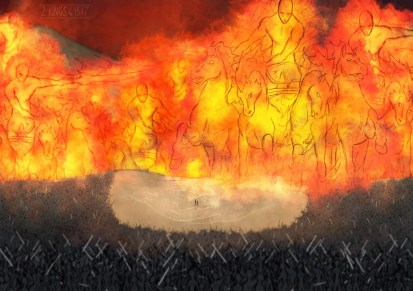 And the young servant sees a huge host of angels with horses and chariots of fire all around Elisha. The Syrian army rushes in toward them. Elisha simply prays that the entire army would be struck with blindness, and they are. Then Elisha leads this blinded army straight into the capitol of Israel where they are all captured. In this account, we see the unfolding of what is said in Ps. 34:7, “The angel of the Lord encamps around those who fear him, and delivers them.”
 Hebrews 12:22-24 says that in church we have “come to Mount Zion and to the city of the living God, the heavenly Jerusalem, and to innumerable angels in festal gathering…” Jesus says that the angels in heaven are joyful over one sinner who repents (Lk. 15:7, 10). As we confessed our sins earlier, a whole host of angels whom we cannot see or hear rejoiced as they heard Christ absolve and free us from our sins. In fact, Heb. 1:14 calls angles ‘liturgizing’ spirits (the ESV translates λειτουργικός as ‘ministering’). Using the liturgy is a way that we connect our worship with the worship of the angels in heaven, which is why we draw the words and order of our liturgy from the words of Scripture.
 down and out of heaven. How was Satan cast down? The text is clear. Satan was cast out by the blood of the Lamb.
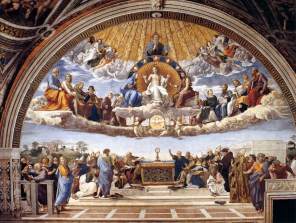 So today, dear saints, come to Jesus’ table and receive His body given for you. Receive His blood which was shed for you for the forgiveness of your sins knowing that neither death nor life, nor angels nor rulers, nor things present nor things to come, nor anything else in all creation, will be able to separate you from the love of God in Christ Jesus your Lord (Ro. 8:38-39).
 them, “Go and show yourselves to the priests.”And as they went they were cleansed. 15 Then one of them, when he saw that he was healed, turned back, praising God with a loud voice; 16 and he fell on his face at Jesus’ feet, giving him thanks. Now he was a Samaritan. 17 Then Jesus answered, “Were not ten cleansed? Where are the nine? 18 Was no one found to return and give praise to God except this foreigner?” 19 And he said to him, “Rise and go your way; your faith has made you well.”
 This Samaritan who returns to the true Temple and true High Priest. He returns to Jesus to give thanks. Did you catch what Jesus said there, “Was no one found to return and give praise to God except this foreigner?” In other words, the nine went onto the Temple and God’s house, but God wasn’t there. He was walking in the flesh between Samaria and Galilee where the Samaritan falls at His human feet giving Him thanks. Some people will read the Gospels and say that Jesus never claimed to be God. Well, sorry, they are wrong. He does right here.

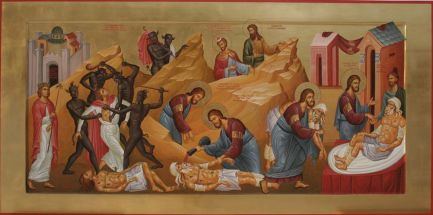 Because, first and foremost, the parable of the Good Samaritan is a picture of what Jesus has done for you. Jesus, and Jesus alone, is the Good Samaritan who has compassion. He left His throne in the glory of heaven to become your neighbor. He risks His own safety while scoundrels and robbers are roaming about. He stops to give you aid. He pours on you oil and wine. He gives up His own comfort and convenience to bring you to the inn of the holy Christian Church. And Jesus sets up an all-expenses-paid stay there promising to return. Jesus is the one who has and continues to show you mercy. Amen.
 32 And they brought to him a man who was deaf and had a speech impediment, and they begged him to lay his hand on him. 33 And taking him aside from the crowd privately, he put his fingers into his ears, and after spitting touched his tongue. 34 And looking up to heaven, he sighed and said to him, “Ephphatha,”that is, “Be opened.” 35 And his ears were opened, his tongue was released, and he spoke plainly. 36 And Jesus charged them to tell no one. But the more he charged them, the more zealously they proclaimed it. 37 And they were astonished beyond measure, saying, “He has done all things well. He even makes the deaf hear and the mute speak.”
 Groaning, however, is an involuntary response to being hurt or wounded. Every time the New Testament uses this word ‘groan’ it is from sorrow or suffering because of sin. And, in the New Testament, only four things groan – creation groans, believers groan, the Holy Spirit groans, and Jesus groans twice.
 And He no longer groans in pain when He does it. The price has been paid. Your forgiveness has been purchased and won on the cross.
 10 “Two men went up into the temple to pray, one a Pharisee and the other a tax collector. 11 The Pharisee, standing by himself, prayed thus: ‘God, I thank you that I am not like other men, extortioners, unjust, adulterers, or even like this tax collector. 12 I fast twice a week; I give tithes of all that I get.’ 13 But the tax collector, standing far off, would not even lift up his eyes to heaven, but beat his breast, saying, ‘God, be merciful to me, a sinner!’ 14 I tell you, this man went down to his house justified, rather than the other. For everyone who exalts himself will be humbled, but the one who humbles himself will be exalted.”
 The parable does teach that the worst of sinners can go to heaven. We know this, but unfortunately, we can grow a little numb to this. But the main reason Jesus tells this parable is to destroy any self-righteousness and contempt we would have against other sinners.
 Dear saint, you look there too. Look to the cross. Look to the blood of Jesus shed for you on Calvary. Look to His death. Look to His resurrection. Look to His ascension. And know that Jesus promises that all of that is for you.
 Three times the English word ‘gifts’ came up in this text, but in Greek, Paul uses two different words that get translated as ‘gifts.’ Twice the Greek word is χάρισμα (which is singular and the plural is χαρίσματα – I’m going to try to be grammatically correct through the sermon). Χάρισμα is where we get our word ‘charismatic.’ Inv. 4, “there are varieties of gifts/χαρίσματα,” and in v. 9, he mentions the “gifts/χαρίσματα of healing…” But in v. 1, Paul uses a different word that gets translated as ‘spiritual gifts’ or ‘spiritual things.’
 According to our text (v. 4-7), these various gifts are given through the Holy Spirit, but the Holy Spirit doesn’t ever work alone; instead, the entire Trinity is involved. These various gifts are given by the Spirit; the varieties of service are given by the same Lord, Jesus Christ, the Son; and the varieties of activities are empowered by the same God (think Father) who empowers them all in everyone. We don’t determine what gift we receive, it’s up to our Triune God. And God will provide whatever we need to fulfill our Christian duty to our neighbor.
 Do you believe in Christ’s death and resurrection for the forgiveness of your sins? Do you trust that His blood has covered all your iniquities and transgressions? If so, praise God! Then ask, “What is my vocation/station in life? What am I called to do right now?” “What do I need now as a mother?” “What do I need now as a husband?” “As a child?” “A student?” “A customer?” “A citizen?” God has called you to those vocations and He won’t leave you in a lurch. He will give you the gifts you need. In every moment of every day, you have a particular relationship to someone else, so you are called to be God’s representative in that moment. So, ask God to give you what you need to fulfill that vocation.
 This reduction was, of course, not legally binding. The rich man could have simply said, “Hang on everyone. I fired that guy before he lowered your debt. You still owe the original amount.” But that isn’t the character of the rich man. Instead, the whole town is singing the praises of the rich man because he is so generous. And the rich man isn’t willing to harm his reputation as a merciful guy. So, what does the rich man do in the parable? He tells the fired, scoundrel of a manager, “Dude, you’re shrewd. You knew I’d rather be known as a merciful person rather than hold on to my wealth. And by your shrewdness, you’ve helped yourself.”
 Now, Jesus is absolutely clear, “You cannot serve God and money.”It can’t be done. If you trust in money, you do not trust God. So, repent of your love of money.
 The only thing that matters for your salvation is what Christ has done and completed for you upon the cross. Even when you are stingy and fail to be generous with what God has given to you, God was not. He gave what was most valuable to Him for your salvation. God, in His mercy, gave Jesus to die upon the cross for you. Don’t trust in your stewardship of what God has given you. Instead, trust in Christ’s giving of Himself completely for you and for others. Amen.
 Out of that conversation came creation, and most importantly, out of that conversation came the creation of humanity. We get to hear that conversation in Gen. 1:26 where the Triune God says, “Let Us make man in Our image, after Our likeness.” It was so, and it was good – very good.
 One of the most amazing things is that God even gives His prophets a seat and a voice in this council. You remember when God was going to destroy Sodom and Gomorrah, and Abraham speaks up and gets God to agree to not destroy the cities if ten righteous people are found there (Gen. 18:22-33). Or, when God is going to destroy the Israelites for making the golden calf, Moses speaks up in the council and says, “God, if You go down and destroy them, the Egyptians will say that You only brought them out of slavery to destroy them.” And God relents of the disaster He had said He would bring on the people (Gen. 32:1-14).
 Now, Jesus has ascended to the right hand of the Father. Today, your Savior is talking with the Father, your Creator, and with the Holy Spirit, your Sanctifier. And do you know what they are talking about? They are talking about you and the cross. They are talking about how Jesus won your salvation there. How His blood shed there made a place in heaven for you forever. And the Holy Spirit is there, translating your prayers and interceding for you with groanings too deep for words (Ro. 8:26). The Holy Spirit whispers into your ear that you are an adopted child of God and heir with Christ. And you respond by crying, “Abba, Father” (Ro. 8:12-17).
 Our English word ‘desolation’ contains the word ‘solo,’ and that gives a sense of what ‘desolation’ means. Adam and Eve went solo. Rather than trusting God, they went solo and trusted the devil’s lie bringing sin, death, condemnation, and desolation into the world.
 Look at what Jesus, God in the flesh does – notice the verbs. He calls the disciples. Jesus directs the crowd to sit down. He takes the bread. Christ gives thanks for the bread. He breaks the bread. He gives the bread to the disciples to set before the people. Jesus blesses the fish. He gives the fish to the disciples to set before the people. And Jesus watches them all eat until every last one of them is satisfied. Jesus continues to do this for us today.
 Pastorsamwise
You must be logged in to post a comment.