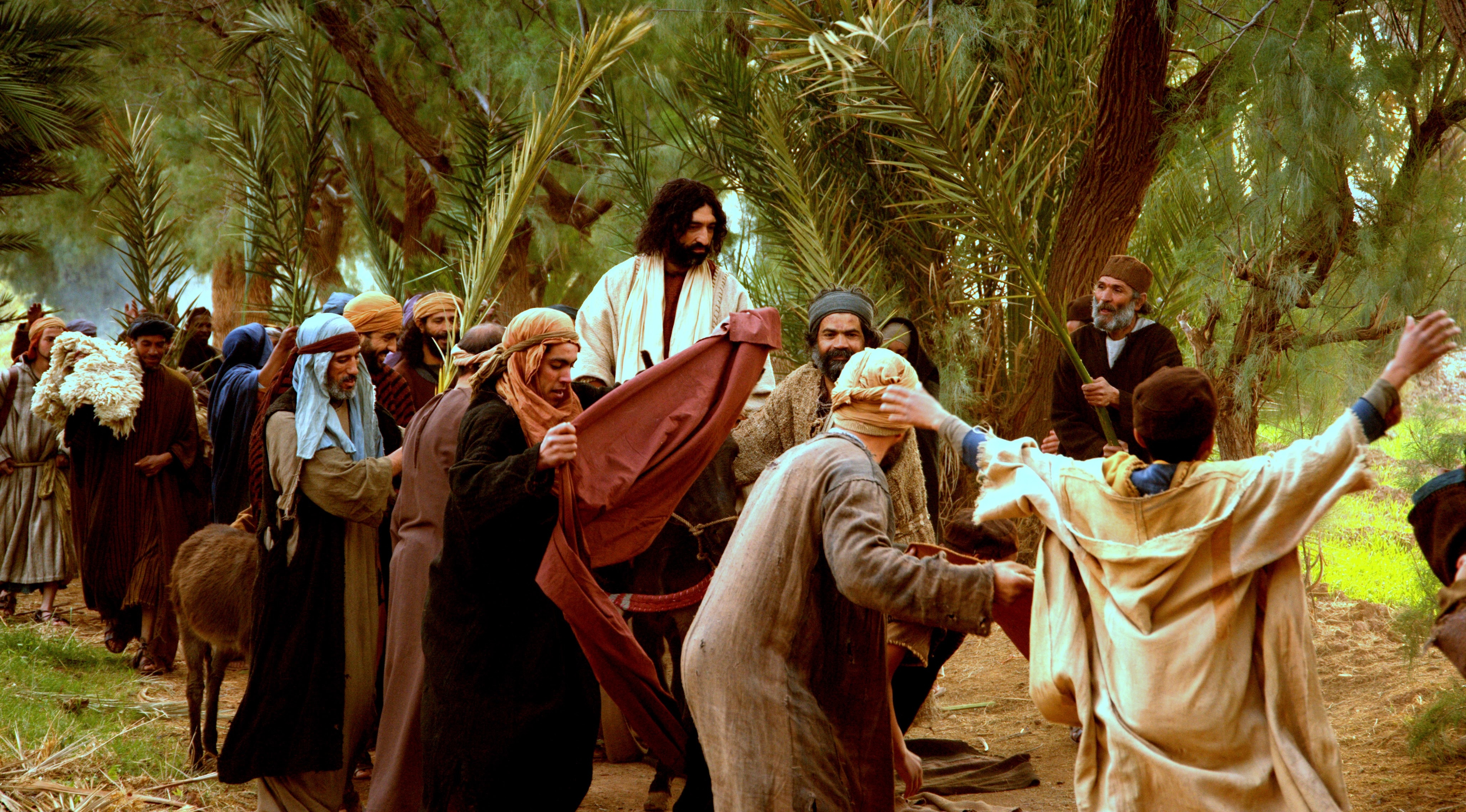
Forsaken – Sermon on Mark 15:33-35 for Good Friday

Mark 15:33-35

33 And when the sixth hour had come, there was darkness over the whole land until the ninth hour. 34 And at the ninth hour Jesus cried with a loud voice, “Eloi, Eloi, lema sabachthani?” which means, “My God, my God, why have you forsaken me?” 35 And some of the bystanders hearing it said, “Behold, he is calling Elijah.”

In the name of Jesus. Amen.

On Good Friday, our Lord Jesus Christ suffered in three distinct ways. And it’s helpful to distinguish and contrast them. The three kinds of suffering are 1) physical suffering, 2) suffering the shame, and 3) the suffering of forsakenness.

We know what it is to have physical pain. We’ve all experienced it. Maybe not to the extent that Jesus did, but we’ve all had physical pain. You scrape your knee, get your finger caught in a door, or just sleep or sit wrong. Physical pain is something we naturally try to avoid. The physical pain of the cross was, without a doubt, excruciating for Jesus. But His physical pain was not what won your redemption and salvation. Physical pain was not the price that Jesus had to pay.

If Jesus’ physical pain won your salvation, then you and I have the same capacity to suffer physically as Jesus did. Plenty of people were beaten, whipped, and crucified in Jesus’ day, but their physical suffering didn’t save them.

We also know what it is to experience shame. The shame Jesus endures in His Passion is also horrible. He was spit on. The soldiers placed robes on Him, put a crown of thorns on Him, and bowed down to Him as they mocked, “Hail, King of the Jews.”

He was blindfolded and punched as people asked Him to prophesy, “Who was it that hit you?” People walked by the cross wagging their heads, saying, “You saved others. You don’t seem to be able to do anything now. You trusted in God, where is He now?” That’s the shame of the cross. And yet, the shame Jesus suffered is also not what wins your salvation. Other people have suffered similar shame.

But there’s that third suffering. It’s a hidden suffering, but it is the one that’s most profound of all. We get a glimpse of it in this fourth word of Jesus, “My God, My God, why have You forsaken Me?” That’s the greatest suffering of the cross.

In that moment, Jesus is suffering all the wrath of God over sin. He’s suffering all of God’s anger that you and I deserve. 2 Corinthians 5:21 says that Jesus, who knew no sin, was made to be sin for us, so that in Him we could become the righteousness of God.

In other words, all of the anger, all of the wrath, all of the punishment, and the separation from God that you and I deserve – it all falls on Jesus. He suffers all of that as our sins are laid on Him. In that moment, God is looking down at Jesus, and God does not see the Son whom He loves. Instead, God only sees sin and all the things that He hates and abhors.

In that moment, God the Father forsakes Jesus and pours out all of His wrath onto Christ. This why Isaiah says that Jesus is smitten, stricken by God, and afflicted (Is. 53:4). All of God’s righteous anger falls on Jesus. When Jesus says these words, “My God, My God, why have You forsaken Me?” that is what is taking place.

The most profound word of that prayer from Jesus’ lips is, “Why?”Christ doesn’t pray, “My God, My God, You have forsaken Me.” Instead, it’s, “Why? Why have You forsaken Me?” And this is a real, honest question. Several times throughout His life Jesus denies using His divine knowledge and omnipotence. This is one of those times. For those moments, even the purpose of Jesus’ suffering is hidden from Him.

This wasn’t always the case. When He was nailed to the cross, Jesus knew what He was doing there. That’s why He said, “Father, forgive them.” God can’t forgive without the cross. Jesus knew what He was doing on the cross when He told the thief, “Today you’ll be with Me in paradise.” And in just a few minutes Jesus shows that He knows again why He’s there when He says, “It is finished.”

But here, right in the middle of the crucifixion as Jesus cries out, “Why have You forsaken Me?” He temporarily denies His knowledge of what He is doing there. The point of it all is hidden from Him.

In that moment Jesus has nothing. Nothing to cling to. No hope. No comfort at all. He doesn’t have the comfort of knowing that He’ll be raised on the third day. He doesn’t have the comfort that this is happening for your salvation. In that moment, all Jesus knows is that He’s suffering all of God’s wrath against sin even though He’s done nothing wrong or sinful.

That is the suffering that wins your salvation. That suffering of being forsaken by God that Jesus is enduring here is beyond our comprehension.

We can see the beating and the whip. We can see the crown of thorns. We can see the shame and hear all the mockery. We can see the nails. But what you can’t see is the thing that matters most. The vengeance and wrath of God towards sinners is all poured out on Christ.

That’s the reason. That’s why Jesus goes to the cross. He goes there so that you will never see this wrath. So that you will never know this suffering under God’s righteous judgment. So that you will never know what it is to be forsaken by God. 

Jesus says, “My God, My God, why have You forsaken Me?” so that you never have to.

Dear saints, you will never have to say that because God will not forsake you. He has promised (Heb. 13:5-6). He will not leave you alone in your sin. He doesn’t let your sin and guilt remain because Jesus has taken it and has suffered for it in your place.

That’s the suffering that wins and accomplishes your salvation. It is a suffering that we can’t imagine. And, Christian, because of Jesus, you never will. Jesus is your substitute. He pushes you out of the way of God’s wrath so that wrath hits Him and not you.

“My God, My God, why have You forsaken Me?” As He said that, Jesus didn’t know. But, dear saints, you do. You know the answer. He was forsaken by God so that you will be not only accepted, but also loved as God’s redeemed child for all eternity. Amen.

The peace of God, which surpasses all understanding, will guard your hearts and minds in Christ Jesus. Amen. 

The Lord’s Battle – Sermon on 1 Samuel 17:40-51 for the First Sunday of Lent

1 Samuel 17:40–51

40 Then he took his staff in his hand and chose five smooth stones from the brook and put them in his shepherd’s pouch. His sling was in his hand, and he approached the Philistine. 

41 And the Philistine moved forward and came near to David, with his shield-bearer in front of him. 42 And when the Philistine looked and saw David, he disdained him, for he was but a youth, ruddy and handsome in appearance. 43 And the Philistine said to David, “Am I a dog, that you come to me with sticks?” And the Philistine cursed David by his gods. 44 The Philistine said to David, “Come to me, and I will give your flesh to the birds of the air and to the beasts of the field.” 45 Then David said to the Philistine, “You come to me with a sword and with a spear and with a javelin, but I come to you in the name of the Lord of hosts, the God of the armies of Israel, whom you have defied. 46 This day the Lord will deliver you into my hand, and I will strike you down and cut off your head. And I will give the dead bodies of the host of the Philistines this day to the birds of the air and to the wild beasts of the earth, that all the earth may know that there is a God in Israel, 47 and that all this assembly may know that the Lord saves not with sword and spear. For the battle is the Lord’s, and he will give you into our hand.” 

48 When the Philistine arose and came and drew near to meet David, David ran quickly toward the battle line to meet the Philistine. 49 And David put his hand in his bag and took out a stone and slung it and struck the Philistine on his forehead. The stone sank into his forehead, and he fell on his face to the ground. 

50 So David prevailed over the Philistine with a sling and with a stone, and struck the Philistine and killed him. There was no sword in the hand of David. 51 Then David ran and stood over the Philistine and took his sword and drew it out of its sheath and killed him and cut off his head with it. When the Philistines saw that their champion was dead, they fled.

In the name of Jesus. Amen.

Faith is the main characteristic David exhibits when he faces Goliath – not courage. Of course, David is courageous. There’s no question about that, but David’s courage is fueled by and rooted in faith. 

What you just heard isn’t the whole story of David and Goliath. And please know that when I use the word ‘story,’ that doesn’t mean that this is some made-up fairytale. Not at all. This story, this true story, happened. When we talk about Bible stories, we’re doing it in the same way you might ask your parents to tell you the story of how they met. It’s something that actually happened in history.

There was a Philistine warrior named Goliath who was over 9 ft. tall, who had a coat of bronze armor that weighed about 125 lbs., and whose spear tip weighed around 14.5 lbs. (1 Sam. 17:4-7). Goliath and the rest of the Philistine army assembled on one mountain while King Saul and the Israelite army mustered on an opposing mountain with a valley between them (1 Sam. 17:1-3). Every morning and evening for forty days, Goliath would issue a challenge, “Give me a man to fight. If he kills me, we’ll be your servants. But if I kill him, you’ll be our servants” (1 Sam. 17:8-10, 16).

Enter David. David was the youngest of Jesse’s eight sons. David’s three oldest brothers had followed Saul into battle, and Jesse asked David to go and see how his brothers were doing in the battle and bring them some bread and cheese (1 Sam. 17:12-18). While David was there, Goliath issued his challenge again, and David heard (1 Sam. 17:23).

You have to remember the context. Saul is still the king, but we already know that the next king won’t be a descendant of Saul. Back in ch. 16, David was already anointed to be the next king after Saul. After that anointing, the Holy Spirit rushed upon David (1 Sam. 16:6-13). But David doesn’t immediately go to the palace and ascend the throne; instead, David only goes to the palace to play his guitar whenever King Saul is tormented by a demon (1 Sam. 16:14-23). Even though he’s been anointed to be the next king, David fluctuates between serenading Saul and tending his father’s sheep.

David has faith in God’s promise that he’s going to be the next king. David so firmly believes this that, when he’s sitting in the field watching over his sheep, he’s not worried when bears or lions come after his lambs. He figures, “I’m not king yet, so not so fast, bear. Get back here, lion.” And he grabs them by the beard and kills them (1 Sam. 17:34-35). Easy peasy lemon squeezy. In other words, David rightly believes that until he becomes king, God is going to protect him.

It’s the same thing when David hears Goliath defying God and His armies and His people. Since Saul still has the crown that will eventually belong to David, he won’t let Goliath’s mockery stand. God has promised to make David the next king, so what could Goliath possibly do to him before he ascends the throne? It is that faith that gives David courage. So, David accepts Goliath’s challenge.

David simply trots onto the battlefield, reaches into his bag to take out a stone, flings it into the Philistine’s skull, and lops off Goliath’s head with his own blade. David might not have even broken a sweat. And when the Philistines saw that their champion was dead, headless, and utterly defeated, they fled.

Dear saints, last week I mentioned how we wrongly think of ourselves as the heroes of all sorts of Bible stories, and I specifically mentioned how we aren’t David defeating Goliath. Instead, we should see Jesus fulfilling this story. In Jn. 5:39, Jesus says that the Scriptures bear witness about Him (see also Lk. 24:44). While the true story of David defeating Goliath is something that actually happened, even it points us to Jesus who has defeated our greatest enemy.

It’s helpful to start by remembering who your enemy is. Eph. 6:12 says that we do not wrestle against flesh and blood, but against the rulers, against the authorities, against the cosmic powers over this present darkness, against the spiritual forces of evil in the heavenly places. Those enemies, who would all easily overpower us, have the devil as their champion, a giant that opposes us and mocks us.

But dear saints, you have a David, a shepherd, who had perfect faith in God’s promises. In our Gospel reading (Mt. 4:1-11), you heard how Jesus perfectly trusted God despite the devil’s temptations. Christ trusted God’s promise to give Him food at the right time. You heard how Jesus perfectly trusted God’s promise to protect Him from danger. You heard how our Lord perfectly trusted God’s promise to give Him all the kingdoms of the world. So, He engaged in the battle and won.

This same Jesus, with the same perfect faith, perfectly trusted that God would deliver Him, would not let Him see corruption (Act. 2:27), and would not abandon Him. So, Jesus engaged in battle against Satan, sin, and death. The odds against Christ looked overwhelming. But on that cross, Jesus dealt the death blow to your enemy. And on the morning of the Resurrection, Christ emerged victoriously holding the crushed, severed head of the devil (Gen. 3:15; 1 Sam. 17:57). Jesus disarmed all the powers of evil and put them to open shame (Col. 2:15).

Jesus is your David, who has defeated your Goliath.

Now, do you have a place in this story? Sure, absolutely you do. You are in the Lord’s army and have endured the bragging, the mocking, and the scorn of the devil. But Jesus brought all of that to an end. Because of His death and resurrection, you know that the Lord saves not with a sword or spear but with the precious blood of Christ.

The battle is the Lord’s, and He has given all your enemies into your hand (1 Sam. 17:47). In the verses that follow our text, Saul’s army pursued the defeated the Philistines and pushed them back until they had plundered their camp (1 Sam. 17:52-53). That’s where you come in.

You, dear saints, are in the mop-up crew. Jesus, your Champion, has won on the field of battle, and His victory encourages you to join Him in the fray. You see Christ’s victory, and it fills you with a newfound strength and courage. Jesus’ triumph fills your mouth with laughter and puts shouts of joy on your tongue (Ps. 126:2). His conquest transforms you.

Before His victory all you could do cower in fear as your enemy boasted and mocked you. Now, that is all over. Now that Christ has won, you are turned into men again. Men who are emboldened to engage in the war.

Now, you participate in the battle – even though that part doesn’t win the war in a meritorious sense. You are heartened and encouraged by Christ, your Champion, and participate in His victory. You wage war against a routed, headless, defeated foe.

God is not mocked. The battle is His. He is risen. He is now seated on the throne with all things subjected under His feat because He has won.

No one would say that the fighting you do is safe or without danger. No one would say that there is no skill needed for the part you have to play. Far from it. To be sure, the challenges you face are real and they are dangerous. But you know that the outcome is not a mystery. 

Your Champion has already turned the tide. Jesus has defeated the Goliath of sin, death, and the devil. So the foes you face, whether that foe is temptation or sickness or trauma or whatever, know they all fear you because your Champion has defeated theirs. Goliath is dead and headless. Jesus has won. He brings you in His train and on His team.

Christ has won the victory. He doesn’t need you, but He has won you. Now, you follow Him on the field of victory. What Christian would not want to follow Him? You know who fights for you. You know who has concurred and gives you the victory. And you also know the promises He has made to you. Promises that He will fulfill. Believe those promises, and act and live accordingly. Amen.

The peace of God, which surpasses all understanding, will guard your hearts and minds in Christ Jesus. Amen.

Pause – Sermon on Luke 18:31-43 for Quinquagesima Sunday

Luke 18:31–43

31 And taking the twelve, he said to them, “See, we are going up to Jerusalem, and everything that is written about the Son of Man by the prophets will be accomplished. 32 For he will be delivered over to the Gentiles and will be mocked and shamefully treated and spit upon. 33 And after flogging him, they will kill him, and on the third day he will rise.” 34 But they understood none of these things. This saying was hidden from them, and they did not grasp what was said. 

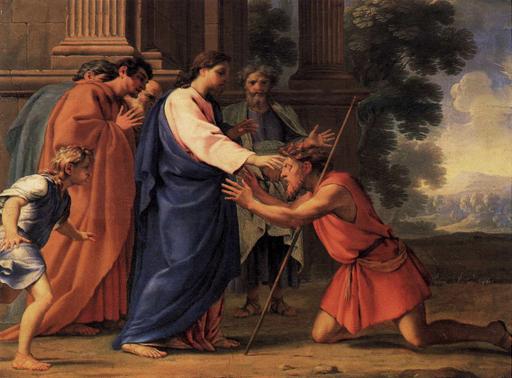
35 As he drew near to Jericho, a blind man was sitting by the roadside begging. 36 And hearing a crowd going by, he inquired what this meant. 37 They told him, “Jesus of Nazareth is passing by.” 38 And he cried out, “Jesus, Son of David, have mercy on me!” 39 And those who were in front rebuked him, telling him to be silent. But he cried out all the more, “Son of David, have mercy on me!” 40 And Jesus stopped and commanded him to be brought to him. And when he came near, he asked him, 41 “What do you want me to do for you?” He said, “Lord, let me recover my sight.” 42 And Jesus said to him, “Recover your sight; your faith has made you well.” 43 And immediately he recovered his sight and followed him, glorifying God. And all the people, when they saw it, gave praise to God.

In the name of Jesus. Amen.

Generally, when we let our imagination go wild, we like to be the heroes. Boys imagine hitting a grand slam in Game 7 bottom of the 9th two outs down by three, or they imagine they are the receiver who dives to catch the hail Mary as time expires to win the Super Bowl. Girls imagine they are Cinderella dancing the night away with Prince Charming, and getting engaged after he returns her glass slipper. Even when it comes to Bible stories, we like to imagine that we are Joshua toppling the walls of Jericho or David slaying Goliath or Elijah defeating the prophets of Baal.

In the two parts of today’s text – the Passion prediction and the healing of the blind man – the only hero is clearly Jesus, and He fully embodies the perfect love that was described in our Epistle reading (1 Co. 13:1-13). This is the third time Jesus explains to the disciples that He is going to Jerusalem to be betrayed, mocked, shamefully treated, spit upon, flogged, crucified, and raised from the dead. But the disciples don’t understand Jesus, the saying is hidden from them, and they could not grasp what Jesus said.

Still, Jesus’ love is on full display. Jesus is patient with and kind toward them. He is not irritated or resentful at their thick skulls. Jesus is going to Jerusalem and will endure all these things because His love does not insist on its own way. Instead, Christ submits to His Father’s will in perfect obedience.

By going to the cross, Jesus will bear all things. All the burdens, all the sins, all the transgressions, all the iniquities, all the wrongdoings, all the evil, all the brokenness of this fallen world – Jesus will bear all of it in His body (1 Pet. 2:24). He does it all for you. Jesus’ journey from His throne in heaven, down into your flesh. His fasting and temptation in the wilderness. His path through the lands of Israel with no place to lay His head (Lk. 9:58). His teaching, healing, casting out demons, forgiving, and restoring. His triumphal entry. His betrayal. His suffering. His death. His burial. His three day rest in the tomb. His resurrection. His ascension. And His continual rule and authority over all things is a journey of love for you.

Jesus’ entire work is directed outward. He didn’t need to do any of that to benefit Himself, and He doesn’t do it for His own, personal gain. He does it because He loves you. And this love of Jesus wasn’t based on your loveliness. It was based on the fact that the God the Father loves you and wanted to rescue you. So, Jesus, God the Son, loved you and did everything necessary to save you.

God hated seeing what sin and death had brought to His creation, so He did something about it by undoing sin and death by the death and resurrection of Jesus. Christ lived the life we were unable to live. He obeyed the whole will and Law of God that we were unable to obey. He took up His cross, endured punishment that you and I deserved, and gave up His dying breath. All of this is done for you.

Jesus does all of this with full knowledge. None of it surprised Him. Christ knew exactly what is going to happen to Him. And still, He goes and does all of this to love you with His perfect, pure love. 

Back in Lk. 9:51, we are told that Jesus had “set His face to go to Jerusalem.” In other words, Jesus is determined to do this loving thing for you. He was focused on redeeming creation, on getting there, and accomplishing it. He goes toward Jerusalem in love.

Day after day, Jesus gets closer to His goal until He arrives in the city of Jericho, which is about fifteen miles from Jerusalem. He’s close – about a day’s journey from the city. But Jesus isn’t in a rush. Sometimes, when you have to do things that you know are going to be unpleasant and painful, you just want to get it over with and put in your rearview mirror. Again, Jesus doesn’t do that. Instead, He paused along His way through Jericho.

Christ hears the blind man’s cry, “Son of David have mercy on me.” Jesus doesn’t say, “I’ve got more important things to do. I’m going to have mercy on you when I get to Jerusalem and go to the cross.” No. Our Lord stops.

The cry for mercy from any corner of His creation gets Jesus’ full attention. He commands that the blind man be brought to Him. Jesus asks him, “What do you want Me to do for you?” “Lord, let me recover my sight.” And in love, Jesus gives the man the mercy he desired. “Recover your sight; your faith has made you well.”

Jesus’ mission to be the Savior of all creation does not stop Him from pausing to give His mercy to the individual He meets along the way. He pauses and heals him.

Dear saints, Lent begins on Wednesday, and Lent is a good time for us to pause and consider all that God has done for us. Today, pause and ponder whom you are most like in this text. Again, we’re not the hero; we’re not Jesus. Instead, sometimes, we’re like the disciples who do not understand or grasp what God is doing for us and saying to us. Sometimes, even though God has plainly and clearly spoken, we are blind and don’t understand what God is doing.

Sometimes, we are broken like the blind man. Even though the blind man could not see with his physical eyes, he understands who Jesus is and what He has come to do. Despite his physical blindness, he has faith that Jesus can and will restore what is broken. So, when Jesus is present, he cries out for mercy. And Jesus gives him the mercy, restoration, and healing that he needed. Maybe, like the blind man, you look foolish to the world how you relentlessly call out to Jesus for His mercy.

Whom are you more like? It probably depends on the day, maybe even the moment.  Whether you don’t have any clue of what God is up to like the disciples or whether all you can do is cry out for mercy, the thing to do is follow Jesus.

Notice that even though the disciples don’t get all the things that God had said through Jesus and through the Scriptures, even though they are blind in their hearts and minds – what do they do? They go with Jesus. They follow Him to Jerusalem and the cross. The blind man, even though he could not see anything until Jesus gave him the sight he desperately wanted, what did he do? He followed too.

Whether you understand what God is up to or not, the conclusion is the same. Follow Jesus. Follow Him to the cross. No matter where you are in your journey through life, no matter how much you understand what God is doing, no matter how much you need from God, no matter how much God has already given you, follow Jesus to the cross.

Stay the course. And as you go with Christ, He will give you ample reasons to glorify God and give Him praise. Amen.

The peace of God, which surpasses all understanding, will guard your hearts and minds in Christ Jesus. Amen.

Purified & Redeemed – Sermon on Hebrews 9:11-15 for the Fifth Sunday of Lent

Hebrews 9:11–15

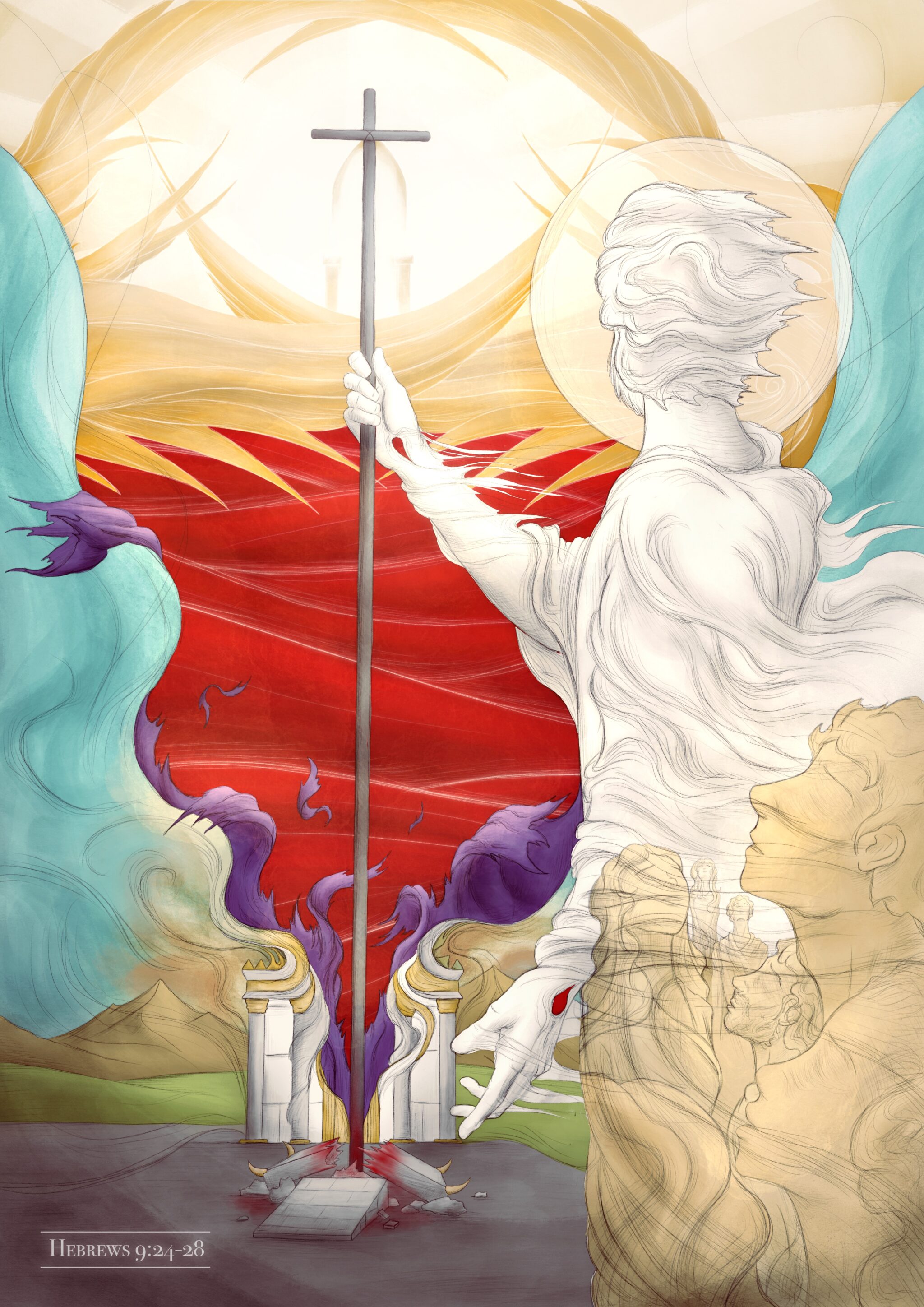
11 But when Christ appeared as a high priest of the good things that have come, then through the greater and more perfect tent (not made with hands, that is, not of this creation) 12 he entered once for all into the holy places, not by means of the blood of goats and calves but by means of his own blood, thus securing an eternal redemption. 13 For if the blood of goats and bulls, and the sprinkling of defiled persons with the ashes of a heifer, sanctify for the purification of the flesh, 14how much more will the blood of Christ, who through the eternal Spirit offered himself without blemish to God, purify our conscience from dead works to serve the living God. 

15 Therefore he is the mediator of a new covenant, so that those who are called may receive the promised eternal inheritance, since a death has occurred that redeems them from the transgressions committed under the first covenant.

Coming to Save – Sermon on Isaiah 35:3-7 for Quinquagesima Sunday

Isaiah 35:3–7

3 Strengthen the weak hands, 
and make firm the feeble knees. 
4 Say to those who have an anxious heart, 
“Be strong; fear not! 
Behold, your God 
will come with vengeance, 
with the recompense of God. 
He will come and save you.” 

5 Then the eyes of the blind shall be opened, 
and the ears of the deaf unstopped; 
6 then shall the lame man leap like a deer,
and the tongue of the mute sing for joy. 
For waters break forth in the wilderness, 
and streams in the desert; 
7 the burning sand shall become a pool, 
and the thirsty ground springs of water; 
in the haunt of jackals, where they lie down, 
the grass shall become reeds and rushes.

In the name of Jesus. Amen.

I promise that we’ll get to this text from Isaiah, but it will be in a roundabout way. When God commanded, “Thou shalt not steal,” He meant it. Stealing is a disruption of God’s creation. When God gives something to someone, that is where He wants it to be. That is why thieves were required to repay the ones they robbed. Throughout the Scriptures, God says that a thief must give back what was stolen, and that repayment comes with interest. If you rob someone of their money or goods but it can be recovered, God says the cost is to pay back double what was stolen (Ex. 22:4, 7). But God set a higher price for other things that were stolen – especially if they could not be recovered. If a thief stole and killed one sheep, he was required to pay back four sheep. For every unrecoverable stolen ox, the repayment was five oxen. And If you stole food, you have to pay that back sevenfold (Pr. 6:31).

The first robbery recorded in the Bible was a theft of food in the Garden of Eden. All of creation belonged to God, and He freely handed it over to the man and woman that He had created in His image. Every plant was nutritious and delicious. And God gave all the plants for food (Gen. 1:29) – except one tree, the Tree of the Knowledge of Good and Evil. That tree, like every other tree, belonged to God. It’s fruit was His, and He said, “You don’t get to eat it.” But that first couple reached out their hands, took God’s fruit, and ate it. They stole food from God.

Now, here’s the problem, how would they repay God sevenfold as the Bible requires? It’s more complex than it might sound. They couldn’t pay with more fruit from that tree. All the fruit that remained on the tree already belonged to God. And to make things worse, they couldn’t put the fruit they had eaten back because it had become part of them. The only way to restore the fruit would be for Adam and Eve to be put back on the tree. But even that repayment was impossible because now they were thieves and sinners. Because it was stolen, that fruit was cursed and infected Adam and Eve with death that was coursing through their veins.

For the seven-fold payment to be made, Adam and all his children, needed a new Adam to offer payment in their place. Jesus entered this world as that new, sinless, and perfect Adam (Ro. 5:14; 1 Cor. 15:45). Only Jesus, perfect God and perfect man, could make repayment for that theft. And that is exactly what He does.

In our Gospel reading (Lk. 18:31-43), we heard how Jesus restored the sight of blind Bartimaeus (Mk. 10:46-52) on the road outside of Jericho. And Jesus did this by taking Bartimaeus’ blindness into Himself (Is. 53:4; Mt. 8:17) while also restoring his sight. That miracle, and all of Jesus’ miracles, show that Christ was removing the venom of sin and death, putting creation back together, and making the payment for that original sin and all subsequent sins. But all of Jesus’ miracles were merely a beginning of the full repayment He was about to make. Bartimaeus’ eyes eventually went blind again when he died. That is why that full, seven-fold repayment for the thievery in Gen. 3 is only made when Jesus is pinned to the cross, sheds His perfect blood, and dies. All of that brings us to this reading from Isaiah.

What is weak is to become strong. What is feeble is to become firm. To you who are anxious and troubled in heart, God says, “Be strong; fear not! Behold, your God will come with vengeance, with the recompense of God.” Normally, when sinners hear about vengeance and recompense, they are afraid and rightly so. But notice what this vengeance and recompense accomplishes – God comes to save you. He pays the debt that you owe. He has avenged your sin upon His only begotten Son. The payment has been made; your sin is atoned for (Is. 6:7).

Throughout Jesus’ ministry, He healed many more blind people besides Bartimaeus. Christ opened the ears of many who were deaf. Our Lord made many lame people walk and loosened all sorts of tongues to sing for joy. Each of those miracles were a display of Jesus’ divine power and authority to fix what sin and death had brought to creation. All of Christ’s miracles showed that He had come to undo the curse of the Fall. And yet, they aren’t the fullness of what Jesus had come to accomplish. They were limited in scope. Here, Isaiah says all the eyes of all the blind shall be opened and all the ears of all the deaf unstopped. 

Jesus didn’t just come to open a few eyes and ears. He came to open all of them. When you read through the Gospels, Jesus is doing these miracles almost constantly. But there is no doubt that there were more blind and deaf in Israel and throughout the world that didn’t get the blessing of Jesus’ miraculous touch. In other words, there is more healing, more restoring, more removal of the curse to be done than Christ accomplished through His miracles.

But now that Christ has died and risen again, now that He is seated on the throne of all creation as the New Adam at the Father’s right hand, the curse of sin and death that hangs over all creation has been paid for. Your God has come and saved. And the day is coming when the eyes of all who are in the category of ‘blind’ will be opened. All the ears of the deaf will be unstopped. All the lame shall leap like a deer. And all the mute will sing for joy because the price has been paid. It has been paid by Jesus for you. Whatever parts of the curse still lay upon you have all been taken by Jesus. Christ has redeemed you by becoming a curse for you (Gal. 3:13).

As we move into Lent this year, we are going to consider what the suffering of Christ has accomplished. Out of God’s great love for you, Christ endured all the wrath, judgment, and death you deserved because of your sins. In Christ, God came to save you. Every illness, every malady, every pain, every sorrow you experience had a price, and that price was the precious death of God’s beloved Son.

And as we go on this Lenten journey, we do it remembering the destination – eternal life with God. Take a Bible and open to the end of Isaiah 35. Just after our text, Isaiah speaks of a highway. Listen to how Isaiah describes it. Isaiah 35:8-10, “And a highway shall be there, and it shall be called the Way of Holiness; the unclean shall not pass over it. It shall belong to those who walk on the way; even if they are fools, they shall not go astray. No lion shall be there, nor shall any ravenous beast come up on it; they shall not be found there, but the redeemed shall walk there.” Pause there for a minute.

All of that is to say that God has come to save you, and He has placed you on this highway. When you pass through areas of this highway that are dreadful, don’t worry because Jesus is with you. When you pass through areas of this highway that are delightful, remember, it is only the highway. The highway has its own joys and foretastes of what is to come, but the destination lies ahead. And what is that destination?

Back to Isaiah 35:10, “And the ransomed of the Lord shall return and come to Zion with singing; everlasting joy shall be upon their heads; they shall obtain gladness and joy, and sorrow and sighing shall flee away.” In other words, the point of the highway is the destination. The Resurrection, the new creation, the life of the world to come – that is your destination, believer. Don’t forget that.

Your God has come and saved you. Your journey is secure on God’s highway. How unspeakably great will it be when we arrive at our ultimate destination? Amen.

The peace of God, which surpasses all understanding, will guard your hearts and minds in Christ Jesus. Amen.

Fleshly Thorns – Sermon on 2 Corinthians 11:19-12:9 for Sexagesima Sunday

2 Corinthians 11:19–12:9

19 You gladly put up with fools since you are so wise! 20 In fact, you even put up with anyone who enslaves you or exploits you or takes advantage of you or pushes himself forward or slaps you in the face. 21 To my shame I admit that we were too weak for that! 

What anyone else dares to boast about—I am speaking as a fool—I also dare to boast about. 22 Are they Hebrews? So am I. Are they Israelites? So am I. Are they Abraham’s descendants? So am I. 23 Are they servants of Christ? (I am out of my mind to talk like this.) I am more. I have worked much harder, been in prison more frequently, been flogged more severely, and been exposed to death again and again. 24 Five times I received from the Jews the forty lashes minus one. 25Three times I was beaten with rods, once I was stoned, three times I was shipwrecked, I spent a night and a day in the open sea, 26 I have been constantly on the move. I have been in danger from rivers, in danger from bandits, in danger from my own countrymen, in danger from Gentiles; in danger in the city, in danger in the country, in danger at sea; and in danger from false brothers. 27 I have labored and toiled and have often gone without sleep; I have known hunger and thirst and have often gone without food; I have been cold and naked. 28 Besides everything else, I face daily the pressure of my concern for all the churches. 29 Who is weak, and I do not feel weak? Who is led into sin, and I do not inwardly burn? 

30 If I must boast, I will boast of the things that show my weakness. 31 The God and Father of the Lord Jesus, who is to be praised forever, knows that I am not lying. 32 In Damascus the governor under King Aretas had the city of the Damascenes guarded in order to arrest me. 33 But I was lowered in a basket from a window in the wall and slipped through his hands. 

1 I must go on boasting. Although there is nothing to be gained, I will go on to visions and revelations from the Lord. 2 I know a man in Christ who fourteen years ago was caught up to the third heaven. Whether it was in the body or out of the body I do not know—God knows. 3 And I know that this man—whether in the body or apart from the body I do not know, but God knows— 4 was caught up to paradise. He heard inexpressible things, things that man is not permitted to tell. 5 I will boast about a man like that, but I will not boast about myself, except about my weaknesses. 6 Even if I should choose to boast, I would not be a fool, because I would be speaking the truth. But I refrain, so no one will think more of me than is warranted by what I do or say. 

7 To keep me from becoming conceited because of these surpassingly great revelations, there was given me a thorn in my flesh, a messenger of Satan, to torment me. 8 Three times I pleaded with the Lord to take it away from me. 9 But he said to me, “My grace is sufficient for you, for my power is made perfect in weakness.” Therefore I will boast all the more gladly about my weaknesses, so that Christ’s power may rest on me.

In the name of Jesus. Amen.

This is a fairly long text, and Paul boasts about himself quite a bit here, but please notice he acknowledges that. He even calls himself a fool and madman (2 Cor. 11:21, 23) for talking like this. But still, to our northern Minnesota, Midwestern ears, a lot of this text can be a bit off-putting. Paul would probably be more ‘at home’ in a place like New York or New Jersey. But basically, all that bragging is Paul defending status as an apostle. That long list of things he endured – the beatings, lashings, shipwrecks, and dangers – all of that is Paul saying that he learned what Jesus meant when He said, “If anyone would come after Me, let him deny himself and take up his cross and follow Me” (Mt. 16:24).

Then, Paul mentions this vision that he had fourteen years before he wrote this letter, but he does it in a roundabout way. He talks about a man who was caught up into the third heaven. We don’t know what this ‘third heaven’ is other than the fact that Paul calls it ‘paradise.’ While he was there, he heard things that he isn’t allowed to speak about; in other words, the vision was just for him. That isn’t unique. In the book of Revelation, John has a similar experience; he hears the voice of seven thunders, but he isn’t allowed to write what those thunders said (Rev. 10:1-4). Now, it’s clear that the man who had the vision is Paul himself. Notice how in 2 Cor. 12:7, Paul says that he was given a thorn in the flesh to keep him from becoming conceited because of the surpassing greatness of that vision. God knew Paul’s weakness of being prideful, so to limit that pride, God gives Paul this thorn in the flesh to keep him humble.

We don’t know exactly what this thorn is. We can speculate, but we can’t say for sure. The possibility that I gravitate toward is that this thorn in Paul’s flesh was poor vision (see Act. 9:18; Gal. 6:11). But I also will admit that I lean toward that understanding because I can identify with it. I also think Paul is intentional about not saying exactly what this thorn is so that you can take his conclusion about the thorn and apply it to yourself in whatever afflictions and suffering you face. Whatever this thorn in the flesh is, it wasn’t a minor thing for Paul. He pleads and begs with Jesus three times to have it removed. This thorn, Paul’s pleading, Jesus’ response to that pleading, and Paul’s conclusion have a lot to teach us about suffering as a Christian.

The first thing to notice is that this thorn was given to Paul. So, who gave it? Well, we have some clues. That thorn is a messenger (lit. an ἄγγελος) of Satan to harass him. In other words, it is one of the devil’s demons who afflicts and torments Paul with the thorn. The devil’s intention is always to push us toward more pride and greater sin. You especially see it when the devil tempts Adam and Eve by saying, “you’ll be like God,” in the Garden of Eden (Gen. 3:5). Because of this, we might conclude it was the devil who gave this thorn, but hold on just a second. Also notice that this thorn was given in order to limit Paul’s pride and conceit. The devil wouldn’t want to do that. So, who gave Paul this thorn? We’d have to conclude God did, but God does it through the devil.

So, here’s the lesson for us: Both the thorn and the demon are evil – utterly and completely evil – but God takes those evil things and uses them for good. When Ro. 8:28 says that God works all things together for good for those who love him, it is true. Even the work and attacks of the devil can be tools in God’s hand to bring about good. We see a similar thing happen with Job. God allows the devil to afflict Job by destroying all Job’s possessions and even Job’s health (Job. 1:9-12, 2:4-6). There, the devil admits that he can’t touch anything connected with Job unless God permits it. The devil’s intention in tormenting Job with all that suffering is to get Job to curse God. But when you get to the end of the book of Job, you see that Job remains blameless and upright. God uses that affliction of the devil to increase Job’s faith, and on top of that, Job’s three “friends” get brought closer to God as well.

The devil’s intention with both Job’s suffering and Paul’s thorn in the flesh is to destroy faith and increase sin, but God uses the devil’s work to accomplish His purposes. This happens all the time, but the clearest place we see this is in the crucifixion of Jesus. The devil’s fingerprints are all over it! Judas’ betrayal, the crowds who get stirred up by the priests and elders to release the murderer Barabbas instead of Jesus (Mt. 27:20), and the high priest Caiaphas who says that Jesus should die instead of the whole nation perishing (Jn. 11:49-50), there’s no question that all of that was Satan’s work in order to kill Jesus on the cross.

But what actually happened on the cross? Did the devil win by getting Jesus pinned there? Nope! It is on the cross that Jesus crushes that worm’s head. On the cross, Jesus took the record of debt that stood against us and nailed it to the cross which completely disarmed the devil and demons and put them to open shame (Col. 2:14-15). In the crucifixion, Satan thought he was beating God, but God was using the devil’s own strategy and plan to utterly defeat Satan, to deliver you, and to win you back for Himself. God be praised!

Now, let’s draw some practical application from all of this because there are all sorts of lessons to take away from this text (more than I’m going to cover here).

First, God can and does use suffering for your benefit. You don’t have to like suffering; in fact, we long for our suffering to be over. But you can know that God is working in and through your suffering – whatever it is. Scripture doesn’t call you to rejoice because of your suffering, but it does call you to rejoice even in the midst of your suffering (Ro. 5:3-5).

Second, if you are suffering in any way, if you have some thorn, that does not mean that God is angry with you or pitted against you. Remember, Job’s suffering began because God bragged about Job to the devil (Job 1:8, 2:4). And God wasn’t angry with Paul either. It was God’s love for Paul that permitted that fleshly thorn that Paul dealt with for so long.

Third, if you are afflicted by demons, that doesn’t mean you are a bad Christian. Paul had one for fourteen years while he was proclaiming the Gospel, starting new churches, and furthering the kingdom of God. And Jesus tells Paul, “My grace is sufficient for you. I’m going to let that demon do his thing while I give you My grace. This will show My strength is working through you.”

Fourth, unanswered prayers and denied petitions do not mean that God is unhappy with you. Paul begged and pleaded three times, and Jesus said, “No.” Yes, sometimes, Jesus will release you from the things that cause you suffering, but even when He says, “No,” it is for your benefit.

Finally, look at Paul’s reaction to all of this. He doesn’t say, “I asked for this thorn to be removed, but Jesus said, ‘No,’ so I’m going to complain.” No! He says, “Therefore I will boast all the more gladly of my weaknesses, so that the power of Christ may rest upon me. I’ll be content with weaknesses, insults, hardships, persecutions, and calamities. For when I am weak, then I am strong.”

Dear saints, you are right to lament and long for your suffering to come to an end. Jesus came to rescue you from all suffering. But in your suffering, know that God is at work, and you don’t know what kind of fruit God will bring about through that suffering. Christ is right there beside you in every affliction and weakness you have. He is there present with His strength. And He comes now to strengthen you with His all-powerful Body and Blood, given and shed for you for the forgiveness of all your sins. To Him be all the glory, honor, praise, and thanks now and forever. Amen.

The peace of God, which surpasses all understanding, will guard your hearts and minds in Christ Jesus. Amen.

See and Rejoice – Sermon on John 8:42-59 for the Fifth Sunday in Lent

John 8:42-59

42 Jesus said to them, “If God were your Father, you would love me, for I came from God and I am here. I came not of my own accord, but he sent me. 43 Why do you not understand what I say? It is because you cannot bear to hear my word. 44 You are of your father the devil, and your will is to do your father’s desires. He was a murderer from the beginning, and does not stand in the truth, because there is no truth in him. When he lies, he speaks out of his own character, for he is a liar and the father of lies. 45 But because I tell the truth, you do not believe me. 46 Which one of you convicts me of sin? If I tell the truth, why do you not believe me? 47Whoever is of God hears the words of God. The reason why you do not hear them is that you are not of God.”

48 The Jews answered him, “Are we not right in saying that you are a Samaritan and have a demon?” 49Jesus answered, “I do not have a demon, but I honor my Father, and you dishonor me. 50 Yet I do not seek my own glory; there is One who seeks it, and he is the judge. 51 Truly, truly, I say to you, if anyone keeps my word, he will never see death.” 52 The Jews said to him, “Now we know that you have a demon! Abraham died, as did the prophets, yet you say, ‘If anyone keeps my word, he will never taste death.’ 53 Are you greater than our father Abraham, who died? And the prophets died! Who do you make yourself out to be?” 54 Jesus answered, “If I glorify myself, my glory is nothing. It is my Father who glorifies me, of whom you say, ‘He is our God.’ 55But you have not known him. I know him. If I were to say that I do not know him, I would be a liar like you, but I do know him and I keep his word. 56 Your father Abraham rejoiced that he would see my day. He saw it and was glad.” 57 So the Jews said to him, “You are not yet fifty years old, and have you seen Abraham?” 58 Jesus said to them, “Truly, truly, I say to you, before Abraham was, I am.” 59 So they picked up stones to throw at him, but Jesus hid himself and went out of the temple.

In the name of Jesus. Amen.

This portion of John is one of the high points of the four Gospels because, here, Jesus pulls back the veil and reveals Himself to be God saying, “Truly, truly, I say to you, before Abraham was, I am.” There is a whole sermon there, but it will have to wait until the next time this text rolls around. Today, we’re going to consider just two sentences from our Lord. The first reveals just how stubborn mankind is in our sin and how desperate we are to believe lies, and the second sets us up for the Scripture readings we are going to be hearing next Sunday and through Holy Week.

In the last half of v. 46, Jesus asks, “If I tell the truth, why do you not believe Me?” That question should startle us – especially because it comes from the lips of our Savior. In our fallen, sinful state, we are willing to reject the truth even when it stares us in the face. When the truth is difficult and hurts us, we would rather live by lies than change course. We have this false idea in our minds where we think that if people are presented with the facts so that the truth is crystal clear, then everybody will agree and everything will be right in the world. But that is false.

Here, Jesus, who is the Truth (Jn. 14:6), speaks the truth to the people in the Temple, but they refuse to believe and are ready to stone Him. No matter how clearly the truth is spoken or how authoritative the speaker of truth is, there are some who will simply reject it and refuse to live in reality.

Sometimes, we think that problems we face are caused by the news channels, social media suppression, or other sources of misinformation. Those things certainly don’t help. But don’t imagine that if someone waived a magic wand and made all those things disappear that, suddenly, everything would be right in the world and everyone would automatically believe the truth. People didn’t believe Jesus when He spoke the truth. And even worse, Jesus was persecuted when He spoke the truth. Dear saints, we should expect the same. In fact, that is exactly what we see today.

The reason people reject truth, especially the truth about God, is that we are by nature children of wrath (Eph. 2:3). Because of our sin, we do not and cannot love God. We cannot come to Him or understand Him. Instead, we naturally run away from Him. But God still desires to bring you back unto Himself. So, God goes out to battle and fights for you. And – it is so important to understand this – when God fights for you, yes, He is fighting against Satan and the demons, against sin and death. But even more importantly, when God fights for you, He is even fighting against you, against your sinful nature and mine.

The texts through Lent have all been about this fight. The first Sunday of Lent, we saw how Jesus fought against the devil in His temptation (Mt. 4:1-11). The second and third Sundays of Lent, we saw how Jesus fought against the demons (Mt. 15:21-28, Lk. 11:14-28). Last week, we saw how Jesus fought against the crowds who wanted Jesus to satisfy all their fleshly desires and make Him a bread king (Jn. 6:1-15). Today, there is an obvious fight between and the crowds as Jesus simply speaks truth and is rejected. The crowds were so adamant in their rejection they are ready to stone Him (Jn. 8:59). And those crowds would have killed Jesus if it had been His time to die, but it wasn’t His time – not yet. But in next week’s Gospel lesson, which will be Matthew’s account of Jesus’ passion (Mt. 26:1-27:66) and then again in the texts for Good Friday, it will be Jesus’ time to die. The same crowds will call for Jesus to be crucified. And there, on the cross, Jesus will fight the final, decisive battle against all the forces of evil.

Lent is about God fighting against evil. When we get to Easter and the Resurrection, we will celebrate Jesus’ victory. With the resurrection, Jesus reveals His victory over all evil, even the evil within you and me. Because of the resurrection, you can know that Christ has snatched you away from the kingdom of darkness and transferred you to His kingdom of light (Eph. 1:13, 1 Pet. 2:9). And as His people, we will celebrate His victory. On Easter, we will rejoice and sing, and our hearts will be glad when we celebrate the resurrection. But what will we do, and how will we react, as we hear Jesus fighting that battle? What will be our response as we see Jesus going to the cross and suffering God’s eternal wrath against our sin?

Some of you have mentioned to me how you don’t like Good Friday and Christ’s crucifixion and would much rather jump straight to Easter and the resurrection. Now, I understand the sentiment. I do. But there is no Easter joy, no resurrection gladness, apart from Good Friday. Easter cannot happen unless Jesus dies first. One of the Sunday school teachers (and I apologize, but don’t remember who it was) mentioned to me in the past couple weeks how one of their students asked why call the day of Jesus’ death ‘Good Friday.’ What is good about that? Well, today Jesus tells us.

Jesus makes a comment in v. 56 of today’s text that helps us know how to approach the texts of Holy Week and how to see His crucifixion. Jesus says, “Your father Abraham rejoiced that he would see My day. He saw it and was glad.” What is Jesus talking about there? Notice, Jesus doesn’t say that Abraham ‘believed in My day and was glad.’ No. Abraham saw it and was glad. Well, Abraham saw Jesus’ day in our Old Testament text (Gen. 22:1-14).

There, when Isaac was spared from being sacrificed, Abraham sees the ram caught in a thicket by its horns. And Abraham doesn’t have to be told anything. Immediately, Abraham takes Isaac off the wood and places the ram in Isaac’s place. Abraham sacrifices the ram instead of Isaac, Abraham’s beloved son. Through that sacrifice, God is visibly showing Abraham what He will do through Jesus, His only-begotten Son. In that text, Abraham saw what God would do in and through Jesus as He goes to the cross in your place. Abraham saw, rejoiced, and was glad.

Dear saints, as we approach the crucifixion and see Jesus’ day of victory over sin, death, the devil, and our own sinful flesh, let us see and rejoice as well. Jesus willingly goes to the cross in your place. There on Mt. Calvary, Christ wins the victory and battle for you. As we approach Holy Week, let us look to Jesus, the founder and perfector of our faith and remember that Scripture says it was “for the joy,” the joy, “that was set before Him, He endured the cross” (Heb. 12:2) for Abraham, for Isaac, for you, and for all sinners.

Dear saints, on the cross your Savior has won the battle. Christ has shed His blood and with that blood, He now cleanses your conscience from dead works to serve the living God. Come now and receive the Body and Blood of your Savior who brings you into the new covenant and to your promised, eternal inheritance (Heb. 9:14-15). Amen.

The peace of God, which surpasses all understanding, will guard your hearts and minds in Christ Jesus. Amen.

Tree of Life to the Cross – Sermon on Genesis 2:15-17, 3:22-24; 1 Peter 2:21-25; and John 3:14-15

Genesis 2:15-17, 3:22-24; 1 Peter 2:21-15; John 3:14-15

In the name of Jesus. Amen.

I love looking at maps. At the risk of you thinking I’m a complete geek (which I probably am), I sometimes relax by opening the Google Earth app on my iPad and search for little islands near Antarctica, the north pole, and in the middle of the Pacific Ocean. I’ll zoom in as close as possible and tilt the view to see what the terrain of those islands looks like. Then, I’ll zoom out and see how close those islands are to other locations that I am familiar with.

Let’s do something similar tonight. Don’t actually pull out your devices, just do this in your mind. How would you find the place where Jesus was crucified? If you wanted to find it on Google Earth, you would probably zoom out and scroll over to the Mediterranean Sea. Then, you would zoom in again to find Jerusalem, and there you have it. Geographically, slightly outside of Jerusalem, Jesus was crucified on the hill of Golgotha. But most of the time, when you think about the location of Jesus’ death, you probably don’t imagine a map. Instead, you likely think about the instrument of His death – the cross. The cross is where Jesus paid the price for your sin. The exact latitude and longitude of where Jesus’ cross was planted isn’t certain; Scripture doesn’t give all those details and didn’t need to. But, believer, you can know for certain that the cross of Jesus is where God saved you.

Now, there was a point to all that. In our Epistle lesson tonight (1 Pet. 2:21-25), Peter zooms in as close as possible to the place where you were reconciled to God. In v. 24, Peter says, “[Jesus] Himself bore our sins in His body on the tree.” Notice, Peter doesn’t say that Jesus bore your sins in His body on the cross, but on the tree. It’s no accident Peter uses that word. Just briefly, the Greek word Peter uses that gets translated as ‘tree’ can mean either ‘wood’ or ‘tree.’ The same thing is true in Hebrew; Hebrew has one word for ‘wood’ and ‘tree.’

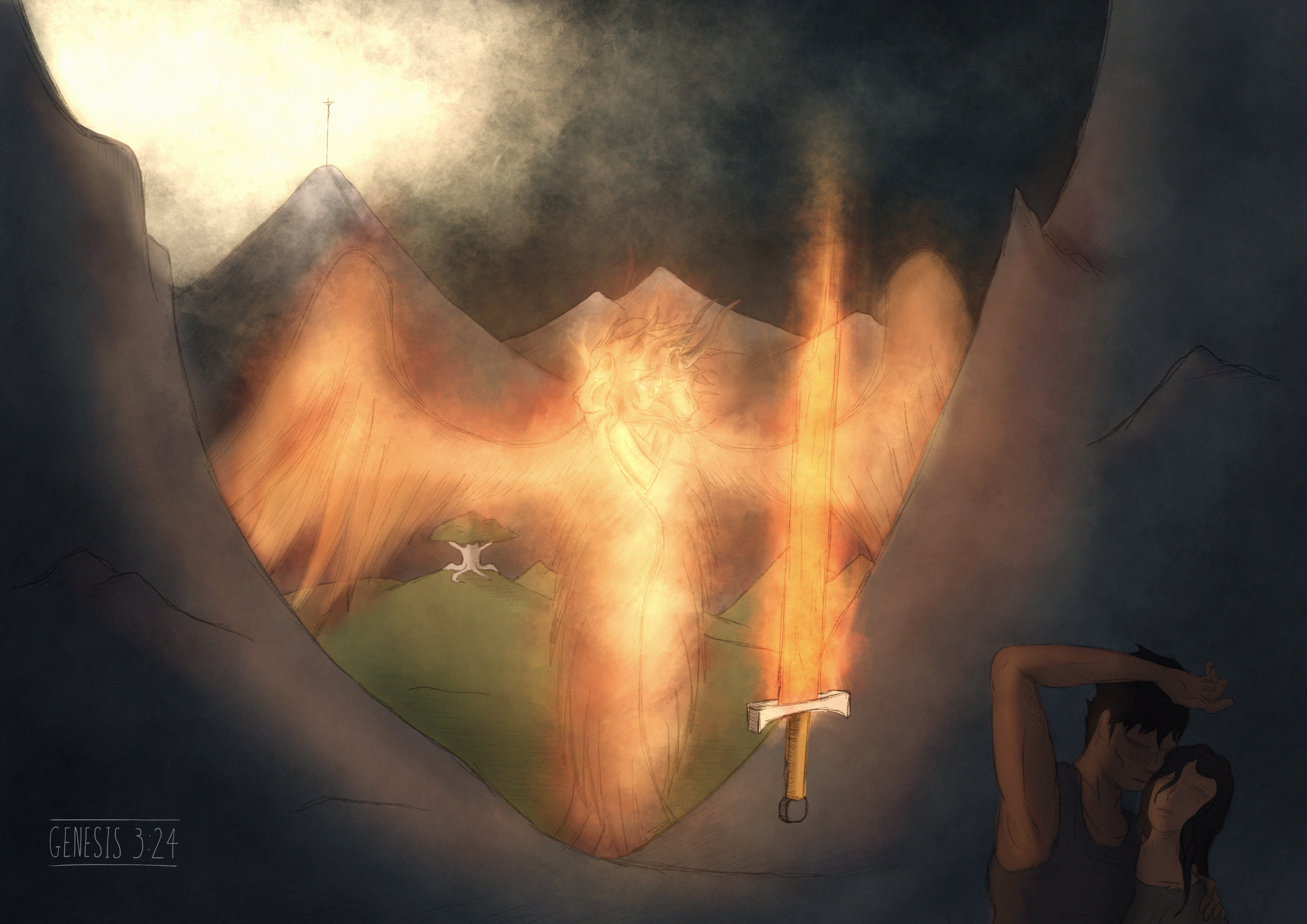
Now, with that in mind, let’s go back to the beginning. God placed man and woman in the Garden of Eden to work and keep it. In the middle of the Garden of Eden (Gen. 2:9), God put two trees, two living woods – the Tree (or ‘wood’) of Life and the Tree (or ‘wood’) of the Knowledge of Good and Evil. The fruit of the Tree of Life was, of course, life. That is why God wouldn’t even finish the thought of Adam and Eve eating its fruit after they fell. They would live forever in sin and death. And the fruit of the Tree of the Knowledge of Good and Evil was forbidden because it brought forth death. But there, at the trunk of the Tree of the Knowledge of Good and Evil, Adam and Eve listened to and believed the lies of the devil. That disobedience has cast us into exile and away from life itself. Before humanity could have access to the Tree of Life again, sin had to be dealt with.

Because of our sin, you and I are not able to be part of the solution to sin and death. In our sin, we are left stumbling helplessly through this world. Restoring ourselves to God is impossible and beyond our reach, but not beyond the reach of God. Even though we were overcome by the fruit of a tree, God has come and restored us by the fruit of another tree – the wood of the cross that was planted outside Jerusalem on Golgotha.

Jesus, the Son of Man was lifted up on a tree just as Moses lifted up the bronze serpent in the wilderness (Jn. 3:14-15). The tree of the cross – a piece of wood that was used as an instrument of torture, suffering, and death – is the Tree of Life upon which Jesus is lifted up. There, Christ bears your sins – all of them. Just as all mankind brought the curse of sin and death upon himself by eating the fruit of the forbidden tree, Jesus takes all the curse of sin and death upon Himself by becoming a curse for us. The Scriptures say, “cursed is everyone who hangs on a tree” (Dt. 21:23, Gal. 3:13). Now, through Jesus’ wounds you are healed because He has taken the curse that belonged to you upon Himself. And now, whoever believes in Him has eternal life.

Jesus has led you out of your exile away from the Garden, away from the Tree of Life to the new Tree of Life.. Through faith in Jesus, the promised Seed of the Woman (Gen. 3:15), you follow your Savior to the tree of life, which is the tree of the cross, whose fruit gives you life. 

You heard God say in Genesis 3:22, “Behold, the man has become like one of us in knowing good and evil.” Listen carefully here, “Now, lest he reach out his hand and take also of the tree of life and eat, and live forever—” God wouldn’t even finish the thought of you being cursed by living forever in sin. But now Jesus has come and become a curse for you by dying on the tree of the cross. The way to the Tree of Life is open again to you. In John 6:51 (and listen to how closely this parallels Gen. 3:22), Jesus says, “I am the living bread that came down from heaven. If anyone eats of this bread, he will live forever. And the bread that give for the life of the world is My flesh.” Now that you are redeemed by Jesus, He desires that you eat and live forever with Him. Jesus has come to bring you home, out of exile, and give you eternal life free from sin, pain, guilt, shame, and death. A new life of joy, peace, and perfection that is forever.

Dear saints, by Jesus’ wounds on the new Tree of Life, which is His cross, you have been healed. You are no longer straying like sheep but have returned to the Shepherd and Overseer of your soul. Amen.

The peace of God, which surpasses all understanding, will guard your hearts and minds in Christ Jesus. Amen.

What Does Such Baptizing with Water Signify? – Sermon for Midweek Lent 4

Listen here.

IV. What Does Such Baptizing with Water Signify?

It signifies that the old Adam in us, together with all sins and evil lusts, would be drowned by daily sorrow and repentance and be put to death; and that the new man should daily come forth and rise to live before God in righteousness and holiness forever.

Where is it so written?

St. Paul writes in the sixth chapter of the Epistle to the Romans: “Therefore we have been buried with Him through baptism into death, so that as Christ was raised from the dead through the glory of the Father, so we too might walk in newness of life.”

Martin Luther Small Catechism

In the name of Jesus. Amen.

Baptism saves (1 Pe. 3:21), forgives sins (Act. 2:38), delivers from death and the devil (Col. 1:13), and gives the new begetting from above (Jn. 3:35-6). Still, one of the most common objections people have to those Scriptural teachings is they will say, “Baptism doesn’t save. Only Jesus saves by His death and resurrection.” Well, they’re half right. We agree with the second part of that statement.

Jesus alone saves us by His death and resurrection. Colossians 1:20 says that Jesus reconciled all things by making peace through the blood of His cross. Ephesians 2:13 says that we who were far off have been brought near by the blood of Christ. In 1 Corinthians 2:2, Paul says that he decided to know nothing among the Corinthian Christians except Christ and Him crucified. And, finally, Galatians 6:14 says, “Far be it from me to boast except in the cross of our Lord Jesus Christ.” By His death and resurrection, Jesus, the eternal Son of God, won our salvation. Period.

But that leaves us with a problem. We weren’t there. Jesus was crucified 1,998 years ago and 6,185.425 miles away (as the crow flies between East Grand Forks and Jerusalem). So how does Jesus’ victory over sin, death, and the devil get to us who live nearly 2,000 years later? How do we get the benefits of Jesus’ blood which was shed half the world away from here? According to Romans 6:3-4, it happens through your Baptism.

Your salvation was won and purchased on the cross, but it isn’t distributed there. The only one we know was saved on Mt. Calvary on that Good Friday was the thief on the cross, the one to whom Jesus said, “Truly, I say to you, today you will be with Me in paradise” (Lk. 23:43).

Think back to all the sporting competitions you have watched. The team that wins the Super Bowl might win the game on a play that happens in the 2nd quarter, but they don’t get the Lombardi Trophy until after the game clock runs out, and probably on a different part of the field than where the winning play occurred. In the Olympics, the person who wins the 100m dash doesn’t get their gold medal as they cross the finish line in first place. It wouldn’t be safe. Just imagine what would happen if the officials tried to hang the gold medal on the winner at the finish line of downhill skiing or the luge. Talk about an epic clotheslining. I can’t think of any instance where the prize is awarded at the exact moment and location of where the victory is won.

The same is true of salvation. Your salvation is won by Christ on the cross, but it isn’t delivered there. Your salvation is delivered to you in your Baptism.

I know that this final question from the Catechism asks, “What does Baptizing with water signify?” We’ll get to what it signifies, but first Romans 6 says that Baptism actually does something. All of us who have been Baptized into Christ Jesus were Baptized into His death. We were buried therefore with Him by Baptism into death, in order that, just as Christ was raised from the dead by the glory of the Father, we too might walk in newness of life.

Your Baptism actually joined you to Jesus’ death. It isn’t just that it was a sign or some symbology (sic.). It actually picked you up from wherever you were when you were Baptized, brought you back in time to 33 AD, and joined you to Christ’s death on the cross.

Being joined to Jesus’ death is a good thing because that means you have a Jesus-kind of death – a death that doesn’t last very long. Christ was in the tomb for three days before He rose again, and since you have been Baptized into Christ and joined to Jesus’ death you can know that your time in the grave will not last either. Being joined to Jesus’ death means that you will certainly be united with Him in a resurrection like His (Ro. 6:5).

Your Baptism is where God delivered your justification. It is where God declares you to be not guilty of your sins. Beyond that, your Baptism is where God calls you to think of yourself differently – to think of yourself as one who is and is being sanctified. In other words, your Baptism allows you to say that you are no longer defined by your sins, but by God’s righteousness.

Because of that, Baptism signifies that you daily die to sin and live before God in righteousness. That’s why our Epistle text (Ro. 6:1-14) closes by calling us to not let sin reign in our mortal bodies and make us obey our sinful passions. 

Through your Baptism you are truly forgiven, regenerated, and made holy. That is how God looks at you, Baptized Christian. But we also recognize from Scripture and our experience that this new life has only begun. It is not yet complete. You recognize that the Old Adam still dwells in you despite the fact that he was drowned in your Baptismal waters. Also, you recognize that the devil and the world still remain around you pestering you, trying to deceive you and lead you astray. The devil, the world, and your own sinful flesh want you to continue in those sins which were drowned and return to slavery to sin.

What occurred in your Baptism, the drowning and rising, the death and resurrection, isn’t something that is merely in the past, but neither is it something to come later in the future. Your Baptism is your present life, believer. Daily you repent of your sins, daily you believe in Christ crucified for your forgiveness, and daily you walk in newness of life until that great day when your Old Adam finally perishes, and you are perfectly and eternally renewed.

In other words, because your Baptism has actually joined you to Christ’s death and resurrection, live that out. Sin now has no dominion over you, since you are not under law but under grace.

So, each night, as you go to your bed, let it be a practice run at your death. Over and over, Scripture speaks about the death of believers as them falling asleep (Mt. 9:24Jn. 11:4141 Cor. 15:61 Thess. 4:13). As you go to bed, confess your sins and read a passage of absolution. Hear how God has cast all your sins behind His back (Is. 38:17). How God blots out your transgressions for His own sake and will not remember your sins (Is. 43:25) Know that God promises that He removes your sins from you as far as the east is from the west (Ps. 103:12) and that He tread your sins under His foot and cast them into the depths of the sea (Mic. 7:19). And as you sleep, die to those sins knowing that God’s steadfast love never ceases, His mercies never come to an end, they are new every morning, great is His faithfulness (Lam. 3:22-23) to you.

Then, each morning think of your getting out of bed as a dress rehearsal for the Resurrection. Let your new, forgiven self come forth daily to rise and live before God in righteousness and holiness. Dear Baptized Christian, let each day of your forgiven life be a day where you take up your cross and follow after your Savior trusting in Him as you live and wait for your eternal inheritance with Him. Amen.

The peace of God, which surpasses all understanding, will guard your hearts and minds in Christ Jesus. Amen.

Ride on – Sermon on Matthew 26:1-27:66 for Palm or Passion Sunday

Listen here.

The congregation read the quotes from all the characters (with the exception of Jesus) in the Passion narrative this year.

In the name of Jesus. Amen.

That Gospel reading is a lot to take in – all the injustice, betrayal, brutality, and morbidity. But the whole reason Jesus rode on into Jerusalem was to endure all of this for you. Even though we might wish to turn away from it, we can’t. We must hear, see, look, and ponder because in this reading we see who we truly are.

We are the chief priests who want to get rid of God secretly and stealthily. We are the disciples who think it is possible to give too much to God. We are Judas wanting to gain something earthly from our relationship with Jesus – even though it ends up being less than thirty pieces of silver. We are Peter bragging about our commitment to Jesus, but when the heat gets turned up, we deny. We are the disciples who cannot stay awake while we watch and pray with Jesus.

We are Caiaphas who demands a sign from Jesus and refuses to take Christ at His Word. And when Jesus says something we don’t like, we pass judgment on Him. We are the chief priests who tell those who are crushed under the weight of their sins to go away and figure it out on their own instead of pointing them to God’s mercy. We are Pilate who is given every chance to do the right thing but fails. We are the soldiers who insult and strike Jesus, but we don’t do it with a reed. We do it with our continual sins. And we are the crowds to pass by Jesus and mock Him.

Repent. Repent but do not despair because you are also the centurion who rightly confesses, “Truly this is the Son of God!” (Mt. 27:54). You are the crowds who cry out, “Hosanna,” which means, “Save us now.” You are also the crowds who cry out, “His blood be on us and on our children” (Mt. 27:25). The crowds who shouted those words in our text thought God didn’t see or didn’t care if they put His only begotten Son to death. But, dear saint, you know better. You know that Jesus’ blood is what cleanses you from your sin.

You are Barabbas, a notorious sinner who gets off scot free. You are the thief on the cross who will be with Jesus in paradise. You are Peter who gets restored. You are Simon of Cyrene who lives a life of carrying Jesus’ cross enduring the weight and suffering, but doing it willingly and joyfully because you know that to live is Christ and to die is gain (Php. 1:21). And, God be praised, you will be those who rise from your grave when Christ returns.

Yes, dear saints, this text is some of the most difficult Scripture to read, but at the same time it is the most beautiful because in it you see Jesus’ love for you. Scripture says, for the joy – think of that, for the joy! – that was set before Him, He endured the cross despising its shame, and now, He is seated at the right hand of the throne of God (Heb. 12:2).

Christ’s joy and delight is to redeem and save you by dying on the cross. So, ride on, King Jesus. Ride on and save us. Hosanna in the highest! Amen.

The peace of God, which surpasses all understanding, will guard your hearts and minds in Christ Jesus. Amen.