One – Sermon on Ephesians 4:1-6 for the Seventeenth Sunday after Trinity

Ephesians 4:1-6

1 I therefore, a prisoner for the Lord, urge you to walk in a manner worthy of the calling to which you have been called, 2 with all humility and gentleness, with patience, bearing with one another in love, 3 eager to maintain the unity of the Spirit in the bond of peace. 4 There is one body and one Spirit—just as you were called to the one hope that belongs to your call— 5 one Lord, one faith, one baptism, 6 one God and Father of all, who is over all and through all and in all.

In the name of Jesus. Amen.

What is your impression of or reaction to the following words: unity; inclusion; oneness; togetherness?

They are all good words and concepts, but those words probably throw up some red flags for you. Who doesn’t want unity? Wouldn’t it be great if our country was really the United States of America? No one wants to be excluded and left on the outside. It’s true that the team that plays together wins together. But would you say that we live in a time of unity? Probably not. We’ve gotten used to hearing that we are more divided now than at almost any other point in our nation’s brief history. Some even speculate that we may be on the verge of another civil war. Who knows?

But the more divided, fractured, and fragmented we become, the higher the desire there is for unity. The biggest obstacle to unity in this world, though, just might be the desire and calls for unity. For there to be unity, there needs to be something people are united on. And because the world is full of sinners who all want our own way, we are going to have a difficult time finding a point of unity. The selfishness, pride, and greed around and within us – yes, even in us Christians who still wrestle with our old Adam – will continue to cause division.

Well, this text doesn’t give us any suggestions for bringing unity to our culture or nation. There is nothing here to help us mend the political, economic, racial, and other divisions that we face in our society and culture today. Sorry. There are other passages of Scripture deal with that. Hebrews 12:14 says, “Strive for peace with everyone.” Romans 12:18 says, “If possible, so far as it depends on you, live peaceably with all.” And Philippians 2:4 probably gives us the best advice in achieving peace in our culture when it says to not look only to your own interest but to the interest of others.

Our text today, when it talks about unity and being one, refers to the unity that exists between Christians, and this unity between Christians is twofold.

First, there is a unity that all Christians simply have. We could call this a ‘vertical unity,’ and this unity consists of how sinners are made one with God. All Christians are sinners who by nature were children of wrath (Eph. 2:3). Christians of all time and in all places are united by the one faith in Jesus who is our Savior, the only Savior. Because Jesus is the only Savior, we are united in Christ who is the Way, the Truth, the Life, and the only access we have to God the Father (Jn. 14:6). When the Holy Spirit works faith in us, this unity simply exists.

All Christians believe that Jesus is the Lamb of God who takes away the sin of the world (Jn. 1:29). Through Him, every Christian of every tribe, language, race, and even denomination is united on the confession that Jesus is the Christ, the Son of the living God (Mt. 16:16). Through that Holy Spirit-wrought faith, every Christian is joined to the one holy Christian Church confessing the one hope of forgiveness and eternal life. That means that every Christian is part of the one body with Christ as the head (Eph. 4:15). This unity exists, but we also recognize that this unity is invisible.

This brings us to the second unity, and that is the unity that all Christians are to strive for. We can call this a ‘horizontal unity’ of how we as Christians are united with one another. This unity is of conviction and true confession. We rejoice in the unity we have here in our congregation, and we have been rejoicing in the unity we have with our sister congregation on the other side of the river as we gather together on Wednesdays. But we also rejoice in the unity we have with Christians of other denominations: Lutheran Brethren, AALC, Missouri Synod, ELS, ELCA, Evangelical Free, Covenant, Baptist, Methodist, Presbyterian, Assembly of God, Catholic, and I could go on and on.

Now, even as I mention all those different church bodies, you are probably thinking, “Pastor, aren’t all the different denominations a sign that we Christians are not united?” To a degree, yes. But there is also something counterintuitive about all the different denominations is actually a sign of our unity. 

Now, please bear with me as I flesh this out. Go back to the first unity, our vertical unity. All Christians have one Lord, one faith, one Baptism. But one of the things that divides the various Christian denominations and disrupts that horizontal unity is what the different church bodies believe and teach about Baptism. Here at Christ the King, we teach that Baptism is God’s work where He forgives sins (Act. 2:38), joins us to Jesus’ death and resurrection (Ro. 6:3-11), gives us the new birth (Jn. 3:5), and saves us (1 Pet. 3:21). Many Christians (and please note that I am calling them ‘Christians’) who attend other churches do not believe that is what the Bible teaches about Baptism. They will say that Baptism is something a believer does for God as an outward expression of an inward change.

The Bible does not teach both of those things. Those two doctrines cannot both be true. One is right, and the other is wrong. And it would be wrong and even sinful for either us or other Christians who believe differently to say, “Well, it doesn’t really matter what we believe about Baptism.” It does matter. What we believe about Baptism matters because Scriptures teach us about Baptism. And Jesus tells Christians to keep and observe all that He has said to us in and through the Scriptures (Mt. 28:20). Just a few verses after our text, Paul tells us to “not be tossed to and fro by the waves and carried about by every wind of doctrine” (Eph. 4:14). God wants us to be rooted and grounded so that we rightly handle His Word of truth (2 Tim. 2:15).

Christians want to stay true to what the Scriptures teach. The only way we can stay true to what the Scriptures teach is to continue to grow in our knowledge of the Scriptures. That is why it is important for you, Christian, to keep learning and diving into the Scriptures that are inspired by God and profitable for teaching, for reproof, for correction, and for training in righteousness that the man of God may be complete, equipped for every good work (2 Tim. 3:16). So, dear saints, be in the Scriptures. Read and meditate on them daily. Come to Bible study and Sunday School to continue being equipped by and through God’s Word. The best way to maintain and strengthen the horizontal unity between Christians is to be grounded in the Bible.

This brings us back around to the differences between Christian church bodies: The silver lining in the doctrinal differences that exist between the various denominations is that we are all trying to be true to what the Bible teaches. In other words, we are taking what Jesus teaches in the Bible seriously. We take it seriously enough that we recognize when those differences exist and when we are not united in doctrine. We don’t rejoice in that horizontal disunity, but we love each other enough to be honest about it because what the Bible teaches is important. That is why we – with humility, gentleness, and patience – point those who believe differently than we do to what Jesus has said. We don’t pridefully lambast them saying, “You aren’t a Christian if you don’t believe just like I do.” No!

Instead, we do what our text calls us to do. We work to maintain the unity of the Spirit in the bond of peace. We can’t maintain or keep the unity of the Spirit unless that unity already exists, and it does. The unity of the one holy Christian Church is a gift given by God Himself through faith in Christ.

The unity of the Spirit in the bond of peace, the oneness that God has given all Christians, is a precious thing. We hold on to this unity as we hold onto Christ and His Word in humility. Jesus was glorified after He humbled Himself by being obedient to His death on the cross (Php. 2:8). That act of humiliation was rewarded by God the Father. And because of Christ’s obedience, the entire Christian Church is washed clean of sin. Christ’s humiliation is the glory of every Christian. So, let us imitate His humility by bearing with our brothers and sisters in Christ in love and forgiving as we have been forgiven. And we rejoice in God’s promise that we are now, right now, united in Him and are one with all our fellow Christians in a unity that is real whether or not we see of feel it.

And we patiently await the day when Christ will return and bring His one holy Christian and apostolic Church to live forever with Him as one. Amen.

The peace of God, which surpasses all understanding, will guard your hearts and minds in Christ Jesus. Amen.

The Line – Sermon on Matthew 6:24-34 for the Fifteenth Sunday after Trinity

Matthew 6:24-34

24 “No one can serve two masters, for either he will hate the one and love the other, or he will be devoted to the one and despise the other. You cannot serve God and money.

25 “Therefore I tell you, do not be anxious about your life, what you will eat or what you will drink, nor about your body, what you will put on. Is not life more than food, and the body more than clothing? 26 Look at the birds of the air: they neither sow nor reap nor gather into barns, and yet your heavenly Father feeds them. Are you not of more value than they? 27 And which of you by being anxious can add a single hour to his span of life? 28 And why are you anxious about clothing? Consider the lilies of the field, how they grow: they neither toil nor spin, 29 yet I tell you, even Solomon in all his glory was not arrayed like one of these. 30 But if God so clothes the grass of the field, which today is alive and tomorrow is thrown into the oven, will he not much more clothe you, O you of little faith? 31 Therefore do not be anxious, saying, ‘What shall we eat?’ or ‘What shall we drink?’ or ‘What shall we wear?’ 32 For the Gentiles seek after all these things, and your heavenly Father knows that you need them all. 33 But seek first the kingdom of God and his righteousness, and all these things will be added to you.

34 “Therefore do not be anxious about tomorrow, for tomorrow will be anxious for itself. Sufficient for the day is its own trouble.”

In the name of Jesus. Amen.

The things Jesus tells us to not be worried about in this text are, typically, not the things that we are actually worried about. The last time you didn’t have a meal was probably because you chose not to eat, either you are on a diet, you chose to do something other than eat, or you didn’t like the food you had on hand. You probably aren’t worried about clothing either. Your dressers and closets are likely full of clothes. Even if they are last year’s styles, they would still do what clothes are meant to do. Yes, clothes wear out, but in a pinch you could stitch together something to keep you warm and covered. You have food and clothing. And here Jesus promises that He will give you everything you need for this life as long as He wants to keep you in this life. And Jesus wants you to trust that He will do this. 

That is why Jesus harps on all of us for our worry over and over in this text. Even though we don’t typically worry about food, drink, and clothing, we certainly do worry about other things. The economy. Gas prices. Inflation. Cancer. Heart disease. The upheaval and unrest in our country and throughout the world. Those things and things like it are the things we worry about, and we try to excuse our worry about those things. But  today, Jesus says, “Do not be anxious, saying, ‘What shall we eat?’ or ‘What shall we drink?’ or ‘What shall we wear?’ For the Gentiles,” in other words, the pagans and unbelievers, “the Gentiles seek after all these things.” According to Jesus here, one of the marks of the unbeliever is worry. Yet, you and I still worry. This text gives us all ample reasons to repent. 

Notice how Jesus draws a line in the last verse. After telling us not to worry about food, drink, or clothing or anything else we need for this life, Jesus adds, “Do not be anxious about tomorrow, for tomorrow will be anxious for itself. Sufficient for the day is its own trouble.” Last week, we considered how thankfulness looks back to the good gifts of God in the past. Well, worry does the opposite. Worry looks at the unknown, bad things in the future and has a wrong belief that we have to face that future alone. Tomorrow is clouded in the unknown, but tomorrow is also clothed with the promises of God to be with us, to never leave or forsake us, to provide all that we need, and to protect us with His power and might. God will care for us. Now, that doesn’t mean that we get to be lazy or idle. But too often we sinfully think that worry is the work we need to do to face the troubles of tomorrow.

That is why Jesus draws this line for us. The things that God sets before us today are the things that should have our attention. We are to do everything God gives us to do to confront and combat those evils and troubles that we face each day. Jesus wants us to go about our business and exert our efforts while God promises to give us the strength we need for every moment of today. But when Jesus says, “Do not worry about tomorrow,” He draws a line at the end of today. Anything past that line, we are to leave in His gracious hands.

With all of Jesus’ talk about not worrying, we can fall off the other side of the horse and become sinfully passive and idle. We might be tempted to think we don’t ever have to work or do anything to combat the evils we face and think God will just take care of everything as we can just back and do nothing. Well, that isn’t right either. For example, it is a sin to pray for a hole when God has given you a shovel. God uses you as His hands and feet to combat the evils of the day, and He promises to give you the strength you need as you face those evils. And since each day has enough evil of its own, don’t let tomorrow’s evil distract you with worry from what God has given you to face today. Jesus promises that He will give you everything you need to meet the evil, ugly troubles of today. And, if He gives you another day tomorrow, He will do it again.

Our Old Testament lesson (1 Kgs. 17:8-16) is a great example of God giving what is needed to face the troubles of today. In Elijah’s days, things were bad. God’s own people had given up the faith and were worshipping Baal, the false god of fertility. So many had abandoned the faith that Elijah worries that he was the only believer left (1 Kgs. 19:10). God had sent a drought to punish Israel, but God told Elijah to live by the brook Cherith promising, “I have commanded the ravens to feed you there” (1 Kgs. 17:4). We don’t know exactly how long Elijah lived by that stream with the crows waiting on him, but as the drought went on, the brook dried out, and that is where our text picks up. God tells Elijah to go the city of Zarephath because, “I have commanded a widow there to feed you” (1 Kgs. 17:9).

For however long he lived at Cherith, Elijah had become accustomed to the ravens flying to him and providing his food because God had commanded them to feed him. Now, Elijah gets to Zarephath, but this widow isn’t like the crows who just delivered his food to him. She doesn’t come up to him and say, “There you are. Diner is at my place. God commanded me to feed you.” Not even close! Elijah watches this widow picking up a couple of sticks, asks her for a drink of water, and as the woman heads off to get it Elijah adds a bite of bread to his order. The widow doesn’t say, “No way! I can’t give you anything.” Instead, her response is, basically, “I’ve only got enough ingredients for my son and I to have a bite. I’m grabbing these sticks so we can bake it, eat, and die.” But Elijah gives her a promise from God that the flour and oil will not run out until God would send rain and provide relief from the drought (1 Kgs. 17:14, 16). For the entire three and a half years of the drought, God gave Elijah what he needed to face the evil of each of those days. Dear saints, God will provide all you need for this life until He calls you out of this veil of tears. So don’t worry.

Some of you have watched the pain that a family endures while their child is being treated for cancer. Some of you have gone through this, but for those of you who haven’t, you might think, “I could never handle that the way they handled that. I don’t have the strength.” You were right. You don’t have the strength to handle that because God hasn’t called you to face that – at least not yet. But here’s the thing. When Jesus says, “Do not worry about tomorrow,” Jesus is saying that He doesn’t want you to worry about that diagnosis coming tomorrow because it distracts you from meeting the troubles that God has called you to face today. If the day comes when God calls you to meet that evil (or any other evil), Jesus promises to give you the strength to meet that evil each and every day it is yours to endure.

You see, when you get to the end of the day and are completely worn out, remember, God designed your tank to be empty at the end of the day. So, go to sleep in peace (Ps. 4:8). And when you wake up again, be ready to face the trouble that comes your way that day because God will give you His strength to meet it then.

Dear saints, work and strive and face the evil, troubling that are before you. But draw a line at the end of the day, and don’t worry about anything past that line since you can’t do anything about it anyway. God promises that He will give you the strength to meet the evil things that come your way each and every day of your life, and He is faithful.

Above all, remember what Christ has done by taking on our flesh. Jesus Himself got hungry and thirsty and tired and hot and cold, so He knows the struggles you face. Christ endured it all without a shred of worry because He trusted that God the Father would provide the strength He needed to endure it. Even as He went to the cross, carrying all your sin of doubt and anxiety, Christ entrusted Himself to God (1 Pet. 2:23), and there on the cross Jesus provided what you needed most – His forgiving blood shed for you. On the cross, Christ overcame and defeated all the evils of every day that you face and has now opened the kingdom of heaven to you.

This means that you can face the evils of each day of your life knowing that God will give you the strength to meet those evils, and you don’t need to help Him with your worry. Without fail, Christ will give you everything you need until the day He calls you into His gracious presence. Amen.

The peace of God, which surpasses all understanding, will guard your hearts and minds in Christ Jesus. Amen.

As You Believe, So It Is – Sermon on 2 Samuel 22:26-34 for the Ninth Sunday after Trinity

2 Samuel 22:26-34

26 With the merciful you show yourself merciful; 
with the blameless man you show yourself blameless; 

27 with the purified you deal purely, 
and with the crooked you make yourself seem tortuous. 

28 You save a humble people, 
but your eyes are on the haughty to bring them down. 

29 For you are my lamp, O Lord, 
and my God lightens my darkness. 

30 For by you I can run against a troop, 
and by my God I can leap over a wall. 

31 This God—his way is perfect; 
the word of the Lord proves true; 
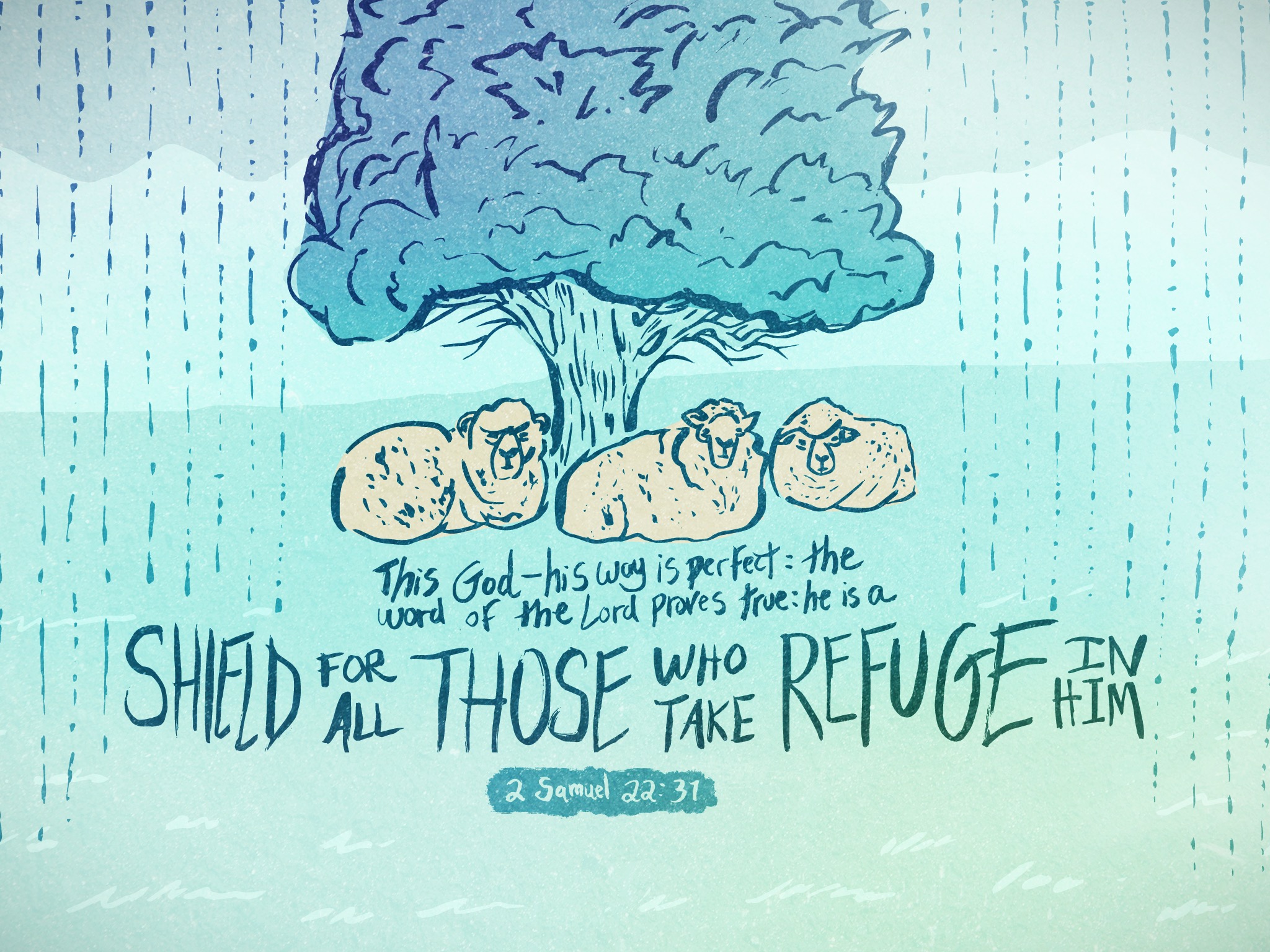
he is a shield for all those who take refuge in him. 

32 “For who is God, but the Lord? 
And who is a rock, except our God? 

33 This God is my strong refuge 
and has made my way blameless. 

34 He made my feet like the feet of a deer 
and set me secure on the heights.

In the name of Jesus. Amen.

If this text feels like a Psalm, you are a good student of Scripture. 2 Samuel 22 is actually the same as Psalm 18. David wrote at least 74 of the 150 Psalms, and it’s interesting (at least, I think it’s interesting) that this is the only place in the story of David’s life where a Psalm recorded. We don’t know exactly when the Psalm was written. But this is placed here in 2 Samuel 22 at the end of David’s life, and v. 1 tells us that this was David’s song, “when the Lord delivered [David] from the hand of all his enemies, and from the hand of Saul.” And the contents of the Psalm are a very fitting way to wrap up David’s story.

David had fought his last war. He had faced the lions and bears as a shepherd. He had killed the giant, Goliath. He was rescued from the spears of King Saul. David had been saved from the Philistines. David was reestablished as king even after his own son, Absalom, had dethroned and hunted him. And, maybe, most importantly, God had rescued David from himself. God forgave David for his adultery with Bathsheba. God absolved David from the sin of murdering Bathsheba’s husband, Uriah. Through it all, God was faithful to David in the face of David’s enemies of the devil, the world, and David’s own sinful flesh. From a humble shepherd who was the youngest of the eight sons of Jesse to the conquering King of Israel, David’s life is a rags to riches story. But morally, David started out better than he ended. The tail end of David’s life was disappointing to say the least, but that is what makes this passage so interesting.

The verses you just heard are the middle of the Psalm where David is reflecting on all of God’s gracious acts throughout his life. David addresses God, “With the merciful You show Yourself merciful; with the blameless man You show Yourself blameless; with the purified You deal purely.” God does show us all these things about Himself, but it sounds as though David is bragging that he was those things – merciful, blameless, and pure. How could such a great sinner like David say something like that?

Well, look again at v. 33. “God is my strong refuge and [He] has made my way blameless.” It was God who made David all those things. By God’s declaration, by God’s mercy, and by God’s absolution, David was merciful, blameless, and pure.

Now, whenever we hear passages like this, we need to recognize God’s actions come first and then God’s attributes shine through God’s children. The text does not say that God is merciful to the merciful, blameless to those who are blameless, and pure to those who are pure. If that were the case, God’s mercy, blamelessness, and purity would never be revealed because we are all sinners. Instead, we need to recognize that God is the one who makes us blameless, makes us merciful, and makes us pure, and all of that shines through us. We are not the light of the world. Jesus is, and His light shines through us for all the world to see. God is merciful, blameless, and pure according to His nature, and God works on us and in us to make us like He is. Colossians 3:10 says that we are being renewed after the image of God, and Romans 8:29 says we are being conformed to the image of Christ. As Christians, God is renewing us in His image.

So, again, with the merciful God shows Himself merciful; with the blameless God shows Himself blameless; with the purified God deals purely. But then notice how v. 27 changes gears, “with the crooked You make Yourself seem tortuous.” Big change there. Just quickly, the translation there is tortuous not torturous. Torturous is related to torture and causing extreme pain and suffering. That’s not the translation here. Instead it is tortuous (remove the second ‘r’) which means full of twists and turns or shifty. It isn’t as though God is shifty toward crooked, bent sinners. Notice very carefully, shifty and complex is simply how God seems to the crooked.

Dear saints, we don’t and can’t change the nature or character of God, but what you believe about God does shape how God will appear to you. In short, as you believe, so it is (Mt. 8:13, 9:29). If you believe God is merciful, and He is, you have no trouble seeing God’s mercy. If you believe God is blameless, and He is, His blamelessness is apparent. If you believe God is pure, and He is, you will see and receive His purity. But if you wrongly believe that God isn’t those things, if you believe God is a as crooked as you are, it will seem and appear as though God is twisted, convoluted, and out to get you even though God by His nature and character is direct and straight; He is merciful and gracious, slow to anger and abounding in steadfast love and faithfulness (Ex. 34:6) toward you.

We can see this in how Jesus deals with the scribes and Pharisees. They were always out to get Jesus and trap Him in His teaching, and Jesus will respond in a similar way. Remember when they were trying to trap Jesus by asking Him a question about divorce (Mt. 19:1-9), and Jesus responds to this Law question in a similar fashion by asking them what the Law says. The Pharisees wanted to live by the Law, which isn’t possible, so Jesus lovingly points them back to the Law in an effort to mercifully show them that life does not come through the Law (Ro. 7:5-12). But rather than fleeing to Jesus to receive God’s mercy, the Pharisees stubbornly reject Jesus and are left under the torture of needing to keep the Law perfectly. Because of this, God seems tortuous.

Dear saints, the way you view God will affect the way you interpret all reality. Lord, have mercy on us, and deliver us from believing wrongly about You.

When life gets tough and bad things happen, when we feel the weight of the burdens and crosses we bear, one of the first things we sinners do is blame God. We ask questions like, “What have I done to deserve this?” “How could You do this to me, God?” Or, even, “What kind of God would allow this evil?” In those moments of grief, sorrow, and despair, God does seem absent, uncaring, and tortuous, but remember that your feelings do not dictate reality.

I’ve said it before, but it bears repeating. Your feelings are a good and important gift from God. But your feelings are also fallen and infected with sin and don’t always match up with reality. So, when God seems to be absent, when God seems to be uncaring, when God seems tortuous, that is not the time to reject or abandon God. That is the time to run to Him.

God loves you with the purest love. He has demonstrated His love for you in that while you were a sinner and enemy of God, rebelling against Him, God gave Jesus, His Son, to die for you and restore you (Ro. 5:8). So, when you feel forsaken, abandoned, and even cheated by God, ask yourself, “Did God send Jesus as the Lamb of God who takes away the sin of the world to die for my sins?” The answer to that question is always, “Yes.” Then, be honest with God about your feelings. Cling to His promises that He gives you in His Word. Run back to Him in prayer, and ask Him to be true to those promises. That is what faith does.

Dear saints, God has given you His mercy by sending His blameless Son to redeem you and make you pure. That is how He is toward you now and for all eternity. Believe that, and watch how God’s mercy, blamelessness, and purity flow freely to you. Believe that and God will always be your rock, your strong refuge, and your shield as you take refuge in Him. Amen.

The peace of God, which surpasses all understanding, will guard your hearts and minds in Christ Jesus. Amen.

If you have a heart that can expect of Him nothing but what is good—especially in need and distress—and a heart that also renounces and forsakes everything that is not God, then you have the only true God. If, on the contrary, your heart clings to anything else from which it expects more good and help than from God, and if your heart does not take refuge in Him but flees from Him when in trouble, then you have an idol, another god.[1]


[1] LC. 1st Commandment, par. 28.

Standards – Sermon on Matthew 5:17-26 for the Sixth Sunday after Trinity

Matthew 5:17-26

17 [Jesus says,] “Do not think that I have come to abolish the Law or the Prophets; I have not come to abolish them but to fulfill them. 18 For truly, I say to you, until heaven and earth pass away, not an iota, not a dot, will pass from the Law until all is accomplished. 19 Therefore whoever relaxes one of the least of these commandments and teaches others to do the same will be called least in the kingdom of heaven, but whoever does them and teaches them will be called great in the kingdom of heaven.

20 “For I tell you, unless your righteousness exceeds that of the scribes and Pharisees, you will never enter the kingdom of heaven.

21 “You have heard that it was said to those of old, ‘You shall not murder; and whoever murders will be liable to judgment.’ 22 But I say to you that everyone who is angry with his brother will be liable to judgment; whoever insults his brother will be liable to the council; and whoever says, ‘You fool!’ will be liable to the hell of fire. 23 So if you are offering your gift at the altar and there remember that your brother has something against you, 24 leave your gift there before the altar and go. First be reconciled to your brother, and then come and offer your gift. 25 Come to terms quickly with your accuser while you are going with him to court, lest your accuser hand you over to the judge, and the judge to the guard, and you be put in prison. 26 Truly, I say to you, you will never get out until you have paid the last penny.”

In the name of Jesus. Amen.

I don’t know how well this analogy will work, but I’m going with it. Imagine you are riding a horse up a mountain. Everyone knows the shortest distance between two points is a straight line, but paths up mountains rarely go in a straight line. (I have to say that to you Red River Valley-ers because some of you might not have any idea how to get up a mountain, or even what a mountain is.) This path you are on traverses back and forth, back and forth. The incline of the path is steep, but you’re riding a horse, so that doesn’t bother you too much.

After riding for a while and navigating the switchbacks, you’ve gotten fairly high up the mountain, and you start to get a little nervous because the path is only a little wider than your horse. You took to the left, and you can see hundreds and hundreds of feet below you. If you fell off your horse to the left, you’d fall to your death. But when you look to your right, you see the mountain slope and a fall that way would result in some bumps and bruises, so you decide to lean to the right. This leaning does result in a fall now and then, but you figure the scrapes and bruises are an acceptable alternative compared to certain death. But then you come to one of the switchbacks. Now, when you look to your right, you see a deadly fall, and when you look to your left, you see the slope and a fall of only a few feet. So, you decide to lean a little bit to the left. Your leaning still means falling now and then. More bumps and more bruises. Still much preferrable to falling off a mountain. This keeps happening. Lean right. Switchback. Lean left. Switchback. Right. Left. You’re always trying to avoid the big fall, but the fall keeps changing sides. And those little falls are now leaving you bruised and bloodied.

After hours of riding, leaning, and falling, you’re nearing the top of the mountain, but you aren’t to the summit yet. You’re at the highest ridge, and there’s still a long way to the top. Now, the path is only as wide as the horse. You look to your right, and you see that a fall means death. You look to your left, same thing. Now, you have to stay directly on top of the horse. But you’ve spent hours leaning – right, left, right, left. You’ve also gotten used to falling, and you’re absolutely terrified. 

Today, Jesus is teaching us about God’s Law. (Obvious statement of the day, there.) Whenever we consider the Law of God, we Christians can quickly and easily fall into one of two errors; both are dangerous and harmful. But at times we think falling to one side is going to be less deadly than falling off the other side. But a fall is a fall. Even though those falls don’t necessarily mean death, they still harm us. And the more we fall, the more difficult it is to stay on the horse. In this text, Jesus is teaching us about the Law and our relationship to it in a way that helps us stay on the horse.

When it comes to God’s Law, staying on the horse means that you take it seriously and fear to break God’s Commandments, but it also means that you never, never ever, trust in your Commandment keeping to save you.

As you live the life of faith, there will be times when you will put more trust in your keeping of the Law. You think that by doing righteous things, God is more and more pleased with you. This was the error of the Pharisees and is called ‘legalism.’ Legalism will have varying degrees. Some legalists will figure so long as they do one more good thing than bad thing that God is obligated to save them. Other legalists think that God’s grace saves them, but once they are saved, they have to make sure they live a certain way to stay saved. Legalists take the Law seriously, and figure that not taking the Law seriously is the bigger danger. Legalists would rather fall of the horse on the side of self-justification figuring it is less dangerous. But, again, falling off the horse is always harmful.

At other times in your life of faith, you might think that because Jesus has died for and forgiven you of all your sins that the Law doesn’t apply to you anymore. And because the Law doesn’t apply anymore, you are free to do whatever you want. This error is called ‘antinomianism’ (i.e. no-law-ism). Some antinomians will go so far as to say, “You don’t know what grace is until you have done some really sinful thing and been forgiven.” They will think that the worse past you had before being saved will make you a stronger or more thankful Christian.

Sometimes, antinomians aren’t that extreme. Instead, they will hear passages of Scripture similar to the portion of this Gospel text where Jesus teaches the full meaning of, “Thou shalt not kill,” where He says that anger and name-calling is the same as murder. Antinomians will justify breaking the 5th Commandment about murder saying that their anger toward someone else is justified because, “Look what they did.” Antinomians will justify breaking the 8th Commandment about lying by pointing to the fact that the gossip they spread is true. The Small Catechism rightly teaches that to keep the 8th Commandment, we must defend our neighbor, speak well of our neighbor, and put the most charitable construction on all our neighbor does. Would you want someone sharing an embarrassing truth about you to other people? Do you like it when people assume your motives when you have done something questionable? When you gossip, you either assign false motives to someone else’s actions or you invite the person you are sharing that gossip with to assign false motives to someone else’s actions. In other words, you are being an antinomian thinking that the 8th Commandment doesn’t apply to you. And every one of us does this from time to time with all the Commandments. Repent. 

Both legalism and antinomianism are errors and false doctrine. Both are poison to the soul. It is easy to think that legalism and antinomianism are opposite errors because legalism leads to a strict keeping of the Law and antinomianism leads to ignoring or belittling the Law. But these two errors are not opposites. The two share the same basic problem. Both legalism and antinomianism lower the standard of God’s Law. Legalism lowers the standard by saying that the Law is doable, followable, attainable, and achievable. Antinomianism lowers the standard by saying that the Law doesn’t matter, that the Law doesn’t actually demand what it demands. And, again, we fall into both of these errors. Sometimes, it is in our attitude to the whole Law. Or, we might fall into legalism when it comes to certain Commandments and into antinomianism when it comes to other commandments. But every one of us, at certain times, thinks that falling into one of those errors is preferable to falling into the other error, but that is always a deception. Again, repent.

Dear saints, when it comes to the Law, God doesn’t ever lower the standard. God doesn’t smile and wink at antinomians. God’s grace and mercy does not mean that God doesn’t care about sin. Yes, Jesus welcomed sinners, but not because He overlooked their sin. He welcomed them because He forgave their sin.

And your Pharisaic, legalistic good works and piety don’t impress God. God doesn’t watch your good works and respond. “Great job. I owe you for that.” No, His standards are higher than yours. Your righteousness must, it absolutely must, exceed the best of the best, or you will never enter the kingdom of heaven.

So, where does this righteousness come from? It only comes through Christ. The righteous do not live by the Law; the righteous live by faith (Ro. 1:17). Romans 10:4 says, “Christ is the end of the law for righteousness to everyone who believes.”

Dear saints, stay squarely on the horse. Don’t lean either toward antinomianism or legalism. God does require you to be perfect as He is perfect (Mt. 5:48; Lev. 19:2; 1 Pet. 1:16). And Jesus freely gives you His perfect obedience to every iota and dot of the Law. Christ has filled and fulfilled the Law in your place. His death removes your sin, and His perfection is credited to you through faith. Jesus has attained the righteous, perfect obedience to the Law that God requires, and Jesus freely gives you the righteousness that guarantees your entrance into the kingdom of heaven.

Jesus has come, not to take away the requirements and demands of the Law. He has come to take away the guilt of the Law. On the one hand, don’t imagine you are performing before God to gain His applause, and on the other hand, don’t think God doesn’t care about how you regard His Commands. Instead, God desires to freely give you His gifts of mercy, pardon, grace, and forgiveness which He gives, not through the Law, but through the Gospel.

Dear saints, you are not righteous because you do much. You are righteous when you believe much in Christ. There is a righteousness that exceeds the righteousness of the scribes, Pharisees, and every other moral person you can think of – that is the righteousness given to you by Christ. And, through God-given faith, that righteousness belongs to you. Amen.

The peace of God, which surpasses all understanding, will guard your hearts and minds in Christ Jesus. Amen.

Reconsidering Repentance – Sermon on Luke 15:1-32 for the Third Sunday after Trinity

Luke 15:1-32

In the name of Jesus. Amen.

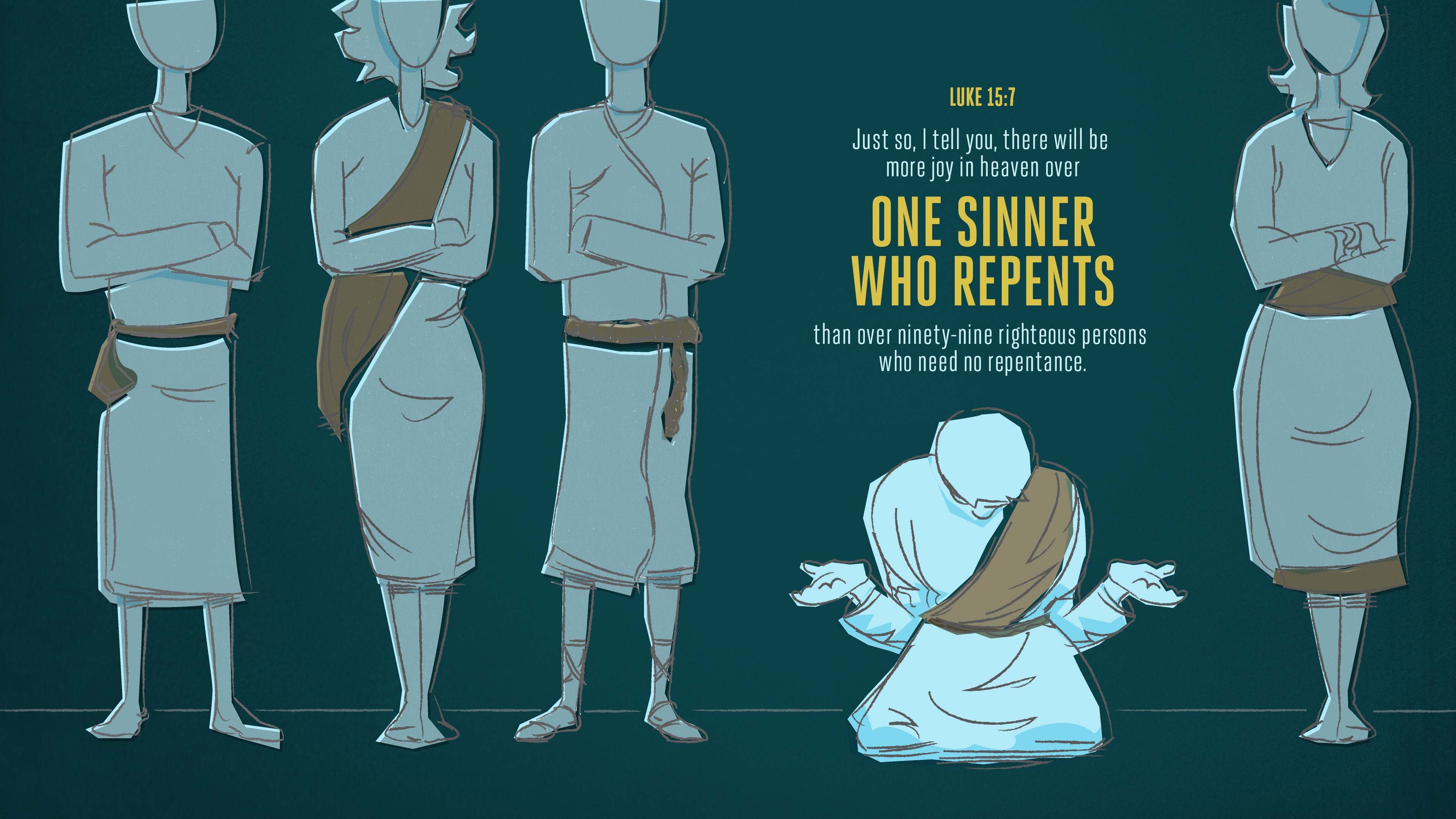
The night Jesus was born, shepherds were out in the field keeping watch over their flocks. A multitude of the heavenly host arrived praising God and saying, “Glory to God in the highest, and on earth peace among those with whom He is pleased.” Heaven was filled with rejoicing the night of Jesus’ birth because your Savior had come to rescue you from sin, death, and the devil. Now, in this Gospel lesson, Jesus says, “There will be more joy in heaven over one winner who repents than over ninety-nine righteous persons who need no repentance” (Lk. 15:7).

Well, there aren’t ninety-nine righteous persons who need no repentance; there has only ever been One righteous person who needed no repentance, Jesus Christ. This is probably a little ridiculous and silly, but should we imagine the joy of those angels the night of Jesus’ birth is multiplied by 99 plus a bit more when one sinner repents? Well, joy isn’t measured in units, so forget about attempting the math problem. But we can know from Jesus’ own lips that heaven rejoices more at the repentance and salvation of one sinner than it rejoiced over Christ’s birth.

Because Jesus brings the topic up in this text, the question for us today is: What is repentance? The word translated ‘repent’ or ‘repentance’ simply means “a change of mind,” but throughout the New Testament, you will find that repentance refers to a complete spiritual change. In fact, many of the times you come across the word ‘repent’ in Scripture it carries the whole idea of conversion.[1] The Bible does not teach that repentance is one step in some twelve-step salvation program. Salvation is instantaneous; just like in creation, God speaks, and it is. And salvation is always an act of God’s grace. “For by grace you have been saved through faith. And this is not your own doing; it is the gift of God, not a result of works, so that no one may boast” (Eph. 2:8-9). The Bible does teach that repentance is necessary for salvation, but if we see repentance as something we do, as our little contribution, then salvation is no longer a free gift. It would be dependent on you. 

So, let’s reconsider repentance, what it is and what it looks like from this parable Jesus teaches.

The Pharisees and scribes are complaining that Jesus receives sinners. Luke tells us that Jesus’ response to their grumbling is telling them “this parable” – singular. Luke could have said, “so He told them these three parables,” but he doesn’t. “This parable.” One parable. Three sections, parts, or chapters – it’s fine to think of it that way – but it’s one parable. And I’ve said it before, but I’ll say it again: we typically know these three sections or chapters of this one parable as the lost sheep, the lost coin, and the prodigal son. But it would be better if we referred to them as the seeking shepherd, the seeking woman, and the seeking father because that would help us keep the emphasis on the right syllable when it comes to seeing what Jesus teaches about repentance.

Now, in the first two sections of this parable, it’s a little hard to see where repentance comes into the stories. A sheep gets lost, the sheep gets found, and the shepherd throws a party. A coin gets lost, the coin gets found, and the woman throws a party. Just looking at the stories, we would probably conclude that Jesus isn’t teaching about repentance. He’s just talking about salvation. But Jesus concludes both of those sections by talking about heaven’s joy over repentance, so repentance has to be in there somewhere. According to those two parts of the parable, repentance is nothing more than the lost being found and restored by the owner. Then, the owner celebrates because of the joy of restoration.

Now, you might be saying, “Pastor there’s a lot more to repentance than the lost being found and restored. To repent, you have to feel bad about what you’ve done. You have to recognize the hurt and pain you have caused. You need to be scared because of the punishment that’s coming. You need to want to do better. That’s repentance.” To which I have to say, “Well, not according to this parable.” Guilt, shame, fear of punishment, and resolve to do better are all right responses when it comes to our sin, and all of those things may accompany repentance from time to time. But they aren’t necessary for repentance to be true or genuine.

A lost sheep might be scared. I don’t know enough about sheep to know if they feel remorse, but a lost sheep might wish it had never wandered away from the flock. A lost sheep might try to find its way back to the herd. But in the first section of this parable, the repentance of that sheep is somewhere in the shepherd’s finding and carrying this sheep back to the pen. In the second section of the parable, the coin doesn’t have any feelings or sorrow. A lost coin just sits in the crack gathering dust. And the repentance of that coin is nothing more than the woman picking it up and putting it back in her purse. So, these first two sections picture repentance as something God does to the lost.

Just so you know I’m not making this up: In Acts 10-11, we are told the story about how Peter went to preach at Cornelius’ house. Cornelius was a Gentile, so a lot more could be said about the whole story, but I’m going to keep it short. Peter arrives there and preaches about Jesus’ death and resurrection. Peter’s Pentecost sermon is very similar in it’s content, but unlike that Pentecost sermon, Peter doesn’t hammer everyone with heavy Law. He just says that Jesus died and rose again, and he announces that everyone who believes in Jesus receives the forgiveness of sins. The people who hear that sermon are filled with the Holy Spirit and are Baptized. All of that takes place in Acts 10. When you get into Acts 11, Peter is in Jerusalem and is being accused of hanging out with the wrong crowd (similar to Jesus here in Lk. 15). Peter simply relays the story of what happened. And the response is incredibly interesting. The Jerusalem church leaders respond, “Then to the Gentiles also God has granted repentance that leads to life” (Act. 11:18). Dear saints, repentance is a gift given by God.

Now, when we get to the third section of the parable, things are a little different. In the third chapter of the parable, it sure sounds like the younger son is repentant. But where does his repentance take place? Now, we have to set this up a little bit.

The third section of the parable has three main characters – a father and his two sons. The younger son tells his father to drop dead. That’s how you get an inheritance. Basically, the younger son tells his dad, “I want my share of your stuff, but I want it without you.” And the father gives it to him. Now, this would have meant public shame for the father because it would have involved selling off at least 1/3 of his estate to give the money to his little brat of a son. The son takes the cash and blows it all. He becomes so desperate in his effort to stay alive that he hires himself out to a pig farmer and is jealous of the slop the pigs are eating. 

Now, just a quick aside here. This also gives us a picture of what our sin does. Our sin isn’t just us getting lost. Sin is worse than a sheep aimlessly wandering away from the flock or a coin getting dropped. No, our sin makes us lower than and jealous of pigs.

Sitting there in the pigpen, the son starts crafting a speech. And that speech sounds like repentance, but it isn’t. Instead, the younger son realizes his father’s employees have plenty of food, and he’s dying of starvation. He plans to go to his father and say, and listen carefully, “Father, I have sinned against heaven and before you.” So far, completely true and right. “I am no longer worthy to be called your son.” No duh. “Treat me as one of your hired servants.” Now, all of this, again, sounds like repentance. He recognizes the stupidity of his actions and the ramifications of his rebellion. But it’s that last part that shows the brat’s real intention. He wants his dad to give him a job so he can have some food. The interesting thing that I had never noticed is the wording Jesus uses in this part of the parable.

Jesus doesn’t use the normal word for a servant which is doulos. A servant, a doulos, would live on the estate of the master and would even eat meals with the master’s family. But the younger son uses a different word here, misthios. A misthios is someone who would commute to work at the estate. A misthios would have no relationship with the master except when it was time to get paid for work done. His speech just shows how lost and unrepentant he still is. He still wants the benefits his dad can offer, but he doesn’t want anything to do with his dad. In his despair, he’s basically saying, “Dad, I screwed up big time. Can you just help me to stay alive? I won’t bother you and you won’t have to bother with me.” That’s his prepared speech.

He starts his walk home. But as he rounds the corner, his father comes running to him, embraces him, and kisses him. The son begins his speech, “Father, I have sinned against heaven and before you. I am no longer worthy to be called your son.” But the father, the father doesn’t care. He restores him to his rightful place as a son. “Bring the best robe and a ring and shoes; put them all on him. Kill the fattened calf and let’s throw a party. For this my son was dead, and is alive again; he was lost, and is found.” It is in that love and finding and restoration of the father that the son is granted repentance. 2 Corinthians 7:10 says, “Godly grief produces a repentance that leads to salvation without regret, whereas worldly grief produces death.” The son had a worldly grief that would have left him in the death of a lost relationship with his father. But the father here lets the godly grief of his lost son, that true and right realization of what he had done, produce a repentance that leads to salvation and complete restoration. The son doesn’t get to finish his speech. He doesn’t get to be misthios, a hireling. He gets to be a son again – nothing more, nothing less.

Now, I know this sermon is getting long, but I have one more thing, so please bear with me. I made a big deal about this chapter being one parable with three sections. Well, the third section has two parts. There is still the issue of the older son. The older son, who never left, was out working in the field. He comes home, hears the partying, learns what is going on, and is livid. He refuses to join the party. And even though this older son never left his father, he is just as lost as the younger son was back in the pig stye.

And here is why I bring this up. We wrongly think that God is happy when we are doing everything we are supposed to. We think God is happy with us when we are consistent, strong, and can show all the things we’ve accomplished. But that isn’t the case. Your heavenly Father is only happy when His children are forgiven and together with him at the feast. That is why the father leaves his own party and pleads with this older son to come back into the fold.

Dear saints, stop dwelling on your unfaithfulness and sin. Yes, you’ve been the rebellious younger son. But your heavenly Father has sought you out and heaven rejoices at your repentance and salvation. Stop dwelling on your obedience and work for God; don’t be the entitled older brother. Yes, go serve, love, and do your good works diligently, but don’t think that God is going to throw a party for your commandment-keeping.

Heaven rejoices with God when He brings you back into His grace and mercy where nothing is earned or deserved. Instead, it is all freely given for the sake of Jesus, your Savior. Amen.

The peace of God, which surpasses all understanding, will guard your hearts and minds in Christ Jesus. Amen.


[1] Clear examples would include Mt. 4:17; Lk. 5:32; 13:3; 16:30; 24:47; Act. 11:18; 2 Cor. 7:10.

Ask & Receive – Sermon on John 16:23-33 for the Sixth Sunday of Easter

John 16:23-33

23 [Jesus says,] “In that day you will ask nothing of me. Truly, truly, I say to you, whatever you ask of the Father in my name, he will give it to you. 24 Until now you have asked nothing in my name. Ask, and you will receive, that your joy may be full.

25 “I have said these things to you in figures of speech. The hour is coming when I will no longer speak to you in figures of speech but will tell you plainly about the Father. 26 In that day you will ask in my name, and I do not say to you that I will ask the Father on your behalf; 27 for the Father himself loves you, because you have loved me and have believed that I came from God. 28 I came from the Father and have come into the world, and now I am leaving the world and going to the Father.”

29 His disciples said, “Ah, now you are speaking plainly and not using figurative speech! 30 Now we know that you know all things and do not need anyone to question you; this is why we believe that you came from God.” 31 Jesus answered them, “Do you now believe? 32 Behold, the hour is coming, indeed it has come, when you will be scattered, each to his own home, and will leave me alone. Yet I am not alone, for the Father is with me. 33 I have said these things to you, that in me you may have peace. In the world you will have tribulation. But take heart; I have overcome the world.”

Alleluia! Christ is risen!
He is risen indeed! Alleluia!

In the name of Jesus. Amen.

I’m a complete sucker for advertisements. My wife will confirm this. If I hear about a product, a service, or food on one of my favorite podcasts or on social media and the ad makes that thing even slightly appealing, I’m probably going to give it a try. Well, in this text, Jesus gives the best advertisement for prayer in all the Scriptures. Jesus says, “Truly, truly, I say to you, whatever you ask of the Father in My name, He will give it to you. Until now you have asked nothing in My name. Ask, and you will receive, that your joy may be full.”

Jesus means what He says here. Whatever you ask of God the Father in Jesus’ name, God will give it to you, so ask and you will receive. But we sinful humans take this statement from Jesus and tend to fall into one of two errors.

Some fall into the name-it-and-claim-it error. Some will preach that this statement of Jesus means that God will give you whatever you want. All you have to do is ask and believe enough. And it’s no wonder that those types of preachers are popular on television and make a lot of money preaching that. They’re wrong. And if you want that type of preaching, you’ll have to find another preacher because that isn’t what Jesus is teaches.

Jesus says that whatever you ask of the Father, in Jesus’ name, God will give it to you. This does not mean that throwing a quick, “in Jesus’ name,” to the end of your prayers is the magical “abracadabra” that gets God’s attention and make Him your slave so He must do your bidding. No. We have a sinful nature that does not desire the right things. So, if you pray for $500 M, if you really want it, and if you ask for it in Jesus’ name, that doesn’t mean that God is obligated to give it to you. (More on this later.) To pray in Jesus’ name is to pray according to Jesus’ will.

That leads us to the other error. And, in my opinion, this is more common among us (myself included). Too often, we have a fatalistic approach to our prayer, and here’s what I mean by that. We know that God is omniscient. He knows everything; He knows everything that will happen – past, present, and future. And we know that God is omnipotent, or all-powerful, and He rules over everything. Those are important truths that the Scriptures teach. But when we take those doctrines with us into prayer, we can come to the wrong conclusion that our prayer isn’t going to do any good or change anything because God has already determined what He will do and will do it no matter how we pray. But that line of thinking makes prayer pointless because our prayers won’t change anything. Well, that view is also just plain wrong.

The Bible teaches the opposite. Christian, when you pray, you pray as a child of God, and God reacts to your council and input on what is going on in the world. Picture it this way: When a president or king is fighting a war, he has advisors. They sit around a table and strategize, consult, and plan together. Those advisors are important, and the person in charge values their input and alters his plans based on that discussion.

Scripture teaches that you, Christian, you, child of God, are at that table. When God commands you to pray, He is inviting you into His war room to give your input as to how things should be handled on the battlefield. God wants your thoughts and ideas on how situations should be handled. God turns to you and asks, “My beloved child, what do you think we should do?” And your prayers are your response.

For your sermon homework today, you can chose one of three optional assignments (you’ll get extra credit if you do all three): The first would be to read Gen. 18:22 to the end of the chapter. There, God lets Abraham know about the judgment He is going to rain down on Sodom and Gomorrah. And Abraham intercedes for those cities and negotiates with God in prayer. Through Abraham’s intercession, God agrees to not destroy those cities if He finds ten righteous people there (Gen. 18:17-33). Prayer works.

Your second optional assignment is to reread our Old Testament lesson (Num. 21:4-9). There, God’s people sinfully complain about being in the wilderness and about the mana and quail that God daily provided for them. When God sends the fiery serpents to punish and judge them, the people ask Moses to intercede and pray for them. And God answers Moses’ prayer by providing the bronze serpent. And if anyone was bitten by the venomous snakes, they could look at the bronze serpent and be saved from death. Moses’ prayer worked and saved lives.

Your third optional assignment is to read Jonah 3. There, the people of Nineveh have heard Jonah preach about God’s impending judgment for their sins. After they hear that sermon, the king of Nineveh orders all the Ninevites to pray as a last resort. The king says, “Everyone needs to fast, pray, repent, and stop being evil. Who knows? Maybe God will relent of the disaster and judgment He is bringing upon us.” The Ninevites pray, and God responds by changing His mind. Jonah 3:10 says that prayer worked, “God relented of the disaster that He had said He would do to them, and He did not do it.”

I could have you look at a whole bunch of texts, but the reason I mention those three is because of the different degrees of proximity between the one praying and those being prayed for. Abraham prays that God would be merciful toward the people of Sodom and Gomorrah even though Abraham has no connection to their sin, and God responds. Moses prays for God to be merciful to the sinners all around him, and God responds. The king of Nineveh prays for God to be merciful to him (and, yes, the sinners around him), and God responds.

It is true that God always knows what is best to do, but when we pray, we are at the table as God’s advisors and counselors. He desires your input through your prayers. Now, I promised you that I’d come back to this. Again, God hasn’t bound Himself to answer every prayer exactly how we pray for it.

As a congregation, we’ve been praying for our dear sister, Phyllis. We’ve asked God to heal her and give her strength. Nine days ago, she died and is now with the Lord. But God has answered and is answeringour prayers. When Christ returns, Phyllis will rise again. Her body and soul will be put back together, and she will live eternally with no more pain, sorrow, tears, fatigue, etc. We have prayed and interceded for her. We have asked in Jesus’ name, and we are receiving the answers to those prayers. Maybe it isn’t the timing we wanted or in the way we wanted. But God always works all things together for good for those who love Him and are called according to His purpose (Ro. 8:28). He has promised!

Remember, even Jesus had one of His prayers denied initially. Jesus prayed to not go to the cross, “Father, if it is possible, let this cup pass from Me” (Mt. 26:39). That prayer from Jesus, your Savior, was the most futile and impossible prayer that has ever been prayed or will ever be prayed. Jesus’ death was the only answer for our sin. But God listened to Jesus’ prayer, and He loved to hear it. Jesus prayed that prayer without sinning, and God still answered Jesus’ prayer because Christ also prayed, “Nevertheless, not as I will, but as You will.”

Dear saints, don’t ever be embarrassed about praying to God for trivial and simple things. If you want something, it doesn’t matter how small or silly it is, pray for it. Whenever you ask God for something, you’re going to the right Source! You are asking your merciful, loving, generous, and kind heavenly Father for what you want. God will listen to your prayers and answer them to mold and shape what happens in this world, and He will use your prayers to help mold and shape you. Psalm 37:4 says, “Delight yourself in the Lord, and He will give you the desires of your heart.” When the Lord is what you want and desire, when His good gifts are the object of your delight, you have everything you want and desire.

So, pray. Prayer is your ultimate weapon against evil. Prayer is your defense spiritually and physically. Your prayers spring God into action with His divine power. So, be people of prayer, and if you haven’t been praying, start.

Before I conclude here, I want to give you three quick and easy prayers to put in your back pocket. I’ve preached this before, but it bears repeating. I think one of the best ways to be more regular and faithful in prayer is simply to do it more often, and these three little prayers can help with that. It might not feel like these prayers are important, but they absolutely are.

The first little prayer is for whenever you see something good happen. Pray, “God be praised.” It is good and right for you to verbally and mentally acknowledge and recognize that that good thing, whatever it is, has come from God.

The second little prayer is for whenever you see something bad or evil. Pray, “Lord, have mercy.” This is a perfect prayer in the face of any evil or disaster because God always desires to give you His mercy.

The third and final little prayer is for whenever you are making plans or looking to the future. Pray, “Lord willing,” or “If the Lord wills” (see Jam. 4:13-15). I think one of the most important lessons God was teaching us through COVID was a reminder that we are not in control. And I sincerely hope and pray we all take that lesson seriously. That prayer will help you remember that everything is in God’s merciful hands.

Dear saints, you have the ear of the One who created and rules all things. Jesus promises that whatever you ask in His name, God will give to you. So, pray and watch how God acts for your good and for the good of others. Amen.

Alleluia! Christ is risen!
He is risen indeed! Alleluia!

The peace of God, which surpasses all understanding, will guard your hearts and minds in Christ Jesus. Amen.

See and Rejoice – Sermon on John 8:42-59 for the Fifth Sunday in Lent

John 8:42-59

42 Jesus said to them, “If God were your Father, you would love me, for I came from God and I am here. I came not of my own accord, but he sent me. 43 Why do you not understand what I say? It is because you cannot bear to hear my word. 44 You are of your father the devil, and your will is to do your father’s desires. He was a murderer from the beginning, and does not stand in the truth, because there is no truth in him. When he lies, he speaks out of his own character, for he is a liar and the father of lies. 45 But because I tell the truth, you do not believe me. 46 Which one of you convicts me of sin? If I tell the truth, why do you not believe me? 47Whoever is of God hears the words of God. The reason why you do not hear them is that you are not of God.”

48 The Jews answered him, “Are we not right in saying that you are a Samaritan and have a demon?” 49Jesus answered, “I do not have a demon, but I honor my Father, and you dishonor me. 50 Yet I do not seek my own glory; there is One who seeks it, and he is the judge. 51 Truly, truly, I say to you, if anyone keeps my word, he will never see death.” 52 The Jews said to him, “Now we know that you have a demon! Abraham died, as did the prophets, yet you say, ‘If anyone keeps my word, he will never taste death.’ 53 Are you greater than our father Abraham, who died? And the prophets died! Who do you make yourself out to be?” 54 Jesus answered, “If I glorify myself, my glory is nothing. It is my Father who glorifies me, of whom you say, ‘He is our God.’ 55But you have not known him. I know him. If I were to say that I do not know him, I would be a liar like you, but I do know him and I keep his word. 56 Your father Abraham rejoiced that he would see my day. He saw it and was glad.” 57 So the Jews said to him, “You are not yet fifty years old, and have you seen Abraham?” 58 Jesus said to them, “Truly, truly, I say to you, before Abraham was, I am.” 59 So they picked up stones to throw at him, but Jesus hid himself and went out of the temple.

In the name of Jesus. Amen.

This portion of John is one of the high points of the four Gospels because, here, Jesus pulls back the veil and reveals Himself to be God saying, “Truly, truly, I say to you, before Abraham was, I am.” There is a whole sermon there, but it will have to wait until the next time this text rolls around. Today, we’re going to consider just two sentences from our Lord. The first reveals just how stubborn mankind is in our sin and how desperate we are to believe lies, and the second sets us up for the Scripture readings we are going to be hearing next Sunday and through Holy Week.

In the last half of v. 46, Jesus asks, “If I tell the truth, why do you not believe Me?” That question should startle us – especially because it comes from the lips of our Savior. In our fallen, sinful state, we are willing to reject the truth even when it stares us in the face. When the truth is difficult and hurts us, we would rather live by lies than change course. We have this false idea in our minds where we think that if people are presented with the facts so that the truth is crystal clear, then everybody will agree and everything will be right in the world. But that is false.

Here, Jesus, who is the Truth (Jn. 14:6), speaks the truth to the people in the Temple, but they refuse to believe and are ready to stone Him. No matter how clearly the truth is spoken or how authoritative the speaker of truth is, there are some who will simply reject it and refuse to live in reality.

Sometimes, we think that problems we face are caused by the news channels, social media suppression, or other sources of misinformation. Those things certainly don’t help. But don’t imagine that if someone waived a magic wand and made all those things disappear that, suddenly, everything would be right in the world and everyone would automatically believe the truth. People didn’t believe Jesus when He spoke the truth. And even worse, Jesus was persecuted when He spoke the truth. Dear saints, we should expect the same. In fact, that is exactly what we see today.

The reason people reject truth, especially the truth about God, is that we are by nature children of wrath (Eph. 2:3). Because of our sin, we do not and cannot love God. We cannot come to Him or understand Him. Instead, we naturally run away from Him. But God still desires to bring you back unto Himself. So, God goes out to battle and fights for you. And – it is so important to understand this – when God fights for you, yes, He is fighting against Satan and the demons, against sin and death. But even more importantly, when God fights for you, He is even fighting against you, against your sinful nature and mine.

The texts through Lent have all been about this fight. The first Sunday of Lent, we saw how Jesus fought against the devil in His temptation (Mt. 4:1-11). The second and third Sundays of Lent, we saw how Jesus fought against the demons (Mt. 15:21-28, Lk. 11:14-28). Last week, we saw how Jesus fought against the crowds who wanted Jesus to satisfy all their fleshly desires and make Him a bread king (Jn. 6:1-15). Today, there is an obvious fight between and the crowds as Jesus simply speaks truth and is rejected. The crowds were so adamant in their rejection they are ready to stone Him (Jn. 8:59). And those crowds would have killed Jesus if it had been His time to die, but it wasn’t His time – not yet. But in next week’s Gospel lesson, which will be Matthew’s account of Jesus’ passion (Mt. 26:1-27:66) and then again in the texts for Good Friday, it will be Jesus’ time to die. The same crowds will call for Jesus to be crucified. And there, on the cross, Jesus will fight the final, decisive battle against all the forces of evil.

Lent is about God fighting against evil. When we get to Easter and the Resurrection, we will celebrate Jesus’ victory. With the resurrection, Jesus reveals His victory over all evil, even the evil within you and me. Because of the resurrection, you can know that Christ has snatched you away from the kingdom of darkness and transferred you to His kingdom of light (Eph. 1:13, 1 Pet. 2:9). And as His people, we will celebrate His victory. On Easter, we will rejoice and sing, and our hearts will be glad when we celebrate the resurrection. But what will we do, and how will we react, as we hear Jesus fighting that battle? What will be our response as we see Jesus going to the cross and suffering God’s eternal wrath against our sin?

Some of you have mentioned to me how you don’t like Good Friday and Christ’s crucifixion and would much rather jump straight to Easter and the resurrection. Now, I understand the sentiment. I do. But there is no Easter joy, no resurrection gladness, apart from Good Friday. Easter cannot happen unless Jesus dies first. One of the Sunday school teachers (and I apologize, but don’t remember who it was) mentioned to me in the past couple weeks how one of their students asked why call the day of Jesus’ death ‘Good Friday.’ What is good about that? Well, today Jesus tells us.

Jesus makes a comment in v. 56 of today’s text that helps us know how to approach the texts of Holy Week and how to see His crucifixion. Jesus says, “Your father Abraham rejoiced that he would see My day. He saw it and was glad.” What is Jesus talking about there? Notice, Jesus doesn’t say that Abraham ‘believed in My day and was glad.’ No. Abraham saw it and was glad. Well, Abraham saw Jesus’ day in our Old Testament text (Gen. 22:1-14).

There, when Isaac was spared from being sacrificed, Abraham sees the ram caught in a thicket by its horns. And Abraham doesn’t have to be told anything. Immediately, Abraham takes Isaac off the wood and places the ram in Isaac’s place. Abraham sacrifices the ram instead of Isaac, Abraham’s beloved son. Through that sacrifice, God is visibly showing Abraham what He will do through Jesus, His only-begotten Son. In that text, Abraham saw what God would do in and through Jesus as He goes to the cross in your place. Abraham saw, rejoiced, and was glad.

Dear saints, as we approach the crucifixion and see Jesus’ day of victory over sin, death, the devil, and our own sinful flesh, let us see and rejoice as well. Jesus willingly goes to the cross in your place. There on Mt. Calvary, Christ wins the victory and battle for you. As we approach Holy Week, let us look to Jesus, the founder and perfector of our faith and remember that Scripture says it was “for the joy,” the joy, “that was set before Him, He endured the cross” (Heb. 12:2) for Abraham, for Isaac, for you, and for all sinners.

Dear saints, on the cross your Savior has won the battle. Christ has shed His blood and with that blood, He now cleanses your conscience from dead works to serve the living God. Come now and receive the Body and Blood of your Savior who brings you into the new covenant and to your promised, eternal inheritance (Heb. 9:14-15). Amen.

The peace of God, which surpasses all understanding, will guard your hearts and minds in Christ Jesus. Amen.
When Prayer Gets Violent – Sermon on Matthew 15:21-28 for the Second Sunday in Lent

Matthew 15:21-28

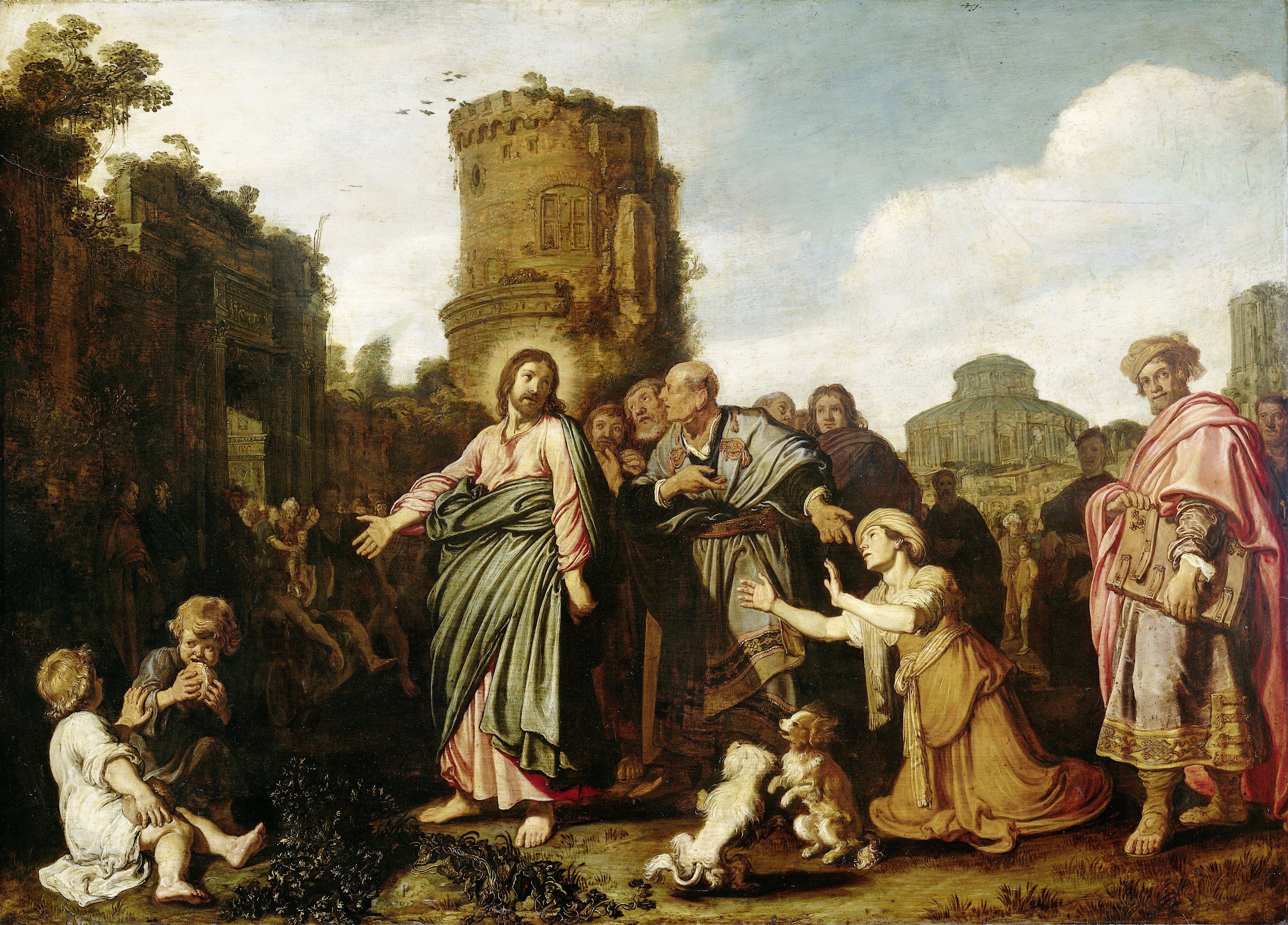
21 And Jesus went away from there and withdrew to the district of Tyre and Sidon. 22 And behold, a Canaanite woman from that region came out and was crying, “Have mercy on me, O Lord, Son of David; my daughter is severely oppressed by a demon.” 23 But he did not answer her a word. And his disciples came and begged him, saying, “Send her away, for she is crying out after us.” 24 He answered, “I was sent only to the lost sheep of the house of Israel.” 25 But she came and knelt before him, saying, “Lord, help me.” 26 And he answered, “It is not right to take the children’s bread and throw it to the dogs.” 27 She said, “Yes, Lord, yet even the dogs eat the crumbs that fall from their masters’ table.” 28 Then Jesus answered her, “O woman, great is your faith! Be it done for you as you desire.” And her daughter was healed instantly.

In the name of Jesus. Amen.

In our Old Testament lesson today (Gen. 32:22-32), you heard how Jacob wrestled with God. Jacob was already tired and under a lot of stress. He was returning home after living with and working for his father-in-law for a couple decades, and he was approaching his brother Esau who had sworn to kill Jacob for taking his birthright and blessing (Gen. 27:41-42). The night before Jacob and Esau met, God came down to Jacob, and they wrestled mano a mano. Once the dust from their scuffle settled, God blessed Jacob and gave him a new name. Now, Jacob is known as ‘Israel’ which means ‘God strives.’

That text is a fantastic set-up for this Gospel lesson. Here, God has again descended, and Jesus wrestles with one of His creatures who, like Jacob, is already tired and afraid. This time, God’s opponent is a woman; she is a foreigner; and she is a pagan. Three strikes, so she should be out. But she approaches Jesus in great need. She comes boldly, and her prayer is violent. It doesn’t sound so violent in our translation. We heard that she is ‘crying out,’ but the Greek word there conveys the shrieking of a raven. We heard that she ‘knelt’ before Jesus, but the Greek word there is more along the lines of flung – she flung herself at Jesus feet.

Notice how she addresses Jesus with two titles: ‘Lord’ and ‘Son of David.’ In the Gospel of Matthew, only disciples address Jesus as ‘Lord.’ And she refers to Jesus as only an Israelite would with the kingly title, ‘Son of David.’ And her request isn’t for herself. Her little daughter is severely oppressed by a demon. So, her prayer checks all the right boxes. Jesus is the Lord and King. And He has come to destroy the works of the devil (1 Jn. 3:8). But Jesus acts in a way that can make us Christians feel a bit awkward.

Christ first ignores her. The disciples start praying against her and beg Jesus to send her away. Then, Jesus says, “I was sent only to the lost sheep of the house of Israel.” And when she flings herself into the dust before Jesus’ feet with a last gasp prayer, “Lord, help me,” Jesus calls her a dog. This isn’t the Jesus we are used to hearing about in the Gospels, the one who welcomes the lowly and despised, the one who heals, the one who casts out all sorts of demons.

But even though Jesus has her in a submission hold (figuratively speaking), this woman has one last punch to throw at Jesus to win this fight, and it’s a haymaker. Yes, Jesus has called her a dog, but she takes the insult. She says, in effect, “Yes Lord, I am a dog. I don’t belong or have any right to sit at Your table. I don’t deserve the bread that You feed to Your children. But if You call me a dog, I’ll be your dog. And I’ll be content with nothing more than what the dogs get. The crumbs from Your table are enough for me.”

After that statement, Jesus taps out, “O woman, great is your faith!” This is one of two times in the Gospels that Jesus praises someone’s faith (Mt. 8:5-13 is the other). “Be it done for you as you desire.” And her daughter was healed instantly.

This wrestling match between Jesus and the Canaanite woman reminds me of the parable of the unrighteous judge that Jesus tells in Lk. 18:1-6. In that parable, a woman repeatedly asks an unjust judge for justice. The judge just ignores her, but the woman keeps crying out for justice. Finally, the judge gives her what she wants because, according to the judge, the woman is beating him down with her continual requests. Luke tells us that Jesus told that parable to encourage His disciples to be persistent in their prayers because God is just and will not delay in answering.

There is no question, Jesus heard every one of this Canaanite woman’s prayers. Christ loved this woman and her daughter and had come to set them free from the oppression of demons. So, why did it take so long for Jesus to give her what she wanted, and why did He treat her like this? I think the only safe answer to those questions is, “I don’t know.” God’s ways are not our ways (Is. 55:8-9). But we can say this because Scripture clearly teaches it:

By delaying His answer to her prayer, Jesus purifies this woman’s faith. James 1:2-3 says, “Count it all joy, my brothers, when you meet trials of various kinds, for you know that the testing of your faith produces steadfastness.” And our Epistle Lesson today (Ro. 5:1-5) says that we can rejoice in our suffering because suffering produces endurance, and endurance produces character, and character produces hope. Jesus knows how much heat this woman can take, and she comes out the other side with a stronger faith than what she had before this violent wrestling match of prayer.

There is no question that Jesus sent trial after trial to this woman. But that is what makes her faith so beautiful. Rather than turning her back on Jesus for being a jerk, her roots sink in deeper. She knows there is no other help for her and her daughter. So, here is the real question. Can you trust God when, to all appearances, He ignores you? Can you trust God when the wicked prosper, when the world is falling apart, and when your loved ones die too early? Will you trust Him when He doesn’t do what you ask? Faith trusts in God even when it is contrary to experience and our fallen reason.

The greatness of the woman’s faith wasn’t in her confidence or certainty. Its greatness was in its weakness. Her faith was great not when she was crying, “Son of David have mercy on me,” but it was great when she says, “Yes, Lord. I am Your dog.” It was great then because it only wanted what He gave.

In your walk of faith, remember that God doesn’t keep every promise you can imagine. But He has, does, and will keep every promise He has made. When it appears – and please note, I said, appears – that God isn’t listening to your prayers and seems to be sending you away, have the ingenuity of this woman. When God tells you, “You are lost,” you can take God at His Word and cry to Him, “Yes, God. I’m lost; find me.” When God says, “You’re a sinner,” say, “Yes, God. I’m a sinner; save me.” When God says, “You’re dead,” cry to Him “Yes, raise me.”

Finally, don’t give up on your prayers. Keep wrestling in them. You can’t hurt God by getting too violent with your prayer. Jesus wants you, like this woman did, to continue bringing your requests to Him. Jesus says, “Ask, and it will be given to you; seek, and you will find; knock, and it will be opened to you” (Mt. 7:7). So, keep asking; keep seeking; keep knocking. God will answer in the best way and at the exact right time.

Dear saints, you can be bold in your prayers because Christ has come and restored peace between you and God; you now stand in God’s grace (Ro. 5:2). He will remember His mercy and steadfast love, and He will redeem you out of all your troubles (Ps. 25:6, 22). Amen.

The peace of God, which surpasses all understanding, will guard your hearts and minds in Christ Jesus. Amen.

Eden to Heaven – Sermon on Genesis 3:22-24 & Revelation 22:1-5

Genesis 3:22-24 & Revelation 22:1-5

In the name of Jesus. Amen.

God created you to live in perfection. In six days, God created everything in the universe. He created light and darkness. He placed the sun, moon, stars, and galaxies in their places. God established land, sea, and plants and filled the earth with birds, fish, and every kind of animal. And God planted the garden of Eden. Only after all that was completed did God create the crown of creation – man and woman. And Adam and Eve were placed in the Garden of Eden to work it and keep it.

But it wasn’t the kind of work that we experience – it was pure joy. There was no need to look at the forecast to see what the weather would be. No worries about gas prices and inflation. No crisis. No war. No disease or pandemic. Everything was in perfect harmony. In God’s own estimation, all that He created was good, in fact, very good (Gen. 1:21). Best of all was the perfect relationship that existed between God and man. God freely giving and man graciously receiving. Even the one command that God gave was gracious, “Of the tree of the knowledge of good and evil you shall not eat, for in the day you eat of it you shall surely die” (Gen. 2:17).

Now, some suggest that God put the tree of the knowledge of good and evil in the garden so Adam and Eve could choose to trust or reject God. But this is not the case. God’s prohibition to eat from that tree was a promise for Adam and Eve to believe. Just track with me for a minute here. Scripture repeatedly says, “The righteous shall live by faith” (Hab. 2:4; Ro. 2:17; Gal. 3:11; Heb. 10:38). In other words, to be righteous is to have faith. We know that for us sinners to be righteous is to have faith in Jesus as our Savior. But what kind of faith did Adam and Eve have before the Fall? They already knew the mercy, goodness, and graciousness of God because they constantly experienced it in everything that God had given and in everything God was to them. So, what is it that Adam and Eve believed before the Fall that made them righteous through faith?

Well, at some point in those first six days, God created the angels. Now, Scripture doesn’t tell us specifically when, but at some point in those days of creation the devil and demons rebelled and fell. In other words, evil existed. When God banned Adam and Eve from eating from the tree of knowledge of good and evil, God was giving a promise, “Evil exists, and I just want you to trust Me on this. When you find out what evil is, it won’t go well for you, in fact, you’ll die.” So, Adam and Eve could go to the tree of the knowledge of good and evil and know, “What a good God we have. He has given us everything and doesn’t want us to experience or even know what evil is.”

But, as you heard in Sunday’s Old Testament lesson (Gen. 3:1-21), Satan stirred up discontentment in Adam and Eve. The devil told Eve that she could become something more than God had created her to be. Satan said that she would become like God. So, deceived as she was (Gen. 3:13; 2 Cor. 11:3), Eve took the fruit. Adam was even worse; he wasn’t deceived and knew exactly what he was doing (1 Tim. 2:14). They both sinned and fell. They took. They ate. Their eyes were opened. They had become something more. You heard God say it Himself tonight, “Behold, the man has become like one of us in knowing good and evil” (Gen. 3:22).

But Adam and Eve knowing evil wasn’t better. Not even close. Now, because the head of creation had fallen into sin, creation fell with him (Ro. 8:20-21). And Adam and Eve were sent into exile – away from God’s presence, away from the Garden of Eden, and away from the tree of life which was now guarded by the cherubim and a flaming sword. But God sent them into this exile with a new promise to believe. A promise that paradise would be restored to them when the seed of the woman would come and crush the serpent’s head (Gen. 3:15). And it was through faith in that promise that God went with them.

Dear saints, you and I live in exile. We wander about sinfully trying to become like God by our own works, but all our effort is curved in upon itself. Instead of being like our giving God, we seek after our own comfort and desires. Unlike God who is generous and giving, we try to pile up riches for ourselves. We try to create our own little gardens of Eden in an attempt to regain the paradise we lost. But we never achieve the perfection we long for. The treasures we acquire quickly fade and fall apart in our hands.

We cannot return from this exile by our own reason or strength. Yet, God walks alongside us, calling us back unto Himself. Out of His great love for us, He continues to give us promise after promise. And God delivers on every one of His promises. He has sent Jesus into this world of exile to bring us back to paradise. He comes to us who are bent over in our sin and frees us. He delivers us from the bondage of Satan (Lk. 13:16) and gives us rest. He announces to us that because of what He has done by His death and resurrection, we will be eternally restored. While Jesus was on the cross, He told the thief next to Him, “Today, you will be with Me in paradise” (Lk. 23:43). That word ‘paradise’ means ‘an enclosed garden.’

In our reading from Rev. 22:1-5 tonight, we get a picture of that garden of paradise. And that is what lies ahead for you, dear saint. Through faith in Jesus, you are righteous. Your destination is the bright crystal river, the tree of life yielding its twelve kinds of fruit, and leaves for the healing of the nations. There you will see God’s face, and there will be no more night. You will need no light of lamp or sun, for you will be restored to God, and He will be your light. Your time in exile has an end. And there, in eternal bliss, you will reign forever and ever. Amen.

The peace of God, which surpasses all understanding, will guard your hearts and minds in Christ Jesus. Amen.
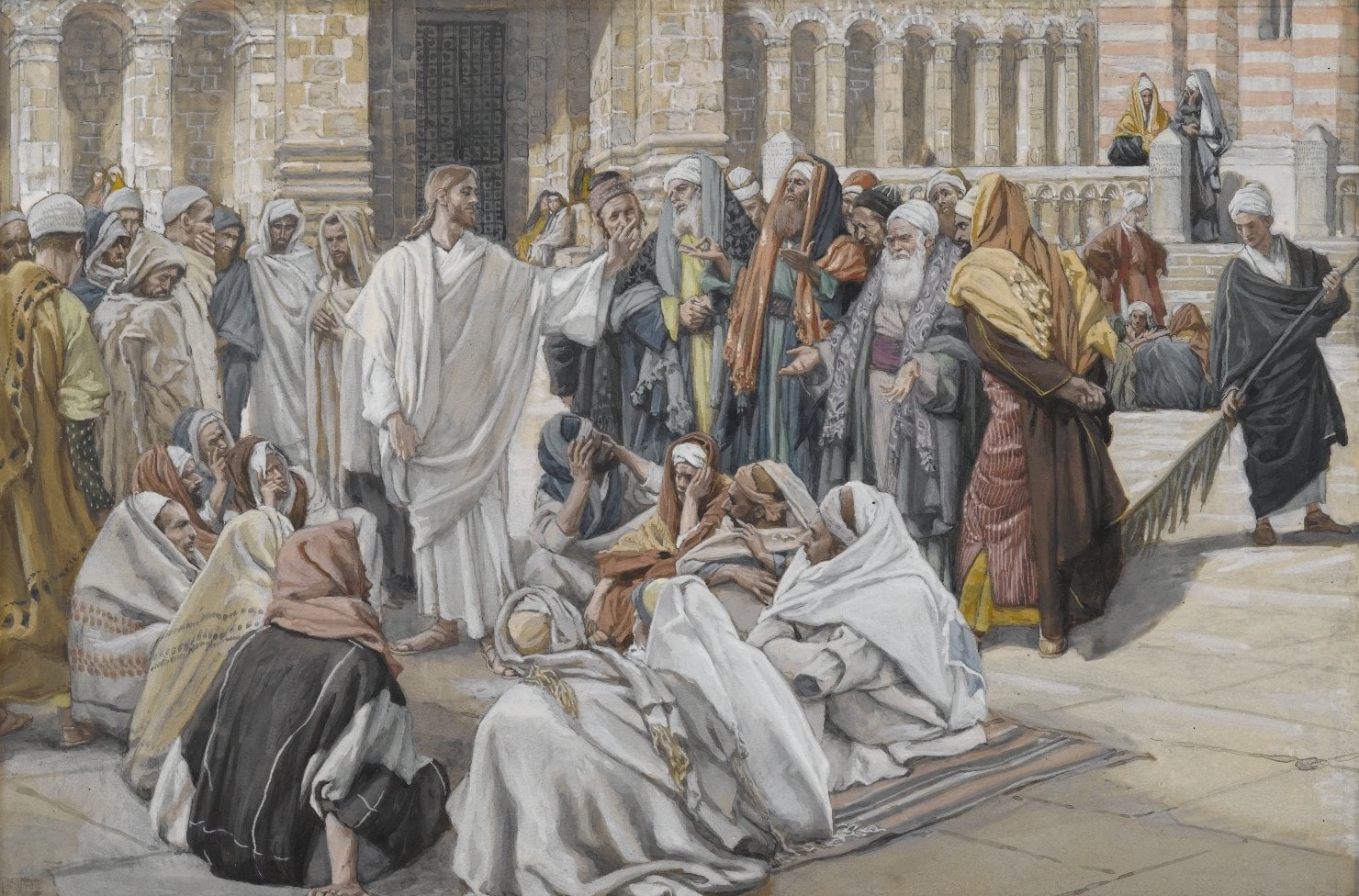
Even the Greatest Struggle – Sermon on Matthew 11:2-11 for the Third Sunday of Advent

Matthew 11:2-11

2 Now when John heard in prison about the deeds of the Christ, he sent word by his disciples 3 and said to him, “Are you the one who is to come, or shall we look for another?” 4 And Jesus answered them, “Go and tell John what you hear and see: 5 the blind receive their sight and the lame walk, lepers are cleansed and the deaf hear, and the dead are raised up, and the poor have good news preached to them. 6 And blessed is the one who is not offended by me.”

7 As they went away, Jesus began to speak to the crowds concerning John: “What did you go out into the wilderness to see? A reed shaken by the wind? 8 What then did you go out to see? A man dressed in soft clothing? Behold, those who wear soft clothing are in kings’ houses. 9 What then did you go out to see? A prophet? Yes, I tell you, and more than a prophet. 10 This is he of whom it is written,

“‘Behold, I send my messenger before your face, 
who will prepare your way before you.’

11 Truly, I say to you, among those born of women there has arisen no one greater than John the Baptist. Yet the one who is least in the kingdom of heaven is greater than he.”

In the name of Jesus. Amen.

John the Baptizer, you know him. You love him. That camel hair wearing, locust eating, outspoken prophet in the wilderness is a combination of a biker gang member, wilderness survivalist, and street-corner preacher. John preached, “Repent for the kingdom of heaven is at hand.” He announced that Jesus was coming after him, and John said he wasn’t worthy to stoop down and untie Christ’s sandals (Mk. 1:7). Scripture tells us that the people of Jerusalem, all Judea, and all the region around the Jordan were going to be baptized by John (Mt. 3:5). John came to bear witness to Jesus as the true Light who gives light to everyone (Jn. 1:6-9). And he pointed people to Jesus as the Lamb of God who takes away the sin of the world (Jn. 1:29ff).

John preached the Gospel, but he also preached the Law. He would call out the Pharisees and Sadducees, calling them a brood of vipers (Mt. 3:7). And when Herod the tetrarch married his brother’s wife, John spoke out against this evil thing (Lk. 3:19-20). That is why John is in prison when we meet him here. (Just a side note: Yes, there are times that a preacher should call out the evil things politicians do.) For his whole life, John had been a faithful steward of the mysteries of God’s Word (1 Cor. 4:1-2).

But here, in this text, John is nearing the end of his life and is soon to be executed. He is in a dank, dark prison cell. He probably had no heat or light, wasn’t being fed well, and was shackled in some way. But even though he is in prison, John was able to visit with his disciples. From that dark place, John sends his disciples to ask Jesus an important but surprising question, “Are You the one who is to come, or should we look for another?”

The question, in and of itself, is a great question, but we should be surprised and utterly shocked at the source and originator of this question. John already knew the answer. On top of everything I’ve already mentioned about him, John is the one who baptized Jesus. After that baptism, John saw the Holy Spirit descend and remain on Jesus (Jn. 1:31-33). John heard God the Father say, “This is My beloved Son, with whom I am well pleased” (Mt. 3:17). And John publicly proclaimed that Jesus is the Son of God (Jn. 1:34).

But now, John asks Jesus, “Are You really the Messiah?” It’s shocking. So shocking, in fact, that after Jesus answers the question with all the proofs – the blind see, the lame walk, lepers are cleansed, the deaf hear, and the dead are raised up – Jesus then turns to the crowds and defends John for even asking this question and talks him up a bit. Christ basically says, “Listen, you didn’t go out in the wilderness to listen to a reed shaken by the wind or to see a guy dressed up funny clothes.” And, quite honestly, what Jesus says there is at least PG-13, just ask me after the service. Jesus goes on to say that John the Baptist is a prophet, and more than a prophet. He is the long-promised messenger who would prepare the way of the Messiah (Mal. 3:1). On top of that, Jesus says that John the Baptizer is the greatest of all men ever born. This is absolutely stunning.

Just think about this. According to Jesus, John is greater than Noah, Abraham, Moses, David, Solomon, Elijah, Isaiah, Jeremiah, Ezekiel. So, the question before us this morning is why does John ask Jesus, “Are You he one who is to come, or should we look for another?”?

Now, there are two schools of thought as to why John would ask this question. Some say that John is having legitimate doubts and is second-guessing his entire ministry of pointing people to Jesus, but others completely dismiss that possibility and say that John is asking this question to get his disciples to follow Jesus. But I don’t think we can simply dismiss the theory that John doubted. Here’s why.

Everything we know about John is that is he was direct and doesn’t beat around the bush. If he wanted his disciples to follow Jesus, he would have told them straight out, and we have passages of Scripture where John does exactly that (Jn. 1:26-30). Another reason to reject the theory that John is trying to get his disciples to follow Jesus is that Jesus doesn’t go along with the plan. Christ sends those disciples back to John to report what they hear and see. If John was trying to get his disciples to follow Jesus, you would think that Jesus would invite them to follow Him. But Jesus takes John’s question seriously. Finally, the speculation that John is trying to get his disciples to follow Jesus typically works under the assumption that Christians cannot or should not ever have serious doubts or difficulties. And that assumption is wrong.

All sorts of strong believers in Scripture went through times of struggle and doubt. Abraham, Jacob, Job, Moses, David, Elijah, Peter, and Paul all faced serious doubts – some of them more than once. Why wouldn’t John, even though he is the greatest man ever born, face that too?

Dear saints, even the greatest struggle in the faith. Just consider, for a moment: how many people did John minister to? How many did he point to Jesus when they faced temptation, guilt, pain, suffering, and struggles? But, now, as John is sitting in prison, he is the one who needs the ministry of the Gospel. He needs to be reminded. He needs to be pointed to the same Jesus he pointed others to as he travels down his own dark road. If John the Baptizer gets to that place, so will you, if you haven’t already.

So, I want to leave you with two thoughts, which should also be encouraging. First of all, there is a difference between John’s question here, where he is struggling and panicking a bit (I think we can categorize his question that way), there is a difference between that and real intellectual questions about Christianity, God, the resurrection, and other aspects of our faith. None of us are immune to the struggle that John is going through here. If even the greatest man ever born struggles in this way, expect that you will as well. So, when (not if but when) you face these spiritually dark times, don’t panic. Do as John does here and bring those questions to Jesus. Dive into Scripture and hear God’s promises again. Pull out the Psalms and see how often they deal with these spiritually low places. And know that I am here to help. I’m here to minister to you in those times, and so are all your brothers and sisters in Christ.

Now, there might be times where you have intellectual questions about the faith. That is a different thing entirely. If that’s the case, if you have a question about creation because of what you have heard in a science class that is teaching the theory of evolution, or a question about if the Resurrection of Jesus actually happened, or about Christianity in general, ask someone who knows more than you do. I can help answer a lot of those questions or I can help you search for and find the answers. Don’t be a fool and think there aren’t answers for those types of questions. You aren’t so smart that you have found a hole in our faith that hasn’t already been answered. Christianity is intellectually rigorous and can answer even your most difficult questions. So don’t be afraid to ask them. But remember that is a different thing than going through a dark, difficult time spiritually.

The second thing I want you to observe is how gently Jesus answers John’s question. Consider this question from Jesus’ perspective. Throughout the Gospels, Jesus hardly gets a break. He’s always teaching, healing, ministering. Even when Christ does try to get away from the crowds for a bit, He ends up being found and having to do more (Mk. 6:30-34), or Jesus will try to sit down to rest but ends up ministering to another lost soul (Jn. 4:6-26), or Christ tries to catch a quick nap and His disciples will wake Him up with their problems (Mt. 8:23-27). When this question comes from John, Jesus doesn’t throw up His hands, groan, and say, “What! John needs help too? Isn’t he supposed to be the greatest? I don’t have time for this.” No, Jesus answers John’s question kindly, softly, and without a single, solitary shred of impatience.

Jesus doesn’t rebuke John. He doesn’t complain about how busy and tired He is. Jesus simply says exactly what John needs to hear. Jesus is patient and gentle with John, and He is with you too.

I know this text of John the Baptizer sitting in prison and struggling in his faith doesn’t sound very Christmassy, but it is very practical, real life, and down to earth stuff. This can be a dark and lonely time of year. But the same Lord who loved John and gave him the encouragement he needed in the moment he needed it is here for you to speak peace to you and encourage you. Rejoice! He will see you through because He has promised. Amen.

The peace of God, which surpasses all understanding, will guard your hearts and minds in Christ Jesus. Amen.