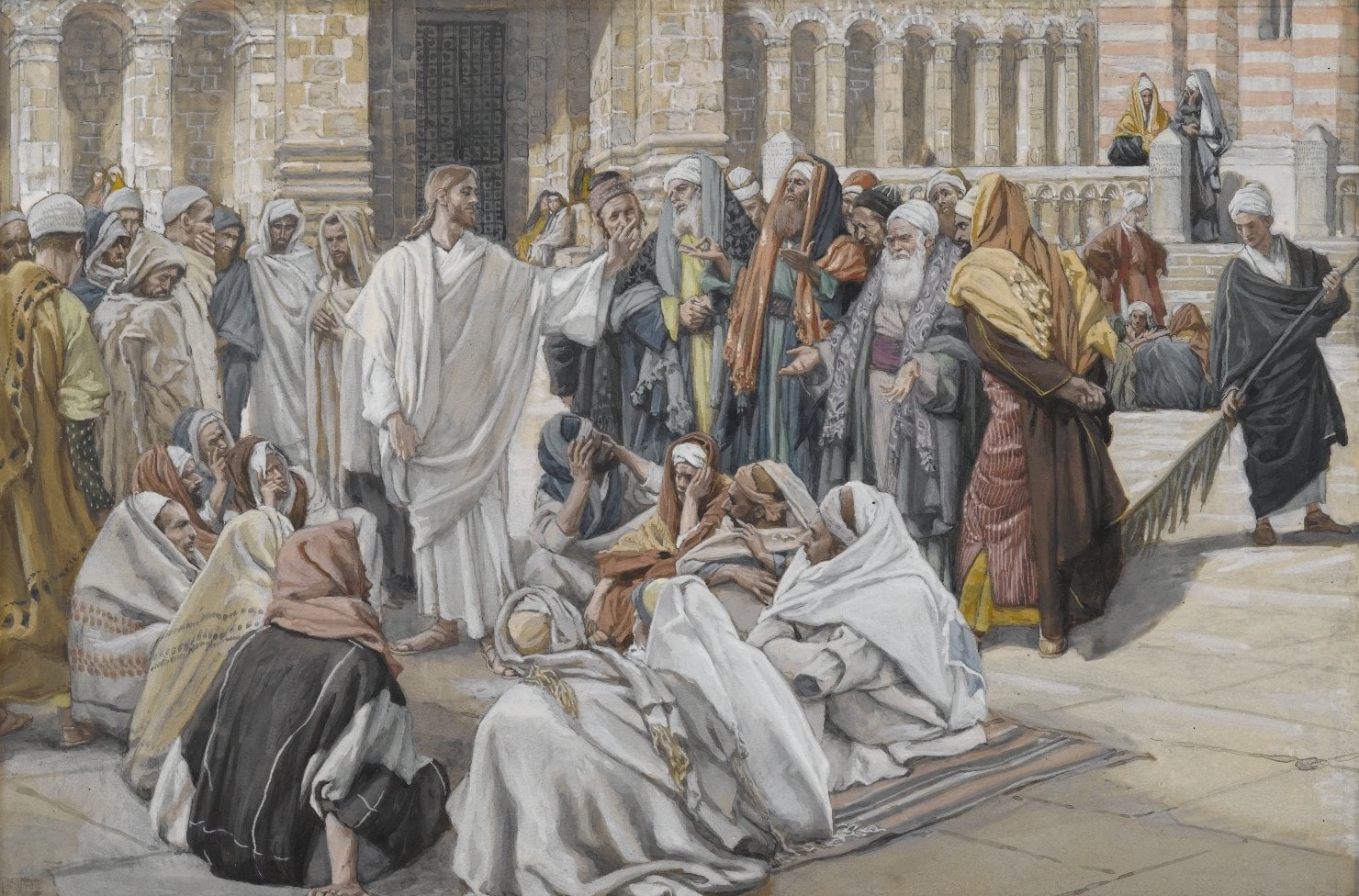
When Prayer Gets Violent – Sermon on Matthew 15:21-28 for the Second Sunday in Lent

Matthew 15:21-28

21 And Jesus went away from there and withdrew to the district of Tyre and Sidon. 22 And behold, a Canaanite woman from that region came out and was crying, “Have mercy on me, O Lord, Son of David; my daughter is severely oppressed by a demon.” 23 But he did not answer her a word. And his disciples came and begged him, saying, “Send her away, for she is crying out after us.” 24 He answered, “I was sent only to the lost sheep of the house of Israel.” 25 But she came and knelt before him, saying, “Lord, help me.” 26 And he answered, “It is not right to take the children’s bread and throw it to the dogs.” 27 She said, “Yes, Lord, yet even the dogs eat the crumbs that fall from their masters’ table.” 28 Then Jesus answered her, “O woman, great is your faith! Be it done for you as you desire.” And her daughter was healed instantly.

In the name of Jesus. Amen.

In our Old Testament lesson today (Gen. 32:22-32), you heard how Jacob wrestled with God. Jacob was already tired and under a lot of stress. He was returning home after living with and working for his father-in-law for a couple decades, and he was approaching his brother Esau who had sworn to kill Jacob for taking his birthright and blessing (Gen. 27:41-42). The night before Jacob and Esau met, God came down to Jacob, and they wrestled mano a mano. Once the dust from their scuffle settled, God blessed Jacob and gave him a new name. Now, Jacob is known as ‘Israel’ which means ‘God strives.’

That text is a fantastic set-up for this Gospel lesson. Here, God has again descended, and Jesus wrestles with one of His creatures who, like Jacob, is already tired and afraid. This time, God’s opponent is a woman; she is a foreigner; and she is a pagan. Three strikes, so she should be out. But she approaches Jesus in great need. She comes boldly, and her prayer is violent. It doesn’t sound so violent in our translation. We heard that she is ‘crying out,’ but the Greek word there conveys the shrieking of a raven. We heard that she ‘knelt’ before Jesus, but the Greek word there is more along the lines of flung – she flung herself at Jesus feet.

Notice how she addresses Jesus with two titles: ‘Lord’ and ‘Son of David.’ In the Gospel of Matthew, only disciples address Jesus as ‘Lord.’ And she refers to Jesus as only an Israelite would with the kingly title, ‘Son of David.’ And her request isn’t for herself. Her little daughter is severely oppressed by a demon. So, her prayer checks all the right boxes. Jesus is the Lord and King. And He has come to destroy the works of the devil (1 Jn. 3:8). But Jesus acts in a way that can make us Christians feel a bit awkward.

Christ first ignores her. The disciples start praying against her and beg Jesus to send her away. Then, Jesus says, “I was sent only to the lost sheep of the house of Israel.” And when she flings herself into the dust before Jesus’ feet with a last gasp prayer, “Lord, help me,” Jesus calls her a dog. This isn’t the Jesus we are used to hearing about in the Gospels, the one who welcomes the lowly and despised, the one who heals, the one who casts out all sorts of demons.

But even though Jesus has her in a submission hold (figuratively speaking), this woman has one last punch to throw at Jesus to win this fight, and it’s a haymaker. Yes, Jesus has called her a dog, but she takes the insult. She says, in effect, “Yes Lord, I am a dog. I don’t belong or have any right to sit at Your table. I don’t deserve the bread that You feed to Your children. But if You call me a dog, I’ll be your dog. And I’ll be content with nothing more than what the dogs get. The crumbs from Your table are enough for me.”

After that statement, Jesus taps out, “O woman, great is your faith!” This is one of two times in the Gospels that Jesus praises someone’s faith (Mt. 8:5-13 is the other). “Be it done for you as you desire.” And her daughter was healed instantly.

This wrestling match between Jesus and the Canaanite woman reminds me of the parable of the unrighteous judge that Jesus tells in Lk. 18:1-6. In that parable, a woman repeatedly asks an unjust judge for justice. The judge just ignores her, but the woman keeps crying out for justice. Finally, the judge gives her what she wants because, according to the judge, the woman is beating him down with her continual requests. Luke tells us that Jesus told that parable to encourage His disciples to be persistent in their prayers because God is just and will not delay in answering.

There is no question, Jesus heard every one of this Canaanite woman’s prayers. Christ loved this woman and her daughter and had come to set them free from the oppression of demons. So, why did it take so long for Jesus to give her what she wanted, and why did He treat her like this? I think the only safe answer to those questions is, “I don’t know.” God’s ways are not our ways (Is. 55:8-9). But we can say this because Scripture clearly teaches it:

By delaying His answer to her prayer, Jesus purifies this woman’s faith. James 1:2-3 says, “Count it all joy, my brothers, when you meet trials of various kinds, for you know that the testing of your faith produces steadfastness.” And our Epistle Lesson today (Ro. 5:1-5) says that we can rejoice in our suffering because suffering produces endurance, and endurance produces character, and character produces hope. Jesus knows how much heat this woman can take, and she comes out the other side with a stronger faith than what she had before this violent wrestling match of prayer.

There is no question that Jesus sent trial after trial to this woman. But that is what makes her faith so beautiful. Rather than turning her back on Jesus for being a jerk, her roots sink in deeper. She knows there is no other help for her and her daughter. So, here is the real question. Can you trust God when, to all appearances, He ignores you? Can you trust God when the wicked prosper, when the world is falling apart, and when your loved ones die too early? Will you trust Him when He doesn’t do what you ask? Faith trusts in God even when it is contrary to experience and our fallen reason.

The greatness of the woman’s faith wasn’t in her confidence or certainty. Its greatness was in its weakness. Her faith was great not when she was crying, “Son of David have mercy on me,” but it was great when she says, “Yes, Lord. I am Your dog.” It was great then because it only wanted what He gave.

In your walk of faith, remember that God doesn’t keep every promise you can imagine. But He has, does, and will keep every promise He has made. When it appears – and please note, I said, appears – that God isn’t listening to your prayers and seems to be sending you away, have the ingenuity of this woman. When God tells you, “You are lost,” you can take God at His Word and cry to Him, “Yes, God. I’m lost; find me.” When God says, “You’re a sinner,” say, “Yes, God. I’m a sinner; save me.” When God says, “You’re dead,” cry to Him “Yes, raise me.”

Finally, don’t give up on your prayers. Keep wrestling in them. You can’t hurt God by getting too violent with your prayer. Jesus wants you, like this woman did, to continue bringing your requests to Him. Jesus says, “Ask, and it will be given to you; seek, and you will find; knock, and it will be opened to you” (Mt. 7:7). So, keep asking; keep seeking; keep knocking. God will answer in the best way and at the exact right time.

Dear saints, you can be bold in your prayers because Christ has come and restored peace between you and God; you now stand in God’s grace (Ro. 5:2). He will remember His mercy and steadfast love, and He will redeem you out of all your troubles (Ps. 25:6, 22). Amen.

The peace of God, which surpasses all understanding, will guard your hearts and minds in Christ Jesus. Amen.
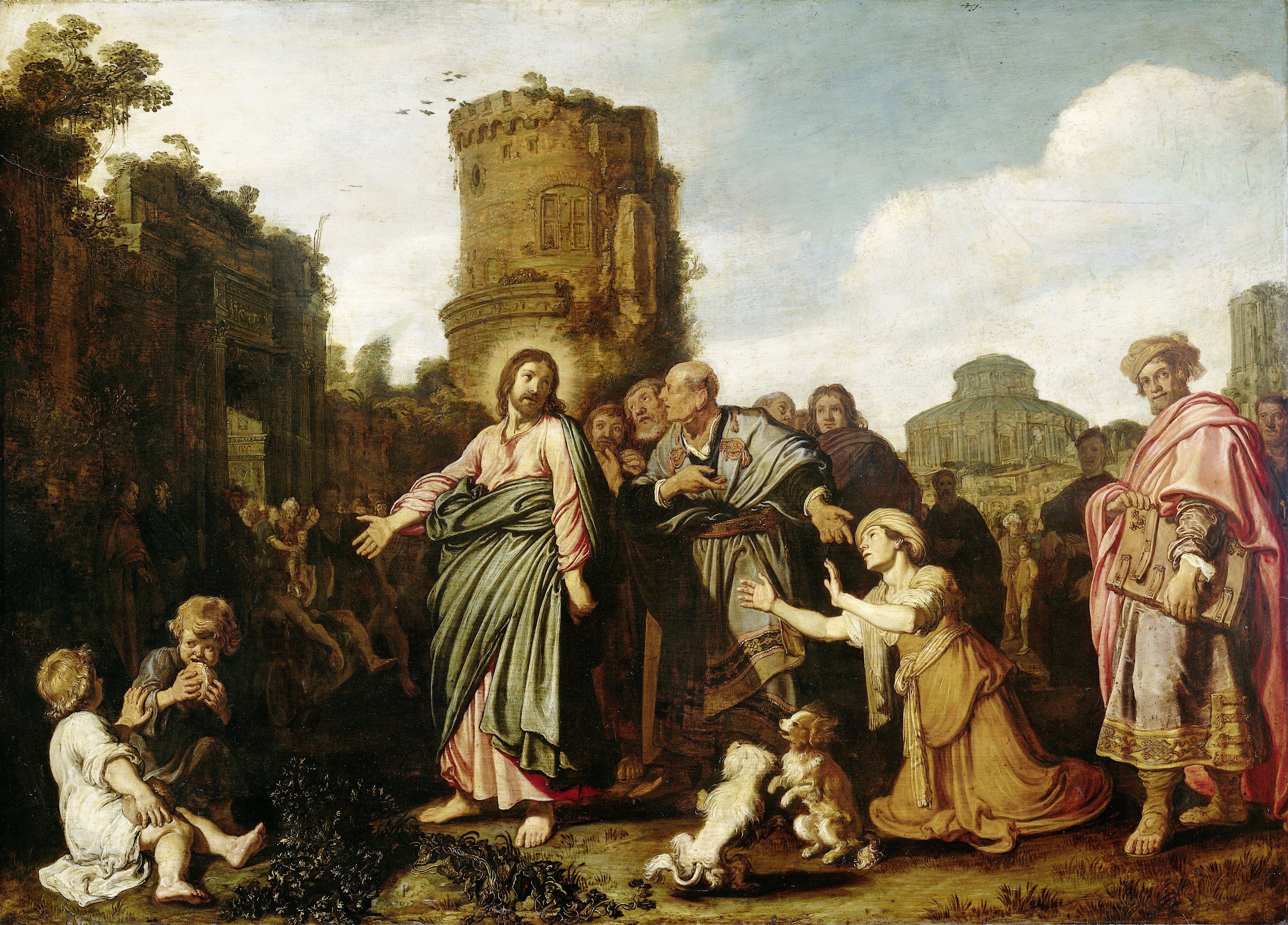
Eden to Heaven – Sermon on Genesis 3:22-24 & Revelation 22:1-5

Genesis 3:22-24 & Revelation 22:1-5

In the name of Jesus. Amen.

God created you to live in perfection. In six days, God created everything in the universe. He created light and darkness. He placed the sun, moon, stars, and galaxies in their places. God established land, sea, and plants and filled the earth with birds, fish, and every kind of animal. And God planted the garden of Eden. Only after all that was completed did God create the crown of creation – man and woman. And Adam and Eve were placed in the Garden of Eden to work it and keep it.

But it wasn’t the kind of work that we experience – it was pure joy. There was no need to look at the forecast to see what the weather would be. No worries about gas prices and inflation. No crisis. No war. No disease or pandemic. Everything was in perfect harmony. In God’s own estimation, all that He created was good, in fact, very good (Gen. 1:21). Best of all was the perfect relationship that existed between God and man. God freely giving and man graciously receiving. Even the one command that God gave was gracious, “Of the tree of the knowledge of good and evil you shall not eat, for in the day you eat of it you shall surely die” (Gen. 2:17).

Now, some suggest that God put the tree of the knowledge of good and evil in the garden so Adam and Eve could choose to trust or reject God. But this is not the case. God’s prohibition to eat from that tree was a promise for Adam and Eve to believe. Just track with me for a minute here. Scripture repeatedly says, “The righteous shall live by faith” (Hab. 2:4; Ro. 2:17; Gal. 3:11; Heb. 10:38). In other words, to be righteous is to have faith. We know that for us sinners to be righteous is to have faith in Jesus as our Savior. But what kind of faith did Adam and Eve have before the Fall? They already knew the mercy, goodness, and graciousness of God because they constantly experienced it in everything that God had given and in everything God was to them. So, what is it that Adam and Eve believed before the Fall that made them righteous through faith?

Well, at some point in those first six days, God created the angels. Now, Scripture doesn’t tell us specifically when, but at some point in those days of creation the devil and demons rebelled and fell. In other words, evil existed. When God banned Adam and Eve from eating from the tree of knowledge of good and evil, God was giving a promise, “Evil exists, and I just want you to trust Me on this. When you find out what evil is, it won’t go well for you, in fact, you’ll die.” So, Adam and Eve could go to the tree of the knowledge of good and evil and know, “What a good God we have. He has given us everything and doesn’t want us to experience or even know what evil is.”

But, as you heard in Sunday’s Old Testament lesson (Gen. 3:1-21), Satan stirred up discontentment in Adam and Eve. The devil told Eve that she could become something more than God had created her to be. Satan said that she would become like God. So, deceived as she was (Gen. 3:13; 2 Cor. 11:3), Eve took the fruit. Adam was even worse; he wasn’t deceived and knew exactly what he was doing (1 Tim. 2:14). They both sinned and fell. They took. They ate. Their eyes were opened. They had become something more. You heard God say it Himself tonight, “Behold, the man has become like one of us in knowing good and evil” (Gen. 3:22).

But Adam and Eve knowing evil wasn’t better. Not even close. Now, because the head of creation had fallen into sin, creation fell with him (Ro. 8:20-21). And Adam and Eve were sent into exile – away from God’s presence, away from the Garden of Eden, and away from the tree of life which was now guarded by the cherubim and a flaming sword. But God sent them into this exile with a new promise to believe. A promise that paradise would be restored to them when the seed of the woman would come and crush the serpent’s head (Gen. 3:15). And it was through faith in that promise that God went with them.

Dear saints, you and I live in exile. We wander about sinfully trying to become like God by our own works, but all our effort is curved in upon itself. Instead of being like our giving God, we seek after our own comfort and desires. Unlike God who is generous and giving, we try to pile up riches for ourselves. We try to create our own little gardens of Eden in an attempt to regain the paradise we lost. But we never achieve the perfection we long for. The treasures we acquire quickly fade and fall apart in our hands.

We cannot return from this exile by our own reason or strength. Yet, God walks alongside us, calling us back unto Himself. Out of His great love for us, He continues to give us promise after promise. And God delivers on every one of His promises. He has sent Jesus into this world of exile to bring us back to paradise. He comes to us who are bent over in our sin and frees us. He delivers us from the bondage of Satan (Lk. 13:16) and gives us rest. He announces to us that because of what He has done by His death and resurrection, we will be eternally restored. While Jesus was on the cross, He told the thief next to Him, “Today, you will be with Me in paradise” (Lk. 23:43). That word ‘paradise’ means ‘an enclosed garden.’

In our reading from Rev. 22:1-5 tonight, we get a picture of that garden of paradise. And that is what lies ahead for you, dear saint. Through faith in Jesus, you are righteous. Your destination is the bright crystal river, the tree of life yielding its twelve kinds of fruit, and leaves for the healing of the nations. There you will see God’s face, and there will be no more night. You will need no light of lamp or sun, for you will be restored to God, and He will be your light. Your time in exile has an end. And there, in eternal bliss, you will reign forever and ever. Amen.

The peace of God, which surpasses all understanding, will guard your hearts and minds in Christ Jesus. Amen.

Even the Greatest Struggle – Sermon on Matthew 11:2-11 for the Third Sunday of Advent

Matthew 11:2-11

2 Now when John heard in prison about the deeds of the Christ, he sent word by his disciples 3 and said to him, “Are you the one who is to come, or shall we look for another?” 4 And Jesus answered them, “Go and tell John what you hear and see: 5 the blind receive their sight and the lame walk, lepers are cleansed and the deaf hear, and the dead are raised up, and the poor have good news preached to them. 6 And blessed is the one who is not offended by me.”

7 As they went away, Jesus began to speak to the crowds concerning John: “What did you go out into the wilderness to see? A reed shaken by the wind? 8 What then did you go out to see? A man dressed in soft clothing? Behold, those who wear soft clothing are in kings’ houses. 9 What then did you go out to see? A prophet? Yes, I tell you, and more than a prophet. 10 This is he of whom it is written,

“‘Behold, I send my messenger before your face, 
who will prepare your way before you.’

11 Truly, I say to you, among those born of women there has arisen no one greater than John the Baptist. Yet the one who is least in the kingdom of heaven is greater than he.”

In the name of Jesus. Amen.

John the Baptizer, you know him. You love him. That camel hair wearing, locust eating, outspoken prophet in the wilderness is a combination of a biker gang member, wilderness survivalist, and street-corner preacher. John preached, “Repent for the kingdom of heaven is at hand.” He announced that Jesus was coming after him, and John said he wasn’t worthy to stoop down and untie Christ’s sandals (Mk. 1:7). Scripture tells us that the people of Jerusalem, all Judea, and all the region around the Jordan were going to be baptized by John (Mt. 3:5). John came to bear witness to Jesus as the true Light who gives light to everyone (Jn. 1:6-9). And he pointed people to Jesus as the Lamb of God who takes away the sin of the world (Jn. 1:29ff).

John preached the Gospel, but he also preached the Law. He would call out the Pharisees and Sadducees, calling them a brood of vipers (Mt. 3:7). And when Herod the tetrarch married his brother’s wife, John spoke out against this evil thing (Lk. 3:19-20). That is why John is in prison when we meet him here. (Just a side note: Yes, there are times that a preacher should call out the evil things politicians do.) For his whole life, John had been a faithful steward of the mysteries of God’s Word (1 Cor. 4:1-2).

But here, in this text, John is nearing the end of his life and is soon to be executed. He is in a dank, dark prison cell. He probably had no heat or light, wasn’t being fed well, and was shackled in some way. But even though he is in prison, John was able to visit with his disciples. From that dark place, John sends his disciples to ask Jesus an important but surprising question, “Are You the one who is to come, or should we look for another?”

The question, in and of itself, is a great question, but we should be surprised and utterly shocked at the source and originator of this question. John already knew the answer. On top of everything I’ve already mentioned about him, John is the one who baptized Jesus. After that baptism, John saw the Holy Spirit descend and remain on Jesus (Jn. 1:31-33). John heard God the Father say, “This is My beloved Son, with whom I am well pleased” (Mt. 3:17). And John publicly proclaimed that Jesus is the Son of God (Jn. 1:34).

But now, John asks Jesus, “Are You really the Messiah?” It’s shocking. So shocking, in fact, that after Jesus answers the question with all the proofs – the blind see, the lame walk, lepers are cleansed, the deaf hear, and the dead are raised up – Jesus then turns to the crowds and defends John for even asking this question and talks him up a bit. Christ basically says, “Listen, you didn’t go out in the wilderness to listen to a reed shaken by the wind or to see a guy dressed up funny clothes.” And, quite honestly, what Jesus says there is at least PG-13, just ask me after the service. Jesus goes on to say that John the Baptist is a prophet, and more than a prophet. He is the long-promised messenger who would prepare the way of the Messiah (Mal. 3:1). On top of that, Jesus says that John the Baptizer is the greatest of all men ever born. This is absolutely stunning.

Just think about this. According to Jesus, John is greater than Noah, Abraham, Moses, David, Solomon, Elijah, Isaiah, Jeremiah, Ezekiel. So, the question before us this morning is why does John ask Jesus, “Are You he one who is to come, or should we look for another?”?

Now, there are two schools of thought as to why John would ask this question. Some say that John is having legitimate doubts and is second-guessing his entire ministry of pointing people to Jesus, but others completely dismiss that possibility and say that John is asking this question to get his disciples to follow Jesus. But I don’t think we can simply dismiss the theory that John doubted. Here’s why.

Everything we know about John is that is he was direct and doesn’t beat around the bush. If he wanted his disciples to follow Jesus, he would have told them straight out, and we have passages of Scripture where John does exactly that (Jn. 1:26-30). Another reason to reject the theory that John is trying to get his disciples to follow Jesus is that Jesus doesn’t go along with the plan. Christ sends those disciples back to John to report what they hear and see. If John was trying to get his disciples to follow Jesus, you would think that Jesus would invite them to follow Him. But Jesus takes John’s question seriously. Finally, the speculation that John is trying to get his disciples to follow Jesus typically works under the assumption that Christians cannot or should not ever have serious doubts or difficulties. And that assumption is wrong.

All sorts of strong believers in Scripture went through times of struggle and doubt. Abraham, Jacob, Job, Moses, David, Elijah, Peter, and Paul all faced serious doubts – some of them more than once. Why wouldn’t John, even though he is the greatest man ever born, face that too?

Dear saints, even the greatest struggle in the faith. Just consider, for a moment: how many people did John minister to? How many did he point to Jesus when they faced temptation, guilt, pain, suffering, and struggles? But, now, as John is sitting in prison, he is the one who needs the ministry of the Gospel. He needs to be reminded. He needs to be pointed to the same Jesus he pointed others to as he travels down his own dark road. If John the Baptizer gets to that place, so will you, if you haven’t already.

So, I want to leave you with two thoughts, which should also be encouraging. First of all, there is a difference between John’s question here, where he is struggling and panicking a bit (I think we can categorize his question that way), there is a difference between that and real intellectual questions about Christianity, God, the resurrection, and other aspects of our faith. None of us are immune to the struggle that John is going through here. If even the greatest man ever born struggles in this way, expect that you will as well. So, when (not if but when) you face these spiritually dark times, don’t panic. Do as John does here and bring those questions to Jesus. Dive into Scripture and hear God’s promises again. Pull out the Psalms and see how often they deal with these spiritually low places. And know that I am here to help. I’m here to minister to you in those times, and so are all your brothers and sisters in Christ.

Now, there might be times where you have intellectual questions about the faith. That is a different thing entirely. If that’s the case, if you have a question about creation because of what you have heard in a science class that is teaching the theory of evolution, or a question about if the Resurrection of Jesus actually happened, or about Christianity in general, ask someone who knows more than you do. I can help answer a lot of those questions or I can help you search for and find the answers. Don’t be a fool and think there aren’t answers for those types of questions. You aren’t so smart that you have found a hole in our faith that hasn’t already been answered. Christianity is intellectually rigorous and can answer even your most difficult questions. So don’t be afraid to ask them. But remember that is a different thing than going through a dark, difficult time spiritually.

The second thing I want you to observe is how gently Jesus answers John’s question. Consider this question from Jesus’ perspective. Throughout the Gospels, Jesus hardly gets a break. He’s always teaching, healing, ministering. Even when Christ does try to get away from the crowds for a bit, He ends up being found and having to do more (Mk. 6:30-34), or Jesus will try to sit down to rest but ends up ministering to another lost soul (Jn. 4:6-26), or Christ tries to catch a quick nap and His disciples will wake Him up with their problems (Mt. 8:23-27). When this question comes from John, Jesus doesn’t throw up His hands, groan, and say, “What! John needs help too? Isn’t he supposed to be the greatest? I don’t have time for this.” No, Jesus answers John’s question kindly, softly, and without a single, solitary shred of impatience.

Jesus doesn’t rebuke John. He doesn’t complain about how busy and tired He is. Jesus simply says exactly what John needs to hear. Jesus is patient and gentle with John, and He is with you too.

I know this text of John the Baptizer sitting in prison and struggling in his faith doesn’t sound very Christmassy, but it is very practical, real life, and down to earth stuff. This can be a dark and lonely time of year. But the same Lord who loved John and gave him the encouragement he needed in the moment he needed it is here for you to speak peace to you and encourage you. Rejoice! He will see you through because He has promised. Amen.

The peace of God, which surpasses all understanding, will guard your hearts and minds in Christ Jesus. Amen.

The Child Who Is Zechariah’s Hope – Sermon on Luke 1:5-15 for Midweek Advent 1

Luke 1:5-25

5 In the days of Herod, king of Judea, there was a priest named Zechariah, of the division of Abijah. And he had a wife from the daughters of Aaron, and her name was Elizabeth. 6 And they were both righteous before God, walking blamelessly in all the commandments and statutes of the Lord. 7 But they had no child, because Elizabeth was barren, and both were advanced in years. 

8 Now while he was serving as priest before God when his division was on duty, 9 according to the custom of the priesthood, he was chosen by lot to enter the temple of the Lord and burn incense. 10 And the whole multitude of the people were praying outside at the hour of incense. 11 And there appeared to him an angel of the Lord standing on the right side of the altar of incense. 12 And Zechariah was troubled when he saw him, and fear fell upon him. 13 But the angel said to him, “Do not be afraid, Zechariah, for your prayer has been heard, and your wife Elizabeth will bear you a son, and you shall call his name John. 14 And you will have joy and gladness, and many will rejoice at his birth, 15 for he will be great before the Lord. And he must not drink wine or strong drink, and he will be filled with the Holy Spirit, even from his mother’s womb. 16 And he will turn many of the children of Israel to the Lord their God, 17 and he will go before him in the spirit and power of Elijah, to turn the hearts of the fathers to the children, and the disobedient to the wisdom of the just, to make ready for the Lord a people prepared.” 

18 And Zechariah said to the angel, “How shall I know this? For I am an old man, and my wife is advanced in years.” 19 And the angel answered him, “I am Gabriel. I stand in the presence of God, and I was sent to speak to you and to bring you this good news. 20 And behold, you will be silent and unable to speak until the day that these things take place, because you did not believe my words, which will be fulfilled in their time.” 21 And the people were waiting for Zechariah, and they were wondering at his delay in the temple. 22And when he came out, he was unable to speak to them, and they realized that he had seen a vision in the temple. And he kept making signs to them and remained mute. 23 And when his time of service was ended, he went to his home. 

24 After these days his wife Elizabeth conceived, and for five months she kept herself hidden, saying, 25“Thus the Lord has done for me in the days when he looked on me, to take away my reproach among people.”

In the name of Jesus. Amen.

Zechariah and Elizabeth were an ideal couple. They were both righteous before God. In other words, they both had faith in God’s promises to send the Messiah who would crush the serpent’s head and deliver all God’s people (Gen. 3:15Is. 9:14). They both walked blamelessly in keeping the commandments and statues of the Lord. But this dear couple had to walk the sad road of infertility. They had no child.

It is interesting how often Scripture will introduce a new era of salvation history with a barren womb. The beginning of God’s chosen people who would be the lineage of the Messiah begins with Sarah’s barren womb which would bring forth Isaac. In the age of the kings, the focus is on Hannah’s barren womb which would bring forth the prophet and king-anointer, Samuel. Now here, at the time of the Messiah, God will bring the forerunner and proclaimer of the Messiah from Elizabeth’s barren womb. And the Messiah Himself will come from the virgin womb of Mary.

As Zechariah is serving in the Temple, he is given all these wonderful promises about the child he and Elizabeth will bear, but he doubts. “How shall I know this? For I am an old man, and my wife is advanced in years.” It’s ironic that Zechariah doubts like this. After all, Zechariah’s name means, “God remembers.” Apparently, Zechariah didn’t live up to his name. He didn’t remember that God remembers. Somehow, this righteous and blameless man didn’t remember how God had acted for Abraham and Sarah with the birth of Isaac and for Elkanah and Hannah with the birth of Samuel. Zechariah didn’t remember, but God did. God remembered His merciful promises to deliver mankind from sin and death. God remembered His mercy and steadfast love (Ps. 25:6-7). Whenever Scripture talks about God remembering, it isn’t simply that a bit of information had been momentarily lost in God’s mind and suddenly found. No. When God remembers, He acts.

God sent the angel Gabriel to Zechariah that day in the Temple to announce that God was going to act and bring about the long-promised salvation. God was about to send John the Baptizer, the one whom God promised would come in the spirit and power of Elijah to prepare God’s people for the coming of the Savior (Mal. 4:5-6). But Zechariah, God’s priest, doubted and was made silent for his unbelief.

Dear saints, too often we are like Zechariah. We have been made God’s royal priests (1 Pet. 2:9). In His mercy, God has chosen you to do priestly work – to pray, to train your children in the Scriptures, and to proclaim God’s goodness and mercy to everyone you meet. You and I have every reason to be bold and confident in everything we do because of God’s promises to us. But too often we find ourselves doubting. Doubting that God has and will deliver us. Doubting that we have been justified by grace through faith. Doubting that we have peace with God. Doubting that we have access to God’s grace. All of this doubt grieves the Holy Spirit. And our doubt mutes us from proclaiming God’s love to others.

Like Zechariah, we may forget, but God does not forget. Instead, God continues to act. He has sent Jesus, the Messiah who is our Great High Priest (Heb. 4:14) and the Lamb of God who takes away the sin of the world (Jn. 1:29).

Jesus came and used His voice to bless, to pray, to teach, and the gather sinners. Our guiltless Christ was silent before His accusers and went to an unjust death in your place. There, from the cross, Jesus uttered the greatest blessing any priest could speak, “Father, forgive them, for they know not what they do” (Lk. 23:34). Now, Jesus sits at God’s right hand as your intercessor and advocate.

In Advent, we focus on Jesus’ coming. He came in humility at His birth in Bethlehem. He comes in humility now in His Word and Sacraments. And He will come again in glory on the Last Day. So, as we wait, let us remember His mercy never comes to an end but is new each and every morning. And He gives us better than we ask or think.

We ask for comfort from our wounded consciences, and He gives comfort on top of comfort (Is. 40:2). We ask Him to help is in our earthly trials, and He gives us an eternal Kingdom. We ask for help to endure pain, disease, and sickness, and He gives us the promise of full and complete healing in the resurrection on the Last Day.

Dear saints, whenever we consider the Child whose birth we will soon celebrate, let the answer to “What Child is this?” always be, “This is Christ the King whom angels sing.” And may our voices join with theirs now and for all eternity because He who has promised is faithful and He will surely do it. Amen.

The peace of God, which surpasses all understanding, will guard your hearts and minds in Christ Jesus. Amen.

The Problem – Sermon on Matthew 25:1-13 for the Last Sunday of the Church Year

Matthew 25:1-13

1 “Then the kingdom of heaven will be like ten virgins who took their lamps and went to meet the bridegroom. 2 Five of them were foolish, and five were wise. 3 For when the foolish took their lamps, they took no oil with them, 4 but the wise took flasks of oil with their lamps. 5 As the bridegroom was delayed, they all became drowsy and slept. 6 But at midnight there was a cry, ‘Here is the bridegroom! Come out to meet him.’ 7Then all those virgins rose and trimmed their lamps. 8 And the foolish said to the wise, ‘Give us some of your oil, for our lamps are going out.’ 9 But the wise answered, saying, ‘Since there will not be enough for us and for you, go rather to the dealers and buy for yourselves.’ 10 And while they were going to buy, the bridegroom came, and those who were ready went in with him to the marriage feast, and the door was shut. 11 Afterward the other virgins came also, saying, ‘Lord, lord, open to us.’ 12 But he answered, ‘Truly, I say to you, I do not know you.’ 13 Watch therefore, for you know neither the day nor the hour.”

In the name of Jesus. Amen.

The five foolish virgins had one problem. They were “morons.” That’s literally the word Jesus uses – μωρός. So that’s how I’ll refer to them; if you have a problem with me calling them morons, you can take it up with Jesus. Being morons was their only problem. The fact that they had lamps but no oil is problematic, but their problem is that they are morons. Having an oil lamp but no oil is silly. Wicks without oil can only burn for a few seconds before disappearing in a choking mess of smoke.

We might think that the wise virgins not sharing their oil with the morons is a problem. It doesn’t seem very charitable. Why don’t the wise just offer to let the morons walk in the light of their lamps? Well, we don’t know enough about the customs of Jesus’ day to know why each girl needed to have her own lamp. And who knows? Maybe that arrangement would have been acceptable. But notice what the morons did. When the call rings out, “Here is the bridegroom! Come out to meet him,” they moronically wander away from the banquet hall to try and buy some “midnight oil.” What shop would be open at that hour?

While the morons are gone on their hopeless shopping trip, the bridegroom arrives. The five wise virgins go in to the marriage feast, and the door is shut. When the five morons finally return begging to be allowed in to the feast, they are met with the horrifying reply, “Truly, I say to you, I do not know you.”

Jesus tells this parable as a warning for us to be ready for His return. The moral of the parable is, “Watch therefore, for you know neither the day nor the hour.” Jesus will return to judge the living and the dead. But Jesus didn’t tell us when He would return. So, He commands us to watch and be ready. Wake up from your sleep today. Wake up now. When the feast begins, Jesus wants you there. Have oil. Don’t be left outside.

But now, we have a problem. Jesus doesn’t tell us what the oil is. Is it the Bible, faith, grace, the Holy Spirit, or the Sacraments? Jesus doesn’t say. But the Scriptures would indicate that it can be and is all of those. I’m open to other suggestions that you might have, but my guess is that Jesus doesn’t tell us what the oil is so that we seek after all those things because each of them – Bible, faith, grace, absolution, and the Sacraments – are kingdom of heaven things. And Christ tells us to, “Seek first the kingdom of God and His righteousness” (Mt. 6:33).

That is why you are here today. God has gathered you here around His Word and Sacrament. This is where you need to be and where you belong. In this place, you hear God’s Word, are absolved of your sins, and receive Christ’s risen Body and Blood. In this place, you are supported by your brothers and sisters in Christ, and your presence ministers to them. Here, you unite in prayer making intercessions for yourselves and others, for our nation and this world. This is how faith is given, sustained, and strengthened. The Church is the well-fortified barracks where you are fitted with the whole armor of God (Eph. 6:11). And, here, you help others prepare for the battle.

But you don’t get to stay here. You will return to the battlefield of the world. It is necessary, and it is, in fact, what God has called you to do. You are called by God to go into the world and deal with lazy coworkers and incompetent supervisors and bosses. You will have to endure your children’s temper tantrums, your spouse’s failures and shortcomings, the loneliness of a widowed house, and your relatives’ problems. You will go back to school and classes with boring teachers, pointless homework, and bullies. God calls you to face all of that even while you struggle with your own sins of anger, lust, gossip, and envy.

In each of those places, each of those callings and vocations, the devil has laid all sorts of traps and snares for you; he prowls around like a roaring lion seeking to devour you (1 Pet. 5:8). Satan attacks you in those arenas because everywhere you go, you carry God’s light to a darkened world. Christian, every relationship you have is a holy, divine calling. And because you are God’s child, everything you do has spiritual value. How you handle work, school, chores, laundry, dishes, and whatever else has both temporal and eternal consequences. That is why you come to church and get what is necessary for your salvation. But what happens here must extend to the rest of your week.

Don’t be a moron thinking that a couple hours at church each week (or two to three times each month) is enough to prepare you for what you will face out there. You need more. And parents, listen up. Your children can’t share your oil and can’t walk in the light of your lamp. Each one needs his or her own lit lamp. So, if it hasn’t been your family’s practice in the past, start today. Make the reading of Scripture, prayer, and fellowship around God’s Word together as a family your top priority each day. Fathers, God calls you to take the lead on this. Wives, if he doesn’t do it on his own, pester and nag him until he does.

Family time in the Bible doesn’t need to be complicated or fancy. Start simple. Start with the Gospel of John and read one paragraph each day. After you read, pray for your friends and family. It can be as simple as, “Bless grandma and help Phil. Amen.” Then, pray the Lord’s Prayer. That will take five minutes. You can do that. You have the time to do that. And if you don’t have enough time, rip something out of your schedule. If your job makes it impossible, quit. Find a new one – even if it means a pay cut and you have to buy a smaller, cheaper house. This is eternally serious. Your salvation and the salvation of your children depends on it. If you miss a day, don’t give up. Start again the next. Make it a habit for you and your kids to pray together on the way to school or practice or wherever. All of this will help to begin to make God’s Word part of your regular conversations as you watch and remain ready for His return.

Ok. That was the Law part of the sermon. And, I hope was a bucket of ice water to awaken you from slumber. Now, we need the Gospel. And there is one more problem to address: Now, be honest. Does this parable strike fear into you?

Honestly, if you summarize the parable, it is a story of ten silly girls who fall asleep waiting for a party. Five are able to light a lamp and get to go into the party. Five can’t, so they have to go away. And if your high school experience was like mine, if you aren’t at the party, you just end up at home sulking and feeling a bit lonely and sorry for yourself.

So, when Jesus tells us that the purpose of this parable is to get us to watch for the day of His return, why did He use this analogy of a wedding party and ten silly, sleepy girls? If being ready for His return is so important, why not tell a parable with more urgency and more horrific consequences? Why not a parable of ten fishermen – five who wear life jackets and five morons who don’t and drown when the storm comes and the boat sinks? How about ten soldiers – five who carry their sword at all times and five morons who leave their swords lying around and get slaughtered when the enemy ambushes them?

Well, that is precisely why Jesus’ parable is different. In either of the parables I just suggested, the return of Jesus is depicted as a terrible, tragic event – a storm at sea, or a sudden attack by an enemy army. But in Jesus’ parable, the thing we need to be ready for, well, it’s the greatest day ever – the day of the arrival of Jesus, the Bridegroom and Savior of all mankind. A day of feasting, joy, laughter, and blessedness for those who are ready to enter with Him. It is the very thing we are looking forward to and longing for.

Once we have worked ourselves into a tizzy about the dire urgency of Christ’s return, we need to step back, take a deep breath, and remember: Christ’s return is not something horrific that you need to be scared of. Jesus’ return means that you will be in eternal bliss, happiness, contentment, and joy. There will be no more pain, tears, or sorrow. Christ’s return is something to anticipate – more than a child anticipates the arrival of her favorite aunt and cousins. That excited expectation is what Jesus is highlighting with this parable.

Yes, this parable is a warning. Our lamps can run dry. Faith must be continually fed by God’s Word and the Sacraments. Repent. Believe. Have faith in Christ.

And yes, Jesus teaches that as the end draws near the signs of His return are alarming: wars and rumors of wars, nation rising up against nation, earthquakes, persecution, hatred, false teaching, and love growing cold (Mt. 24:4-12). But, when you see those things, remember what that means for you. Christ says it means your redemption is drawing near (Lk. 21:28). The bridegroom is coming, and you are His bride without spot, wrinkle, or blemish (Eph. 5:27).

Dear saints, this world is ending. Good riddance. You have Christ. Your redemption is secure and your eternity certain. So, look forward to that day. Stay awake. Keep eagerly anticipating and looking for the resurrection of the dead and the life of the world to come. Amen.

The peace of God, which surpasses all understanding, will guard your hearts and minds in Christ Jesus. Amen.

The Fear of a Fraud – Sermon on Genesis 28:10-17 for the Nineteenth Sunday after Trinity

Genesis 28:10-17

10 Jacob left Beersheba and went toward Haran. 11 And he came to a certain place and stayed there that night, because the sun had set. Taking one of the stones of the place, he put it under his head and lay down in that place to sleep. 12 And he dreamed, and behold, there was a ladder set up on the earth, and the top of it reached to heaven. And behold, the angels of God were ascending and descending on it! 13 And behold, the Lord stood above it and said, “I am the Lord, the God of Abraham your father and the God of Isaac. The land on which you lie I will give to you and to your offspring. 14 Your offspring shall be like the dust of the earth, and you shall spread abroad to the west and to the east and to the north and to the south, and in you and your offspring shall all the families of the earth be blessed. 15 Behold, I am with you and will keep you wherever you go, and will bring you back to this land. For I will not leave you until I have done what I have promised you.” 16 Then Jacob awoke from his sleep and said, “Surely the Lord is in this place, and I did not know it.” 17 And he was afraid and said, “How awesome is this place! This is none other than the house of God, and this is the gate of heaven.”

In the name of Jesus. Amen.

With a stone under his head, imagine what was going through Jacob’s mind as he lay down to sleep. We have to track what has happened in Jacob’s life up to this point. The name ‘Jacob’ name means ‘deceiver,’ and he had certainly lived up (or down) to his name (Gen. 27:36). Jacob was the younger twin of Isaac and Rebekah. Esau was the older brother by a foot (Gen. 25:25-26) because Jacob was born clinging to Esau’s heel. As the younger sibling, Jacob wasn’t in line to receive either the birthright or the blessing that God had first given to Abraham who passed it on to Isaac. Now, Esau was supposed to get them.

These two brothers grew up, and, one day, Jacob was cooking a pot of stew when Esau came home exhausted from working in the field. Esau asked Jacob for some of the soup, but Jacob didn’t act in a brotherly way. Instead, Jacob pulled off the biggest case of price-gouging in history and sold a single cup of that stew for Esau’s birthright (Gen. 25:29-34). Of course, Esau was a fool to agree to this sale (Heb. 12:16-17), but that doesn’t let Jacob off the hook for being a total jerk.

Later, when their father was old, blind, and thought he was near death, Isaac asked Esau to prepare a meal for him so he could pass God’s blessing on to Esau. Jacob’s mother, Rebekah, heard about this and told Jacob to pull a fast one over on his dad so he would get the blessing. Initially, Jacob was hesitant, but ultimately, he went along with his mom’s plan. Jacob dressed up in Esau’s clothes so he would smell like Esau. He even put animal skins on his arms so he would feel hairy like Esau in case his blind father touched him. The plan worked pretty well. At first, Isaac was skeptical because he recognized Jacob’s voice. But after Jacob lied several times, insisting he really was Esau, Isaac gave Jacob the blessing that the Messiah would come from Jacob’s descendants (Gen. 27:1-29).

After this, Esau decided he’d had enough and planned to kill Jacob after their father died. Rebekah heard about Esau’s murder plot, so she sends Jacob from their home in Beersheba to Haran (which is about 450 miles away as the crow flies) to find a wife. Our text here picks up about 50 miles into the trip, maybe two days into the journey.

So, again, imagine all the fear Jacob must have faced as he lay down. He had reason to fear because, for the first time in his life, he is away from his parents. He had reason to fear because his brother has plans to kill him. He had reason to fear because he is going to an unfamiliar land where his mother wants him to get a wife. His past is full of fraud, and his future fat with fear. And now, as the sun goes down, he has nothing to lay his head on but that rock.

Yes, the rock would have been an uncomfortable pillow, but what really made Jacob uncomfortable is his rightly guilty conscience telling him how big of a fraud he had been. Sure, in the eyes of men Jacob had gotten both the birthright and the blessing, but what about in the eyes of God? Would God honor the blessing that had been passed down to him?

Well, God came to Jacob that night and gave him the comfort he wasn’t expecting. In a dream, Jacob saw a ladder set up between heaven and earth. That ladder was the connection between the two as the angels of God ascended and descended on it. And God said to Jacob, “I am Yahweh, the God of Abraham and the God of Isaac. The land on which you lie I will give to you and to your offspring. Your offspring will spread abroad to the west, east, north, and south. And in your offspring all the families of the earth will be blessed. Jacob, I am with you and will keep you wherever you go and will bring you back to this land. For I will not leave you until I have done what I have promised you.”

In other words, God is saying, “Jacob do not be afraid. You may be a fraud, but I am not. I’m going to keep My promises. Yes, you took advantage of your brother to get the birthright, but I’m still going to give you the offspring and land I promised to give to Abraham and Isaac. Yes, you fooled your father into giving you the blessing, but he still spoke the words that I put into his mouth. So, I’m going to give you what was promised even though you received that promise deceptively and impurely. The Messiah that I swore to give to Abraham and to your father is going to come from your own body. And when the Messiah dwells in this land that I promised to give to you, heaven is going to touch earth. The Messiah, who will be your descendant, is going to unite heaven and earth, unite God and mankind, and bring my forgiveness and blessing to all the families of the earth. With His forgiveness, all mankind will have the right to ascend to the throne of God. Jacob, don’t think for one second that your fraud and deceit will make My promises void and go away. My promises are My promises. Your sin, deceit, and trickery cannot change what I have promised.”

Do you ever find yourself having similar fears as Jacob had? Do you ever worry that God’s promises aren’t really for you because you are unworthy? Do you think His blessings aren’t for you because you have too much sin and baggage? Do you see all your unfaithfulness think His mercy cannot be yours? You have confessed to have faith in Jesus in the past, but do you question if you’ve really meant it? You recognize that the sins you speak against publicly are the same sins that you privately love. You are surrounded by all sorts of evidence that you are a fake Christian and a complete fraud. You know that God can see through your façade, so you figure His promises aren’t for you.

Dear saints, do not fear. Even though you are a fraud, God is not. When you are filled with that doubt and fear, close your eyes and look for Jacob’s ladder, and you find that ladder in Christ. Jesus is the One who unites heaven and earth (Jn. 1:51). The eternal Son of God took on your flesh and blood and shed His blood which cleanses you from all your sin. This Jesus is the one who has given you the right to become children of God (Jn. 1:12). A right that you have not earned or deserved, but God Himself has stamped His seal of approval on your adoption papers with the very blood of Jesus.

It is absolutely true that those who do not believe in Jesus will be eternally condemned. But know this, the sincerity of your faith does not and cannot change the fact that Jesus died on the cross and rose again for you (1 Jn. 2:2). Your faith is not what causes your salvation. Faith is what receives that salvation. God doesn’t save you because you believed His promises purely. God saves you because He sent Jesus to be Jacob’s ladder connecting heaven and earth and reuniting God to the sinners of this world. Look to the cross. Look to the perfect work of Jesus alone.

Notice Jacob’s reaction after this vision. Notice how, in the last verse, we are told that Jacob was afraid and said, “How awesome is this place! This is none other than the house of God, and this is the gate of heaven.” All of Jacob’s fears of leaving his family, the threats of his brother, even the fear of himself because of his doubt is all removed. The only fear Jacob has left is God alone. The multitude of God’s grace promised to him brings Jacob a holy and right fear of God.

I’m going to change gears a bit here because we might find it surprising that Jacob would fear after hearing all these wonderful promises. The thing is: fear and service go together. Hebrews 2:15 teaches us that our fear of death actually causes us to become slaves of the devil. We don’t like to think about it this way, but the truth is that we end up serving what we fear. For example, if you are afraid of public shame and humiliation, you might be hesitant to share about your faith in Christ and end up serving your reputation instead of God. But there is a right fear – the fear of God. Luther’s explanation to the 1st Commandment, “Thou shalt have no other gods before Me,” is, “We should fear, love, and trust in God above all things.” And Scripture repeatedly says, “The fear of the Lord is the beginning of wisdom,” (Pr. 1:7Pr. 9:1015:33; and Mic. 6:9).

Even though we live in the safest time in all of history, there is a lot of fear today. The best explanation for why that is is that we fear things that are not worthy of our fear (Lk. 12:4-7) and we end up serving them instead of fearing and serving God alone. But when we fear God alone, He casts out all other fears (1 Jn. 4:18).

I’ll close here with a few verses that are so interesting. (I printed them on the back of the Scripture insert for you.) It’s Jer. 33:7-9 where God gives all these wonderful promises. He promises there that He will bring Judah and Israel home from their captivity. He promises to cleanse them from their sin and rebellion. He promises that their city will be a name of joy, a praise and a glory before all the nations of the earth who hear about all the good God will do for them. And here is God’s conclusion to all those promises: “they shall fear and tremble because of all the good and prosperity I will provide for them.”

Dear saints, like He did for Jacob in our text, God has a multitude of promises to love you, forgive you, care for you, deliver you, and rescue you out of every trouble. Let Him alone be your fear, and He will cast out every other fear with His love and mercy. Amen.

The peace of God, which surpasses all understanding, will guard your hearts and minds in Christ Jesus. Amen.

Fear, Love, & Trust – Sermon on Matthew 22:34-46 for the Eighteenth Sunday after Trinity

Matthew 22:34-46

34 But when the Pharisees heard that he had silenced the Sadducees, they gathered together. 35 And one of them, a lawyer, asked him a question to test him. 36 “Teacher, which is the great commandment in the Law?” 37 And he said to him, “You shall love the Lord your God with all your heart and with all your soul and with all your mind. 38 This is the great and first commandment. 39 And a second is like it: You shall love your neighbor as yourself. 40 On these two commandments depend all the Law and the Prophets.”

41 Now while the Pharisees were gathered together, Jesus asked them a question, 42 saying, “What do you think about the Christ? Whose son is he?” They said to him, “The son of David.” 43 He said to them, “How is it then that David, in the Spirit, calls him Lord, saying,

44 “The Lord said to my Lord, 

       ‘Sit at my right hand, 
until I put your enemies under your feet’?

45 “If then David calls him Lord, how is he his son?” 46 And no one was able to answer him a word, nor from that day did anyone dare to ask him any more questions.

In the name of Jesus. Amen.

Well, here they go again. Those tricksy Pharisees. Trying to catch Jesus, trying to get our Lord to say something that would get Him in trouble. Last week, it was at a banquet watching to see what Jesus would do with a sick man (Lk. 14:1-11). This week, it’s with a test question. “Teacher, which is the great commandment in the Law?”

To be honest, there isn’t really anything wrong with the lawyer’s question as it is. (More on that in a bit.) But the motive behind the question was sinful. The Pharisees wanted to catch Jesus pitting one part of God’s Word against another. It’s impossible to know exactly what they had planned to do with Jesus’ response. Maybe, they figured Jesus would say that the 1st Commandment, “Thou shalt have no other gods before Me,” was the greatest. Then, they could falsely accuse Him of teaching that profaning God’s name, dishonoring parents, murder, stealing, or lying wasn’t a big deal. Whatever their plans and thoughts were, they were trying to make Jesus look like a fool with this question about the Law.

They miscalculated. Badly.

They didn’t realize with Whom they were speaking. Jesus is the Author of the Ten Commandments. He carved them into stone tablets and declared them to Moses and all the people of Israel (Jn. 1:18). Trying to trick Jesus with a question about the Ten Commandments is like trying to trick Herman Melville with a question about Moby Dick, Mark Twain with a question about Huck Finn, C.S. Lewis with a question about Aslan, George Lucas with a question about Luke Skywalker, or Dr. Seuss with a question about the Cat in the Hat. (Hopefully, one of those combinations works for you.)

Jesus, the Author of the Law, will not let one part of His perfect will – which is expressed in the Commandments – be pitted against the rest. The Commandments are not in competition with each other. To love God with the whole heart, whole soul, and whole mind is the first and great commandment. And notice how Jesus continues. He says there is another commandment, a second commandment, that is like the first and great commandment. Love your neighbor as yourself.

Now, it is interesting in Mark’s account of this same encounter with the Pharisees Jesus says there’s no other commandment – singular – greater than these – plural (Mk. 8:31). In other words, perfect love of God and perfect love of your neighbor go together. The two are inseparably tied together and are really one commandment. On these hang all the Law and the Prophets. Love for God is demonstrated by love for the neighbor. 1 John 4:20 says, “If anyone says, ‘I love God,’ and hates his brother, he is a liar; for he who does not love his brother whom he has seen cannot love God whom he has not seen.” In other words, when you love your neighbor, you are loving God who has commanded you to love your neighbor.

Some people today will say that since Jesus distills the Commandments down to, “Love God, and love your neighbor,” that we don’t need the Commandments or any other teaching about God’s Law. Basically, they will say, “We just have to love each other.” Be careful with that. The reality is that we need the Commandments, we need the Law, to teach us what love looks like.

If you want to love God, love your neighbor, and here is what that looks like: Loving God is obeying His command to honor your father and mother by serving, obeying, and respecting them. Loving God is obeying His command to not murder your neighbor or cause him any suffering. Loving God is obeying His command to not commit adultery – which means, husbands, live a chaste life for your wife, and wives, live a chaste life for your husband. Love is not stealing, rather helping your neighbor improve and protect his property. Love is not bearing false witness and putting the most charitable construction on all that your neighbor does.

Honestly, it doesn’t matter if you think what you are doing is motivated by love; if your thoughts, words, or actions fall outside of these Commands, it is not love. In fact, we could go a step farther and say that, whenever your actions fall outside of the Ten Commandments, they are selfish and sinful actions motivated by hatred toward both God and neighbor.

Dear saints, all of this is to say, we all have a lot of reasons to repent. We do not fear, love, and trust in God above all things, and we do not love our neighbor as ourselves. We let our fear of things other than God dictate how we act. We let our love of things that are not God distract us from the God who loves us. We let our trust in things other than God draw us away from God. Again, dear saints, repent. The Law always accuses us and shows how we fail in our obligation to love God and neighbor.

Now, I said earlier that there isn’t anything wrong with the lawyer’s question about what is the greatest Command. But that question, by itself is incomplete because the Law leaves us hanging out to dry under God’s wrath and punishment. At best, the Law can only curb and deter people from sin, but that’s as far as it can go. The Law is good because it tells us what we must do, but the Law is limited because it can only reveal what we have failed to do. The Law is never helpful in saving us unless we also know the One who hung upon the cross for all our sins of failing to love God and neighbor.

That is why Jesus asks His question about the Christ. Just like in last week’s Gospel lesson, Jesus turns the tables and asks the Pharisees a question, “The Messiah, whose son is he?” And the Pharisees were right when they answered, “David’s son.” God had promised that a son of David would sit on David’s throne forever (1 Sam. 7). But David also wrote in Psalm 110:1, which is the verse that Jesus quotes, that this Son of David is also David’s Lord. So, Jesus’ question is, “How can the Messiah, David’s son, also be David’s Lord?”because a father would never call his descendent, “Lord.”

Here, Jesus is teaching the Pharisees and you that the Messiah is both God and man. Here’s why that is so important:

Because the Messiah is God, He has kept the Law perfectly. And because He is man, that keeping of the Law is for you. Jesus perfectly loved God and your neighbor in your place. And through faith, that perfect keeping of the Law is credited to you (2 Cor. 5:21).

The easiest example of this is the 4th Commandment. The Law says, “Honor thy father and mother. Love God by loving your parents as yourself.” And you are left saying, “God, I haven’t done that. I need Your help.” If the Jesus had not come to earth as a Man, God would have to say, “Well, I’m God. I don’t have a father or mother, so I can’t help you. You have to do that yourself.” But God did become a Man. Jesus had a mom and a dad. He did love and honor them perfectly. So, He can and does help you by reckoning His obedience and keeping the Commandment to your account. And this applies to each and every one of the Commandments.

Jesus, the eternal, righteous Son of God, became a Man, perfectly loved God and neighbor, died, and rose again. Through this, He has brought the Law to perfection. This might be too simplistic of an explanation, but it might help shape our thinking.

In His answer to the lawyer’s question, Jesus shows us that the Law has a divine aspect and a physical aspect – love God (divine) and love neighbor (physical). God be praised, that He has given you a Savior who is also divine and physical – God and Man. So, now, when you hear the Law and what it requires of you, you realize that you are lost and deserve God’s wrath and judgment in both body and soul. So, you cry out, “God I’m lost. I deserve punishment and death, could You take that punishment and die for me?” And because the Son of God has taken up your flesh, Jesus says, “Sure. I already have.”

Dear saints, Jesus has perfectly loved God and neighbor for you. All of His perfection and righteousness – His perfect fear, love, and trust in God – is given to you through faith. And to strengthen that faith, your Savior is here now to give you His Body and Blood for the forgiveness of all your sins. For that, God be praised. Amen.

The peace of God, which surpasses all understanding, will guard your hearts and minds in Christ Jesus. Amen.

Today – Sermon on Matthew 6:24-34 for the Fifteenth Sunday after Trinity

Matthew 6:24-34

[Jesus says,] 24 “No one can serve two masters, for either he will hate the one and love the other, or he will be devoted to the one and despise the other. You cannot serve God and money.

25 “Therefore I tell you, do not be anxious about your life, what you will eat or what you will drink, nor about your body, what you will put on. Is not life more than food, and the body more than clothing? 26 Look at the birds of the air: they neither sow nor reap nor gather into barns, and yet your heavenly Father feeds them. Are you not of more value than they? 27 And which of you by being anxious can add a single hour to his span of life? 28 And why are you anxious about clothing? Consider the lilies of the field, how they grow: they neither toil nor spin, 29 yet I tell you, even Solomon in all his glory was not arrayed like one of these. 30 But if God so clothes the grass of the field, which today is alive and tomorrow is thrown into the oven, will he not much more clothe you, O you of little faith? 31 Therefore do not be anxious, saying, ‘What shall we eat?’ or ‘What shall we drink?’ or ‘What shall we wear?’ 32 For the Gentiles seek after all these things, and your heavenly Father knows that you need them all. 33 But seek first the kingdom of God and his righteousness, and all these things will be added to you.

34 “Therefore do not be anxious about tomorrow, for tomorrow will be anxious for itself. Sufficient for the day is its own trouble.”

In the name of Jesus. Amen.

Of all the things we humans do, there is nothing more pointless and draining than worrying and being anxious. A reasonable argument could be made that worry is a bigger waste of time than watching television, playing endless video games, or scrolling on your phone all day. Anxiety not only fills our mind and distracts us from doing productive things, it can, depending on how anxious we are, also zap us of physical energy. But now, kids, listen to me carefully: Don’t use that statement to argue with your parents when they tell you to stop wasting time watching TV or whatever. You don’t have my permission to say, “But pastor says it’s better than being worried.”

How many times have you been really worried and incredibly anxious about something, but then everything fell into place and life simply moved on? We all remember times when we have been incredibly worried, but it can be easy to forget what we were worrying about because everything worked out just fine. God gave you what you needed, and you made it through. There are other times you weren’t worried about anything, and God still gave you what you needed. So, whether you are anxious and worried or not, God provides.

Three times in this text, Jesus commands you, “Do not worry.” One other time He asks almost sarcastically, “Why do you worry?” Jesus cares a lot about us not worrying because He has an interest in your confidence and trust. He doesn’t want you to be anxious. In this text, Jesus makes two things clear: First, God wants to and does give you everything you need for life. And second, God wants you to have confidence that He will give you everything you need.

We sit in strong, solid, well-built homes that have cupboards, pantries, and refrigerators full of food. In fact, we often end up throwing perfectly good food away. We have dressers, closets, and storage bins filled with more clothes than we could ever use, but we wonder if God cares about us. Birds and grass have a lot to teach us about trusting our Creator.

God cares for the birds by feeding them. Each day, every bit of food eaten by every bird on the planet was put there by God. God knows you need food just like a bird does. He’ll make sure you have it. God cares for the flowers by clothing them more splendidly than Solomon was ever clothed. If God clothes the grass like that, He will make sure you have what you need.

We live in a world surrounded by unbelievers who are always worried about the future. The sad fact is that they think their worry actually accomplishes something. Christ doesn’t want you to live like that. Jesus says you are free to seek first the kingdom of God and His righteousness, and all these things – food, clothing, house, home, money, goods, etc. – will be given to you as well.

Listen, God promises that if your regular source of food and clothing is depleted or cut off, He will provide another one. Our Old Testament lesson (1 Kgs. 17:8-16) is a great example. God sent a drought to punish Israel during the days of Elijah, so God told Elijah to live by a brook named Cherith promising, “I have commanded the ravens to feed you there” (1 Kgs. 17:4). Scripture doesn’t say how long Elijah lived there with the crows waiting on him, but as the drought went on, the brook dried out, and that is where our text picks up. God tells Elijah to go the city of Zarephath because, “I have commanded a widow there to feed you” (1 Kgs. 17:9). That line really struck me this week. 

For however long he lived at Cherith, Elijah had become accustomed to the ravens flying to him and providing his food because God had commanded them to feed him. Now, he gets to Zarephath, but this widow doesn’t come up to him and say, “There you are. Diner is at my place. God commanded me to feed you.” Not even close! Elijah watches this widow picking up a couple of sticks and asks her for a drink of water, and the woman heads off to get it. Only then does Elijah decide to add a bite of bread to his order, and the woman doesn’t say, “No way! I can’t give you anything.” Instead, her response is, basically, “I’ve only got enough ingredients for my son and I to have a bite. I’m grabbing these sticks so we can bake it, eat, and die.” I wonder if this is how Elijah recognizes that she is the one God had commanded to feed him. Then, there is the promise that the flour and oil will not run out until God would send rain and provide relief from the drought (1 Kgs. 17:1416). Again, once Elijah’s supply of food from the ravens was gone, God provided Elijah another supply of food.

Dear saints, God will provide all you need for this life until He calls you to heaven. And in the New Creation, God will provide you with a feast of rich food for all eternity (Is. 25:6). He has promised!

Now, all of that brings us to v. 34 which is where I really want to focus our attention, and if your mind has been wandering, come back. After telling us to not be anxious about what we will eat, drink, or wear, Jesus says, “Do not be anxious about tomorrow.” Again, Jesus has given us ample reasons to not worry about food and clothing, but I honestly don’t know many, if any, people who are anxious about those things. (God has certainly blessed us!) But I do know a lot of you here are worried about what will happen tomorrow, a month from now, a year from now, and in the coming decades.

Some are worried about the virus and the variants. Some are worried about what long-term side effects the vaccines might have. Some are worried about the government becoming too authoritative. Some are worried the government isn’t doing enough to stop the virus or terrorists, and with the 20th anniversary of 9/11, some are worried about another terrorist attack on our soil. Some are worried about the world becoming more and more hostile toward Christians. All of this can pile up and make us worried about the world our kids, grandkids, and great grandkids will live in. But Jesus straight up tells us, “Do not worry about tomorrow.”

Now, I’ve been trying to figure out a way to say this succinctly since Tuesday, and I still haven’t found it. So, bear with me. When Christ commands us, “Do not worry about tomorrow,” Jesus almost gives us permission to worry about today, but it’s like we are to draw a line at the end of the day and not have any worry whatsoever about anything past that line. To be sure, Jesus tells us to not worry about our life – food, clothing, etc., but the evil and ugly things we face today are enough for us. And we are to do everything God gives us to do to confront and combat those evils each day God gives us.

Here’s what I mean, with all of Jesus’ talk about not worrying, we can fall off the other side of the horse and become sinfully passive and idle. We might be tempted to think we don’t ever have to work or do anything to combat the evils we face and think God will just take care of everything. Well, that isn’t right either. For example, it is a sin to pray for a hole when God has given you a shovel.

And since each day has enough evil of its own, don’t let tomorrow’s evil distract you with worry from the evil you face today. Jesus promises that He will give you everything you need to meet the evil, ugly challenges of today. And, if He gives you another day tomorrow, He will do it again.

For example: Some of you have watched the pain family endures while their child is being treated for cancer. Some of you have actually gone through this. But for those of you who haven’t, you might think, “I could never handle that. I don’t have the strength.” You were right. God hasn’t called you to do that – at least not yet. But Jesus doesn’t want you to worry about that diagnosis coming tomorrow because it distracts you from meeting the challenges and evil God has called you to face today. If the day comes when God calls you to meet that evil (or any evil like that), Jesus promises to give you the strength to meet that evil each and every day it is yours to endure.

You see, when you get to the end of the day and are completely worn out, remember, God designed your tank to be empty at the end of the day. So, go to sleep in peace (Ps. 4:8). And when you wake up again, be ready to face the trouble that comes your way that day.

Above all, remember what Christ has done by taking on our flesh. Jesus Himself got hungry and thirsty and tired and hot and cold, so He knows the struggles you face. He endured it all without a shred of worry because He trusted that God the Father would provide the strength He needed to endure it. Even as He went to the cross, carrying all your sin of doubt and anxiety, He entrusted Himself to God (1 Pet. 2:23), and there on the cross Jesus provided what you needed most – His forgiving blood shed for you. On the cross, Christ overcame and defeated all the evils of every day that you face and opened the kingdom of heaven to you.

So, when you face the evil of each of your todays, remember that God has promised to take care of it.Ps. 37:32-33 says, “The wicked watches for the righteous and seeks to put him to death. The Lord will not abandon [the righteous] to [the wicked’s] power or let him be condemned when he is brought to trial.” That means that none of the devil’s charges against you can stand in God’s court, and nothing that the world can throw at you will ever change that.

Dear saints, be comforted and be at peace. Your God knows what you need to face today and all your future todays. And He will provide the strength you need. He has promised. He is faithful. He will surely do it (1 Thes. 5:24). Amen.

The peace of God, which surpasses all understanding, will guard your hearts and minds in Christ Jesus. Amen.

Dead to Sin, Alive to God – Sermon on Romans 6:1-11 for the Sixth Sunday after Trinity

Romans 6:1-11

1 What shall we say then? Are we to continue in sin that grace may abound? 2 By no means! How can we who died to sin still live in it? 3 Do you not know that all of us who have been baptized into Christ Jesus were baptized into his death? 4 We were buried therefore with him by baptism into death, in order that, just as Christ was raised from the dead by the glory of the Father, we too might walk in newness of life.

5 For if we have been united with him in a death like his, we shall certainly be united with him in a resurrection like his. 6 We know that our old self was crucified with him in order that the body of sin might be brought to nothing, so that we would no longer be enslaved to sin. 7 For one who has died has been set free from sin. 8 Now if we have died with Christ, we believe that we will also live with him. 9 We know that Christ, being raised from the dead, will never die again; death no longer has dominion over him. 10 For the death he died he died to sin, once for all, but the life he lives he lives to God. 11 So you also must consider yourselves dead to sin and alive to God in Christ Jesus.

In the name of Jesus. Amen.

This epistle text is dropping us near the middle of Paul’s letter to the church in Rome. Because that is the case, I want to quickly summarize what Romans says up until this point: In Ro. 1-2, Paul lays out everyone’s state under God’s Law. We’re all in trouble. We have all sinned and fall short of the glory of God (Ro. 3:23). And there is nothing you or I can do about it. Your works and my works cannot save. The Ten Commandments shut our mouths before the right and just judgment of God. Then, at the end of Ro. 3, we are given hope. In Ro. 3:21-24, Paul says that the righteousness God requires has been manifested apart from the Law through faith in Christ.

When he gets to Ro. 4, Paul uses the example of Abraham who was declared to be righteous not because he was such a good person but because he believed God’s promise to him (Ro. 4:3 see also Gen. 15:6). In Gen. 15, God promised old, childless Abraham that He would bless him with a son. God brought Abraham outside, told him to try to count the stars, and promised that his offspring would be as numerous as the stars. God made a direct promise to Abraham there under that night sky, and Gen. 15:6 says, “[Abraham] believed the Lord, and He counted it to him as righteousness.”

And notice how God connected His promise to Abraham to something physical, the stars. Think about how the nights were for old Abraham after that. Imagine him going out on a clear, cloudless night and seeing all the stars. How many nights, do you suppose, Abraham would remember God’s promise and start trying to count the stars? How long would he count before he would give up, realizing it wasn’t possible? And then Abraham would get tired, yawn, smile to himself, go to his bed, and fall asleep thinking, “Well, God made a promise to me. It’s hard to imagine and believe, but God promised.”

Back to Romans. When we get to Ro. 5, Paul changes gears and compares Jesus to Adam by saying that Jesus is the second Adam and new head of humanity. The first Adam brought sin and death to all humanity, but Christ, the second Adam, brings forgiveness, justification, salvation, and life. Paul writes in Ro. 5:18-19, and listen carefully to these verses, “Therefore, as one trespass led to condemnation for all men, so one act of righteousness leads to justification and life for all men. For as by the one man’s disobedience the many were made sinners, so by the one Man’s obedience the many will be made righteous.”

Through Jesus’ righteousness and obedience, you, believer, are made righteous. Eternal life has been secured for you – not by your works, efforts, and achievements but solely by the work of Christ, which is yours through faith. God be praised!

All that brings us to our text. In this first part of Ro. 6, Paul deals with a question even before it is allowed to enter a forgiven sinner’s mind. When we hear the Gospel, that we are forgiven and reconciled to God for Christ’s sake, the old Adam in us wants to go wild. “If God loves to forgive, let’s give Him lots to forgive!” Paul says, “Not a chance; may the possibility of that thought never come to be! How can you live in sin when you are dead to it?”

“Don’t you know that all of us who have been Baptized into Christ Jesus were Baptized into His death?” (Ro. 6:3). Just like He did for Abraham, God has made a promise to you that is connected to something physical, the water of your Baptism. You who are Baptized have been picked up from where and when you are and joined to Jesus’ death and resurrection. In your Baptism, God joined you to Jesus’ death so that you have a Jesus-kind of death. In other words, a death that doesn’t last very long, and a death concludes with resurrection. That means that sin and death no longer have a say in your life. You are dead to them. You are alive to God in Christ Jesus. The day you were Baptized was both your death day and the day you were begotten from above (Jn. 3:3-5).

But Paul goes on to say that this truth is something you have to take on faith. “You must consider yourself dead to sin and alive to God in Christ Jesus” (Ro. 6:11). This is why we don’t believe that everyone who is Baptized will be saved. Yes, Baptism is where and how God saves you (1 Pet. 3:21) and delivers what Jesus has done for you by His death and resurrection (Ro. 6:3-11). But you can walk away from the promises God gives you in Baptism.

“Consider yourself dead to sin and alive to God in Christ Jesus.” Believer, you have two identities at once – one in Adam and another in Christ. You must reckon yourself as dead and alive at the same time. By your birth into this world, you are a sinner. By your new birth from above (Jn. 3:3-5), you are a child of God.

This means something for you each day of your life. It means that sin is no longer your master because sin has been dethroned by Jesus. He’s your Lord now, not sin. So, don’t put sin back on the throne. Fight against it. Don’t use your body as an instrument of unrighteousness. Sin and death will have no dominion over you because they have no dominion over Jesus, which is what Paul says in the next few verses after our text (Ro. 6:12-14).

Dear saints, you are, right now, dead to sin and alive to God. That fact might seem strange because you know that you still sin. The old Adam still clings closely to you. At times, you feel that old Adam and know the guilt and shame of your sin. You recognize that you are not what God intended you to be. The wages of sin is death (which is what you earn by yourself) but the free gift of God is eternal life in Christ Jesus our Lord (Ro. 6:23). That’s why considering and reckoning yourself dead to sin and alive to God is so important. You are simultaneously righteous and sinner.

So, when you are inclined to sin and cave into temptation, you have all the proof you need that the old Adam is still hanging around and you need repentance. So, repent. Repenting is saying and believing what God says about sin. Confessing that you do not deserve anything good from God, but don’t stop there. Keep going! Confessing your sin also means saying what God says, that those sins have been died for and are forgiven because of Christ.

And when you are upset, discouraged, and appalled that you have sinned, when you resist and fight back against your wicked thoughts, words, and deeds, you can know for certain that you are alive to God.

Through your Baptism you are truly forgiven, regenerated, and made holy. That is how God looks at you, Christian. But we also recognize from both Scripture and our experience that this new life has only begun. It is not yet complete. But know that the God who began a good work in you, He will be faithful to bring it to completion (Php. 1:6).

What occurred in your Baptism – the drowning and rising, the death and resurrection – isn’t something that is merely in the past, but neither is it something will only come later in the future. Your Baptism is your present life, believer. Daily you repent of your sins, daily you believe in Christ crucified for your forgiveness, and daily you walk in newness of life until that great day when your Old Adam finally perishes, and you are perfectly and eternally renewed.

In other words, because your Baptism has joined you to Christ’s death and resurrection, live that out. Sin now has no dominion over you. You are dead to sin and alive to God. Amen.

The peace of God, which surpasses all understanding, will guard your hearts and minds in Christ Jesus. Amen.

Carried – Sermon on Luke 16:19-31 for the First Sunday after Trinity

Luke 16:19-31

19 “There was a rich man who was clothed in purple and fine linen and who feasted sumptuously every day. 20 And at his gate was laid a poor man named Lazarus, covered with sores, 21 who desired to be fed with what fell from the rich man’s table. Moreover, even the dogs came and licked his sores. 22 The poor man died and was carried by the angels to Abraham’s side. The rich man also died and was buried, 23 and in Hades, being in torment, he lifted up his eyes and saw Abraham far off and Lazarus at his side. 24 And he called out, ‘Father Abraham, have mercy on me, and send Lazarus to dip the end of his finger in water and cool my tongue, for I am in anguish in this flame.’ 25 But Abraham said, ‘Child, remember that you in your lifetime received your good things, and Lazarus in like manner bad things; but now he is comforted here, and you are in anguish. 26 And besides all this, between us and you a great chasm has been fixed, in order that those who would pass from here to you may not be able, and none may cross from there to us.’ 27 And he said, ‘Then I beg you, father, to send him to my father’s house— 28 for I have five brothers—so that he may warn them, lest they also come into this place of torment.’ 29 But Abraham said, ‘They have Moses and the Prophets; let them hear them.’ 30 And he said, ‘No, father Abraham, but if someone goes to them from the dead, they will repent.’ 31 He said to him, ‘If they do not hear Moses and the Prophets, neither will they be convinced if someone should rise from the dead.’”

In the name of Jesus. Amen.

Right off the bat, this text confirms that there are things much worse than being poor, hungry, covered with sores, and having dogs as your only friends and caretakers. There is eternal life after this life, and after you die, there are only two destinations. Heaven and hell are real. You will spend eternity either in bliss with God your Creator, Redeemer, and Sanctifier, or in eternal damnation and torment.

Because that truth stares you in the face when hearing this text, I want us to focus for a moment on a rich man in this text.

There was a rich man who was adorned with the finest garb. This man daily feasted on the best food. Wherever he went, he was chauffeured around in decadence. This rich man had the most precious things in all creation and was truly blessed. And this rich man’s name was… Lazarus.

Now, I can hear what you’re thinking: “Pastor, Lazarus didn’t have anything good in this life. Abraham even said that Lazarus received bad things in his lifetime.” Absolutely, I’ll concede that point. But with this parable, Jesus is trying to fix our hearts where true joys are found. Both in this life and the next, true joy is to be found in the promises of God’s Word.

Too often, we Christians are tempted to think that if things aren’t going a certain way that God is mad at us. I often hear testimonies of Christians who will say things like, “I thought I was saved, but…” Then, they’ll recount some difficulty or hardship they have gone through. Then they will continue, “But then, I truly gave my life to Jesus, and everything got so much better. And now I’m really saved.” Honestly, that is sad to hear.

Dear saints, beware that kind of thinking and mentality. The devil wants us to tie our assurance of salvation to how things are going in this life. Honestly, that type of thinking is precisely what the book of Job is teaching against. God says that Job is righteous and upright (Job 1:8, 2:3), but the devil says, “Hey God, let me have a crack at him. Let me take everything from him – his wealth, family, possessions, and health. And Job will curse You to Your face, God” (Job 1:9-11, 2:4-5). And even when Job’s friends try to get Job to confess that he must have done something sinful to cause all the evil he endured, Job clung to faith in God’s promises.

Considering our life and judging what God thinks of us based on our blessings or lack of blessings is a dangerous place to be. Jesus Himself says that the life of faith is going to be difficult. Remember, Jesus promises that if the world persecuted Him, believers will be persecuted too (Jn. 15:20). Jesus calls Christians to follow Him which means picking up a cross – not a lazy boy (Lk. 9:23). If we are always stuck looking at how our lives are going, we’ll never be at rest as Christians. In fact, we will easily fall away. All the devil will have to do is keep bouncing us between highs and lows, and eventually, we will break.

Now, there are all sorts of ways we can go wrong when we consider this parable about Lazarus and the rich man unless we understand Jesus when He says, “Blessed are those who hear the Word of God and keep it” (Lk. 11:28). Those who hear God’s Word and believe it live blessed lives despite all appearances to the contrary. And that is the main difference between Lazarus and the rich man.

So, back to the idea that Lazarus was the truly rich man in this parable: Yes, absolutely. Lazarus was poor in this life, but when we consider what God’s Word says, we see that Lazarus was rich. In the parable, Jesus doesn’t say what kind of rags Lazarus wore, but Scripture does say that all believers are clothed with Christ (Gal. 3:27). In fact, Ephesians 5:25-27 says that Christ loved the Church and gave Himself up for her, that He might sanctify her and cleanse her by the washing of water with the Word, so that He might present the Church to Himself in splendor, without spot or wrinkle or any such thing, holy and without blemish. Because Lazarus was a Christian, that is how he was clothed – despite the appearance of his beggarly clothes.

In the parable, Jesus says that Lazarus was hungry and desired to be fed with what fell from the rich man’s table. But because Lazarus was a Christian, he did not live on bread alone, but on every Word that proceeds from the mouth of God (Mt. 4:4). Lazarus knew the mercy of Christ, the Word made flesh (Jn. 1:14), who is the living bread that comes down from heaven (Jn. 6:50-51). That Word of God was sweet to Lazarus’ taste, sweeter than honey (Ps. 119:103).

And Lazarus had the finest chauffeurs who, when he died, carried him to Abraham’s side. The angels took care of all his transportation needs. Yes, despite all the suffering Lazarus had in this life, he was truly blessed.

And when we consider the rich man in the parable, we see the opposite. For all the temporal blessings the rich man had in this life, he did not have the most important thing – faith in God’s Word. Even as he is tormented in hell, the rich man continues to reject God’s Word. In damnation, he has the audacity to tell Abraham that God’s Word isn’t enough to warn his five living brothers about the peril of their sins. He demands that Lazarus be raised from the dead and warn them. But Abraham responds, “If they do not hear Moses and the Prophets (in other words, the Scriptures), neither will they be convinced if someone should rise from the dead.” In other words, to hold fast to God’s Word is to be truly rich through faith in Christ. Blessed are those who hear the Work of God and keep it.

Don’t trip up on v. 25 where Abraham says, “Child, remember that you in your lifetime received your good things, and Lazarus in like manner bad things.” Some will say that statement teaches that the poor in this life go to heaven and the rich in this life go hell. That can’t be the case. Instead that again teaches us to not look at our blessings in this life, whether they be many or few.

Just think about the other rich man you heard about today in our Old Testament lesson (Gen. 15:1-6) – Abraham himself. In his day, Abraham was one of the wealthiest men in the world. One night, the Lord promised Abraham that His reward would be very great. But when Abraham looked at himself, he saw an old, wrinkled man. When Abraham looked at his wife, he saw an old woman who was past the age of bearing children. Abraham looked over at his servant Eliezer who was going to get all Abraham’s stuff when he died because Abraham had no heir. So God took Abraham outside, told him to look at the stars and try to number them. And God promised, “So shall your offspring be.” And Abraham stopped looking at his temporal blessings, and he looked past the limitations that seemed to contradict God’s promise. Instead, Abraham believed the Lord, and God counted it to him as righteousness.

Lazarus had that same faith. The name “Lazarus” means “one whom God helps.” Even with his beggarly status in life, Lazarus rested on the promises of God for forgiveness, life, and salvation despite all appearances to the contrary. Those promises carried Lazarus throughout his life, so when he died, the angels carried Lazarus to paradise. Yes, the rich man had earthly treasures in this life, but once he died, those treasures were gone forever. Because he didn’t have faith in God’s Word, he had nothing and was truly poor.

So, parents, this is mainly directed at you, but it is also for all of us Christians: We need to reconsider how we encourage our children and young people. Too often, we urge kids to grow up to be like the unnamed rich man in the parable. Obviously, he was wildly successful financially. He was a family man who cared about his siblings. He was probably a very generous man. Why else would Lazarus be begging at this man’s gate each day? The unnamed rich man was independent, successful, and a model, upstanding citizen. But he lacked the faith and fear of God. And without that, he had nothing.

And don’t get me wrong here. It is good to teach, instruct, and encourage our children to work hard, be independent, earn an honest living, and take pride in their accomplishments. It is important to do that. But never to the neglect of faith in God’s Word. Above all else, let us train our children and encourage one another to be dependent upon God and rest in His promises.

Those promises of God’s love, mercy, and forgiveness carry us through this life. And when our time comes, may we be found faithful to Christ and like Lazarus be carried by the angels to the side of our crucified, risen, and ascended Savior, Jesus Christ. Amen.

The peace of God, which surpasses all understanding, will guard your hearts and minds in Christ Jesus. Amen.