Luke 18:9-14
9 He also told this parable to some who trusted in themselves that they were righteous, and treated others with contempt:  10 “Two men went up into the temple to pray, one a Pharisee and the other a tax collector. 11 The Pharisee, standing by himself, prayed thus: ‘God, I thank you that I am not like other men, extortioners, unjust, adulterers, or even like this tax collector. 12 I fast twice a week; I give tithes of all that I get.’ 13 But the tax collector, standing far off, would not even lift up his eyes to heaven, but beat his breast, saying, ‘God, be merciful to me, a sinner!’ 14 I tell you, this man went down to his house justified, rather than the other. For everyone who exalts himself will be humbled, but the one who humbles himself will be exalted.”
In the name of Jesus. Amen.
Happy Labor Day weekend. Labor Day became an official national holiday when President Grover Cleveland signed the bill into law on June 28, 1894. I came across an article from 2017 titled, “Have we forgotten the true meaning of Labor Day?” The article claimed (and, from what I have read, it is true) that the original establishment of Labor Day was to help unify union workers and reduce the typical workday from twelve hours. It was to be a recognition of the contributions that workers have made for our country.
But, like many holidays (especially Christian/church holidays), the intention behind the celebration gets lost. Traditions grow while reasons fade. Today, most citizens look at Labor Day as just another day off. It’s commonly considered the end of summer, the weekend to close up the lake cabin, and the date after which you should no longer wear white clothing.
I’d better get to the point of all this and how it relates to Jesus’ parable before us. The Pharisee in the parable is celebrating his own personal version of Labor Day. He is there in the Temple to recognize how much his own work has contributed to… well, himself. He is there to celebrate his works and labors and how great his holiness is. Literally, Jesus says that the Pharisee prayed to himself, “God, I thank you that I am not like other men, extortioners, unjust, adulterers, or even like this tax collector. I fast twice a week; I give tithes of all that I get.” Talk about recognition of work.
The Pharisee is there in the Temple praying to himself. You have to understand that the Temple is the very place where God said that He would dwell with His people in order to forgive their sins. When Solomon prayed at the dedication of the Temple, he said six times that when God’s people prayed toward the Temple that God would hear their pleas and, in His mercy, would forgive (2 Chron. 6:12-42). But there, in the place of forgiveness, this Pharisee doesn’t want forgiveness because, in his mind, he doesn’t need forgiveness. Instead, he wants recognition, he wants accolades, he wants God’s applause. His prayer is nothing less than, “Hey, God. Look at how great I am.” Not even, “Hey, God. Look at how great You have made me.” God gets none of the credit. The Pharisee’s prayer is one of the most self-centered, self-interested, self-idolizing statements in the Scriptures.
The tax collector, on the other hand, when he looks at himself sees nothing good, nothing worthy, nothing laudable. So, there is nothing for this tax collector to pray for except mercy. And that is precisely what he receives. He goes home justified. You have to imagine what is going on behind the scenes. In heaven’s courtroom, this tax collector’s case is heard. All charges are dropped and every accusation against him is dismissed.
 The parable does teach that the worst of sinners can go to heaven. We know this, but unfortunately, we can grow a little numb to this. But the main reason Jesus tells this parable is to destroy any self-righteousness and contempt we would have against other sinners.
We, I mean us here at Christ the King, need to take this to heart. There are people who have been raised in the church and appear to live good, decent lives who will not go to heaven. Some of our friends who regularly attend church and appear to be upstanding citizens will not go to heaven because they do not have faith in Christ. Not all pastors go to heaven. Flip this around. Some who have political views that appear, at least in our minds, to be incongruous and inconsistent with the Scriptures (either left or right) will be in heaven. Don’t be surprised if you even meet a repentant drug dealer, illegal immigrant, or abortionist in glory.
We are not better than other people, but, because of our sinful nature, we are always tempted to think the worst of others and impose our conceived motivations behind others’ actions. Stop it. Repent.
Dear saints, don’t fall into the trap that this Pharisee did. We are not better than other people – no matter how good we are. We are all equally deserving of God’s wrath and condemnation. We all need the grace and mercy of Christ which covers a multitude of sins.
Maybe that waitress who seems to be annoyed with you was in court fighting to keep custody of her children and away from her abusive boyfriend. Maybe that driver who appears completely incompetent behind the wheel is on his way home after watching his mother die. Maybe that rude, intrusive, foul-mouthed kid on the playground hasn’t gotten any attention from her parents in months. Don’t look down on them and treat them with contempt.
Sinners who come to Christ for the forgiveness they need tend to be more patient with others.
We can make a mistake and think that, because the Pharisee’s pride condemns him to hell, that it is the tax collector’s humility is what sends him home justified. A person’s humility is not what merits justification. None of us, including this tax collector, are humble enough to get to heaven. Too easily we switch out the good works that the Pharisee mentions – his upright living, his fasting, his tithing – with the tax collector’s humility. But when we do that humility becomes just another good work, and we will begin boasting about our humility. We easily swap the Pharisees’ prayer with our own version, “God, I thank You that I am not like other men, self-righteous, pretentious, holier-than-thou types, or even like this Pharisee. I’ve given You my heart, dedicated my life to You, and made You my Lord.” You might as well be praying to yourself.
The point Jesus is making in this parable is to not look inside or to yourself at all. Don’t try to find some super spirituality inside of yourself. The thing, the only thing, that the tax collector looks to is the mercy of Christ. The tax collector is there in the Temple looking to the mercy seat, to the place where God says that He would forgive and dwell with His people.
 Dear saint, you look there too. Look to the cross. Look to the blood of Jesus shed for you on Calvary. Look to His death. Look to His resurrection. Look to His ascension. And know that Jesus promises that all of that is for you.
In our Epistle text (1 Cor. 15:1-10), that is where you are pointed. Look to and remember the Gospel. Christ died for your sins according to the Scriptures. He was buried and rose again. Jesus appeared to the first believers. They have seen and have born witness so that you would also believe (Jn. 20:30-31; 21:24-25).
Don’t be like the Pharisee. Don’t look to yourself, your good works, your piety, your heart, your decisions. Don’t even seek to be like the tax collector. Instead, look to Christ and to Christ alone.
We’d better get to Communion where Christ delivers this mercy. Amen.
The peace of God, which surpasses all understanding, will guard your hearts and minds in Christ Jesus. Amen.
 She prays because she remembers that the God of Israel promised to deliver His people from the devil, which is why she addresses Jesus as the Son of David – to remind Him of His promises. And she remembers that she doesn’t deserve Jesus’ help because of her sins, so her prayer is, “Have mercy on me.”
 Boone, and all of you, be bold in your prayers. Even when it seems that God is distant and ignoring you, He hears you. He loves you. Jesus has died and risen for you and is even now interceding for you before His Father in heaven (1 Jn. 2:1).
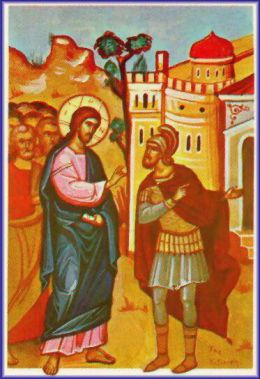 5 When he had entered Capernaum, a centurion came forward to him, appealing to him, 6 “Lord, my servant is lying paralyzed at home, suffering terribly.” 7 And he said to him, “I will come and heal him.” 8 But the centurion replied, “Lord, I am not worthy to have you come under my roof, but only say the word, and my servant will be healed. 9 For I too am a man under authority, with soldiers under me. And I say to one, ‘Go,’ and he goes, and to another, ‘Come,’ and he comes, and to my servant, ‘Do this,’ and he does it.” 10 When Jesus heard this, he marveled and said to those who followed him, “Truly, I tell you, with no one in Israel have I found such faith. 11 I tell you, many will come from east and west and recline at table with Abraham, Isaac, and Jacob in the kingdom of heaven,12 while the sons of the kingdom will be thrown into the outer darkness. In that place there will be weeping and gnashing of teeth.” 13 And to the centurion Jesus said, “Go; let it be done for you as you have believed.”And the servant was healed at that very moment.
 Hell is the place where people are given over to their anger. It is full of people whose pride has lead them to think that God owes them something because they are so good and righteous or because they belonged to the right club or had the right lineage. But they are wrong and so they are in torment stewing in their anger against God and there is no relief or release. All of that is the gnashing of teeth. So, when Jesus speaks of what hell will be, He gives a picture of darkness, sorrow, and anger.
 He couldn’t do it because he didn’t have the strength or authority. The centurion’s truest strength was his submission and faith that Christ’s authority far surpassed his own. So, the centurion in faith and hope asks Jesus to merely speak the word, and his servant is healed at that very moment.
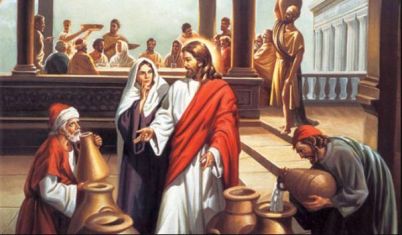 6 Now there were six stone water jars there for the Jewish rites of purification, each holding twenty or thirty gallons. 7 Jesus said to the servants, “Fill the jars with water.”And they filled them up to the brim. 8 And he said to them, “Now draw some out and take it to the master of the feast.”So they took it. 9 When the master of the feast tasted the water now become wine, and did not know where it came from (though the servants who had drawn the water knew), the master of the feast called the bridegroom 10 and said to him, “Everyone serves the good wine first, and when people have become drunk, then the poor wine. But you have kept the good wine until now.” 11 This, the first of his signs, Jesus did at Cana in Galilee, and manifested his glory. And his disciples believed in him.
 Jesus tells the servants to fill the jars with water, and they fill them up to the brim. And, at Jesus’ command, they take some of it to the master of the feast. The master tastes it, and it isn’t water anymore. It is wine. The master didn’t know. The guests didn’t know. Only Jesus, Mary, the servants, and the disciples know that this had been water miraculously turned into wine.
 But, dear saint, that is precisely the point. God is willing to give His gifts and mercy anyway. This isn’t a license to go on and sin because God will forgive you anyway. In fact, you are to abhor what is evil and hold to fast to what is good. Love one another. Outdo one another in showing honor (Ro. 12:9-11). And do all of that as you remember that God gives better than you deserve or appreciate.
 32 So likewise a Levite, when he came to the place and saw him, passed by on the other side. 33 But a Samaritan, as he journeyed, came to where he was, and when he saw him, he had compassion. 34 He went to him and bound up his wounds, pouring on oil and wine. Then he set him on his own animal and brought him to an inn and took care of him. 35 And the next day he took out two denarii and gave them to the innkeeper, saying, ‘Take care of him, and whatever more you spend, I will repay you when I come back.’ 36 Which of these three, do you think, proved to be a neighbor to the man who fell among the robbers?” 37 He said, “The one who showed him mercy.” And Jesus said to him, “You go, and do likewise.”
 Christ has come to find you. He has bound up your wounds. Jesus has poured out His healing, life-giving blood for you. Jesus nurses you in your brokenness. He has ascended into heaven and has promised to come back and pay for everything you need.
 This miracle, on the other hand, is odd. It’s dirty. Maybe, you even find it disgusting. Jesus takes a deaf man who has a speech impediment off to the side. He sticks His fingers into wax-filled ears. God in the flesh spits (apparently, Jesus wasn’t taught how to give a proper wet-Willy). Christ literally seizes, not just ‘touches,’ the man’s tongue. And then, Jesus looks up to heaven. Sighs. And says, “Ephphatha,” which means,“Be opened.”
 Jesus had come to be the Lamb of God who takes away the sin of the world, not to be the audiologist who takes away the deafness of the world. Jesus had come to give eternal life through His death and resurrection, not to give a voice to the voiceless.
 Yes, Jesus sighs and acts. He gets involved with us even though it hurts Him. He cannot help Himself. In His love and mercy, He gets bound up in the mess we make and that others have made for us. He gets entangled in our sin. In fact, He becomes sin so that we might become the righteousness of God (2 Cor. 5:21).
 Jesus says, “Judge not,”and our fallen, twisted, evil, amoral society latches on to these words like stink on poo. If an unbeliever loves any words of Jesus, it is probably, “Judge not.”
 Know this: No one will thank you from hell for remaining silent about their sin on earth. And God forbid that they curse you from hell for remaining silent about their earthly sin.
 God loves you from His very heart. God gives you real mercy. He loves the good and bad, the greatest and the least. He loves the sinner who strives to be merciful but fails, the hardened drug lord who doesn’t care about his sin, and He even loves you. In His mercy, God doesn’t simply get frustrated with your hypocrisy and ignore it.
 The road to the cross passes through Jericho. In the city where the walls had come-a-tumblin’ down, lived a blind man. Mark tells us that his name is Bartimeaus (Mk. 10:46). Bartimeaus heard all sorts of commotion and asked what it was all about. He is told nothing more than that Jesus of Nazareth is passing through. As blind as he is, Bartimeaus sees his opportunity and cries out, “Jesus, Son of David, have mercy on me.” And don’t miss this.
 Dear Charlie. Today, you are Baptized. Today, your God and Lord has had mercy upon you. Today, God joined all His promises of forgiveness, life, and salvation to water and poured out all His love upon you. The perfect, Divine love we heard in our Epistle lesson (1 Cor. 13) has been given to you and to all your brothers and sisters in Christ.
 Pastorsamwise
You must be logged in to post a comment.