In the name of Jesus. Amen.
When someone is learning to ride a bike, they need to learn how to balance, how to keep up their speed, and how to stop. Those are the most basic things, but they need to learn other things too. Another dimension of riding a bike is knowing where to look. If a rider looks at the wrong thing, it can lead to a crash. There’s actually a term for it—“target fixation.” Fighter pilots in World War II had to be taught not to lock their focus on the target, or they would fly right into it. Your hands follow your eyes. Pilots, motorcycle riders, and bikers are still taught the dangers of target fixation. A bicyclist has to learn not to stare at the pothole, the mailbox, or the parked car. If they fixate on the thing they are trying to miss, they will drift straight into it. Yes, notice potholes, mailboxes, and cars. Just don’t make them the thing you look at.
Here, the Ephesians are staring at a pothole. Paul, the man who brought the Gospel to them and founded their congregation, was in prison. He’s suffering on account of the Gospel, and they can see it. They see trouble and start doing what comes naturally to all of us. They get fixated on it and start to measure the trouble. How deep is the trouble? How long will it last? Will it spread? Will they also end up in prison? Or will they face something even worse?
Paul knows they are fixated on the wrong thing, which is why he writes, “Do not lose heart over what I am suffering for you, which is for your glory” (Eph. 3:13). Paul isn’t trying to put a positive spin on his suffering or make it sound like everything is just fine. He doesn’t deny it’s happening. But he doesn’t want the Ephesians to fixate on it. He refuses to let suffering be the only thing they measure.
We naturally measure our pain. We stretch our measuring tape across the height, depth, breadth, and length of our troubles. Then we let our hearts live inside those numbers. We could produce an exact 3D rendering of our troubles because we will fixate on them for weeks or months or years. It’s no wonder we keep drifting toward them.
Notice what Paul prays for here. He drops to his knees before the Father to ask for strength for the Ephesians and for you. He asks that, according to the riches of God the Father’s glory, you would “be strengthened with power through the Holy Spirit in your inner being, so that Christ may dwell in your hearts through faith” (Eph. 3:16-17).
The first thing Paul asks for is not that his prison door would open. He prays that the people who are worried about his imprisonment would be strengthened to measure something other than suffering. And the thing he wants them to measure is too big for a weak heart to measure. They will need some help, strength, endurance, and focus to measure Christ’s love.
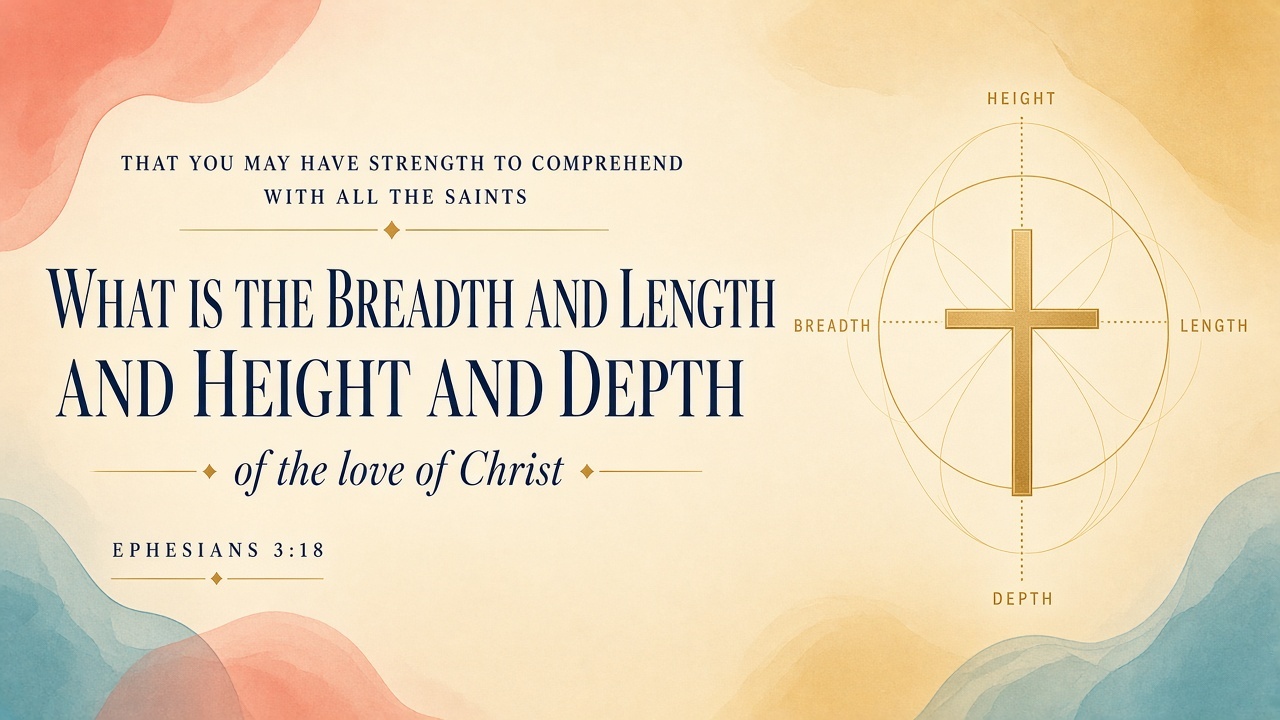
Look at v. 17-19 to see the rest of his prayer. “That you, being rooted and grounded in love, may have strength to comprehend with all the saints what is the breadth and length and height and depth, and to know the love of Christ that surpasses knowledge, that you may be filled with all the fullness of God” (Eph. 3:17-19).
God repeatedly does this in Scripture. There are several times God hands someone a measuring rod when things look hopeless. In a vision, Ezekiel is told to measure the Temple while he is in exile (Ezek. 40:3-5). Zechariah has a vision of a man measuring Jerusalem while it is still a pile of wreckage (Zech. 2:1-5). John is told to measure the Temple of God and those who worship there in the middle of tribulation (Rev. 11:1-2). When it would be natural to simply stare at the wreckage, God will tell people to, “Measure what I have claimed, even before you see it restored.” Here, Paul is handing you the same kind of rod.
So, here’s some saintly geometry for you. Four dimensions: breadth, length, height, depth. He wants them (and you) to measure the immeasurable love of Christ.
Measure its breadth. How wide is the love of Christ? His love is as wide as the world He died for. He is the Lamb of God who takes away the sin of the world (Jn. 1:29) and the propitiation—the atoning sacrifice—for our sins, and not for ours only but for the sins of the whole world (1 Jn. 2:2). No matter how far you drift, Christ’s mercy reaches wider than your wandering.
Measure its length. How long has this love been after you? Paul opened this letter by saying that, from before the foundation of the world, He chose you in Christ (Eph. 1:4). Through every year you can remember all the way to eternity, He who began a good work in you will bring it to completion at the day of Jesus Christ (Php. 1:6). This love was there from eternity past and continues with you until the Last Day. And even after the Last Day it doesn’t run out.
Measure its height. How high has He lifted you? You were dead in your trespasses and sins, but He made you alive together with Christ and seated you with Him in the heavenly places (Eph. 2:1, 5-6). Death looked like the highest wall imaginable. Christ’s love soared over it.
Measure its depth. How deep has Jesus come for you? He came all the way down to earth when He took on flesh for you. But Christ went deeper. He humbled Himself by becoming obedient to the point of death, even death on a cross (Php. 2:8).
Already, that’s a lot of measuring, and it has only scratched the surface. Paul knows that. That’s why he says that the love of Christ surpasses knowledge. Did you catch that in v. 19? Paul wants you to know something that surpasses your capacity to know—the love of Christ. He wants you to be rooted and grounded in that love. Those words—rooted and grounded—are the right words here. A tree doesn’t study to get a degree in soil science. It simply lives in the soil. Christ’s love is the soil God wants you to live in. Sink your roots deep.
Paul says you don’t take this measurement alone but “with all the saints” (Eph. 3:18). You are not the first one holding the rod. The saints who have already finished the race are not measuring their troubles anymore. They are measuring His love, and they are not disappointed.
What he prays for the Ephesians, he prays for you. He asks that God the Father would grant you strength “according to the riches of His glory” (Eph. 3:16). This strengthening happens as the Holy Spirit gives you strength and as Christ dwells in your heart through faith.
And there’s no sugarcoating here. This doesn’t make the suffering go away. Paul was still in prison when they finished reading his letter. But this saintly geometry—the breadth and length and height and depth of Christ’s love—reorients you. Look there. Your heart will follow.
“Now to Him who is able to do far more abundantly than all that we ask or think, according to the power at work within us, to Him be glory in the Church and in Christ Jesus throughout all generations, forever and ever” (Eph. 3:20-21). Amen.
The peace of God, which surpasses all understanding, will guard your hearts and minds in Christ Jesus (Php. 4:7). Amen.
 Jesus says, “Judge not,”and our fallen, twisted, evil, amoral society latches on to these words like stink on poo. If an unbeliever loves any words of Jesus, it is probably, “Judge not.”
 Know this: No one will thank you from hell for remaining silent about their sin on earth. And God forbid that they curse you from hell for remaining silent about their earthly sin.
 God loves you from His very heart. God gives you real mercy. He loves the good and bad, the greatest and the least. He loves the sinner who strives to be merciful but fails, the hardened drug lord who doesn’t care about his sin, and He even loves you. In His mercy, God doesn’t simply get frustrated with your hypocrisy and ignore it.

You must be logged in to post a comment.