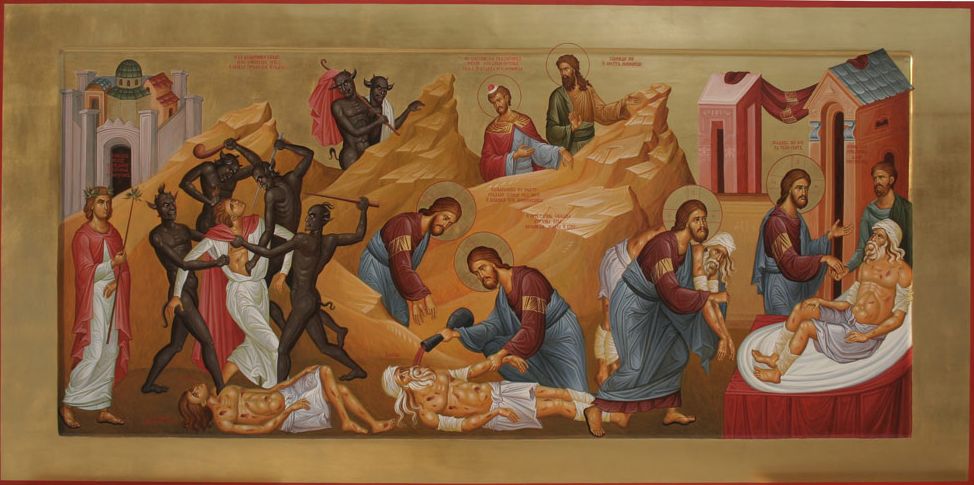
Where – Sermon on John 6:1-15 for the Fourth Sunday of Lent

John 5:1-15

1 After this Jesus went away to the other side of the Sea of Galilee, which is the Sea of Tiberias. 2 And a large crowd was following him, because they saw the signs that he was doing on the sick. 3 Jesus went up on the mountain, and there he sat down with his disciples. 4 Now the Passover, the feast of the Jews, was at hand. 5 Lifting up his eyes, then, and seeing that a large crowd was coming toward him, Jesus said to Philip, “Where are we to buy bread, so that these people may eat?” 6He said this to test him, for he himself knew what he would do. 7 Philip answered him, “Two hundred denarii worth of bread would not be enough for each of them to get a little.” 8 One of his disciples, Andrew, Simon Peter’s brother, said to him, 9 “There is a boy here who has five barley loaves and two fish, but what are they for so many?” 10 Jesus said, “Have the people sit down.” Now there was much grass in the place. So the men sat down, about five thousand in number. 11Jesus then took the loaves, and when he had given thanks, he distributed them to those who were seated. So also the fish, as much as they wanted. 12 And when they had eaten their fill, he told his disciples, “Gather up the leftover fragments, that nothing may be lost.” 13 So they gathered them up and filled twelve baskets with fragments from the five barley loaves left by those who had eaten. 14 When the people saw the sign that he had done, they said, “This is indeed the Prophet who is to come into the world!” 

15 Perceiving then that they were about to come and take him by force to make him king, Jesus withdrew again to the mountain by himself.

In the name of Jesus. Amen.

Maybe you’re like me and hate tests. I thought one of the greatest benefits of finishing my schooling was that I wouldn’t have to take any more tests. Ha! Kids, I’m sorry to burst your bubble, but if you think that the end of school means the end of tests, you’re wrong. Life is full of tests. Sure, those tests aren’t turned in to be corrected with a red pen, recorded in a book, and reflected on a report card. But there are plenty of tests throughout your life.

Specifically, God gives tests. Like it or not, God regularly gives you tests. 1 Peter 4:12 says that you should not be surprised when fiery trials come to test you. Next week, we’ll consider Gen. 22:1-14 where God tells Abraham to take his beloved son, Isaac, and offer him as a burnt offering. When Heb. 11:17 comments on that event, it says that God was testing Abraham.

Listen to these verses from James 1 because they beautifully and clearly tell us what God is doing when He gives us these tests. “Count it all joy, my brothers, when you meet trials of various kinds, for you know that the testing of your faith produces steadfastness. And let steadfastness have its full effect, that you may be perfect and complete, lacking in nothing” (Jam. 1:2-4). James goes on to say later in that chapter, “Blessed is the man who remains steadfast under trial, for when he has stood the test he will receive the crown of life, which God has promised to those who love him” (Jas. 1:12).

So, Scripture is clear that, when God gives these tests, it’s never to see if we can pass the test. God is not testing us because He needs to find out information. God isn’t up in heaven thinking, “I wonder if he’s a good enough Christian,” or, “I wonder if she really trusts Me. I’d better give a test.” No! God is not sitting up in the clouds trying to figure out if a student has learned enough. God knows everything, and He doesn’t need to put your scores in a grade book.

Instead, God tests us to produce endurance and steadfastness in us. God’s testing molds and shapes us. Those tests move us toward completion. They bring about endurance, character, and hope (Ro. 5:3-5). In other words, the tests God gives are for your benefit. Through those tests, God is stretching you and strengthening your faith.

Here in John 6, Jesus tests Philip by asking, “Where are we to buy bread, so these thousands of people may eat?” (Jn. 6:6). Again, Jesus isn’t testing Philip because it’s been a while since He recorded a score under Philip’s name. Jesus isn’t using this test to set up Philip for failure. Instead, Jesus is testing Philip to bring something about for Philip. Jesus wants to produce something in him, to work in him. When Jesus wants to do something in a person and produce something in a person, He does it perfectly.

It would be verydangerous for us to think that Jesus is trying to get Philip to fail and fall into sin. Instead, Jesus tests Philip to bring something about in Philip. And it’s clear and simple to see what Jesus wants to produce in Philip, “Hey Philip, where are we going to buy bread for these folks?” And Philip responds, “Money will not help in this situation.” That’s the thing Jesus wanted to produce in Philip. Jesus wanted Philip to know that money cannot feed this crowd. Jesus wanted Philip to know that money isn’t always the solution.

Imagine a normal day where Jesus is sitting in a house or by an evening fire or on the shore of the Sea of Galilee – it’s just Him and the disciples – and He asks Philip, “Hey Philip, do you think money can solve every problem?” Philip is no fool. He’d probably start imagining all sorts of hypothetical situations. “Money won’t help someone who’s falling down a cliff. Money wouldn’t help someone who fell out of the boat and was drowning.” I’m sure Philip would have said, “No. Money isn’t always the answer.” But Jesus isn’t asking Philip about a hypothetical situation. Jesus is asking it in real time with a real throng of hungry people surrounding them.

Generally, hunger issolved by money. To put it more accurately, generally God satisfies hunger through His gift of money. God gives you money. Then, you take your money, you go to the market, you buy food, you cook the food, and you eat it. But God hasn’t limited Himself to feeding people through money. God can make food fall down from the sky and feed millions of people (Num. 1:45-46) for forty years (Ex. 16:2-21; Josh. 5:12). If God wants to feed people that way. It isn’t a problem at all. Philip knew this, and you know this too.

Still, money can be a powerful idol. How often do find yourself in a situation, and the first thought you have is, “If I just had a little more money this wouldn’t be a problem”? Be honest! It’s probably a regular occurrence.

Thinking about money isn’t necessarily sinful. We do need to think about money because God has given it to us to be good stewards of it. But we’re too often greedy for money. We’re tempted to trust it as though it’s the solution to our problems. And for that, we repent. 

Repent, and know this: Money can never help you if God Himself does not supply it. Money is useless by itself. The only reason money has ever benefited you because Jesus gave it as a tool. 

So, in Philip’s case here, Jesus asks Philip about money to knock the idol of money out of Philip’s hand. But Jesus doesn’t leave Philip with empty hands, does He? No. Jesus empties Philip’s hands so He can put bread and fish into Philip’s hands. Philip and the disciples receive the bread and fish from Jesus’ hands and distribute it (Mt. 14:19; Lk. 9:16). The picture we have is that the disciples just keep handing out what Jesus gives them. They distribute more and more of what first came from the hand of Jesus.

The whole text makes it abundantly clear that money didn’t feed this crowd, but who did? Where did the provision come from? Jesus. Jesus is the answer. Jesus gives. Jesus distributes. Jesus provides, and not only does Jesus provide enough for the crowd; He provides enough for each of the disciples. Philip and the other disciples distribute what Jesus provided, but they still weren’t done. Jesus sends them back out into the crowd to gather up the leftovers. Leftovers? Yes. Twelve baskets worth. A basket for each disciple. Why not thirteen? Why isn’t there a basket for Jesus? At this point in the sermon, you can probably guess. Jesus doesn’t need money to provide, and He doesn’t need a basket of food.

Dear saints, when you are tested in times of need, where should you look? Our Old Testament reading (Is. 49:8-13) has the answers. Where you cry, God answers. Where you need help, God saves. Where you need certainty, God keeps you. Where you are imprisoned, God frees. Where you face darkness, God brings light. Where you hunger, God feeds. Where there is hard terrain, God makes straight. Where you face affliction, God comforts and has compassion.

So, sing for joy. The Lord has comforted His people. He has compassion on His afflicted. Amen.

The peace of God, which surpasses all understanding, will guard your hearts and minds in Christ Jesus. Amen.

The Gift of Time – Sermon on Luke 16:1-13 for the Ninth Sunday after Trinity

Luke 16:1–13

1 He also said to the disciples, “There was a rich man who had a manager, and charges were brought to him that this man was wasting his possessions. 2 And he called him and said to him, ‘What is this that I hear about you? Turn in the account of your management, for you can no longer be manager.’ 3 And the manager said to himself, ‘What shall I do, since my master is taking the management away from me? I am not strong enough to dig, and I am ashamed to beg. 4 I have decided what to do, so that when I am removed from management, people may receive me into their houses.’ 5 So, summoning his master’s debtors one by one, he said to the first, ‘How much do you owe my master?’ 6 He said, ‘A hundred measures of oil.’ He said to him, ‘Take your bill, and sit down quickly and write fifty.’ 7 Then he said to another, ‘And how much do you owe?’ He said, ‘A hundred measures of wheat.’ He said to him, ‘Take your bill, and write eighty.’8 The master commended the dishonest manager for his shrewdness. For the sons of this world are more shrewd in dealing with their own generation than the sons of light. 9 And I tell you, make friends for yourselves by means of unrighteous wealth, so that when it fails they may receive you into the eternal dwellings.

10 “One who is faithful in a very little is also faithful in much, and one who is dishonest in a very little is also dishonest in much. 11 If then you have not been faithful in the unrighteous wealth, who will entrust to you the true riches? 12 And if you have not been faithful in that which is another’s, who will give you that which is your own? 13 No servant can serve two masters, for either he will hate the one and love the other, or he will be devoted to the one and despise the other. You cannot serve God and money.”

In the name of Jesus. Amen.

The scam was over. His gig had been discovered. The pink slip was coming because this manager’s Ponzi scheme had been reported to his boss. Now, the rich man was going to cut ties with his crooked manager. But rather than sitting around and stewing about how everything had gone wrong, instead of denying the charges, fighting the accusations, or making excuses, the manager gets busy. His paychecks had dried up, but the manager recognized that he had something much more valuable than his salary. He had time, and he was going to use that time to his advantage.

This scoundrel manager scrambles to make sure that he’ll still have a bite to eat and a place to stay now that the gravy train had made its last stop. He calls in all the people who owed the rich man a debt. We only get to hear two of the conversations, but all of them get called in, and you can imagine those debtors were nervous and afraid as they are brought into the office one by one. No one likes calls from the debt collector.

The manager knows their fear, and he uses it to his advantage. He asks all of the debtors, “How much do you owe? Ufda. Yes, I can see why you’re worried about that. Well, I have some good news for you. I’m going to make things easier. Take that debt, and lower it.” And all these debtors leave the office with a lighter burden, feeling better about their own future, and extremely grateful toward this soon-to-be jobless manager. And he will go home at the end of the day with no job and no prospects but a lot of new friends. Of course, those friends were gotten by deception and cheating, but they had become his friends.

Now, this is probably Jesus’ most confusing parable. It’s one of only a couple times that Jesus holds up someone who does bad things as an example. Another one comes later in Luke 18:1-8 where Jesus tells the parable of the unrighteous judge who grants justice to the widow who keeps badgering him for justice. In that parable, Jesus teaches that bad people will sometimes do the right thing. But here, Jesus teaches that bad people do bad things and sometimes get good results – at least for themselves.

To help make sense of it, let’s try an analogy. If I said, “Barry Bonds hit a lot of home runs,” what would you think of that statement? Honestly, it doesn’t matter what you think because it’s true. Bonds stands alone at the top of list of all baseball players in history for hitting the most home runs. It’s undeniable. Of course, the reason he hit a lot of his home runs is that he cheated by taking steroids, but he still hit more baseballs over the fence than anyone else. But that doesn’t, necessarily, mean that other players who hit lots of home runs are cheaters. Managers will still encourage their players to hit the ball far and hard even though some do it by cheating. Jesus wants you, Christian, to be shrewd. That doesn’t mean He want you to cheat. But He does want you to be shrewd in ways that invest in the kingdom of God.

We still probably wonder, “Why wouldn’t Jesus use a different parable with a character who is more respectable to teach us to be shrewd?” Honestly, I don’t know the answer. From the rest of the Gospels, it’s clear that Jesus isn’t in favor of theft and cheating. He doesn’t approve of this guy’s stealing and dishonesty (see Mt. 5:17-37). The manager is a crook, thief, and scoundrel. But Jesus does want us Christians to imitate and emulate this manager’s shrewdness. Simply stated, it all boils down to these three ways he is shrewd: One, the manager recognizes who he is. Two, the manager recognizes he temporarily has at his disposal things that will not last or endure. And three, he knows how to use things that are slipping away to secure a future for himself. Let’s dissect each of those.

First, Jesus wants us to be shrewd like the manager and rightly recognize who we are. When the manager heard that his pink slip was coming, he recognizes that he’s about to lose all of his income and that there’s no one to blame except himself. But more importantly, he recognizes that he either can’t or won’t do certain things. He isn’t strong enough to work in construction, and he’s too ashamed to stand on a corner holding a cardboard sign with a sad story which will move people in such a way that they give him money. The guy is brutally honest with himself about himself and his situation.

Jesus wants us to have that same shrewdness. Christ wants us to recognize who we are as sinners. We do this here every week with our confession of sins. We confess that we are, by nature, sinful and unclean and have sinned in thought, word, and deed. We confess that we need to flee to God’s infinite mercy which He freely gives for the sake of Christ’s death and resurrection. It is good and right that we do that here and receive Jesus’ forgiveness which He gives to all of us through the absolution (Jn. 20:23). And it is good to confess our sins each and every day and hear God’s sure, certain promise of forgiveness and mercy.

Second, Jesus wants us to be shrewd like the manager by recognizing what does not last. The manager’s career was fleeting. He’s in the process of being fired, and because his career doesn’t last, his income isn’t a stable fixture either. The only thing he has is time, but that won’t last either. Eventually, the rich man will send guards to bring the paperwork back to the headquarters. So, the manager acts quickly. He sees that every second is a gift, so he uses every precious second. This manager shrewdly recognizes that time is a lot more valuable than money.

Dear saints, time is always short because time is always a gift. We take time for granted, but we strive for money. This is backwards. If you found a $200 recurring charge on your bank account had no idea what that $200 was going toward, you would investigate. But how much time do we waste each day or week or month and barely even notice?

Your income of time doesn’t and can’t increase. The amount of time everyone has is the same. You can’t save time to use later in your retirement. Still, time flies away, and we think little about it. The gift that you always have the same amount of is time. So, what are you doing with it? In the parable, the rich man realizes how intelligent and shrewd this manager was in his use of the gift of time. The manager used his time to secure a future for himself by treating the time he had as something incredibly precious. Jesus wants us to do the same. Which leads us to the third way Jesus wants us to be shrewd like the manager and that is to use things that are fleeting – especially the gift of time – to our advantage.

You don’t have any guaranteed time. None at all. Every second you are breathing in and out is a gift. What are you doing with that gift? Are you investing your time in things that last like hearing God’s Word, growing in your faith, training your children, and building up your brothers and sisters in Christ? Stop acting that you are in charge of your life. Be reconciled to God now. If you have accounts to settle, if you have something to confess to God or to someone else, now is the time to do that. If you have something important to do, today is the day for that very thing. The only things that will last are what God says will last. Everything else will fail.

Jesus wants us children of light to make friends for ourselves by means of ‘unrighteous wealth,’ in other words, Jesus wants us to make friends by means of things that will not last, by means of things that will fade away. A time will come when you have to speak to the Master and explain what you have done with the temporary gifts that He has given to you.

Dear saints, as you see everything else fail and fade, also see that the cross is not going away. Jesus’ hands are still wounded for you. Christ’s blood has still paid for all of your life. God’s will for you in Christ Jesus is that you be reconciled to God. Jesus is the same today, yesterday, and forever (Heb. 13:8). Time doesn’t touch Jesus, so your time with Him cannot touch you. Invest in Him. Put your time in Him, not in things that fail.

You, child of God, be shrewd. Pour yourself in lasting things. Confess, forgive, love, and receive the promises of God knowing the time is precious. Invest in what lasts, and you will reap a rich and lasting reward because Christ and His kingdom will never fail. Amen.

The peace of God, which surpasses all understanding, will guard your hearts and minds in Christ Jesus. Amen.

Feast & Famine – Sermon on Luke 16:19-31 for the First Sunday after Trinity

Luke 16:19–31

19 “There was a rich man who was clothed in purple and fine linen and who feasted sumptuously every day. 20 And at his gate was laid a poor man named Lazarus, covered with sores, 21 who desired to be fed with what fell from the rich man’s table. Moreover, even the dogs came and licked his sores. 22 The poor man died and was carried by the angels to Abraham’s side. The rich man also died and was buried, 23 and in Hades, being in torment, he lifted up his eyes and saw Abraham far off and Lazarus at his side. 24 And he called out, ‘Father Abraham, have mercy on me, and send Lazarus to dip the end of his finger in water and cool my tongue, for I am in anguish in this flame.’ 25 But Abraham said, ‘Child, remember that you in your lifetime received your good things, and Lazarus in like manner bad things; but now he is comforted here, and you are in anguish. 26 And besides all this, between us and you a great chasm has been fixed, in order that those who would pass from here to you may not be able, and none may cross from there to us.’ 27 And he said, ‘Then I beg you, father, to send him to my father’s house— 28 for I have five brothers—so that he may warn them, lest they also come into this place of torment.’ 29 But Abraham said, ‘They have Moses and the Prophets; let them hear them.’ 30 And he said, ‘No, father Abraham, but if someone goes to them from the dead, they will repent.’ 31 He said to him, ‘If they do not hear Moses and the Prophets, neither will they be convinced if someone should rise from the dead.’ ”

In the name of Jesus. Amen.

Psalm 37:16 says, “Better is the little that the righteous has than the abundance of many wicked” (see also Pro. 15:16).

Today, Jesus puts before us two men. One is fabulously rich, the other pitifully poor. One wears royal clothes, the other painful sores. One feasts sumptuously every day, the other craves crumbs. Jesus makes sure to highlight these major differences between the two men, but Jesus also makes sure that we know what they have in common.

First and most obviously, both die. Both face an eternal existence after death. And that existence is something that all the powers of this world have no influence to change or control. After his death, the rich man is no longer rich, and he is powerless to modify that. After his death, Lazarus is no longer poor. He has eternal riches and gifts that he didn’t earn and cannot be taken away.

But there is something else that these two men have in common with one another. Both men are passive. In other words, things happen to them. Now, this can be easy to miss, but once you see it you can’t ignore it.

To see it, let’s start with Lazarus. Jesus says that Lazarus is located at the rich man’s gate. But notice how Lazarus gets there. Jesus says that Lazarus is laid there. In other words, someone or something puts him there. Lazarus doesn’t intentionally go to the rich man’s gate day after day after day. If you were a destitute beggar but could move on your own, you’d go places where you would get help. And it would make sense to go to a rich man’s gate, but if you saw that rich dude feasting every day and he never gave you crumbs that fell from his table, you’d probably move somewhere else and hope to get noticed and helped in that new location. So, Jesus is clear that Lazarus is laid there (v. 20), but Jesus doesn’t say exactly who put Lazarus there, so let’s keep investigating.

Jesus says that the dogs came and licked Lazarus’ sores. Where did those dogs come from? They weren’t people’s personal pets that are sent to Lazarus. They were likely wild dogs. Psalm 50:10 says that every beast and the cattle on a thousand hills belong to God. Again, it isn’t directly stated that God sent the dogs. So, let’s keep looking.

When Lazarus dies, what happens? Jesus says that the angels are standing there, waiting to carry him to heaven. Now, there’s an important clue. Psalm 103:20 says that the angels are the mighty ones who obey God’s Word. Here, these angels are commanded to not only escort Lazarus to heaven, they are also the ones who carry him there. They wait for God’s command and direction. And in God’s timing, those angels carry Lazarus to heaven but not one moment before God decides.

Now, if God is in total, complete control of the end of Lazarus’ life, it would make sense that God was in control of everything leading up to that as well. No sparrow falls to the ground without God knowing it. Scripture promises that the hairs of your head are numbered (Mt. 10:29-31). The Bible is clear that God was in control of everything happening to Lazarus during his entire life (Ps. 139). God was governing all of his steps and movements. So, Lazarus, poor and sick though he was, was being taken care of by God throughout his entire life. God was the one who laid him at the rich man’s gate. God sent the dogs to comfort him by licking his sores. God sent the angels to carry him to heaven. And after he dies, God comforts Lazarus in paradise. Lazarus is passive. Things happen to him at God’s direction.

Now, consider the rich man. When Abraham is responding to the rich man’s request for Lazarus to give him a drop of water (more on that in a bit), Abraham says, “Remember that you in your lifetime received your good things” (Lk. 16:25). That tells us a lot about the rich man and his riches. All the things he enjoyed in his lifetime were given to him as gifts. His royal, purple clothes were a gift. His sumptuous feasts, a gift. His house and gate, a gift. Even the beggar Lazarus lying at his gate was a gift from God. Lazarus was a God-given opportunity for the rich man to share all the good things he received. But the rich man didn’t see any of his blessings as a gift. By all appearances, the rich man imagined those gifts were all things that he had earned, and he saw Lazarus as an inconvenient nuisance. But from heaven’s perspective, they were all gifts that were given.

That doesn’t mean that the rich man wasn’t a hard worker or a savvy investor. What it means is that He was a recipient of all the good things he enjoyed during his life. God gave it all. Everything he had – even the things he had earned – was given to him by God. But this rich man didn’t receive them as God’s good gifts. Instead, he saw everything revolving around him. If it was good, it was for his own pleasure and use. If it was inconvenient – like a beggar at his gate, it was a hurdle to his pleasure. He never gave thanks to God for the gifts, so he never thought to share the gifts God had given to him with others. He was foolish in his thinking and life (Ro. 1:21-22). All of this meant that he couldn’t enjoy the gifts he had been given. Even his feasting was a famine because he received it in isolation. He didn’t share his bounty with others.

In the end, it didn’t matter how little Lazarus had, and it didn’t matter how much the rich man had. What mattered was faith. Lazarus had faith that was credited to him as righteousness (Gen. 15:6). The rich man didn’t have faith, and when he stood before God to be judged (Heb. 9:27), he lacked the righteousness God demands (Mt. 5:20).

Now, we might feel sorry for the rich man as he’s suffering in hell. It is a pitiful thing to see someone think that a drop of water is merciful. And we certainly don’t want anyone to go to eternal condemnation. But the rich man’s torment doesn’t lead him to repentance. Look at how the rich man acts in hell. It doesn’t seem like the rich man has changed at all. He doesn’t ask to leave hell. He’d rather have Lazarus leave his comfort. Even in torment, the rich man is bossing people around. He still doesn’t talk to Lazarus; instead, he tries to tell Abraham what to do. The rich man thinks it is unfair that he is in hell. Underlying his desire to have Lazarus rise from the dead and warn his brothers is an attitude that arrogantly says that he knows better how to evangelize unbelievers. The rich man is basically saying, “If someone rises from the dead, then there will be a lot more people in heaven and fewer in hell. If I had seen someone rise from the dead, I wouldn’t be here.”

But in the end, the rich man hadn’t listened to the Scriptures. He hadn’t believed God’s Word. He hadn’t repented. He hadn’t believed in God’s mercy. Instead, he neglected God’s Word, and because of that, he was poor. On the other hand, Lazarus had the eternal treasure of God’s Word which made him rich – even in his earthly poverty. In Lazarus, we see the truth of what Pro. 15:15 says, “All the days of the afflicted are evil, but the cheerful of heart has a continual feast.”

Now, where does this leave us? We aren’t as wealthy as the rich man, and we aren’t as poor and destitute as Lazarus. All of us are somewhere in the middle, but that doesn’t change the fact that everything we have – whether it is a feast or a famine – is given to us from the hand of God.

God has given you two hands with two palms which are created to receive the things that God gives. And those hands have five fingers with space between them, which allows the good gifts of God fall through your hands to others. Because He is the Creator of all things, God has an infinite supply of gifts to give to you. He gives you everything freely, and He desires that you receive it as a gift so you don’t clutch at it and try to keep it for yourself. You, dear saints, are a conduit that receives from God and passes His bounty on to others. Proverbs 19:17 says, “Whoever is generous to the poor lends to the Lord, and he will repay him for his deed.”

Most importantly, you were poor miserable sinners. But Jesus saw you in your poverty. He left His feasting and became poor for your sake so you, through His poverty, would become rich (2 Cor. 8:9). Christ has come to give His own Body and Blood unto death for your sake. Now, He is risen forever and invites you not to have just some crumbs that fall from His plate. He invites you to have a seat at His table. Leave the famine of your sin and greed. Come and feast in His presence. Amen.

The peace of God, which surpasses all understanding, will guard your hearts and minds in Christ Jesus. Amen.

The Malicious Master of Mammon – Sermon on Matthew 6:24-34 for the Fifteenth Sunday after Trinity

Matthew 6:24–34

24 “No one can serve two masters, for either he will hate the one and love the other, or he will be devoted to the one and despise the other. You cannot serve God and money.

25 “Therefore I tell you, do not be anxious about your life, what you will eat or what you will drink, nor about your body, what you will put on. Is not life more than food, and the body more than clothing? 26 Look at the birds of the air: they neither sow nor reap nor gather into barns, and yet your heavenly Father feeds them. Are you not of more value than they? 27 And which of you by being anxious can add a single hour to his span of life? 28 And why are you anxious about clothing? Consider the lilies of the field, how they grow: they neither toil nor spin, 29 yet I tell you, even Solomon in all his glory was not arrayed like one of these. 30 But if God so clothes the grass of the field, which today is alive and tomorrow is thrown into the oven, will he not much more clothe you, O you of little faith? 31 Therefore do not be anxious, saying, ‘What shall we eat?’ or ‘What shall we drink?’ or ‘What shall we wear?’ 32 For the Gentiles seek after all these things, and your heavenly Father knows that you need them all. 33 But seek first the kingdom of God and his righteousness, and all these things will be added to you.

34 “Therefore do not be anxious about tomorrow, for tomorrow will be anxious for itself. Sufficient for the day is its own trouble.”

In the name of Jesus. Amen.

When we are anxious and full of worry, we are serving the false god of mammon. Jesus says, “You cannot serve two masters. You cannot serve God and mammon.” I know our translation says ‘money,’ but the word there is mammon. It includes money, but it also refers to all our stuff. Worry and anxiety is the worship we give to the stuff of this world. When we worry, we are living out the future before it has even gotten here. That’s the opposite of faith. Faith simply trusts that when the future becomes the present, our heavenly Father will be there to give us what we need because He promises to do so.

This is how and why mammon is such a malicious master. Mammon cannot promise you anything in the future because all the money and stuff of this life is temporary and fleeting. Money and things come and go. One moment you have plenty, the next you have little. That is why, when mammon is your god, the one command is to try to possess more in the false hope of finding pleasure or security. But there is no pleasure or security in the things of creation apart from God’s giving of those things. And because we aren’t ever satisfied with what we have, we think the answer is to get more. But that turns into a vicious cycle. If we do, somehow, get more, we find that we aren’t satisfied with the more we’ve gotten. Repent.

Jesus wants you to listen to the preaching of the lilies. The lilies Jesus speaks about here aren’t the large lilies we know from Eastertime. Those don’t grow in Galilee. The lilies Jesus refers to here are tiny flowers that grow along the grass in the fields.

It isn’t quite true to say that the lilies grow. Saying it that way gives the impression that their growth has to do with their achievement. Instead, it is more accurate to say that God grows the lilies. All a lily can do is wait on God to give it the strength and resources it needs to grow. A lily can’t go out and get any more nourishment than what God gives to it. It can’t try to find soil that is better fertilized, and it can’t dig irrigation ditches to get more water. Every aspect of the lily’s life is in God’s hand. That’s why lilies aren’t impatient, and they don’t try to grow up to be trees. Instead, God grows the lily slowly, steadily, and quietly to be what He designed it to be. And the lily is content to receive what God has given it.

The same is true for the birds. When was the last time you saw a bird driving a tractor or operating a combine? A bird cannot plant and harvest like we can, but God didn’t design birds to do that. He designed us to do that. Birds simply do what God designed them to do: have chicks, raise them, and sing.

A bird wakes up, finds a branch, and sings the song God puts into its beak. While that little bird sings, it isn’t worried about food even though it has more reason to be worried than we do because that bird doesn’t know where its food is going to come from. It can’t go to the store to buy food. The bird just sits there and sings for a while. Then, when it is hungry, it flies off and finds the food God has set out for it.

Now, to be clear, Jesus isn’t telling you to not work in this text. The lily isn’t preaching to you that you should sit down, do nothing, and expect God to drop your clothing from the sky. God didn’t create you to be a lily. The birds aren’t preaching that you should just fly around and make music and serenate the rest of creation for free. God didn’t create you to be a bird.

We humans were created to work. Jesus’ whole life was hard work, and He has given you work to do that calls for energy, effort, and diligence. But because we rebelled against God’s design, we bear the curse of sin and our work, which should be happy and creative, has become a toil and burden. What Jesus wants for you is to have your work and, now, even the burden of work be free of anxiety and worry.

The pagans go around full of anxiety asking, “What are we going to eat and drink? How are going to get clothes?” Here, Jesus wants you to know, to be confident, and to be content in the fact that you are not your own maker. You don’t live by your own hand. The food you eat isn’t just the nourishment you have earned. No, it’s the food that God has given you. The house you live in, isn’t just a bunch of wood, sheetrock, wiring, and plumbing; it’s the combination of all those things that God has given to you.

Dear saints, you live by everything that proceeds from God’s hand. You live by Him and because of Him.

In 1 Timothy 6:6-10, Paul writes what basically serves as a commentary what Jesus says in this text: “Godliness with contentment is great gain, for we brought nothing into the world, and we cannot take anything out of the world. But if we have food and clothing, with these we will be content. But those who desire to be rich fall into temptation, into a snare, into many senseless and harmful desires that plunge people into ruin and destruction. For the love of money is a root of all kinds of evils. It is through this craving that some have wandered away from the faith and pierced themselves with many pangs.”

When Paul says, “Godliness with contentment is great gain,” the word Paul uses for ‘godliness’ does not mean to be like God. In English, when we talk about godliness, it can mean that, and there is a right place to do that. But the word there means “right reverence.” It means to have a right and proper attitude and response toward God. To have the right attitude and reverence toward God is to recognize that He is the Giver of all good things, and when we recognize that, we can be content.

So rather than wasting your time and energy by worrying and living in the unknown future (which you can’t do anyway, all that does is drain you in the present), you can work diligently in the present knowing that God promises to give what you need in the future. Yes, it will mean more work and toil for you, but God promises to give you the strength to do that as well. Live your life in the present knowing that God holds the future in His omnipotent hand.

Philippians 4:6 says, “Do not be anxious about anything, but in everything with prayer and supplication with thanksgiving let your requests be made known to God.” So, when you worry, take that worry and turn it around. Don’t let it be the slavish worship you offer to the malicious master of mammon. Instead, when you are worried about anything, make it your prayer. Pray, “God, You have told me not to be anxious. You have told me not to worry. Well, I’m worried about ______. You take care of that. Help me. Provide for me. Protect me.” Then your worry is transformed into true service to God.

Dear saints, God loves you. He has already provided you with everything you need for your eternal future. In His mercy, He sent His only-begotten Son to shed His blood on the cross to make you His own so that you will live forever in His kingdom. There is no reason for you to doubt His provision of the things you need today or tomorrow (Ro. 8:32).

And then, be free. Free to seek first the kingdom of God and His righteousness – the righteousness He freely delivers to you in His Word and the righteousness He gives you now in His Body and Blood given and shed for the forgiveness of all your sins. Seek that first because you know where to find it – here at His altar. And He clearly promises that all other things will be added to you as well. Amen.[1]The peace of God, which surpasses all understanding, will guard your hearts and minds in Christ Jesus. Amen.



[1] Portions of this sermon – especially regarding lilies – were adapted from a sermon by Rev. Dr. Norman Nagel.

The Steward – Sermon on Luke 16:1-13 for the Ninth Sunday after Trinity

Luke 16:1–13

1 He also said to the disciples, “There was a rich man who had a manager, and charges were brought to him that this man was wasting his possessions. 2 And he called him and said to him, ‘What is this that I hear about you? Turn in the account of your management, for you can no longer be manager.’ 3 And the manager said to himself, ‘What shall I do, since my master is taking the management away from me? I am not strong enough to dig, and I am ashamed to beg. 4 I have decided what to do, so that when I am removed from management, people may receive me into their houses.’ 5 So, summoning his master’s debtors one by one, he said to the first, ‘How much do you owe my master?’ 6 He said, ‘A hundred measures of oil.’ He said to him, ‘Take your bill, and sit down quickly and write fifty.’ 7 Then he said to another, ‘And how much do you owe?’ He said, ‘A hundred measures of wheat.’ He said to him, ‘Take your bill, and write eighty.’8 The master commended the dishonest manager for his shrewdness. For the sons of this world are more shrewd in dealing with their own generation than the sons of light. 9 And I tell you, make friends for yourselves by means of unrighteous wealth, so that when it fails they may receive you into the eternal dwellings.

10 “One who is faithful in a very little is also faithful in much, and one who is dishonest in a very little is also dishonest in much. 11 If then you have not been faithful in the unrighteous wealth, who will entrust to you the true riches? 12 And if you have not been faithful in that which is another’s, who will give you that which is your own? 13 No servant can serve two masters, for either he will hate the one and love the other, or he will be devoted to the one and despise the other. You cannot serve God and money.”

In the name of Jesus. Amen.

Psalm 24 opens by saying, “The earth is the Lord’s and the fullness thereof, the world and those who dwell therein, for He has founded it upon the seas and established it upon the rivers.” Simply stated, everything and everyone belongs to God because He created it all. There is nothing you can see, hear, feel, taste, smell, or experience that isn’t God’s. It all belongs to Him.

The only reason we think the stuff we have belongs to us, and the only reason we imagine the people in our lives are ‘my husband, my wife, my kids, my parents, my friends’ is that God is so deeply generous. He is a giver. 1 John repeatedly says, “God is love” (1 Jn. 4:8, 16). In other words, if God ceased to be loving and generous, He would no longer be God. That is why you have everything and everyone you have. God loves you, and He loves to give you good gifts.

Let’s take that one step further because this isn’t true only for Christians. It’s true for everybody. Everyone is the recipient of God’s generosity. From the body they have, to the clothes they wear, to the food they eat, to the house they live in, to the people in their lives – everyone received all of it from God’s loving, generous, giving hand. The remarkable thing about all of this is that most people never have and never will acknowledge God’s provision, generosity, and love. But that doesn’t stop God from giving it.

Now, with that understanding, we can go to the parable. It’s a difficult parable because it’s one of those parables where Jesus uses the actions of a bad, sinful character to make His main point. A rich man had a manager working for him. This manager was a steward of the rich man’s accounts; he was in charge of the books. This manager was crooked enough that he had to be fired. But instead of putting him in chains to be escorted straight to prison, the rich man is generous. He tells the manager to go back to the office, assemble the books, and turn them over. In other words, the rich man, even though he has fired the steward, gives the steward the gift of time. To properly understand the lesson Jesus is teaching with the parable, our main concern is to understand what the steward does with that the rich man’s generosity.

The manager calls in the rich man’s debtors one by one, and you can imagine that they are all terrified of this meeting. They aren’t just getting a phone call from a debt collector; they get brought into his office. Each of them knows they owe these debts, so they’re afraid. And their fear plays right into the manager’s hand.

I imagine the interactions go something like this. A debtor enters the room, and the manager says, “My boss wants to know: what is your plan for this debt you have?” And you can imagine the debtor saying, “Yes. I know. I’ll try to shift things around a bit. Would it work if I got half of it to you by the end of the month and get the other half next month? I’ll do my best to get everything taken care of as soon as possible.” And the manager pretends to be compassionate and says, “Here, let’s just make this a little easier. I’ll talk the rich man down. Write a new debt here, and we’ll just call it good. Let me take some of that stress off of you.” How those conversations actually went we don’t know, but it is clear that the manager knows how to use these people and their stress to his advantage. His plan is to take care of them now so they will take care of him later – let him stay in their vacation houses after he’s left out on the street.

Is it unrighteous? Yup. Absolutely. He’s cancelling debts he has no authority over any longer. Or, to put it another way, he’s giving away someone else’s money. But here’s why it is so shrewd – the rich man, the manager’s former boss, is such a generous person that he isn’t going to reinstate those debts. The rich man is going to hear the whole town singing his praises for having lowered their debts, and if he were to reinstate them – which, by the way, he would have had every right to do – his reputation of being generous would be tarnished. The rich man would rather eat those losses than have his mercy and generosity doubted. The manager knows this about his former boss, and he bets everything on it in the hope his connection to the reduced debts will make people generous toward him later. That is what Jesus is commending.

Christ is saying with this parable that you can bet everything you have on God’s love, mercy, and generosity. Our Lord concludes the parable by saying, “Make friends for yourselves by means of unrighteous wealth, so that when (not ‘if’ but ‘when’) it fails they may receive you into the eternal dwellings.”

Now, this is one of the most difficult things that Christ said. We know from everything else Jesus says that the unrighteous wealth can’t refer to things that you get in an unrighteous way like this manager did. Jesus clearly teaches against cheating and stealing. So, I think the best understanding of what Jesus means by ‘unrighteous wealth’ is just the stuff that God gives you that doesn’t deliver you God’s mercy and forgiveness – i.e. what we would refer to as ‘1st Article gifts.’ That is all the created blessings that God the Father Almighty, Maker of heaven and earth gives to you. Yes, your money, but also your house, your job, your relationships, your time, your talents, etc. Use those things to make friends for yourself, but not just any kind of friends. Jesus here refers to the kind of friends who receive you into the eternal dwellings.

I think that is an important clue to understand what Jesus is saying here. You can give your stuff away and gain a lot of friends. But the way you get friends to dwell with for eternity is for them to become Christians. In short, Jesus is encouraging us to be as shrewd as this scoundrel of a manager and use our 1st Article gifts to promote the preaching of the Gospel.

So, what does that look like? Well, there are billions of possibilities. So, I can’t tell you exactly what to do in every situation. But I’ll try a few.

It might mean you learn that your neighbor or coworker likes a certain food that you enjoy making. So, you invite that person over to prepare your grandma’s special recipe. You invest in that relationship and invite that person to come with you to church so they can hear the Gospel and believe.

It might mean that you use your talents to make things that you can donate to an auction that supports the Women’s Pregnancy Center or Riverside so a mom who is in a bad situation can get help that will also point her to the Gospel and so Christian children can be built up through their education to be lights in the communities they will eventually live in.

And, even more simply, return a portion of God’s money that He has given and entrusted to you by putting it into the offering plate to support the preaching of the Gospel and the ministry of God’s Word that takes place here. It isn’t as though God wants you to fill the offering plate apart from Him. Instead, it is that God Himself wants to fill the offering plate through you, so you become generous, giving, and loving like He is.

And know that the unrighteous wealth Jesus talks about here isn’t just about money. It’s about all the 1stArticle gifts that God gives to you. Be a shrewd steward of everything God gives to you – your time, your talents, and your treasures – to make friends for eternity. By doing that, you become more and more conformed to the image of your giving and generous God.

As children of God and stewards of God’s gifts, be imitators of God by being merciful, loving, kind, giving, and generous. And the reason you can be generous with your 1st Article gifts is that God has given you His 2nd and 3rd Article gifts along with your 1st Article gifts. You have the true riches. You have God’s love, mercy, forgiveness, and holiness freely given to you because of what Christ has done for you by dying and rising again. Those things will never fade, fail, or diminish. They are yours, Christian, now and for all eternity. Amen.

The peace of God, which surpasses all understanding, will guard your hearts and minds in Christ Jesus. Amen.

Your Good Things – Sermon on Luke 16:19-31 for the First Sunday after Trinity

Luke 16:19–31

19 “There was a rich man who was clothed in purple and fine linen and who feasted sumptuously every day. 20 And at his gate was laid a poor man named Lazarus, covered with sores, 21 who desired to be fed with what fell from the rich man’s table. Moreover, even the dogs came and licked his sores. 22 The poor man died and was carried by the angels to Abraham’s side. The rich man also died and was buried, 23 and in Hades, being in torment, he lifted up his eyes and saw Abraham far off and Lazarus at his side. 24 And he called out, ‘Father Abraham, have mercy on me, and send Lazarus to dip the end of his finger in water and cool my tongue, for I am in anguish in this flame.’ 25 But Abraham said, ‘Child, remember that you in your lifetime received your good things, and Lazarus in like manner bad things; but now he is comforted here, and you are in anguish. 26 And besides all this, between us and you a great chasm has been fixed, in order that those who would pass from here to you may not be able, and none may cross from there to us.’ 27 And he said, ‘Then I beg you, father, to send him to my father’s house— 28 for I have five brothers—so that he may warn them, lest they also come into this place of torment.’ 29 But Abraham said, ‘They have Moses and the Prophets; let them hear them.’ 30 And he said, ‘No, father Abraham, but if someone goes to them from the dead, they will repent.’ 31 He said to him, ‘If they do not hear Moses and the Prophets, neither will they be convinced if someone should rise from the dead.’ ”

In the name of Jesus. Amen.

If you had to choose, which character in this parable would you rather be? The rich man is clothed like royalty and has daily feasts. Sounds like a pretty good life. Lazarus has nothing. He apparently can’t walk; he has to be laid at the rich man’s gate. He’s poor and diseased. He’s so hungry he wants to the garbage that falls from the rich man’s table. And he can’t even fend off the dogs who come and lick his sores. But then, both of them die, and everything changes. Lazarus is escorted by the holy angels to paradise and bliss. The rich man dies, is buried, and goes to hell and eternal torment. So, which character would you rather be?

Most of you are probably thinking Lazarus. No one would choose to be the rich man. But a few of you smarties out there would say, “I’ll be Abraham. He was rich during his earthly life, and he went to heaven.” Very clever of you.

Today, we are going to focus on v. 25 of the parable where Abraham says to the rich man, “Child, remember that you in your lifetime received your good things, and Lazarus in like manner bad things, but now he is comforted here, and you are in anguish.”

That response is a little surprising to the eternal torment of the rich man. We expect that Abraham would tell the rich man, “You didn’t believe in Jesus,” or, “You didn’t love the Bible,” or even, “You received good things.” But Abraham doesn’t say any of that; instead, he says, “You received your good things.” It’s almost a little sarcastic as though Abraham is saying that the rich man received things that he thought were good – the clothes, the feasts, the expensive house, etc. All of those are good things and are gifts from God’s hand, but those aren’t God’s best things.

The rich man didn’t receive God’s steadfast love and salvation (Ps. 13:5-6); he didn’t receive God’s mercy and forgiveness. The rich man didn’t care about those things during his life, and he didn’t even care about them while suffering in hell. In hell, the rich man only desired relief from his suffering, and, when he couldn’t get that, he wanted his brothers to avoid the suffering. The rich man’s problem is that during his life and even in hell he rejected the means to avoid that suffering which is God’s mercy, steadfast love, and salvation which is delivered through the Bible – through the word of Moses, the prophets, and the apostles.

The devil wants to twist this parable so we think that we have to choose between two different existences. On the one hand, we could love God and go to heaven, or, on the other hand, we could love money and stuff and go to hell. So, we suppose, “I guess I’ll pick God” and go grumbling through this life. But the idea that you can only have either riches and hell or poverty and heaven is a false dichotomy.

God is the One who gave you the desire for nice things. The Scriptures even teach that God promises to fulfill the longings you have. Psalm 37:4 says, “Delight yourself in the Lord, and He will give you the desires of your heart.”

So, Christian, do you care about living in a fancy house? Yes, you do. Don’t lie. Remember Jesus promised, “In My Father’s house are many mansions, and I’m going to prepare a place for you” (Jn. 14:2). When you go to heaven and Jesus shows you the mansion He prepared for you, are you going to tell Him, “Meh. I don’t really care about that”? No!

Christian, do you care about good food and feasting? Yes, you do. How many times does the Bible talk about eternal life as a lavish feast (Is. 25:6; Mt. 22:1-10; Rev. 19:9)? God promises that feast because He knows that it is appealing to you. It’s something you want from His hand.

Christian, do you care about nice clothes? Yes, you do. The Bible promises that you will have extravagant, dazzling robes that are washed white in the blood of the lamb (Eph. 5:26-27; Rev. 7:13-14).

Christian, do you care about living a pain-free life? If you don’t now, just wait a few years and you will. You care about a life without pain, and God has promised that one day your body will be raised incorruptible, glorified, imperishable (1 Cor. 15:42-44) and you will have no more pain (Rev. 21:4).

Being a Christian doesn’t mean you have to give up your desire for nice things. You don’t have to have some Buddhist or monastic attitude toward the blessings that God gives you. Instead, you can and should give thanks and praise to God who gives every blessing. The Bible talks about the mansions, feasting, spectacular clothing, and escape from pain and suffering because God knows that it is a draw for you – it’s something you desire. You long for those things, and that isn’t a problem – not by itself anyway.

What is a problem is trying to get those things apart from God’s giving of those things. When you’re narrowly focused on living a comfortable earthly life, it becomes easy to forget about eternity. When you are focused on temporal mercies, you quickly forget about eternal mercies. Do you want your enjoyment of all those nice things now for the fleeting moments of this life? Or would you rather have them just a little bit later and retain them forever?

I know this sounds like some of the prosperity preaching you might hear on TV. To be clear, the health and wealth preachers are heretics, and I’m not becoming one of them. Those preachers are wrong – not because they promise health and wealth – but because of when they promise it. They promise it now when God makes no such promise in the Scriptures, but God does promise you will have it for eternity. 

The point of the parable is that the rich man loved those blessings more than he loved God and His Word. The rich man found his joy in the God’s gifts more than in the God who gives those gifts. The parable wants us to consider this question: What are my good things? Are your good things the temporal, fleeting pleasures of this life? Or are your good things the steadfast love, mercy, and salvation of God?

No one here is as destitute as Lazarus, and no one here is as wealthy as the rich man. You are all somewhere in between. The point of the parable is not for you to make yourself poor like Lazarus was, and the point is certainly not to make yourself like the rich man. The point of the parable is to get you to take your eyes off of the earthly things you either have or don’t have and focus on the eternal things that God gives you in His mercy which cannot be taken away. Remember, where your treasure is, there your heart will be also (Mt. 6:21).

Our call to worship helps us have the right focus. Psalm 13:5-6 says, “I have trusted in Your steadfast love; my heart shall rejoice in Your salvation. I will sing to the Lord, because He has dealt bountifully with me.” Christian, you have God’s steadfast love; you have His salvation. God be praised! That is more than enough. God has dealt bountifully with you because of what Jesus has done. Through Christ’s death and resurrection, you have an eternal inheritance that surpasses anything that the richest person could even dream of having.

Recognizing that you have the riches of Christ’s death and resurrection is the main point of the parable. And the parable has something to say about the riches you have in this life.

All of us are richer than we know. Even the poorest in our country would be the envy of most kings throughout history. Again, you aren’t the wealthy like the rich man, but you aren’t destitute like Lazarus. You’re somewhere between.

Don’t think to yourself, “If I were a little wealthier and closer to the rich man, I would be more generous with my things.” Don’t let the perfect be the enemy of the good. Jesus praised the two small copper coins that the widow gave, and not the fat checks of the rest (Lk. 21:1-4). Even though that widow’s gift was nothing in earthly comparison to the large sums put in by others, it was much more in Jesus’ eyes than all the other offerings combined. And remember, Lazarus didn’t want the rich man’s house, fancy clothes, or lavish feast. Lazarus only wanted what fell from the rich man’s table.

So, no; you probably can’t set up a trust fund that would cover the annual expenses of our congregation. Fine. But you can give your tithe. You probably can’t give a donation to pay for a new addition of a fellowship hall. Fine. But you can come and vacuum the sanctuary and scrub the toilets.

Dear saints, share your crumbs. They are more valuable than you know, and God will bless you as you give them away.

Hebrews 10:34 says, “You [Christians] joyfully accepted the plundering of your property, since you knew that you yourselves had a better possession and an abiding one.” In other words, whatever blessings you might lose in this life, they pale in comparison to the eternal blessings and treasures God has in store for you. So, if you lose something here, don’t worry about it. Your eternal inheritance cannot be taken from you.

Dear saints, seek first the kingdom of God and His righteousness – which God freely gives through His Word – and every other blessing will be added unto you (Mt. 6:33). Amen.

The peace of God, which surpasses all understanding, will guard your hearts and minds in Christ Jesus. Amen.

The Price – Sermon on Matthew 27:62-28:15 for the Vigil of Easter

A single cross with the reflection of an empty tomb.

Matthew 27:62-28:15

62 The next day, that is, after the day of Preparation, the chief priests and the Pharisees gathered before Pilate 63 and said, “Sir, we remember how that impostor said, while he was still alive, ‘After three days I will rise.’ 64 Therefore order the tomb to be made secure until the third day, lest his disciples go and steal him away and tell the people, ‘He has risen from the dead,’ and the last fraud will be worse than the first.” 65 Pilate said to them, “You have a guard of soldiers. Go, make it as secure as you can.” 66 So they went and made the tomb secure by sealing the stone and setting a guard. 

1 Now after the Sabbath, toward the dawn of the first day of the week, Mary Magdalene and the other Mary went to see the tomb. 2 And behold, there was a great earthquake, for an angel of the Lord descended from heaven and came and rolled back the stone and sat on it. 3 His appearance was like lightning, and his clothing white as snow. 4 And for fear of him the guards trembled and became like dead men. 5 But the angel said to the women, “Do not be afraid, for I know that you seek Jesus who was crucified. 6 He is not here, for he has risen, as he said. Come, see the place where he lay. 7 Then go quickly and tell his disciples that he has risen from the dead, and behold, he is going before you to Galilee; there you will see him. See, I have told you.” 8 So they departed quickly from the tomb with fear and great joy, and ran to tell his disciples. 9 And behold, Jesus met them and said, “Greetings!” And they came up and took hold of his feet and worshiped him. 10 Then Jesus said to them, “Do not be afraid; go and tell my brothers to go to Galilee, and there they will see me.”

11 While they were going, behold, some of the guard went into the city and told the chief priests all that had taken place. 12 And when they had assembled with the elders and taken counsel, they gave a sufficient sum of money to the soldiers 13 and said, “Tell people, ‘His disciples came by night and stole him away while we were asleep.’ 14 And if this comes to the governor’s ears, we will satisfy him and keep you out of trouble.” 15 So they took the money and did as they were directed. And this story has been spread among the Jews to this day.

Alleluia! Christ is risen!
He is risen indeed! Alleluia!

In the name of Jesus. Amen.

When Jesus died on Friday, things happened quickly and somewhat haphazardly because the Sabbath was about to begin at dusk. Joseph of Arimathea asked for the body of Jesus and laid it in his own new tomb (Mt. 27:57-61). Jesus had His Sabbath rest in that tomb from all the work that He had done (Gen. 2:2), but the chief priests and Pharisees don’t rest because they can’t rest. Instead, they work. They work like busy, busy bees. Even though it is the Sabbath day (and a high Sabbath because of the Passover), they go to Pilate and ask that a guard be set because they remember that Jesus had said He would rise after three days (Mt. 27:63-64). In a sad twist of irony, the enemies of Christ take His prediction of the resurrection more seriously than Jesus’ own disciples do.

Pilate seems to be a little annoyed by the request. He figures Jesus is dead and is no longer a threat, but here are these chief priests completely obsessed with a guy who has been crucified and is dead. So, Pilate says, “You have a guard of soldiers.” The Greek here is a little ambiguous. Pilate’s words there could be either a statement – which is how it is in our translation – or a command, “Here, have/take a guard of soldiers. Go, make it as secure as you can.”

I bring this up because it would make a difference as to which soldiers are stationed to guard the tomb. If it is a command, “Have a guard of soldiers,” it would be Roman soldiers. But if it is a statement, “You have a guard of soldiers,” then it would be soldiers from the Jewish Temple guard. I used to think that they were Roman soldiers (probably because of all the artwork I’ve seen depicts them as Roman soldiers). It could very well be that they were Roman soldiers, but I think there are enough clues to see that it is a real possibility that these guards are part of the Jewish Temple guard, and that is the assumption I’ll be using through the rest of the sermon tonight.

Toward the dawn of the first day of the week, the women go “to see the tomb” (Mt. 28:1), but they are invited by the angel to see that the place where Jesus lay and rested was now empty because Jesus has risen (Mt. 28:6). The angel sends them to tell the disciples the good news, but on the way, Jesus meets them. If you want to hear more about that exchange (which is so rich and beautiful), you’ll have to come back tomorrow morning.

While the women restart their journey to tell the disciples, the guard that had been stationed at the tomb go not to Pilate but to the chief priests and report everything that had taken place (Mt. 28:11). And the chief priests don’t accuse the soldiers of being crazy or drunk. Imagine someone came to your front door and said, “I was in the cemetery, and a guy came out of his grave,” your first reaction would not be, “Here’s some money, don’t tell anybody.” But that is what the chief priests do. They pay the guards to lie about what had happened, and it took a significant payment. Our text says, “a sufficient sum of money,” or, literally, “silver” (Mt. 28:12). That “hush silver” was the price of the soldiers’ lie. The chief priests instruct the soldiers to say, “Jesus’ disciples came while we were asleep and stole the body.”

This is why I think these soldiers were part of the Temple guard. Roman soldiers knew that falling asleep while on duty was a death sentence. Roman soldiers were well-trained and well-armed, so even lying about a bunch of fishermen being able to steal what they were guarding would be humiliating. And excuses from the chief priests would not satisfy Pilate to keep them out of trouble (Mt. 28:14), no matter how elaborate those excuses were. But the soldiers take the silver, and the “stolen body theory” spread to deny the fact of Jesus’ resurrection.

Now, all of that was to set this up: Everyone has a price. Judas’ price to betray Jesus was thirty pieces of silver (Mt. 26:15). The soldiers’ price to lie and defame their own honor was a large sum of silver (Mt. 28:12, 15). Now, ask yourself, “What is my price?” 

I don’t think anyone here would betray Jesus, like Judas did, for any amount of money. And I would guess that all of us would say that we are willing to die rather than deny Christ, but so did Peter (Mt. 26:35). We might not think that we have a price. And yet, we are all bought with a lower price for lower things.

Every time we sin, we are easily bought. We sin and despise God’s Word by skipping church and neglecting to gather with our brothers and sisters in Christ because we don’t want to pay the price of getting extra sleep on Saturday night, missing our kids’ tournament, or researching to find a church while we are on vacation. We sin and lie because we aren’t willing to pay the price of our reputation when the truth will cost us. Whenever we fall into sin, we sell our souls for the deadly wages that sin pays us (Ro. 6:23). Dear saints, repent.

Repent and know that the price of your sins has been paid by Jesus. Everyone has a price, even God. The story of Abraham and Isaac (Gen. 22:1-18) showed what kind of price, what kind of sacrifice, was needed. There, Abraham places his son on the altar, and even though God stopped the sacrifice of Isaac, it gives us an idea of the price and what kind of sacrifice needed to take place for our redemption.

God the Father took His Son, His only Son, Jesus whom He loved and sacrificed Him on Calvary. God didn’t just forgive your sin willy-nilly. No. He sent Jesus to pay the price for every sin you have committed. Your God and Lord has paid the debt you owed to Him. And because the price has been paid, you are now Jesus’ brothers and children of God.

And the resurrection proves that God has accepted the payment. Because of Jesus’ death and resurrection, you have been brought out of slavery. You have been delivered through the sea of your Baptism and through the flood of God’s wrath against your sin. You have been saved from the fiery furnace and brought to dawn of the New Creation and into the life everlasting.

And now that the, you are invited to your seat at the Lord’s table where Jesus gives you His Body and His Blood. God invites you, “Come, everyone who thirsts, come to the waters; and he who has no money, come, buy and eat! Come, buy wine and milk without money and without price” (Is. 55:1). And you have this invitation because Jesus, your crucified and risen Savior, has fully paid the price for you.

Alleluia! Christ is risen!
He is risen indeed! Alleluia!

Amen.The peace of God, which surpasses all understanding, will guard your hearts and minds in Christ Jesus. Amen.

To Your God Belongs All – Sermon on Deuteronomy 10:12-21 for the Eighteenth Sunday after Trinity

Deuteronomy 10:12-21

12 “And now, Israel, what does the Lord your God require of you, but to fear the Lord your God, to walk in all his ways, to love him, to serve the Lord your God with all your heart and with all your soul, 13 and to keep the commandments and statutes of the Lord, which I am commanding you today for your good? 14 Behold, to the Lord your God belong heaven and the heaven of heavens, the earth with all that is in it. 15 Yet the Lord set his heart in love on your fathers and chose their offspring after them, you above all peoples, as you are this day. 16 Circumcise therefore the foreskin of your heart, and be no longer stubborn. 17 For the Lord your God is God of gods and Lord of lords, the great, the mighty, and the awesome God, who is not partial and takes no bribe. 18 He executes justice for the fatherless and the widow, and loves the sojourner, giving him food and clothing. 19 Love the sojourner, therefore, for you were sojourners in the land of Egypt. 20 You shall fear the Lord your God. You shall serve him and hold fast to him, and by his name you shall swear. 21 He is your praise. He is your God, who has done for you these great and terrifying things that your eyes have seen.”

In the name of Jesus. Amen.

Don’t put the cart before the horse. When we hear this text, it is very easy to focus on all the things we are called to do because the text opens with the question: “What does the Lord your God require of you?” Then all these directives come. Fear God. Walk in His ways. Love Him. Serve Him with all your heart and with all your soul. Keep His commandments and statutes. Don’t be stubborn. Love the sojourner. Hold fast to Him. There is a lot to do there – so much, in fact, that we recognize that we have not even begun to do what God requires of us. Right away we find that we have a lot of repenting to do, and repent we should. But, again, don’t put the cart before the horse.

Notice who wants you to do all these things – the Lord your God. Six times in this text, that is God’s title – the Lord your God. And just to make sure you get it drilled into your head, you are reminded in the final verse that He is your God (v. 21).

Know, dear saints, this God of gods and Lord of lords – the One who owns heaven and the heaven of heavens, the earth with all that is in it – He is your God. He has chosen you. He could have chosen anyone, but He chose you. He did not choose you because you were bigger, stronger, smarter, more obedient, or more faithful than others. He has not chosen you because of anything you have thought, said, or done. You belong to God. You, dear saints, according to 1 Pet. 2:9, are His chosen people, His royal priesthood, His holy nation, and a people for His own possession. You are these things because the Lord God of heaven and earth has chosen you and set His heart in love on you (v. 15). He is your God because He has called you out of darkness into His marvelous light. And the Lord your God has done all of this because of what Jesus has done for you.

Jesus, your Savior, lived a perfect life. He was perfectly obedient to God. He took all your sin to the cross (1 Pet. 2:24) where God poured out all His wrath upon your sin, and not one bit of that wrath is left for you. Jesus paid it all, and He paid it all for you. Your sin had left a crimson stain, but Jesus has washed you white as snow. To God belongs heaven and the heaven of heavens, the earth and all that is in it, and Jesus has restored you to your proper place – your proper place before God and your proper place in His creation. That’s the horse that pulls the cart, and now we can turn to the cart.

As this text lays out all the things the Lord your God requires of you, it is nothing more than a call for you to be like Him and follow after His image. In other words, if we boil down all these things God calls us to be, it is a call for us to be the stewards He has created us to be.[1]

So, think back to the creation. God created Adam and Eve in His image and blessed His image-bearers saying, “Be fruitful and multiply and fill the earth and subdue it, and have dominion over the fish of the sea and over the birds of the heavens and over every living thing that moves on the earth.” Because of our sinful nature, we hear those instructions “have dominion” and “subdue” and think that we get to call all the shots and beat creation into submission so that it conforms to our will. But that wasn’t the case originally. Because Adam and Eve were created in God’s image and perfectly reflected the will and heart of the God who created and owns all things, they were simply stewards of everything God created.

As Genesis 2 closes, Adam and Eve were doing exactly what God had created them to do. They were perfectly stewarding God’s creation. They were receiving from God all that He wanted to give to them. God had created the entire universe to bless mankind, the crown of His creation. God designed them to have open hands that received all the blessings they needed for life. But then, in Genesis 3, the serpent comes slithering into the picture. He lies and convinces them that God was holding out on them and not giving them everything He had to give. After hearing this lie, Eve begins to look at things differently. Watch what her hands do. Instead of having an open hand to receive all of God’s blessings, her hand turns over to take. Both Adam and Eve take and eat. This taking betrays their identity. Instead of being stewards, they wrongly thought they were the owners, but there had been no transfer of ownership.

The creature cannot be the Creator, and the steward cannot be the Owner. Adam and Eve’s attempt to change their identity ends up destroying the perfect relationship that existed between Creator, steward, and creation. Because of that, life became hard. All creation, which God designed to be a blessing that supported life, will cause them pain and suffering. Now their work, will be filled with sweat, toil, pain, and, ultimately, death.

The interesting thing in all of this, though, is that God did not remove them from their calling and duty of being stewards. And this is where you come into the story. You, as God’s creature, are still a steward of God’s creation. Even though you daily and regularly fail in this role, it is still yours. Even though your hands turn over to reach out and take what is not yours, Jesus has come to redeem you and forgive you of all your sins. On the cross, your debt was paid. The empty tomb on Easter is the receipt (Ro. 4:25).

This means, dear saints, that you are a new creation; the old has passed away and the new has come. And now, God has entrusted you with being a steward of the Gospel which is the message of reconciliation (2 Cor. 5:17-20). With an open hand, you receive God’s forgiveness and mercy, and that open hand allows that forgiveness and mercy to also flow to others. And it is those same open hands that freely receive and freely give all of God’s other gifts too. And one of the ways that you continue in your role as a steward is by giving to the work of God’s church.

On the back of your Scripture insert, I’ve included two passages about Christian stewardship (1 Cor. 16:2 and 2 Cor. 9:6-8) and four points to consider about how to give.[2] I would encourage each of you to read through those texts and points as you consider how you steward what God has given to you. In the Old Testament, the stewardship of tithing was set at a certain amount, 10%. Now I want to be clear: there is no New Testament command on what percentage you should give to the work of God’s kingdom. Let that be between you and God. But I do want to highlight one thing from those verses.

2 Cor. 9:6 says, “Whoever sows sparingly will also reap sparingly, and whoever sows bountifully will also reap bountifully.” If you plant one tomato plant, you can only expect so many tomatoes. If you plant ten, fifty, or one hundred plants, well, you’ll get a lot more. The text goes on to tie that analogy to what you give to the church. And the interesting thing about this is what the Old Testament has to say about where those tithes end up.

Just a few chapters after our text, God talks about what was to be done with the tithes. In Dt. 14:22-26, God says that the tithes given to Him are given back to the one who brought that tithe, and it is given back as a feast. God tells His people to bring the tithe of their crops, their wine, their oil, and their herds to the Temple.[3]If the trip to the Temple was too far to bring all of it, they should sell those things and turn them into money. Then, they would go to Jerusalem and purchase whatever things they wanted to eat. Then, they would offer their tithe and eat it before God with rejoicing.

Dear saints, the gifts, offerings, and tithes you give to God are returned back to you as gifts from the Lord your God. Those gifts bless you as you come here and receive God’s mercy, and they also bless your neighbor who needs to receive that mercy and love. The offerings and gifts that you have placed on the Lord’s table will be used by God to continue to further His kingdom.

And now, Jesus, your God, invites you to come and receive a priceless treasure that could never be bought with money. He invites you to come to His table and receive His Body and blood given and shed for the forgiveness of all your sin. Come into the presence of the Lord your God. Receive and rejoice. Amen.

The peace of God, which surpasses all understanding, will guard your hearts and minds in Christ Jesus. Amen.

Christian Stewardship

1 Corinthians 16:2 

On the first day of every week, each of you is to put something aside and store it up, as he may prosper, so that there will be no collecting when I come. 

2 Corinthians 9:6–8 

The point is this: whoever sows sparingly will also reap sparingly, and whoever sows bountifully will also reap bountifully. Each one must give as he has decided in his heart, not reluctantly or under compulsion, for God loves a cheerful giver. And God is able to make all grace abound to you, so that having all sufficiency in all things at all times, you may abound in every good work.

From these two texts, we see that Christians are to give…

  1. …voluntarily & cheerfully. Giving should not be done under compulsion or grudgingly. Giving is God’s gracious call to join Him in His work.
  2. …of our first-fruits. Giving should be from the first-fruits of our labor. Our giving is what we do on the first day of the week before our other expenses are due.
  3. …proportionately. Giving is not to be an arbitrary set dollar amount each week. Instead, it is to be in accordance with ‘how we have prospered’ each week. In other words, setting aside a certain proportion (percentage) of our income for God’s work through the Church.
  4. …faithfully. We have God’s promise that He will take care of all our needs in this body and life. As we give, we are trusting God to keep that promise.

[1] The following five paragraphs are an adaptation of chapter 2 of the book Stewardship: For the Care of Souls by Pr. Nathan Meador and Pr. Heath R. Curtis.

[2] I’ve included those below under the title “Christian Stewardship.”

[3] The text says to bring the tithe to “the place that He will choose, to make His name dwell there.” I am simply condensing that because the Temple is where God chose to make His name dwell (2 Chron. 6:16-20).

No Conflict – Sermon on Luke 10:23-37 for the Thirteenth Sunday after Trinity

Listen here.

Today, at Christ the King, we had our first Stewardship Sunday. This sermon is slightly shorter for that reason. The presentation/catechesis on Biblical Stewardship will be available later.

Luke 10:23-37

23 Then turning to the disciples he said privately, “Blessed are the eyes that see what you see! 24 For I tell you that many prophets and kings desired to see what you see, and did not see it, and to hear what you hear, and did not hear it.”

25 And behold, a lawyer stood up to put him to the test, saying, “Teacher, what shall I do to inherit eternal life?” 26 He said to him, “What is written in the Law? How do you read it?” 27 And he answered, “You shall love the Lord your God with all your heart and with all your soul and with all your strength and with all your mind, and your neighbor as yourself.” 28 And he said to him, “You have answered correctly; do this, and you will live.” 29 But he, desiring to justify himself, said to Jesus, “And who is my neighbor?”

30 Jesus replied, “A man was going down from Jerusalem to Jericho, and he fell among robbers, who stripped him and beat him and departed, leaving him half dead. 31 Now by chance a priest was going down that road, and when he saw him he passed by on the other side. 32 So likewise a Levite, when he came to the place and saw him, passed by on the other side. 33 But a Samaritan, as he journeyed, came to where he was, and when he saw him, he had compassion. 34 He went to him and bound up his wounds, pouring on oil and wine. Then he set him on his own animal and brought him to an inn and took care of him. 35 And the next day he took out two denarii and gave them to the innkeeper, saying, ‘Take care of him, and whatever more you spend, I will repay you when I come back.’ 36 Which of these three, do you think, proved to be a neighbor to the man who fell among the robbers?” 37 He said, “The one who showed him mercy.” And Jesus said to him, “You go, and do likewise.”

Jesus Good Samaritan Icon

In the name of Jesus. Amen.

Too often, when we hear the summary of the Law, “Love the Lord with all your heart, soul, mind, and strength. And love your neighbor as yourself,” we see it as setting up an order of operations. First, love God; then second, love neighbor so long as it doesn’t conflict with loving God. That is the attitude the priest and the Levite had in the parable.

According the laws of Moses, they needed to protect themselves from becoming unclean. If they helped the man in the ditch, they might defile themselves by touching a dead person and not be able to do their priestly functions. They are essentially saying to themselves, “I feel bad for this poor guy. I will pray for him. But if I go over there and help him, I won’t be able to do the sacrifices or declare people clean and free from sin. And I have been called by God to be faithful in those works. So, if I go help this guy, I might become unable to do those things, I will be unfaithful to God.”

The priest and Levite were convinced that they couldn’t help their neighbor because they had a higher obligation to love God. Too often, we think the same way.

We avoid people who are addicted to drugs or alcohol because Scripture tells us to avoid the appearance of evil (1 Thess. 5:22), and we don’t want to tarnish our reputation as a good Christian by being around people who have vices. When people are cruel and angry because they have been absolutely broken, we avoid them because they bring out the worst in ourselves. However, we should be going out of our way to love and befriend them and earn their trust. But we don’t do that because we think we have a higher duty to God to keep ourselves righteous so we try to maintain a safe distance from people who might make us to become unrighteous and jaded.

But one of the things Jesus shows us in the parable of the Good Samaritan is this misunderstanding between loving God and loving our neighbor. This parable is a nice explanation of what we are told in 1 John 4:20 which says, “If anyone says, ‘I love God,’ and hates his brother, he is a liar; for he who does not love his brother whom he has seen cannot love God whom he has not seen.” Love of God and love of neighbor are never in conflict with each other. God wants us to show our love for Him by loving our neighbor.

We have called today “Stewardship Sunday,” and we have had a lot of focus on what God’s Word has to say about our tithes and offerings. And this text has something to say about our giving to the church as well. Just as loving our neighbor does not conflict with loving God, loving God does not conflict with loving our neighbor either.

I might be wrong on this, but I would venture to guess that the prevailing attitude about giving to the church is seen as fulfilling the first of the two great commandments – to love God. And very often, we think giving to the church is not seen as fulfilling the second – to love our neighbor. At least, this is a common accusation of the world against the church, and I don’t think we are immune to those accusations.

Maybe, you have seen different threads on social media that pop up from time to time which basically say, “If money is the root of all evil, why do they keep asking for it in church?” Never mind the fact that they aren’t quoting Scripture correctly. The verse (1 Tim. 6:10), says, “The love of money is the root of all kinds of evils…”

But also, the world will say that Christians are hypocrites because giving to the church means they don’t care about the hungry and poor. They’ll say that Christians are so busy loving God by giving money to the church that they are refusing to love their neighbor. But there is no conflict between the two.

Scripture says that all have sinned and fallen short of the glory of God. Every neighbor you come into contact with is a sinner. And what do sinners need most? Even if they are naked and starving, sinners’ greatest need to hear the Gospel. They need to hear the Word preached. They need the Sacraments. They need to be pointed to Jesus Christ, the Lamb of God who takes away the sin of the world. In other words, they need the Church.

So, Christian, see what you are doing when you give to the church. You are doing exactly what the Good Samaritan did in the parable. You are providing for the continual care of those whom Christ has redeemed. Remember, the Good Samaritan gave the innkeeper money to care for the robbed man and promised to return and pay off any expenses that weren’t covered by his initial two denarii.

After the parable concluded, Jesus asked the lawyer, “Who proved to be a neighbor to the man who fell among the robbers?”And the lawyer rightly responded, “The one who showed him mercy.” And Jesus said, “You go, and do likewise.”

Have mercy and compassion on your neighbor by making sure that they have the blessing of seeing what you see and hearing what you hear. Make sure they have a place where they can go to hear of Jesus. Where they can have their wounds bound up by Christ’s absolution. Where they can have the oil and wine of the Sacraments poured on their sinful scars. Where they can recover in the inn of the church.

Christian, you go, and do likewise. Do this, but don’t ever draw strength and assurance by how well you have loved your neighbor. Instead, draw strength to love your neighbor by how God Himself has loved and cared for you.

Good Samaritan Jesus IconBecause, first and foremost, the parable of the Good Samaritan is a picture of what Jesus has done for you. Jesus, and Jesus alone, is the Good Samaritan who has compassion. He left His throne in the glory of heaven to become your neighbor. He risks His own safety while scoundrels and robbers are roaming about. He stops to give you aid. He pours on you oil and wine. He gives up His own comfort and convenience to bring you to the inn of the holy Christian Church. And Jesus sets up an all-expenses-paid stay there promising to return. Jesus is the one who has and continues to show you mercy. Amen.

The peace of God, which surpasses all understanding, will guard your hearts and minds in Christ Jesus. Amen.


Additional thoughts on the text that were removed from the sermon:

You can’t do something to gain an inheritance. All Scripture shows that God’s people do not inherit eternal life by doing something. As our Epistle Text (Gal. 3:15-22) said, the inheritance of eternal life has always and will always come through the promise of God. The lawyer knew this. He knew exactly what he must do to have eternal life. Love God perfectly and love his neighbor perfectly which is exactly how Jesus Himself sums up the Law (Mt. 22:34-40). Jesus tells the lawyer, “Bingo! Do this, and you will live.”But Jesus might just as well have said, “Yup. Go to hell.”

And the lawyer gets it. He sees how he is stuck in his sin. The Law has exposed him for the wretched sinner that he is. The Law has left him scared and confused because he doesn’t know the Gospel. He wants an out and clamors for a loophole. He asks, “Well, who is my neighbor? Whom should I love?”

But every Sunday school student knows the answer. “Who is my neighbor?” Everyone. “Whom should I love?” Everyone and without fail. But Jesus doesn’t tell the parable to answer the question, “Who is my neighbor?” Jesus tells the parable to change the question to get the answer He wants. The point of the parable is not to teach us to love everyone. Scripture teaches that all over the place but here, not in this parable.

Instead, Jesus tells the parable because He wants to show the lawyer and you hope. Jesus wants to show you what God mercifully does for you. He wants your eyes to see and your ears to hear the Gospel.

Manage – Sermon on Luke 16:1-13 for the Ninth Sunday after Trinity

Listen here.

Luke 16:1-13

He also said to the disciples, “There was a rich man who had a manager, and charges were brought to him that this man was wasting his possessions. And he called him and said to him, ‘What is this that I hear about you? Turn in the account of your management, for you can no longer be manager.’ And the manager said to himself, ‘What shall I do, since my master is taking the management away from me? I am not strong enough to dig, and I am ashamed to beg. I have decided what to do, so that when I am removed from management, people may receive me into their houses.’ So, summoning his master’s debtors one by one, he said to the first, ‘How much do you owe my master?’ He said, ‘A hundred measures of oil.’ He said to him, ‘Take your bill, and sit down quickly and write fifty.’ Then he said to another, ‘And how much do you owe?’ He said, ‘A hundred measures of wheat.’ He said to him, ‘Take your bill, and write eighty.’ The master commended the dishonest manager for his shrewdness. For the sons of this world are more shrewd in dealing with their own generation than the sons of light. And I tell you, make friends for yourselves by means of unrighteous wealth, so that when it fails they may receive you into the eternal dwellings.

10 “One who is faithful in a very little is also faithful in much, and one who is dishonest in a very little is also dishonest in much. 11 If then you have not been faithful in the unrighteous wealth, who will entrust to you the true riches? 12 And if you have not been faithful in that which is another’s, who will give you that which is your own? 13 No servant can serve two masters, for either he will hate the one and love the other, or he will be devoted to the one and despise the other. You cannot serve God and money.”

In the name of Jesus. Amen.

No getting around it. This parable is one of the most difficult texts in the Gospels and all of Scripture. A lot of pastor friends of mine were joking about how this text is the reason churches have associate pastors and interns so the ‘regular’ pastor can be protected from having to preach on this text. Unfortunately for me – and, maybe, you – I don’t have that luxury. Just so you know. I’m purposefully skipping Jesus’ words in v. 9. I’ve heard a few explanations and interpretations of v. 9 that may be right, but I’m not entirely convinced by any of them. So, I’m not preaching on it.

So, since the parable is already difficult to preach, I’m going to double down. I’ll deal with the parable first, and then I’ll preach about money, stewardship, and tithing. A double-whammy.

First, the parable. A rich man, who owns a lot of land and leases it out to farmers, has a manager who keeps the books, and the manager is a crook. He cooks the books and is swindling his boss, the rich man. When the manager is confronted by his boss, he has no response because he’s been caught red-handed. So, the rich man fires him, but the rich man is also generous. He doesn’t have the guy thrown straight into prison. Instead, the rich man is gracious and lets the manager head back to his office to get the books and turn them in for the last time.

On the way to his office, the manager is worried about his future well-being. He realizes that he’s too weak for manual labor and too proud to beg. But he recognizes that he has a window of opportunity which is only open until he turns in the books. So, the manager secretly calls in his master’s debtors and decreases their debts in order to make friends with them. It is interesting to note that the fifty measures of oil and the twenty measures of wheat are both roughly equal to the same amount of money – about five-hundred denarii (or 500 days’ wages).

H-63 Trinity 9 (Lu 16.1-9)This reduction was, of course, not legally binding. The rich man could have simply said, “Hang on everyone. I fired that guy before he lowered your debt. You still owe the original amount.” But that isn’t the character of the rich man. Instead, the whole town is singing the praises of the rich man because he is so generous. And the rich man isn’t willing to harm his reputation as a merciful guy. So, what does the rich man do in the parable? He tells the fired, scoundrel of a manager, “Dude, you’re shrewd. You knew I’d rather be known as a merciful person rather than hold on to my wealth. And by your shrewdness, you’ve helped yourself.”

That’s the key to understanding the parable. The rich man in Jesus’ parable doesn’t praise the sinfulness of the fired manager. Instead, he praises how shrewd the manager was. The manager put all his eggs in one basket – the basket of the rich man’s generosity and mercy. And it paid off. By betting on the mercy of the rich man, the manager made himself some friends before everything was taken from him.

And notice that Jesus wishes we were more daring with what we have been given. In the last half of v. 8, Jesus says, “The sons of this world are more shrewd in dealing with their own generation than the sons of light.”Christian, you have been given mercy, forgiveness, salvation, eternal life, eternal hope, eternal joy, eternal peace, eternal love – all things that cannot be taken from you. But you still are careful about sharing those things with others. Repent!

Why are you so careful about sharing God’s love for you with others? Don’t be ashamed! Christian, you have Jesus, and you have the Gospel. You have God’s unfailing, unending love. You have been entrusted with the power of God for salvation to everyone who believes (Ro. 1:16).

Stop being afraid of losing friends if you share the Gospel with them. God has given you the perfect righteousness and perfect obedience of Christ. Be faithful with what God has given you for your life and salvation. Be willing to give it away. Be faithful in your stewardship of the Gospel. That’s the parable.

Now, we move on to stewardship because, notice what Jesus says (v. 12), “If you have not been faithful in that which is another’s, who will give you that which is your own?”

If you aren’t faithful with the grace you have been freely given in Jesus Christ, why would God trust you with lesser things, things like money? God is right to not trust you with money if you cannot be trusted with the Gospel. This is a shift in gears here, but stick with me.

God often deals with sin and idols by using those sins and idols to be their own punishment. In Daniel, some pagans planned on getting Daniel thrown into the lion’s den and killed for disobeying the king and praying to God. But they are the ones who end up being eaten by the lions (Dan. 6). Or do you remember the book of Esther? The wicked Haman plans on killing faithful, God-fearing Mordecai by hanging him on a pole, but then Haman ends up being executed on that very instrument of death. This happens with unbelievers, but it also happens with believers. David’s sin of lust plagues him the rest of his life after he commits adultery with Bathsheba. The same thing happens with the most common idol in the world – money.

There have been studies on income and happiness, and a correlation has been found about how much you make and how happy you are. The interesting thing is that once you make a certain amount, happiness actually decreases. What do you think the amount is where happiness starts to decrease? It’s probably lower than you think – somewhere around $70,000. If you have little money but think that just a bit more will make you happier, money is your idol, and you will always be discontent with how much you have. But if you idolize money when you have lots of it, you still aren’t happy and spend all your time trying to hold on to it.

GreedNow, Jesus is absolutely clear, “You cannot serve God and money.”It can’t be done. If you trust in money, you do not trust God. So, repent of your love of money.
One of the best ways to protect yourself against idolizing money is to be generous – recklessly generous. Remember, everything you have – your life, your house, your clothes, your food, your finances, your money – everything is a gift from God. As Creator of everything, it all belongs to God.

You are merely a manager, a steward of what God, the Rich Man, has given and entrusted to you. And God is extremely loose and permissive in how much freedom you have in managing what is entrusted to you. God is actually pleased when you use the things that He has given you to manage and you take those things and use them to care for your family. God is even pleased when you enjoy things that might even be considered frivolous – like expensive coffee, or a gourmet steak and lobster dinner. God is pleased to give those things to you especially when you recognize that He is the One who has given it to you.

But God doesn’t want you to hoard everything He has given you to pamper yourself. He wants to use you and your management to provide for others as well. So, ask yourself, “What is the most important thing God wants to provide for others?” Yes, people need food and water and clothing. But the most important thing God wants people to have is the Gospel. The Gospel which provides for others not just in this life but for all eternity.

So, I would encourage you. Take a look at your finances. Yes, look at how you spend your money, but more importantly look at how much you give away – and where are you giving that money. Are you providing for people’s temporal needs by giving to the food shelf, the homeless shelter, etc.? Good. But you should be shrewd enough to give more to provide for people’s eternal needs. First, you should be giving to this congregation to make sure that both you and your brothers and sisters will be fed with the Gospel. Then, you should be giving to missionaries who call people to repentance and faith in Christ. Then, give to those other places as well.

I hope you know that what you give in the offering plate does go out from here too. As a congregation, we tithe 10% of what you give in the offering plate to provide for missionaries, the promotion of the Gospel, and to agencies in our community that provide temporal needs to others in our community.

If all this talk about tithing and money makes you squirm because you realize that you have not been a faithful manager of what God has given you, repent. Repent and amend your ways. And if you hear this and think to yourself, “I’m glad pastor is finally telling other people to give the way that I give.” Or if you’re thinking, “I wish so-and-so was here to hear this.” You repent too because this is law. And the law should always make us squirm. Your bank ledger isn’t what matters when it comes to your salvation.

Cross and CommunionThe only thing that matters for your salvation is what Christ has done and completed for you upon the cross. Even when you are stingy and fail to be generous with what God has given to you, God was not. He gave what was most valuable to Him for your salvation. God, in His mercy, gave Jesus to die upon the cross for you. Don’t trust in your stewardship of what God has given you. Instead, trust in Christ’s giving of Himself completely for you and for others. Amen.

The peace of God, which surpasses all understanding, will guard your hearts and minds in Christ Jesus. Amen.