Follow – Sermon on Matthew 26:1-27:66 for Palm Sunday

Matthew 26:1-27:66 & John 12:12-19

In the name of Jesus. Amen.

Most of you here today have known the story of Jesus’ life for as long as you can remember. For that, God be praised! You know that the Palm Sunday welcome will quickly move to the bitter account of Jesus’ Passion that we just finished reading.

But imagine that you didn’t know. Imagine attending our service and hearing all of this for the first time. Imagine all of it was new. You hear about Jesus being welcomed into Jerusalem with the shouts of, “Hosanna,” as He rides into Jerusalem on a donkey. Then, not even half an hour later, you hear about Jesus’ crucifixion. You might wonder, “What changed? How did this turn around so quickly? Why are the people who were shouting, ‘Hosanna, blessed is he who comes in the name of the Lord,’ now shouting for Jesus to be crucified?”

Hearing all of this for the first time would probably be shocking to you. But, again, you know the story of Jesus’ life. You know how it begins with Jesus being born in Bethlehem. You know how it ends with Jesus’ resurrection and ascension. Jesus knew this too.

As He rode into Jerusalem on that day nearly 2,000 years ago, Jesus knew. He knew that the palm branches that were being waved to welcome Him as the king would be followed by the whip that would be waved across His back. Jesus knew that the shouts of, “Hosanna,” would soon turn to shouts of, “Crucify.” Jesus knew that the jackets across the road would morph into the soldiers, gambling for His clothes. Riding into Jerusalem on a donkey, Jesus knew that He would ride out of Jerusalem lifeless and laid on a bier. We don’t know if Jesus heard the Pharisees saying, “The whole world is going after him.” But Jesus knew that, in a few short days, almost everyone would turn their back on Him. Christ knew that, soon, it would be just a couple of men – Joseph of Arimathea and Nicodemus (Jn. 19:38-40) – and a few women who would lay Him in the tomb.

Jesus knew all of this as He triumphantly went into Jerusalem. He wasn’t surprised by anything that happened the following Thursday or Friday. That was the reason He went into Jerusalem. Christ wasn’t surprised by the change between that Sunday and Friday. He went knowing exactly what was going to happen, knowing exactly what was going to take place, knowing that He would be betrayed, knowing that Judas mark Him as the one the soldiers should arrest, knowing that Peter would deny Him, knowing that His disciples would flee.

Jesus knew all of it. He knew that he would suffer. He knew that He would be mocked. He knew that He would be ridiculed and beaten. He knew that He would be stripped. He knew the crown of thorns would be pressed onto His head and nails driven through His hands and feet. Jesus knew all of this. Christ knew that the reason He was going to Jerusalem was so that He could suffer, die, and rise again for you (Lk. 18:31-33).

Jesus knew that He was going to bear all of humanity’s sins before God, the Judge. Jesus – the perfect, sinless Son of God, who knew no sin – He became sin so that you, through faith, might become the righteousness of God (2 Co. 5:21). And Jesus followed through with His Father’s plan to save you.

Conceivably, we could plead innocent of all the injustices that Jesus faced – the betrayal, the denial, the false accusations, the beating, the whipping, the mocking, the scorning. We weren’t there. We didn’t do those things to Him. We would probably not be convicted of killing of Jesus before any earthly judge and jury. We could honestly say that we weren’t shouting, “Crucify, crucify Him!” We weren’t calling for Barabbas to be released and innocent Jesus be crucified. We weren’t daring God by calling for the guilt Christ’s blood to be upon us and upon our children.

Dear saints, we could say Jesus did not die because of us, but please believe that He dies for us. He goes to the cross on our behalf and in our place. Isaiah says that the Lord laid on Jesus the iniquity of us all (Is. 53:6). That leaves no doubt, no question, we – you and I – are why Jesus is on the cross.

Yet, that isn’t the entire story either, is it? Out of His love for you, Jesus willingly went to the cross. He went for the joy that was set before Him (Heb. 12:2) – the joy of winning you as His own.

The eternal Son of God did not count equality with God a thing to grasp at all costs. Instead, He emptied Himself and took the form of a servant. He was born in the likeness of men. In other words, God Himself was willing to be seen in your flesh and blood. But Jesus went lower. He humbled Himself by becoming obedient to the point of death, even a cursed (Gal. 3:13) cross kind of death (Php. 2:5-8) so that you could be reconciled to Him. Dear saints, have that same mind of Christ.

Even as the whip followed the palm branches; the shouts of, “Crucify,” followed the, “Hosannas”; the gambling for Jesus’ clothes followed the coats laid out on the road; let us also follow Jesus this Holy Week.

Follow Him to the upper room, where He gives His Body and Blood for the forgiveness of sins (Mt. 26:26-28). Follow Him to His trial, where He is falsely accused. Follow Jesus out to the hill of Golgotha, where He is forsaken by God (Mt. 27:46). Follow Jesus as He goes to the tomb, but let’s not stop there either.

Continue to follow Jesus out of the tomb, out of death, out of all that we deserve because of our sins. Follow Jesus, having His mind, having His humble attitude, having received His gracious love and mercy by faith. Follow Him and extend His humble, sacrificial love to others until that great day when every knee shall bow and every tongue confess that Jesus Christ is Lord. Amen.

The peace of God, which surpasses all understanding, will guard your hearts and minds in Christ Jesus. Amen.
Pause – Sermon on Luke 18:31-43 for Quinquagesima Sunday

Luke 18:31–43

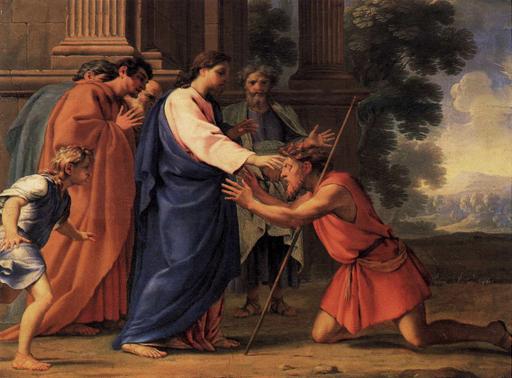
31 And taking the twelve, he said to them, “See, we are going up to Jerusalem, and everything that is written about the Son of Man by the prophets will be accomplished. 32 For he will be delivered over to the Gentiles and will be mocked and shamefully treated and spit upon. 33 And after flogging him, they will kill him, and on the third day he will rise.” 34 But they understood none of these things. This saying was hidden from them, and they did not grasp what was said. 

35 As he drew near to Jericho, a blind man was sitting by the roadside begging. 36 And hearing a crowd going by, he inquired what this meant. 37 They told him, “Jesus of Nazareth is passing by.” 38 And he cried out, “Jesus, Son of David, have mercy on me!” 39 And those who were in front rebuked him, telling him to be silent. But he cried out all the more, “Son of David, have mercy on me!” 40 And Jesus stopped and commanded him to be brought to him. And when he came near, he asked him, 41 “What do you want me to do for you?” He said, “Lord, let me recover my sight.” 42 And Jesus said to him, “Recover your sight; your faith has made you well.” 43 And immediately he recovered his sight and followed him, glorifying God. And all the people, when they saw it, gave praise to God.

In the name of Jesus. Amen.

Generally, when we let our imagination go wild, we like to be the heroes. Boys imagine hitting a grand slam in Game 7 bottom of the 9th two outs down by three, or they imagine they are the receiver who dives to catch the hail Mary as time expires to win the Super Bowl. Girls imagine they are Cinderella dancing the night away with Prince Charming, and getting engaged after he returns her glass slipper. Even when it comes to Bible stories, we like to imagine that we are Joshua toppling the walls of Jericho or David slaying Goliath or Elijah defeating the prophets of Baal.

In the two parts of today’s text – the Passion prediction and the healing of the blind man – the only hero is clearly Jesus, and He fully embodies the perfect love that was described in our Epistle reading (1 Co. 13:1-13). This is the third time Jesus explains to the disciples that He is going to Jerusalem to be betrayed, mocked, shamefully treated, spit upon, flogged, crucified, and raised from the dead. But the disciples don’t understand Jesus, the saying is hidden from them, and they could not grasp what Jesus said.

Still, Jesus’ love is on full display. Jesus is patient with and kind toward them. He is not irritated or resentful at their thick skulls. Jesus is going to Jerusalem and will endure all these things because His love does not insist on its own way. Instead, Christ submits to His Father’s will in perfect obedience.

By going to the cross, Jesus will bear all things. All the burdens, all the sins, all the transgressions, all the iniquities, all the wrongdoings, all the evil, all the brokenness of this fallen world – Jesus will bear all of it in His body (1 Pet. 2:24). He does it all for you. Jesus’ journey from His throne in heaven, down into your flesh. His fasting and temptation in the wilderness. His path through the lands of Israel with no place to lay His head (Lk. 9:58). His teaching, healing, casting out demons, forgiving, and restoring. His triumphal entry. His betrayal. His suffering. His death. His burial. His three day rest in the tomb. His resurrection. His ascension. And His continual rule and authority over all things is a journey of love for you.

Jesus’ entire work is directed outward. He didn’t need to do any of that to benefit Himself, and He doesn’t do it for His own, personal gain. He does it because He loves you. And this love of Jesus wasn’t based on your loveliness. It was based on the fact that the God the Father loves you and wanted to rescue you. So, Jesus, God the Son, loved you and did everything necessary to save you.

God hated seeing what sin and death had brought to His creation, so He did something about it by undoing sin and death by the death and resurrection of Jesus. Christ lived the life we were unable to live. He obeyed the whole will and Law of God that we were unable to obey. He took up His cross, endured punishment that you and I deserved, and gave up His dying breath. All of this is done for you.

Jesus does all of this with full knowledge. None of it surprised Him. Christ knew exactly what is going to happen to Him. And still, He goes and does all of this to love you with His perfect, pure love. 

Back in Lk. 9:51, we are told that Jesus had “set His face to go to Jerusalem.” In other words, Jesus is determined to do this loving thing for you. He was focused on redeeming creation, on getting there, and accomplishing it. He goes toward Jerusalem in love.

Day after day, Jesus gets closer to His goal until He arrives in the city of Jericho, which is about fifteen miles from Jerusalem. He’s close – about a day’s journey from the city. But Jesus isn’t in a rush. Sometimes, when you have to do things that you know are going to be unpleasant and painful, you just want to get it over with and put in your rearview mirror. Again, Jesus doesn’t do that. Instead, He paused along His way through Jericho.

Christ hears the blind man’s cry, “Son of David have mercy on me.” Jesus doesn’t say, “I’ve got more important things to do. I’m going to have mercy on you when I get to Jerusalem and go to the cross.” No. Our Lord stops.

The cry for mercy from any corner of His creation gets Jesus’ full attention. He commands that the blind man be brought to Him. Jesus asks him, “What do you want Me to do for you?” “Lord, let me recover my sight.” And in love, Jesus gives the man the mercy he desired. “Recover your sight; your faith has made you well.”

Jesus’ mission to be the Savior of all creation does not stop Him from pausing to give His mercy to the individual He meets along the way. He pauses and heals him.

Dear saints, Lent begins on Wednesday, and Lent is a good time for us to pause and consider all that God has done for us. Today, pause and ponder whom you are most like in this text. Again, we’re not the hero; we’re not Jesus. Instead, sometimes, we’re like the disciples who do not understand or grasp what God is doing for us and saying to us. Sometimes, even though God has plainly and clearly spoken, we are blind and don’t understand what God is doing.

Sometimes, we are broken like the blind man. Even though the blind man could not see with his physical eyes, he understands who Jesus is and what He has come to do. Despite his physical blindness, he has faith that Jesus can and will restore what is broken. So, when Jesus is present, he cries out for mercy. And Jesus gives him the mercy, restoration, and healing that he needed. Maybe, like the blind man, you look foolish to the world how you relentlessly call out to Jesus for His mercy.

Whom are you more like? It probably depends on the day, maybe even the moment.  Whether you don’t have any clue of what God is up to like the disciples or whether all you can do is cry out for mercy, the thing to do is follow Jesus.

Notice that even though the disciples don’t get all the things that God had said through Jesus and through the Scriptures, even though they are blind in their hearts and minds – what do they do? They go with Jesus. They follow Him to Jerusalem and the cross. The blind man, even though he could not see anything until Jesus gave him the sight he desperately wanted, what did he do? He followed too.

Whether you understand what God is up to or not, the conclusion is the same. Follow Jesus. Follow Him to the cross. No matter where you are in your journey through life, no matter how much you understand what God is doing, no matter how much you need from God, no matter how much God has already given you, follow Jesus to the cross.

Stay the course. And as you go with Christ, He will give you ample reasons to glorify God and give Him praise. Amen.

The peace of God, which surpasses all understanding, will guard your hearts and minds in Christ Jesus. Amen.
Silently Accused – Sermon on Matthew 26:1-27:66 for Palm Sunday

Matthew 26:1-27:66

In the name of Jesus. Amen.

It doesn’t matter how familiar you are with a passage of Scripture, there’s always something more to see, to glean, to meditate on. That’s true for short, familiar passages, but it is certainly true for a long passage like this. While preparing this week, what struck me in a fresh way is what Matthew tells us in Mt. 27:20. The chief priests and elders persuaded the crowd to ask for Barabbas and destroy Jesus.

Of the four Gospels, Matthew is the sharpest on this. They don’t persuade the crowd to just kill, execute, or even crucify Jesus. They want Him destroyed. That’s their desire.

There is utter malice behind this. Jesus looks so weak. He had already been betrayed by Judas. The other eleven disciples fled when He was arrested. Peter denied even knowing Him. Jesus had been mocked, spit upon, beaten, bound, and whipped. And they still call for Jesus to be destroyed. The cruelty of wanting Jesus destroyed is absolutely astounding.

But through all of it, Jesus barely speaks. Jesus talks a lot at the beginning of this reading while He is with the disciples, but once He is arrested, He only speaks three more times before His death here in Matthew’s gospel. All these false accusations are thrown at Him, but He doesn’t respond to any of them. Jesus just stays passive and silent as He is accused. Again, He looks weak.

During His trial before Caiaphas, all sorts of false charges are brought against Jesus, but He simply stands there and receives them. He doesn’t say a word. He only talks when Caiaphas demands, “Tell us if you are the Christ, the Son of God” (Mt. 26:63). But then, Jesus says, “You have said so. But I tell you, from now on you will see the Son of Man seated at the right hand of Power coming on the clouds of heaven.”

It sure doesn’t look like Jesus is seated at the right hand of Power through the rest of His Passion. His silence looks like weakness, but that’s not how we should see it. It is powerful.

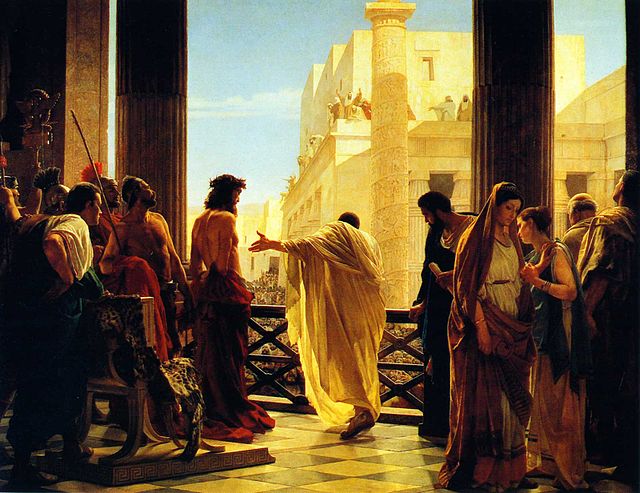
Jesus doesn’t speak again until Pilate asks Him, “Are you the King of the Jews?” There, Jesus says,“You have said so.” But again, as the chief priests and elders accuse Jesus before Pilate, Jesus is silent (Mt. 27:12). Even though Pilate asks Jesus to respond to all these accusations, Jesus still gives no answer, not even to a single charge. In His silence, Jesus looks weak and passive.

All of this reminds me of the scapegoat. Do you remember what God had commanded His people to do on the Day of Atonement (Lev. 16)? Each year, there were two goats. One was sacrificed and the blood of that goat allowed the high priest to enter the Holy of Holies. But the other goat, the scapegoat – it had a different purpose. The high priest laid both of his hands on the head of that goat and confessed all the iniquities, all the transgressions, and all the sins of the people. And God said that what happened there was that the high priest was placing all that sin on the goat’s head (Lev. 16:21).

And what do you suppose that goat did during that? It couldn’t object. The goat didn’t say, “Hey, what do you think you’re doing?” The goat remained passive and silent and simply received it. Once all those sins were placed on that goat’s head, it was led into the wilderness carrying all those sins away from the sinners (Lev. 16:22). The scapegoat and all those sins were destroyed, never to be seen again. Yes, the scapegoat was passive, but by it God powerfully removed those sins.

Pilate hears all these accusations and sees how Jesus is silent. He knows these religious leaders want Jesus destroyed for no good reason, but Pilate has an idea. Pilate has the notorious Barabbas in custody who had committed murder and started a riot and insurrection (Mk. 15:7; Lk. 23:18-19). Pilate puts Barabbas and Jesus forward as his nominees to potentially be released. It seems as though Pilate figured Barabbas was such a rotten individual and danger to society that the crowds would rather have Barabbas crucified for their own safety and protection. But the crowd calls out for Barabbas to be released and for Jesus to be crucified.

And that’s what Jesus wants too. So, Jesus stays silent, passive, and powerful.

It was God’s will that Jesus should be on the cross instead of Barabbas. By taking Barabbas’ place on that cross, Jesus also takes your place under God’s wrath against your sins.

God takes all this evil, malice, and injustice and uses it for your eternal good (Ro. 8:28). Jesus’ Passion isn’t a tragedy. It is God’s victory. In fact, this is the victory. Jesus’ silence in all of this isn’t weakness. It’s God’s power because this is God’s plan playing out. This is how God powerfully removes your sins from you as far as the east is from the west (Ps. 103:12). Jesus is crucified and heaven rejoices to see God’s great, powerful love for His creation. This is how God loves the world. This is how God loves you.

Jesus silently takes all those accusations, He is loaded up with all your sins, and He is led into the wilderness of death as He is crucified and destroyed. But death will no power over Him.

Dear saints, welcome to Holy Week. Easter is coming. Amen.

The peace of God, which surpasses all understanding, will guard your hearts and minds in Christ Jesus. Amen.
Purified & Redeemed – Sermon on Hebrews 9:11-15 for the Fifth Sunday of Lent

Hebrews 9:11–15

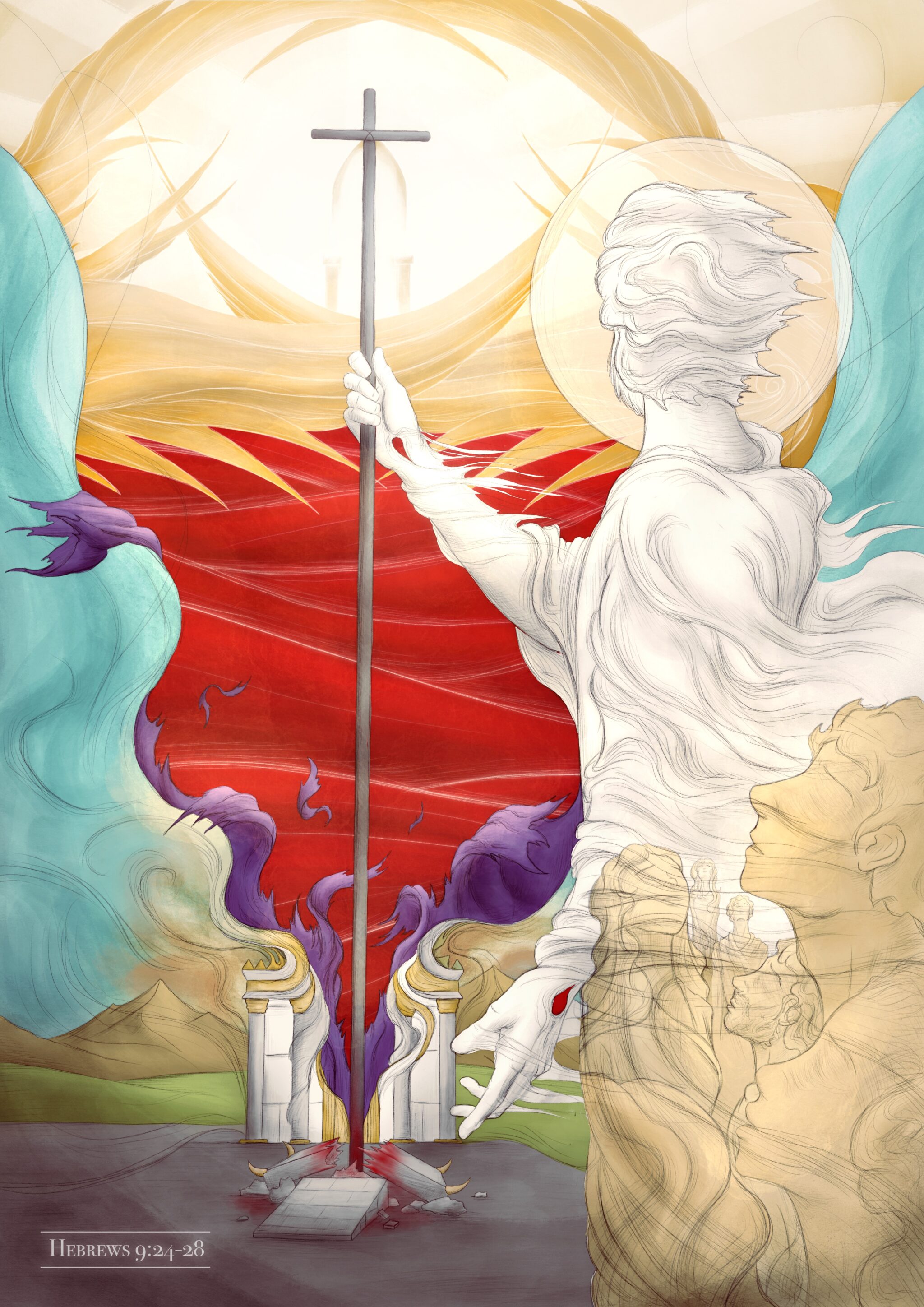
11 But when Christ appeared as a high priest of the good things that have come, then through the greater and more perfect tent (not made with hands, that is, not of this creation) 12 he entered once for all into the holy places, not by means of the blood of goats and calves but by means of his own blood, thus securing an eternal redemption. 13 For if the blood of goats and bulls, and the sprinkling of defiled persons with the ashes of a heifer, sanctify for the purification of the flesh, 14how much more will the blood of Christ, who through the eternal Spirit offered himself without blemish to God, purify our conscience from dead works to serve the living God. 

15 Therefore he is the mediator of a new covenant, so that those who are called may receive the promised eternal inheritance, since a death has occurred that redeems them from the transgressions committed under the first covenant.

Innocent Blood – Sermon on Matthew 26:1-27:66 for Palm Sunday

Matthew 26:1-27:66

In the name of Jesus. Amen.

Matthew is the only one of the four Gospels that tells us what happened to Judas after Jesus was arrested and condemned (Mt. 27:3-10). Judas was overcome with regret and guilt because he knew that God had cursed anyone for taking a bribe to shed innocent blood (Dt. 27:25). Our translation says that Judas “changed his mind” (Mt. 27:3). In Greek, it’s one word (μεταμέλομαι) that is similar to the word for repentance (μετανοέω), but the change of mind Judas had was only one-sided. And here’s what the text conveys: Judas was very sorry. He wished that what he had done could be undone. He regretted his betrayal, but Judas did not repent the way Christians repent. Christian repentance has two parts. It includes the regret and change of mind Judas had. But saving repentance goes one step further. Christian repentance also trusts and believes in God’s grace and mercy given on account of Jesus’ death and resurrection (Mk. 1:15). Judas was lacking that faith and trust.

That lack of faith in God’s mercy is why Judas goes to the chief priests and elders. He doesn’t know where else to turn even though he had been taught better. Sadly, Judas brings his confession to the wrong place. Judas went to the Temple which had been the place of forgiveness (1 Kgs. 8:30), but the night before, Jesus had clearly told Judas and the rest of the disciples that He was instituting the New Covenant (Jer. 31:33-34) in His Blood for the forgiveness of sin (Mt. 26:26-29). The result was that Judas went to the very ones who had been seeking Jesus’ death (Mt. 26:14-15). Judas knew where he needed to go for forgiveness – he had been told just a few hours earlier. But instead of going to Jesus, he sought forgiveness where it could not be found.

Judas’ confession of sin and his action of returning the thirty pieces of silver were both right. He had betrayed innocent blood and returning the payment he received for his sin was what he should do. But his sorrow and penance could not undo what he had done; it could not remove the guilt of his sin. The chief priests and elders were supposed to be forgivers, absolvers, and ministers of atonement. Yet, after hearing Judas’ confession, they refuse to lift the burden of guilt from him. Instead, they bind Judas’ sin and betrayal on his head. “What is that to us? See to it yourself” (Mt. 27:4). What a chilling, horrific thing to say to someone who is crushed with guilt.

Throughout the Gospels, those religious leaders had tried to convict Jesus of sin. They would accuse Jesus and the disciples of eating with defiled hands (Mt. 15:1-20) and of eating and associating with tax collectors and sinners (Lk. 15:1-2). They were always trying to trap Jesus (Mt. 22:15-40). You would think that they would at least tell Judas something like, “Don’t worry, Jesus isn’t innocent. He’s a sinner. He’s dangerous. He’ll bring trouble to all of us with his teaching.” But they don’t. They don’t try to convince Judas that Jesus was guilty. They don’t even offer that little shred of comfort to Judas. It appears as though they also know that Jesus was innocent. Back in Mt. 23:2-4, Jesus rightly said of them, “They tie up heavy burdens, hard to bear, and lay them on people’s shoulders, but they themselves are not willing to move them with their finger.”

If the chief priests and elders had offered Judas forgiveness, it would have required them to admit their own guilt. Again, they were the ones who conspired with Judas to shed Jesus’ innocent blood. But instead of repenting, they insisted they were doing the right thing in condemning Jesus. So, they become absurdly hypocritical.

After Judas throws the pieces of silver in the Temple, they quickly work to get that money out of the Temple because it is blood money. They recognize they cannot put the bounty they had placed on Jesus’ head back in the holy treasury because it is unclean money (Dt. 23:18). But (here’s the hypocrisy) they were the ones who defiled that holy money. They were the ones who took it from the treasury. They were the ones who turned that silver into blood money using it to pay Judas for his betrayal (Mt. 26:15).

While it is tempting to despise the chief priests and Judas, in Christian humility we need to recognize that we do just as they did. Too often, we are filled with sinful desires and passions and make any excuse to attempt to justify them. Too often, we will do all sorts of horrific things and try to hide them under the guise of holiness while we ignore the carnage it wreaks on others. Too often, we are like Judas and don’t realize how destructive our behavior is until it’s too late. When we do, finally, realize the great harm we have done, it can lead us to despair. And despair is a dangerous place to walk. Judas despairs of all hope and kills himself. Judas is condemned, not because he kills himself, and not even because he betrayed Jesus. Jesus’ death covered even Judas’ sins of suicide and betrayal. Judas is condemned because he died outside of faith in Jesus’ grace and mercy. Jesus calls Judas the “son of destruction” (Jn. 17:12) and says that it would have been better for Judas if he had never been born (Mt. 26:24). Jesus never says anything like that about His sheep.

Please allow me a brief aside here: Suicide, self-murder, is not the unforgivable sin. Can people commit suicide and still be a Christian? Yes. To those of you who have lost someone to suicide, you can have comfort in the promises of Scripture. Christ Himself is the man of sorrows, acquainted with grief (Is. 53:3). When someone is walking in grief, depression, and even in the valley of the shadow of death, Jesus is with them (Ps. 23:4) and desires to save them (1 Tim. 2:4). In that deathly vale, Jesus calls to them, “Come to Me, all who labor and are heavy laden, and I will give you rest” (Mt. 11:28). All that being said, suicide is an evil death and is never the answer to despair.

The answer to all sin and despair is in the innocent Blood of Jesus which has been shed for you. His innocent Blood was shed to cleanse you of your guilty blood. Whenever you recognize your guilt and sin against God, bring those sins to Christ. Let Him deal with them because He has dealt with them in His death and resurrection. He is the Lamb of God who takes away the sin of the world (Jn. 1:29). 

The answer to sin is the innocent Blood of Jesus that He freely gives to you in Holy Communion. And now, Jesus invites you to His table to receive that Blood which He will put in your mouth. Here, Jesus’ innocent Blood becomes your blood. Dear saints, come, take, eat, and drink the perfect, innocent Blood of your Savior which He has shed for the forgiveness of all your sins. Amen.

The peace of God, which surpasses all understanding, will guard your hearts and minds in Christ Jesus. Amen.
See and Rejoice – Sermon on John 8:42-59 for the Fifth Sunday in Lent

John 8:42-59

42 Jesus said to them, “If God were your Father, you would love me, for I came from God and I am here. I came not of my own accord, but he sent me. 43 Why do you not understand what I say? It is because you cannot bear to hear my word. 44 You are of your father the devil, and your will is to do your father’s desires. He was a murderer from the beginning, and does not stand in the truth, because there is no truth in him. When he lies, he speaks out of his own character, for he is a liar and the father of lies. 45 But because I tell the truth, you do not believe me. 46 Which one of you convicts me of sin? If I tell the truth, why do you not believe me? 47Whoever is of God hears the words of God. The reason why you do not hear them is that you are not of God.”

48 The Jews answered him, “Are we not right in saying that you are a Samaritan and have a demon?” 49Jesus answered, “I do not have a demon, but I honor my Father, and you dishonor me. 50 Yet I do not seek my own glory; there is One who seeks it, and he is the judge. 51 Truly, truly, I say to you, if anyone keeps my word, he will never see death.” 52 The Jews said to him, “Now we know that you have a demon! Abraham died, as did the prophets, yet you say, ‘If anyone keeps my word, he will never taste death.’ 53 Are you greater than our father Abraham, who died? And the prophets died! Who do you make yourself out to be?” 54 Jesus answered, “If I glorify myself, my glory is nothing. It is my Father who glorifies me, of whom you say, ‘He is our God.’ 55But you have not known him. I know him. If I were to say that I do not know him, I would be a liar like you, but I do know him and I keep his word. 56 Your father Abraham rejoiced that he would see my day. He saw it and was glad.” 57 So the Jews said to him, “You are not yet fifty years old, and have you seen Abraham?” 58 Jesus said to them, “Truly, truly, I say to you, before Abraham was, I am.” 59 So they picked up stones to throw at him, but Jesus hid himself and went out of the temple.

In the name of Jesus. Amen.

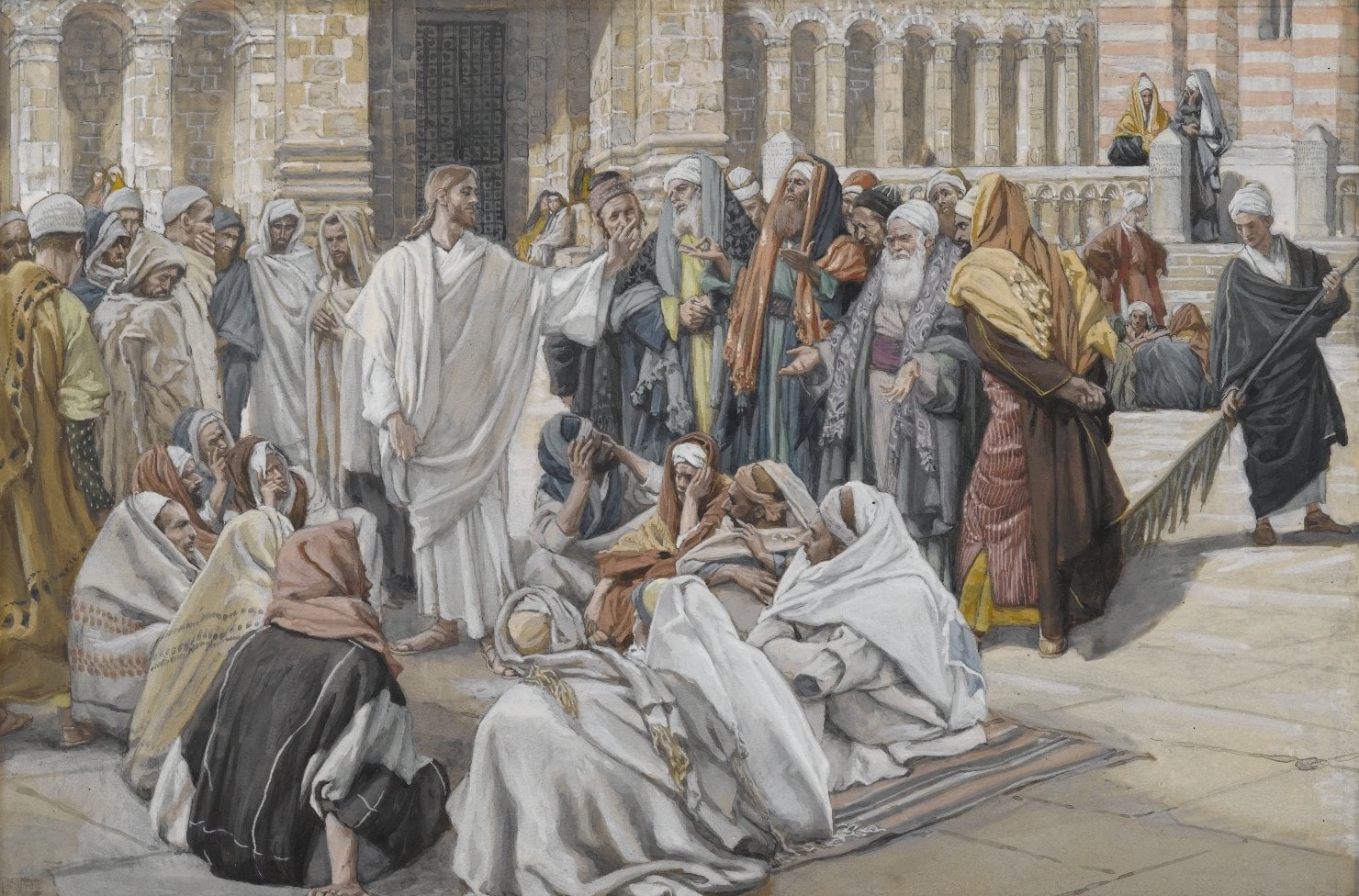
This portion of John is one of the high points of the four Gospels because, here, Jesus pulls back the veil and reveals Himself to be God saying, “Truly, truly, I say to you, before Abraham was, I am.” There is a whole sermon there, but it will have to wait until the next time this text rolls around. Today, we’re going to consider just two sentences from our Lord. The first reveals just how stubborn mankind is in our sin and how desperate we are to believe lies, and the second sets us up for the Scripture readings we are going to be hearing next Sunday and through Holy Week.

In the last half of v. 46, Jesus asks, “If I tell the truth, why do you not believe Me?” That question should startle us – especially because it comes from the lips of our Savior. In our fallen, sinful state, we are willing to reject the truth even when it stares us in the face. When the truth is difficult and hurts us, we would rather live by lies than change course. We have this false idea in our minds where we think that if people are presented with the facts so that the truth is crystal clear, then everybody will agree and everything will be right in the world. But that is false.

Here, Jesus, who is the Truth (Jn. 14:6), speaks the truth to the people in the Temple, but they refuse to believe and are ready to stone Him. No matter how clearly the truth is spoken or how authoritative the speaker of truth is, there are some who will simply reject it and refuse to live in reality.

Sometimes, we think that problems we face are caused by the news channels, social media suppression, or other sources of misinformation. Those things certainly don’t help. But don’t imagine that if someone waived a magic wand and made all those things disappear that, suddenly, everything would be right in the world and everyone would automatically believe the truth. People didn’t believe Jesus when He spoke the truth. And even worse, Jesus was persecuted when He spoke the truth. Dear saints, we should expect the same. In fact, that is exactly what we see today.

The reason people reject truth, especially the truth about God, is that we are by nature children of wrath (Eph. 2:3). Because of our sin, we do not and cannot love God. We cannot come to Him or understand Him. Instead, we naturally run away from Him. But God still desires to bring you back unto Himself. So, God goes out to battle and fights for you. And – it is so important to understand this – when God fights for you, yes, He is fighting against Satan and the demons, against sin and death. But even more importantly, when God fights for you, He is even fighting against you, against your sinful nature and mine.

The texts through Lent have all been about this fight. The first Sunday of Lent, we saw how Jesus fought against the devil in His temptation (Mt. 4:1-11). The second and third Sundays of Lent, we saw how Jesus fought against the demons (Mt. 15:21-28, Lk. 11:14-28). Last week, we saw how Jesus fought against the crowds who wanted Jesus to satisfy all their fleshly desires and make Him a bread king (Jn. 6:1-15). Today, there is an obvious fight between and the crowds as Jesus simply speaks truth and is rejected. The crowds were so adamant in their rejection they are ready to stone Him (Jn. 8:59). And those crowds would have killed Jesus if it had been His time to die, but it wasn’t His time – not yet. But in next week’s Gospel lesson, which will be Matthew’s account of Jesus’ passion (Mt. 26:1-27:66) and then again in the texts for Good Friday, it will be Jesus’ time to die. The same crowds will call for Jesus to be crucified. And there, on the cross, Jesus will fight the final, decisive battle against all the forces of evil.

Lent is about God fighting against evil. When we get to Easter and the Resurrection, we will celebrate Jesus’ victory. With the resurrection, Jesus reveals His victory over all evil, even the evil within you and me. Because of the resurrection, you can know that Christ has snatched you away from the kingdom of darkness and transferred you to His kingdom of light (Eph. 1:13, 1 Pet. 2:9). And as His people, we will celebrate His victory. On Easter, we will rejoice and sing, and our hearts will be glad when we celebrate the resurrection. But what will we do, and how will we react, as we hear Jesus fighting that battle? What will be our response as we see Jesus going to the cross and suffering God’s eternal wrath against our sin?

Some of you have mentioned to me how you don’t like Good Friday and Christ’s crucifixion and would much rather jump straight to Easter and the resurrection. Now, I understand the sentiment. I do. But there is no Easter joy, no resurrection gladness, apart from Good Friday. Easter cannot happen unless Jesus dies first. One of the Sunday school teachers (and I apologize, but don’t remember who it was) mentioned to me in the past couple weeks how one of their students asked why call the day of Jesus’ death ‘Good Friday.’ What is good about that? Well, today Jesus tells us.

Jesus makes a comment in v. 56 of today’s text that helps us know how to approach the texts of Holy Week and how to see His crucifixion. Jesus says, “Your father Abraham rejoiced that he would see My day. He saw it and was glad.” What is Jesus talking about there? Notice, Jesus doesn’t say that Abraham ‘believed in My day and was glad.’ No. Abraham saw it and was glad. Well, Abraham saw Jesus’ day in our Old Testament text (Gen. 22:1-14).

There, when Isaac was spared from being sacrificed, Abraham sees the ram caught in a thicket by its horns. And Abraham doesn’t have to be told anything. Immediately, Abraham takes Isaac off the wood and places the ram in Isaac’s place. Abraham sacrifices the ram instead of Isaac, Abraham’s beloved son. Through that sacrifice, God is visibly showing Abraham what He will do through Jesus, His only-begotten Son. In that text, Abraham saw what God would do in and through Jesus as He goes to the cross in your place. Abraham saw, rejoiced, and was glad.

Dear saints, as we approach the crucifixion and see Jesus’ day of victory over sin, death, the devil, and our own sinful flesh, let us see and rejoice as well. Jesus willingly goes to the cross in your place. There on Mt. Calvary, Christ wins the victory and battle for you. As we approach Holy Week, let us look to Jesus, the founder and perfector of our faith and remember that Scripture says it was “for the joy,” the joy, “that was set before Him, He endured the cross” (Heb. 12:2) for Abraham, for Isaac, for you, and for all sinners.

Dear saints, on the cross your Savior has won the battle. Christ has shed His blood and with that blood, He now cleanses your conscience from dead works to serve the living God. Come now and receive the Body and Blood of your Savior who brings you into the new covenant and to your promised, eternal inheritance (Heb. 9:14-15). Amen.

The peace of God, which surpasses all understanding, will guard your hearts and minds in Christ Jesus. Amen.
Passion Miracles – Sermon on Matthew 26:1-27:66 for Palm Sunday

Listen here.

Matthew 26:1-27:66

In the name of Jesus. Amen.

The seven sayings of Jesus on the cross are the most important words spoken in all history. We have considered them in the past, and we will hear them again on Friday. But Jesus isn’t the only member of the Trinity speaking during the crucifixion. God the Father speaks too, but not audibly. Instead, the Father speaks through the miracles that take place while Jesus is on the cross, and we are going to give our attention to those today.

The first miracle is the darkness. In the Gospel of Mark, we are told that Jesus was crucified, nailed to the cross, at the third hour (Mk. 15:25), which would be about 9 AM. Then, the Gospels tell us that there was darkness from sixth hour until the ninth hour. In other words, that darkness lasted from noon until 3 PM when Jesus died.

Now, Matthew says this darkness was over “all the land” (Mt. 27:45). The interesting thing there is that the word ‘land’ can mean portions of a country. But most of the time, the word there means the entire earth. Matthew uses it in both senses throughout his Gospel. It could be that this darkness was localized to the region surrounding Jerusalem where Jesus was crucified, but it could have been much more than just that – even the entire earth.

This darkness was not a solar eclipse. Jesus was crucified at the time of the Passover which means there would have been a full moon, and a solar eclipse can only happen at a new moon. Plus an eclipse only lasts minutes, not hours. We also know that this darkness wasn’t the result a bunch of thick, dark clouds gathering. A Greek historian named Phlegon of Tralles, who was born shortly after Jesus’ death, records what he calls an eclipse. He wrote that it became night at noon so that the stars even appeared in the heavens. Now, Phlegon wasn’t a Christian. He might not have even been aware of the Gospels recording this same event. But the dating of his account matches up precisely with the timing of the crucifixion. Today, secular scholars have tried to come up with an explanation for this darkness Phlegon mentions, but they can’t. No astronomical or meteorological explanation can be made, but the historical accounts aren’t denied either.

This darkness happened because of God. God has the authority to turn off the sun if He wants to. Over and over in Scriptures, darkness is a sign connected with God’s judgment and anger over sin. Remember the ninth plague of darkness over the land of Egypt (Ex. 10:21-22). For three hours during the crucifixion, this darkness covered the land.

So, what was going on here; what was God the Father saying with this darkness? Well, Jesus had taken upon Himself the sins of all humanity, and God’s judgment was laid upon Christ (Is. 53:6). Think of all the sins you just heard about: treachery of Judas, the cowardice of Pilate, the blasphemy of the chief priests, the malice of the crowds. All those heinous sins were all placed upon Jesus.

But it was more than that too. The murder committed by Cain, the hard-heartedness of Pharaoh, the continual unbelief of the Israelites, the pagan practices of the inhabitants of Canaan, the adultery of David, every bit of sin in the world up to that point was all placed on Jesus. All the sins that have happened since: the sins of Nero, Hitler, Stalin, bin Ladin, and every other wicked, evil person were laid upon Jesus. Your sins were there too: your anger, lust, pride, gossip, lies, and covetousness. And all the sins that are still to happen in the future. All of it was there in that moment on Christ as He hung on the cross.

All of those sins angered God. He noticed them and was angry because of them. But know this. God only let the darkness of judgment fall when those sins were laid upon Christ and were no longer yours. So, between noon and three on that Good Friday, Jesus took all of those sins. Christ Himself bore your sins in His body on the cross, and by His wounds you are healed (1 Pet. 2:24). That’s why Jesus says from the cross, “It is finished” (Jn. 19:30). His redemption for every sin of every person who has ever lived and will ever live was paid in full. Jesus suffered the punishment of God for it all.

The second miracle was the tearing of the curtain in the Temple. The curtain was thick and heavy, so it was no coincidence that it tore from top to bottom. For hundreds of years, that curtain stood as a barrier between God and all of humanity. Only the priest could go behind that curtain into God’s presence on the Day of Atonement. Remember that both the Tabernacle and the Temple served as copies of heaven (Heb. 8:59:23; Ex. 25:9). So, for generations, that curtain preached a sermon to God’s people that said, “Heaven is off limits to you.” But when the high priest would go in behind the curtain on the Day of Atonement, that yearly event preached another sermon. A very different sermon. That sermon preached that access to heaven would come, but only through a substitute.

So, when that Temple curtain tore from top to bottom, what was God saying? God was saying that you who were once far off have been brought near by the blood of Christ (Eph. 2:13). God is pleased with you now. He loves you, and heaven is open to you because of Jesus’ death.

The third miracle was the earthquake. The same historian I mentioned earlier, Phlegon, he wrote about this earthquake too. And he wrote about it in Nicaea which is almost 700 miles away from Jerusalem. It’s hard to say for certain what this earthquake means – especially because there is another earthquake Easter morning (Mt. 28:2). But remember how the Pharisees wanted Jesus to rebuke the people who were crying out, “Hosanna,” as He rode into Jerusalem? Jesus answers them, “If these were silent, the very stones would cry out” (Lk. 19:36-40) It could be related to that. It could be a sign that God had redeemed all creation by the death of Jesus (Ro. 8:21-23). We can’t say for sure why the earthquake happened. But creation noticed and responded to both the death and resurrection of Jesus.

Finally, the fourth miracle is that many of the saints were raised. We heard how Matthew mentions that these risen saints walked around after Jesus’ resurrection and appeared to many (Mt. 27:52-53). What this shows us is that death is no longer the enemy it was before the death of Jesus. God can raise the dead in an instant. Jesus has paid the price. Disease, death, violence, virus, plague, and pandemic are no longer your enemy. They are all defeated by Christ. 

Dear saints, these miracles prove that you have nothing to fear. Christ has paid the price for your sins. God is on your side. He is risen, and so will you. Your King has come with righteousness and salvation (Zech. 9:9). He has spoken peace to you (Zech. 9:10). Return, you prisoners of hope; return to God, your stronghold (Zech. 9:12).

Christ has humbled Himself for you to death – even death on a cross (Php. 2:8). At the name of Jesus every knee will bow and every tongue confess that He is Lord.

So, yes, “Hosanna! Hosanna to the Son of David! Hosanna in the highest!” Ride on Jesus. Ride on and save us. Welcome to Holy Week. Amen.

The peace of God, which surpasses all understanding, will guard your hearts and minds in Christ Jesus. Amen.

Ride on – Sermon on Matthew 26:1-27:66 for Palm or Passion Sunday

Listen here.

The congregation read the quotes from all the characters (with the exception of Jesus) in the Passion narrative this year.

In the name of Jesus. Amen.

That Gospel reading is a lot to take in – all the injustice, betrayal, brutality, and morbidity. But the whole reason Jesus rode on into Jerusalem was to endure all of this for you. Even though we might wish to turn away from it, we can’t. We must hear, see, look, and ponder because in this reading we see who we truly are.

We are the chief priests who want to get rid of God secretly and stealthily. We are the disciples who think it is possible to give too much to God. We are Judas wanting to gain something earthly from our relationship with Jesus – even though it ends up being less than thirty pieces of silver. We are Peter bragging about our commitment to Jesus, but when the heat gets turned up, we deny. We are the disciples who cannot stay awake while we watch and pray with Jesus.

We are Caiaphas who demands a sign from Jesus and refuses to take Christ at His Word. And when Jesus says something we don’t like, we pass judgment on Him. We are the chief priests who tell those who are crushed under the weight of their sins to go away and figure it out on their own instead of pointing them to God’s mercy. We are Pilate who is given every chance to do the right thing but fails. We are the soldiers who insult and strike Jesus, but we don’t do it with a reed. We do it with our continual sins. And we are the crowds to pass by Jesus and mock Him.

Repent. Repent but do not despair because you are also the centurion who rightly confesses, “Truly this is the Son of God!” (Mt. 27:54). You are the crowds who cry out, “Hosanna,” which means, “Save us now.” You are also the crowds who cry out, “His blood be on us and on our children” (Mt. 27:25). The crowds who shouted those words in our text thought God didn’t see or didn’t care if they put His only begotten Son to death. But, dear saint, you know better. You know that Jesus’ blood is what cleanses you from your sin.

You are Barabbas, a notorious sinner who gets off scot free. You are the thief on the cross who will be with Jesus in paradise. You are Peter who gets restored. You are Simon of Cyrene who lives a life of carrying Jesus’ cross enduring the weight and suffering, but doing it willingly and joyfully because you know that to live is Christ and to die is gain (Php. 1:21). And, God be praised, you will be those who rise from your grave when Christ returns.

Yes, dear saints, this text is some of the most difficult Scripture to read, but at the same time it is the most beautiful because in it you see Jesus’ love for you. Scripture says, for the joy – think of that, for the joy! – that was set before Him, He endured the cross despising its shame, and now, He is seated at the right hand of the throne of God (Heb. 12:2).

Christ’s joy and delight is to redeem and save you by dying on the cross. So, ride on, King Jesus. Ride on and save us. Hosanna in the highest! Amen.

The peace of God, which surpasses all understanding, will guard your hearts and minds in Christ Jesus. Amen.

Our Lord’s Passion – Sermon on Matthew 26:1-27:66 for Palm Sunday

Listen here.

In the name of the Father and of the Son and of the Holy Spirit. Amen.

Throughout history, great kings and rulers have been given great titles. Cyrus, Alexander, and Charles all had “the Great” as monikers. There was also William the Conqueror and Richard the Lion-Heart. Two of my favorites – there was Brochwel “the Fanged” who ruled in Scotland and Ferdinand “the Bomb” who ruled in Italy.

Palm Sunday King of GloryThe main focus of Matthew’s Passion account we just heard is the royalty of Jesus. Christ rode into Jerusalem on a royal donkey just like King David and King Solomon (1 Kgs. 1:38) had done. But Matthew doesn’t focus on Jesus’ royal greatness or magnificence. Instead, Matthew focuses on King Jesus’ innocence. Matthew points us to King Jesus “the Innocent.”

Though Jesus is falsely accused of many things, constant, consistent testimonies keep showing up that our Lord is innocent. After he had betrayed Jesus, Judas confesses, “I have sinned by betraying innocent blood” (Mt. 27:4). Pilate’s wife tells her husband, “Have nothing to do with that righteous man” (Mt. 27:19). Pilate knows that Jesus was innocent and tries to wash his hands of the capital punishment. And the centurion, when he witnessed Jesus’ death, confessed, “Truly, this was the Son of God” (Mt. 27:54). Yes, Jesus was innocent.

Jesus was innocent, but you are not. When you stand on trial before God on the last day, innocence is what you need, not greatness. But, again, you have not been innocent. Instead, you’ve sought to be great, mighty, important, and powerful. In your quest for greatness, you have left a wake of pain and suffering behind you. You’ve been selfish, and your words and actions have hurt those who love you most. By your thoughts, words, and deeds, you place yourself not beside Jesus “the Innocent,” but by Barabbas “the Murdering Rebel” (Lk. 23:19).

But in our Lord’s Passion, guilty Barabbas goes free. The Gospel text you just heard is called “the Passion” because this is how God loved you and the reason that you love Him.

When you hear John 3:16, “For God so loved the world that He gave His only-begotten Son,” have the Passion accounts in your mind. The word ‘so’ in John 3:16 means “in this way.”

King Jesus the Innocent has come into the world to trade places with sinners – to trade places with you. The weight of sin you carry on your back was whipped into His back. Your hurtful actions went into His hands so that your hands may be cleansed. The bitter words you have spoken have gone into His ears so that you can hear the sweet words, “Not guilty,” on the Last Day.

And even now, you are declared to be innocent by God. Connected to Jesus the Innocent’s death and resurrection in your Baptism, there is now no condemnation for you (Ro. 8:1). This is Christ’s love for you.

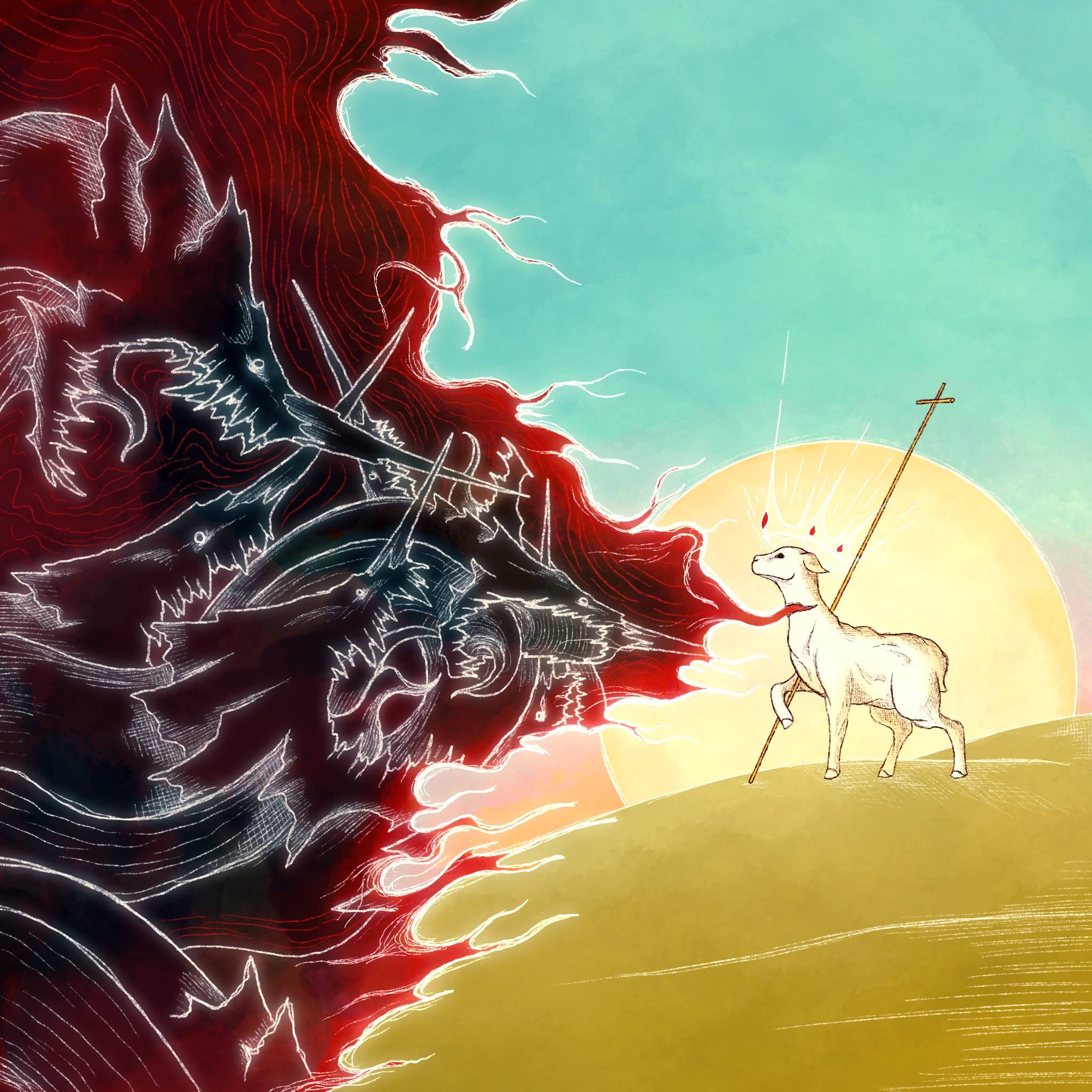
Revelation 17 14 War against the LambJesus has arrived in Jerusalem. The Priest has come to the Temple. The Prophet has come to Mt. Zion. The King has come to His city. But most importantly the Lamb of God has come to His altar, where He would in five days breathe His last and pour out His blood for you (Pr. Wolfmueller). This is your Lord’s Passion, done and completed for you. Amen.

The peace of God, which surpasses all understanding, will guard your hearts and minds in Christ Jesus. Amen.