Wholly Opened – Sermon on Mark 7:31-37 for the Twelfth Sunday after Trinity

Mark 7:31-37

In the name of Jesus. Amen.

No one expects infants to be able to speak from the moment they are born. They cry and fuss and make noises. After a while they start to babble and eventually are able to say “Mama” or “Dada.” For most, it takes more than a year before they are able to say words, and months more before they can put those words together into a sentence. Even then, most people outside the family can’t understand a toddler and need parents to translate. Learning to speak is a long, slow process. That’s not what happens to this man.

Jesus is far from His normal stomping grounds and is in Gentile territory. He has just healed the Canaanite woman’s daughter near Tyre and Sidon and is returning to Galilee, but He takes an odd route. Instead of traveling straight south, He turns east and goes through the region of the Decapolis. That would be like traveling from here to Fargo by way of Bemidji. It appears that Jesus goes out of His way to be at this precise place at this precise time. Even though He’s far from where He spent most of His life, the people there know that Jesus can heal. So, they bring this man who was deaf and mute to Him.

Jesus takes the man away from the crowd and does this little liturgy. He stuffs His fingers into the man’s ears, spits, touches his tongue, looks up to heaven, sighs (lit. ‘groans’), and says one word, “Ephphatha,”which means “Be opened.” Jesus isn’t just acting like a magician with some sleight of hand. His power is displayed through His one-word command to deaf ears. He’s the One who spoke creation into existence (Jn. 1:3). This miracle shows us that the Creator has come down into His creation to undo the Fall. And this comes at a cost to Him.

Mark wants us to ponder that last part where Jesus looked up into heaven and sighed. ‘Sighed’ is a fine translation so long as we see it as a heavy sigh. The word is normally translated ‘groan’ (Ro. 8:23262 Co. 5:24). We should see that Jesus is pained and burdened when He sees what sin and death have done to this man and to all creation. Also, see that these miracles come at a cost to Jesus. They take something out of Him. With this groan, it’s like Jesus is taking the man’s deafness and muteness into His Own body, and it weighs on Him.

And the word Jesus speaks, “Ephphatha,” is interesting. He’s speaking a command to deaf ears, but He doesn’t demand them to open. (Sometimes, I’ll try to open a jar for my wife and command the lid, “Open.” Spoiler alert: lids don’t care about my commands.) That isn’t what Jesus says here. Instead, it’s a passive command, “Be opened.” And they are. (Maybe I should try that next time I come across a stubborn lid.) Immediately, the man’s ears are opened, his tongue is released, and he spoke plainly. The word Mark uses for plainly is orthōs, which is where we get the word ‘orthodox’ and means rightly or correctly.

The remarkable thing is how thoroughly the man is healed. Even though this guy had never spoken, he doesn’t start in the same place as a newborn. He didn’t have to go through the long process of learning words; learning how to manipulate his tongue, lips, and mouth to speak them; and then combining those words into sentences. He spoke as though he had been speaking correctly his entire life. Jesus opened his ears and lips wholly and completely. This is the same kind of power Jesus demonstrates when He rebuked the wind and waves. Jesus simply says, “Peace! Be still!” (Mk. 4:39). The wind didn’t slowly die down. It ceased. The white caps didn’t turn to rolling waves then ripples. The sea turned to glass. The same thing happens here. The results are immediate and complete. He opened this man the same way—wholly. 

This is what Isaiah had promised in our Old Testament reading (Is. 29:17-24), “In that day the deaf shall hear the words of a book, and out of their gloom and darkness the eyes of the blind shall see” (Is. 29:18). The man had been closed in the gloom and darkness of silence, but the word of Jesus reaches him and does its work. The man hears and speaks the way he was created to hear and speak. Our Lord opens his lips, and his mouth declares God’s praise (Ps. 51:15).

God created our ears to hear His Word and our lips to respond in worship. Faith comes from hearing, and hearing through the Word of Christ (Ro. 10:17). With the heart one believes and is justified, and with the mouth one confesses and is saved (Ro. 10:10). Now, this man can do both. He hears the Word and speaks it rightly.

Throughout the Gospels, Jesus often heals immediately. This man. The woman who had been bleeding for twelve years is made well the moment she touches His garment (Mk. 5:25-34). Lazarus (Jn. 11:43-44). The blind, the sick, the lame, and the leprous are all made whole at His word (Mk. 1:34).

We often pray and desire those immediate results. We want the diagnosis reversed now. We want the relationship fixed now. The grief gone now. The wandering soul to repent and be saved now. We pray for all sorts of things and want God to have it done before we finish with our “Amen.”

Sometimes, God will do that. More often, He makes us wait. But in that waiting, He is doing something more. So, what should we do when we have to wait? We remember and retreat to His promises.

God is not slow to deliver on His promises (2 Pet. 3:9). He is not reluctant or limited in giving us what is good. The same Jesus who immediately and wholly opened this man is the One who hears your prayers. If the full restoration is delayed, it is not because He cannot do it. Instead, it is because God knows what He is doing. He is working a better opening than the one we have imagined. He is teaching us to live by every word that comes from His mouth (Dt. 8:3), and not only by the kind of answers we can see and hear right now.

So, when you have to wait, you can groan with Jesus at the fallen state of creation. But you do not groan without hope (Ro. 8:23-24). Christ has given you the Holy Spirit to open your ears to the Gospel. Let His promises drown out the noise of the rest of this broken world. Your tongue has been loosed. Use it to confess that He has defeated death by His death and resurrection and that He now reigns.

Even as you live through things that are not as God intended them to be, you know that Christ’s return is coming. Jesus Himself will descend from heaven with another word—a cry of command (1 Th. 4:16). That cry will be another “Ephphatha.” The graves will open. Ears that have been closed by death will hear. Tongues that have decayed will speak correctly. The meek shall obtain fresh joy, and the poor shall exult in the Holy One of Israel (Is. 29:19). He will make all things new (Rev. 21:5). Until that day, you wait. But you wait with Christ’s Word in your ears and the confession of His Gospel on your tongue.

Dear saints, your Savior has done all things well, He does all things well, and He will do all things well. He knows what He is doing. The One who spoke “Ephphatha” to this man will speak again over all creation. And in that day, nothing will remain closed. It will all be wholly opened. Amen.

The peace of God, which surpasses all understanding, will guard your hearts and minds in Christ Jesus (Php. 4:7). Amen.
Devoted & Multiplied – Sermon on Acts 2:41-47 for the Fourth Sunday of Lent

Acts 2:41-47

In the name of Jesus. Amen.

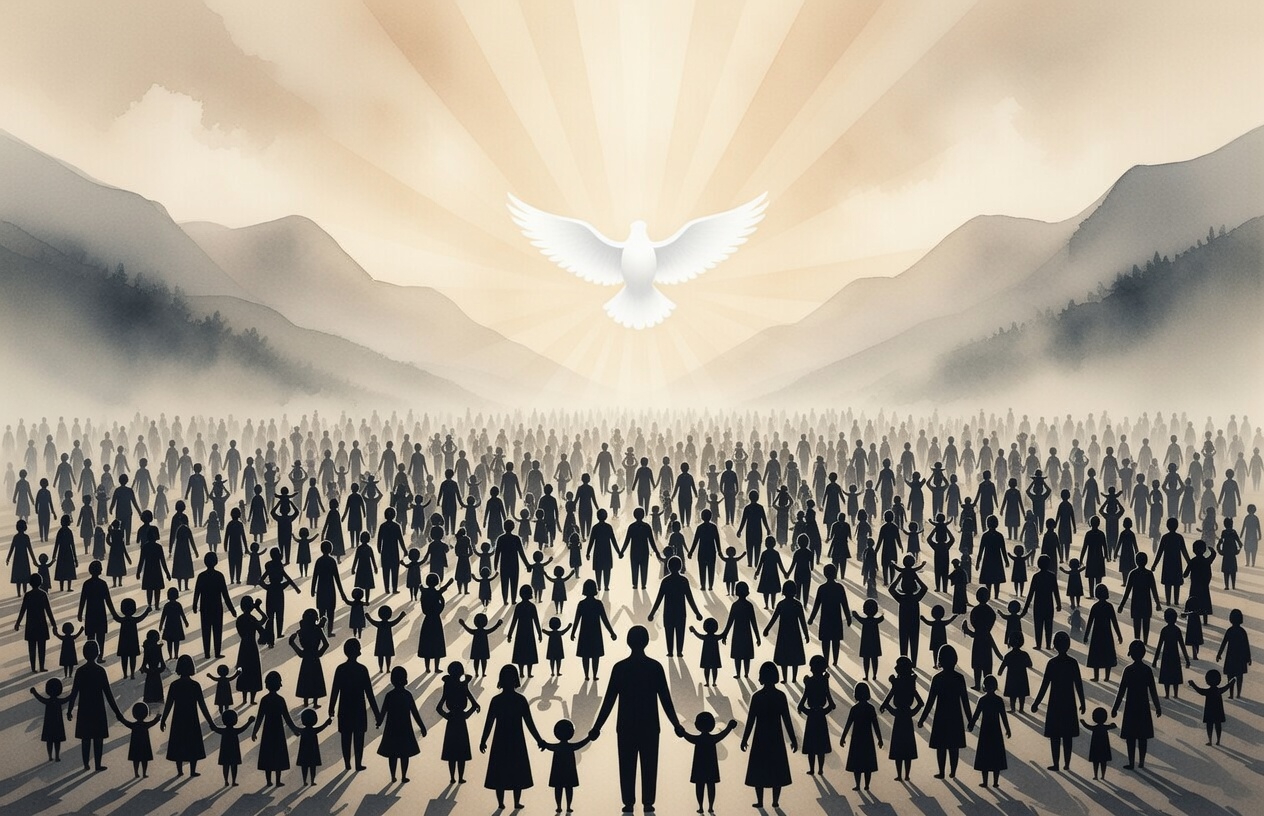
It’s not uncommon to hear people – both Christians and unbelievers – say that the current Church is nothing like what depicted here on the day of Pentecost and the first days following Pentecost. You can hear heathen unbelievers say that Christians are just a bunch of selfish capitalist hypocrites while the Church here in Acts 2 was communist. I said it a few weeks ago, but I’ll say it again. Don’t let people who hate God and His Word interpret Scripture for you. Jesus didn’t institute a Communist church. Here, the believers are lovingly and willingly selling their possessions and giving them away. These brothers and sisters in Christ were saying, “What’s mine is yours.” Communism is different. Communism says, “What’s yours is mine. And we’ll make sure the state agrees, takes it from you, and gives it to someone else.” The early New Testament Church wasn’t Communist, but it was commonist [sic.]. There’s a big difference. Communism is when the state breaks the seventh Commandment, “Thou shalt not steal.”

But even Christians will lament and say that today’s Church isn’t like the believers here in Act. 2. They’ll say, “That was the real Church. It was vibrant, united, multiplying. And look at it now. It’s antiquated, old, dying.” They think we’ve lost something and that we need to get back to what we see in the early days after Pentecost.

That simply isn’t true. The pattern of life that those first Christians had is exactly what we have here – maybe not identically, but substantively. That isn’t to say that we are flawless – far from it. Do we have issues? Yup. That’s why we confess our sins every week. We do it for good reason. We are in constant need of God’s absolution. But the same living Lord who Baptized those 3,000 souls in May of 33 AD in Jerusalem is the same Savior who gathers us here in East Grand Forks in 2026. Christ’s work in them and among us is the same, and the pattern of life they had is the pattern we have.

After Peter’s Pentecost sermon pierced their hearts (Act. 2:37), those 3,000 repented, were Baptized for the forgiveness of their sins, and received the Holy Spirit. Then, what did they do? They devoted themselves to the apostles’ teaching and the fellowship, to the breaking of bread and the prayers.

That word translated ‘devoted’ is strong. It means they steadfastly persisted in these things. They held on to those things like a man clinging to a lifeline in a storm in the middle of the ocean. It wasn’t optional. It was essential. And notice what these pillars were. In our translation, it looks like there are four, but it might be only three. I’ll explain when we get there.

First, they devoted themselves to the apostles’ teaching. The apostles were the men Jesus had chosen, taught, and sent to be His witnesses (Act. 1:8). They proclaimed what they had seen and heard – the life, death, resurrection, and ascension of their Lord and Savior and your Lord and Savior. Through their teaching, the early Christians heard the voice of Christ Himself (Jn. 13:201 Th. 2:13). Jesus sent them to proclaim and teach how Moses, the Prophets, and the Psalms – all the Old Testament – pointed to Him (Lk. 24:44-48). Their teaching wasn’t just bland, mundane information. It was life-giving truth that nourished their souls day by day.

Second, the believers devoted themselves to “the fellowship.” The Greek word there is koinonia. It’s two Greek words smooshed together that mean ‘common’ and ‘union.’ The believers weren’t just acquaintances. They were family and a body (1 Co. 12:12ff) bound together by their unity with Jesus.

Next is “breaking of bread.” There’s no question that ‘breaking of bread’ here refers to Communion, the Lord’s Supper, where Jesus gives His true Body and Blood for the forgiveness of sins (Mt. 26:26-291 Co. 11:23-25). Grammatically, it could be that Luke intended that the “breaking of bread” is directly tied to the “fellowship” he just mentioned. I won’t get too technical about the grammar. (You’re welcome.) Luke might be mentioning two pairs of things the people were devoting themselves to – the apostles’ teaching and fellowship, as well as Communion and the prayers. But it’s also possible Luke is listing three things – 1) the apostles’ teaching, 2) the fellowship that comes from the breaking of bread in the Lord’s Supper (1 Co. 10:16), and 3) the prayers. When we meet Luke at Jesus’ feet, we can ask if he intended this to be three or four things.

Finally, the first Christians devoted themselves to the prayers. ‘The prayers’ here refers to the liturgical prayers they had been using before they believed in Christ. These prayers included the Psalms, the Lord’s Prayer, and the parts of the liturgies that had echoed in synagogues and temple for hundreds of years. Now, all of those prayers are now rightly centered on Jesus as the fulfillment of those Old Testament liturgies that had been established by God. In other words, the New Testament Church was devoting itself to corporate, collective prayers.

Dear saints, this is also a description of us. Every Sunday we gather around the apostles’ teaching as we hear it in the Gospel and Epistle readings. God’s Word is read, proclaimed, and applied to our lives by the power of the Holy Spirit. We share in the same fellowship because we are also Baptized into Christ and break bread in the holy Sacrament, receiving the medicine of immortality. And we pray together as our Lord taught us and as the Psalms direct us. Here in this building, week by week, we devote ourselves to the exact same things. So, the Church here in Acts 2 isn’t a distant memory of some bygone era of Christianity. It’s the living reality we are participating in right now – today and every week.

As we are devoted to those things, the Holy Spirit produces the fruit of the Spirit. Love and concern for our neighbor. Joy and peace that enable us to open our hands to share. Patience that calms us when we have to wait for God to provide. Kindness, goodness, faithfulness, gentleness, and self-control that are visible to others and appealing to them.

Think of how amazing this newly formed congregation is. Our Gospel reading today (Jn. 6:1-15) was Jesus feeding the 5,000 men plus women and children. Before the meal was distributed, Jesus gave this pop quiz to Philip and Andrew, “Where are we to buy bread so that these people may eat?”Both Philip and Andrew throw up their hands. Philip looks at their lack of money, and Andrew looks at the tiny bit of food they do have. Both say, “It isn’t enough.” So, Jesus takes the five loaves and two fish and multiplies them.

Dear saints, it’s nothing for Jesus to do that. It isn’t a problem for Him. And here in Acts 2, this fellowship is formed a little more than a year after the feeding of the 5,000. Apparently, Philip and Andrew get a retake on Jesus’ test. And they teach the crowd about how generously God gives. It wouldn’t surprise me at all if they taught the people how Jesus multiplied the bread and fish, which results in such a generous congregation. The same apostles who once despaired of not having enough become instruments through which the Holy Spirit creates this fellowship of radical generosity. “All who believed were together and had all things in common. And they were selling their possessions and belongings and distributing the proceeds to all, as any had need” (Act. 2:44-45).

What changed the apostles and their teaching? It wasn’t a new philosophy or political program. It was Christ’s resurrection. It was the fact that the Holy Spirit now dwelled in them (1 Co. 6:19-20). The One who multiplied loaves now multiplied faith, hope, and love in their hearts. Scarcity gave way to abundance – not because they had more stuff, but because they had a firmer devotion to Christ.

Dear saints, the same Gospel is at work among us. In a world gripped by fear of scarcity – too little money, too little time, too little security – Jesus invites us to trust His provision. He doesn’t always multiply literal bread and fish before our eyes, though He could. Instead, He multiplies grace through His appointed means. Through the apostles’ teaching preached and heard, He feeds our faith. Through fellowship, He binds us together so that no one suffers alone. Through the breaking of bread in Holy Communion, He gives us His very Self, Body and Blood, for the forgiveness of sin and strengthening of our faith. Through the prayers, He draws us into communion and fellowship with Himself and with the Father (Jn. 10:14-15).

Dear saints, we are the same Church with the same Lord and the same Savior. So, when doubts creep in and you wonder if God has forgotten you, the Word declares, “I will never leave you nor forsake you” (Heb. 13:5). When loneliness hits you hard, the fellowship of this congregation reminds you that you belong to a family bought with the Blood of Christ. When guilt weighs heavy, the Supper assures you, “This is My blood of the covenant, poured out for many for the forgiveness of sins” (Mt. 26:28). When anxiety about the future grips you, the prayers lift you to the throne, where God’s peace, which surpasses all understanding, guards your hearts and your minds in Christ Jesus” (Php. 4:7).

So, continue to devote yourselves to these things. Don’t treat them as optional add-ons to life. Make the apostles’ teaching in the Scriptures your daily nourishment. Read your Bible with your family at home. Meditate on it in quiet moments. Cherish the fellowship. Stay after service to talk. Hear and bear one another’s burdens (Gal. 6:2). Come often to the breaking of bread in the Lord’s Supper for your strengthening in faith. And join faithfully in the prayers – our regular services here in this building, where we confess the Creed, pray, sing the hymns, and lift our common supplications to our God who sits on the throne of all creation. These are the very conduits through which Christ pours His life into yours.

Jesus is here now in our midst (Mt. 18:20), and He calls you to His table where He gives you the benefit of His death and resurrection. Here, in this Sacrament, He joins you to God the Father through His Body given for you and His Blood shed for you. And because you are individually joined to God, you are also joined to one another. Forgiven together, fed together, united in the one holy Christian Church. Come, dear saints. Taste and see that the Lord is good (Ps. 34:8). Amen.

The peace of God, which surpasses all understanding, will guard your hearts and minds in Christ Jesus (Php. 4:7). Amen.