Luke 10:17-20
 17 The seventy-two returned with joy, saying, “Lord, even the demons are subject to us in your name!” 18 And he said to them, “I saw Satan fall like lightning from heaven. 19 Behold, I have given you authority to tread on serpents and scorpions, and over all the power of the enemy, and nothing shall hurt you. 20 Nevertheless, do not rejoice in this, that the spirits are subject to you, but rejoice that your names are written in heaven.”
In the name of Jesus. Amen.
As I mentioned at the beginning of the service, our texts today would have us consider the work of God’s holy angels. Now, there are some who, when they talk about angels, say all sorts of things that are not biblical. And I have to admit that because there is so much false teaching and beliefs about angels that I have had a tendency to not preach or teach about them very much. So, let’s fix that by first considering what the Scriptures do teach about the angels.
The word “angel” means “messenger” in both Hebrew and Greek (מַלְאָךְ, ἄγγελος). Angels are spiritual beings who were created during the first six days of creation. We know this because before the six days of creation there was only God (Jn. 1:1-3) and after the sixth day, God rested from all His work. There is good evidence that the angels were created in the first three days because of what God says in Job 38:4-7. “Where were you when I laid the foundation of the earth? … Who determined its measurements? … On what were its bases sunk or who laid its cornerstone when the morning stars sang together and all the sons of God shouted for joy?” God seems to be talking about the third day of creation when He created the land and sea, and the singing of the morning stars and shouting of the sons of God was the angels (see also Job 1:6).
We know that God created a huge number of angels; Heb. 12:22 says they are innumerable. The angels were all created good by God (Gen. 1:31), but at some point before the devil tempted Adam and Eve, Satan led a significant number of angels in rebellion against God and they fell. Those fallen angels, we now call demons. More on that later, but from here on, know that if I use the term ‘demons’ I am simply referring to those fallen angels.
There are orders and classes of angels – Cherubim (Gen. 3:24; Ps. 80:1), Seraphim (Is. 6:2), archangels (1 Th. 4:16). There are also greater and lesser demons (Lk. 11:15, 18-19).
Even though angels are spirits, they can move and manipulate material things. They are able to take Lot and his family by the hand to get them out of Sodom before God destroyed it (Gen. 19:16). So, when you or someone you love has a close call, it very well may be that God’s angels have protected you.
Scripture teaches that angels have power and strength (Ps. 103:20; 2 Th. 1:7) which is greater than ours, and they use their strength to guard and protect us from things that would overpower us (Ps. 91:11-13). Demons are also strong. Scripture says that the devil holds unbelievers securely captive in his kingdom (Lk. 11:21-22), and believers can only withstand the attacks of Satan in the power of God (Eph. 6:10-17).
The angels’ work is to sing praises to God (Is. 6:3; Lk. 2:13) and to fight on our behalf (Ps. 104:4; Heb. 1:14); in other words, their tools are the song and the sword. A fantastic text about angels fighting on behalf of God’s people is found in 2 Kgs. 6[:8-23] where Elisha and his servant get surrounded by the army of Syria during the night. Elisha’s servant gets up early in the morning (maybe to get the newspaper or the milk or something) and sees this army surrounding the entire city. He runs inside to tell Elisha and says, “Alas, my master! What are we going to do?” But Elisha calmly says, “Do not be afraid, for those who are with us are more than those who are with them.” Elisha asks God to open the eyes of his servant so that he can see what is going on. 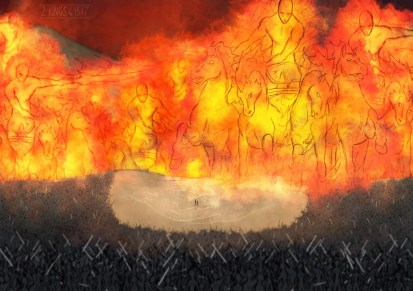 And the young servant sees a huge host of angels with horses and chariots of fire all around Elisha. The Syrian army rushes in toward them. Elisha simply prays that the entire army would be struck with blindness, and they are. Then Elisha leads this blinded army straight into the capitol of Israel where they are all captured. In this account, we see the unfolding of what is said in Ps. 34:7, “The angel of the Lord encamps around those who fear him, and delivers them.”
Scripture teaches that angels are sent in particular to serve children (Mt. 18:10), believers in their vocations (Ps. 91:11-12), and those who are dying (Lk. 16:22). It is very possible that each believer has an angel or squad of angels for protection. In Mt. 18:10, Jesus says, “See that you do not despise one of these little ones. For I tell you that in heaven their angels always see the face of my Father who is in heaven” (see also Act. 12:15). And Heb. 1:14 says that the angels are “ministering spirits sent out to serve for the sake of those who are to inherit salvation.”
Scripture teaches that angels were present at the giving of the Ten Commandments at Mt. Sinai (Dt. 33:2; Gal. 3:19). Angels are sent to proclaim the conception (Lk. 1:26), birth (Lk. 2:11), and resurrection of Christ (Lk. 24:5-7). In fact, angels remain at the empty tomb even after Jesus left.
We should not pray to angels as though they are the ones responding to our prayers. Every time in Scripture that someone begins to worship an angel, the angel protests and directs worship to God (esp. Rev. 22:8-9). Also, we shouldn’t listen to angels unless they are pointing us to Jesus Christ and Him crucified. Paul plainly says in Gal. 1:8, “But even if we or an angel from heaven should preach to you a gospel contrary to the one we preached to you, let him be accursed.”
Many Christians have stories about being helped in a particular situation by someone who suddenly appeared and wasn’t seen again. It may indeed be that God sent an angel to help and defend. Also, there are times when Christians have helped someone who was in trouble, and they have a sense that something was different about that encounter. It may be than an angel appeared to give an opportunity to the Christian to serve in a particular way. Heb. 13:2 says, “Do not neglect to show hospitality to strangers, for thereby some have entertained angels unawares.”
Finally, and maybe most importantly, we should realize that angels are present with us right here and now as we are gathered in worship. Hebrews 12:22-24 says that in church we have “come to Mount Zion and to the city of the living God, the heavenly Jerusalem, and to innumerable angels in festal gathering…” Jesus says that the angels in heaven are joyful over one sinner who repents (Lk. 15:7, 10). As we confessed our sins earlier, a whole host of angels whom we cannot see or hear rejoiced as they heard Christ absolve and free us from our sins. In fact, Heb. 1:14 calls angles ‘liturgizing’ spirits (the ESV translates λειτουργικός as ‘ministering’). Using the liturgy is a way that we connect our worship with the worship of the angels in heaven, which is why we draw the words and order of our liturgy from the words of Scripture.
So, there is a quick overview of the Scriptural teaching of angels. Now, to our texts. First this Gospel lesson:
Jesus had sent these seventy-two ahead of Him to preach and heal in every town He was about to go Himself (see Lk. 10:1-12). And Jesus didn’t beat around the bush; He plainly tells them, “Behold, I am sending you out as lambs in the midst of wolves.” Their mission was already dangerous, but to top it all off, Jesus tells these lambs to march out in the midst of wolves with no resources – no moneybag, knapsack, or sandals. They would be housed and nurtured by the people who welcomed them. Jesus told them to heal the sick and say to the people, “The reign (βασιλεία) of God has come near to you.”
We hear them joyfully report that the demons – the evil, fallen angels – were subject to them in Jesus’ name. They saw victories in their various spiritual battles. But then Jesus says that something even greater was going on that they couldn’t see. While those seventy-two were proclaiming the reign of Jesus, Christ says, “I saw Satan fall like lightening from heaven.” More was going on than these seventy-two could see. It was more than just isolated, individual battles.
And in our Epistle text (Rev. 12:7-12), we heard how the archangel Michael was given the privilege of throwing Satan (‘Satan,’ by the way, means ‘accuser’), the deceiver of the whole world,  down and out of heaven. How was Satan cast down? The text is clear. Satan was cast out by the blood of the Lamb.
Now, there are Christians who would disagree with what I am about to say here, but I think we should see Jesus’ proclamation to the seventy-two of seeing Satan falling from heaven and the text in Rev. 12:7-12 as confirmation that the shedding of Christ’s blood and the preaching of the Gospel of the reign of Christ was what cast Satan down from heaven.
This means that Satan is no longer able to accuse you before God which is what he was constantly doing day and night before God in heaven (Rev. 12:10). Remember the book of Job? Satan was there in heaven accusing Job of Job’s sins before God by saying that the only reason Job loved God was because God was nice to Job (Job 1:8-11, 2:1-5). But now, Satan has been expelled from heaven, and that is good news.
However, there is also a warning at the end of that Epistle text. Satan is no longer able to accuse you before God because he has been expelled from God’s presence. But that doesn’t mean he is done accusing. The devil can’t accuse you before God anymore, but he can and does try to accuse you in your conscience, and he is very good at that. He will say that your sins are too many or too great to be forgiven. The accuser now roams about like a roaring lion seeking to devour you (1 Pet. 5:8), constantly whispering in your ear, “Did God really say, ‘Your sins are forgiven’?”
Dear saints, when the devil does this, he needs to be expelled from your conscience. How is this done? It is done with the same weapons that Michael and the angels used – the blood of the Lamb, and the word of your testimony (Rev. 12:11).
Dear saints, when you confess your faith that Christ has been crucified and shed His blood for you, you expel Satan from your conscience. When the devil whispers his accusations, confess that Jesus is the Lamb of God who takes away the sins of the world (Jn. 1:29). Tell Satan, “Christ has taken my sins. So, if you want to talk to someone about my sins, you can’t talk to me about them anymore. Jesus has taken them as His own. Christ owns them now. He has died and shed His blood for them.” And the devil has no reply to that testimony.
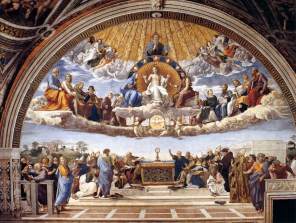 So today, dear saints, come to Jesus’ table and receive His body given for you. Receive His blood which was shed for you for the forgiveness of your sins knowing that neither death nor life, nor angels nor rulers, nor things present nor things to come, nor anything else in all creation, will be able to separate you from the love of God in Christ Jesus your Lord (Ro. 8:38-39).
Satan has been expelled from heaven, and he is expelled from your conscience by the blood of your Savior. In Jesus’ name. Amen.
The peace of God, which surpasses all understanding, will guard your hearts and minds in Christ Jesus. Amen.
 them, “Go and show yourselves to the priests.”And as they went they were cleansed. 15 Then one of them, when he saw that he was healed, turned back, praising God with a loud voice; 16 and he fell on his face at Jesus’ feet, giving him thanks. Now he was a Samaritan. 17 Then Jesus answered, “Were not ten cleansed? Where are the nine? 18 Was no one found to return and give praise to God except this foreigner?” 19 And he said to him, “Rise and go your way; your faith has made you well.”
 This Samaritan who returns to the true Temple and true High Priest. He returns to Jesus to give thanks. Did you catch what Jesus said there, “Was no one found to return and give praise to God except this foreigner?” In other words, the nine went onto the Temple and God’s house, but God wasn’t there. He was walking in the flesh between Samaria and Galilee where the Samaritan falls at His human feet giving Him thanks. Some people will read the Gospels and say that Jesus never claimed to be God. Well, sorry, they are wrong. He does right here.

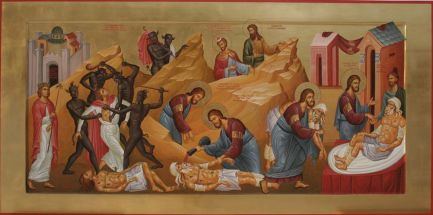 Because, first and foremost, the parable of the Good Samaritan is a picture of what Jesus has done for you. Jesus, and Jesus alone, is the Good Samaritan who has compassion. He left His throne in the glory of heaven to become your neighbor. He risks His own safety while scoundrels and robbers are roaming about. He stops to give you aid. He pours on you oil and wine. He gives up His own comfort and convenience to bring you to the inn of the holy Christian Church. And Jesus sets up an all-expenses-paid stay there promising to return. Jesus is the one who has and continues to show you mercy. Amen.
 32 And they brought to him a man who was deaf and had a speech impediment, and they begged him to lay his hand on him. 33 And taking him aside from the crowd privately, he put his fingers into his ears, and after spitting touched his tongue. 34 And looking up to heaven, he sighed and said to him, “Ephphatha,”that is, “Be opened.” 35 And his ears were opened, his tongue was released, and he spoke plainly. 36 And Jesus charged them to tell no one. But the more he charged them, the more zealously they proclaimed it. 37 And they were astonished beyond measure, saying, “He has done all things well. He even makes the deaf hear and the mute speak.”
 Groaning, however, is an involuntary response to being hurt or wounded. Every time the New Testament uses this word ‘groan’ it is from sorrow or suffering because of sin. And, in the New Testament, only four things groan – creation groans, believers groan, the Holy Spirit groans, and Jesus groans twice.
 And He no longer groans in pain when He does it. The price has been paid. Your forgiveness has been purchased and won on the cross.
 10 “Two men went up into the temple to pray, one a Pharisee and the other a tax collector. 11 The Pharisee, standing by himself, prayed thus: ‘God, I thank you that I am not like other men, extortioners, unjust, adulterers, or even like this tax collector. 12 I fast twice a week; I give tithes of all that I get.’ 13 But the tax collector, standing far off, would not even lift up his eyes to heaven, but beat his breast, saying, ‘God, be merciful to me, a sinner!’ 14 I tell you, this man went down to his house justified, rather than the other. For everyone who exalts himself will be humbled, but the one who humbles himself will be exalted.”
 The parable does teach that the worst of sinners can go to heaven. We know this, but unfortunately, we can grow a little numb to this. But the main reason Jesus tells this parable is to destroy any self-righteousness and contempt we would have against other sinners.
 Dear saint, you look there too. Look to the cross. Look to the blood of Jesus shed for you on Calvary. Look to His death. Look to His resurrection. Look to His ascension. And know that Jesus promises that all of that is for you.
 Three times the English word ‘gifts’ came up in this text, but in Greek, Paul uses two different words that get translated as ‘gifts.’ Twice the Greek word is χάρισμα (which is singular and the plural is χαρίσματα – I’m going to try to be grammatically correct through the sermon). Χάρισμα is where we get our word ‘charismatic.’ Inv. 4, “there are varieties of gifts/χαρίσματα,” and in v. 9, he mentions the “gifts/χαρίσματα of healing…” But in v. 1, Paul uses a different word that gets translated as ‘spiritual gifts’ or ‘spiritual things.’
 According to our text (v. 4-7), these various gifts are given through the Holy Spirit, but the Holy Spirit doesn’t ever work alone; instead, the entire Trinity is involved. These various gifts are given by the Spirit; the varieties of service are given by the same Lord, Jesus Christ, the Son; and the varieties of activities are empowered by the same God (think Father) who empowers them all in everyone. We don’t determine what gift we receive, it’s up to our Triune God. And God will provide whatever we need to fulfill our Christian duty to our neighbor.
 Do you believe in Christ’s death and resurrection for the forgiveness of your sins? Do you trust that His blood has covered all your iniquities and transgressions? If so, praise God! Then ask, “What is my vocation/station in life? What am I called to do right now?” “What do I need now as a mother?” “What do I need now as a husband?” “As a child?” “A student?” “A customer?” “A citizen?” God has called you to those vocations and He won’t leave you in a lurch. He will give you the gifts you need. In every moment of every day, you have a particular relationship to someone else, so you are called to be God’s representative in that moment. So, ask God to give you what you need to fulfill that vocation.
 This reduction was, of course, not legally binding. The rich man could have simply said, “Hang on everyone. I fired that guy before he lowered your debt. You still owe the original amount.” But that isn’t the character of the rich man. Instead, the whole town is singing the praises of the rich man because he is so generous. And the rich man isn’t willing to harm his reputation as a merciful guy. So, what does the rich man do in the parable? He tells the fired, scoundrel of a manager, “Dude, you’re shrewd. You knew I’d rather be known as a merciful person rather than hold on to my wealth. And by your shrewdness, you’ve helped yourself.”
 Now, Jesus is absolutely clear, “You cannot serve God and money.”It can’t be done. If you trust in money, you do not trust God. So, repent of your love of money.
 The only thing that matters for your salvation is what Christ has done and completed for you upon the cross. Even when you are stingy and fail to be generous with what God has given to you, God was not. He gave what was most valuable to Him for your salvation. God, in His mercy, gave Jesus to die upon the cross for you. Don’t trust in your stewardship of what God has given you. Instead, trust in Christ’s giving of Himself completely for you and for others. Amen.
 Out of that conversation came creation, and most importantly, out of that conversation came the creation of humanity. We get to hear that conversation in Gen. 1:26 where the Triune God says, “Let Us make man in Our image, after Our likeness.” It was so, and it was good – very good.
 One of the most amazing things is that God even gives His prophets a seat and a voice in this council. You remember when God was going to destroy Sodom and Gomorrah, and Abraham speaks up and gets God to agree to not destroy the cities if ten righteous people are found there (Gen. 18:22-33). Or, when God is going to destroy the Israelites for making the golden calf, Moses speaks up in the council and says, “God, if You go down and destroy them, the Egyptians will say that You only brought them out of slavery to destroy them.” And God relents of the disaster He had said He would bring on the people (Gen. 32:1-14).
 Now, Jesus has ascended to the right hand of the Father. Today, your Savior is talking with the Father, your Creator, and with the Holy Spirit, your Sanctifier. And do you know what they are talking about? They are talking about you and the cross. They are talking about how Jesus won your salvation there. How His blood shed there made a place in heaven for you forever. And the Holy Spirit is there, translating your prayers and interceding for you with groanings too deep for words (Ro. 8:26). The Holy Spirit whispers into your ear that you are an adopted child of God and heir with Christ. And you respond by crying, “Abba, Father” (Ro. 8:12-17).
 Our English word ‘desolation’ contains the word ‘solo,’ and that gives a sense of what ‘desolation’ means. Adam and Eve went solo. Rather than trusting God, they went solo and trusted the devil’s lie bringing sin, death, condemnation, and desolation into the world.
 Look at what Jesus, God in the flesh does – notice the verbs. He calls the disciples. Jesus directs the crowd to sit down. He takes the bread. Christ gives thanks for the bread. He breaks the bread. He gives the bread to the disciples to set before the people. Jesus blesses the fish. He gives the fish to the disciples to set before the people. And Jesus watches them all eat until every last one of them is satisfied. Jesus continues to do this for us today.
 19 Therefore whoever relaxes one of the least of these commandments and teaches others to do the same will be called least in the kingdom of heaven, but whoever does them and teaches them will be called great in the kingdom of heaven. 20 For I tell you, unless your righteousness exceeds that of the scribes and Pharisees, you will never enter the kingdom of heaven.
 Sure, you aren’t Lady Macbeth yelling at the blood of Duncan to wash off your hands, but you are guilty of murder before God. You have been angry with others. You have called others, “Fool.” You have held grudges. You have refused to ask your neighbor for forgiveness. And Jesus goes on to the other Commandments as well – lust is adultery and fornication, gossip is perjury, etc.
 The Law should never be allowed to access into your ‘How do I stand before God?’ room, your ‘Am I good enough to go to heaven?’ room, your ‘Does God love me?’ room, your ‘Does God think I am a good person?’ room, or your ‘assurance of salvation’ room. The Law should never be allowed to enter those rooms because Jesus has made you as good and as righteous and as perfect as He is.
 Pastorsamwise
You must be logged in to post a comment.