John 2:1-11
1 On the third day there was a wedding at Cana in Galilee, and the mother of Jesus was there. 2 Jesus also was invited to the wedding with his disciples. 3 When the wine ran out, the mother of Jesus said to him, “They have no wine.” 4 And Jesus said to her, “Woman, what does this have to do with me? My hour has not yet come.” 5 His mother said to the servants, “Do whatever he tells you.” 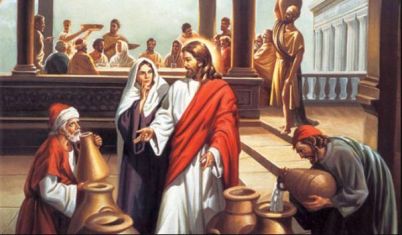 6 Now there were six stone water jars there for the Jewish rites of purification, each holding twenty or thirty gallons. 7 Jesus said to the servants, “Fill the jars with water.”And they filled them up to the brim. 8 And he said to them, “Now draw some out and take it to the master of the feast.”So they took it. 9 When the master of the feast tasted the water now become wine, and did not know where it came from (though the servants who had drawn the water knew), the master of the feast called the bridegroom 10 and said to him, “Everyone serves the good wine first, and when people have become drunk, then the poor wine. But you have kept the good wine until now.” 11 This, the first of his signs, Jesus did at Cana in Galilee, and manifested his glory. And his disciples believed in him.
In the name of the Father and of the Son and of the Holy Spirit. Amen.
Notice first that John doesn’t call this miracle of Jesus a ‘miracle.’ It is, of course, a miracle to take somewhere between 120-180 gallons of water and turn it into wine in an instant. But John doesn’t call it a miracle, he calls it a ‘sign.’ And importantly, this is the first of Jesus’ signs and manifests His glory. This sign becomes the standard by which all other signs of Jesus are known. This sign shows how Jesus loves to give good gifts even when they aren’t known, recognized, or appreciated. And, therefore, this sign shows us how beautiful is Christ’s love and mercy.
Jesus attends a wedding at Cana in Galilee. Galilee is a region that isn’t all that important. The kings, rulers, religious leaders are mainly in Judah to the south. And Cana is a town that was so small and insignificant we still aren’t sure where it is – archeologists haven’t discovered it yet.
At that wedding feast, the wine had run out. Either those planning the wedding didn’t plan properly, or (and probably more likely) the guests had been too busy refilling their glasses. The master of the feast (and we’re going to come back to his statement) will say that the good wine that Jesus provides is a mistake because the guests have become drunk using the same word that the Scriptures will repeatedly warn against.
So, this first sign, this first miracle of Jesus isn’t like His other miracles in the Gospels where Jesus gives sight to the blind, makes the lame walk, gives hearing to the deaf, cleansing to the lepers, freedom to those possessed by demons, and resurrection to the dead. But this turning water into wine is not simply a parlor trick that Jesus does to impress people. It is an act of pure mercy. Jesus turns water into good wine for a bunch of people who already had wine.
Mary lets Jesus know the party has run out of wine. And Jesus doesn’t seem to want to get involved. But Mary has faith that Jesus will do what is good, so she tells the servants, “Do whatever He tells you.” Jesus could have told everyone the feast is over, pack up, and go home. But He doesn’t. His mercy extends far beyond our imagination.
Jesus tells the servants to fill six stone water jars that are there for the Jewish rites of purification. These rites of purification were an addition to God’s commands for His people to be clean. The Pharisees had a bunch of rules about washing before eating (see Mk. 7:1-5where the Pharisees will accuse Jesus’ disciples of not following these man-made rules). So, these jars aren’t there to hold drinking water. In fact, you probably wouldn’t want to drink water from these jars as much as you wouldn’t want to drink from a bowl of water that people had used to wash their hands.
 Jesus tells the servants to fill the jars with water, and they fill them up to the brim. And, at Jesus’ command, they take some of it to the master of the feast. The master tastes it, and it isn’t water anymore. It is wine. The master didn’t know. The guests didn’t know. Only Jesus, Mary, the servants, and the disciples know that this had been water miraculously turned into wine.
Now, we have to slow down for a minute and consider the words of the master of the feast: “Everyone serves the good wine first, and when people have become drunk, then the poor wine. But you have kept the good wine until now.”
Practically speaking, the master is absolutely right. You don’t waste the good stuff on people whose taste buds are numbed and who are probably going to throw it up anyway. You serve the good tasting wine first and serve the crummy wine when they don’t really care what it tastes like any more.
But in doing this, the master of the feast takes on a satanic role. And, I think (you can disagree) that is why John quotes the master of the feast. He is saying that there is a huge waste in giving good wine to people who cannot appreciate it, people who are going to abuse it, and to people who have been abusing it. You could almost say that the master goes to the groom and says, “You are some fool for giving people good wine when they can not appreciate it.”
This is what the devil says about God as God continually gives us His gifts of grace and mercy. Satan is enraged that God would love and forgive us who do not appreciate His gifts and mercy.
 But, dear saint, that is precisely the point. God is willing to give His gifts and mercy anyway. This isn’t a license to go on and sin because God will forgive you anyway. In fact, you are to abhor what is evil and hold to fast to what is good. Love one another. Outdo one another in showing honor (Ro. 12:9-11). And do all of that as you remember that God gives better than you deserve or appreciate.
Finally, remember that this sign occurs, as John says, ‘on the third day.’ This third day is the last in a series of days that John tells us about. The first day was back in Jn. 1:29where John the Baptizer says, “Behold the Lamb of God who takes away the sin of the world.” Then, John says ‘the next day’ Jesus called His first few disciples. Then, this miracle occurs ‘on the third day.’ John could have kept his reckoning of time any way he wished. He could have said Jesus is proclaimed to be the Lamb of God who takes away the sin of the world on Tuesday; on Wednesday, Jesus gets His first disciples; and on Thursday, Jesus was at a wedding in Cana. Or, John could have just kept saying, ‘the next day, the next day, the next day…’ But John doesn’t. John is pointing us to the fact that this is ‘the third day’ which is a foreshadow of the resurrection. ‘On the third day,’ the day of the Resurrection, Jesus gives wine is not earned, deserved, or even appreciated to sinners who at best deserved to be told to go home.
Dear saints, you live in the time of ‘the third day.’ Jesus lives. The shadow is past. Your sins are died for and forgiven. The resurrection is now. The marriage feast has begun. The Holy Spirit is given. You receive the best wine and all of Jesus’ gifts. But it is still not what it will be.
Jesus will return. The trumpet will sound, and then the wedding of the Lamb of God will begin in earnest. And never forget that you are His bride, His beloved. Come and receive now what you have not earned, deserved, or can even fully appreciate. Receive it knowing that your Lord is not afraid to give it to you. His love reaches to the heavens; His faithfulness stretches to the sky (Ps. 108:4). Come and receive His gifts and mercy. Amen.
The peace of God, which surpasses all understanding, will guard your hearts and minds in Christ Jesus. Amen.
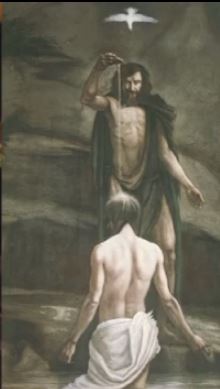 13Then Jesus came from Galilee to the Jordan to John, to be baptized by him. 14John would have prevented him, saying, “I need to be baptized by you, and do you come to me?” 15But Jesus answered him, “Let it be so now, for thus it is fitting for us to fulfill all righteousness.”Then he consented. 16And when Jesus was baptized, immediately he went up from the water, and behold, the heavens were opened to him, and he saw the Spirit of God descending like a dove and coming to rest on him; 17and behold, a voice from heaven said, “This is my beloved Son, with whom I am well pleased.”
 To that very place and in that very context comes Jesus Christ, our Lord. And what is He coming to do? He’s coming to be baptized!
 Christ’s glory, His exultation is to call you and chose you who are not wise according to worldly standards, not powerful, not of noble birth. Instead, He is exalted to choose us who are foolish, weak, and despised in the world (1 Cor. 1:26-31).
 3 When Herod the king heard this, he was troubled, and all Jerusalem with him; 4 and assembling all the chief priests and scribes of the people, he inquired of them where the Christ was to be born. 5 They told him, “In Bethlehem of Judea, for so it is written by the prophet:
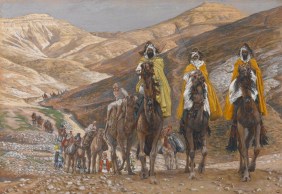 Ouija boards, etc. – all things that the Scriptures consistently forbid because they are all demonic, satanic practices. So, again v. 1, “Now after Jesus was born in Bethlehem of Judea in the days of Herod the king, check this out, magi from the east came to Jerusalem.” It’s absolutely shocking. These are the first Gentile (non-Jewish) people in all the Gospels to seek Jesus, the Son of God.
 The magi take leave of Herod. The star appears again to lead them (Had it disappeared for a time?). They see it and “rejoice with exceedingly great joy.” And they find what they’ve been looking for, what they have been traveling for months to find. There, in a house, is the infant Jesus Christ, God in the flesh. And they worship the Child who will grow up and die on the cross for them. But then, notice, they have to be warned in a dream to not return to Herod. And they return to their country by another way.
 And always remember, that God doesn’t give up on you either. Through the same Scriptures, God has led you here to Himself. He hasn’t used a something as uncertain as star or a dream. He has led you with something more certain (2 Pet. 1:19) – His Word. He has led here to receive His mercy, grace, and forgiveness. He leads you now to His altar to receive His very Body and Blood given and shed for the forgiveness of your sins. Leave your sins behind. Come, taste, and see that your God is merciful and gracious, full of steadfast love and righteousness. Amen.
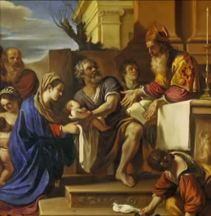 And he came in the Spirit into the temple, and when the parents brought in the child Jesus, to do for him according to the custom of the Law, 28 he took him up in his arms and blessed God and said,
 This forty-day-old Jesus is going to bring a division between believers and unbelievers. Simeon, inspired by the Holy Spirit, says this division comes because what a person does with Jesus will reveal the thoughts of their heart. The division falls in one of two ways: many will oppose and reject Jesus to their fall, to their ruin, and to their damnation, and many will trust in Him to their resurrection and eternal life.
 There can be, and often is, a conflict between how God sees you in your reborn spirit and how you see yourself in your soul – your thoughts, and emotions. You have probably experienced this. Part of you, your spirit, wants to live a certain way. You want to keep God’s commands, you want to live a God-pleasing life, you want to love your neighbor, etc. But part of you, your soul, doesn’t. Your soul would rather make sure you are comfortable and doesn’t really care about what God has commanded or what would benefit others. Paul talks about this conflict in Ro. 7(:7-25)where he wants to do good, but instead he keeps doing the sinful thing that he hates.
 The artist Michelangelo (not the Ninja Turtle) used to say that when he looked at a hunk of marble, he didn’t see big rock. Instead, he saw the sculpture that he was going to free from the rest of the rock that he would eventually chip away. He would say that he wasn’t creating a sculpture, he was just getting rid of all the rock that wasn’t part of the sculpture. That is somewhat the idea in the verse from Hebrews about the Word of God doing the work of dividing soul and spirit.
 24 (Now they had been sent from the Pharisees.) 25 They asked him, “Then why are you baptizing, if you are neither the Christ, nor Elijah, nor the Prophet?” 26 John answered them, “I baptize with water, but among you stands one you do not know, 27 even he who comes after me, the strap of whose sandal I am not worthy to untie.” 28 These things took place in Bethany across the Jordan, where John was baptizing.
 John the Baptizer was important. He was the forerunner of the Messiah and the last prophet. He was foretold in Scripture. He had the attention of all Judea and Jerusalem as they came out to him. And the religious authorities were sending envoys to him asking, “Who are you?” They wanted to find out exactly why John was doing what he was doing.
 Now, you aren’t the voice of one crying out in the wilderness, but you are a Christian. And you are a Christian because there is a Christ. You bear His name. You are washed clean of all your sins in His blood. You hear Jesus’ Word. You pray His prayers. You live His life. You have been crucified with Christ. It is no longer you who live but Christ who lives in you (Gal. 2:20). This means that you have your own God-given calling, role, task, and vocation to carry out. So be faithful in those callings and vocations.
 John was born and grew up as a Nazarite, so his hair was never cut. Imagine his big, bushy beard and his long, tattered hair. John preached out in the wilderness wearing clothes made of camel hair and leather belt. He had a peculiar diet of locusts and wild honey (Mk. 1:6). Imagine having locust breath – probably even worse than coffee breath. Matthew summarizes John’s preaching as this message: “Repent for the kingdom of heaven is at hand” (Mt. 3:2). People would come out to the wilderness to hear him preach, and when he saw them he said, “You brood of vipers! Who warned you to flee from the wrath to come?” (Mt. 3:7). He would preach about the axe that was laid to the root of every tree that would cut down each tree that didn’t bear fruit and throw it into the fire (Mt. 3:10). So, John was a preacher of the Law. But still all the country of Judea and Jerusalem was going out to John and being baptized and confessing their sins (Mk. 1:4-5).
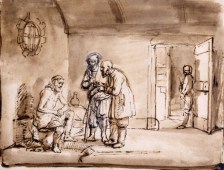 John was anxious in prison knowing he was probably going to be executed for what he had preached. Probably, John was wondering if he had preached rightly. And Jesus’ response points John and you to the Scriptures. In particular, Jesus points John to Isaiah 35:4-6, and you have to hear the context of those verses because it shows how beautifully Jesus answers John’s question, “Are you the One who is to come?” Here it is Isaiah 35:4-6, “Say to those who have an anxious heart, ‘Be strong; fear not! Behold, your God will come with vengeance, with the recompense of God. He will come and save you.’ Then the eyes of the blind shall be opened, and the ears of the deaf unstopped; then shall the lame man leap like a deer, and the tongue of the mute sing for joy….”
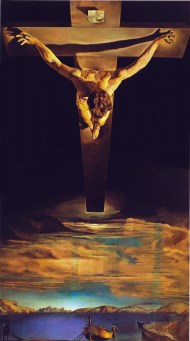 He opened the eyes of the blind. Christ made the deaf hear, the lame walk, and the mute to sing. All of that means that salvation has come to you who are anxious and poor in spirit. Rejoice.
 28 Now when these things begin to take place, straighten up and raise your heads, because your redemption is drawing near.”
 Normally, you would be terrified in a situation like that. But not now. Not now because you are in the prison of that castle being held captive. And the commander who is leading the army that is storming the castle is Jesus coming to save you.
 At first blush, this seems simple enough. Just follow Dave Ramsey’s advice for getting rid of your loans, car payments, and mortgage. Then live your life humming the Beatles, “All you need is love. All you need is love. All you need is love, love, love. Love is all you need.”
 So, as our text says, put on Christ. Clothe yourself in Him. Make His life, His obedience, His perfection your coat, your suit, your dress, your shirt, your shorts, your jeans, and your pajamas. How do you do that? Galatians 3:27 says, “As many of you as were baptized into Christ have put on Christ.”
 Well, there is something more, but it isn’t anything different. Repent again. Cast off the works of darkness again. Put on Christ again. Return to the promises God made when made you His child, when you were born again of Water and the Spirit (Jn. 3:5) in your Baptism.
 There were ten fishermen – five wise who wore their life jackets the whole time they were on the boat and five foolish who drown because they figured they would have enough time to put them on when the storm hit.
 And remember that as the end approaches, as you continually see signs of Christ’s return, remember what that means for you. Christ says it means your redemption is drawing near (Lk. 21:28). The bridegroom is coming, and you are His bride. Jesus has purchased and redeemed you so that you are without spot, wrinkle, or blemish (Eph. 5:27).

You must be logged in to post a comment.