Luke 11:14–28
14 Now he was casting out a demon that was mute. When the demon had gone out, the mute man spoke, and the people marveled.  15 But some of them said, “He casts out demons by Beelzebul, the prince of demons,” 16 while others, to test him, kept seeking from him a sign from heaven. 17 But he, knowing their thoughts, said to them, “Every kingdom divided against itself is laid waste, and a divided household falls. 18 And if Satan also is divided against himself, how will his kingdom stand? For you say that I cast out demons by Beelzebul. 19 And if I cast out demons by Beelzebul, by whom do your sons cast them out? Therefore they will be your judges. 20 But if it is by the finger of God that I cast out demons, then the kingdom of God has come upon you. 21 When a strong man, fully armed, guards his own palace, his goods are safe; 22 but when one stronger than he attacks him and overcomes him, he takes away his armor in which he trusted and divides his spoil. 23 Whoever is not with me is against me, and whoever does not gather with me scatters.
24 “When the unclean spirit has gone out of a person, it passes through waterless places seeking rest, and finding none it says, ‘I will return to my house from which I came.’ 25 And when it comes, it finds the house swept and put in order. 26 Then it goes and brings seven other spirits more evil than itself, and they enter and dwell there. And the last state of that person is worse than the first.”
27 As he said these things, a woman in the crowd raised her voice and said to him, “Blessed is the womb that bore you, and the breasts at which you nursed!” 28 But he said, “Blessed rather are those who hear the word of God and keep it!”
Grace, mercy, and peace be to you from God our Father and from our Lord and Savior, Jesus Christ. Amen.
Some people will never believe. Their hearts are so hardened that, no matter how great a sign they see from the hand of God Himself, they still refuse to believe. This doesn’t mean that we should stop proclaiming the Gospel to them or stop praying for them. It is just reality. And, in fact, it is a call to further prayer because we recognize that conversion is always, always a work of the Holy Spirit chiseling away at sin-hardened hearts.
Jesus casts a mute demon out of a man. Some marveled. Some were still seeking from a sign from heaven. And some accused Jesus of casting out the demon by the power of Beelzebul (which means ‘lord of the flies’ a derogatory title for Satan stating that the devil is the lord of the dung heap).
Now, as illogical as the accusation is, we need to see how that it infinitely more blasphemous. Jesus delivers a man from a demon that made him mute. But people say, “Jesus is doing the devil’s work.”
And we need to pause here because nothing has changed. This world still calls good evil and evil good. If you are pro-life, you are sexist who just wants to control women’s bodies. If you stand for marriage as God created it or believe that men are men and women are women, you are homophobic.
Believer, this world hates God and hates Jesus, and it hates you too because you are God’s child. We live in a world that constantly stands good and evil on their heads. And the sooner you admit it, the better.
Jesus shows how ludicrous the claim that He is casting out demons by the power of Beelzebul. Instead, Jesus says it is by the finger of God that He is casting out demons which means that the kingdom, the reign, of God has come among those who scoff at wheat Jesus is doing.
This expression Jesus uses “the finger of God” is interesting. That phrase is only used four times in the Bible. You heard it in our Old Testament lesson (Ex. 8:16-24). Pharaoh’s magicians recognize that the plague of gnats is the finger of God coming in judgment against them. In Exodus 31[:18] and Deuteronomy 9[:10], Scripture talks about God’s finger writing the Ten Commandments on the stone tablets. Now here, Jesus talks about God’s finger casting out demons. The point is that Jesus casting out demons is a fulfillment of the Law and a plague on hell. Jesus tells demons to go and they have to go.
Then, Jesus tells something like a parable. He says that when a strong man [the devil] who is fully armed guards (and keep that word ‘guards’ in the back of your mind because it comes up again in a little bit) his house [the world] his goods [sinners] are safely under his lordship. But Jesus says that when one stronger than him [Jesus] is going to come and attack him, take away his armor, and divide the spoil [you].
Jesus says that He has come to rob the devil’s house and you are the spoils, the treasure, the plunder that Jesus is taking out of the devil’s cellar. He has won, redeemed, purchased, and grabbed you from the devil’s clutches. All by the power of His finger.
He has pulled you out of darkness and into His marvelous light. And notice what Jesus says, “Whoever is not with Me is against me.” There is no spiritual neutral ground. You are either rescued by Jesus and delivered into His kingdom, or you are held captive in the devil’s domain. And if you are not filled by the Holy Spirit, then the demons come back, and your last state is worst than the first.
So how do you know if you are in the kingdom of God or in the kingdom of the devil? Well, Jesus answers that. A woman says to Jesus, “Blessed is the womb that bore you, and the breasts that nursed you.” Now, Mary was certainly blessed. She is the mother of our Lord. But Jesus says, even better than being His mother is to hear the Word of God and keep (there is that same word used about the devil ‘guard’) it.
Though you were guarded by Satan, Jesus has come and rescued you with His finger transferring you to His kingdom. Now, you guard the Word that Jesus used to deliver you from Satan.
 Guard it. Keep it. Take it. Eat and drink it. Because Jesus joins that Word of deliverance and forgiveness of sins to bread and wine. With His little finger, He destroyers the stronghold and armor of the devil. He claims you as His own. And He guards and keeps you now and for all eternity. Amen.
The peace of God, which surpasses all understanding, will guard your hearts and minds in Christ Jesus. Amen.
 22 The same night [Jacob] arose and took his two wives, his two female servants, and his eleven children, and crossed the ford of the Jabbok. 23 He took them and sent them across the stream, and everything else that he had. 24 And Jacob was left alone. And a man wrestled with him until the breaking of the day. 25 When [he] saw that he did not prevail against [him], he touched his hip socket, and Jacob’s hip was put out of joint as he wrestled with him. 26 Then he said, “Let me go, for the day has broken.” But [he] said, “I will not let you go unless you bless me.” 27 And he said to him, “What is your name?” And he said, “Jacob.” 28 Then he said, “Your name shall no longer be called Jacob, but Israel, for you have striven with God and with men, and have prevailed.” 29 Then Jacob asked him, “Please tell me your name.” But he said, “Why is it that you ask my name?” And there he blessed him. 30 So Jacob called the name of the place Peniel, saying, “For I have seen God face to face, and yet my life has been delivered.” 31 The sun rose upon him as he passed Penuel, limping because of his hip. 32 Therefore to this day the people of Israel do not eat the sinew of the thigh that is on the hip socket, because he touched the socket of Jacob’s hip on the sinew of the thigh.
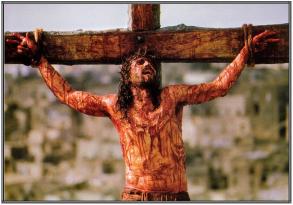 Loaded with your sin and the sin of the whole world, He fights to the very end, to the last breath. And the fight looked lost. Jesus looked like a loser – dead, lifeless, buried. But, even in that apparent defeat, He rose victorious.
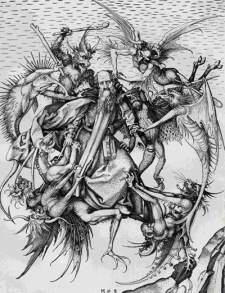 But this also means that, in this life, you are in the devil’s crosshairs. Satan hates you and will tempt you to doubt that God is truly your Father who gives you all things. The devil tempts you to sin by putting God’s promises in front of you, but he wants you to lay hold of those promises in your own way and timing. But Satan’s way never brings the joy that God wants to give you.
 The second temptation of the devil is for Jesus to throw Himself down from the pinnacle of the Temple. The devil says, “God will protect you by sending angels to make sure you don’t even hurt your foot.”
 Instead, rejoice in Jesus’ temptation. Rejoice because Jesus has endured where you have fallen and obeyed where you rebelled. Rejoice because Jesus knows the temptations you face, and He will always provide a way of escape (1 Cor. 10:13).
 The road to the cross passes through Jericho. In the city where the walls had come-a-tumblin’ down, lived a blind man. Mark tells us that his name is Bartimeaus (Mk. 10:46). Bartimeaus heard all sorts of commotion and asked what it was all about. He is told nothing more than that Jesus of Nazareth is passing through. As blind as he is, Bartimeaus sees his opportunity and cries out, “Jesus, Son of David, have mercy on me.” And don’t miss this.
 Dear Charlie. Today, you are Baptized. Today, your God and Lord has had mercy upon you. Today, God joined all His promises of forgiveness, life, and salvation to water and poured out all His love upon you. The perfect, Divine love we heard in our Epistle lesson (1 Cor. 13) has been given to you and to all your brothers and sisters in Christ.
 9 And when his disciples asked him what this parable meant, 10 he said, “To you it has been given to know the secrets of the kingdom of God, but for others they are in parables, so that ‘seeing they may not see, and hearing they may not understand.’ 11 Now the parable is this: The seed is the word of God. 12 The ones along the path are those who have heard; then the devil comes and takes away the word from their hearts, so that they may not believe and be saved. 13 And the ones on the rock are those who, when they hear the word, receive it with joy. But these have no root; they believe for a while, and in time of testing fall away. 14 And as for what fell among the thorns, they are those who hear, but as they go on their way they are choked by the cares and riches and pleasures of life, and their fruit does not mature. 15 As for that in the good soil, they are those who, hearing the word, hold it fast in an honest and good heart, and bear fruit with patience.”
 Third, Jesus blows away any misconceptions we may have that if the devil left us alone and the seed gets the nourishment that it needs, then everything would be hunky dory. The seed that falls among the thorns – that is the riches and pleasures of this life – it dies too. Even good things in this life are a threat to your faith. Thorns don’t just prick you like a needle leaving a little pain behind. They entangle and trap. Enjoy the good gifts God gives you in this life, but also recognize how easily they choke out your faith.
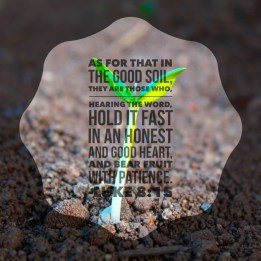 And hear again what Jesus says in the last verse of our text: “As for that in the good soil, they are those who, hearing the word, hold it fast in an honest and good heart, and bear fruit with patience.”
 In the name of the Father and of the Son and of the Holy Spirit. Amen.
 The point of this parable at the twenty-eight-year-old’s funeral was that this famous rabbi had done enough good works to go to heaven early. In other words, be good, do good, and get rewarded. Santa Claus anyone?
 And, with the Gospel, there is no room for despair. God’s love has been poured out for you to save you. In Christ, God has won your salvation on the cross. On the cross, Jesus bore the heat of the day, the heat of God’s wrath. And you, believer, get His wages.
 In the name of Jesus. Amen.
 In the Transfiguration, Jesus is truly beautiful, divinely beautiful. But in there is another beauty that is better than the Transfiguration. The beauty of Jesus is what you see on the cross where God in the flesh dies for the disciples and for you to save you from your sin.
 5 His mother said to the servants, “Do whatever he tells you.” 6 Now there were six stone water jars there for the Jewish rites of purification, each holding twenty or thirty gallons. 7 Jesus said to the servants, “Fill the jars with water.” And they filled them up to the brim. 8 And he said to them, “Now draw some out and take it to the master of the feast.” So they took it. 9 When the master of the feast tasted the water now become wine, and did not know where it came from (though the servants who had drawn the water knew), the master of the feast called the bridegroom 10 and said to him, “Everyone serves the good wine first, and when people have become drunk, then the poor wine. But you have kept the good wine until now.” 11 This, the first of his signs, Jesus did at Cana in Galilee, and manifested his glory. And his disciples believed in him.
 When you or a loved one is plagued with sickness and disease you pray for healing. You pray for a clean scan. You pray that the next doctor appointment will show that everything is normal. You pray for a miracle. These are all good things to pray for.
 sin of this world. He has answered them by sending His Own, beloved Son to die and rise again. He has glory for you that is unspeakable and unimaginable.
 46 After three days they found him in the temple, sitting among the teachers, listening to them and asking them questions. 47 And all who heard him were amazed at his understanding and his answers. 48 And when his parents saw him, they were astonished. And his mother said to him, “Son, why have you treated us so? Behold, your father and I have been searching for you in great distress.” 49 And he said to them, “Why were you looking for me? Did you not know that I must be in my Father’s house?” 50 And they did not understand the saying that he spoke to them. 51 And he went down with them and came to Nazareth and was submissive to them. And his mother treasured up all these things in her heart. 52 And Jesus increased in wisdom and in stature and in favor with God and man.
 But as sinners, we never want to own our sin. Instead, we offer excuses and expect others to justify us in our sin. That is why, when someone offends you, you are more likely to tell someone else how mad you are rather than speak to the person you are angry with. Sometimes, we do get approval for our sinful actions from others. But we do ourselves no favors finding approval from others because when we do, we start to think that we can play the same game with God.
 If you’ve ever played hide and seek with a little child, you don’t have difficulty finding her. She will hide in the same three or four spots every time. Behind a door. Under a lumpy, moving blanket on the floor with her legs sticking out. Or lying face-down on the couch with her eyes shut because if she can’t see you then you can’t see her, obviously.
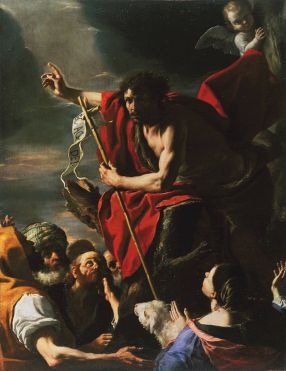 “What then? Are you Elijah?” He said, “I am not.” “Are you the Prophet?” And he answered, “No.” 22 So they said to him, “Who are you? We need to give an answer to those who sent us. What do you say about yourself?” 23 He said,
 And they ask this because of what we heard in our Old Testament lesson (Dt. 18:15-19). In that text, Moses told the people that God would raise up a prophet for His people from among them. And Moses made it very clear, “To Him you shall listen.”
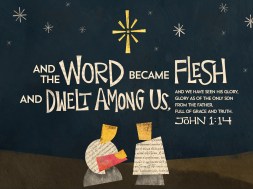 Finally, take a page out of John’s playbook and point people to Jesus. John has a laser-like focus on Jesus and isn’t interested in talking to people unless he is pointing them to Christ. Point others to the One who delivers them from sin. Point them to Jesus, the Lamb of God who takes away the sin of the world. Tell them that they don’t need to save themselves. Jesus saves them.

You must be logged in to post a comment.