Listen here.
Note:
The last Sunday in October is the day when most Lutheran churches (and other churches for that matter) will remember the Reformation. This coming Thursday, October 31st will mark the anniversary of five-hundred-two years ago when Martin Luther posted his 95 Theses on the door of the Castle Church in Wittenberg Germany. This event was just the beginning of what would take place over the next few decades which is the rediscovery of the Gospel that God saves us by grace alone, through faith alone, on account of Christ alone.
This isn’t a day when we thank and praise Luther. No. Instead, we thank and praise God for using sinful people who are faithful to the Scriptures to call us back to the eternal truths of God’s Word so that we repent of our sins and believe the Gospel. May we, as God’s people, be faithful to the life-giving Word of God.
Romans 3:19-28
19 Now we know that whatever the law says it speaks to those who are under the law, so that every mouth may be stopped, and the whole world may be held accountable to God. 20 For by works of the law no human being will be justified in his sight, since through the law comes knowledge of sin.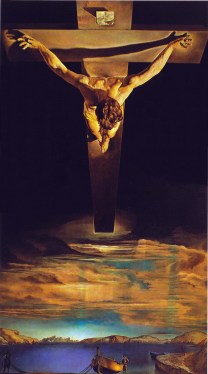
21 But now the righteousness of God has been manifested apart from the law, although the Law and the Prophets bear witness to it— 22 the righteousness of God through faith in Jesus Christ for all who believe. For there is no distinction: 23 for all have sinned and fall short of the glory of God, 24 and are justified by his grace as a gift, through the redemption that is in Christ Jesus, 25 whom God put forward as a propitiation by his blood, to be received by faith. This was to show God’s righteousness, because in his divine forbearance he had passed over former sins. 26 It was to show his righteousness at the present time, so that he might be just and the justifier of the one who has faith in Jesus.
27 Then what becomes of our boasting? It is excluded. By what kind of law? By a law of works? No, but by the law of faith. 28 For we hold that one is justified by faith apart from works of the law.
In the name of the Father and of the Son and of the Holy Spirit. Amen.
This text is centered around righteousness and justification. There is one Greek root in this text that is used ten times in this text and gets translated as righteous, righteousness, just, justified, and justifier. When you look at the text in the Greek, that root word is constantly popping up. It’s harder to see in English because of the various ways it gets translated (which overall, I think are good and helpful; it just is a little more hidden in English). Anyway, the sermon is going to be centered around the second sentence of v. 25, “This was to show God’s righteousness, because in His divine forbearance He had passed over former sins.”
So, to begin: Imagine that you have been caught after robbing a bank and are in a courtroom being tried for robbery, shooting a security guard, and fleeing police. The prosecution has presented a monumental case against you. They presented security footage from inside the bank with a clear picture of your face. Witnesses who were there all pointed to you as the one who demanded the money and fired at the security guard. The attorney produced the gun you used which was registered to you and had your fingerprints all over it. The police identified that it was your car that fled the scene. Bank records show that you deposited the exact amount of cash that was stolen into your own account, and the serial numbers of the bills match the numbers taken from the bank. They even produced text messages of you bragging to your friend about how you took the money and escaped. Every bit of evidence points to your guilt.
Now, you stand before a judge who is about to announce the verdict. Nothing you could say will change the facts. You did it, and nothing can excuse what you have done. It doesn’t matter that the reason you stole the money is that you lost your job and needed to feed your family.

You have taken what was not yours. You harmed and endangered others in the process. But you stand before the judge and say, “I am sorry, and I need forgiveness.”
Imagine that the judge, after considering all the evidence says, “I find the defendant not guilty.” He pounds his gavel, your handcuffs are removed, and you are free to go.
The whole courtroom would erupt. The prosecutors would shake their heads. The witnesses, the security guard’s family, and police would be enraged. The judge would probably soon be facing impeachment. That verdict of innocence would be seen as a travesty of justice because that is precisely what it is.
The fact is that this scenario had played out countless times through history – or at least scenarios very much like it. Moses murdered an Egyptian and fled his punishment; yet, God used him to lead Israel out of slavery in Egypt. Samson was a womanizing braggart, but God used Samson to deliver His people from their enemies, the Philistines. And think of David. David used the power and influence God had given him as king to commit adultery, steal another man’s wife, and, in an act of total cowardice, to murder that man by the hands of another. But, when David is confronted by his many and great sins and confesses them, the prophet Nathen simply forgives him and says, “The Lord has put away your sin” (2 Sam. 12:13).
Imagine being Uriah’s father. Your son is dead; his wife was violated and stolen. And the man who did it is simply forgiven? It is egregious, scandalous, shocking, and abhorrent.
I’m going to change gears, so please stay with me. One of the most common criticisms of Christians and Christianity today is people who say that God’s wrath against sin is unjust. Unbelievers will say things like, “How can you believe in a god who destroys all but eight people in a flood, rains down fire and sulphur on Sodom and Gomorrah, and condemns all humanity for eating a piece of fruit?” Unbelievers typically think that the wrath of God is unrighteous and unjust. But it isn’t just unbelievers who think this way.
In fact, God’s kindness and mercy is so prominent in the Scriptures that, when we see God being nice and patient, we start to think that is how He should act. Then, when God is angry, wrathful, and demands death as a punishment for sin, well, we get uncomfortable with that. 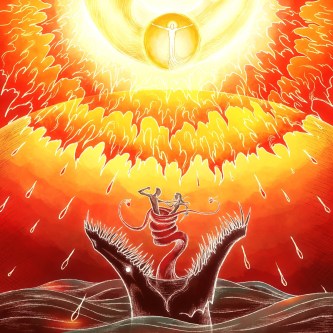 I have to confess, as I was doing my devotions this week, even when I had this sermon running through my mind, I got uncomfortable with some of the punishments God commanded for certain sins. But God does not owe us an explanation for His anger and wrath.
The reason God doesn’t owe us an explanation for His anger and wrath is given in this text. It is probably one of the verses you know by heart Ro. 3:23, “for all have sinned and fall short of the glory of God.” We all believe that, but it doesn’t have the bite that it should. We have a tendency to turn the phrase, “all have sinned,” into a trite and simple, “Nobody’s perfect.” And the phrase, “fall short of the glory of God,” what does that mean? It doesn’t sound so bad. Maybe, if we have fallen short, maybe we got kinda close.
Well, first of all “have fallen short” is a slightly weak translation; the word there means ‘lack.’ We lack the glory of God. But still, what’s the big deal? Are we supposed to have an equal amount of God’s glory? Did Adam and Eve match God’s glory before they fell into sin? Well, God did create us in His image, but even still we are the creature and do not and could match or equal the glory of our Creator.
To lack the glory of God means something different. And we can be thankful that Romans tells us what this means back in Ro. 1:23. There, Paul describes our fall into wickedness and sin, and he makes this statement we, “exchanged the glory of the immortal God for images.” We lack the glory of God because we knew about God’s glory – it had been given to us in nature and creation, it had been given to us in our conscience before we fell into sin – and though we knew it, we traded it away for idols. Our sin is that we would rather find our contentment and joy and fulfillment in the things God has given us than in God Himself. We took what should be our greatest joy and happiness and exchanged it for trinkets and crumbs.
This is a silly analogy, but… Imagine you gave your grown child a new house, a fancy car, and got him an easy, secure, high-paying job in a stable company. But imagine that your child went and traded every last bit of it away for one of those packets of salt that you can get at Culver’s so he could sprinkle it over his scrambled eggs. As egregious and wasteful as that would be, it still pales in comparison to us exchanging the glory of the immortal God for our sinful desires.
God’s wrath and anger against sin are assumed in the Scripture. And God doesn’t need to explain His punishment of our deep and damnable sins. But this text does say that God did need to explain something else. God did find it necessary to show, explain, and manifest His righteousness, but not because of His anger against or His punishment of our sin. Instead, God needed to manifest and show His righteousness because of His mercy.
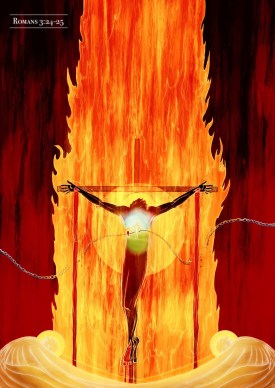 Remember, I told you that this sermon was going to be an explanation of that sentence in v. 25, “This was to show God’s righteousness, because in His divine forbearance He had passed over former sins.” What is it that showed God’s righteousness in giving us mercy? Nothing but Jesus Christ. Nothing but Jesus shedding His blood and dying on the cross. Nothing but Jesus being our propitiation – the atoning sacrifice, the mercy seat, the place where God forgives us and meets with us sinners.
Jesus’ death in our place, His suffering for our sins, shows God’s righteousness and proves that God is just when He justifies us and declares us innocent through faith in Jesus.
Think back to that analogy of the judge declaring you innocent of robbing the bank. Imagine that, as the judge was being questioned to be impeached, he said, “Yes, all the evidence pointed to guilt. But trust me, I’m going to make it all right. I’m going to repay everyone who lost money in the robbery. I’m going to completely heal and restore the security guard who was shot. I’m going to take away all the fatigue of the police who chased him. I’m going to remove every last fear of all the people who were put in danger. Everything will be put back to right.”
Christian, Jesus has removed your sin and has put everything back in its proper place. C. S. Lewis expresses this in a beautiful analogy in The Lion, the Witch, and the Wardrobe with the character that represents Jesus, Aslan the lion. “Wrong will be right, when Aslan comes in sight. At the sound of his roar, sorrows will be no more. When he bares his teeth, winter meets its death. And when he shakes his mane, we shall have spring again.” Jesus has done all of this and more on the cross, and it will again be manifested when He returns in glory.
Dear saints, God has justly proclaimed and declared that you are righteous and just in His court because of Christ. Because of what Jesus has done, you are justified. This means you are exactly what you ought to be in God’s sight by His verdict of innocence. You are holy, perfect, and just through God-given faith in Christ. When He looks at you, God does not find the tiniest speck of sin in you. He sees you and treats you as completely and wholly worthy. He does this not because you are sinless or without guilt. No, He does this because of the perfect completeness of Christ’s finished work on the cross.
This is all of God’s just mercy. It leaves no room for us to boast. For this, may God alone be praised, now and forever. Amen.
The peace of God, which surpasses all understanding, will guard your hearts and minds in Christ Jesus. Amen.
 Dear Lincoln, today you are Baptized. Today, God has given you the new birth of water and the Spirit (Jn. 3:5). Today in your Baptism, you have been joined to Jesus’ death and resurrection (Ro. 6:3-5) and have been clothed with Christ (Gal. 3:27). And Lincoln, Derek, Brittney, and all you saints, that means that today is a day to rejoice. Even as we see the grass wither, the flower fade, and creation crumble, we know that the Word of our God will stand forever. God continues to shower His blessings upon us through that Word. And His Word to us today, and every day of our Christian walk, is the Word of the Gospel which causes us to rejoice.
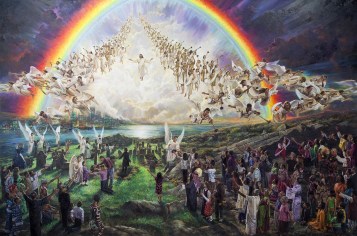 In Advent we are watching and waiting for the coming of our Savior and the end of our exile in this fallen, sinful world. Advent is the Christian life in a nutshell. We watch and we wait for the coming of our Lord. And as we wait, we are reminded that, whatever may happen to us in this veil of tears, the end is a joyful day for you whose citizenship is in heaven. As we wait, we remember that all the cares and sorrows of this world are temporary.
 God’s holiness creates three interlocking spheres which I’ve tried to show with this figure.
 offered himself without blemish to God, purify our conscience from dead works to serve the living God.”
 In Jesus, God has come into this common world and brought His holiness to you. Because of what Christ has done, God has claimed you as His own so that you can live with Him in His kingdom and serve Him in everlasting righteousness. He placed His holy name upon you when you were Baptized. In your Baptism, you were marked with the name of the Father, Son, and Holy Spirit (Mt. 28:18-20). That holiness, given to you in your Baptism, is now continually delivered to you when you hear and believe God’s holy Word. As you hear the word of truth, the gospel of your salvation, you are sealed with the promised Holy Spirit (Eph. 1:13). God continues to place His name on you as He blesses you, keeps you, makes His face shine upon you, and be gracious to you (Num. 6:22-27). Bearing His holy name, you are brought into His holy presence, and radiate His holiness to those around you.
 Our texts today seem to have conflicting messages. This text from Romans 15 has a lot to say about endurance, encouragement, hope, harmony, joy, and peace. It’s nice. But in our Gospel lesson, when Jesus talks about the day of His return, He speaks of signs in the sun and moon and stars. He mentions the distress of nations in perplexity, the roaring of the sea and waves, and people fainting with fear and foreboding because of what is coming on the world. Our Lord declares that the powers of the heavens will be shaken.
 The castle doors and the walls are shaking. Boulders are hurled against the fortress. Windows are shattering and dust is falling from the ceiling. The floor you are standing on is rocked by the sounds of battle all around you.
 What was defiled was made holy. What was dead was raised. Where there were sinners, Christ brought forgiveness. And all of that was just the beginning. All of this was written to give us encouragement to endure in the hope that the healing Christ brought to the broken of this world would be ushered into the entire creation – into the new creation.
 In our Old Testament lesson tonight (Ex. 3:1-5), Moses found himself standing on holy ground when God appeared in a bush. That bush was burning because of God’s holy presence, and Moses’ curiosity was piqued when he noticed that though the bush was aflame it was not consumed; it didn’t burn up. In the same way, when God’s holiness comes to us, it burns but God does not want us to be consumed by the fire of His holiness. Instead, He wants us to be changed by it.
 So, the second thing God’s holiness does to Isaiah is rub off on him. God sent one of the seraphs to fetch a burning coal, take it to Isaiah, and touch his lips with it and give a word of promise, “Behold, this has touched your lips; your guilt is taken away, and your sin atoned for.”
 6 But at midnight there was a cry, ‘Here is the bridegroom! Come out to meet him.’ 7Then all those virgins rose and trimmed their lamps. 8 And the foolish said to the wise, ‘Give us some of your oil, for our lamps are going out.’ 9 But the wise answered, saying, ‘Since there will not be enough for us and for you, go rather to the dealers and buy for yourselves.’ 10 And while they were going to buy, the bridegroom came, and those who were ready went in with him to the marriage feast, and the door was shut. 11 Afterward the other virgins came also, saying, ‘Lord, lord, open to us.’ 12 But he answered, ‘Truly, I say to you, I do not know you.’ 13 Watch therefore, for you know neither the day nor the hour.”
 But thanksgiving, yes it recognizes the goodness of the thing, but it looks past that and sees the goodness of the giver of the thing. This is why Christians can give thanks in all circumstances (1 Th. 5:18). Even in the tough stuff, even in difficult times, in sorrow, and in afflictions that come to us in this broken world, you can know that everything comes to you from the very same hands that were nailed to the cross for you.
 Now, to the parable. Honestly, it is very difficult, and the difficulty mainly lies in the fact that we don’t know enough about Jewish wedding customs in Jesus’ day to know why it was so important that these virgins have lit lamps when the groom arrived.
 28 But when that same servant went out, he found one of his fellow servants who owed him a hundred denarii, and seizing him, he began to choke him, saying, ‘Pay what you owe.’ 29 So his fellow servant fell down and pleaded with him, ‘Have patience with me, and I will pay you.’ 30 He refused and went and put him in prison until he should pay the debt. 31 When his fellow servants saw what had taken place, they were greatly distressed, and they went and reported to their master all that had taken place. 32 Then his master summoned him and said to him, ‘You wicked servant! I forgave you all that debt because you pleaded with me. 33 And should not you have had mercy on your fellow servant, as I had mercy on you?’ 34 And in anger his master delivered him to the jailers, until he should pay all his debt. 35 So also my heavenly Father will do to every one of you, if you do not forgive your brother from your heart.”
 Think about the other night. You were watching that show. Men, that woman wasn’t your wife; she was sitting next to you. But God knew your lusts. Women, that handsome, considerate, compassionate character wasn’t your husband. You know what? That’s lust too.
 Let your ears be attentive to the voice of my pleas for mercy! [W]ith the Lord there is steadfast love, and with him is plentiful redemption. And he will redeem Israel from all his iniquities.”
 However, because we are sinful and corrupt to our core, we have a tendency to turn God’s good gifts into idols. This happens all over in the Scriptures. God has given beautiful trees and precious metals and stones, but people would take those things and make images out of them into false gods and bow down and worship them. In Isaiah 44[:9-20], God mocks the people for the foolishness of idols. God says, “You foolish people will cut down a tree and take some of the wood and make a bonfire to warm yourself and bake bread. Then, you take other parts of that same tree and carve it into an idol, bow down to it, and worship it saying, ‘Deliver me, for you are my god!’” What folly to say to a hunk of wood, “You are my god.”
 There is a quote from C. S. Lewis in your Scripture insert from his book The Problem of Pain, which I’d encourage you to read. Here’s the quote, “God whispers to us in our pleasures, speaks in our conscience, but shouts in our pain; [pain] is His megaphone to rouse a deaf world.” In other words, in His mercy, God gets our attention by allowing pain to bring us back to Him for mercy and grace.
 Second, God will not leave you alone with your idols. Know that, even when you make an idol of God’s good gifts, God wants you to have what He has given you in a way that is better than you deserve or know. Even in those moments when your pain is acute and severe, God is good and is working all things together for good for those who love and trust Him. So, trust Him because He is completely worthy of your trust.
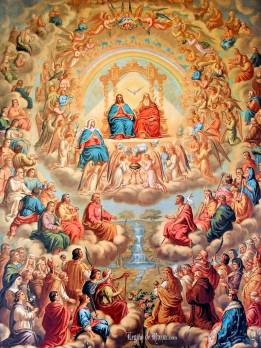 9 After this I looked, and behold, a great multitude that no one could number, from every nation, from all tribes and peoples and languages, standing before the throne and before the Lamb, clothed in white robes, with palm branches in their hands, 10 and crying out with a loud voice,
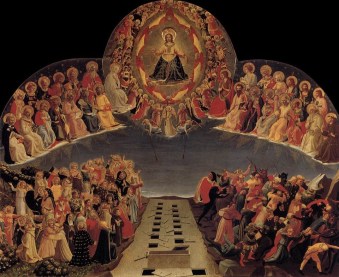 While death may come suddenly and abruptly here, those who die in the faith are not surprise arrivals in heaven. The company in heaven is not startled or shocked by those who show up at the doors of glory. The gates are open, and the believers who arrive there have been anticipated and are welcomed into the great multitude to be with the Lamb who shepherds them. Their arrival into glory is no shock to the residents of heaven. It is perfectly ordinary and on time.
 Because of this, we can have joy in the midst of sorrow. Here and now, as we are gathered together in God’s house and are invited to God’s table, we come to what is described in Hebrews 12(:22-24). This very morning in a small church on the north end of East Grand Forks, MN, we have come, “to Mount Zion and to the city of the living God, the heavenly Jerusalem, and to innumerable angels in festal gathering, and to the assembly of the firstborn who are enrolled in heaven, and to God, the judge of all, and to the spirits of the righteous made perfect, and to Jesus, the mediator of a new covenant.”

You must be logged in to post a comment.