Table for 4,000, Please? – Sermon for the Seventh Sunday of Trinity on Mark 8:1-9

Listen here.

Mark 8:1-9

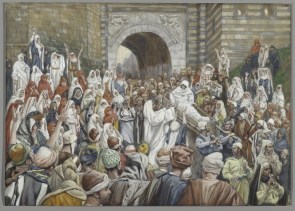
In those days, when again a great crowd had gathered, and they had nothing to eat, he called his disciples to him and said to them, “I have compassion on the crowd, because they have been with me now three days and have nothing to eat. And if I send them away hungry to their homes, they will faint on the way. And some of them have come from far away.” And his disciples answered him, “How can one feed these people with bread here in this desolate place?” And he asked them, “How many loaves do you have?”They said, “Seven.” And he directed the crowd to sit down on the ground. And he took the seven loaves, and having given thanks, he broke them and gave them to his disciples to set before the people; and they set them before the crowd. And they had a few small fish. And having blessed them, he said that these also should be set before them. And they ate and were satisfied. And they took up the broken pieces left over, seven baskets full. And there were about four thousand people. And he sent them away.

In the name of the Father and of the Son and of the Holy Spirit. Amen.

The last food you ate came from God even though it didn’t come directly from God. An exception will be made if you gathered up manna in your yard this morning. If you did, let me know. I’d like to come over this afternoon, so I can have a taste before it goes bad tomorrow. Talk to me after the service.

Your food comes from God, but God in His infinite wisdom has seen fit to give you that food through a long food-pipeline. Through farmers and ranchers who grow and raise the food. Through factories and workers that process, grind, and package. Through truckers and train engineers who haul. Through construction workers who build and maintain the roads and buildings. Through plumbers, electricians, engineers, and mechanics who design, make, and keep the roads, railways, machines, and buildings working. And even through insurance agents, accountants, and computer programmers who make all the work efficient and organized.

In fact, I bet if you and I sat down and put our minds together, we could figure out how every wholesome task performed in the world ends up putting food in our mouth. (Maybe we can do that while we enjoy that manna of yours.)

Now, God doesn’t have to use this massive, intricate food-pipeline. He could feed us directly as Jesus does in this text. God is the author of all good work and a master at it all.

This crowd has been with Jesus in a desolate place for three days hearing Him teach. They were so excited to follow Him that these silly people didn’t bring any food with them. Jesus tells the disciples that He has compassion on the people because if He sends them away, they won’t make it home. Some of them will faint and die of hunger. The disciples ask, “How can one feed these people (4,000 men plus women and children [see Mt. 15:32-39]) with bread here in this desolate place?” Their question is legitimate. Even if you had the means to pay for it, I bet you’d have a hard time buying enough bread for a crowd that size if you went to Hugo’s right after the service.

But watch what Jesus does in slow motion. He becomes the master of many trades all at once. He plows, plants, harvests, threshes, grinds, and bakes bread in a moment. Then, He sails, fishes, processes, cleans, and cooks fish to give the crowd a second course.

Yes, Jesus does this with what the disciples have among themselves. So, in a small way, He works within His creation and preserves the food-pipeline. But He certainly didn’t need to use what the disciples had because when it is all said and done, there are seven baskets of leftovers. The disciples end up with more than they had at the beginning.

This is a miracle. No one can feed such a large crowd, but Jesus can and does. But this miracle of feeding the 4,000 pales in comparison to the miracle of food that will be on your plate at lunch. The same Jesus is working through hundreds if not millions of people to make sure you have a bite later when He could simply make the food appear on your plate without any of them.

You are constantly surrounded by miracles. But you have gotten so used to seeing them that you don’t see the splendor and glory of God’s provision for you.

Do you realize how miraculous farming and gardening is? You take a seed – a tiny part of something, put it in the ground, and you get more of that same thing. How many thousands and even millions of tomatoes are in a single tomato seed when God uses His creation to nurture and grow that seed? We hardly give tomato seeds a second thought. But in each of those seeds is a lifetime supply of tomatoes for you and your family. But it is a lot less work for you to simply go to the store and purchase more tomatoes.

We are too easily bored with God’s miracles. And worse, we even grow to despise God’s work among us.

We get excited when a child takes her first steps. Her body has miraculously formed and developed the muscles, bones, and tendons needed to support her frame. Her mind has learned to control all those parts of her body so she can keep her balance. But how many weeks pass before her parents are tired of keeping her from walking to the garbage can, tipping it over, and rummaging through the contents? They wish she were still stationary.

Think for a moment of the miracle of life. Your body is made up of somewhere around 35 trillion individual cells that serve various functions. If the DNA in those cells were laid out end to end, it would travel from here to the sun and back 100 times. From the moment you were conceived, the information in your DNA would fill 600,000 pages. And right now, in each of the 35 trillion cells of your body, biological “machines” are copying volumes of information into amino acids which are taken by other machines and folded in very specific ways into proteins. So, don’t let anyone tell you that you are lazy.

These miracles are going on all around you and inside of you. And as we are able to learn even more about how this all works, it will simply get more intricate and amazing. You are fearfully, wonderfully, and miraculously made. And the fact that all of this is done because of your Creator should cause you to fall on your knees in reverence and praise.

From a seed producing a plant that produces more fruit and more seeds to a child learning to walk to your cells writing and rewriting the information that keeps you alive, God keeps this creation working. But because all of this happens every day, it doesn’t capture our wonder and amazement as much as if it only happened once.[1]

The feeding of this crowd does show us that Jesus is God in the flesh. But that is not Jesus’ purpose in feeding the crowd. Jesus did not do this miracle to show the crowd that He is divine. Rather Jesus’ purpose in feeding and providing for them is His own compassion.

If Jesus provides so richly and abundantly for a crowd who got themselves into trouble by something so simply as forgetting to bring their lunch, how much more compassion will He have for you, sinner? You who are rightful recipients of death – the wages of sin – will Jesus not have compassion on you?

He does have that compassion and He has given that compassion. He has come in your flesh after your likeness. He died on the cross and shed His blood for you to give you His forgiveness and righteousness. And this same Jesus will provide for your needs in this body and life as well.

To this hungry and dying crowd of 4,000 in a desolate place, Jesus brings life on the third day. Just as He fed the people on the third day, He has risen on the third day for your justification.

So, rejoice and trust your Savior. When Jesus said, “Seek first the kingdom of God and His righteousness, and all these things…,”your food, drink, clothing, shelter, and everything you need for life, “all these things will be added to you,”He meant it. Amen.

The peace of God, which surpasses all understanding, will guard your hearts and minds in Christ Jesus. Amen.

[1]Revised from a quote by John Donne, “There is nothing that God has established in the constant course of nature, and which therefore is done everyday, but would seem a miracle, and exercise of our admiration, if it were done but once.”

The Law Fulfilled – Sermon for the Sixth Sunday of Trinity on Exodus 20:1-17 & Matthew 5:17-26

Listen here.

Exodus 20:1-17

And God spoke all these words, saying,

God Gives the Ten Commandments“I am the Lord your God, who brought you out of the land of Egypt, out of the house of slavery.

“You shall have no other gods before me. You shall not make for yourself a carved image, or any likeness of anything that is in heaven above, or that is in the earth beneath, or that is in the water under the earth. You shall not bow down to them or serve them, for I the Lord your God am a jealous God, visiting the iniquity of the fathers on the children to the third and the fourth generation of those who hate me, but showing steadfast love to thousands of those who love me and keep my commandments.

“You shall not take the name of the Lord your God in vain, for the Lord will not hold him guiltless who takes his name in vain.

“Remember the Sabbath day, to keep it holy. Six days you shall labor, and do all your work, 10 but the seventh day is a Sabbath to the Lord your God. On it you shall not do any work, you, or your son, or your daughter, your male servant, or your female servant, or your livestock, or the sojourner who is within your gates. 11 For in six days the Lord made heaven and earth, the sea, and all that is in them, and rested on the seventh day. Therefore the Lord blessed the Sabbath day and made it holy.

12 “Honor your father and your mother, that your days may be long in the land that the Lord your God is giving you.

13 “You shall not murder.

14 “You shall not commit adultery.

15 “You shall not steal.

16 “You shall not bear false witness against your neighbor.

17 “You shall not covet your neighbor’s house.

“You shall not covet your neighbor’s wife, or his male servant, or his female servant, or his ox, or his donkey, or anything that is your neighbor’s.”

In the name of the Father and of the Son and of the Holy Spirit. Amen.

administration american flag country daylight

Wednesday, the United States of America, turned 242 years old, and she doesn’t look a day over 220. In the midst of the heat, barbeques, mosquitoes, and fireworks, I hope you took time to thank God your Father for His good gift of the nation that you live in. God has blessed us with a country that allows her citizens the freedom to use their God-given talents and abilities to better their own lives and the lives of others. Our nation, in many ways, is the envy of people throughout the history of the world.

Yet, our nation is not without major flaws. A former US Senate Chaplain, Peter Marshall, said, “May we think of freedom, not as the right to do what we please, but as the opportunity to do what is right.” Sadly, too many people and politicians in our country believe freedom means we can do whatever we want, and then, use those freedoms as a cover for evil.

In this country, we have the freedom of speech. But a current US senator has advocated and promoted violence against those who disagree with her politics. In our country, parents have the freedom to educate their children in the way they think is best. But slowly and steadily, parents are losing freedom to even know how their children are being educated in school. Marriage has been eroding in our nation for decades, and it is now being proactively attacked. Our Declaration of Independence says that all men are endowed by their Creator with certain unalienable rights – life, liberty, and the pursuit of happiness. But some states allow ‘physician-assisted suicide.’ In other words, it is now legal to be an accomplice to murder if you are a doctor, and when that happens, euthanasia is never far behind. And our country has made it legal to murder over 60 million babies through abortion.

The first verse of our national anthem closes with a question, “O say, does that star-spangled banner yet wave o’er the land of the free and the home of the brave?” Yes, the flag still flies over this land, and for that, we can thank God. But can we still be considered the land of the free when the lives of the most vulnerable are not protected?

Abraham Lincoln supposedly said, “America will never be destroyed from the outside. If we falter and lose our freedoms, it will be because we destroyed ourselves.” Lincoln might be wrong. We may still be destroyed by another nation. But at the rate the culture in our nation is disintegrating, Lincoln’s words appear to be accurate.

If a nation wants to destroy itself, all it has to do is ignore, undermine, or explain away the Ten Commandments. And that is precisely what is happening in our country, and it has been happening for a long time.

America needs to repent. Nations that have gone down the path our country is marching on don’t last long. God destroys them. America needs to repent.

But nations don’t repent. Individuals do. Americans need repentance, and it needs to start with you.

You are not what you should be. Do you hear these Ten Commandments and think, “Well, I’m way better than the society, culture, and people around me”? Then, you are the problem. The Law does not and cannot save you.

That is what Jesus was getting at in our Gospel lesson (Mt. 5:17-26). The Pharisees took the 5thCommandment, “You shall not murder,” and figured they must be pretty good. They were busy patting themselves on the back thinking they had impressed God. The Commandment was enough by itself. Jesus isn’t adding to the Commandment when He says that your anger makes you a murderer; instead, He is reminding you and I that we haven’t begun to be the people God created and wants us to be.

You need a righteousness that exceeds the righteousness of the best person you know or have heard of or you will never enter the kingdom of heaven. It is a righteousness you cannot attain or achieve by your works and efforts. Repent.

Small Catechism - Ten Commandments Cross IconRepent and know that there is righteousness that exceeds that of the scribes and Pharisees. Jesus came and kept the Law. Jesus did everything the Commandments demanded and did not do anything the Law forbade. Jesus does not get angry with someone without cause. Jesus does not look upon a woman with lust. Jesus does not chase after or desire things that are not given to Him. Instead, Jesus gladly accepts what the Father gives and then waits with perfect trust that the Father is good and will provide.

Jesus kept that faith even when He was forsaken by His Father as He hung on the cross shedding His holy, perfect, sinless blood for you. He endured an eternity of Hell for all of humanity. And as He breathed His last, He cried, “It is finished.”

There, the Law was fulfilled, and all the holy Commandments were perfectly kept. The last penny was paid, and there is nothing left for you to do to make God happy with you.

Because now, Jesus gives His righteousness away for free to all who believe in Him. He joins you to Himself through His word of promise, through your Baptism, and through His holy Supper. God looks at you and sees Jesus, and He delights in you.

Christian, you have died to sin. Live in it no longer. Rejoice in God’s will for you revealed in the Commandments.

Because Jesus will come back. When He does, sin and death and hell will die as well. And you will rise, free from your bondage to sin and free to bask in the grace of your Savior who loves you now and forever. Amen.

The peace of God, which surpasses all understanding, will guard your hearts and minds in Christ Jesus. Amen.

Scary Success – Sermon for the Fifth Sunday of Trinity on Luke 5:1-11

Listen here.

Luke 5:1-11

Jesus Teaches from Peter's BoatOn one occasion, while the crowd was pressing in on him to hear the word of God, he was standing by the lake of Gennesaret, and he saw two boats by the lake, but the fishermen had gone out of them and were washing their nets. Getting into one of the boats, which was Simon’s, he asked him to put out a little from the land. And he sat down and taught the people from the boat.

And when he had finished speaking, he said to Simon, “Put out into the deep and let down your nets for a catch.” And Simon answered, “Master, we toiled all night and took nothing! But at your word I will let down the nets.” And when they had done this, they enclosed a large number of fish, and their nets were breaking. They signaled to their partners in the other boat to come and help them. And they came and filled both the boats, so that they began to sink. But when Simon Peter saw it, he fell down at Jesus’ knees, saying, “Depart from me, for I am a sinful man, O Lord.” For he and all who were with him were astonished at the catch of fish that they had taken, 10 and so also were James and John, sons of Zebedee, who were partners with Simon. And Jesus said to Simon, “Do not be afraid; from now on you will be catching men.” 11 And when they had brought their boats to land, they left everything and followed him.

In the name of the Father and of the Son and of the Holy Spirit. Amen.

God gives better than you ask, and His promises exceed everything that you desire.

Peter was tired. He had spent the whole night fishing. Well, ‘fishing’ is too strong of a word. He caught nothing. If he had been using a pole and hook, he would have been up all night drowning worms, but Peter and his partners used nets to catch fish. Through the dark hours of the night, they cast their nets again and again and again only to bring them up empty each and every time.

You can imagine their frustration as they pulled the boats to shore while the sun broke on the horizon. They probably talked with each other about what went wrong. Maybe, they wondered how they would provide for their families and where their money would come from the next week. Now, they simply wanted to clean their nets, go home, and sleep.

But while they clean their nets, Jesus is there on the shore teaching God’s Word to a massive crowd. Everyone is trying to get close to hear Him. So, Jesus says, “Hey Peter, why don’t you row Me out a bit so I can keep preaching?”Peter obliges, and the boat becomes a pulpit.

Jesus’ sermon ends. Unlike me, Jesus doesn’t, apparently, slip into what I call a ‘post-liturgical coma.’ Instead, Jesus has an idea. “Hey Peter, why don’t we row out a bit further and catch some fish?”

Now, Peter knew fishing. There was a reason he and his partners had been out all night and not during the day – that’s when you catch fish. He had just finished cleaning his nets so they would be ready for their next excursion. Peter just wanted to go home and find his pillow.

Peter could have said, “Listen here, Jesus. Sure, You can teach the Scriptures like nobody else. But listen, Mr. Carpenter, fishing is my game. Why don’t You stick to teaching and woodworking?” But he doesn’t. Peter responds, “At Your word, I will let down the nets.” This statement is as good as faith gets on this side of eternity.

Now, imagine this. Peter and Andrew put down the nets and sail around a bit, knowing this isn’t the time to do this. They reach down to draw the net into the boat. That night, they had gotten used to lifting nothing but the weight of the net, but this time they feel resistance. They pull and tug and heft. The nets start creaking and breaking because of all the weight. They signal to their partners to come and help. All of them together can’t lift the net into the boat, so they start scooping fish into both boats as fast as they can. They are wet, slimy, and breathless as both boats become so full of fish that they begin to sink.

Pause here for a minute. Peter and his partners, apparently, had quite an operation going for themselves. They weren’t simply recreational fishermen. This was a business – several professionals operating several boats. They had never had a catch like this. You would think the first thing to go through Peter’s mind would be to sign Jesus as their navigator and guide. He could tell them when and where to cast their nets. They could buy a fleet of boats, hire more fishermen, and find a crew to clean and mend the nets. How slick would this be? Peter could retire early and live on easy street. But none of that enters his mind.

Catch of Fish from Luke 5Getting a catch like that would be the dream any fisherman. But it is too much of a good thing. This catch is threatening their livelihood, nearly breaking the nets and causing the boats to sink; it is killing them. And these fish – which had been their life and livelihood – could not save them. This fishing expedition is a massive success. Surrounded by what would provide for his life for months if not years, Peter can only see his sin.

Consider your life. What do you do each and every day? Where do you spend your time and effort? What are you focused on? What are your goals and dreams? What do you pray for and ask God to give you? Do you ever get frustrated with God when He does not answer? And when God does give you what you ask, how long are you satisfied?

Repent. Your goals and dreams are not what they should be. God knows what is good for you even better than you do. God is still good when He doesn’t give you what you what you ask for. God was good when He allowed the disciples to catch nothing that night. And Jesus is good by denying Peter’s request to depart.

“Depart from me, for I am a sinful man, O Lord,” is a stupid prayer. If Jesus answered that prayer, Peter would not only drown, he would go to hell because hell is where God is not present in His mercy for sinners.

Jesus knows how to answer better than Peter knows how to ask. Jesus answers Peter’s prayer in a way that exceeded anything sinful Peter could have desired. Jesus says, “Do not be afraid.”

Two weeks ago, we heard the scribes and Pharisees grumbling about Jesus, “This Man receives sinners and eats with them.” What they meant as mocking and jest is your faithful and holy confession.

Yes, Jesus does receive sinners. In fact, Jesus has this in mind when He gives Peter his new calling, “From now on, Peter, you will be catching men alive.”Jesus uses a particular word here. It doesn’t simply mean to catch, it means to catch alive.

Jesus does not depart. Instead, He draws closer to Peter so that Peter and the other apostles can have a new calling – to catch men alive with the net of the life-giving Gospel.

Cross and CommunionJesus’ will is that you be caught by the net of the Gospel, that you be brought into the boat of the church, and that you have fellowship with Him now and forever. It is Jesus’ will that He not depart from you but that He draw you to Himself.

Jesus says to you, “Fear not. I give to you My Body which was crucified but lives. I give to you My shed Blood which is the source of your life and forgiveness.”Jesus says, “Come and receive what you wouldn’t dare ask for, but I freely and happily give to you.”And you? You say, “At Your word, Lord, I will do as You say.” Amen.

The peace of God, which surpasses all understanding, will guard your hearts and minds in Christ Jesus. Amen.

Measured – Sermon for the Fourth Sunday of Trinity on Luke 6:36-42

Listen here.

Luke 6:36-42

36 “Be merciful, even as your Father is merciful.

37 “Judge not, and you will not be judged; condemn not, and you will not be condemned; forgive, and you will be forgiven; 38 give, and it will be given to you. Good measure, pressed down, shaken together, running over, will be put into your lap. For with the measure you use it will be measured back to you.”

39 He also told them a parable: “Can a blind man lead a blind man? Will they not both fall into a pit? 40 A disciple is not above his teacher, but everyone when he is fully trained will be like his teacher. 41 Why do you see the speck that is in your brother’s eye, but do not notice the log that is in your own eye? 42 How can you say to your brother, ‘Brother, let me take out the speck that is in your eye,’ when you yourself do not see the log that is in your own eye? You hypocrite, first take the log out of your own eye, and then you will see clearly to take out the speck that is in your brother’s eye.”

In the name of the Father and of the Son and of the Holy Spirit. Amen.

Before we really get into this text, we have to understand that the way the world interprets these verses is wrong and sinful. Do Not JudgeJesus says, “Judge not,”and our fallen, twisted, evil, amoral society latches on to these words like stink on poo. If an unbeliever loves any words of Jesus, it is probably, “Judge not.”

The godless sinners of our society (and of all times) think this means Christians are not allowed to say that anything is sinful or wrong. How many times have you spoken against some sin and had these words, “Judge not,”thrown in your face? Even worse, how many times have you kept your mouth shut when you see sin because these words had been thrown at you?

Sin is evil and should and must be spoken against. When Jesus says, “Judge not,”He does not mean that you should be silent when it comes to others’ sin – even though the world will call you a hypocrite for doing so.

If someone steals your car, it is not helpful to you, to your faith, or to society to simply say, “Well, I guess it was his car.” That is simply adding sin to sin. The seventh commandment was broken when they stole the car. The thief probably also broke the eighth commandment saying the car was theirs. Don’t join them in breaking the eighth commandment by lying yourself.

When Joseph forgave his brothers (in our OT text [Gen. 50:15-21]), he didn’t say, “When you seized me, threw me in a pit, planned to kill me, and sold me as a slave instead of treating me like your brother, God was really doing a good thing through you.” No! Joseph says that what they did was evil. Yet, he forgave them and extended them mercy.

When we don’t call sin, “Sin,” we are judging God.

The parable about a blind man leading a blind man and Jesus’ statement about specks and logs in eyes shows that we as Christians are called to speak against sin. If you were blind, you wouldn’t offer to be a hiking guide for the blind at the Grand Canyon. You’ll all fall in. But if you see, you can and should lead the blind man safely. And Jesus isn’t saying that you should never remove specks from others’ eyes. No, Jesus says to receive His free forgiveness which removes the log in your eye. Then reprove, rebuke, and correct the one who has a speck in his.

Judge Hypocrite Adam4dKnow this: No one will thank you from hell for remaining silent about their sin on earth. And God forbid that they curse you from hell for remaining silent about their earthly sin.

The Apostle Paul sums up Jesus’ words for us in Galatians 6:1. “Brothers, if anyone is caught in any transgression, you who are spiritual should restore (this is a command) him in a spirit of gentleness. Keep watch on yourself (also a command), lest you too be tempted.”

So, do you see that this text isn’t a prohibition against you calling sin, “Sin”? Good. Now, the text can wallop you, you hypocrite.

Your fallen mind is selfish, always measuring your motives and actions against others’. You speak against the sins of others while ignoring the fact that you are committing the same sin.

Take the Fifth Commandment, “Thou shalt not kill,” for example. You decry the plague of abortion in our country. You know that it is the heinous murder of the most vulnerable in our society and is the cousin of the Holocaust. But then, you don’t think twice about encouraging a young married couple to get settled in their careers before having kids. Or, you look at your own kids as a burden. You place your sinful actions on a scale and measure them to be less offensive and sinful. You hypocrite!

Take the Sixth Commandment, “Thou shalt not commit adultery,” for example. You speak against the sin of homosexuality and say that it is against God’s order. You are right that it is. But then, you turn around and do not love and honor your spouse as you should. Instead, wives, you undermine your husband and speak ill of him to anyone who will listen. Husbands, you do not treat your wives with the love and care they deserve, and you don’t avert your eyes from the lustful images that come your way. With your faulty scale, your sin doesn’t even register in your conscience. You hypocrite!

Take the Eighth Commandment, “Thou shalt not bear false witness against thy neighbor.” You get enraged when others spread false, malicious gossip about you. But then you talk about others behind their back in ways you never would if they were standing next to you. By doing so, you measure your sin against theirs with your thumb pressing down on their sin.You hypocrite!

You are not what you should be. “Be merciful, even as your Father is merciful.”You, as a child of God, should and must resemble your Heavenly Father. But you don’t.

Repent. As Scripture says, “The saying is trustworthy and deserving of full acceptance, that Christ Jesus came into the world to save sinners, of whom I am the foremost” (1 Tim. 1:15). Because these words are Scripture, they are true and inerrant. But they are also wrong. Paul was not the foremost of sinners; I am. And I hope you can honestly and vehemently say the same.

We sinners keep measuring. We want what is our due. We demand our rights. We forgive only when we think our enemy deserves it – which isn’t forgiveness at all. Pretending that it is is harmful to our faith. Mercy, by definition, is never deserved.

Repent and hear again Jesus’ words, “Your Father is merciful.”

Jesus takes and becomes sinGod loves you from His very heart. God gives you real mercy. He loves the good and bad, the greatest and the least. He loves the sinner who strives to be merciful but fails, the hardened drug lord who doesn’t care about his sin, and He even loves you. In His mercy, God doesn’t simply get frustrated with your hypocrisy and ignore it.

No. God, in His infinite mercy, sends Jesus – His beloved, hypocrisy-free, perfect Son – to shed His innocent blood and die for that sin. God doesn’t simply love you with words but also with His actions.

God’s love for you in Christ is that He sees no log or speck of sin in your eye. His measure of mercy isn’t changed by the standard of your mercy toward others. His mercy is poured into your lap – good measure, pressed down, shaken together, and overflowing. So, let that mercy change you. And let that mercy pour out to others. Amen.

The peace of God, which surpasses all understanding, will guard your hearts and minds in Christ Jesus. Amen.

The Father’s Feast – Sermon for the Third Sunday of Trinity on Luke 15:1-32

Listen here.

In the name of the Father and of the Son and of the Holy Spirit. Amen.

Three parables. A shepherd seeks and finds his lost sheep. A woman seeks and finds her lost coin. And a father seeks and finds his lost son. Yes, the father is the one doing all the work to restore his son – not the other way around.

Jesus teaches these parables in response to the Pharisees and scribes who were grumbling about the company Jesus was keeping. Christ was eating with tax collectors (read thieving traitors) and sinners (read prostitutes and adulterers).

Now, it is not as though the Pharisees and scribes would say they were sinless and perfect. They would admit their sin, that they weren’t perfect. But in their minds, their sin certainly wasn’t as bad as those shady characters surrounding Jesus.

In fact, these grumblers might have argued that they cared about the tax collectors and sinners more than Jesus because they didn’t want them to continue in their sin. They would have called them to repent and change their ways. Try harder. Live better. Do some good works.

The Pharisees and scribes see Jesus associating and eating with these sinners as though their behavior doesn’t matter at all. Is Jesus soft when it comes to sin? Is Jesus liberal when it comes to lifestyles? Is He tolerant and affirming of their evil? Does Jesus’ mercy mean that sin doesn’t matter to Him?

Tuck that question in the back of your mind because we will find the answer when we compare the parables. The three parables all have the same outline and progression. Something is lost; that thing is found and restored; and there is a party. But Jesus tells all three. He could have just told the parable of the shepherd seeking and finding his lost sheep, but He didn’t. Each parable helps us to see what is happening in the others.

First, we have to see who the hero is in each of the parables, and it is the one who finds, restores, and invites to the feast. As the shepherd finds and restores the sheep and as the woman finds and restores the coin, we have to remember the father finds and restores the lost son.

The son is not the hero. The son’s pig-pen plan is not to become a son again. As he is sitting in the slop, he realizes that his life would be better as a servant of his father. But the father is like the shepherd who does the work of searching out and carrying home the lost sheep. He sees his son from a distance, runs to him, and brings him home. The father is like the woman sweeping her house. He picks up his son from the dust of his slavish plan. The father cleans the piggy poo from his boy and brings him back into his home.


You see, the heroes in each story all do the same thing. They seek, find, and save the lost. Then, the hero throws a feast. So back to our question: By eating with these sinners, is Jesus implying that the sin doesn’t matter?

Well, again, look at the parables. Consider each thing that gets lost. Sheep get lost, and shepherds don’t blame the sheep. And the only time a coin gets lost is when its owner messes up. So, if Jesus had only told the first two parables, we might think that sin doesn’t matter. In fact, if we only consider the second parable the lostness is God’s fault.

But then, comes the third parable, and we see what causes that separation. The son who wishes his father was dead. The son who wastes his father’s living. The son who brings embarrassment and shame to his entire family. The son who squanders his father’s good gifts until there is nothing left. The son is to blame for his lostness.

The scribes and Pharisees were tough on sin, but Jesus is even more so. Jesus knows who He is eating with. He knows what these sinners have done. And He knows what you have done.

Jesus knows what you have taken. Jesus knows what your eyes have seen when they should have turned away. Jesus isn’t blind to your sin. He knows it all. He knows that you have acted like the lost son wishing that He were dead and out of your life.

And, yet, He still sees you as His lost sheep. He cherishes you and searches for you. He loves you regardless of yourself. He spares no cost in restoring you and rejoicing over you. This is how your heavenly Father is toward you, sinner.

Today, on Fathers’ Day it is good for us to remember that God is the source of all fatherhood. Too often, we flip the script. When the Bible talks about God being our Father, we think that our earthly fathers are where we can get an idea about who God is. It’s the other way around.

Fathers, learn your vocation from your Heavenly Father. Be the loving, seeking, restoring, patient, kind, merciful father to your family in the same way that God has been toward you. And remember that God and all the hosts of heaven rejoice over one sinner who repents and is restored.

You see, God cares about all the lost. He cares about the one out of one hundred. He cares about the one out of ten. He cares about the one out of two. And He still cares about the one who will not come and feast with Him. Your heavenly Father cares about all. He cares about you.

Because Jesus has died and lives again, He invites you to His feast. So, come. Come and celebrate your Father’s mercy toward you and toward all. Rejoice with God in what He is doing and what He has done. Amen.

The peace of God, which surpasses all understanding, will guard your hearts and minds inChrist Jesus. Amen.

Excuses – Sermon for the Second Sunday of Trinity on Luke 14:15-24

Listen here.

Luke 14:15-23

15When one of those who reclined at table with him heard these things, he said to him, “Blessed is everyone who will eat bread in the kingdom of God!”

16But he said to him, “A man once gave a great banquet and invited many. 17And at the time for the banquet he sent his servant to say to those who had been invited, ‘Come, for everything is now ready.’ 18But they all alike began to make excuses. The first said to him, ‘I have bought a field, and I must go out and see it. Please have me excused.’ 19And another said, ‘I have bought five yoke of oxen, and I go to examine them. Please have me excused.’ 20And another said, ‘I have married a wife, and therefore I cannot come.’ 21So the servant came and reported these things to his master. Then the master of the house became angry and said to his servant, ‘Go out quickly to the streets and lanes of the city, and bring in the poor and crippled and blind and lame.’ 22And the servant said, ‘Sir, what you commanded has been done, and still there is room.’ 23And the master said to the servant, ‘Go out to the highways and hedges and compel people to come in, that my house may be filled. 24For I tell you, none of those men who were invited shall taste my banquet.’”

In the name of the Father and of the Son and of the Holy Spirit. Amen.

Once, there was a young child whose parents loved him very much. They taught him the Scriptures, and the child was gradually learning to repeat the passages his parents read to him. The child grew, and it was time to train him to use the toilet. His parents would sit him on the potty chair and give him privacy to do his business. This child, schooled in the Scriptures, had a signal to his parents when he needed help cleaning himself after going number 2. He would recite from our text, “Come, for everything is now ready.” Thankfully, his parents were not like those who offered excuses in the parable. They were loving and went and cared for his needs.

The men who make excuses to escape going to the king’s banquet are treating the invitation like it is a call to help wipe a toddler’s derriere. They simply aren’t interested in going to the banquet because they thought they had something better to do, and they don’t care about the repercussions if they are absent. They are comfortable insulting the king, his invitation, and his feast because they have treasures on earth. They don’t realize that, unlike the feast, the invitation is not eternal.

The point of the parable is easy to see. Not everyone goes to heaven. Those who do not think they need God’s grace will find that, outside of His grace, there is only eternal loneliness and torment. As our hymn just said:

But they who have … resisted His grace
And on their own virtue depended,
Shall then be condemned and cast out from His face,
Eternally lost and unfriended.
Have mercy upon us, O Jesus![1]

At the time of death or when Jesus returns, the invitation is withdrawn. Those who reject the invitation will get what they want. They won’t have to offer any more excuses to the king and his messengers. Those who continually reject God’s invitation will one day be free of God, but they will be eternal prisoners of themselves.

Invite as many as you find to the wedding feastSo, this parable should give us an urgency. There is still room for more at the feast. We should be those who go out and call more of the poor, crippled, blind, and lame. We should go out to the highways and hedges and compel more to come in. And we wouldn’t even have to go far from this very place. How many Muslim refugees do we have living less than one block away? They play in our yard and use our trees for shade. Jesus wants them to come to His feast as much as He wants you.

But this parable should hit each and every one of us harder because of the context. And when this parable hits us harder, we will become more eager to extend the invitation of Christ the King.

Here is why this parable should crush us – it isn’t just that it exposes our sinful hesitation to share the Gospel with others. Jesus tells this parable in response to a statement, “Blessed is everyone who will eat bread in the kingdom of God.” In its context, that is a heretical benediction.

Now, don’t get me wrong. At face value, it is true. Everyone who eats bread in the kingdom of God is blessed. But the person who says this is, at that very moment, eating with Jesus. In that context, this statement would be like a newlywed husband getting to the hotel on his wedding night and saying to his bride, “Today was nice, but I’m really looking forward to my retirement party.” The man who says, “Blessed is everyone who will eat bread in the kingdom of God,” doesn’t realize that he is, in truth, living in that present blessing. The blessed existence he that would come sometime in the future was going on right around him.

Wherever Jesus is, there is the kingdom of God. Jesus came preaching that the kingdom of God was at hand (Mk. 1:14-15). And just a couple of chapters earlier in Luke’s Gospel, Jesus said that because He was casting out demons by the finger of God that God’s kingdom had come (Lk. 11:20).

You see, the person sitting there with Jesus at the table was sitting with the present King and eating with God incarnate. So, this parable speaks to us today about being at church. When God’s people gather together to hear God’s Word and receive His gifts, there is the kingdom of God. So, if you are looking forward to going to heaven and being with Jesus, you should also look forward to coming to church because it is a foretaste of eternity with Jesus.

Each of the men who offer excuses in the parable aren’t saying that they never want to go to the party; they just want to go when it is more convenient for them. And their excuses show that they view the things of the world as more important than eternal things.

The pleasures and cares of this world are dangerous to faith when we appreciate and love them more than the blessing of gathering with our Lord and Savior and brothers and sisters in Christ here every Sunday morning.

Wedding Feast of the LambWeekends at the lake, sport tournaments, and even time with family are all blessings from God. But when those things keep us from gathering around God’s Word in the place where God says He meets with us, they are deadly. They are idols. When you are not in church for whatever reason on any given Sunday, you are missing the blessing of being and feasting with God.

The king is angry with those who offer excuses. And notice – this is the most amazing thing that is hard to wrap our minds around – the king is angry because all he wants is for them to be there with him. The king is angry because he wants these people to have the good and joyous things he has for them. God is much more desirous of giving to and helping us than we are of receiving or asking for those things (Luther).

Repent. Repent of your excuses. Jesus has died and shed His blood so that the sinful excuses you would offer are washed away. They are removed as far from you as the east is from the west. And know that God’s invitation stands. “Come. Come to my feast. Come and receive what you could never earn or deserve. Come, you who are worthy. Come, you who are unworthy. Come, for all the blessings of heaven are here for you for free. Come, for everything is now ready.”Amen.

The peace of God, which surpasses all understanding, will guard your hearts and minds inChrist Jesus. Amen.

[1]“There Many Shall Come” Ambassador Hymnal #627. Magnus Brostrup Landstad.

Before the Throne of God – Sermon for Holy Trinity Sunday on Isaiah 6:1-7

Listen here.

Isaiah 6:1-7

1In the year that King Uzziah died I saw the Lord sitting upon a throne, high and lifted up; and the train of his robe filled the temple. Isaiah 62Above him stood the seraphim. Each had six wings: with two he covered his face, and with two he covered his feet, and with two he flew. 3And one called to another and said:

“Holy, holy, holy is the Lordof hosts;
the whole earth is full of his glory!”

4And the foundations of the thresholds shook at the voice of him who called, and the house was filled with smoke. 5And I said: “Woe is me! For I am lost; for I am a man of unclean lips, and I dwell in the midst of a people of unclean lips; for my eyes have seen the King, the Lordof hosts!” 6Then one of the seraphim flew to me, having in his hand a burning coal that he had taken with tongs from the altar. 7And he touched my mouth and said: “Behold, this has touched your lips; your guilt is taken away, and your sin atoned for.”

In the name of the Father and of the Son and of the Holy Spirit. Amen.

Why do you come to church?

Last year, Gallop polled fifteen hundred adults[1]to see why they go to church. They gave seven options, and here is the order those options were ranked:

  1. Sermons or talks that teach me more about Scripture.
  2. Sermons or talks that help connect religion to my life.
  3. Spiritual programs geared toward my children.
  4. Lots of community outreach and volunteer opportunities.
  5. A leader who is interesting and inspiring.
  6. Social activities to get to know people in my community.
  7. Good music.

Do you notice anything missing from that list? Anyone? Bueller?

No mention of receiving forgiveness.

Each of those responses is starting with the premise that when Christians gather together they are the ones doing something. “I’m learning. I’m becoming more religious. I’m doing my duty for my children. I’m helping my community.” And each of these responses is dead wrong.

When Christians gather together to hear God’s Word, God is the One who is acting, and we are the ones being acted upon. He sends His Word to convict of sin. And God sends His Word to forgive sin. That is why we want our service to be filled with Scripture. We want everything to be centered around God’s Word – Law and Gospel.

Isaiah tells us about what happened to him while he was at church one day.

Isaiah was a normal dude. He wasn’t a priest, so Isaiah couldn’t enter the holy places of the Temple. So, Isaiah is in the courtyard of the Temple where the laity would gather to offer their sacrifices and hear the Word of God. It was how God’s people did church in Isaiah’s day.

But while he is there, God gives Isaiah this vision to see what is really happening. Isaiah sees the Lord high, lifted up, and sitting on the throne. In the Gospel of John, we are told that Isaiah saw Jesus on that throne (Jn. 12:41) with the train of His glorious robe filling the Temple.

But Jesus isn’t alone. With Him are the seraphim – glowing, fiery angels with six wings. Why six wings? God didn’t create them with unnecessaryparts, and they aren’t mutations. These angels are perfect. Perfectly created, and perfect in their conduct. The angels never sinned and didn’t need to be redeemed. But even they need to cover the parts that show their creatureliness.

Each seraph calls out, “Holy, holy, holy is Yahweh of hosts; the whole earth is full of His glory.” This threefold ‘holy’ is not just repetition. Each of these holy’s stands on its own; it could be translated, “Holy One. Holy One. Holy One.” Three distinct Holy Ones each deserving of praise. Isaiah only sees one – Jesus, but the seraphim are worshipping Three – Holy Father, Holy Son, and Holy Spirit.

Isaiah sees and hears this as he is there to worship at the Temple, and it is true for us, even though we don’t see it, every time we gather for worship as well. Every time Christians gather together, more are there than can be seen. Jesus promises that the Trinity is with even the smallest congregation (Mt. 18:20).

Wedding Feast of the LambHebrews 12[:22–23]tells us that there are many more here today than our eyes can see, “But you have come to Mount Zion and to the city of the living God, the heavenly Jerusalem, and to innumerable angels in festal gathering,and to the assembly of the firstborn who are enrolled in heaven, and to God, the judge of all, and to the spirits of the righteous made perfect.”

Isaiah sees what we can’t see, and he hears the worship we can’t hear. So he cries out, “Woe is me! For I am lost.” Essentially, Isaiah is saying, “I’m cooked.” Before the lofty throne of the Almighty, Eternal, Triune, Holy God, Isaiah figures God is there to punish him. How incredibly sad!

Isaiah is a Christian. He believes that God is “merciful and gracious, slow to anger, and abounding in steadfast love and faithfulness, keeping steadfast love for thousands, forgiving iniquity and transgression and sin” (Ex. 34:6-7).

If God had wanted to judge Isaiah, He could have opened up a hole in the ground and swallowed Isaiah to the pits of hell. God doesn’t toy around when it comes to executing judgment.

But Isaiah knows his sin. He knows that his sin isn’t something outside of him that sort of hovers over him. And his sin isn’t just something recorded in a divine naughty-or-nice list. Instead, Isaiah knows that his sin is on his lips, in his body, and part of who he is.

We wouldn’t have done any better than Isaiah did if we had this same encounter. We would have been just as terrified. The sins that we commit and don’t even think about would have been equally exposed. And we know that we have no excuse and no alibi when standing before the God and judge of all creation. We would rightly fear the Holy Trinity who after killing the body can throw us into hell (Mt. 10:28).

But when God appears to sinners. He isn’t there to destroy them. He is there to redeem them, forgive them, and comfort them. Jesus did not come into the world to condemn the world, but that the world might be saved through Him.

That seraph, that messenger of God, takes a burning coal from the altar and touches Isaiah’s lips, and absolves him: “See this has touched your lips; your guilt is taken away, and your sin atoned for.”

What comes right after this text is comical. We, at least I, forget that sometimes. There is the Holy, Holy, Holy, Triune God and forgiven Isaiah. And God asks a question. “Whom shall I send, and who will go for Us?” God could have just given Isaiah his marching orders, “Ok, Isaiah. Now that I’ve forgiven you, you’re going to do something for Us.”

No, God gives Isaiah a chance to confess that he is forgiven. And Isaiah does, “Here am I. Send me.” Isaiah, the man cleansed of unclean lips, is given the task of proclaiming God’s Word as God’s prophet.

And you here today, you saints, you who have come into the presence of the Holy, Holy, Holy God, you too have been cleansed. Your guilt has also been taken away. Your sin has been completely atoned for. As you leave this place, go with a clean conscience. Go and do everything that God calls you to do this week. Go be God’s salt and light in this world.

And come back. Come back next week before the throne of God to once again receive His grace, mercy, forgiveness, and love. Amen.

The peace of God, which surpasses all understanding, will guard your hearts and minds inChrist Jesus. Amen.

[1]http://news.gallup.com/poll/208529/sermon-content-appeals-churchgoers.aspx?utm_source=alert&utm_medium=email&utm_content=morelink&utm_campaign=syndication

Remembrance – Sermon for Pentecost on John 14:23-31

Due to technical difficulties, no audio for today’s sermon.

John 14:23–31

23Jesus answered him, “If anyone loves me, he will keep my word, and my Father will love him, and we will come to him and make our home with him.24Whoever does not love me does not keep my words. And the word that you hear is not mine but the Father’s who sent me.

25“These things I have spoken to you while I am still with you.26But the Helper, the Holy Spirit, whom the Father will send in my name, he will teach you all things and bring to your remembrance all that I have said to you.

27“Peace I leave with you; my peace I give to you. Not as the world gives do I give to you. Let not your hearts be troubled, neither let them be afraid.28You heard me say to you, ‘I am going away, and I will come to you.’ If you loved me, you would have rejoiced, because I am going to the Father, for the Father is greater than I.29And now I have told you before it takes place, so that when it does take place you may believe.30I will no longer talk much with you, for the ruler of this world is coming. He has no claim on me,31but I do as the Father has commanded me, so that the world may know that I love the Father. Rise, let us go from here.”

In the name of the Father and of the Son and of the Holy Spirit. Amen.

Jesus says that the Holy Spirit’s job is, “to bring to your remembrance all that I have said to you.”

What was the last thing you forgot? Now, there’s a scary question. If you can remember the last thing you forgot, then you’ve remembered. You maybe didn’t remember on time, but you did remember. The very question, “What was the last thing you forgot?” makes you wonder the dozens, or thousands, of things that you should remember but don’t.

We all have stories of entering the room with decision, purpose, and intent but we enter the room and ask ourselves, “What did I come here to do?” Some mornings, in the clamor of trying to get the kids to school, I frantically search for my keys wondering to myself, “Where in the world and I put them?” only to look down and find my misplaced keys in my hand.

Well, today is Pentecost. We are fifty days after Easter, and today we celebrate God sending His Holy Spirit. And, I hope you remember, three weeks ago Jesus said that the Holy Spirit convicts the world concerning sin, righteousness, and judgment (Jn. 16:5-15).

In case you don’t remember, the Holy Spirit convicts us of our sin to show us that we need a Savior, Jesus. The Holy Spirit convicts us of righteousness to show us that Jesus’ perfect sacrifice on the cross makes us righteous. And the Holy Spirit convicts us of judgment to remind us that Satan no longer has any claim on us because he is judged.

In other words, wherever the Gospel is preached, where Jesus’ death and resurrection are proclaimed, where Jesus is announced as the Lamb of God who takes away the sin of the world – there, the Holy Spirit is, without question, at work. Wherever the Word of God is being faithfully proclaimed, the Holy Spirit is doing His work calling, gathering, enlightening, sanctifying, and preserving the Christian Church.

In our Old Testament reading (Gen. 11:1-9), we heard how God dispersed the people after the Flood. They had plans to build a tower that would have its top in the heavens. Possibly, they were trying to protect themselves from another flood even though God had promised to never flood the earth again. They were sinfully rebelling against God’s command to fill the earth. However, God, in His mercy, came down to stop their sin and to disperse them by confusing their language – sort of a “we can do this the easy way or the hard way.” By this act of judgment, God nudges His creatures to do what He commanded them.

In our reading from Acts (2:1-21), we heard how God doesn’t remove the confusion of language He brought to Babel. Instead, God continues to be gracious. So the Gospel can be proclaimed in all creation, God gives the apostles the gift of speaking in tongues. They are enabled to preach the mighty works of God in all the human languages present that day of Pentecost.

We didn’t hear Peter’s whole sermon in our reading today. But in the next fifteen versus, he preaches Jesus. He doesn’t preach about the Holy Spirit; he preaches Jesus. And what happens in the crowd reveals the Holy Spirit’s work. They are convicted of sin.

They heard that Jesus, whom they crucified, was both Lord and Christ. And when they heard this, “they were cut to the heart,” and asked, “What shall we do?” And Peter continued to be the Holy Spirit’s instrument saying, “Repent.” Now, the people were already convicted, so Peter isn’t telling them to feel bad about their sin. Instead, the Holy Spirit through Peter is telling the people to trust Jesus’ forgiveness.

“Repent and be baptized in the name of Jesus Christ for the forgiveness of your sins. For this promise is for you and for your children and all who are far off, everyone whom the Lord our God calls to Himself” (Act. 2:38-39). That day, 3,000 souls were added to the Christian church by the working of the Holy Spirit. And the Holy Spirit continued to work in those believers’ hearts reminding them of Christ’s forgiveness.

The devil’s work is similar to the Holy Spirit’s work, but only at one point. The devil wants to do the first work of the Holy Spirit but leave you there. Like entering a room and not remembering why you are there, the devil wants to leave you in the fog and doubt of your sin.

Thank God for the Holy Spirit! He removes the fog. No matter how thick and dense your sin is, the Holy Spirit brings to your remembrance the truth that God has removed your every sin, transgression, and iniquity sin by Jesus’ death and resurrection.

And the Holy Spirit is about to do another work.

The only other time that Jesus uses this word, ‘remembrance,’ is when He institutes the Lord’s Supper. Jesus says to take and eat the bread which is His Body given unto death and to drink the wine which is His very Blood shed for the forgiveness of your sins. Jesus says we are to do this ‘in remembrance’ of Him.

Through this Bread and Wine, the Holy Spirit is at work giving you Jesus. Believe Him that through this holy and blessed Sacrament, all your sins are completely forgiven. Then, rise and go from here remembering the comfort of your Savior’s mercy. Amen.

The peace of God, which surpasses all understanding, will guard your hearts and minds inChrist Jesus. Amen.

Use It – Sermon for Easter 7 on 1 Peter 4:7-14

Listen here.

1 Peter 4:7-14

7The end of all things is at hand; therefore be self-controlled and sober-minded for the sake of your prayers. 8Above all, keep loving one another earnestly, since love covers a multitude of sins. 9Show hospitality to one another without grumbling. 10As each has received a gift, use it to serve one another, as good stewards of God’s varied grace: 11whoever speaks, as one who speaks oracles of God; whoever serves, as one who serves by the strength that God supplies—in order that in everything God may be glorified through Jesus Christ. To him belong glory and dominion forever and ever. Amen.

12Beloved, do not be surprised at the fiery trial when it comes upon you to test you, as though something strange were happening to you. 13But rejoice insofar as you share Christ’s sufferings, that you may also rejoice and be glad when his glory is revealed. 14If you are insulted for the name of Christ, you are blessed, because the Spirit of glory and of God rests upon you.

Alleluia, Christ is risen!
He is risen indeed! Alleluia!

In the name of the Father and of the Son and of the Holy Spirit. Amen.

The end is near. Peter said so nearly two-thousand years ago, and this world hasn’t gotten any better. But we are not told to panic and worry. Instead, Scripture tells us to be self-controlled, sober-minded, loving, hospitable, and to use the gifts God has given us so that God may be glorified through Jesus Christ. Today, we are going to consider God’s good gift of motherhood because whether or not you are a mother, you have a mother. And in the gift of motherhood, we see the beauty of God’s love for us.

When our society decides to dedicate a day to celebrate one of the Ten Commandments, we in the church say, “Fantastic idea. Let’s do it!” Actually, our society has dedicated two whole days to the 4thCommandment, “Honor thy father and thy mother.”

Through the vocation of motherhood, God chose to save the world – literally. God’s act of creation and salvation intersect in the office of motherhood. In the opening chapters of Scripture, God creates man and woman telling them, “Be fruitful and multiply, fill the earth and subdue it.” However, Satan attacked God’s good creation, and all humanity fell because of Adam and Eve’s disobedience.

After the Fall, God said that He would put enmity between the devil and the woman, and between the devil’s offspring and the woman’s offspring. God promised that an Offspring of the woman would come and crush the serpent’s head even as the serpent bruised His heel. God was promising to send Jesus as He gave this first promise of the virgin birth of our Savior.

Adam and Eve clearly believed this because it was only after this promise that Adam gives his wife the name Eve. Before that, she was simply called ‘woman.’ Now, Eve was going to be the mother of all the children in all creation. So why does Adam change her name to Eve, which means ‘life-giver’? Because they both believed God’s promise to defeat Satan and remove the curse of sin and death that they had brought into the world.

This is why the devil attacks the family and especially motherhood. Satan attacked the family right away in the jealous feud Cain had with Abel. That attack continued down through the birth of Jesus when the devil roused Herod to kill the infant boys in Bethlehem. And the attack continues today in our culture of death.

Whenever there is a child in the womb of a mother, the devil sees a reminder of the Christ Child. So, Satan has filled our society with his lies thatmotherhood is not a burden worth bearing. Instead, the devil tries to make everything about me: my plans, my rights, my body, my choice. Too often today, children in the womb are said to be parasites when they are God’s greatest gift after the forgiving blood of Jesus.

But even as we Christians point this outand proclaim repentance and forgiveness for those who would kill children in the womb where they should be protected, we are accused of only caring for children in the womb and not when they are born. Let those attacks come. But let us all live our lives in such a way that those attacks are completely baseless and totally untrue.

God’s intent is that we, His creatures, continue with Him in His work of creation having children and continuing life through families – fathers, mothers, and children. Mothers know how to suffer for the sake of the lives of their children. When God said to Eve, “In pain you will bring forth children,” He wasn’t only speaking about the pain of labor and birth. Every mother continues to know the pain and suffering that goes into the responsibility of nurturing, caring for, and raising children. They make sacrifices, shed tears, and worry for their children. Mothers, you are doing God’s good work when you do those things.

So, all of you, thank your mom because mothers are a picture of how Jesus picked up our sorrows and carried our burdens. He suffered for your sake, for your eternal life, and for your salvation. Like Jesus, mothers lay down their lives for the sake of others.

In college, I studied a poem by Billy Collins titled The Lanyard. In it, the poet remembers how he crafted a lanyard for his mother while he was away at camp even though he had no idea what a lanyard was or what a person would do with it. Here is a bit of that poem:

She gave me life and milk from her breasts,
and I gave her a lanyard.
She nursed me in many a sick room,
lifted spoons of medicine to my lips,
laid cold face-cloths on my forehead,
and then led me out into the airy light
and taught me to walk and swim,
and I, in turn, presented her with a lanyard.
‘Here are thousands of meals,’ she said,
‘and here is clothing and a good education.’
‘And here is your lanyard,’ I replied,
‘which I made with a little help from a counselor.’
‘Here is a breathing body and a beating heart,
strong legs, bones and teeth,
and two clear eyes to read the world,’ she whispered,
‘and here,’ I said, ‘is the lanyard I made at camp.’

The poem closes with Collins wishing he could give his mother a different gift – an apology. He wants to confess that when he gave his mother that lanyard as a young boy he thought it was enough to make him even with her.

But here’s the point, mothers are glad to have gifts from their children. They love getting the drawings and sketches, the poorly spelled notes and letters, and the bouquets of dandelions from their children – not because those things are so well-done – but because they love their children. They don’t care about the artistry or worth of what their children give. They love their children and, therefore, they love what their children do.

The same is even more true of God. God isn’t concerned about you repaying Him so that you are even. Your prayers, your tithes, your acts of charity toward your neighbor are infinitesimally less than a son giving his mother a lanyard. But that doesn’t matter to God.

Christian, what you do in faith is never in vain. God takes what you do in faith and uses it to serve your neighbor so that He is glorified.

So, as our text here says, as you see that the end of all things is at hand, as each of you has received a gift, use it. Use it to serve one another, as good stewards of God’s varied grace.

Alleluia, Christ is risen!
He is risen indeed! Alleluia! Amen.

The peace of God, which surpasses all understanding, will guard your hearts and minds in Christ Jesus. Amen.

Spirit-Convicted – Sermon for Easter 5 on John 16:5-16

Listen here.

John 16:5-15

“But now I am going to him who sent me, and none of you asks me, ‘Where are you going?’ But because I have said these things to you, sorrow has filled your heart. Nevertheless, I tell you the truth: it is to your advantage that I go away, for if I do not go away, the Helper will not come to you. But if I go, I will send him to you. And when he comes, he will convict the world concerning sin and righteousness and judgment: concerning sin, because they do not believe in me; 10 concerning righteousness, because I go to the Father, and you will see me no longer; 11 concerning judgment, because the ruler of this world is judged.

Holy Spirit Dove Stained Glass12 “I still have many things to say to you, but you cannot bear them now. 13 When the Spirit of truth comes, he will guide you into all the truth, for he will not speak on his own authority, but whatever he hears he will speak, and he will declare to you the things that are to come. 14 He will glorify me, for he will take what is mine and declare it to you. 15 All that the Father has is mine; therefore I said that he will take what is mine and declare it to you.”

Alleluia, Christ is risen!
He is risen indeed! Alleluia!

In the name of the Father and of the Son and of the Holy Spirit. Amen.

Jesus tells the disciples that it is to their advantage that He is going away. Because of that, I was tempted to title this sermon, “Go away, Jesus.”

This ‘going away’ that Jesus is talking about is His death on the cross. Jesus goes to the cross and to His Father so that first Easter evening He can breathe on His disciples giving them the Holy Spirit and sending them with the proclamation of Christ’s forgiveness (Jn. 20:22-23).

Right off the bat, it is probably important to address something. Sometimes, Lutherans are accused of not talking about the Holy Spirit enough. People today think the Holy Spirit is at work when they get a particular feeling or emotion because of the things going on around them during the service. Scripture is very clear that feelings are not a good gauge to determine whether or not the Holy Spirit is at work.

Now, maybe it is a fair assessment to say Lutherans don’t talk about the Holy Spirit enough. But it should be noted that the Holy Spirit is very content not being talked about. In fact, the work of the Holy Spirit is to point us to Jesus. Just a few verses before our text today, which we will hear in next weeks’ Gospel lesson, Jesus says that when the Holy Spirit comes, “He will bear witness about Me” (Jn. 15:26).

In other words, whenever you hear about Jesus death and resurrection for the forgiveness of your sins, the Holy Spirit doing His primary work of creating faith. That is why Jesus calls the Holy Spirit, as our translation puts it, the ‘Helper.’

The word Jesus uses means ‘advocate, intercessor, or mediator.’ And Jesus focuses on three convictions of the Holy Spirit. He convicts us – He brings out into the open, or convinces us – concerning sin, righteousness, and judgement. And we need to consider each of these.

First, Jesus says the Holy Spirit convicts the world concerning sin “because the world does not believe in Me.”Notice that Jesus doesn’t say that the Holy Spirit convicts the world of sin because they are so horrible.

Christ of St John on the Cross Salvador DaliWe think that the opposite of sin is good works. So, we wrongly think our sin is something we can manage on our own. We imagine we can hide our stains by being kind to those around us. We think we can distract God from our lust, anger, pride, and selfishness with a few good works.

But the opposite of sin is notgood works. The opposite of sin is faith in Jesus, the Lamb of God who takes away the sin of the world. Romans 14[:23] says, “Whatever does not proceed from faith is sin.”

So, the Holy Spirit shows us the depths of our sin. He points us to Jesus who has taken all the punishment. The Holy Spirit shows us that we are fools if we think our sin can be taken away by anything other than the blood of Jesus shed on the cross. The Holy Spirit convicts us of our sin showing us that we need Savior Jesus.

But even when the Holy Spirit has convicted us of our sin, He isn’t done. There is still more Spirit convicting to do.

Second, Jesus says the Holy Spirit convicts the world concerning righteousness “because I go to the Father.”

The Holy Spirit speaks through the Scriptures to convict you that because Jesus has died, you are completely freed from those sins which should separate you from God for eternity.

Satan, the accuser, comes along and tries to tell you that God doesn’t love you. He lies saying that Jesus’ death and resurrection isn’t enough. He comes along and tries to tell you have been lying to yourself and that you really aren’t a Christian. Or if you call yourself a Christian you aren’t a ‘true Christian’ or a ‘committed Christian’ or an ‘on-fire Christian. Hogwash.

Listen to what the Spirit says in the Scriptures: You have been made perfect as your heavenly Father is perfect (1 Pet. 1:16). The Holy Spirit says Jesus became sin for you so that you would become the righteousness of God (2 Cor. 5:21). The Holy Spirit promises that there is no condemnation for you who are in Christ Jesus (Ro. 8:1).

The Holy Spirit shows you that the righteousness you needed has been totally and completely provided for you by Jesus who went to His Father saying, “It is finished.”

And the Holy Spirit still isn’t done.

Jesus says the Holy Spirit convicts the world concerning judgment. Now, you might be thinking that Jesus is going back to Law. But notice that the Holy Spirit convicts the world concerning judgment not because you are judged, rather “because the ruler of this world is judged.”

Christian, when you suffer, when bad things happen to you, you might think that God is judging you. But the Holy Spirit comes and says to you that you are not the target of God’s judgment. Satan is, and he always has been.

When God confronted Adam and Eve in the Garden, the first judgment He gave was to the devil. God promised that He would send Jesus to crush the serpent’s head. Jesus has come and done just that.

The Holy Spirit’s work is to bring all this out into the open. Because of what Christ has done for you, you are not God’s enemy. God demonstrates His love for you that while you were still a sinner, Christ died for you (Ro. 5:8). And even when you were God’s enemy, here’s how He treated you – He reconciled you to Himself by the death of Jesus (Ro. 5:10). The Holy Spirit points you to Jesus’ own words where He says that hell was designed not for you but for the devil and his angels (Mt. 25:41).

John 16_13 - Spirit.jpgThis is the Holy Spirit’s work. The Holy Spirit convicts you of sin, righteousness and judgment. The Holy Spirit takes all the work of Jesus and declares it to you. He is your Helper, Comforter, Advocate. Through Spirit’s working, He opens the Scriptures creating, sustaining, and strengthening faith and guiding you into all the truth.

So, believe. Your sin is paid in full by Christ’s shed blood. Christ’s righteousness covers you. And you are judged worthy of eternal life because of Jesus. All that the Father has belongs to Jesus. And the Holy Spirit takes all that Jesus has and declares it to you.

Alleluia, Christ is risen!
He is risen indeed! Alleluia! Amen.

The peace of God, which surpasses all understanding, will guard your hearts and minds inChrist Jesus. Amen.