Matthew 2:1-12
1 Now after Jesus was born in Bethlehem of Judea in the days of Herod the king, behold, magi from the east came to Jerusalem, 2 saying, “Where is he who has been born king of the Jews? For we saw his star when it rose and have come to worship him.”  3 When Herod the king heard this, he was troubled, and all Jerusalem with him; 4 and assembling all the chief priests and scribes of the people, he inquired of them where the Christ was to be born. 5 They told him, “In Bethlehem of Judea, for so it is written by the prophet:
6 “‘And you, O Bethlehem, in the land of Judah,
are by no means least among the rulers of Judah;
for from you shall come a ruler
who will shepherd my people Israel.’”
7 Then Herod summoned the magi secretly and ascertained from them what time the star had appeared. 8 And he sent them to Bethlehem, saying, “Go and search diligently for the child, and when you have found him, bring me word, that I too may come and worship him.” 9 After listening to the king, they went on their way. And behold, the star that they had seen when it rose went before them until it came to rest over the place where the child was. 10 When they saw the star, they rejoiced exceedingly with great joy. 11 And going into the house, they saw the child with Mary his mother, and they fell down and worshiped him. Then, opening their treasures, they offered him gifts, gold and frankincense and myrrh. 12 And being warned in a dream not to return to Herod, they departed to their own country by another way.
In the name of the Father and of the Son and of the Holy Spirit. Amen.
Before we dive in here, I would just like to note something: One of Martin Luther’s sermons on this text is 110 pages long. As tempting as it is to preach a three-hour sermon, I promise to be slightly more succinct. You’re welcome.
When Matthew says there in v. 1, “behold,” he’s putting up a big sign. Matthew wants us to slow down and be amazed at what is going on in this text. If we put it in today’s language, v. 1 could be translated, “Now after Jesus was born in Bethlehem of Judea in the days of Herod the king, check this out, magi from the east came to Jerusalem.”
Now, who are these magi? We have to clear up some misconceptions that have become so engrained in our minds. Sometimes, we call them ‘wise men.’ Well, there is nothing in the Scripture that identifies them as ‘wise’ – at least not anything they do is particularly wise, except for when they worship the Christ Child. They may have been educated, learned men, but not ‘wise.’ In fact, we will see how they are constantly dependent on the Word of God to do the right thing. Sometimes, they are called kings like in the hymn “We Three Kings.” But there is nothing to indicate that they were kings or lords or governors or rulers or anything like that. The Scriptures indicate that they are well off financially, but that certainly doesn’t mean that they are kings. And there is nothing to tell us for sure that there were three of them. All we know is that there were at least two because the word magi is plural. They do bring three gifts that are fit for a king – gold, frankincense, and myrrh. (The idea of there being three of them is kind of nice unless you like to imagine a fourth magi standing sheepishly in the corner while the other three give their gifts.) So, who are these magi?
The Scriptures call these guys μάγοι which is where we get our word ‘magicians.’ Now, we aren’t talking about street performers who can tell you what card you drew from a deck or pull a rabbit out of a hat. This ‘magic’ that they would have practiced is satanic stuff. The pagan king, Nebuchadnezzar, had some magi at his disposal when he had a dream in Daniel 2(:2-11). Nebuchadnezzar called in his magi, enchanters, and sorcerers (see how these jobs are lumped together). He wanted these people to come tell him what his dream was and what it meant.
So, when the first readers of Matthew came across this term ‘magi,’ they would have understood this to mean these men would have been involved in witchcraft, astrology, sorcery, fortune-telling, speaking to the dead, 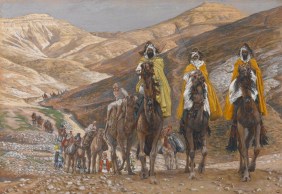 Ouija boards, etc. – all things that the Scriptures consistently forbid because they are all demonic, satanic practices. So, again v. 1, “Now after Jesus was born in Bethlehem of Judea in the days of Herod the king, check this out, magi from the east came to Jerusalem.” It’s absolutely shocking. These are the first Gentile (non-Jewish) people in all the Gospels to seek Jesus, the Son of God.
Through their demonic practices, probably astrology but whatever those practices were, they see a star that leads them to Jerusalem and to Herod. They ask, “Where is He who has been born king of the Jews? We saw His star and have come to worship,” not just give Him honor and respect, “we have come to worship Him.” Herod could have legitimately said, “Well, you’re in luck. I’m Herod, king of the Jews. Go ahead and bow down.” But even Herod, for all his evil, wicked, murderous ways, even Herod recognizes he isn’t divine and deserving of worship.
But notice what Herod does do. He summons the chief priests and scribes and asks notwhere the descendant of King David would be born but “where the Christwas to be born.” Herod makes the connection – the King of the Jews these magi are looking for is the Christ, the promised Messiah.
The chief priests and scribes rightly go to Micah 5:2which states that Christ the King will be born in Bethlehem. So, Herod calls the magi back in secretly; he has a private meeting with them to find out when they first saw the star. We know his intentions were evil because right after this text, Herod will use the information from that meeting to try and kill Jesus by exterminating all the boys in Bethlehem who were 2 and under.
 The magi take leave of Herod. The star appears again to lead them (Had it disappeared for a time?). They see it and “rejoice with exceedingly great joy.” And they find what they’ve been looking for, what they have been traveling for months to find. There, in a house, is the infant Jesus Christ, God in the flesh. And they worship the Child who will grow up and die on the cross for them. But then, notice, they have to be warned in a dream to not return to Herod. And they return to their country by another way.
So, there’s the text, and there is so much we could focus on: How an infant Child is worthy of worship. How the chief priests and scribes and all the people of Jerusalem trembled in fear when they should have been crawling to the house to worship the Child. But today, we are going back to behold, to check out, the magi. And most importantly how God graciously leads them to Himself.
God wants all people to be saved and come to a knowledge of the truth (1 Tim. 2:4) – even these magi who practice demonic arts. And God gives them signs to see even as they live in their sin. But those signs don’t lead them directly to the king they are looking for. God could have used the star to bring them straight to Jesus, but remember that God always works and calls people to Himself through His Word. And those signs lead the magi only as far as the Scriptures. Remember, they followed the star which, initially, only got them as far as Jerusalem and Herod; Herod connects the magi to the chief priests and scribes; and the religious leaders are the ones who introduce the magi to the Scriptures (specifically Micah 5:2).
Now, I want to be clear that I’m going to speculate for a moment here. But it isn’t, at least in my opinion, reaching very far: These magi learn about the sacred text from Micah 5about the one they are seeking. They would have probably been used to studying ancient texts, so it is very conceivable that they would want to know more about what Micah had to say. When you have been traveling for months to find something and stop to get more directions, you want to be sure those directions are legitimate. The passage about the Messiah being born in Bethlehem was from Micah 5:2. And, if you keep reading and get to Micah 5:12, God says there, “I will cut off (lit.exterminate) sorceries from your hand, and you shall have no more tellers of fortunes.” So there is no question that God uses the star to lead these magi to the Scriptures. But conceivably, the magi study the Scriptures further which leads them to repentance of their livelihood, and finally to their Savior.
Now, even if that isn’t the case, here is the point: Don’t give up on praying for your friends and family who are far from God even when it seems that they are so far from God you think they are a lost cause. Point them to the Scriptures. Point them to Jesus, the Word who became flesh and brings God’s mercy, forgiveness, and salvation. To do that, of course, you will have to know the Scriptures.
 And always remember, that God doesn’t give up on you either. Through the same Scriptures, God has led you here to Himself. He hasn’t used a something as uncertain as star or a dream. He has led you with something more certain (2 Pet. 1:19) – His Word. He has led here to receive His mercy, grace, and forgiveness. He leads you now to His altar to receive His very Body and Blood given and shed for the forgiveness of your sins. Leave your sins behind. Come, taste, and see that your God is merciful and gracious, full of steadfast love and righteousness. Amen.
The peace of God, which surpasses all understanding, will guard your hearts and minds in Christ Jesus. Amen.
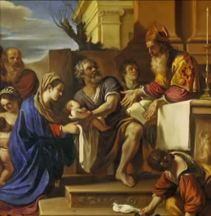 And he came in the Spirit into the temple, and when the parents brought in the child Jesus, to do for him according to the custom of the Law, 28 he took him up in his arms and blessed God and said,
 This forty-day-old Jesus is going to bring a division between believers and unbelievers. Simeon, inspired by the Holy Spirit, says this division comes because what a person does with Jesus will reveal the thoughts of their heart. The division falls in one of two ways: many will oppose and reject Jesus to their fall, to their ruin, and to their damnation, and many will trust in Him to their resurrection and eternal life.
 There can be, and often is, a conflict between how God sees you in your reborn spirit and how you see yourself in your soul – your thoughts, and emotions. You have probably experienced this. Part of you, your spirit, wants to live a certain way. You want to keep God’s commands, you want to live a God-pleasing life, you want to love your neighbor, etc. But part of you, your soul, doesn’t. Your soul would rather make sure you are comfortable and doesn’t really care about what God has commanded or what would benefit others. Paul talks about this conflict in Ro. 7(:7-25)where he wants to do good, but instead he keeps doing the sinful thing that he hates.
 The artist Michelangelo (not the Ninja Turtle) used to say that when he looked at a hunk of marble, he didn’t see big rock. Instead, he saw the sculpture that he was going to free from the rest of the rock that he would eventually chip away. He would say that he wasn’t creating a sculpture, he was just getting rid of all the rock that wasn’t part of the sculpture. That is somewhat the idea in the verse from Hebrews about the Word of God doing the work of dividing soul and spirit.
 24 (Now they had been sent from the Pharisees.) 25 They asked him, “Then why are you baptizing, if you are neither the Christ, nor Elijah, nor the Prophet?” 26 John answered them, “I baptize with water, but among you stands one you do not know, 27 even he who comes after me, the strap of whose sandal I am not worthy to untie.” 28 These things took place in Bethany across the Jordan, where John was baptizing.
 John the Baptizer was important. He was the forerunner of the Messiah and the last prophet. He was foretold in Scripture. He had the attention of all Judea and Jerusalem as they came out to him. And the religious authorities were sending envoys to him asking, “Who are you?” They wanted to find out exactly why John was doing what he was doing.
 Now, you aren’t the voice of one crying out in the wilderness, but you are a Christian. And you are a Christian because there is a Christ. You bear His name. You are washed clean of all your sins in His blood. You hear Jesus’ Word. You pray His prayers. You live His life. You have been crucified with Christ. It is no longer you who live but Christ who lives in you (Gal. 2:20). This means that you have your own God-given calling, role, task, and vocation to carry out. So be faithful in those callings and vocations.
 John was born and grew up as a Nazarite, so his hair was never cut. Imagine his big, bushy beard and his long, tattered hair. John preached out in the wilderness wearing clothes made of camel hair and leather belt. He had a peculiar diet of locusts and wild honey (Mk. 1:6). Imagine having locust breath – probably even worse than coffee breath. Matthew summarizes John’s preaching as this message: “Repent for the kingdom of heaven is at hand” (Mt. 3:2). People would come out to the wilderness to hear him preach, and when he saw them he said, “You brood of vipers! Who warned you to flee from the wrath to come?” (Mt. 3:7). He would preach about the axe that was laid to the root of every tree that would cut down each tree that didn’t bear fruit and throw it into the fire (Mt. 3:10). So, John was a preacher of the Law. But still all the country of Judea and Jerusalem was going out to John and being baptized and confessing their sins (Mk. 1:4-5).
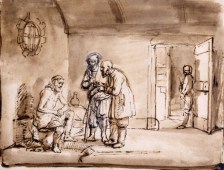 John was anxious in prison knowing he was probably going to be executed for what he had preached. Probably, John was wondering if he had preached rightly. And Jesus’ response points John and you to the Scriptures. In particular, Jesus points John to Isaiah 35:4-6, and you have to hear the context of those verses because it shows how beautifully Jesus answers John’s question, “Are you the One who is to come?” Here it is Isaiah 35:4-6, “Say to those who have an anxious heart, ‘Be strong; fear not! Behold, your God will come with vengeance, with the recompense of God. He will come and save you.’ Then the eyes of the blind shall be opened, and the ears of the deaf unstopped; then shall the lame man leap like a deer, and the tongue of the mute sing for joy….”
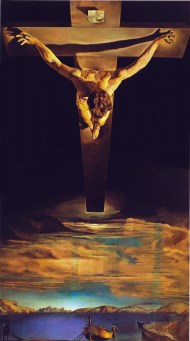 He opened the eyes of the blind. Christ made the deaf hear, the lame walk, and the mute to sing. All of that means that salvation has come to you who are anxious and poor in spirit. Rejoice.
 28 Now when these things begin to take place, straighten up and raise your heads, because your redemption is drawing near.”
 Normally, you would be terrified in a situation like that. But not now. Not now because you are in the prison of that castle being held captive. And the commander who is leading the army that is storming the castle is Jesus coming to save you.
 At first blush, this seems simple enough. Just follow Dave Ramsey’s advice for getting rid of your loans, car payments, and mortgage. Then live your life humming the Beatles, “All you need is love. All you need is love. All you need is love, love, love. Love is all you need.”
 So, as our text says, put on Christ. Clothe yourself in Him. Make His life, His obedience, His perfection your coat, your suit, your dress, your shirt, your shorts, your jeans, and your pajamas. How do you do that? Galatians 3:27 says, “As many of you as were baptized into Christ have put on Christ.”
 Well, there is something more, but it isn’t anything different. Repent again. Cast off the works of darkness again. Put on Christ again. Return to the promises God made when made you His child, when you were born again of Water and the Spirit (Jn. 3:5) in your Baptism.
 There were ten fishermen – five wise who wore their life jackets the whole time they were on the boat and five foolish who drown because they figured they would have enough time to put them on when the storm hit.
 And remember that as the end approaches, as you continually see signs of Christ’s return, remember what that means for you. Christ says it means your redemption is drawing near (Lk. 21:28). The bridegroom is coming, and you are His bride. Jesus has purchased and redeemed you so that you are without spot, wrinkle, or blemish (Eph. 5:27).
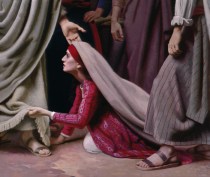 20 And behold, a woman who had suffered from a discharge of blood for twelve years came up behind him and touched the fringe of his garment, 21 for she said to herself, “If I only touch his garment, I will be made well.” 22 Jesus turned, and seeing her he said, “Take heart, daughter; your faith has made you well.” And instantly the woman was made well.
 He says to the mourners, “Go away, for the girl is not dead but sleeping.” And the mourners laugh, mocking Jesus and His words.
 He will raise you from the dead when He returns in glory. Even if you don’t get the things you want now, Christ will give you everything on the Last Day.
 Pastorsamwise
You must be logged in to post a comment.