Luke 7:11-17
11 Soon afterward he went to a town called Nain, and his disciples and a great crowd went with him. 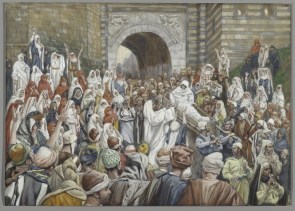 12 As he drew near to the gate of the town, behold, a man who had died was being carried out, the only son of his mother, and she was a widow, and a considerable crowd from the town was with her. 13 And when the Lord saw her, he had compassion on her and said to her, “Do not weep.” 14 Then he came up and touched the bier, and the bearers stood still. And he said, “Young man, I say to you, arise.” 15 And the dead man sat up and began to speak, and Jesus gave him to his mother. 16 Fear seized them all, and they glorified God, saying, “A great prophet has arisen among us!” and “God has visited his people!” 17 And this report about him spread through the whole of Judea and all the surrounding country.
In the name of the Father, Son, and Holy Spirit. Amen.
Funeral processions – you see them from time to time. A hearse drives down the road followed by a line of cars driving from a church or funeral home on their way to a cemetery. Car after car follows the dead body of the husband or wife, brother or sister, father or mother, child or friend. You see death, and out of respect you pause for the mourners. You yield the right-of-way and let death pass.
Contrast a funeral procession with a parade.
Parades are also long lines of people and vehicles. Parades are also given the right-of-way. Out of respect for the people in the parade you smile and wave no matter how silly the costume no matter how poorly the band is marching and playing, no matter how vehemently you disagree with the political candidate. It is a parade. Parades are happy.
Well, what happens when a parade – a line of celebration, happiness, and glee – meets a funeral procession – a line of despair, mourning, and death? That is precisely what happens in our text today, and Luke gives beautiful details.
Jesus is at the height of His popularity; a great crowd follows Him – people who have been healed or were witnesses of Jesus giving sight to the blind, hearing to the deaf, cleansing to the diseased, and good news to all. Jesus is bringing the reign of God to earth, and a parade follows Him.
But as this parade following Jesus reaches the gate of Nain (which means ‘Beautiful’), they meet something ugly – the funeral procession for a young man. Luke tells us that this young man was the only begotten son of his mother. Death has reared its ugly head to the town called ‘Beautiful.’
This mother is familiar with funeral processions. She had walked out of that same gate following the same path to the same cemetery to bury her husband. Even though the road was familiar, the procession has lost none of its bite or pain. In fact, this procession is more bitter, more final because, now, this widow is truly alone (1 Tim. 5:3-5).
You would think that, out of compassion for this widow, Jesus would respectfully turn His parade aside in quiet respect for the dead. You would think that happiness and joy would pause and defer to mourning and death. But you would be wrong. Jesus and His parade simply will not yield. And what Jesus does is so foreign to our thinking.
If you saw a hearse leading a line of cars to a cemetery, you would not swerve in front of the hearse blocking the road. You would not demand that the driver get out of the vehicle and throw the keys into the ditch. You would not go to the back of the hearse and pull out the casket. And you certainly wouldn’t open the casket revealing the body and start speaking to it. But that is what Jesus does.
There’s no question that Jesus has compassion on this woman, but it doesn’t pass for what we would call compassion. Jesus speaks only two words to this woman, “Weep not.”Imagine telling a parent who is mourning the death of a child, “Quit crying.” But as shocking as that is, Jesus goes even further – He stops the procession, touches the bier, and speaks to that dead flesh, “Young man, I say to you, arise.”
The dead boy sits up and is given back to his mother. He is put back where he belonged.
Jesus does not yield to death. Instead, death yielded to Jesus. This account reminds us of another time when Jesus and death marched toward each other.
Then, the funeral procession began long before death stuck its blow. 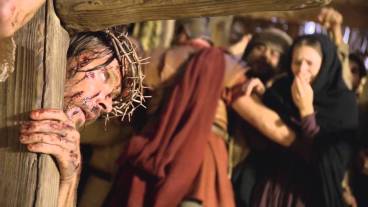 The funeral procession began at the sentencing as crowds shouted out, “Crucify, crucify Him.” In that funeral procession, Jesus carried His own bier, His own cross, until He could carry it no more. A great crowd of people followed Jesus mourning and lamenting for Him. But even in the midst of that funeral procession, Jesus’ words are the same, “Weep not”(Lk. 23:26-28).
At that confrontation between Jesus and death, Jesus’ own widowed mother mourned the loss of her Son. In that epic meeting between Jesus and death, by all appearances, death had won. The Man who had raised the dead was now dead. His corpse buried, and for three days it rested in the ground from which it was taken.
But, once again, death gave way to Jesus.
Funeral processions can get ugly. The weeping and mourning and wailing can make us uncomfortable. Even though death is in your future, you deny or ignore it. Be honest, you see everything around you rotting, decaying, and dying. You have grown so accustomed to sin and being around death that you don’t notice it very often.
This morning, you were part of a funeral procession. You are guilty of sin, so the stink of death hangs around you. You are part of your own, constant funeral procession. Young and old – man, woman, and child – you all dragged some dead thing here with you today.
Is it your relationship with your spouse that is slowly dying, and yet you stand idly by?
Is it the cadaver of disobedience to parents or others in authority over you? You only do what you need to get by, even though you know you could do more.
What dead thing have you brought with you?
Is it the dying remains of your finances that cause you to worry and doubt, or simply discontentment with what God has given you?
Is it the carcass of lust that flames within you?
Is it the rottenness of pride that is so focused inward that you do not see the needs of others? A pride that boasts in your own accomplishments and belittles others?
What dead thing have you brought here with you?
Maybe, it is not even your fault. Maybe, it is just the fear of what will happen in the future. Maybe, it Is the worry and concern you have for others. Maybe it is anger for how your neighbor has wronged you. Maybe, your dead thing is your own sick, crumbling body. What dead thing have you brought here with you?
You are in your own funeral procession. Yes, maybe it will be months, years, or decades before you are finally lowered into the ground, but from the time you were born you have been marching toward your grave. Just admit it.
Jesus approaches your funeral procession, and He does not stop; Jesus does not yield. Jesus does not give way or defer to death; He doesn’t have time for it.
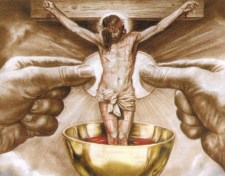 Instead, Jesus defeats death, each and every time He meets it.
Jesus is here today. Jesus meets you as you plod along in your personal funeral procession and gives you life. Jesus meets you at this altar, this beautiful gate, to give you His living Body and His life-giving Blood. Amen.
The peace of God, which surpasses all understanding, will guard your hearts and minds in Christ Jesus. Amen.
This sermon was reworked from 2014.

 But when you worry, you make it double. Don’t worry; be happy. Woo, ooh.”
 And Jesus addresses the most common master that you and I serve – possessions and stuff.
 When was the last time you saw a bird driving a tractor or operating a combine? A bird cannot plant and harvest like we can. But God didn’t design them to do that. He designed us to do that. Birds simply do what God designed them to do: have chicks and raise them and sing.
 “God You have told me not to be anxious. You have told me not to worry. Well, I’m worried about ______. You take care of that. Help me. Protect me. Etc.” Then your worry becomes a true service to God.
 32 So likewise a Levite, when he came to the place and saw him, passed by on the other side. 33 But a Samaritan, as he journeyed, came to where he was, and when he saw him, he had compassion. 34 He went to him and bound up his wounds, pouring on oil and wine. Then he set him on his own animal and brought him to an inn and took care of him. 35 And the next day he took out two denarii and gave them to the innkeeper, saying, ‘Take care of him, and whatever more you spend, I will repay you when I come back.’ 36 Which of these three, do you think, proved to be a neighbor to the man who fell among the robbers?” 37 He said, “The one who showed him mercy.” And Jesus said to him, “You go, and do likewise.”
 Christ has come to find you. He has bound up your wounds. Jesus has poured out His healing, life-giving blood for you. Jesus nurses you in your brokenness. He has ascended into heaven and has promised to come back and pay for everything you need.
 This miracle, on the other hand, is odd. It’s dirty. Maybe, you even find it disgusting. Jesus takes a deaf man who has a speech impediment off to the side. He sticks His fingers into wax-filled ears. God in the flesh spits (apparently, Jesus wasn’t taught how to give a proper wet-Willy). Christ literally seizes, not just ‘touches,’ the man’s tongue. And then, Jesus looks up to heaven. Sighs. And says, “Ephphatha,” which means,“Be opened.”
 Jesus had come to be the Lamb of God who takes away the sin of the world, not to be the audiologist who takes away the deafness of the world. Jesus had come to give eternal life through His death and resurrection, not to give a voice to the voiceless.
 Yes, Jesus sighs and acts. He gets involved with us even though it hurts Him. He cannot help Himself. In His love and mercy, He gets bound up in the mess we make and that others have made for us. He gets entangled in our sin. In fact, He becomes sin so that we might become the righteousness of God (2 Cor. 5:21).
 They thought, wrongly, that Cain was the promised offspring who would crush the serpent’s head.
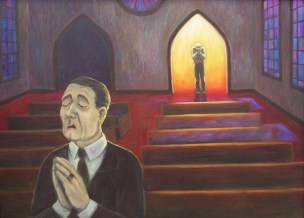 You see, the only way to approach God is through an offering, a sacrifice. Examine your life and ask yourself why you believe God will hear your prayers, why God will notice you, why God will have regard for you. But remember, you don’t get to pick which sacrifices are pleasing to God. Your good works are not enough, and your perceived lack of sin is nothing but an illusion of your own fallen mind. If you think and believe otherwise, sin isn’t just crouching at your door. Sin is your master. Repent.
 About 40 years later, the Roman armies would come to the City of Peace and fulfill Jesus’ prophecy. In one of the most horrific events in all of history, God would send the Roman general Titus to demolish Jerusalem. The Romans would kill around one million of its residents, take enough gold from the Temple to fund the building of the Coliseum, tear the Temple down to the ground brick-by-brick and stone-by-stone, burn the city, and leave it a smoldering pile of charred rubble.
 Repent. This isn’t a social club or just a nice place to spend a Sunday morning. This is where God comes to meet you. This is where God delivers His gifts of Word and Sacrament. This is a place of wonder as you hear the Gospel, a place of joy as you receive forgiveness, and a place of shelter in God’s presence. Here and now, God is delivering to you all the things that make for peace. Receive them. Rejoice in them. Live in them.
 The false teachers that Jesus warns about are cleverly disguised. Under their soft, wooly exterior are teeth filled with the blood of sheep. The devil always disguises himself and his lies. He doesn’t wear a t-shirt that says, “Caution: I’m the devil.” Instead, he comes and offers you the things that you want, things that seem good and right. In our Old Testament lesson (Jer. 23:16-29), God says that the prophets of the devil say to those who despise God’s Word, “It will be well with you.” And to those who follow their own heart, the devil says, “No disaster will come upon you.”
 Beware. Do the Scriptures teach, as Roman Catholics believe, that when the pope speaks officially, his words have the same authority as the Scriptures? No. Does the Bible say, as Methodists teach, that Christians reach a point where they no longer sin? No. Does God’s Word say, as many churches say today, that baptism is the first act of obedience of a Christian? No.
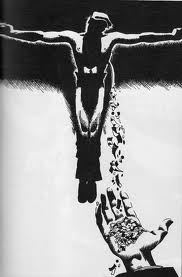 You need the good fruit of God’s Word. It is your source of life. It is your nourishment that sustains you in this life and the next. Pluck that good fruit from the cross which has become the tree of life.
 2 “I am the Lord your God, who brought you out of the land of Egypt, out of the house of slavery.
 Repent and know that there is righteousness that exceeds that of the scribes and Pharisees. Jesus came and kept the Law. Jesus did everything the Commandments demanded and did not do anything the Law forbade. Jesus does not get angry with someone without cause. Jesus does not look upon a woman with lust. Jesus does not chase after or desire things that are not given to Him. Instead, Jesus gladly accepts what the Father gives and then waits with perfect trust that the Father is good and will provide.

You must be logged in to post a comment.