
John 8:31-36
31 So Jesus said to the Jews who had believed him, “If you abide in my word, you are truly my disciples,32 and you will know the truth, and the truth will set you free.” 33 They answered him, “We are offspring of Abraham and have never been enslaved to anyone. How is it that you say, ‘You will become free’?” 34 Jesus answered them, “Truly, truly, I say to you, everyone who practices sin is a slave to sin. 35 The slave does not remain in the house forever; the son remains forever. 36 So if the Son sets you free, you will be free indeed.”
In the name of Jesus. Amen.
The crowds answered Jesus, “We are offspring of Abraham and have never been enslaved to anyone.” Right.
They must have completely forgotten their history. They had been slaves in Egypt until God delivered them from their slavery. Even when they arrived in the Promised Land, they were ruled by the Philistines, the Ammonites, the Midianites, and the Moabites. They were taken captive by the Assyrians and Babylonians. They had been under the Greeks and the Persians. And even when Jesus is talking to them here, they are under Roman authority. They had to pay taxes to Caesar and are worried that if people believe in Jesus, the Romans will come and take away their place and nation (Jn. 11:47-48). And remember, the chief priests wanted to kill Jesus, but they had to get permission from the Roman governor Pilate (Jn. 18:11). In fact, when you consider the 1,500-year history of the Jewish people, there is probably only a few hundred years where they were not in some sort of slavery to another nation or power.
But when Jesus says, “If you abide in My Word, you are truly My disciples, and you will know the truth, and the truth will set you free,” they are offended. Even though these are words of comfort and Gospel, there is an implied bit of Law here. Since the truth will (future tense) will set you free, that means that you are in bondage.
We have to recognize Jesus’ audience. He is speaking to the Jews who believed in Him. I know our translation throws in the word ‘had’ in there – “the Jews who had believed in him.” But that implies that they believed at one time but have stopped believing in Him. That isn’t what the Greek is trying to get across. The verb makes it clear.
Jesus is talking to people who do currently believe in Him, but their faith is shallow and in danger. In fact, by the end of this chapter, the faith of these people will be gone. They are offended at Jesus’ Words of Gospel and freedom. They believed in Him, maybe because of the miracles or because He was interesting to listen to. But they don’t abide, they don’t remain, in Jesus’ Word. They are a prime example of the path in Jesus’ parable of the Sower and the Seed. The Word is sown there, but the devil and demons quickly snatched it away (Mt. 13:4, 19) because their hearts were hardened with pride.
“If you abide in My Word, you are truly My disciples, and you will know the truth, and the truth will set you free.” These are gracious words, but there is also a warning here for you and for me. That warning is this: It is possible to fall away. If you do not abide and remain in Jesus’ Word, then you are certainly not Jesus’ disciples; you will not know the truth, and you will not be free. Only those who abide and remain in Jesus’ Word are true disciples and become free.
Dear saints, Jesus might as well be speaking these very same words to you here today. You also need to abide in Jesus’ Word. You also need to know the truth which sets you free. Whether you recognize it or not, you are in bondage worse than any slavery this world can throw at you. Jesus says, “Truly, truly, I say to you, everyone who practices sin is a slave to sin.”
Sin has so infected us that we have a wrong sense of freedom. We think freedom means that we can do whatever we want whenever we want. We think freedom is a life without obligation or responsibility. That kind of existence, well, it doesn’t exist. Instead, we are captive and slaves to our sinful desires.
The Scripture readings you heard today have made this entirely clear. “All have sinned and fall short of the glory of God” (Ro. 3:23). “Everyone who practices sin is a slave to sin” (Jn. 8:34). We sin; therefore, we are slaves to sin. And you can’t just wiggle out of this saying, “Well we don’t really have a choice in the matter.” Our slavery to sin is at a higher level than that. We are slaves in our will. We deliberately chose to sin. It isn’t just weakness or mistakes. We have all ignored our conscience, and knowing exactly what we are doing, we have chosen to sin. We sin on purpose and repeatedly.
And even when we do fight against our sinful desires, which is good, we still are doing so out of slavery. Jesus’ parable of the Prodigal Son (Lk. 15:11-32) shows that there is a slavery when we rebel and try to live apart from our heavenly Father, and there is also a slavery when we try to win the approval of our heavenly Father by life of obedience.
So, remember the younger son? He deliberately tells his father to drop dead so he can have his inheritance early. That son takes all that he has, quickly wastes it in reckless living, and has to hire himself out feeding pigs. Remember, he was longing to eat the slop he was feeding the pigs. What he thought would bring him freedom made him a slave to pigs. So, he concocts a plan to go and ask to become a servant in his dad’s house in order to get a little food in his hungry tummy. Now of course, you know the story. The father doesn’t even hear the offer of his wayward son. Instead, the father restores this little brat to be a son and throws a party.
But don’t forget about the older son. He didn’t do all the wrong things his younger brother had done. He didn’t tell his father to drop dead. He didn’t demand his inheritance be given to him so he could move away and blow it all. He didn’t end up in the pigpen. No, the older brother hadn’t done anything wrong. But that didn’t make him any less of a slave.
Instead, that older brother insists that he did all the right things. He was dutifully working in his father’s field when his despicable brother returned. And when his father came outside to compel him to come and join the party celebrating his brother’s restoration, he answered his father, “I’ve served,” notice that, “I’ve servedyou my whole life. I’ve never disobeyed your command. I’ve never wasted your money. But when this son of yours comes home, you go and kill the fattened calf for him.” And the parable ends with the father pleading with his oldest son to join the party.
We know that slavery can come from living contrary to God’s Commandments; that is entirely clear and plain as the nose on your face. But there is another slavery – a slavery that is more sneaky – and that is the slavery of the older brother and the people Jesus is speaking to in this text. That is a slavery of us trying to live in such a way that God owes us for all the good we have done. My fellow sinners, repent of that thought as well. God will never be in our debt.
In this text and in parable of the Prodigal Son, we clearly see that God doesn’t want slaves. He wants sons. Slaves don’t remain in the house forever – only sons do.
That is why Jesus has come. The only begotten Son of God came to do His Father’s will. He came to fulfill God’s Law and to be the perfect sacrifice for your sins and free you from slavery. Yes, you sin, and that reveals your slavery. But at the same time you are also a son – redeemed, purchased, and adopted by the blood of Christ. At the same time, you are a slave and a son, a sinner and a saint.
Dear saints always remember what Jesus says, “If the Son sets you free, you will be free indeed.”Christ has. You are free. Free from the condemnation of the Law. Free from the bondage of sin. Free from the fear of death. Free from the burden of having to earn your salvation. Free from the burden of having to complete your salvation. Free to serve God and neighbor without the nagging worry of whether you’ve done it well enough.
Jesus Christ, the eternal Son of God, has set you free by His death and resurrection. He has freely given you the gift of new life, and that comes with a happy and joyful future that will last to all eternity. If the Son sets you free – and Christ has by His death and resurrection – you will be free indeed. So, “Fear not, little flock, for it is your Father’s good pleasure to give you the kingdom,” (Lk. 12:32). Amen.
The peace of God, which surpasses all understanding, will guard your hearts and minds in Christ Jesus. Amen.

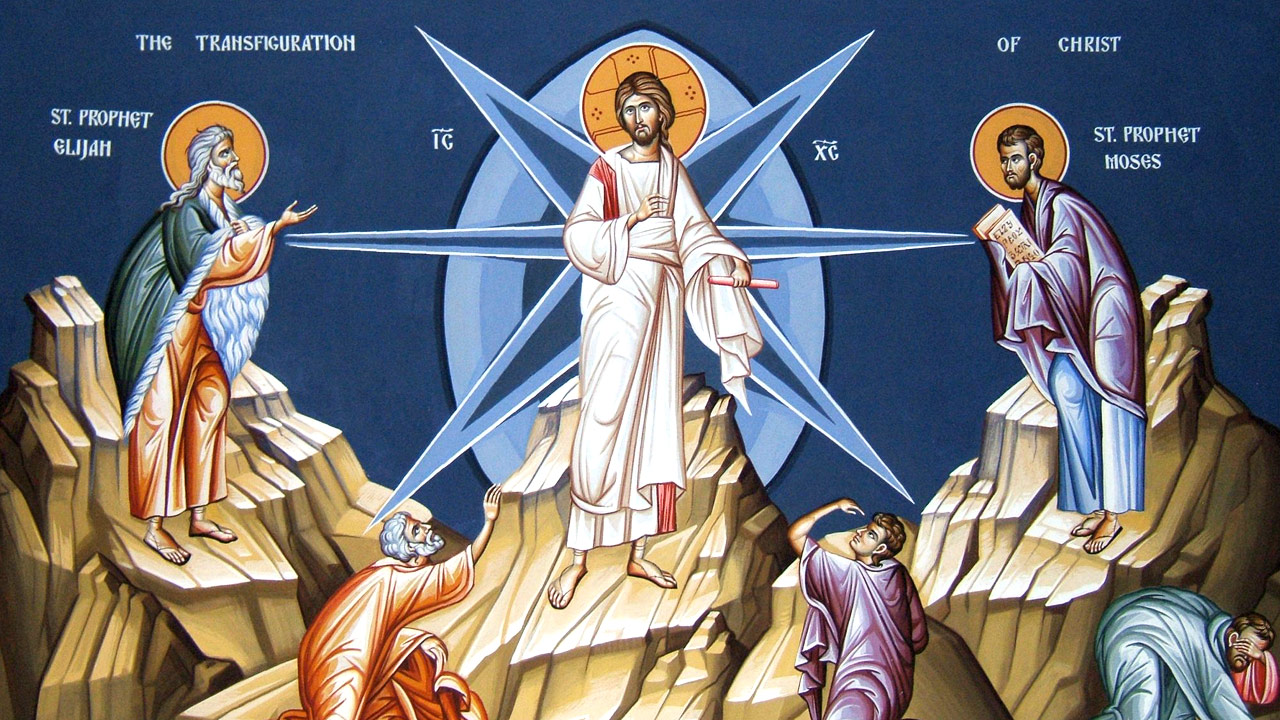
 And from this point, things get a little crazy and awkward. It is almost as though Peter didn’t hear Jesus say that He would rise from the dead because Peter rebukes Jesus – the very one he just confessed is the Son of the living God. Peter says, “Far be it from You, Lord! This shall never happen to You.” It would be easy to sling mud at Peter here for telling God that what He says is going to happen won’t ever happen. But you do it all the time – more on that in a bit.
 But here is where all of this is leading: Jesus comes to Peter, James, and John cowering in their sins and touches them. And notice what He says. He doesn’t continue to rebuke Peter. Jesus doesn’t say, “See I told you so.” Instead, Jesus says, “Rise,” the same word Jesus used when He spoke about His resurrection.“Rise, and have no fear.” Of all the things our Lord could have said, He says, “Rise, and have no fear.” Jesus is resurrecting Peter from his sin.
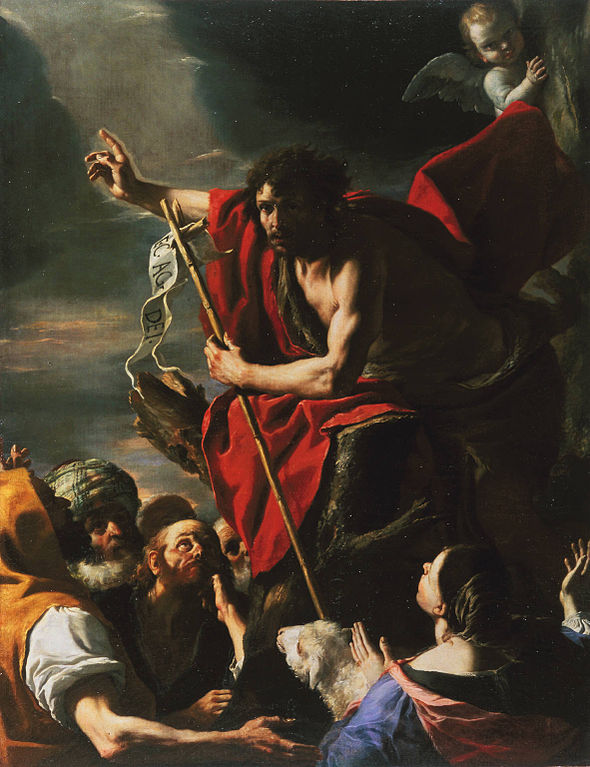 “You brood of vipers! Who warned you to flee from the wrath to come? Bear fruit in keeping with repentance.” The text doesn’t explicitly say it, but it appears as though John refused to baptize at least some of the Pharisees and Sadducees. But why? Why do they get a tongue-lashing and no baptism?
 Now we come to our text. John is baptizing all these people. A thief comes confessing his stealing, an adulterer confesses his adultery, a liar confesses her sin, and John absolves and baptizes them. But then to the front of the line comes Jesus, and John knows Him (Lk. 1:39-45). They’re related to each other. John knows what the angel Gabriel told Mary, that this Jesus would be Son of the Most High, that He would reign over the house of God, and that His kingdom would have no end (Lk. 1:26-38). John knows the angel Gabriel told Joseph that Jesus would be the One to save His people from their sins (Mt. 1:18-25). John knows that Jesus is the sinless God in the flesh. And here He is coming to be baptized unto repentance for the forgiveness of sins? This shouldn’t be!
 But also, the same thing that happens to Jesus in his Baptism happens to you in yours. In your Baptism, you are given the gift of the Holy Spirit and are made God’s beloved child. In your Baptism, God intimately joins you to Jesus, and to His death and resurrection (Ro. 6:3-6).
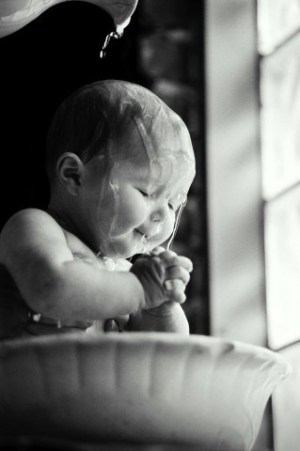 In your Baptism, God has given you the new birth of water and the Spirit (Jn. 3:5). In your Baptism, God has promised to wash away your sins (Act. 2:38-39), save you (1 Pet. 3:21), make you His child (Mt. 3:17), connect you to Jesus’ death and resurrection (Ro. 6:3-6), clothe you with Christ (Gal. 3:27), and fill you with the Holy Spirit (Tit. 3:5). So now, whenever wash your hands or take a shower, you can remember that God Himself has washed you clean and made you holy and sacred. Whenever you take a drink, you can remember that, in your Baptism, Jesus has given you to drink of the living water that wells up to eternal life (Jn. 4:10, 14).
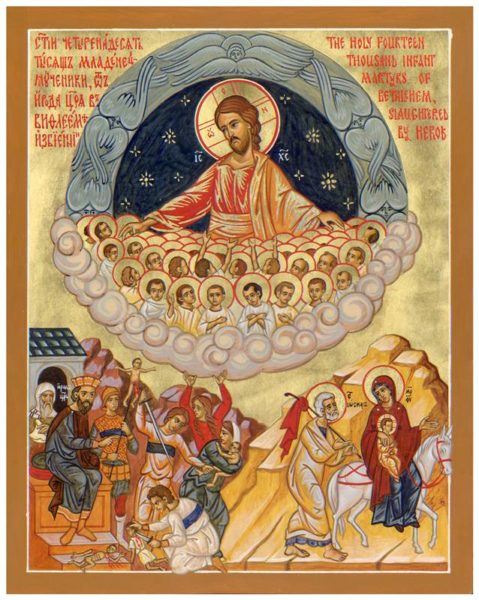 16 Then Herod, when he saw that he had been tricked by the wise men, became furious, and he sent and killed all the male children in Bethlehem and in all that region who were two years old or under, according to the time that he had ascertained from the wise men. 17 Then was fulfilled what was spoken by the prophet Jeremiah:
 The guy who didn’t even want his own children to be king after him hears that someone else has been born to be King of the Jews. Well, Herod isn’t going to let that stand. And when Herod is troubled about this, the rest of Jerusalem is also quaking as they wonder what will happen next.
 In the incarnation, the eternal Son of God shares in the life of every man, woman, and child – born and unborn. We human beings are all taken out of the flesh of Adam which means that we are all part of one another. But even more importantly, by His conception, the eternal Son of God has permeated all of humanity. This is why the devil loves abortion. Satan loves abortion because every unborn child reminds him of the fact that the Son of God came in the flesh, took up residence in His mother’s womb, and defeated him. The fact that your Savior was once a pre-born child is primary the reason Christians oppose abortion.
 Pastorsamwise
You must be logged in to post a comment.