
Sorrow & Sighing Will Flee – Sermon on Matthew 9:18-26 for the Twenty-fourth Sunday after Trinity

Matthew 9:18-26

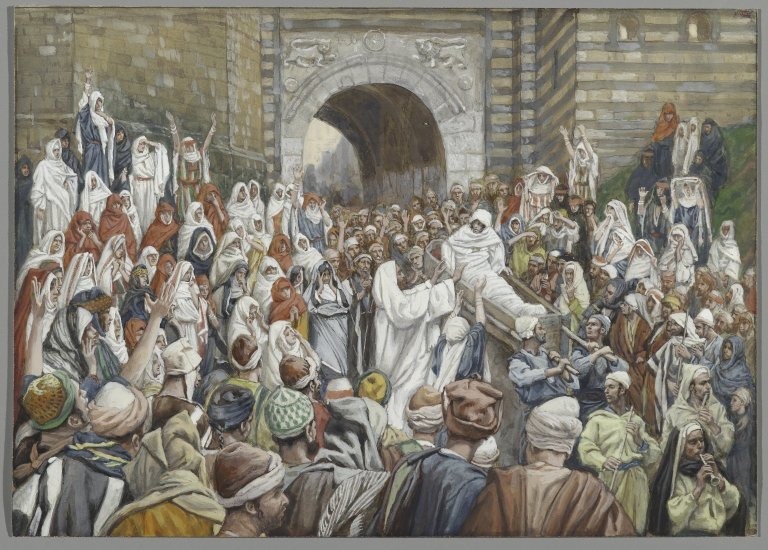
18 While [Jesus] was saying these things to them, behold, a ruler came in and knelt before him, saying, “My daughter has just died, but come and lay your hand on her, and she will live.” 19 And Jesus rose and followed him, with his disciples. 

20 And behold, a woman who had suffered from a discharge of blood for twelve years came up behind him and touched the fringe of his garment, 21 for she said to herself, “If I only touch his garment, I will be made well.” 22 Jesus turned, and seeing her he said, “Take heart, daughter; your faith has made you well.” And instantly the woman was made well. 

23 And when Jesus came to the ruler’s house and saw the flute players and the crowd making a commotion, 24 he said, “Go away, for the girl is not dead but sleeping.” And they laughed at him. 25 But when the crowd had been put outside, he went in and took her by the hand, and the girl arose. 26 And the report of this went through all that district.

In the name of Jesus. Amen.

This text begins with, “While [Jesus] was saying these things….” which means it is plopping us into the middle of a conversation. Matthew could have just told this as a stand-alone story by starting with, “One time a ruler came to Jesus….” Both Mark’s and Luke’s Gospels do that when they record the story (Mk 5:22-43Lk. 8:41-56), but Matthew was inspired by the Holy Spirit to include more context. He connects these two miracles with the discussion Jesus is currently having. So, please, grab your Bible, so you can see what Jesus is saying. Open, turn, tap, or whatever you do in your Bible to Mt. 9:14-17.

Some of John the Baptizer’s disciples come to ask Jesus a question, “Why do we and the Pharisees fast, but Your disciples do not fast?” Notice what their question assumes. “We’re pious, religious people, and we fast. The Pharisees are pious, religious people, and they fast. Why aren’t Your disciples religious and pious like us? Why don’t they fast?” These disciples of John figure that Jesus’ disciples should be practicing their religion like they and others do. In other words, at the root of their question is the idea that Jesus is just a regular teacher and nothing new or special. They must have missed the fact that John had been pointing and pushing them toward Jesus (Jn. 3:25-30).

Jesus answers the question from John’s disciples by saying (Mt. 9:15-17), “Can the wedding guests mourn as long as the bridegroom is with them? The days will come when the bridegroom is taken away from them, and then they will fast.” Then, Jesus goes on to talk about old cloths and new patches and new wine and old wineskins. But the point of interest here is this talk about the Bridegroom being present – something that John the Baptizer had taught.

In Jesus’ day, wedding feasts were an even bigger ordeal than they are today. A wedding feast would last several days – sometimes even a week (Gen. 29:27) or two.[1] Refusing to eat at a wedding feast would be at least inappropriate if not offensive. Imagine if you invited someone to come to your house for dinner in two weeks. You carefully prepare the menu making sure it will be tasty and nourishing. You go out shopping picking the best produce and meat. You spend hours preparing the food. Your guest arrives, sits down for the meal, and announces he won’t be eating because he is fasting. It’s rude and wrong.

When Jesus says that His disciples don’t fast because the bridegroom is present, He is saying that the Old Testament promises about God’s people being married to God (Is. 54:5-662:4-5Hos. 2:14-20) are coming true in His ministry. The day of deliverance that God had been promising since the Fall has come. The Messiah is here, and the wedding feast has begun!

But now, while Jesus is saying these things, a ruler comes and tells Jesus that his daughter has died. Mark’s Gospel tells us that his name is Jairus (Mk. 5:22), so I’m going to refer to him by his name. Jairus has a legitimate reason to be mourning, but the Groom is present. And the wedding feast that is Jesus’ ministry will not be disturbed by death of anyone except the Groom. (But even His death ends up being only a brief interruption of the feast.) Jairus knows that Jesus, the Groom, won’t let his daughter’s death stand, so he says to Jesus, “Come lay Your hand on her, and she will live.” So, what does Jesus do? Look carefully at v. 19, “Jesus rose and followed him.”

Matthew doesn’t just say that Jesus follows Jairus to his home. Christ “rose.” That word that gets translated ‘rose’ a word for resurrection. In fact, Matthew uses that same word again in v. 25 when the little girl will arise from her sleep of death. The word can mean “stand up,” but most literally it is what we do in the morning when we get out of bed. And it is what we Christians will do on the Last Day when we rise up from our graves. But Matthew is giving a nice little foreshadowing of what Jesus is going to do when He gets to Jairus’ house. The little girl’s rising from death only happens because Jesus rises first. Dear saints, the same is true for you. You will rise again because Jesus is risen – no question about that. [Alleluia! Christ is risen! He is risen indeed! Alleluia!]

On the way to Jairus’ house, we get a little interruption in the story. A woman who has been suffering from a discharge of blood for twelve years hears about this wedding feast and decides that all she needs to do is touch the fringe of Jesus’ garment and she will be ‘saved.’ The word there doesn’t just mean ‘made well,’ it means ‘saved’ from her disease. She does. She is. And Jesus proves that her idea of touching His garment isn’t just a superstition about Jesus’ clothes. Her faith saves her.

For twelve years, she had been ceremonially unclean from this menstrual bleeding. This meant for twelve years she couldn’t go to the Temple, couldn’t get married, couldn’t even attend some family gatherings. But Christ brings her into the celebration of the joy of the Messiah’s wedding feast. She gets even better than what Isaiah got when the burning coal touched his lips (Is. 6:7), and she ascends the ladder to heaven that Jacob saw in his dream (Gen. 28:12).

After all this, Jesus arrives at Jairus’ house. He dismisses the people who are there making a commotion and mourning. By the way, these were professional, paid mourners, so they knew who was dead and who wasn’t. But Jesus dismisses them saying, “Go away, for the girl is not dead but sleeping,” which says a lot about what your Savior thinks about your death. The mourners laugh at Christ, but Jesus simply takes this little girl by the hand and lifts her up from the nap of death. Her spirit returns (Lk. 8:55), and she lives.

Dear Natalie, that brings me to you. Natalie, today you are Baptized. Today, Jesus has joined you to Himself by placing His name upon you (Mt. 28:19) and clothed you with Himself (Gal. 3:27). In your Baptism, Jesus joined you to His death so that you have a Jesus-kind of death – in other words, a death that doesn’t last long and ends in resurrection (Ro. 6:3-11).

Natalie, no one here knows what God has in store for your life in this world. But, dear Natalie, we do know this because Scripture promises: You heard it in our Epistle lesson (Col. 1:9-14), God has delivered you from the domain of darkness and transferred you to the kingdom of His beloved Son, in whom you have redemption, the forgiveness of sins.

Natalie, and all you saints, God promises in our Old Testament lesson (Is. 51:9-16), “I, I am He who comforts you.” You are the redeemed of the Lord. You shall come to the eternal Zion with singing. Everlasting joy will be on your head. You will, without a doubt, obtain gladness and joy. Whatever sorrow and sighing you endure in this fallen world, whether it is caused by others or by your own sins and failures, that sorrow and sighing will flee away because they are utterly defeated by Christ’s death and resurrection.

Jesus, your Savior and Groom, has borne your griefs and carried your sorrows. Your sorrow and sighing cannot and will not stay with you. They will flee because Jesus lives. And because He lives, so will you. Amen.

The peace of God, which surpasses all understanding, will guard your hearts and minds in Christ Jesus. Amen.


[1] The apocryphal book of Tobit (8:20) speaks of a two-week wedding feast for a particularly important wedding.
A Strange Congregation – Sermon on Ezekiel 37:1-14 for the Second Sunday of Easter

Listen here.

Ezekiel 37:1-14

1 The hand of the Lord was upon me, and he brought me out in the Spirit of the Lord and set me down in the middle of the valley; it was full of bones. 2 And he led me around among them, and behold, there were very many on the surface of the valley, and behold, they were very dry. 3 And he said to me, “Son of man, can these bones live?” And I answered, “O Lord God, you know.” 4 Then he said to me, “Prophesy over these bones, and say to them, O dry bones, hear the word of the Lord. 5 Thus says the Lord God to these bones: Behold, I will cause breath to enter you, and you shall live. 6 And I will lay sinews upon you, and will cause flesh to come upon you, and cover you with skin, and put breath in you, and you shall live, and you shall know that I am the Lord.” 

7 So I prophesied as I was commanded. And as I prophesied, there was a sound, and behold, a rattling, and the bones came together, bone to its bone. 8 And I looked, and behold, there were sinews on them, and flesh had come upon them, and skin had covered them. But there was no breath in them. 9 Then he said to me, “Prophesy to the breath; prophesy, son of man, and say to the breath, Thus says the Lord God: Come from the four winds, O breath, and breathe on these slain, that they may live.” 10 So I prophesied as he commanded me, and the breath came into them, and they lived and stood on their feet, an exceedingly great army. 

11 Then he said to me, “Son of man, these bones are the whole house of Israel. Behold, they say, ‘Our bones are dried up, and our hope is lost; we are indeed cut off.’ 12 Therefore prophesy, and say to them, Thus says the Lord God: Behold, I will open your graves and raise you from your graves, O my people. And I will bring you into the land of Israel. 13 And you shall know that I am the Lord, when I open your graves, and raise you from your graves, O my people. 14 And I will put my Spirit within you, and you shall live, and I will place you in your own land. Then you shall know that I am the Lord; I have spoken, and I will do it, declares the Lord.”

Alleluia! Christ is risen!
He is risen indeed! Alleluia!

In the name of Jesus. Amen.

Ezekiel had an odd call to preach to a strange congregation. God brought Ezekiel out by the Spirit into the middle of a valley. It was full of bones, lots of bones. And these bones were dry – very dry. This congregation, maybe we could call it Dry Bones Lutheran, they weren’t loving their neighbor. They weren’t shining the love of Christ to the world. They weren’t improving day by day. They were just lying there, dead and dry.

Then God asks Ezekiel the question: “Son of man, can these bones live?” What kind of question is that? When God asks something like that, what answer can you give? Ezekiel goes the safe route, “O Lord God, You know.” That’s as secure of a reply as you can give.

Well, God gives Ezekiel a call to preach to this strange congregation. “Prophesy over these bones, and say to them, ‘O dry bones, hear the word of the Lord.’” It’s an odd call. How many times did Jesus say after His sermons, “He who has ears, let him hear”? But here, God calls Ezekiel to preach to a congregation of bare bones that don’t even have ears.

“O dry bones, hear the word of the Lord. Thus says the Lord God to these bones: Behold, I will cause breath to enter you, and you shall live. And I will lay sinews upon you, and will cause flesh to come upon you, and cover you with skin, and put breath in you, and you shall live, and you shall know that I am the Lord.”

The sermon is preached. And God’s little sermon appears to be working. There is a rattling. The toe bone connected to foot bone to ankle bone to shin bone to knee bone to leg bone to hip bone to back bone to rib bone to shoulder bone to neck bone to head bone. Now hear the Word of the Lord!

But wait a second. Bones are connected, sinews hold together, muscles have grown, and skin covers. But there is still no breath, no spirit, no life. Wasn’t the sermon supposed to be done? Well, not yet. God has more for Ezekiel to preach. “Prophesy to the breath.”

Now, pause here for just a second. In Hebrew, the word for ‘wind’ and ‘breath’ and ‘spirit’ is all the same word. Ten times in this text, that word comes up. Seven times, it is translated as ‘breath.’ In v. 9, it’s translated as ‘wind.’ But back in v. 1 and again in v. 14, it is translated as ‘Spirit’ referring to the Holy Spirit. But, again, it’s all the same word. And I think, I could be wrong, but I think there is a sense here that God is calling Ezekiel to preach a sermon to the Holy Spirit. “Prophesy, son of man, and say to the Spirit, ‘Come from the four winds and breathe on these slain that they may live.’” In other words, it could be something like, “Holy Spirit, come from the four winds and spirit (as a verb) on these slain, that they may live.”

Ezekiel preaches, and after this second sermon is preached, what do you know? God’s Word works. The Spirit comes into these lifeless bodies that just a couple moments before had been bones, dry bones. Now, they live, and they are an exceedingly great army.

Finally, God tells Ezekiel exactly what was going on. The army is the entirety of God’s people. They were complaining that their bones are dried up and they are cut off. But God promises that He will open their graves and raise them up causing life to come into them. He will bring them into their own land. He will put His Spirit into them, they will live, and they will know that God is the Lord. He promises to do this. He is faithful, and He will do it (1 Thes. 5:24).

Now, this lesson from Ezekiel is fulfilled in our Gospel lesson (Jn. 20:19-31). That first Easter evening, the disciples are all huddled together. They aren’t in a valley, but in the upper room. Sure, they aren’t dry, dead bones, but they are as good as dead because of their fear.

We know they were already afraid of suffering the same fate that Jesus suffered because Jesus said that if they persecuted Him they would be persecuted as well (Jn. 15:20). They know that Pilate had Jesus’ tomb sealed because the religious leaders were worried that the disicples would steal Christ’s body and claim that He had risen (Mt. 27:62-66Jn. 20:19). But even worse, they have heard that Jesus is alive. That might have been their biggest cause of fear because they had all abandoned Jesus when He was betrayed. They weren’t with Him during His trial and crucifixion. They don’t know what a resurrected Jesus means for them. Maybe He’s mad and is coming after them for their failure. You don’t want a Guy who can walk out of the grave as your enemy.

But then, Jesus enters the room even though the doors were locked. And what does He do for this little congregation dead in fear? He shows them His hands and side as He preaches, “Peace be with you.” That little band of dry, dead disciples come together to see Christ’s wounds and become glad. But at this point, they’re still like those bones, muscles, sinews, and skin that come together in Ezekiel. But they still have no life, no spirit.

So, Jesus has more to preach to them. And the second sermon starts the same as the first, “Peace be with you. As the Father has sent Me, even so I am sending you.” Jesus breathes on them. Christ spirits them. He gives them the Holy Spirit, just like in Ezekiel’s second sermon. But we have to pause a moment first. When Jesus says He is sending the disciples just like God the Father had sent Him, what does He mean? What are they to do?

Because God sent Jesus to do a lot of things. God sent Jesus to earth to be both God and Man. God sent Jesus to live a perfect life of obedience. God sent Jesus to preach and teach. God sent Jesus to do miracles. And most importantly, God sent Jesus to be the once-for-all sacrifice for sins. God sent Christ to be the Lamb of God who takes away the sin of the world (Jn. 1:29). God sent Jesus, who knew no sin, to be sin (2 Cor. 5:21). God sent Jesus to die on the cross for our sin and rise again for our justification (Ro. 4:25). God sent Jesus to do all of that, but Jesus isn’t saying that He is sending the disciples to do any of those things. 

That’s why Jesus gets very specific after He tells the disciples that He is sending them just as the Father had sent Him. These disciples are sent, just as Jesus had been sent, to do something very specific. Jesus says, “If you forgive the sins of any, they are forgiven them; if you withhold forgiveness from any it is withheld.”

God had sent Jesus to proclaim God’s mercy and forgiveness, and that is what Jesus is saying that He is sending the disciples to do. Jesus sends them out with the Holy Spirit to forgive sins. And this call is given, in the first place to these apostles (‘apostle’ is the term Jesus uses when He says, “I am sending you,” it’s lit.“I’m ‘apostle-ing’ you.”). And this call is extended to pastors who carry on the apostolic ministry. But this call even extends to all Christians who have been given the Holy Spirit and confess the name of Jesus.

So, what does this all mean? When we consider this Old Testament lesson and its fulfillment in our Gospel reading, what do we learn?

First off, as a pastor, that text from Ezekiel has always been comforting to me. It shows that God’s Word will always accomplish what God sends it to do. No matter how dead a congregation seems to be, God will work through His Word to bring about more than you or I could ever imagine. And just to be clear: I haven’t ever thought you are just a valley of dry bones. You were served well and faithfully by those who came before me. But even if you were nothing more than a bunch of dry bones, God’s Word working through the power of the Holy Spirit is effective to breathe life into you.

But let’s go even beyond that. Know that God has caused you to live. God has come and proclaimed the peace of Christ’s forgiveness to you. When Jesus preaches twice to the disciples, “Peace be with you,” I think the peace that we should think of is the peace of Christ’s forgiveness because that is the peace that Christ gives to all of us dry-bones sinners. Christ has given you the Holy Spirit. And Christ has also called you to be forgivers and proclaimers of that same peace in this world.

So, when people come to you and tell you about their problems, when they complain because they feel the weight of their sin, give them Christ’s peace. Proclaim that same peace to them. It doesn’t matter if they are worried about their kids, their health, their finances, their marriage, the state of the country, whatever it is, you can proclaim, “Peace be with you.” And point them to the cross. Point them to what Jesus has done to forgive them of their sins. You can do this because Jesus has called you to do so.

You see, Jesus Himself is part of the army that God has raised up. Christ became a member of those bones that seemed defeated. He went to the grave defeated. But, of course, He was raised alive, victorious over the death. And Christ has gone before you proclaiming peace to this fallen world full of sin. So, follow after Him proclaiming that same peace and forgiveness in His name.

Then watch as God raises dead, dry bones. Watch as God puts His Spirit within those who were dead in sin and know that He is the Lord. He has spoken and He will do it.

Alleluia! Christ is risen!
He is risen indeed! Alleluia!

Amen.

The peace of God, which surpasses all understanding, will guard your hearts and minds in Christ Jesus. Amen.

The Easter Angel – Sermon on Matthew 28:1-7 for the Easter Vigil

Listen here.

Matthew 28:1-7

Alleluia! Christ is risen!
He is risen indeed! Alleluia!

In the name of Jesus. Amen.

The angel caused the earthquake that Easter morning. Our translation says, “there was a great earthquake, for an angel of the Lord descended from heaven” (Mt. 28:2), but it should probably be, “becausean angel of the Lord descended.” The earth shook because the angel caused it to. And it isn’t the quake that moves the stone. The angel rolls it away after the quake then sits on it.

This angel is quite the character. We don’t know his name, but he certainly is a rabble rouser. He has the appearance of lightening and clothing white as snow.

This flashy, showy angel doesn’t sit on the stone because he is tired. Angels don’t get fatigued like we do. He sits there to mock the stone and the tomb that it had sealed. You could almost say that he’s dancing on the grave. But with a different meaning than we usually give to that phrase. He’s dancing on the grave of death.

It would have taken several strong, well-bodied people to roll that stone away. You’ll hear in tomorrow’s Gospel reading from Mark (16:3) that the women were concerned about who was going to move it for them when their plan is to return to the tomb and finish preserving Jesus’ body. Their plans had to change. But for this angel, that stone was puny and totally insignificant. The angel just tosses it aside. It wasn’t capable of keeping Jesus in the grave, and the angel sits on it to show how inconsequential the attempts were to keep Jesus dead.

The guards are terrified by all of this and rightly so. They trembled just like the ground. Their armor, swords, and training were nothing in the presence of this angel. They became like dead men. As they lay there on the ground, they were probably glad that this electrified angel hadn’t sat on them.

But then, Matthew mentions the women. They arrive to this dominant display of angelic power, and the angel tells them, “Do not be afraid,” even though there is no mention of them being fearful. The women had been scared previously. Scared to tears after the death of Jesus. But the time for weeping is over. Psalm 126:5 says, “Those who sow in tears shall reap with shouts of joy.” For these women, and for all believers in Christ, the harvest has come.

Our time of sowing tears is finished. Jesus lives. It is time to gather in the crop of resurrection joy. Because Jesus is risen, our mouths are filled with laughter and our hearts with cheer. The angel sits on that stupid, weak, trivial stone because nothing can stop the victory parade of life.

Jesus had gone weak as a newborn lamb to the cross, but there He stripped the devil of all his strength. The trickster serpent has been tricked. On Good Friday, Satan was tempted just like Eve was in the Garden. The devil saw the forbidden fruit that hung on the tree of Calvary. He took it and ate. But now his belly bursts, and he is the one who has to hide.

He is done, finished, defeated. The devil has no accusations left. He threw all his accusations at Christ, and Jesus has answered for all of them. So now, when Satan tries to accuse you, all you have to do is point him to Christ, and his mouth is silenced. He has no allegations left for you because Jesus has died to take them all away, and Christ is risen to show they are nothing.

Did Satan think that a rock and some guards could keep Jesus dead? Maybe, but this resurrection angel, and all the angels, laugh at the thought. It would be easier to fit the oceans in a styrofoam cup or to ride a unicycle to Pluto than to keep God in the grave.

God wouldn’t let what is His be stolen. He takes it back. He takes back Adam and Eve. He delivers Noah and his family. He frees the whole people of Israel from slavery. He restores to Himself Ezekiel and that valley of dead, dry – very dry – bones. He restores the fortunes of Zion and exalts over them with loud singing. He pulls His people safely from the burning fiery furnace and walks with us in every trouble.

God does all of this because Christ has bought and paid for you on the cross. The devil has no claim – none whatsoever. Satan got what he thought he wanted. He took a bite out of God. The devil bruised His heel by putting Him to death. But Jesus has crushed his head. Jesus died, but He lives.

Every day of our lives now, let’s join this rambunctious angel in mocking sin, death, and the devil. Daily don the robes of righteousness that Christ has given you in your Baptism (Gal. 3:27). Daily let the God-given light of salvation shine through you (Mt. 5:14-16).

The grave is open. It couldn’t hold Jesus. It won’t hold your loved ones who have departed with the sign of faith. And It won’t hold you either.

We don’t know this rambunctious resurrection angel’s name. But one day, God be praised, we will. Amen.[1]

Alleluia! Christ is risen!
He is risen indeed! Alleluia!

The peace of God, which surpasses all understanding, will guard your hearts and minds in Christ Jesus. Amen.


[1] This sermon was adapted from Rev. David Petersen of Redeemer Lutheran Church, Ft. Wayne, ID.

Passion Miracles – Sermon on Matthew 26:1-27:66 for Palm Sunday

Listen here.

Matthew 26:1-27:66

In the name of Jesus. Amen.

The seven sayings of Jesus on the cross are the most important words spoken in all history. We have considered them in the past, and we will hear them again on Friday. But Jesus isn’t the only member of the Trinity speaking during the crucifixion. God the Father speaks too, but not audibly. Instead, the Father speaks through the miracles that take place while Jesus is on the cross, and we are going to give our attention to those today.

The first miracle is the darkness. In the Gospel of Mark, we are told that Jesus was crucified, nailed to the cross, at the third hour (Mk. 15:25), which would be about 9 AM. Then, the Gospels tell us that there was darkness from sixth hour until the ninth hour. In other words, that darkness lasted from noon until 3 PM when Jesus died.

Now, Matthew says this darkness was over “all the land” (Mt. 27:45). The interesting thing there is that the word ‘land’ can mean portions of a country. But most of the time, the word there means the entire earth. Matthew uses it in both senses throughout his Gospel. It could be that this darkness was localized to the region surrounding Jerusalem where Jesus was crucified, but it could have been much more than just that – even the entire earth.

This darkness was not a solar eclipse. Jesus was crucified at the time of the Passover which means there would have been a full moon, and a solar eclipse can only happen at a new moon. Plus an eclipse only lasts minutes, not hours. We also know that this darkness wasn’t the result a bunch of thick, dark clouds gathering. A Greek historian named Phlegon of Tralles, who was born shortly after Jesus’ death, records what he calls an eclipse. He wrote that it became night at noon so that the stars even appeared in the heavens. Now, Phlegon wasn’t a Christian. He might not have even been aware of the Gospels recording this same event. But the dating of his account matches up precisely with the timing of the crucifixion. Today, secular scholars have tried to come up with an explanation for this darkness Phlegon mentions, but they can’t. No astronomical or meteorological explanation can be made, but the historical accounts aren’t denied either.

This darkness happened because of God. God has the authority to turn off the sun if He wants to. Over and over in Scriptures, darkness is a sign connected with God’s judgment and anger over sin. Remember the ninth plague of darkness over the land of Egypt (Ex. 10:21-22). For three hours during the crucifixion, this darkness covered the land.

So, what was going on here; what was God the Father saying with this darkness? Well, Jesus had taken upon Himself the sins of all humanity, and God’s judgment was laid upon Christ (Is. 53:6). Think of all the sins you just heard about: treachery of Judas, the cowardice of Pilate, the blasphemy of the chief priests, the malice of the crowds. All those heinous sins were all placed upon Jesus.

But it was more than that too. The murder committed by Cain, the hard-heartedness of Pharaoh, the continual unbelief of the Israelites, the pagan practices of the inhabitants of Canaan, the adultery of David, every bit of sin in the world up to that point was all placed on Jesus. All the sins that have happened since: the sins of Nero, Hitler, Stalin, bin Ladin, and every other wicked, evil person were laid upon Jesus. Your sins were there too: your anger, lust, pride, gossip, lies, and covetousness. And all the sins that are still to happen in the future. All of it was there in that moment on Christ as He hung on the cross.

All of those sins angered God. He noticed them and was angry because of them. But know this. God only let the darkness of judgment fall when those sins were laid upon Christ and were no longer yours. So, between noon and three on that Good Friday, Jesus took all of those sins. Christ Himself bore your sins in His body on the cross, and by His wounds you are healed (1 Pet. 2:24). That’s why Jesus says from the cross, “It is finished” (Jn. 19:30). His redemption for every sin of every person who has ever lived and will ever live was paid in full. Jesus suffered the punishment of God for it all.

The second miracle was the tearing of the curtain in the Temple. The curtain was thick and heavy, so it was no coincidence that it tore from top to bottom. For hundreds of years, that curtain stood as a barrier between God and all of humanity. Only the priest could go behind that curtain into God’s presence on the Day of Atonement. Remember that both the Tabernacle and the Temple served as copies of heaven (Heb. 8:59:23; Ex. 25:9). So, for generations, that curtain preached a sermon to God’s people that said, “Heaven is off limits to you.” But when the high priest would go in behind the curtain on the Day of Atonement, that yearly event preached another sermon. A very different sermon. That sermon preached that access to heaven would come, but only through a substitute.

So, when that Temple curtain tore from top to bottom, what was God saying? God was saying that you who were once far off have been brought near by the blood of Christ (Eph. 2:13). God is pleased with you now. He loves you, and heaven is open to you because of Jesus’ death.

The third miracle was the earthquake. The same historian I mentioned earlier, Phlegon, he wrote about this earthquake too. And he wrote about it in Nicaea which is almost 700 miles away from Jerusalem. It’s hard to say for certain what this earthquake means – especially because there is another earthquake Easter morning (Mt. 28:2). But remember how the Pharisees wanted Jesus to rebuke the people who were crying out, “Hosanna,” as He rode into Jerusalem? Jesus answers them, “If these were silent, the very stones would cry out” (Lk. 19:36-40) It could be related to that. It could be a sign that God had redeemed all creation by the death of Jesus (Ro. 8:21-23). We can’t say for sure why the earthquake happened. But creation noticed and responded to both the death and resurrection of Jesus.

Finally, the fourth miracle is that many of the saints were raised. We heard how Matthew mentions that these risen saints walked around after Jesus’ resurrection and appeared to many (Mt. 27:52-53). What this shows us is that death is no longer the enemy it was before the death of Jesus. God can raise the dead in an instant. Jesus has paid the price. Disease, death, violence, virus, plague, and pandemic are no longer your enemy. They are all defeated by Christ. 

Dear saints, these miracles prove that you have nothing to fear. Christ has paid the price for your sins. God is on your side. He is risen, and so will you. Your King has come with righteousness and salvation (Zech. 9:9). He has spoken peace to you (Zech. 9:10). Return, you prisoners of hope; return to God, your stronghold (Zech. 9:12).

Christ has humbled Himself for you to death – even death on a cross (Php. 2:8). At the name of Jesus every knee will bow and every tongue confess that He is Lord.

So, yes, “Hosanna! Hosanna to the Son of David! Hosanna in the highest!” Ride on Jesus. Ride on and save us. Welcome to Holy Week. Amen.

The peace of God, which surpasses all understanding, will guard your hearts and minds in Christ Jesus. Amen.

What Does Such Baptizing with Water Signify? – Sermon for Midweek Lent 4

Listen here.

IV. What Does Such Baptizing with Water Signify?

It signifies that the old Adam in us, together with all sins and evil lusts, would be drowned by daily sorrow and repentance and be put to death; and that the new man should daily come forth and rise to live before God in righteousness and holiness forever.

Where is it so written?

St. Paul writes in the sixth chapter of the Epistle to the Romans: “Therefore we have been buried with Him through baptism into death, so that as Christ was raised from the dead through the glory of the Father, so we too might walk in newness of life.”

Martin Luther Small Catechism

In the name of Jesus. Amen.

Baptism saves (1 Pe. 3:21), forgives sins (Act. 2:38), delivers from death and the devil (Col. 1:13), and gives the new begetting from above (Jn. 3:35-6). Still, one of the most common objections people have to those Scriptural teachings is they will say, “Baptism doesn’t save. Only Jesus saves by His death and resurrection.” Well, they’re half right. We agree with the second part of that statement.

Jesus alone saves us by His death and resurrection. Colossians 1:20 says that Jesus reconciled all things by making peace through the blood of His cross. Ephesians 2:13 says that we who were far off have been brought near by the blood of Christ. In 1 Corinthians 2:2, Paul says that he decided to know nothing among the Corinthian Christians except Christ and Him crucified. And, finally, Galatians 6:14 says, “Far be it from me to boast except in the cross of our Lord Jesus Christ.” By His death and resurrection, Jesus, the eternal Son of God, won our salvation. Period.

But that leaves us with a problem. We weren’t there. Jesus was crucified 1,998 years ago and 6,185.425 miles away (as the crow flies between East Grand Forks and Jerusalem). So how does Jesus’ victory over sin, death, and the devil get to us who live nearly 2,000 years later? How do we get the benefits of Jesus’ blood which was shed half the world away from here? According to Romans 6:3-4, it happens through your Baptism.

Your salvation was won and purchased on the cross, but it isn’t distributed there. The only one we know was saved on Mt. Calvary on that Good Friday was the thief on the cross, the one to whom Jesus said, “Truly, I say to you, today you will be with Me in paradise” (Lk. 23:43).

Think back to all the sporting competitions you have watched. The team that wins the Super Bowl might win the game on a play that happens in the 2nd quarter, but they don’t get the Lombardi Trophy until after the game clock runs out, and probably on a different part of the field than where the winning play occurred. In the Olympics, the person who wins the 100m dash doesn’t get their gold medal as they cross the finish line in first place. It wouldn’t be safe. Just imagine what would happen if the officials tried to hang the gold medal on the winner at the finish line of downhill skiing or the luge. Talk about an epic clotheslining. I can’t think of any instance where the prize is awarded at the exact moment and location of where the victory is won.

The same is true of salvation. Your salvation is won by Christ on the cross, but it isn’t delivered there. Your salvation is delivered to you in your Baptism.

I know that this final question from the Catechism asks, “What does Baptizing with water signify?” We’ll get to what it signifies, but first Romans 6 says that Baptism actually does something. All of us who have been Baptized into Christ Jesus were Baptized into His death. We were buried therefore with Him by Baptism into death, in order that, just as Christ was raised from the dead by the glory of the Father, we too might walk in newness of life.

Your Baptism actually joined you to Jesus’ death. It isn’t just that it was a sign or some symbology (sic.). It actually picked you up from wherever you were when you were Baptized, brought you back in time to 33 AD, and joined you to Christ’s death on the cross.

Being joined to Jesus’ death is a good thing because that means you have a Jesus-kind of death – a death that doesn’t last very long. Christ was in the tomb for three days before He rose again, and since you have been Baptized into Christ and joined to Jesus’ death you can know that your time in the grave will not last either. Being joined to Jesus’ death means that you will certainly be united with Him in a resurrection like His (Ro. 6:5).

Your Baptism is where God delivered your justification. It is where God declares you to be not guilty of your sins. Beyond that, your Baptism is where God calls you to think of yourself differently – to think of yourself as one who is and is being sanctified. In other words, your Baptism allows you to say that you are no longer defined by your sins, but by God’s righteousness.

Because of that, Baptism signifies that you daily die to sin and live before God in righteousness. That’s why our Epistle text (Ro. 6:1-14) closes by calling us to not let sin reign in our mortal bodies and make us obey our sinful passions. 

Through your Baptism you are truly forgiven, regenerated, and made holy. That is how God looks at you, Baptized Christian. But we also recognize from Scripture and our experience that this new life has only begun. It is not yet complete. You recognize that the Old Adam still dwells in you despite the fact that he was drowned in your Baptismal waters. Also, you recognize that the devil and the world still remain around you pestering you, trying to deceive you and lead you astray. The devil, the world, and your own sinful flesh want you to continue in those sins which were drowned and return to slavery to sin.

What occurred in your Baptism, the drowning and rising, the death and resurrection, isn’t something that is merely in the past, but neither is it something to come later in the future. Your Baptism is your present life, believer. Daily you repent of your sins, daily you believe in Christ crucified for your forgiveness, and daily you walk in newness of life until that great day when your Old Adam finally perishes, and you are perfectly and eternally renewed.

In other words, because your Baptism has actually joined you to Christ’s death and resurrection, live that out. Sin now has no dominion over you, since you are not under law but under grace.

So, each night, as you go to your bed, let it be a practice run at your death. Over and over, Scripture speaks about the death of believers as them falling asleep (Mt. 9:24Jn. 11:4141 Cor. 15:61 Thess. 4:13). As you go to bed, confess your sins and read a passage of absolution. Hear how God has cast all your sins behind His back (Is. 38:17). How God blots out your transgressions for His own sake and will not remember your sins (Is. 43:25) Know that God promises that He removes your sins from you as far as the east is from the west (Ps. 103:12) and that He tread your sins under His foot and cast them into the depths of the sea (Mic. 7:19). And as you sleep, die to those sins knowing that God’s steadfast love never ceases, His mercies never come to an end, they are new every morning, great is His faithfulness (Lam. 3:22-23) to you.

Then, each morning think of your getting out of bed as a dress rehearsal for the Resurrection. Let your new, forgiven self come forth daily to rise and live before God in righteousness and holiness. Dear Baptized Christian, let each day of your forgiven life be a day where you take up your cross and follow after your Savior trusting in Him as you live and wait for your eternal inheritance with Him. Amen.

The peace of God, which surpasses all understanding, will guard your hearts and minds in Christ Jesus. Amen.

Preview – Sermon on Luke 7:11-17 for the Sixteenth Sunday after Trinity

Listen here.

Luke 7:11-17

11 Soon afterward [Jesus] went to a town called Nain, and his disciples and a great crowd went with him. 12 As he drew near to the gate of the town, behold, a man who had died was being carried out, the only son of his mother, and she was a widow, and a considerable crowd from the town was with her. 13 And when the Lord saw her, he had compassion on her and said to her, “Do not weep.” 14 Then he came up and touched the bier, and the bearers stood still. And he said, “Young man, I say to you, arise.” 15 And the dead man sat up and began to speak, and Jesus gave him to his mother. 16 Fear seized them all, and they glorified God, saying, “A great prophet has arisen among us!” and “God has visited his people!” 17 And this report about him spread through the whole of Judea and all the surrounding country.

We didn’t get to do it enough (at least in person) this past Easter Season. So, since we live in the Easter Age, and since every Sunday is a celebration of the Resurrection…

Alleluia! Christ is risen!
He is risen indeed! Alleluia!

In the name of Jesus. Amen.

This whole text is a wonderful preview of what will happen later in Luke’s Gospel. Everything recorded for us in this text actually happened and is part of actual history, but this text is a beautiful preview.

Jesus approaches the little town of Nain which is in Galilee. Nain is about six miles south of Nazareth where Jesus grew up. Nain, the name of the town, means ‘pleasantness’ or ‘beautiful.’ Nain is on the slopes of a mountain. For those of you who have lived here in the Red River Valley your whole life, a mountain is like a dyke, but it isn’t there to prevent floods. A mountain is where the ground naturally goes up and up really high. It’s bigger than a dyke but isn’t man-made. Nain is on the lower slopes of Mt. Moreh, the same mountain where Gideon and his 300 men defeated the army of Midian with nothing but trumpets and torches in jars (Judges 7).

As Jesus and His entourage approach the gate of this beautiful town, our Lord encounters an ugly scene. Another large crowd is exiting the gate of the city. They follow a corpse carried by pallbearers on a bier which is an open coffin. Just behind the corpse, a widow is joined by most of the citizens of the town, and the corpse on that bier is the lifeless body of her ‘only begotten’ son (the same word used of Jesus in Jn. 3:16). The crowd is following her because the death of one member in the city is mourned by everyone in the city. And this death is particularly sad.

This poor woman is now absolutely alone with no one to provide for her. Her husband had already died, and in those days, she couldn’t just go out and get a job to provide for herself. After the death of his father, this son would have become the main source of hope and income for himself and his mother. But now, the son is dead, her hope is gone, and this woman is, according to Scripture, truly a widow (1 Tim. 5:3-5).

Proper etiquette would mean that Jesus and everyone following Him would move aside, get out of the way, and let this somber march of death pass by without interruption. But Christ, the Lord of Life, doesn’t yield. He doesn’t step aside for death. And so, these two crowds get mixed up and entangled there at the gate. It must have been quite a scene.

We need to pause here a minute. We talked last week about the Three Estates – the Church, the Family, and the State. If you didn’t hear that sermon, I’d encourage you to go back and listen to it because it is a helpful lens through which we can consider the world, what is going on around us, and how we are to serve God in Church, family, and state. And it is an idea I plan on pointing you back to regularly.

The gate where these two crowds meet was on the outer wall which surrounded the town of Nain. One of the ways we can imagine the Three Estates is as a set of three walls of protection around you. In medieval times, the seats of kingdoms would have three walls to protect the center of the city where the palace, the military base, and the stock of supplies were safe from enemies. So, when an enemy attacked a city, the first two walls could be breached, but the people could still defend themselves and what was most important.

That idea of three protective walls is one of the ways theologians picture the Three Estates of Church, Family, and State, and we can see how God protects our lives by providing order and peace in society through the first wall of the Estate of the State. We can see how God gives physical life and provides a safe environment for families to grow and learn and go about their business through the second wall of the Estate of the Family. And we can see how God gives spiritual life and sustains that life through the teaching of God’s Word through the third wall of the Estate of the Church.

But the devil is always attacking these walls and estates, and Satan is most effective in his attacks when he attacks from inside each of these estates. The best way for the devil to attack the Church is through false teachers within the Church. The best way for the devil to attack the Family is by going after parents and tempting them away from their family. The best way for Satan to attack the State is through politicians and leaders who make unjust laws.

Now, I need to address something before we move on here. Kids, listen up. Going off to college and moving away from your family is a dangerous time and you can expect the devil to attack you and your faith. Normally, the State isn’t going to punish you when you break God’s Commandments, so there is already a breech, or a weakness, in the wall of the State. When you move away from your family and live on your own, that wall of protection isn’t there in the same way as when you are living with your parents. And if you are living in a new town and don’t find a Church to attend every week that correctly teaches all of God’s Word, the devil has access to your conscience and will try to lure you away from the faith. In one fell swoop, the walls of protection can crumble around you. Too many kids end up denouncing Christianity shortly after they move away from home. So kids, when the time comes for you to move away from home, I would be delighted and more than happy to help you find a good church wherever you move. Ok?

Back to this poor woman. She has quickly had the wall of her family completely decimated. Her husband and her only son have died. She is vulnerable. She is weeping – and rightly so. Death is unnatural. God never intended that we should die. When someone you love dies, weeping and crying is a right response. Even Jesus, the Son of God in the flesh, weeps at the death of His friend Lazarus (Jn. 11:35). So, why does Jesus tell her, “Stop weeping”?

Christ interrupts the funeral procession and gives her this command because He is about to act. Jesus could have reversed the order. Christ could have raised her son to life then told her to stop weeping, but He doesn’t. Instead, with this command, Jesus gives her an implied promise that her son will live again. These words from Jesus give a little preview into what He is about to do. Then, only after giving that promise, Jesus touches the bier and commands the young man to get up. The life-giving Word of Christ awakens the dead young man from the slumber of death.

Dear saints, I said at the beginning that this account is completely true. But it is also a preview. Christ, who raises the dead as easily as waking them from a nap, this very same Jesus went to His death. He hung on the cross. And as His holy and precious blood flowed out of His hands, feet, and head, He spoke to His widowed mother. Christ gave His mother into the care of John the disciple to provide a new family for her and rebuild that wall of protection. Then, Jesus died and His lifeless body was carried to a tomb.

But also, just like in this text, the march of death was stopped short. Death had to give way to the Word of Jesus at the gate of Nain, and death had to give way to Jesus on the third day when Christ burst from the grip of death. Death tried to swallow up the Lord of Life, but it bit off more than it could chew. In fact, death choked and died when it tried to consume Jesus. And on Easter morning, Christ rose victorious from the grave.

And yet, dear saints, even that is just a preview of what will happen when your Lord returns. Your sorrow, your loneliness, and your death will all be brought to an end. With a simple word, Christ will call you out of your graves. He will raise you and all believers to live forever with Him in perfection and bliss. In that day, we will confess just as the people of Nain did, “God has visited His people!” 

Dear saints, while we look forward to that day, let us confess the same thing now. God has visited you bringing life and salvation to a dark, dying world. May He visit us again soon. Come, Lord Jesus.

Alleluia! Christ is risen!
He is risen indeed! Alleluia!

Amen.

The peace of God, which surpasses all understanding, will guard your hearts and minds in Christ Jesus. Amen.

Out for You – Sermon on Mark 16:1-8 for Easter or the Resurrection of Our Lord

Listen here.

Mark 16:1–8

1 When the Sabbath was past, Mary Magdalene, Mary the mother of James, and Salome bought spices, so that they might go and anoint him. 2 And very early on the first day of the week, when the sun had risen, they went to the tomb. 3 And they were saying to one another, “Who will roll away the stone for us from the entrance of the tomb?” 4 And looking up, they saw that the stone had been rolled back—it was very large. 5And entering the tomb, they saw a young man sitting on the right side, dressed in a white robe, and they were alarmed. 6 And he said to them, “Do not be alarmed. You seek Jesus of Nazareth, who was crucified. He has risen; he is not here. See the place where they laid him. 7 But go, tell his disciples and Peter that he is going before you to Galilee. There you will see him, just as he told you.” 8 And they went out and fled from the tomb, for trembling and astonishment had seized them, and they said nothing to anyone, for they were afraid.

In the name of Jesus. Amen.

Alleluia! Christ is risen!
He is risen indeed! Alleluia!

The tomb is empty. Jesus is out, and He’s out for you.

Normally, when you put a person in the grave, they stay there. But Jesus is not a normal man. Jesus is God in your flesh. On Good Friday, He took your sin, your death, your punishment onto Himself. He bore your griefs and carried your sorrows. He was pierced for your transgressions and crushed for your iniquities (Is. 53:4-5).

You were born a slave to sin (Jn. 8:34, Ro. 6:17). You are deserving of God’s anger and wrath. If you don’t understand this, then Jesus’ cross and resurrection won’t make sense to you. Ephesians 2:3 says that you were, “by nature, children of wrath.” You were born a sinner, despicable to God, completely incompatible with His holiness. Most often, we don’t know this or are aware of it. Typically, we think that we are descent people. But that only shows us how deep the sickness goes. No matter how good we are outwardly, we carry around the virus of sin and death – a danger to others and a ticking time bomb to ourselves. And it is only a matter of time until the disease of sin leads us down into death.

But that is why Jesus went to the cross. He took care of your sin, sickness, and death by His death. Your sin, your suffering, your death was placed on Him until it was finished and done away with.

But now, Jesus is out. Death could not hold Him. The grave could not keep Him. Jesus is alive. He is risen. Jesus is out, and He is out for you.

Jesus, the One who wouldn’t (and couldn’t) stay dead, is out for you. On the one hand, this could be a terrifying thing. A Man who dies but emerges from the grave’s clutches being out for you is a terrifying thing unless that man is Jesus. He is out for you, chasing you down with His forgiveness. He is hunting you down through this broken and fallen world to give you His healing, His restoration, and His life.

Jesus is the Good Shepherd seeking you wandering, straying sheep. Psalm 23 is some of the most beautiful imagery in all the Scriptures. But the closing picture of that Psalm takes on a whole new meaning because of the Resurrection. “Surely goodness and mercy shall follow me all the days of my life, and I shall dwell in the house of the Lord forever.” The word ‘follow’ there is way to weak. It actually means ‘to pursue’ or ‘chase.’ Every other time that word gets used in the Old Testament someone’s enemies are pursuing or chasing. But in a beautiful reversal, it is God’s goodness and mercy that hunts you down. That is why Jesus is out and why He is out for you. To stalk and overtake you with His mercy.

Dear saints, every time you open your Bible, Jesus is out for you. Every time you come to church and hear the Gospel, Jesus is out for you. And someday soon, Jesus will be out for you coming on the clouds to take you to be where He is for all eternity.

Until that day, you have angel’s work to do. Go. Tell others. Tell them that since Jesus has become their brother, they are God’s children. Tell them they are forgiven because of Jesus. Tell them they are made holy because of Jesus. Tell them that Jesus is out for them to bring them His mercy, His forgiveness, and His life.

Alleluia! Christ is risen!
He is risen indeed! Alleluia!

Amen.

The peace of God, which surpasses all understanding, will guard your hearts and minds in Christ Jesus. Amen.

Resurrection Mode – Sermon on Matthew 17:1-9 for the Transfiguration of Our Lord

Listen here.

Matthew 17:1-9

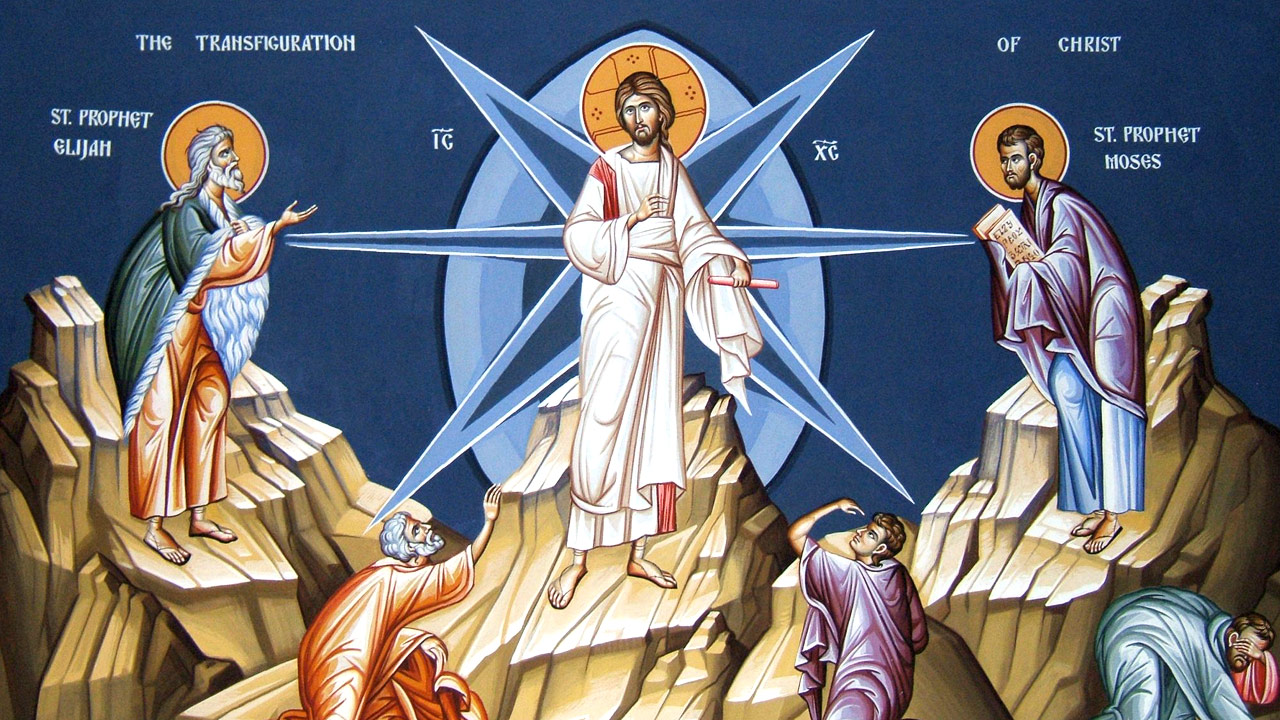
1 And after six days Jesus took with him Peter and James, and John his brother, and led them up a high mountain by themselves. 2 And he was transfigured before them, and his face shone like the sun, and his clothes became white as light. 3 And behold, there appeared to them Moses and Elijah, talking with him. 4 And Peter said to Jesus, “Lord, it is good that we are here. If you wish, I will make three tents here, one for you and one for Moses and one for Elijah.” 5 He was still speaking when, behold, a bright cloud overshadowed them, and a voice from the cloud said, “This is my beloved Son, with whom I am well pleased; listen to him.”

6 When the disciples heard this, they fell on their faces and were terrified. 7 But Jesus came and touched them, saying, “Rise, and have no fear.” 8 And when they lifted up their eyes, they saw no one but Jesus only. 9 And as they were coming down the mountain, Jesus commanded them, “Tell no one the vision, until the Son of Man is raised from the dead.”transfiguration-icon

In the name of Jesus. Amen.

Chapter and verse breaks are helpful for us to find the same passage of Scripture, but they can also get in the way of important context. Our text, which begins a new chapter of Matthew, starts with the phrase “And after six days….” So, before we get to the Transfiguration, we need to see what was happening that week prior to Jesus getting shiny up on the mountain.

Matthew’ context for the Transfiguration starts back in Matthew 16[:13ff]. Jesus asks the disciples, “Who do people say that the Son of Man is?” The disciples report that some say that the Son of Man is John the Baptist, Elijah, Jeremiah, or one of the prophets. But then Jesus turns the question to them, “But who do you say that I am?” and Peter has his great confession, “You are the Christ, the Son of the living God.” Jesus had been proving that all along with His miracles and teaching. So, Jesus praises and blesses Peter even while He states that Peter didn’t come up with this confession on his own. Instead, God the Father had revealed this to Peter.

Then, Matthew tells us from that time Jesus began to show His disciples that He must go to Jerusalem and suffer many things, be killed, and on the third day be raised (Mt. 16:21). Transfiguration & Christ ForsakenAnd from this point, things get a little crazy and awkward. It is almost as though Peter didn’t hear Jesus say that He would rise from the dead because Peter rebukes Jesus – the very one he just confessed is the Son of the living God. Peter says, “Far be it from You, Lord! This shall never happen to You.” It would be easy to sling mud at Peter here for telling God that what He says is going to happen won’t ever happen. But you do it all the time – more on that in a bit.

Now, when Peter confessed that Jesus is the Messiah, it meant something for him. What exactly Peter had in mind that Jesus would do as the Messiah is a bit hard to pin down. But basically, Peter figured that Jesus, the Messiah, had come to fix problems. Exactly what those problems were we can’t say with certainty. But whatever Peter had in mind, one thing is sure, it would be difficult for Jesus the Messiah and Great Problem Solver to fix those problems if He was dead.

So, Peter rebukes Jesus, and Jesus rebukes Peter. “Get behind Me, Satan! You are a hindrance to Me. For you are not setting your mind on the things of God, but on the things of man” (Mt. 16:23). And this is the sharpest rebuke Jesus ever gave an individual.

You know how it can be after you have an argument with someone. You try to avoid the other person for fear that a fight will break out at any moment. When you have to talk with them, you feel uncomfortable during every conversation. You carefully word everything in order to avoid the issue flaring up again. Imagine how Peter must have felt during those six days between this rebuke and the Transfiguration.

Now, let’s ascend the mountain. Jesus invites Peter, James, and John to come up the mountain with Him. Maybe this summons made Peter figure the whole issue was over and done with. Anyway, while they are there, Jesus is transfigured. Christ’s face shines like the sun. His clothes become white as light. Moses and Elijah appear and talk with Jesus. Luke tells us that conversation centered around Jesus’ exodus (usually translated as “departure” but the word is ἔξοδος) which Jesus was about to accomplish at Jerusalem (Lk. 9:30). In other words, they were discussing the very thing that Peter said should never happen just a week ago.

To summarize: Six days prior, Jesus told the disciples about His suffering, death, and resurrection. And Peter didn’t like it then, and Peter doesn’t like it now even in the presence of shiny Jesus. Instead, Peter likes being there on the mountain basking in Jesus’ unveiled glory. But even more than that, Peter doesn’t want Jesus to walk down that mountain, down to Jerusalem, down to be arrested, down to be tried, down to suffer, and down to die on a cross – which would appear to be a complete waste. So, Peter pips up and says, “Lord, it is good that we are here.” And the word that receives the most emphasis in Peter’s statement is ‘here.’ It is nice to be there on the mountain away from where Jesus says He will die, so Peter says, “Let’s stay here. I can build some tents so we can stay here!”

In a few weeks, we are going to hear the account of Jesus’ temptation. After Jesus resists the devil’s temptations in the wilderness, Luke tells us that the devil left Jesus to tempt Him at a more opportune time (Lk. 4:13). This, right here, is a more opportune time. In other words, this statement by Peter is a real temptation for Jesus to stay there with Peter, James, John, Moses, and Elijah on that mountain of glory.

But while Peter was still speaking, a bright cloud overshadowed them, and God the Father speaks the same words He spoke over Jesus at His Baptism, “This is my beloved Son, with whom I am well pleased.” But then the Father has one more thing to say – a command to give – “Listen to Him.” That’s not just friendly advice. The previous week, Peter had been rebuked by Jesus Himself for saying that Jesus shouldn’t die, “Get behind me Satan.” Now, Peter is rebuked again by God the Father for telling Jesus to stay away from Jerusalem and death. God says, “Listen to Him!” And the disciples hear this and are terrified.

Now, which of us does not have the same kind of weakness that Peter had? How often do you think you know better than God? You sin, but instead of confessing it for the rebellion that it is, you try to self-justify your actions. You judge God for being hard-nosed because of the things He has declared are evil. You think you know better than God how to raise your children, run your bank account, drive your car, and what to look at on the internet. Every time you complain, covet, and get angry, you are bucking God’s commands and setting yourself above God. It’s all idolatry, and we are all guilty. Stay in your lane. You don’t know better than God. You don’t get to tell God how things should be. Stay in your lane, and repent.

The voice of the Father from heaven says, “Listen to Him,” and crushes Peter’s conscience along with yours and mine.

Transfiguration - Rise and Have No FearBut here is where all of this is leading: Jesus comes to Peter, James, and John cowering in their sins and touches them. And notice what He says. He doesn’t continue to rebuke Peter. Jesus doesn’t say, “See I told you so.” Instead, Jesus says, “Rise,” the same word Jesus used when He spoke about His resurrection.“Rise, and have no fear.” Of all the things our Lord could have said, He says, “Rise, and have no fear.” Jesus is resurrecting Peter from his sin.

And Jesus stays in resurrection mode. As they are coming down the mountain, Jesus says, “Don’t tell anyone about what you saw until I rise from the dead.” There, Jesus speaks about His death. But it almost seems as though this is the first time the disciples realize Jesus says that as the Messiah that He will die and rise again. Christ will rise again.

Despite your objections; despite your idolatrous thinking that you know better than God; despite your continual, obstinate, insubordination against God; Jesus knows what you need. You need His suffering, the shedding of His blood, His death, and His resurrection. You need exactly what Jesus is here to provide for you right now. Here is His body, given for you. Here is His blood, shed for the forgiveness of all your sins. Here, Jesus gives you Himself to be your Savior. Amen.

The peace of God, which surpasses all understanding, will guard your hearts and minds in Christ Jesus. Amen.

Saints – Sermon on Revelation 7:9-17 for the Observation of All Saints’ Day

Listen here.

Revelation 7:9-17

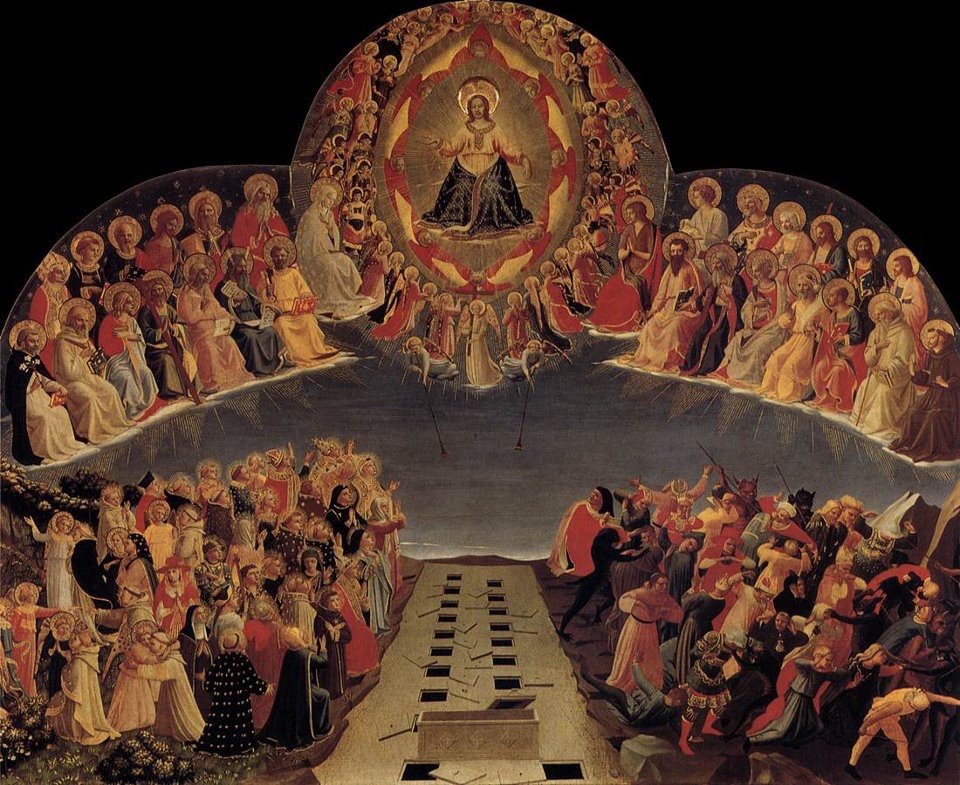
All Saints gathered around the throne9 After this I looked, and behold, a great multitude that no one could number, from every nation, from all tribes and peoples and languages, standing before the throne and before the Lamb, clothed in white robes, with palm branches in their hands, 10 and crying out with a loud voice,
“Salvation belongs to our God who sits on the throne,
and to the Lamb!”

11 And all the angels were standing around the throne and around the elders and the four living creatures, and they fell on their faces before the throne and worshiped God, 12 saying,

“Amen! Blessing and glory and wisdom and thanksgiving
and honor and power and might
be to our God forever and ever! Amen.”

13 Then one of the elders addressed me, saying, “Who are these, clothed in white robes, and from where have they come?” 14 I said to him, “Sir, you know.” And he said to me,

“These are the ones who are coming out of the great tribulation.
They have washed their robes
and made them white in the blood of the Lamb.

15 “Therefore they are before the throne of God,
and serve him day and night in his temple;
and he who sits on the throne
will shelter them with his presence.
16 They shall hunger no more, neither thirst anymore;
the sun shall not strike them, nor any scorching heat.
17 For the Lamb in the midst of the throne will be their shepherd,
and he will guide them to springs of living water,
and God will wipe away every tear from their eyes.”

In the name of Jesus. Amen.

Dear saints, the Apostle John wants you to see what he saw. The text says, “Behold,” so, get this picture in your mind. You see a huge crowd, so many people that you can’t begin count them. Even though there are too many to count, you can see thousands of faces and notice that they are not all the same. They have different skin colors and facial features. They come from all the different tribes and peoples and languages. You want diversity? This is diversity.

Yet, despite their different upbringings every member of that throng is doing the same thing. They are all standing before the throne of God and the Lamb. They are all clothed in white robes and holding palm branches in their hands. And they are all crying out with a loud voice, “Salvation belongs to our God who sits on the throne and to the Lamb!”

The myriads of angels are there, and they cry out with that multitude, “Blessing, glory, wisdom, thanksgiving, honor, power, and might be to our God forever and ever! Amen.”

The elder asks John, “Who are these clothed in white robes, and from where have they come?” John simply responds, “Sir, you know.” It doesn’t seem as though John had no idea who the crowd was. It isn’t as though he throws up his hands and responds, “I have no idea.” Instead, it’s as though John is so overcome with wonder and amazement that he can’t put words together to answer the question. You know how you want your grandpa or one of your friends to tell a story that you were involved in because they can tell it so well? It might be something like that.

The angel, the elder, says, “These are the ones who are coming out of the great tribulation. They have washed their robes and made them white in the blood of the Lamb.” There is no question or debate that John here is seeing the saints, Christians who have died and are with God. But people will debate if John is seeing the Christians who have died during his time or if John was transported into the future and given a glimpse of all the saints after the return of Christ and the resurrection of the dead.

Well, we have a clue to answer this debate in the text. (But I would like to note that, even if the interpretation of this particular phrase of v. 14 is incorrect, everything else I will preach could be shown from a variety of other Scripture passages.) The elder there says, “These are the ones who are coming,” present tense and there is a sense that this is a continual thing, “the ones who are coming out of the great tribulation.” The picture is that there is a constant, steady stream of people continually being added to this great multitude. Of all the things that could be said about these saints, the elder mentions they are coming out of the great tribulation.

Imagine the comfort that this must have been for John. At this point in his life, he is likely the last living apostle of Jesus when he sees this vision. John was the bishop of the entire region of Asia. He has been exiled to the island of Patmos because there was a persecution of Christians at that time. He had at least heard of – and, more likely, had seen with his own eyes – all sorts of men, women, and children who died for their confession of faith in Christ. Like you, John saw and experienced the fact that Christians leave earth. They breathe their last and are buried. And John knows the sadness and mourning that comes along with that.

But here John gets a glimpse of the heavenly view of what happens when Christians depart this earth. He sees the same ones who leave this earth filled with sorrow, difficulty, and tears now entering heaven in victory and glory. Stop and consider this for a minute:

When Christians die and leave this world, it is grievous, sudden, and often unexpected. Even if someone has been sick for a long time and you know they are going to die, there is an abruptness to death – like running into a wall. But that is how it is for us from the perspective of earth. Here, we get the picture of the same thing from the perspective of heaven.

All SaintsWhile death may come suddenly and abruptly here, those who die in the faith are not surprise arrivals in heaven. The company in heaven is not startled or shocked by those who show up at the doors of glory. The gates are open, and the believers who arrive there have been anticipated and are welcomed into the great multitude to be with the Lamb who shepherds them. Their arrival into glory is no shock to the residents of heaven. It is perfectly ordinary and on time.
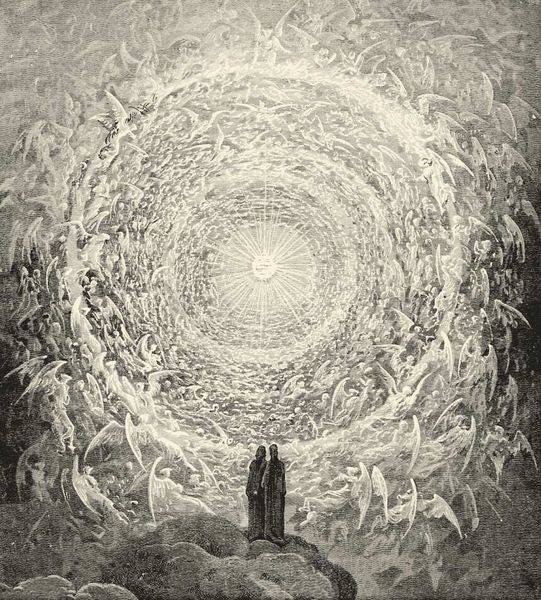
Consider as well that this multitude has come out of the great tribulation. They have come out of corrupted cultures and depraved societies. They endured the same disappointments and failures that you do.Like you, they struggled to balance their faith with their experiences. Like you, their families were hurt and torn apart because of sin. Like you, they wept for family and friends who abandoned faith in Christ. Like you, they served and supported others in ways that went unrecognized and unthanked. Like you, they were ridiculed and mocked for their faith. Like you, they knew the sorrow of pain, sickness, heart attacks, strokes, cancer, and dementia. Like you, they worried about the future. Like you, they feared as they walked through the valley of the shadow of death. Like you, they sinned and fell short of the glory of God. And like you, they pressed on in the midst of it all.

They pressed on and persisted in the faith while Jesus held them in His hand, just as He even now holds you. Jesus, their Shepherd, tenderly spoke to them as He speaks to you right now in His Word. Jesus gave them eternal life, and they will never perish (Jn. 10:28), just as He has given you eternal life and you will never perish.

Here is the point of all of this; here is the comfort for you: No one who believes in Jesus dies. This is a promise directly from the mouth of Jesus. Christ says, “I am the resurrection and the life. Whoever believes in me, though he die, yet shall he live, and everyone who lives and believes in me shall never die” (Jn. 11:25-26).

This year, as a congregation, we have mourned the deaths of Sonia Link, Ken Malm, and Verdie Pederson. You can add the names of others as well – friends and family members who either weren’t known to our congregation or who died years ago. These brothers and sisters in Christ have safely passed through death into life because whoever believes in Jesus lives. You can find comfort and solace in the fact that whoever believes in Jesus is of eternal significance and that person’s faith is of eternal consequence.

All Saints 1Because of this, we can have joy in the midst of sorrow. Here and now, as we are gathered together in God’s house and are invited to God’s table, we come to what is described in Hebrews 12(:22-24). This very morning in a small church on the north end of East Grand Forks, MN, we have come, “to Mount Zion and to the city of the living God, the heavenly Jerusalem, and to innumerable angels in festal gathering, and to the assembly of the firstborn who are enrolled in heaven, and to God, the judge of all, and to the spirits of the righteous made perfect, and to Jesus, the mediator of a new covenant.”

There are more here with us today than we can see or count. The saints of all time – those who are famous and known, those whom we don’t know yet, and our loved ones who preceded us in faith – they are all here with us as we gather together at the Lord’s Table.

Those who have departed this world with faith in Jesus are still united to us in Jesus because they are redeemed in the same Blood of Christ. They have washed their robes and made them white in the Blood of the Lamb. And, dear saints, you who have been made holy, so have you. Amen.

The peace of God, which surpasses all understanding, will guard your hearts and minds in Christ Jesus. Amen.

Death Be Not Proud – Sermon on Matthew 28:1-7 for the Vigil of Easter

Listen here.

Matthew 28:1-7

Now after the Sabbath, toward the dawn of the first day of the week, Mary Magdalene and the other Mary went to see the tomb. And behold, there was a great earthquake, for an angel of the Lord descended from heaven and came and rolled back the stone and sat on it. His appearance was like lightning, and his clothing white as snow. And for fear of him the guards trembled and became like dead men. But the angel said to the women, “Do not be afraid, for I know that you seek Jesus who was crucified. He is not here, for he has risen, as he said. Come, see the place where he lay. Then go quickly and tell his disciples that he has risen from the dead, and behold, he is going before you to Galilee; there you will see him. See, I have told you.”

In the name of the Father and of the Son and of the Holy Spirit. Amen.

Alleluia! Christ is risen!
He is risen indeed! Alleluia!

In 1609 the English pastor and poet John Donne nearly died after being a pastor for eight years. After he recovered, he wrote a poem titled “Death Be Not Proud.” You would think that after nearly escaping death, you would be relieved and grateful. But Donne wrote his sonnet mocking death.

You would think death has a good reason to be proud. To our eyes, it appears that death never loses. Eventually, death gets all of us and our loved ones. We try to fight death with cancer screenings, seat belts, air bags, eating healthy, and a good fitness routine. Some fight death by coloring gray hairs and anti-aging serums. But, in the end, nothing works. And as much as you try to escape his grasp, death is happy and willing to be patient. If he doesn’t get you at sixty, he’ll wait around until seventy or eighty or ninety.

We try to ignore death. Sometimes, death is given more reverence than God Himself. In the Old Testament, people would avoid speaking God’s name because it was so sacred and holy. The same happens with death today. People don’t like to talk about death. Instead, they talk about their loved ones ‘passing away,’ or ‘going to a better place.’ Some insist that their loved ones not have a funeral but a ‘celebration of life.’

Death is lord in our culture and is seen as the answer to many problems in society today. The suicide rate continues to rise. States continue to pass “right to die” laws. And abortion – the murder and death of children in the womb – is viewed as a fundamental right by some.

Death casts a wide shadow, and we live in its shadow every day of our lives. But death has no reason to be proud because of what happened this day.

Death’s pride was death’s undoing. In his pride, death opened his jaws too wide and went too far. Death swallowed up the One who is Life (Jn. 11:24; 14:6) and it was death’s undoing. Our risen Lord and Savior Jesus Christ shows that death has been defeated forever.

Life and death fought against each other, and the Prince of Life came out of that contest victorious. Death stuck his stinger right into Jesus’ hands, feet, and side. And because of that, death has lost his sting (1 Cor. 15:54-56).

King Jesus rode into Jerusalem on a royal donkey to face death. Christ carried His cross to answer for all your faithlessness and sin. Jesus has drowned death in His blood which cleanses you from all your sin.

Death is defeated – now and forever. Even if death takes you, Jesus, the death Destroyer, says that you are not dead. Instead, Christ says, “I am the Resurrection and the Life. Whoever believes in Me, though he die, yet shall he live. And everyone who lives and believes in Me shall never die” (Jn. 11:25-26).

Dear Christian, even in death you are not dead. Instead you are Christ’s. In your Baptism, you have already been joined to Christ’s death, which means that your death will not and cannot last (Ro. 6:3-5). In this Holy Sacrament, Jesus feeds you with His living Body and gives you to drink of His living, life-giving Blood.

Death has no reason to be proud. Not anymore. Jesus has conquered the bitter tyrant of death. And He has connected you to that victory. Amen.[1]

Alleluia! Christ is risen!
He is risen indeed! Alleluia!

The peace of God, which surpasses all understanding, will guard your hearts and minds inChrist Jesus. Amen.

[1]The idea for this sermon comes from a sermon by Pr. Ralph Tausz which can be found here (http://www.apostlesmelrosepark.org/index.php?page=Sermons&sid=380).