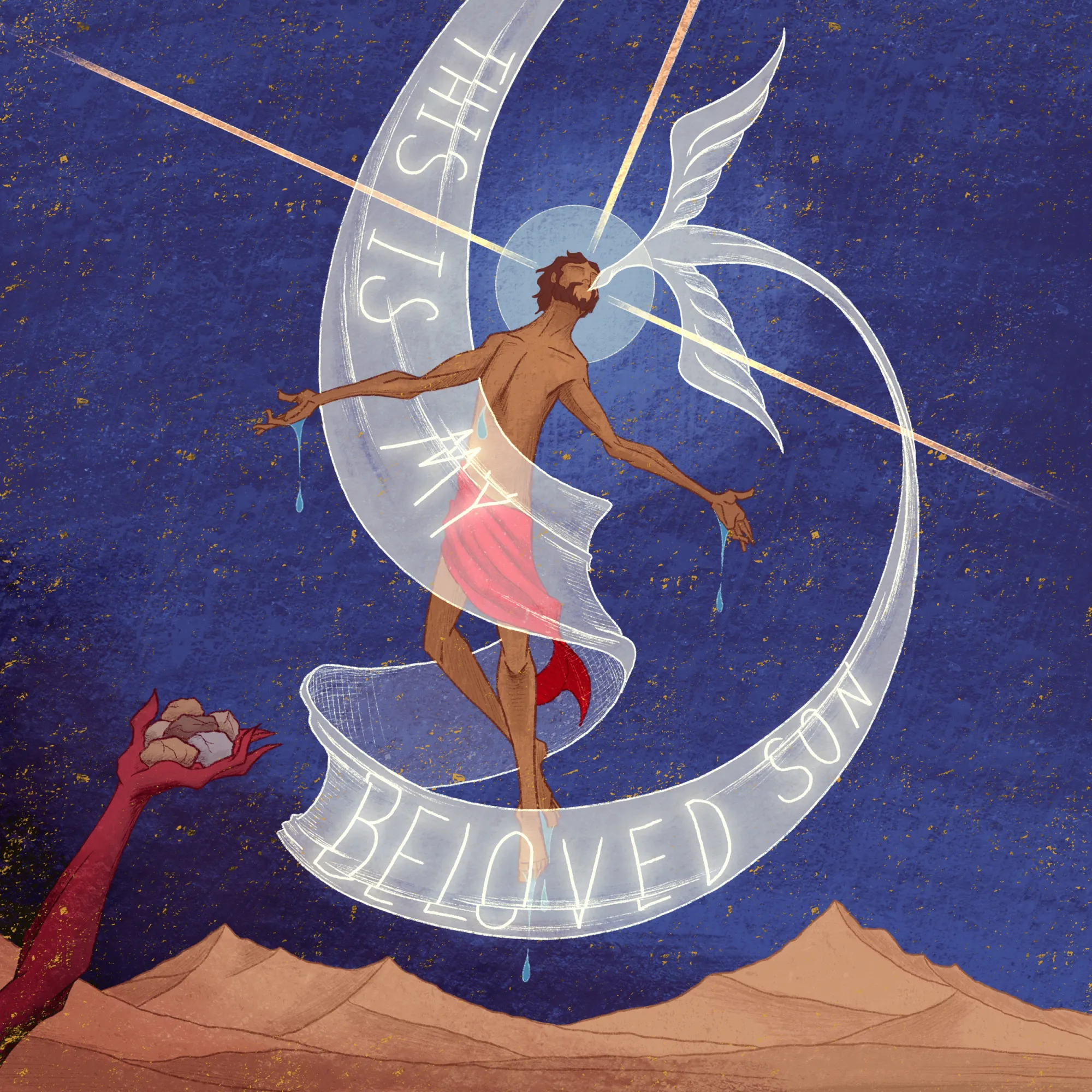
Working with Jesus – Sermon on Matthew 3:13-17 for the Baptism of Our Lord

Matthew 3:13–17

13 Then Jesus came from Galilee to the Jordan to John, to be baptized by him. 14 John would have prevented him, saying, “I need to be baptized by you, and do you come to me?” 15 But Jesus answered him, “Let it be so now, for thus it is fitting for us to fulfill all righteousness.” Then he consented. 16 And when Jesus was baptized, immediately he went up from the water, and behold, the heavens were opened to him, and he saw the Spirit of God descending like a dove and coming to rest on him; 17 and behold, a voice from heaven said, “This is my beloved Son, with whom I am well pleased.”

In the name of Jesus. Amen.

At Christmas, we celebrate the fact that the eternal God the Son came down to us so He could bring us up to Him. God, who is spirit (Jn. 4:24), became flesh and dwelt among us (Jn. 1:14). This is the wonder of wonders and deserves our eternal contemplation, thanks, and praise. That being said, God simply becoming flesh wouldn’t have done us any good unless He did more than simply have a body. God came in the flesh and used that body to be your Savior from sin, and that is what we see happening at Jesus’ Baptism.

Today, we’re mainly going to focus on how Jesus responds to John’s objection, but before we do that, we need to consider for a minute what Jesus’ Baptism accomplishes. John said the reason he was preaching and Baptizing in the wilderness is for repentance (Mt. 3:11), and Lk. 3:3 says John’s baptism was for the forgiveness of sins. But Jesus doesn’t have any sin, so He doesn’t need either repentance or forgiveness. That is why John objects and would have prevented Jesus from being Baptized (Mt. 3:14). Jesus isn’t Baptized because of His sins because, again, He didn’t have any. Instead, Jesus is Baptized to be anointed with the sin of the world. In His Baptism, Jesus steps into the office of being the Messiah or the Christ, both of those titles mean ‘the Anointed One.’

Imagine what was happening as John was Baptizing. People who recognized how they had sinned against God by idolatry, profaning God’s name, and breaking the Sabbath; people who were convicted of how rebellious they were toward their parents, murderers, adulterers, thieves, liars, and coveters; they were all coming to John repenting and to have those sins washed away in the waters of the Jordan River. So, imagine all the sins of all those sinners floating around in the water, making it filthy.

But then, Jesus steps into those repugnant waters. Since Jesus didn’t have any sin to wash away, He soaks up all those sins into Himself like a sponge leaving the waters clean again. This is why, the next time John sees Jesus, he says, “Behold the Lamb of God who takes away the sin of the world” (Jn. 1:29). It is at His Baptism that Jesus, at least, begins to fulfill what was prophesied about Him back in Isaiah 53 – that He would be numbered with the transgressors (Is. 53:12), and that God would lay on Him the iniquity of us all (Is. 53:4-6).

One of my favorite verses is 2 Cor. 5:21, which could be viewed as an interpretation of or teaching about what happens at Jesus’ Baptism, “For our sake, [God] made [Jesus], who knew no sin, to be sin.” And I’d encourage you to personalize that verse: “For my sake, God made pure, perfect, sinless Jesus to be sin. God did that for me.” And the verse doesn’t stop there. It also tells you why God did this. He did it so that in Jesus, you “might become the righteousness of God.” Because of Jesus, believer, you are pure as God is pure (1 Jn. 3:3). Because of Jesus, dear saints, you are holy as God is holy (1 Pet. 1:16). Because of Jesus, Christian, you are righteous as God is righteous (2 Cor. 5:21).

Now, that brings us back to Jesus’ response to John’s objection. John doesn’t want to Baptize Jesus because John is the sinner who needs to be Baptized and have his sins washed away by Jesus. But Jesus replies, “Let it be so now, for thus it is fitting for us to fulfill all righteousness” (Mt. 3:15). Notice that, Jesus doesn’t tell John that He needs to be Baptized so He can fulfill all righteousness by Himself. No. He tells John that John has a role to play in fulfilling all righteousness, “It is fitting for us to fulfill all righteousness.”

John had a role and works to do with Jesus in Christ’s work fulfilling all righteousness. John’s role was to prepare the way of the Lord (Jn. 1:23), to proclaim a Baptism of repentance for the forgiveness of sins (Lk. 3:3), to point people to Jesus (Jn. 1:29) and finally, to Baptize Jesus. That was God’s purpose for John. God put John into that specific office and vocation, and God did that long before John was born. 

The Old Testament closes with the prophet Malachi, which was written about 430 years before Jesus was born saying that God would send Elijah before the “great and awesome day of the Lord comes” (Mal. 4:5). And Jesus says that John is the fulfillment of that prophecy (Mt. 11:13-14). All four Gospels say (Mt. 3:3; Mk. 1:2-3; Lk. 3:4; Jn. 1:23) that John the Baptizer was the fulfillment of what God said in Is. 40:3 about the voice crying in the wilderness to prepare the way of the Lord, which was promised about 750 years before John was born. For at least three-quarters of a millennia, God had planned that John would work with Jesus to fulfill all righteousness. John’s identity and purpose is completely bound up to Jesus’ identity and purpose as the Savior of the world.

Dear saints, the same is true for you. Jesus has also called you to work with Him to fulfill all righteousness. Christ calls you into particular offices and vocations to work with Him in fulfilling all righteousness. Sure, you weren’t called to do the things that John the Baptizer did, but you are called to work with Jesus – even from before the foundation of the world (Mt. 25:34). You’re familiar with Eph. 2:8-9 which says, “By grace you have been saved through faith. And this is not your own doing; it is the gift of God, not a result of works, so that no one may boast.” And don’t forget what the next verse (Eph. 2:10) says, “For we are his workmanship, created in Christ Jesus for good works, which God prepared beforehand, that we should walk in them.”

God places you into different offices in which you work with Jesus to fulfill all righteousness. You kids here, from the moment you were conceived, God put you in the office of being a child so you can work with Jesus to fulfill all righteousness by honoring and obeying your parents. You who are married, at your wedding, God put you into the office of husband or wife to work with Jesus to fulfill all righteousness. As God blesses you with children, He places you into the office of parent where you fulfill all righteousness by raising your children, training them in the way they should go, and teaching them the faith. The same is true in your job, in your extended family, and with your friends. In each and every relationship you have, God is placing you into an office and giving you good works to do in order to fulfill all righteousness.

Whenever you do what God gives you to do in the different offices He places you in, you are serving God by loving your neighbor, and as you do that, you are working with Jesus to fulfill all righteousness. In every good work you do, God’s light shines through you, others see your good deeds, and they will glorify their Father in heaven (Mt. 5:16). Dear saints, you are God’s fellow workers (1 Cor. 3:9) and your deeds follow you (Rev. 14:13).

Now, to strengthen you in those tasks and to give you what you need, your heavenly Father invites you to His table where He will fill you with Jesus’ Body and Blood given and shed for the forgiveness of your sins. Through this meal, He fills you cup so it runs over with His righteousness (Ps. 23:5) and spills over to those around you. Amen.

The peace of God, which surpasses all understanding, will guard your hearts and minds in Christ Jesus. Amen.

Slaves & Sons – Sermon on John 8:31-36 for Reformation Sunday

John 8:31–36

31 So Jesus said to the Jews who had believed him, “If you abide in my word, you are truly my disciples, 32 and you will know the truth, and the truth will set you free.” 33 They answered him, “We are offspring of Abraham and have never been enslaved to anyone. How is it that you say, ‘You will become free’?” 

34 Jesus answered them, “Truly, truly, I say to you, everyone who practices sin is a slave to sin. 35 The slave does not remain in the house forever; the son remains forever. 36 So if the Son sets you free, you will be free indeed.

In the name of Jesus. Amen.

Jesus says, “If you abide in My Word, you are truly My disciples, and you will know the truth, and the truth will set you free.” Those words of our Lord have been rolling around in my mind this past month. What Jesus says there has a lot of implications both for individuals and, by extension, for congregations. To be a disciple of Jesus – in other words to be a Christian – means abiding, remaining, and staying in Jesus’ Word. Those who are saved love to hear their Savior’s words. And that does not only refer to the red-letter words in our Bibles. It’s the whole thing. From the words, “In the beginning,” in Gen. 1:1 through the final, “Amen,” of Rev. 22:21 are all Jesus’ Words.

And notice to whom Jesus says this – this is so important. Jesus is speaking to “the Jews who had believed in Him.” In other words, Christ is speaking to Christians (Ro. 10:17) – people who believe His words. So, what Jesus is calling them to do is to continue abiding and remaining in His Words because if they do notremain in Jesus’ Words, they will not be His disciples, they will not know the truth, and they will not be free. Dear saints, your life as a Christian is to continue to learn and grow in your knowledge and understanding of the Bible. To be a Christian is to be a student of the Scriptures.

Now, all of that is important to ponder and consider, but there is something even more profound here that I want us to consider today. Again, as Jesus speaks to people who believe in Him, He calls them to abide in His Word so that they will (future tense) be set free. In other words, those who believe in Jesus are waiting for a freedom that is still to come. That freedom is promised, and that freedom is the hope of every Christian, but it is still in the future.

Today, as Jesus’ disciples, let’s abide in these words of Jesus here for a moment because many other passages in Scripture say that we are free when we believe. Romans 6:22 says that you, believer, have been set free from sin. A little later in Romans 8:2, Scripture says that the Spirit of Life has set you free in Christ Jesus. Galatians 5:1 says that it is for freedom that Christ has set us free.

Just like the people in this reading did, we might want to ask Jesus, “How is it that You say, ‘You will become free’? Aren’t we free already?” Well, Jesus is clear. “Truly, truly. Amen, amen, I say to you everyone who practices,” probably a better way to translate this would be ‘does,’ “everyone who does sin is a slave to sin.” To do sin is to be a slave to sin.

So, dear saints, consider this: Are you a Christian? Do you believe in Jesus? Do you believe His Word? Yes. Then Scripture is clear, you are free – right now.

But also consider this: Are you perfect? Do you do things that God forbids? Do you not do things that God demands? In other words, do you sin? Yes. Then, your Lord is also clear – you are a slave to sin. And you can’t wiggle out of this. It isn’t just that you make mistakes or that you are programmed to do things that aren’t quite right. No. All of us deliberately sin. We sin on purpose, with full knowledge, and repeatedly. And by sinning, we place ourselves under slavery to sin and put our faith in danger. Repent.

Jesus knows when He says that those who do sin are slaves to sin is a devastating judgment. That’s why He continues speaking and offers us hope saying that even though, “the slave does not remain in the house forever; the son does remain forever. So if the Son sets you free, you will be free indeed.”

Jesus doesn’t just leave you in slavery to sin. He is the Son who sets you free – both now and in the future. Romans 6 says that you have been joined to Jesus’ death and resurrection in your Baptism, and it goes on to say, “our old self was crucified with Him in order that the body of sin may be brought to nothing, so that,” and listen carefully here, “so that we would no longer be enslaved to sin. For one who has died has been set free from sin” (Ro. 6:6-7). 

Jesus tells us the truth. The one who does sin is a slave to sin, and He sets us free from the evil master of sin. These two clear truths from Scripture have to be one of the most difficult tensions in all the world. You are, for a time, both slaves (because you sin) and sons (because you believe and are redeemed). You are free, and at the same time you are a slave to sin. You aren’t one or the other or bounce back and forth. At the same time, you are sons of God and still slaves to sin. The last half of Romans 7 talks about this tension (Ro. 7:14-25).

You are simultaneously saint and sinner, or, as Jesus puts it here, simultaneously slaves and sons. The tension between those two teachings isn’t understandable or comprehensible. But that’s ok. The Bible teaches all sorts of things that are beyond our understanding like the Trinity; the two natures of Jesus, that He is both God and man; etc. We don’t hesitate to believe those things because Scripture clearly teaches them. Well, Scripture also teaches that you are a slave to sin and a redeemed son of God. 

This tension is what keeps you running back to Jesus. It isn’t your obedience or your consistency or the fact that you feel bad about being a sinner that sets you free. Yes, you should feel bad about being a sinner, but that isn’t what sets you free from your slavery to sin. It’s Jesus, the Son, and Him alone who sets you free now and will make you free forever.

Dear saints, when – not ‘if’ but ‘when’ – when you feel the weight of your slavery, when the shackles of your iniquities rub your wrists and ankles raw, when the whip of your transgressions has shredded your back, remember Jesus came for you. He came – not for the righteous because there aren’t any righteous – He came to call you, sinner, to repentance and faith (Mt. 9:13; Mk. 2:17; Lk. 5:32). Jesus sets you free, and if He sets you free, then you are free indeed.

Child of God, abide in Jesus’ Word, and you will remain in the house forever. Amen.

The peace of God, which surpasses all understanding, will guard your hearts and minds in Christ Jesus. Amen.

Depend – Sermon on Matthew 22:34-46 for the Eighteenth Sunday after Trinity

Matthew 22:34–46

34 But when the Pharisees heard that he had silenced the Sadducees, they gathered together. 35 And one of them, a lawyer, asked him a question to test him. 36 “Teacher, which is the great commandment in the Law?” 37 And he said to him, “You shall love the Lord your God with all your heart and with all your soul and with all your mind. 38 This is the great and first commandment. 39 And a second is like it: You shall love your neighbor as yourself. 40 On these two commandments depend all the Law and the Prophets.”

41 Now while the Pharisees were gathered together, Jesus asked them a question, 42 saying, “What do you think about the Christ? Whose son is he?” They said to him, “The son of David.” 43 He said to them, “How is it then that David, in the Spirit, calls him Lord, saying,

44 “‘The Lord said to my Lord, 
“Sit at my right hand, 
until I put your enemies under your feet” ’?

45 If then David calls him Lord, how is he his son?” 46 And no one was able to answer him a word, nor from that day did anyone dare to ask him any more questions.

In the name of Jesus. Amen.

This Gospel reading takes place on Holy Tuesday. In other words, it is just a few days before Jesus will be crucified, and what we heard is Jesus’ last public teaching until He preaches the seven last words from the cross. The Pharisees and Sadducees are asking our Lord three questions to try to entangle Him in His words (Mt. 22:15). They want Jesus to say something they can use against Him and kill Him. The first two questions they asked were about paying taxes and the resurrection. But Jesus answers both questions so skillfully that they can’t find a way to accuse Him.

Our text begins with their third and final trick question that comes from a sleezy lawyer. “Teacher, what is the great commandment in the Law?” It seems as though the intent of this question is to get Jesus to put one of the Commandments above the others, and when He does that, they will say that He teaches that the other nine aren’t as important. But they end up looking like fools. It was Jesus’ finger that carved those words into the stone tablets and His voice that spoke them on Mt. Sinai. Jesus is the Author of the Commandments, and they are all important.

So, Jesus answers the question, “The great Commandment is this: love God with everything you’ve got and love your neighbor as yourself. On these two commandments depend all the Law and the Prophets.” In other words, Jesus is saying, “All the Commandments matter. All of them are the greatest. They all demand that you love God and love your neighbor. All the Commandments depend on these two.” Jesus is clear here, and Scripture is clear elsewhere that what the Commandments require of us is to love. Love is the fulfilling of the Law (Ro. 13:10b). In every situation, you are to love God and love your neighbor. And it is important to spend some time on this because there is a lot of unnecessary confusion about what love looks like. A pastor friend of mine (Pr. Bryan Wolfmueller) put together a list that helps to define and shape what love looks like. And this list is biblical and, I think, very helpful.

First, love is shaped by the Ten Commandments. Love does not mean that there are no other Commandments. No, the Commandments define what love is. Love depends on the Commandments. If you are fornicating and committing adultery, you cannot presume to say that it’s ok because, “We love each other.” Adultery is always unloving.

Second, love is shaped by our vocation or our station in life. Everyone has several vocations, so I’ll use myself as an example here. Some of my vocations are husband, father, pastor, a child of my parents, a friend, etc. In each of those vocations, I am called to love. But what that love looks like depends on those different vocations. For example, part of my love as a father includes providing for my family. So, I earn a living so my wife can go and buy socks for our kids. As a pastor, my love looks different. It looks like faithfully preaching and teaching God’s Word to you, the flock that God has entrusted into my care. My vocation as a pastor does not require me to buy socks for all of you. Pastors are not called to provide socks for their congregations. But that, then, leads us to the third thing that shapes our love.

Our love is also shaped by the needs of our neighbor. If one of you, who aren’t part of my family, needs socks and can’t get them for yourself, my love for you would be to give you socks. Even if the only reason I know you and your need socks is that I’m your pastor, I’m not giving you socks because I’m your pastor. I’m giving you socks because I am your brother in Christ. And if I needed socks, I would want one of you to give me socks if you have the means and resources to provide them. In that instance, I’m loving you as I would love myself. (I think this is the most I’ve ever used the word ‘socks’ in a sermon, but I’m done now.)

That leads us to the fourth thing that shapes our love which is the gifts God has given us. God gives us stuff, skills, and talents so we can use them to love and serve our neighbor. If God has made you successful and given you a lot of money, use those resources to love your neighbor. If God has given you the talent of being good at cooking, you love your neighbor by cooking. If God has given you good mind for math, you can love your neighbor as an engineer or an accountant. The beautiful thing about this one is that the gifts God gives you can help you love your neighbor across different vocations. A person who is good at math can be a good accountant. He can earn a good living and provide for his family and, at the same time, love and serve his clients who need someone to keep their books.

Just briefly here, our neighbor’s need might mean that we have to love our neighbor in a way that we aren’t gifted. Imagine a meteor hit the church during this service. We don’t have an ER doctor here, but we do have an optometrist, a medical student, nurses, and EMTs who are gifted in knowing how the body works and how to heal. They should be the ones who go to the people who are most injured and help them. And if more people are injured, those of us who aren’t gifted in that way are called to do the best we can even though that kind of love is usually reserved for doctors and nurses. Our neighbor’s need trumps how we are gifted. Especially in an emergency, we love and serve others based on their needs rather than our love depending on our gifts. And when the ambulances get here, we who don’t know as much about first aid should step aside and let the professionals use their gifts to serve the people in need.

So, the first four things that shape our love are: 1) the Ten Commandments; 2) our vocation; 3) our neighbor’s need; and 4) our gifts. All of that is fairly obvious and reasonable. But there is another thing that shapes our love, and this last one is one that our culture fights against (for several reasons). But this one is also important to consider. The fifth thing that shapes our love is our neighbor’s sin, and this is where things can get tricky and difficult. But this is also where Jesus’ summary of the Ten Commandments – love God with everything and love your neighbor as yourself – is helpful. And God gives you wisdom to help navigate this.

Imagine you know someone who is addicted to fentanyl, your calling is still crystal clear: you are called to love that person. But now what is that love going to look like? Is it loving to just step aside and let them keep killing themselves by using that fentanyl? No, it isn’t. Their sin against themselves might even mean that you need to break one of the Commandments in order to love them. You might need to steal their fentanyl even though stealing is sin and a violation against the 7th Commandment.

Now, please recognize that the Ten Commandments are still the primary thing that shapes and defines our love. But because of your neighbor’s sin, you break the 7th Commandment about stealing in order for you to keep the 5th Commandment which calls you to do your neighbor no bodily harm, but help and defend him in every need. This is why knowing the Commandments is so important. And, again, your vocation still plays into this too. You aren’t called to travel to San Francisco, Seattle, or Portland and steal fentanyl from all the addicts in those places.

Our neighbor’s sin can hinder the ways we love them. Parents, when your children are breaking the 4thCommandment and not obeying you, your love for them looks like disciplining them; it isn’t what you want to do, but you are called to do it (Pro. 22:15; 23:13; Heb. 12:11). If you have abusive parents, you are still called to keep the 4th Commandment and honor them, but their sin could mean you have to disobey them if they demand you do something contrary to God’s Word. If your cousin, Stacy, is getting married, your love normally looks like going to her wedding and celebrating with her. But if she is breaking the 6th Commandment by trying to be married to another woman, your love for her means not going to the wedding because that would embolden her in her sin against the 6th Commandment. Yes, this is hard and difficult. Yes, this is uncomfortable. Yes, it is even confusing. You are always called to love, but sin can put constraints on love.

And that brings us to the second part of our text which is the question Jesus asks the people who are trying to trip Him up. Jesus turns the discussion to the identity of the Messiah. The Savior is David’s Ancestor and also David’s Lord. The way this is possible is that Jesus is the fully Divine, eternal Son of God and fully human. Christ is God and Man.

Your Savior’s love for you was fully shaped by the Ten Commandments, which Jesus kept perfectly. His vocation was to be the Messiah and shed His blood and bear the punishment for the sins of all humanity because that was our need. He was gifted with everything necessary to be the Savior. And He navigated our sin in such a way that He perfectly loved God by loving us and bearing our sin to the cross. Now, He is risen and lives and reigns on the throne of all creation for eternity. 

Your eternal life totally depends upon what Jesus, the Son of God and Son of David, has done. God be praised that He has done all things well (Mk. 7:37). Amen.

The peace of God, which surpasses all understanding, will guard your hearts and minds in Christ Jesus. Amen.

Roadblock – Sermon on Proverbs 4:10-23 for the Fourteenth Sunday after Trinity

Proverbs 4:10–23

10 Hear, my son, and accept my words, 
that the years of your life may be many. 
11 I have taught you the way of wisdom; 
I have led you in the paths of uprightness. 
12 When you walk, your step will not be hampered,
and if you run, you will not stumble. 
13 Keep hold of instruction; do not let go; 
guard her, for she is your life. 
14 Do not enter the path of the wicked, 
and do not walk in the way of the evil. 
15 Avoid it; do not go on it; 
turn away from it and pass on. 
16 For they cannot sleep unless they have done wrong; 
they are robbed of sleep unless they have made someone stumble. 
17 For they eat the bread of wickedness 
and drink the wine of violence. 
18 But the path of the righteous is like the light of dawn, 
which shines brighter and brighter until full day. 
19 The way of the wicked is like deep darkness; 
they do not know over what they stumble. 

20 My son, be attentive to my words; 
incline your ear to my sayings. 
21 Let them not escape from your sight; 
keep them within your heart. 
22 For they are life to those who find them, 
and healing to all their flesh. 
23 Keep your heart with all vigilance, 
for from it flow the springs of life.

In the name of Jesus. Amen.

In 2019, the AFLC’s Annual Conference was held near Scranton, PA. To save our congregations a bit of money, four other pastors and I decided to travel together. We rented a vehicle in Minneapolis which ended up being a brand new, black GMC Yukon with tinted windows and all the bells and whistles. Our first day of travel together was from Minneapolis to a hotel in Toledo, OH which is just under 700 miles and would take about 10 hours. We had Google Maps plot our course to avoid toll roads, made our way through Wisconsin, and started to enter the Chicago metro. As we got deeper into Chicago, Google kindly told us that our current course had congested traffic and that there was an alternate route which would save us 45 minutes. That’s what you call a no brainer. Reroute.

We got off the freeway and quickly found ourselves driving through the neighborhoods of Chicago. Sure, there were stoplights and stop signs, but we kept moving. Now, one of the other pastors had grown up near Chicago, but he had been asleep in the third-row seat when we decided to reroute. I’m not exactly sure what woke him up, but he looked out the window and asked, “Where are we?” We told him that we were still in Chicago and that we had left the freeway to avoid traffic. He looked at a couple of street signs and said in the most serious voice I had ever heard him use. “We need to get out of here. Now!”

We had been redirected to the south side of Chicago, not only that, but a neighborhood notorious for stray bullets and carjackings. Apparently, Google Maps can help you avoid tolls and traffic jams, but it isn’t able to assist five, slightly overweight, mostly Scandinavian pastors avoid being robbed at gunpoint. We did make it out safely with the rented Yukon.

The point is this: it is easy to quickly and unintentionally end up on the wrong path. For us five pastors, the address of our destination didn’t even change, but we were deeply down the wrong path.

Now, there is a temptation for us to hear about the two paths described in these verses and lull ourselves into a false sense of security. We can wrongly think, “I’ve been taught the Bible which is the Word of Life. I’m not overly influenced by all that bad stuff ‘out there.’ I’ll just set the cruise control on my mostly moral life, make sure the lane departure warning system is enabled so I keep being virtuous, and everything will be just fine and dandy.”

Dear saints, beware of that attitude sneaking up on you because when it does, you are already several steps down the dark path of wickedness. The fork in the road between the path of life and the path of the wicked isn’t just ‘out there’ and clearly marked with signs. No. The exit down road of evil is always in the heart of each of us sinners and you can start down it without realizing that your destination has changed. Repent.

Go back for just a minute to that picture of the wicked being unable to rest or sleep unless they have done wrong or made someone stumble. If it weren’t so haunting, it would almost be comical. Imagine the wicked getting ready for bed. They put on their pajamas, brush their teeth, go to the bathroom, fluff their pillow, snuggle up under the covers, but toss and turn because they realize they haven’t gotten someone else to sin. It sounds so ridiculous, but, if you’re honest, you’ve probably experienced that restlessness and sleeplessness when you realize you haven’t caused someone else to stumble.

Stick with me on this. The most natural reaction we sinners have to our sin is, sadly, not to repent, not to get off the dark, evil path of the wicked. Instead, our natural reaction is to recruit other sinners by trying one of two things:

First, we try to recruit other sinners when we play the comparison game. We compare our sin to the sin of others. We search high and low for people who have fallen into sin and think that God will look more kindly on us because there are others who fell harder or further than we did. In our opinion – which, frankly, doesn’t matter – our sin isn’t as grievous as those other people’s. That comparing our sin to the sin of others brings us to a place where we celebrate the sin and downfall of others. We hope to find others stumbling.

But the second way we recruit others to sin is more dangerous and, I think, more common. We recruit other sinners when we try to defend ourselves and make excuses for our sin. When we make excuses for our sin, we are foolishly trying to rig a jury that has no jurisdiction over our case. We figure if we can get enough people to understand why we did that sinful thing, whatever it was, then they will be ‘on our side.’ We lose sleep thinking of ways to convince others that our sin was justified. We want them to make us comfortable with our unrepented sin.

Adam tried to pull this asinine trick when he ate the forbidden fruit. He tried to excuse his sin by convincing God that the reason he ate the fruit was the fault of God Himself. Adam basically says, “Listen God, the only reason I ate the fruit was that this woman, whom You gave to be with me, gave me that fruit. You’re responsible and culpable for my sin” (Gen. 3:12).

When we make excuses for our sin, what we are actually doing is we are trying to get others to fall into their own sin. We want them to lie by calling the evil, sinful thing we did ‘good’ or ‘ok’ or, at least, ‘neutral.’ But Isaiah 5:20 says, “Woe,” in other words, ‘damned,’ “are those who call evil good and good evil.” When we try to excuse our sin before others, we are trying to get them to call something evil we have done ‘good.’ Again, repent.

Dear saints, constantly be on the alert for the path of the wicked knowing that you are always inclined to reroute yourself to it. See the roadblock that this passage puts in front of that wicked path. “Do not enter the path of the wicked, and do not walk in the way of the evil. Avoid it; do not go on it; turn away from it and pass on” (v. 14-15). Don’t be like a foolish child and blow through that roadblock.

Dear saints, stay on the righteous path. Hold fast to the Words of Scripture. Notice how the opening verses also call this righteous path the way of wisdom. This wise, righteous path is clear of obstacles. When you walk on this path, you will not be hampered, and if you run (I’m so glad that the text leaves that as optional by saying, ‘if’) if you run on this path, you will not stumble. This path is life – it is full of life, and it grants life.

To follow this path means that when Scripture points out your sin, be wise. Confess that sin. Receive God’s mercy and forgiveness freely given to you because it has been bought and paid for by Jesus’ holy and precious blood. Confess that sin and be filled with Christ’s righteousness.

And know that this path is like the light of dawn. You who are righteous through faith in Christ, you don’t walk in the light of the full day – not yet. But you do walk in the light of the dawn which is always growing brighter and brighter so you see the righteous way more clearly as the day of your Savior’s return draws ever nearer. Amen.

The peace of God, which surpasses all understanding, will guard your hearts and minds in Christ Jesus. Amen.

Origins – Sermon on Genesis 2:7-17 for the Seventh Sunday after Trinity

Genesis 2:7-17

7 [T]hen the Lord God formed the man of dust from the ground and breathed into his nostrils the breath of life, and the man became a living creature. 8 And the Lord God planted a garden in Eden, in the east, and there he put the man whom he had formed. 9 And out of the ground the Lord God made to spring up every tree that is pleasant to the sight and good for food. The tree of life was in the midst of the garden, and the tree of the knowledge of good and evil. 

10 A river flowed out of Eden to water the garden, and there it divided and became four rivers. 11 The name of the first is the Pishon. It is the one that flowed around the whole land of Havilah, where there is gold. 12 And the gold of that land is good; bdellium and onyx stone are there. 13 The name of the second river is the Gihon. It is the one that flowed around the whole land of Cush. 14 And the name of the third river is the Tigris, which flows east of Assyria. And the fourth river is the Euphrates. 

15 The Lord God took the man and put him in the garden of Eden to work it and keep it. 16 And the Lord God commanded the man, saying, “You may surely eat of every tree of the garden, 17 but of the tree of the knowledge of good and evil you shall not eat, for in the day that you eat of it you shall surely die.”

In the name of Jesus. Amen.

It should come as no surprise, but this text is fundamental and foundational to understanding who we are as God’s creatures. But to really get to the roots of who we are, we first have to understand who God is as our Creator, and this text gives us one piece of that understanding. The other piece came just before our text.

The Bible gives us two very different accounts of creation. In Genesis 1:1-2:3, God creates the sun, moon, stars, land, sky, plants, fish, birds, mankind, and all things by simply speaking. Whatever He commands comes into being. The whole account is filled with the repeated words, “And God said…. And it was so.” Then, God rests. Throughout those six days of creating and the seventh day of rest, He is simply called “God” (Heb.‘Elohim’). In that first account account of creation, we see a God who is transcendent – He is not subject to the limitations we are used to.

But then in our text here, the second account of creation, we see something remarkably different. The difference can be seen just a few verses before our text began in how Moses refers to God. No longer is He simply ‘God’ – He is the Lord God. In Hebrew, it is Yahweh God. In other words, this transcendent, powerful God has a name, and He is close and personal – especially with the head of His creation, Adam.

Yahweh puts His hands into the earth, molds the clay to form the man, and breathes life into Adam’s nostrils (Gen. 2:7). Then that immanent, personal God plants a garden for Adam (Gen. 2:8-9). After our text, Yahweh remains close to Adam by causing him to sleep and performing a surgery on him in order to create the woman. And Yahweh brings the woman to Adam as his suitable helper and joins them together in marriage so they would become one flesh by having children (Mt. 19:6; Mk. 10:9).

From these two accounts of creation, we have an important insight into God. He is mighty, powerful, and uninhibited. But He is also intimately close and involved with mankind.

Finally, after God finishes creation, He rests on the seventh day. Now, God doesn’t rest on the seventh day because He is tired. He created by merely speaking, and God speaks a lot more through the rest of Scripture but doesn’t grow tired or need a nap (Ps. 121:3-4). Instead, those two creation accounts help us understand something about that day of rest. God rests because He has set up all of creation to be His Temple where He will rest in the order and peace that He has established.

When I was younger, I imagined God created everything while He sat far away in heaven, speaking things into existence, but staying aloof somewhere way up there in heaven. But that scenario isn’t compatible with the rest of Scripture.

God’s desire is to dwell with people, the crown of His creation. The final picture Scripture gives of the eternal bliss of believers is God making His dwelling with you (Rev. 21:3). This desire of God to dwell among His creation becomes especially clear after the Fall. When God delivers His people from slavery in Egypt, He instructs them to build the Tabernacle so He can dwell in their midst (Ex. 25:8). In that Tabernacle, and later in the Temple, God says that He will walk among them (Lev. 26:12; 2 Sam. 7:6-7) just as we see He does in Gen. 3:8. To do that, God’s instructions on how to build the Temple in Jerusalem include many of the same materials, like gold and onyx stones, and the same ‘floorplans’ we read about here in the Garden of Eden.[1]

Now, that brings us to the nature of mankind. God puts Adam in the midst of that newly created Temple of Eden and gives Adam two responsibilities. Our translation says that Adam is there “to work it and keep it.” The two Hebrew words there can refer to a lot of activities, but when Scripture uses these two terms together, they most often refer to the duties and responsibilities of the priests in the sanctuary of the Tabernacle and Temple (Num. 3:7-8, 8:26, 18:5-6). In other words, this text is telling us that mankind was created to be the priest and guardian of sacred space. We were not created just to be gardeners.

On top of being priests, God set up mankind to be kings and queens over creation. God said, “Be fruitful and multiply and fill the earth and subdue it, and have dominion over the fish of the sea and over the birds of the heavens and over every living thing that moves on the earth” (Gen. 1:26-28). So, from our very origin, we were created to be priests and the royal rulers over creation with God reigning in our midst.

Of course, sadly, we did not remain in that original state. Adam and his wife failed in their priestly duties. They did not guard the Temple of Eden as they should have. Instead, they let the foul serpent defile it, and they lost their priestly roles. Instead, God sent a cherubim to take over the responsibility of guarding the way to the Tree of Life (Gen. 3:24 [see also Ezk. 28:14-16]). They also gave up their royal status over creation. Instead of having dominion over everything that creeps on the earth, they listened to what should have been under their rule; they listened to the serpent’s lies. By eating the fruit of the Tree of the Knowledge of Good and Evil, they rejected God and His ordering of the world.

But, dear saints, God has provided a way back to the Tree of Life (Rev. 22:2, 14), a way back to being what we were created to be, a way back to our origin. Jesus, the new Adam (1 Cor. 15:21-22, 45, 47), has come and crushed the serpent’s head. By His death and resurrection, Jesus has now redeemed you and made you what you were created to be. Through faith in Christ, you are a chosen race, a royal priesthood, a holy nation, a people for His Own possession (1 Pet. 2:9). This very Jesus dwells among you even now (Mt. 18:20). And, as Christ’s people, you are called to be His priests and kings and queens, guarding the sacred spaces of this congregation and your family.

So repent. Repent of the times you have chosen to neglect and abdicate your position as God’s priests and royalty. Repent of the times you have listened to the serpent’s lies and not expelled him from the good gardens where God has placed you and given you priestly and royal authority. Repent because the only fruit you have gotten from those sins is death (Ro. 6:21).

And know, as our Epistle reading (Ro. 6:19-23) promises, that you have been set free from sin and are now the servants of God who gives you fruit that leads to sanctification and life (Ro. 6:22). And know that Christ has equipped you with everything you need to be His priests and royalty. You have the full armor of God (Eph. 6:10-18) to defend against the attacks of the devil, the world, and your own sinful flesh. And you have God’s promise that He will never leave you or forsake you. In a world that is still soiled and stained with sin, Christ has brought you back into His kingdom, and He will lead you to eternal paradise with Him. Amen.The peace of God, which surpasses all understanding, will guard your hearts and minds in Christ Jesus. Amen.


[1] Gold and onyx (Gen. 2:11-12) are used to decorate the sanctuaries and priestly garments (Ex. 25:7, 11, 17, 31). The Tabernacle/Temple lampstand probably symbolizes the tree of life (Gen. 2:9; Ex. 25:31-35). Even the river flowing from Eden (Gen. 2:10) resembles Ezekiel’s Temple vision (Ezk. 47:1-12). 

Brought to Light – Sermon on John 16:5-15 for the Fifth Sunday of Easter

John 16:5–15

5 “But now I am going to him who sent me, and none of you asks me, ‘Where are you going?’ 6 But because I have said these things to you, sorrow has filled your heart. 7 Nevertheless, I tell you the truth: it is to your advantage that I go away, for if I do not go away, the Helper will not come to you. But if I go, I will send him to you. 8 And when he comes, he will convict the world concerning sin and righteousness and judgment: 9 concerning sin, because they do not believe in me; 10concerning righteousness, because I go to the Father, and you will see me no longer; 11 concerning judgment, because the ruler of this world is judged.

12 “I still have many things to say to you, but you cannot bear them now. 13 When the Spirit of truth comes, he will guide you into all the truth, for he will not speak on his own authority, but whatever he hears he will speak, and he will declare to you the things that are to come. 14 He will glorify me, for he will take what is mine and declare it to you. 15 All that the Father has is mine; therefore I said that he will take what is mine and declare it to you.”

Alleluia! Christ is risen!
He is risen indeed! Alleluia!

In the name of Jesus. Amen.

Today, Jesus teaches us about the Holy Spirit, and in this text, our Lord calls the Holy Spirit the ‘Helper’ and the ‘Spirit of Truth.’ Considering these titles and what Jesus teaches about what the Holy Spirit does, we should take a moment to pause and consider our conceptions of the Holy Spirit and see if they match up with what Scripture actually teaches.

The other day, I had to look up some information on a church’s website (it wasn’t a Lutheran church). Once I found the information I needed, I did what I normally do and looked at that the beliefs and teachings of that church. (It’s a pastor thing.) Under the congregation’s doctrine section, they talked about being filled with the Holy Spirit. They said that Christians should be “Spirit-controlled,” and the passage they cited was Eph. 5:18-19 which says to not be drunk with wine but be filled with the Spirit. There is a problem with using that passage in that way. Drunk people are not in control of themselves. They say things they wouldn’t normally say and do things they wouldn’t normally do. And by using that verse to talk about being filled by the Holy Spirit, they seem to be saying that Christians should be as unpredictable as drunks when they are filled with the Holy Spirit. The Holy Spirit is not the wild, unpredictable member of the Trinity who makes people act as though they are drunk.[1] The Holy Spirit is not a divine frat boy. Just think of the fruits of the Spirit: love, joy, peace, patience, kindness, goodness, faithfulness, gentleness, and self-control (Gal. 5:22-23). A lot of things that charismatics point to as evidence that the Holy Spirit is active and present (things like: ’holy laughter,’ being ‘slain in the spirit,’ and most of the speaking in tongues that happen today) don’t actually match up with the fruits of the Spirit – especially peace, patience, gentleness, and self-control.

Jesus gives us a very different picture of the Holy Spirit and His work. The clearest teaching about the Holy Spirit in all of Scripture is Jesus’ teaching in John 14-16. Just a few verses before our text today, Jesus says that the work of the Holy Spirit is to point people to Jesus. He says, “The Helper, the Spirit of Truth, will bear witness about Me” (Jn. 15:26). In other words, the surest way to tell if the Holy Spirit is at work is to consider if Jesus, the Son of God, is being pointed to as the Savior and Redeemer because He died and rose again for you and for all sinners. There. The Holy Spirit was at work just now!

Jesus calls the Holy Spirit “the Helper” here in our translation, but it doesn’t just mean that the Holy Spirit is your personal assistant. The word there is paraclete and means “advocate, comforter, or mediator.” It’s a legal term. You can almost think of a defense lawyer, someone who stands by you in court arguing and pleading your case. And the Holy Spirit is not some sleezy defense lawyer who tries to find loopholes in the Law. He is the Spirit of Truth and operates in the truth – more on that in a bit.

But first, we have to get one more thing straight in order to understand what the Holy Spirit does. Jesus teaches that the Holy Spirit will “convict the world concerning sin, righteousness, and judgment” (Jn. 16:8). Convicting sounds bad – especially when that convicting is in regard to sin, righteousness, and judgment. We do the math and figure at least that ⅔rd of that is bad – sin and judgment especially. And if the Spirit is convicting concerning righteousness, we know that we are not righteous. “No one is righteous, no, not one” (Ro. 3:10; Ps. 14:1-3, 53:1-3). When we hear the word ‘convict, we think of a court trial with evidence, testimony, lawyers, a judge, and jury. After the evidence and testimony is considered and the jury renders a guilty verdict, that person is now ‘convicted’ and labeled a ‘convict.’

Even though that is the normal way we use the word ‘convict’ today, that isn’t what Jesus means here at all. When Jesus uses the word ‘convict,’ He’s using it in the sense of “expose, convince, or bring to light.” And each of the things Jesus says that Holy Spirit brings to light end up being comforting and merciful works.

Jesus says that the Holy Spirit convicts the world (think everyone, not just unbelievers) concerning sin. The world is wrong about sin. Today, sins are celebrated. Rebellion and anarchy, violations of the 4thCommandment, is called “self-expression” and “living my truth.” The murder of babies in the mother’s womb, violating the 5th Commandment, is labeled “choice, freedom, and healthcare.” Adultery and fornication, violations of the 6th Commandment, are called “love.” We expect Jesus to say that the Holy Spirit convicts the world concerning sin because we are so evil, wicked, horrible, and depraved. But that’s not what Jesus says.

Instead, the Holy Spirit convicts the world concerning sin “because they do not believe in Me.” Again, the Holy Spirit is the Helper, the Paraclete, who exposes our sin so that we would flee from sin and run to Jesus for the mercy and forgiveness He has won and purchased for us by His death and resurrection. God desires that all be saved and come to the knowledge of the truth of the Gospel (1 Tim. 2:4). That’s why the Holy Spirit convicts concerning sin.

The Holy Spirit convicts the world (again everybody) concerning righteousness because Jesus is going to the Father. For those who do not have faith in Christ, the Holy Spirit brings to light what true righteousness is. Jesus has accomplished and fulfilled all righteousness (Mt. 3:15) and has gone into heaven to the Father. And for you, Christian, the Holy Spirit brings to light that you have the righteousness of Jesus through faith. The Holy Spirit operates on you so that you believe that God made Jesus, who knew no sin, to be sin in your place, so that in Jesus you are filled with the righteousness of God (2 Cor. 5:21). God sees your faith and credits it to you as righteousness (Ro. 3:21-22; Gen. 15:6). Through faith in Jesus, you Christian, have a righteousness that exceeds the righteousness that Adam and Eve had before the Fall. You have the very righteousness of Jesus Himself because He freely gives it to you through faith.

Finally, the Holy Spirit convicts the world concerning judgment because (and listen carefully) the ruler of this world (i.e. the devil himself) is judged. After the Fall, when God confronted Adam and Eve, the first judgment was directed to the devil (Gen. 3:14-15). God promised that He would send Jesus to crush his head. Jesus has done just that. Now, when bad things happen to you, you might think that you are in the crosshairs of God’s judgment. But the Holy Spirit comes and convinces you that you are not the target of God’s judgment. Satan is, and he always has been. The only reason any human is judged and condemned by God is by refusing to believe in the finished work of Jesus and the forgiveness He freely gives.

The Holy Spirit comes to you to bring to light the fact that you are not God’s enemy. God has demonstrated His love for you in that while you were still a sinner, Christ died for you (Ro. 5:8). And even when you were God’s enemy, here’s how He treated you – He reconciled you to Himself by the death of Jesus (Ro. 5:10). The Holy Spirit points you to Jesus’ words where He says that hell was not designed for you but for the devil and his angels (Mt. 25:41). The Holy Spirit brings to light that there is no condemnation for you who are in Christ Jesus (Ro. 8:1). 

The Holy Spirit, your Paraclete, does all this through the Word of God, and the Holy Spirit does this bit by bit. Here, Jesus told the apostles that He had more to say, but they could not bear those teachings then. After Jesus ascended into heaven, the Holy Spirit guided the apostles into all truth and that entire truth has been recorded for you in the Bible.

Just like the disciples, we can’t hear everything Jesus has to teach us, so the Holy Spirit continually guides us and brings all the truth to light through the Bible. This is why the Scriptures always have more to teach us. It doesn’t matter how familiar we are with a passage of Scripture, there is always more to glean, more to be brought to light. So, keep reading, keep searching, and keep learning the Scriptures your entire life. The Holy Spirit will come and declare to you all the glories of your Savior, Jesus Christ.

Alleluia! Christ is risen!
He is risen indeed! Alleluia!

Amen.

The peace of God, which surpasses all understanding, will guard your hearts and minds in Christ Jesus. Amen.


[1] On the day of Pentecost, the first Christians were mocked by being accused of being filled with new wine (Act. 2:13). Peter begins his Pentecost sermon by addressing that false accusation.

The Price – Sermon on Matthew 27:62-28:15 for the Vigil of Easter

A single cross with the reflection of an empty tomb.

Matthew 27:62-28:15

62 The next day, that is, after the day of Preparation, the chief priests and the Pharisees gathered before Pilate 63 and said, “Sir, we remember how that impostor said, while he was still alive, ‘After three days I will rise.’ 64 Therefore order the tomb to be made secure until the third day, lest his disciples go and steal him away and tell the people, ‘He has risen from the dead,’ and the last fraud will be worse than the first.” 65 Pilate said to them, “You have a guard of soldiers. Go, make it as secure as you can.” 66 So they went and made the tomb secure by sealing the stone and setting a guard. 

1 Now after the Sabbath, toward the dawn of the first day of the week, Mary Magdalene and the other Mary went to see the tomb. 2 And behold, there was a great earthquake, for an angel of the Lord descended from heaven and came and rolled back the stone and sat on it. 3 His appearance was like lightning, and his clothing white as snow. 4 And for fear of him the guards trembled and became like dead men. 5 But the angel said to the women, “Do not be afraid, for I know that you seek Jesus who was crucified. 6 He is not here, for he has risen, as he said. Come, see the place where he lay. 7 Then go quickly and tell his disciples that he has risen from the dead, and behold, he is going before you to Galilee; there you will see him. See, I have told you.” 8 So they departed quickly from the tomb with fear and great joy, and ran to tell his disciples. 9 And behold, Jesus met them and said, “Greetings!” And they came up and took hold of his feet and worshiped him. 10 Then Jesus said to them, “Do not be afraid; go and tell my brothers to go to Galilee, and there they will see me.”

11 While they were going, behold, some of the guard went into the city and told the chief priests all that had taken place. 12 And when they had assembled with the elders and taken counsel, they gave a sufficient sum of money to the soldiers 13 and said, “Tell people, ‘His disciples came by night and stole him away while we were asleep.’ 14 And if this comes to the governor’s ears, we will satisfy him and keep you out of trouble.” 15 So they took the money and did as they were directed. And this story has been spread among the Jews to this day.

Alleluia! Christ is risen!
He is risen indeed! Alleluia!

In the name of Jesus. Amen.

When Jesus died on Friday, things happened quickly and somewhat haphazardly because the Sabbath was about to begin at dusk. Joseph of Arimathea asked for the body of Jesus and laid it in his own new tomb (Mt. 27:57-61). Jesus had His Sabbath rest in that tomb from all the work that He had done (Gen. 2:2), but the chief priests and Pharisees don’t rest because they can’t rest. Instead, they work. They work like busy, busy bees. Even though it is the Sabbath day (and a high Sabbath because of the Passover), they go to Pilate and ask that a guard be set because they remember that Jesus had said He would rise after three days (Mt. 27:63-64). In a sad twist of irony, the enemies of Christ take His prediction of the resurrection more seriously than Jesus’ own disciples do.

Pilate seems to be a little annoyed by the request. He figures Jesus is dead and is no longer a threat, but here are these chief priests completely obsessed with a guy who has been crucified and is dead. So, Pilate says, “You have a guard of soldiers.” The Greek here is a little ambiguous. Pilate’s words there could be either a statement – which is how it is in our translation – or a command, “Here, have/take a guard of soldiers. Go, make it as secure as you can.”

I bring this up because it would make a difference as to which soldiers are stationed to guard the tomb. If it is a command, “Have a guard of soldiers,” it would be Roman soldiers. But if it is a statement, “You have a guard of soldiers,” then it would be soldiers from the Jewish Temple guard. I used to think that they were Roman soldiers (probably because of all the artwork I’ve seen depicts them as Roman soldiers). It could very well be that they were Roman soldiers, but I think there are enough clues to see that it is a real possibility that these guards are part of the Jewish Temple guard, and that is the assumption I’ll be using through the rest of the sermon tonight.

Toward the dawn of the first day of the week, the women go “to see the tomb” (Mt. 28:1), but they are invited by the angel to see that the place where Jesus lay and rested was now empty because Jesus has risen (Mt. 28:6). The angel sends them to tell the disciples the good news, but on the way, Jesus meets them. If you want to hear more about that exchange (which is so rich and beautiful), you’ll have to come back tomorrow morning.

While the women restart their journey to tell the disciples, the guard that had been stationed at the tomb go not to Pilate but to the chief priests and report everything that had taken place (Mt. 28:11). And the chief priests don’t accuse the soldiers of being crazy or drunk. Imagine someone came to your front door and said, “I was in the cemetery, and a guy came out of his grave,” your first reaction would not be, “Here’s some money, don’t tell anybody.” But that is what the chief priests do. They pay the guards to lie about what had happened, and it took a significant payment. Our text says, “a sufficient sum of money,” or, literally, “silver” (Mt. 28:12). That “hush silver” was the price of the soldiers’ lie. The chief priests instruct the soldiers to say, “Jesus’ disciples came while we were asleep and stole the body.”

This is why I think these soldiers were part of the Temple guard. Roman soldiers knew that falling asleep while on duty was a death sentence. Roman soldiers were well-trained and well-armed, so even lying about a bunch of fishermen being able to steal what they were guarding would be humiliating. And excuses from the chief priests would not satisfy Pilate to keep them out of trouble (Mt. 28:14), no matter how elaborate those excuses were. But the soldiers take the silver, and the “stolen body theory” spread to deny the fact of Jesus’ resurrection.

Now, all of that was to set this up: Everyone has a price. Judas’ price to betray Jesus was thirty pieces of silver (Mt. 26:15). The soldiers’ price to lie and defame their own honor was a large sum of silver (Mt. 28:12, 15). Now, ask yourself, “What is my price?” 

I don’t think anyone here would betray Jesus, like Judas did, for any amount of money. And I would guess that all of us would say that we are willing to die rather than deny Christ, but so did Peter (Mt. 26:35). We might not think that we have a price. And yet, we are all bought with a lower price for lower things.

Every time we sin, we are easily bought. We sin and despise God’s Word by skipping church and neglecting to gather with our brothers and sisters in Christ because we don’t want to pay the price of getting extra sleep on Saturday night, missing our kids’ tournament, or researching to find a church while we are on vacation. We sin and lie because we aren’t willing to pay the price of our reputation when the truth will cost us. Whenever we fall into sin, we sell our souls for the deadly wages that sin pays us (Ro. 6:23). Dear saints, repent.

Repent and know that the price of your sins has been paid by Jesus. Everyone has a price, even God. The story of Abraham and Isaac (Gen. 22:1-18) showed what kind of price, what kind of sacrifice, was needed. There, Abraham places his son on the altar, and even though God stopped the sacrifice of Isaac, it gives us an idea of the price and what kind of sacrifice needed to take place for our redemption.

God the Father took His Son, His only Son, Jesus whom He loved and sacrificed Him on Calvary. God didn’t just forgive your sin willy-nilly. No. He sent Jesus to pay the price for every sin you have committed. Your God and Lord has paid the debt you owed to Him. And because the price has been paid, you are now Jesus’ brothers and children of God.

And the resurrection proves that God has accepted the payment. Because of Jesus’ death and resurrection, you have been brought out of slavery. You have been delivered through the sea of your Baptism and through the flood of God’s wrath against your sin. You have been saved from the fiery furnace and brought to dawn of the New Creation and into the life everlasting.

And now that the, you are invited to your seat at the Lord’s table where Jesus gives you His Body and His Blood. God invites you, “Come, everyone who thirsts, come to the waters; and he who has no money, come, buy and eat! Come, buy wine and milk without money and without price” (Is. 55:1). And you have this invitation because Jesus, your crucified and risen Savior, has fully paid the price for you.

Alleluia! Christ is risen!
He is risen indeed! Alleluia!

Amen.The peace of God, which surpasses all understanding, will guard your hearts and minds in Christ Jesus. Amen.

When Crumbs Become a Feast – Sermon on Matthew 15:21-28 for the Second Sunday of Lent

Matthew 15:21–28

21 And Jesus went away from there and withdrew to the district of Tyre and Sidon. 22 And behold, a Canaanite woman from that region came out and was crying, “Have mercy on me, O Lord, Son of David; my daughter is severely oppressed by a demon.” 23 But he did not answer her a word. And his disciples came and begged him, saying, “Send her away, for she is crying out after us.” 24 He answered, “I was sent only to the lost sheep of the house of Israel.” 25 But she came and knelt before him, saying, “Lord, help me.” 26 And he answered, “It is not right to take the children’s bread and throw it to the dogs.” 27 She said, “Yes, Lord, yet even the dogs eat the crumbs that fall from their masters’ table.” 28 Then Jesus answered her, “O woman, great is your faith! Be it done for you as you desire.” And her daughter was healed instantly.

In the name of Jesus. Amen.

Whenever you are reading Scripture, look for the surprises. To see the surprises in this particular text, we first have to recognize some things that are not surprising. This Canaanite mother cries out to Jesus because her daughter is severely oppressed by a demon. As harsh as this sounds, it is no surprise at all that her daughter is suffering at the hands of demons.

Jesus is in the district of Tyre and Sidon, and that region was the center of Baal worship. Baal worship, among other horrible things, included child sacrifice. Obviously, this Canaanite woman hadn’t killed her daughter as a sacrifice to Baal. But in that pagan culture, it was common to engage in occult practices and make deals with demons in order to make your fields more fruitful, to get revenge on someone, to make a person fall in love with you, and all sorts of other things. While we don’t know exactly what caused the girl to be demonized, both this woman’s background and what she says suggest that she does know, and it is very possible that it was because of something she had done. If she and her daughter were innocent regarding this demonic possession, the woman would be crying out for justice, but that isn’t what she cries out for. She cries out to Jesus for mercy. She sees her daughter’s suffering and feels guilt.

Let’s bring this to us today. Dear saints, be aware. Demons have not gone away. If you ignore their existence, it is to your own peril. Demons are real, and they are active. Even if you don’t read horoscopes, call psychic hotlines, use healing crystals or ouija boards – and don’t do those things, they are demonic and evil – but even if you don’t do those things, that doesn’t mean you aren’t opening up yourself to demons. Pornography can be a portal for demons. Getting drunk, giving in to your anger, or being lazy also opens you up to their influence (Col. 3:5-8; 2 Thess. 3:6, 11). In fact, all pet sins dabble in the demonic. We want to imagine that our sins are no big deal or excusable. They aren’t. Sin hurts both the sinner and the sinner’s immediate family. Repent. Know that Christ has defeated the demons and protects you from them. But engaging in pet sins is like dangling your bleeding foot in shark-infested waters. Don’t invite the demons into your life by continuing in those sins.

Now, that brings us to the first surprise in the text which comes in the woman’s initial prayer. She addresses Jesus as the Son of David, and that is a loaded term – especially from her. She’s a foreigner. King David never ruled over her people or her homeland. And yet there are all sorts of promises that a descendent of David would sit on the throne forever and save even the inhabitants of the pagan nations (Is. 11:10-16). And this woman believes Jesus is the Son of David who can help her and her daughter. Jesus is her last hope.

And that brings us to the second surprise. Jesus doesn’t answer her a word. Jesus is usually so quick to have mercy when called upon, but not here. More on that surprise in a minute.

First, we have to consider the disciples’ reaction to her. They pray and ask Jesus to send her away. Unfortunately, this isn’t surprising. It’s disappointing, callous, and sinful, but not surprising. They were tired of hearing her shrieking for mercy. They probably speculated that she is suffering because of her own wickedness. Their attitude and thinking toward her seems to be along the lines of, “Well of course your daughter has a demon. You’ve brought this on yourself. Jesus, if You’re not going to help her, at least tell her to take a hike.” But even though this speculation was probably correct, the disciples failed to have compassion.

Dear saints, too often we are like the disciples. We fail to have compassion on those who are suffering around us. When people are groaning under their suffering, that isn’t the time to be like Job’s ‘friend’ Zophar and say, “You’re getting what you deserve. In fact, your sins deserve even worse punishment” (see Job 11:6). Now, we cannot excuse sin or say that sin doesn’t really matter. Downplaying sin is also unmerciful. Don’t do that! There are times where we have to correct and rebuke, but when someone is crying out for mercy, rebuke is not appropriate. Point the suffering to Jesus, the Source of mercy. Comfort them with God’s promises of forgiveness and mercy in the midst their suffering. And pray that God will give you wisdom to know when to comfort and when to rebuke and correct (Jam. 1:5).

Back to Jesus’ surprisingly slow response in giving this woman mercy. First, Jesus ignores her. Then, Jesus says that He came only for the lost sheep of Israel. And finally, He calls her a dog. Yes, it’s surprising, but it shouldn’t be too surprising. Because He is God, Jesus knows this woman; He knows her daughter; He knows the struggles she and her daughter have had with this demon; and, most importantly, Jesus knows this woman’s great faith. There is no question that Jesus is putting her through the ringer, but what He is doing here is strengthening and purifying her faith.

Even though Jesus ignores her, dismisses her, and calls her a dog, she continues to dig her roots of faith deeper and deeper. You heard in our Epistle text (Ro. 5:1-5) that we can rejoice in our suffering because suffering produces endurance which produces character which produces hope. Jesus is using this woman’s suffering to strengthen her faith. Christ knows how much suffering this woman can take, and through that suffering her faith grows, matures, and gets stronger. Jesus uses her suffering for her good. That doesn’t mean that the suffering is good, but Jesus uses it to bring about good.

That leads us to the next surprise. The demon who is causing the suffering wants to destroy this woman and her daughter, but the demon utterly fails because he ends up driving her to Jesus. And Christ draws this woman in even closer to Himself.

Dear saints, when – not if but when – you suffer, flee to Christ. When you are suffering because of your sinful actions, because of the sin of others, or because God doesn’t immediately deliver you, dig your heels into God’s promises. In your prayers, remind God of what He has promised to do and hold Him to those promises. That is faith. Faith is trusting that what God has promised He will do, despite your experience.

That brings us to the final surprise. The woman says that she will be content with crumbs from Jesus table. Even though Jesus calls this woman a dog, she says, “Ok, Jesus. I’ll be a dog so long as I’m Your dog. It isn’t right for You to give me Your children’s bread. I don’t need bread. Crumbs from Your hand are all I need.” She’s content with crumbs, but here’s the surprise – she gets more than crumbs. She gets a full feast.

Jesus says, “O woman, great is your faith! Be it done for you as you desire.” This woman is one of only two people whose faith is praised by Jesus (Mt. 8:10). Jesus is the Bread of Life (Jn. 6:35). Even the crumbs that fall from Jesus’ table deliver mercy, life, and salvation. This woman gets the very thing she desired and more. Her daughter is delivered, and she receives everything Jesus came to give to sinners.

God’s mercy is of such a nature that it never falls in crumbs. God’s mercy is directly and precisely delivered to give exactly what is needed in every situation.

Right now, your Lord invites you to His table. Not to sit under it like a dog waiting for some crumbs to fall from a careless child. No, you are Jesus’ guest of honor. What you receive might look like crumbs to those who do not know what is being given. But through faith, you know that Jesus gives you a full feast of forgiveness, life, and salvation as He gives you His Body and Blood for the forgiveness of all your sins. Welcome to the feast. Amen.

The peace of God, which surpasses all understanding, will guard your hearts and minds in Christ Jesus. Amen.

The Devil’s Playbook – Sermon on Matthew 4:1-11 for the First Sunday of Lent

Matthew 4:1–11

1 Then Jesus was led up by the Spirit into the wilderness to be tempted by the devil. 2 And after fasting forty days and forty nights, he was hungry. 3 And the tempter came and said to him, “If you are the Son of God, command these stones to become loaves of bread.” 4 But he answered, “It is written,

“‘Man shall not live by bread alone, 
but by every word that comes from the mouth of God.’ ”

5 Then the devil took him to the holy city and set him on the pinnacle of the temple 6 and said to him, “If you are the Son of God, throw yourself down, for it is written, 

“‘He will command his angels concerning you,’ 

and 

“‘On their hands they will bear you up, 
lest you strike your foot against a stone.’” 

7 Jesus said to him, “Again it is written, ‘You shall not put the Lord your God to the test.’ ” 8 Again, the devil took him to a very high mountain and showed him all the kingdoms of the world and their glory. 9 And he said to him, “All these I will give you, if you will fall down and worship me.” 10 Then Jesus said to him, “Be gone, Satan! For it is written,

“‘You shall worship the Lord your God 
and him only shall you serve.’”

11 Then the devil left him, and behold, angels came and were ministering to him.

In the name of Jesus. Amen.

For years now, you’ve heard me say that the devil has one trick up his sleeve and that is to get you to doubt God’s Word. In the luscious perfection of the Garden of Eden, the devil began his temptation by asking the woman, “Did God really say?” And in the temptation of Jesus, the devil takes the exact same approach. He begins the first two temptations with, “If you are the Son of God…” Remember, this came immediately after God the Father declared at Jesus’ Baptism, “You are My beloved Son, in whom I am well pleased” (Mk. 1:11; Mt. 3:17). So, when Satan begins, “If you are the Son of God,” he’s trying the exact same tactic he used in the Garden, “Did God really say?” Trying to cast doubt on God’s Word is the only play in the devil’s playbook, and this is helpful to know. But we need to consider this scheme of the devil more closely because he is so skilled at running this play.

Enough of you enjoy football that I’m going to try this analogy. Even if you don’t care about football, I think the analogy is still helpful, so please stick with me. Some teams will primarily use just one play called an ‘option.’ In this play, the quarterback sees where the defense is and how they move at the beginning of the play, and that will determine what he does with the ball – pass, hand it off, or keep it himself. It’s one play that has several options for success, and a skilled quarterback simply choses the best option available. This one play can be extremely effective. So, when we understand how Satan runs his one play to utilize the options he has before him, we can better defend against each of those options.

When the devil tempts us with his, “Did God really say?” he wants us to start speculating, “Why doesn’t God want me to have this thing?” whatever that thing is. There are three main answers to that speculation. One, God doesn’t actually know what I need. Two, God doesn’t want me to be happy. And three, God doesn’t have the power or ability to give that thing to me.

If any of those things are true (which, of course, they aren’t), then God isn’t worthy of our obedience or worship. And when we start speculating on those false possibilities, we begin to think that God either can’t or won’t help us. Then, we assume that we have to help ourselves, but doing that put us in the place of God which means that we fall into idolatry and sin. So, when we recognize what those temptations are doing, we can better defend against the temptation. Because the truth is: God does know what you need. He knows what you need before you ask Him (Mt. 6:8). And He promises to give it to you (Mt. 6:32). God does want you to be happy – happier than you can possibly imagine – just not necessarily in the way or in the timing you might have in mind. He doesn’t withhold any good thing from those who walk uprightly (Ps. 84:11), and He knows how to give good gifts to His children (Mt. 7:11; Ps. 85:12). And God is able and pleased to give you everything that is good for you (Lk. 12:32).

Our problem is that we don’t always recognize how simple and shortsighted we are. We don’t always know what is and isn’t good for us. Too often, we are like spoiled children who think things that are harmful to us would make us happy. God knows better than we do, and He won’t ever hold back when it comes to giving us things that are beneficial for us (1 Cor. 1:7).

With all of that in mind, let’s consider these three temptations. Jesus is starving because He hasn’t eaten for forty days. The devil runs his play, “If you are the Son of God, command these stones to become loaves of bread.” Notice how insidious this is. The devil wants Jesus to speculate, “Why doesn’t God want Me to have bread?” At that very moment, the heavenly Father was providing bread for everyone in the world. Christ is the only one who actually loves and obeys God. So, why is He starving? The devil is tempting Jesus to think that His heavenly Father either: 1) doesn’t know what He needs; 2) doesn’t want to give Jesus what He needs; or 3) isn’t able to give Jesus what He needs. Again, all of those things are false.

But Jesus doesn’t fall for the play; He doesn’t speculate. He simply responds, “Man shall not live by bread alone, but by every word that proceeds from the mouth of God” (Dt. 8:3). Jesus trusts that God can and will provide what is needed when it is needed. He doesn’t fall into the temptation.

If we stick with the football analogy, it’s second down, and the devil goes back to his same play. He takes Jesus to the pinnacle of the Temple and says, “If you are the Son of God, jump off. God has promised to send the angels to protect you.” Satan wants Jesus to test God’s ability to keep Him safe. The devil is, basically, saying, “Let’s see if God will notice when you are in danger and if he can help you when you need it.” But Jesus doesn’t need to test drive God’s protection. God has promised He will care for Him, and that is enough. So, our Lord responds, “You shall not put the Lord your God to the test” (Dt. 6:16).

Now, it’s third down, and the devil is in a bad spot. But he still runs the same play trying to get Jesus to think that God is holding out on Him. Satan shows Jesus all the kingdoms of the world and all their glory and offers them to Jesus if He will worship him. Jesus will, and does, receive all the kingdoms of the world but only after He has redeemed them by dying and rising again. But the devil wants Jesus to take that authority early. But our Lord doesn’t fall for the trick. Jesus quickly responds with Scripture again, “Be gone, Satan! For it is written, ‘You shall worship the Lord your God, and Him only shall you serve’” (Dt. 6:13). Now that He is ascended to the throne of all creation, Christ has all authority in heaven and on earth (Mt. 28:18) with all things placed under His feet (Eph. 1:21-22).

Now, let’s bring this to you. Again, the one play in the devil’s playbook is for the devil to get you to question God’s Word which leads you to speculate that God is holding out on you. Dear saints, God does not and will not ever deny you anything that is good for you. Psalm 84:11 says, “The Lord God is a sun and shield; the Lord bestows favor and honor. No good thing does He withhold from those who walk uprightly.”

Recognizing that God promises to provide and care for us is the best weapon we have to defend against temptation. The last verse of this text is so important for our fight against temptation because it clearly shows us that God wasn’t withholding anything from Jesus. At the right and proper time, God did give Jesus the bread, protection, and authority He needed and desired. “The devil left [Jesus], and behold, angels came and were ministering to Him.” And don’t think for one second that God only does this for Jesus because He does it for us sinners too.

We saw God do the same thing for Adam and Eve in our Old Testament text (Gen. 3:1-24) even after they had fallen into temptation and sinned. God gave them chance after chance to repent. Every question God asks in Gen. 3:9-13 is a merciful call to repentance because God knows that they need confession and absolution. Even when they don’t repent and confess their sins, God still gives them what they need. He gives them a promise that He will send Jesus, the Seed of the woman, to crush the head of the serpent (Gen. 3:15). Then, God instructs both the woman and Adam what life will be like now that they have brought sin into the world (Gen. 3:16-19) which will help them face the challenges ahead. There, God still promises to provide food for them. After that, God covers their nakedness and shame with animal skins (Gen. 3:21). And finally, God sends His cherubim with a flaming sword, to protect them from the horror of eating from the tree of life and living forever in sin (Gen. 3:22-24).

In all of that, God is protecting them, providing for them, loving them, and giving them everything they need for life and salvation. Dear saints, if God will do that for Adam and Eve immediately after they sinned, how much more will God do for you now that He has sent Jesus to die and rise again to redeem and purchase you?

Because of what Christ has done, you are His beloved children. Jesus, your great High Priest has been tempted in every way as you are, yet without sin. Christ knows the difficulty of facing the temptations the devil throws at you, so He has sympathy for you. And even when you fall into temptation and sin, you can draw near to His throne where you will find mercy and grace to help in time of need (Heb. 4:14-16). Amen.

The peace of God, which surpasses all understanding, will guard your hearts and minds in Christ Jesus. Amen.
No Question – Sermon on Jonah 3:1-10 for Ash Wednesday

Jonah 3:1-10

1 Then the word of the Lord came to Jonah the second time, saying, 2 “Arise, go to Nineveh, that great city, and call out against it the message that I tell you.” 3 So Jonah arose and went to Nineveh, according to the word of the Lord. Now Nineveh was an exceedingly great city, three days’ journey in breadth. 4 Jonah began to go into the city, going a day’s journey. And he called out, “Yet forty days, and Nineveh shall be overthrown!” 5 And the people of Nineveh believed God. They called for a fast and put on sackcloth, from the greatest of them to the least of them. 

6 The word reached the king of Nineveh, and he arose from his throne, removed his robe, covered himself with sackcloth, and sat in ashes. 7 And he issued a proclamation and published through Nineveh, “By the decree of the king and his nobles: Let neither man nor beast, herd nor flock, taste anything. Let them not feed or drink water, 8 but let man and beast be covered with sackcloth, and let them call out mightily to God. Let everyone turn from his evil way and from the violence that is in his hands. 9 Who knows? God may turn and relent and turn from his fierce anger, so that we may not perish.” 10 When God saw what they did, how they turned from their evil way, God relented of the disaster that he had said he would do to them, and he did not do it.

In the name of Jesus. Amen.

For several reasons, I don’t preach with props, but if I did tonight’s sermon would begin the sermon with a ‘clapperboard’ – one of those things used during the filming of movies and TV shows. “Jonah called to preach to Nineveh; take two.” “Action!”

We know about the ‘out-take.’ Instead of going to preach to Nineveh, Jonah ran the other direction. He was thrown overboard in a stormy sea, swallowed by a great sea creature, and submerged to the depths of the sea to be digested and die. It looked like Jonah’s refusal to preach to Nineveh would be his own undoing. But from the depths, Jonah prayed to God for mercy, and God heard. God answered from heaven and sent out His steadfast love and faithfulness (Ps. 51:3). God is merciful, but His mercy takes different forms in different situations. In Jonah’s case, mercy looked like being whale vomit instead of becoming whale poo.

God gave Jonah a second chance, “Arise, go to Nineveh, that great city, and call out against it the message that I tell you.” Jonah preached a one-course sermon of Law, “Yet forty days, and Nineveh shall be overthrown!” Notice what the sermon doesn’t do. It does not accuse the people of specific sins. It doesn’t name any of Nineveh’s many evils (Jon 1:2). The sermon only does one thing – it calls Nineveh’s future into question. This is just an aside: In your conversations with unbelievers, be on the lookout for opportunities to point people to the return of Christ, the final judgment, and end of the world (Act. 17:31). Those may be the windows where God will shine the light of the Gospel into the darkness of people’s hearts.

Well, Jonah’s doomsday sermon was used by the Holy Spirit to change the hearts of the Ninevites. From the greatest to the least of them, they called for a fast. Even the king of Nineveh descended from his throne to sit in sackcloth and ashes. He gave a command to all the people of Nineveh, “Fast. Don’t eat or drink. Call out mightily to God. Turn from evil and violence. Who knows? God may turn from His fierce anger against us, so we may not perish.” This wasn’t a revival, it wasn’t a reawakening, it was an initial awakening. But also notice that for the Ninevites this was a shot in the dark. At best it was a, “Maybe,” a “Let’s give this a try,” a, “What if?”

Well, their blind shot at repentance paid off. “God saw what they did, how they turned from their evil way, God relented of the disaster that He said He would do to them, and He did not do it” (Jon. 3:10).

Dear saints, as we begin this repentant season of Lent, you have something better than the preaching of Jonah. You have God’s sure and certain promise forever etched in the Scriptures, “If we confess our sins, He is faithful and just to forgive us our sins and to cleanse us from all unrighteousness” (1 Jn. 1:9). That verse is so important because it contains a promise. We can, and probably should, understand it as, “When we confess our sins, God is faithful and just to forgive us and cleanse us.” Whenever you bring your sins to God, He responds with His forgiveness and mercy.

In Greek, the word ‘confess’ is two words smashed together – ‘same’ and ‘words.’ So, when you confess something, you have the same words as someone or something else. This means that biblical confession of sins has two parts. To confess your sins, you say what God says about those sins. First, you say that those sins are horrible, they are deserving of death, they separate you from God, they harm your neighbor, they earn eternal damnation. That’s what God says about your sins, and when we confess our sins, we have those same words. That’s the first part of confession. But don’t ever stop there!

Keep saying the same words about your sin that God clearly says in His Word. Those sins have been removed from you by Jesus who became sin (2 Cor. 5:21), and God has laid your sin on Christ (Is. 53:4, 6). Those sins are died for by Christ who bore them to the grave which is now empty (Col. 2:14). Those sins are removed from you as far as the east is from the west (Ps. 103:12).

Dear saints, there is no question whatsoever about how God will respond when you confess and cry out to Him for mercy. The answer is the cross and the empty grave. Because of what Christ has done, you, sinner, are forgiven (1 Jn. 2:2). Amen.

The peace of God, which surpasses all understanding, will guard your hearts and minds in Christ Jesus. Amen.