James 1:22–27
22 But be doers of the word, and not hearers only, deceiving yourselves. 23 For if anyone is a hearer of the word and not a doer, he is like a man who looks intently at his natural face in a mirror. 24 For he looks at himself and goes away and at once forgets what he was like. 25 But the one who looks into the perfect law, the law of liberty, and perseveres, being no hearer who forgets but a doer who acts, he will be blessed in his doing.
26 If anyone thinks he is religious and does not bridle his tongue but deceives his heart, this person’s religion is worthless. 27 Religion that is pure and undefiled before God the Father is this: to visit orphans and widows in their affliction, and to keep oneself unstained from the world.
Alleluia! Christ is risen!
He is risen indeed! Alleluia!
In the name of Jesus. Amen.
Today, we’re going to start by going back to the basics. On Wednesday, our confirmation students had their last lesson for the year which was a review of the two main teachings of the Bible – Law and Gospel. As your pastor, Law and Gospel is what you have called me to do. I’m constantly evaluating if a passage is teaching Law, Gospel, or both. In my conversations with you, I try to determine where and when to apply Law or Gospel. While I’m writing sermons, I try to find the right balance of Law and Gospel. But it’s been a while since we’ve gone back and specifically defined what Law and Gospel are. So, it’s time to do it again, and I apologize if this seems elementary to you.
Basically, the Law is what God requires of you. The Law tells you that if you do not do what it demands or if you do what it forbids, you deserve nothing but God’s wrath and punishment. The Gospel, on the other hand, tells you what God has done for you. Specifically, the Gospel tells you that God has removed His anger, wrath, and punishment from you because of what Christ has done by His death and resurrection. Properly distinguishing Law and Gospel is what makes a theologian, and as a Christian there is enough for you to consider there for your entire life.
But let’s go a little further. The first Lutherans give a nice summary about how the Law actually has three “uses.” In other words, the Law is a tool that does three things. These “uses” are pictured 1) as a curb, 2) as a mirror, and 3) as a guide.
The Law is used as a curb to keep both Christians and non-Christians from committing sin. Think of when you are driving and take a corner too sharply. Your tire hits the curb which bounces you back onto the road. It’s good that the curb does that, but you don’t want to hit the curb too often because it’s bad for your tires. The Law is like that too. When you do wrong and get punished, it hurts and isn’t pleasant, but it gets you back on the path. This is why Christians support appropriate punishment when laws are broken. A thief can repent of his sins and be forgiven before God, but that doesn’t mean he should escape jail time or not have to restore what has been stolen. Those punishments help preserve order in society. So, that’s the first use of the Law – a curb. And it’s important to remember that this first use of the Law is for both believers and unbelievers.
I’m going to wait for a moment on the second “use” of the Law and skip to the third “use” of the Law is as a guide. This “use” of the Law is only for Christians. Christians are fully forgiven for the sake of Christ. We are free from the accusations of the Law (Ro. 3:19, 6:14). But that doesn’t mean that we throw out the Law. No, Christians still need the Law to guide us as to how we live in love toward God and our neighbor. The Law guides us in our love and shows us how to love.
So, back to the second “use” of the Law. The second “use” of the Law is as a crystal-clear mirror which exposes our sin and drives us to Jesus who takes away the sin of the world (Jn. 1:29). The Law is used as a mirror for sinners which means that it is for both Christians and non-Christians. Those who are not Christians need to have their sin exposed by the perfect reflection of the Law so that they repent and believe in Christ. And Christians need this too. As long as we live in this fallen, broken world, Christians will still be sinners. We are forgiven and righteous before God, but our old, sinful nature still clings to us. So, we need the mirror of the Law to expose that sin and run back to Christ. And the end of Romans 7[:14-25] makes that very clear.
So, with all of that in mind, we can now turn our attention to our text here from James. This text, at first glance, sounds like all Law – all Law and no Gospel. We are, according to this text, to be doers of the Word and not hearers only. If we only hear the Word and do not do it, we deceive ourselves, and our religion is worthless. This should convict us because it is Law. Too often we fall into the trap of wrongly thinking that our sins don’t really matter before God, that His forgiveness means that He gives us a wink and a nod when we sin. This text should blast that idea out of your head. That is not the case. Repent. If that is your attitude toward sin, you are a hearer and not a doer. You are deceiving yourself, and your religion is worthless.
But, at the same time, this text isn’t only Law. Notice how these verses from James start. “Be doers of the Word… if anyone is a hearer of the Word and not a doer.” Notice James’ vocabulary. It would have been one thing if James had said, “Be doers of the Law and not hearers only… if anyone is a hearer of the Law and not a doer….” If that is what the text said, we should abandon the Lutheran understanding of salvation and call Lutheran doctrine heresy. But James doesn’t say that. He doesn’t use the word ‘law’; he uses the word ‘word.’ The Holy Spirit inspired James to call us Christians to be doers of the Word which includes both Law andGospel. Notice how James continues:
“If anyone is a hearer of the Word and not a doer, he is like a man who looks intently at his face in a mirror. He looks at himself and goes away and forgets what he was like.” Notice how James, again inspired by the Holy Spirit, now uses a synonym for the Word to conclude his analogy about the mirror. “But the one who looks into the perfect law, the law of liberty, and perseveres, being no hearer who forgets but a doer who acts, he will be blessed in his doing.” There, James equates “the Word” with the “perfect law, the law of liberty.” The two are synonymous.
And, to top it off, the Greek word that gets translated as ‘perfect’ there is very important. The root is τελος which means ‘end, completion, or goal.’ The root can be used as several different parts of speech. Possibly, the most famous use of this root is just before Christ dies on the cross and cries out, “Τετέλεσται” or “It is finished” (Jn. 19:30). And just so you know: in the ESV’s translation of the New Testament, of the 34 times the word ‘perfect’ shows up, 31 of them have τελος as the root.
So, when James talks here about the perfect law, the τελος law, the law of liberty – which again is the Scriptures, the Word, both Law and Gospel – James is talking not just about the Law and what God demands of you. James is also talking about the Gospel which is what Christ has done for you.
It would be legitimate to translate the phrase there in v. 25 “the perfect law” as “the completed law.” Jesus perfectly kept the Law for you, in your place. Christ said, “Do not think I have come to abolish the Law or the Prophets,” in other words the Scriptures, “I have not come to abolish them but fulfill them” (Mt. 5:17). This τελος law of liberty declares that Christ’s perfect obedience is credited to your account through faith (Ro. 4:2-5). This law of liberty invites you to look into the mirror of the Scriptures and see yourself as God sees you – both as a sinner and also as righteous and blameless before Him through faith in Christ.
In other words, it isn’t just the Law that serves as a mirror exposing your sin. The Gospel is a mirror too. See in that mirror of the Gospel what Christ has made you. He says in that law of liberty that He has removed your sins from you as far as the east is from the west (Ps. 103:12). He has redeemed you. He has justified you. He has made you holy. You are a Christian. You are God’s perfect and blameless child. God declares that you are righteous. Don’t just hear that. Live it!
Christian, your religion, isn’t worthless. It is of infinite, eternal worth. Do the Word, the perfected, completed law of liberty, which is a mirror that reflects the fact that you are a child of God, at peace with God, and righteous before God – all for the sake of Christ. See that reflection of yourself in the mirror of God’s Word.
Today is Mothers’ Day, and we rejoice in the gift that mothers are for us. Everyone here has a mother, and it is good and right in the sight of God to honor your mother. Call her. Thank her for what she has done for you. And, if necessary, forgive her for any of her failures.
And, you Christian moms, see yourself as God sees you. You care for those that God has given to you. You feed, clothe, protect, defend, encourage, and comfort the children God has given you. And whenever you do that, you are being the very hands and feet of God on this earth. Do you always do it perfectly and with a willing and happy heart? Probably not. But you are still serving your children and home. And when you recognize how you fall short, repent, and know that because of Christ’s forgiveness you stand before God pure and undefiled. You are a forgiven, redeemed, righteous Christian woman, you are that excellent wife in Proverbs 31[:10-31] by God’s declaration (Mt. 25:34-40).
Dear saints, continue to live as doers of the Word and not hearers only. Live in repentance. Live in the faith and perfection that God has given you for the sake of Christ. Look into the perfect, completed law, and God will keep you unstained from the world.
Alleluia! Christ is risen!
He is risen indeed! Alleluia!
Amen.
The peace of God, which surpasses all understanding, will guard your hearts and minds in Christ Jesus. Amen.
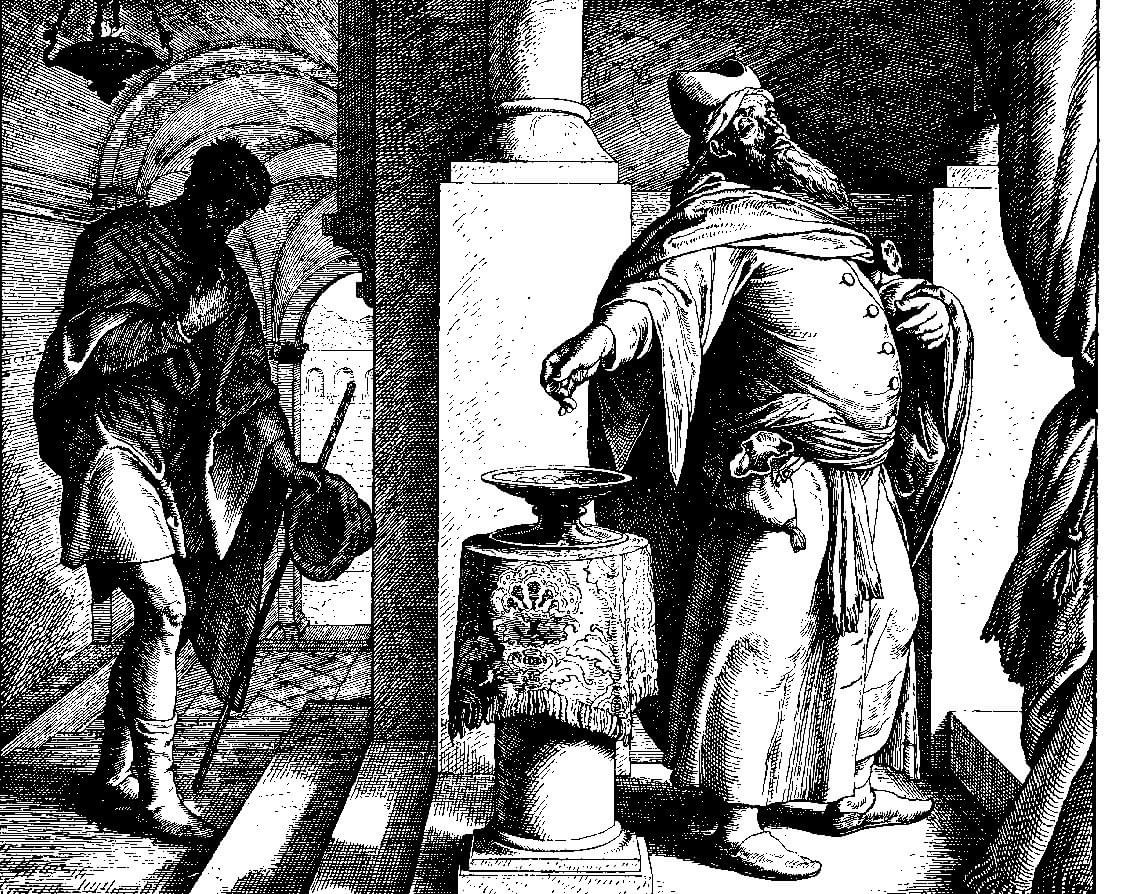 10 “Two men went up into the temple to pray, one a Pharisee and the other a tax collector. 11 The Pharisee, standing by himself, prayed thus: ‘God, I thank you that I am not like other men, extortioners, unjust, adulterers, or even like this tax collector. 12 I fast twice a week; I give tithes of all that I get.’ 13 But the tax collector, standing far off, would not even lift up his eyes to heaven, but beat his breast, saying, ‘God, be merciful to me, a sinner!’ 14 I tell you, this man went down to his house justified, rather than the other. For everyone who exalts himself will be humbled, but the one who humbles himself will be exalted.”
 The tax collector’s eyes of prayer are much different. He doesn’t look to heaven, and he doesn’t look at the sinners around him. He stands far off from the others, likely with his face to the floor, tears flowing down his cheeks, and beating his chest. He looks two places – at himself where there is no hope and to God where the only hope lies.
 When in the hour of deepest need
 Your heart has a wrong desire, and that false desire is conceived and eventually gives birth to sin. Then, when sin grows up, it brings forth death. Knowing this, we know Satan’s game plan. But it is helpful for us to see how the devil’s game plan plays out in real time, and we saw it in our Old Testament text (Gen. 3:1-21).
 When Eve looked at that fruit, she should have recognized, “That fruit is death.” Instead, she wrongly sees that it is to be desired to make one wise. This is the danger for us. There are things that are put in front of us and God says, “That’s bad, and it leads to death.” But instead of regarding those things according to God’s Word, we regard them according to how we see and think. We put ourselves over and above God and judge Him to be wrong. The devil entices us to think that God is the bad guy who is holding out on us, keeping us from having our heart’s desires. Then, we think we know better than God, and we fall for the temptation and into sin.
 Jesus has been fasting forty days and nights. I remember as a kid being hungry forty minutes after dinner. Jesus is famished. He is weakened by this fast. So, this temptation to turn stones into bread is a real temptation. The tempter again tries to exploit the gap between Jesus’ desires and what God has given. Jesus wanted food. Because He is man just like you and me, His stomach and His brain would have been screaming at Him, “Feed us!” But God has not yet given Jesus food. So Satan tries to get Jesus to take for Himself what God has not given.
 “to guard you in all your ways.” God the Father will protect Jesus in all His ways. But God didn’t send Jesus to earth to be some X-Games-temple-pinnacle jumper.
 So, dear saints, be wise. Know the devil’s attacks and tactics. The devil is going to use those tactics against you, but God has given you weapons against the devil, your flesh, and the world (1 Jn. 2:15-16). When the devil comes to tempt you, take up the weapon of prayer. Pray God’s Word and watch the devils flee. When your flesh tempts you, take up the weapon of fasting. If you are tempted to certain desires of your flesh, fast from those things. Tell your body, “Body, you aren’t in control.” And when the world tempts you with its vain riches, give. Be generous to the point that it makes you unable to afford falling into the temptations of this world.

You must be logged in to post a comment.