Romans 11:33–36
33 Oh, the depth of the riches and wisdom and knowledge of God! How unsearchable are his judgments and how inscrutable his ways!
34 “For who has known the mind of the Lord,
or who has been his counselor?”
35 “Or who has given a gift to him
that he might be repaid?”
36 For from him and through him and to him are all things. To him be glory forever. Amen.
In the name of the Father and of the Son and of the Holy Spirit. Amen.
If someone asked you to summarize who God is, how would you do that? How long would it take; how many words would you need? Maybe you would answer with one of the three Creeds. Hopefully you have at least one (the Apostles’) or two (the Nicene) of them memorized. The Athanasian Creed, which we just confessed, is probably the best summarization of who God is according the Scriptures, but I don’t know anyone who has that beast memorized. To answer the question, “Who is God?” with one of the three Creeds is probably the most concise way, and still, to be honest, it is only arrogance that says, “I can tell you exactly who God is.”
God’s judgements are unsearchable and His ways are inscrutable, or, as one of my favorite characters from The Princess Bride would say, “Inconceivable.” Thanks, Vizzini. 1 Timothy 6:16 says that God dwells in unapproachable light. So, to say we have a handle on Him is nothing short of arrogance.
We heard in our Old Testament text (Is. 6:1-7) when Isaiah saw God in the Temple the day he was called to be God’s prophet. Later, in Isaiah 40[:22], Isaiah gives us another image of what God is like. In that text, God isn’t high on the throne surrounded by seraphim and glorious in His holiness. No, there Isaiah tells us that God sits on the circle of the earth, and all the inhabitants are like grasshoppers.
As a kid, I remember catching many grasshoppers during recess on the playground at Rickard Elementary in Williston. Back then, my fourth-grade mind wasn’t very philosophical, but I wonder what those grasshoppers knew about me. At best, they knew two things. First, that I was strong and powerful enough to hold them, and second, that I could – if I wanted to – crush and destroy them. No, I didn’t do that. How much more can we, who are like grasshoppers before the triune God, know about the nature of God?
Isaiah continues on about us grasshoppers in ch 40, “Lift up your eyes on high and see who has created [everything; God has] brought out their host by number, calling them all by name; by the greatness of His might and because He is strong in power, not one is missing” (Is. 40:26).
The God who spoke into the void and created the universe bringing light and life is much more vast and powerful and complex than we could possibly imagine. One glance at the night sky shows God’s power; one peer at a blade of grass shows His intricacy. It’s no wonder that Isaiah concluded about God, “The nations are like a drop from a bucket and are accounted as dust in the scales…. All nations are as nothing before Him, they are accounted by Him as less than nothing and emptiness” (Is. 40:15, 17).
If this is true of all the powerful nations, vast kingdoms, and mighty empires of history, how much less significant are we singular individuals who get pushed and pulled along in the crowds and throngs of people throughout history? For most of us, the past three months have been the biggest reminder that our lives are constantly threatened. We have always guarded ourselves against things that would overwhelm us. When the threats of war, a global pandemic, murder hornets, riots, and random, violent acts are part of the daily and hourly news, we are reminded that our times are not in our own hands. Our times are in God’s hands.
Every person knows that there is a higher power (Ro. 1:20-21), and that we will have to give an account to our Creator. Our conscience constantly reminds us that we are answerable to our Maker, and before Him we all stand guilty. We rightly have every reason to be afraid of God because He expects more from us than we can ever give. God calls us to be holy as He is holy (Lev. 19:2). When we hear that, we, like Isaiah, cry out, “Woe is me; for I am lost!” Repent. Repent, but do not despair.
My fellow grasshoppers, God became a grasshopper just like you. Jesus, the eternal Son of God, shows you who God is and how God is. He came claiming to be God. He said things only God can say, did things only God can do, and accepted worship that belongs only to God. The Son of God came and confronted you as a Man. “The Word became flesh, and dwelt among us” (Jn. 1:14). The eternal, all-knowing, all-powerful, everywhere-present God was seen and heard and touched (1 Jn. 1:1-2).
So, fellow grasshoppers, to know Jesus is to know God and to know what God is like – at least as best as we can possibly know Him. God became a man, went to the cross, and took the wrath and punishment that you deserve. Jesus died for the ungodly; He died for you.
In Jesus, we see best what God is like. He loves you. Even though there was nothing lovable in you and me as sinners, He loved you so that He gave His only-begotten Son. That is love. God loves the sinful and unlovable who could do nothing in return is the truest and purest form of love. God died so that your sin, which separated you from Him would be set aside and forgiven so that you could be His own children.
Through Jesus, and through Him alone, God is your Father. He is the Way, the Truth, and the Life, and no one comes to God the Father except through Christ (Jn. 14:6). God is not your Father because He is your Creator. Even though atheists reject Him as Father and Creator, they still have Him as their Creator.
The good news for us grasshoppers is that God only has forgiven children. And through Jesus, the Son of God, we have forgiveness. To reveal this knowledge to us, God the Father and God the Son have given and sent God the Holy Spirit. The Holy Spirit doesn’t point you to Himself. He gets behind you and swings you around to behold Jesus in faith. As 1 Cor. 12:3 says, “No one can say that Jesus is Lord except by the Holy Spirit.” The Holy Spirit does His work through the Scriptures. Through the Word of God, the Holy Spirit is always active, getting hold of you, pointing you to Jesus, and making you the children of the Father.
So, to know God and know what the Holy Trinity is like is to see what God does. If you want to know the unknowable God, look to His actions. That’s the best way to get to know Him. See His actions, and most importantly see His action of redeeming you through Christ.
God is bigger than our understanding and bigger than His revelation of Himself to us. We understand Him even less than grasshoppers understand the fourth grader who holds them. Even though we are often confused and baffled by God, we are not in complete and fearful ignorance. Even though God has not shown us all of Himself – how could He? – He has shown us enough of Himself to show us that there is mercy and forgiveness for us sinners.
God makes Himself known to us through His Word and delivers Himself to us in His Sacrament. There He shows us what He is like and gives to us what we need because He gives us what Christ won and purchased for us.
Even though we cannot fathom all that He is, He has shows us enough of Himself and His nature that we can know that we have been saved through and by Him. God has shown us that in Him is mercy and forgiveness for us sinners. God is only found by His revealing of Himself. We cannot go to Him, but He comes to us – to you. He shows us what He is like and gives us what Christ has achieved. And we receive Him with thankful and faithful hearts. From Him and through Him and to Him are all things. To Him be glory forever. Amen.
The peace of God, which surpasses all understanding, will guard your hearts and minds in Christ Jesus. Amen.
 2Above him stood the seraphim. Each had six wings: with two he covered his face, and with two he covered his feet, and with two he flew. 3And one called to another and said:
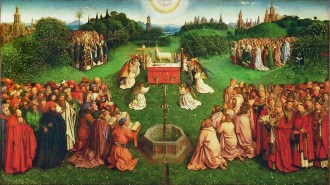 Hebrews 12[:22–23]tells us that there are many more here today than our eyes can see, “But you have come to Mount Zion and to the city of the living God, the heavenly Jerusalem, and to innumerable angels in festal gathering,and to the assembly of the firstborn who are enrolled in heaven, and to God, the judge of all, and to the spirits of the righteous made perfect.”

You must be logged in to post a comment.