John 10:11-16
11 “I am the good shepherd. The good shepherd lays down his life for the sheep. 12 He who is a hired hand and not a shepherd, who does not own the sheep, sees the wolf coming and leaves the sheep and flees, and the wolf snatches them and scatters them. 13 He flees because he is a hired hand and cares nothing for the sheep.
14 “I am the good shepherd. I know my own and my own know me, 15 just as the Father knows me and I know the Father; and I lay down my life for the sheep. 16 And I have other sheep that are not of this fold. I must bring them also, and they will listen to my voice. So there will be one flock, one shepherd.”
Alleluia! Christ is risen!
He is risen indeed! Alleluia!
In the name of Jesus. Amen.
 For our great comfort, Scripture gives many images of God shepherding His people. Psalm 23, of course, comes to mind. We have a picture in the entry of our church of Jesus walking through green pastures and still waters leading a flock of good-looking sheep. Jesus tells the parable of the shepherd who goes out seeking his one lost sheep, hefts it on his shoulders, and brings it home. All of that imagery is Scriptural and comforting and good.
However as comforting as all of that is, it not our Lord’s focus when Jesus calls Himself the ‘good Shepherd’ here. The people who heard Jesus say these words figured He was a lunatic. Their response down in v. 20 is, “He has a demon and is insane; why listen to Him?”
In Jesus’ day and even now, shepherds keep sheep for their wool or their meat. Shepherds put food on the table and a roof over the heads of their family by sheering and slaughtering sheep. In the ways of the world, a ‘good shepherd’ is someone who is successful in making money off of his sheep. Imagine a cattle rancher saying, “I am the good rancher. I love the cows. I like to go out and pet them. And I let them live to a good old age in the field while I go and die for the cows.” You would not call that rancher ‘good.’ You’d call him a fool and a lunatic.
Here’s where this is going: Our translation has Jesus saying, “I am the good Shepherd,”and we use the word ‘good’ to describe all sorts of things that aren’t actually good. Teachers might write ‘good’ on assignments or tests when a student has actually done poor work. Some fathers are sleazy fornicators and only spend time with their children when it is convenient for them while treating their children’s mother like trash. But single mothers might still call them ‘good’ dads even though they scumbags. The word ‘good’ can be vague and simply don’t cut it when we think of Jesus as the ‘good Shepherd.’
On the one hand, ‘good’ is a perfectly legitimate way to translate the word (the adjective) Jesus uses to describe Himself as the Shepherd. But the word that Scripture gives us is much deeper than our word ‘good.’ So, you get to learn a Greek word today. Jesus calls Himself ‘the καλός Shepherd.’
 Yes, it does mean ‘good’ but not in a subjective sense, not in a way that is open to anyone’s interpretation. Jesus is uniquely qualified to be the Shepherd of sinful sheep. Christ is the ‘good for you’ Shepherd. Kalos also means ‘right, fitting, true, beautiful, and competent.’ And Jesus Himself defines exactly what makes Him the kalos Shepherd. His the kalos Shepherd because of the fact that He lays down His life for the sheep.
In other words, Jesus, the kalos Shepherd, guards you, His flock, from the wolf no matter what. Jesus talks about the ‘hired hand’ who doesn’t own the sheep. A hired hand might not leave the flock if he sees a wolf way over there. In that situation, the hired hand might make a bunch of noise to scare away the wolf and save the flock he is watching over. A hired hand might even try to save the majority of the flock while a wolf picks off one or two sheep, and we’d still call him a good hired hand.
But Jesus, the kalos Shepherd, does something unimaginable. Jesus overcomes, defeats, and destroys the wolf by filling the wolf’s mouth with His own Body and thereby saves you from being lost and devoured by the wolf.
Right after our reading ends, Jesus goes on to say that the reason the Father loves Him is that He lays down His life for the sheep. Listen to this: Jesus says (v. 17-18), “For this reason the Father loves Me, because I lay down My life that I may take it up again. No one takes it from Me, but I lay it down of My own accord. I have authority to lay it down, and I have authority to take it up again. This charge (lit. “this command”) I have received from My Father.”
So, ask yourself, “If death cannot separate Him from me, what can?” If Jesus will go to the cross for you, and if Jesus will die for you, and if Jesus will come through death to be with you, He will always abide with you and will not leave you.
Hear this, you wandering sheep: When you had cut yourself off from God by your sin, Jesus, the kalos Shepherd, came down to die on the cross for you. Jesus could have run away like the hired hand, but He didn’t. If Jesus didn’t run away then, what would cause Him to run away from you now? The answer is nothing. There is nothing that will make Him throw up His hands and say, “Well, I’m done with that sheep.”
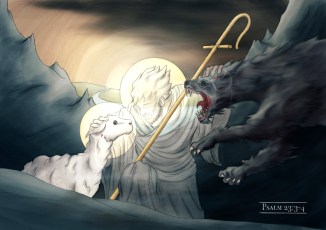 My dear fellow sheep: Jesus is the kalos Shepherd; you are the sheep. You are not called to stand toe-to-toe with the devil. Satan, sin, and death are the wolves, and you are the sheep. Hide behind Jesus. Christ, your kalos Shepherd, places Himself in danger to rescue you from every threat. But even as you hide behind your kalos Shepherd, you do not cower in fear. Hide behind Jesus confidently knowing that He has overcome the wolf, won the victory, and His victory is your victory because you are His.
Alleluia! Christ is risen!
He is risen indeed! Alleluia!
Amen.
The peace of God, which surpasses all understanding, will guard your hearts and minds inChrist Jesus. Amen.
 he showed them his hands and his side. Then the disciples were glad when they saw the Lord. 21 Jesus said to them again, “Peace be with you. As the Father has sent me, even so I am sending you.” 22 And when he had said this, he breathed on them and said to them, “Receive the Holy Spirit. 23 If you forgive the sins of any, they are forgiven them; if you withhold forgiveness from any, it is withheld.”
 Listen carefully: You don’t outgrow your need for the Gospel. Ever. There are many things that Scripture teaches that are important about how to live and function in this world, and all of us need to heed that instruction from the Word. But you don’t graduate from the pure spiritual milk of the Gospel. You never mature past the point of needing to hear about the peace that Jesus has won for you on the cross and which He preaches to His disciples in this text.
 Jesus is speaking about you. Christian, Jesus had you in mind when He spoke those words. You have not seen Your resurrected Savior in the flesh. You don’t see the marks in Jesus’ hands and side. Instead, you see crosses that remind you of the death that Christ died for you. You see the font where Jesus delivers to you His mercy and forgiveness and washes away your sins. You see an altar on which nothing has ever been sacrificed but which Jesus uses as His table to feed you His risen Body and Blood.
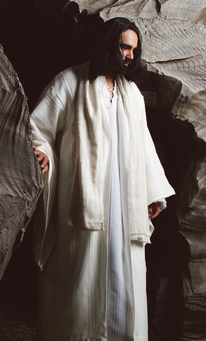 And you can smile in his face, “Yes, death, you used your sting, didn’t you? You should have used your sting on me. The sting would have stuck on me. But you didn’t. Instead, death, you used your sting on my Savior, my God, and my Lord. You used your sting on Jesus, didn’t you? You had Jesus pinned tightly on the cross, and you stuck Him with your stinger and buried it into Him. Death, you were a fool that day. You stung God Himself. You stung Jesus who is the Resurrection and the Life (Jn. 11:25). But when you went to the tomb to find your stinger and get it back, Jesus wasn’t there. And guess what, death, Christ has taken my sin as He hung on the cross. And, death, you will not ever get your sting back. Never. That empty tomb means that your sting is lost forever. Death, I don’t fear you any longer.”
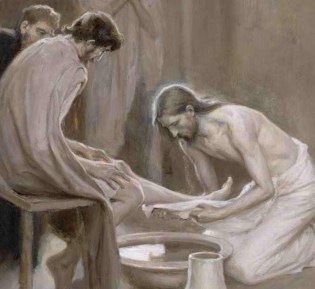 The Man whom Peter had confessed to be the Son of the living God (Mt. 16:16), the Man who had healed the sick, fed the masses, and raised the dead, the Head of all creation (Col. 1:15) kneels to wash Peter’s dirty, smelly feet.
 In your Baptism, Jesus has sprinkled clean water on you thus cleansing you from all your uncleannesses (Ezk. 36:25). In your Baptism, God has given you the new birth (Jn. 3:5), He has connected you to Jesus’ death and resurrection (Ro. 6:3-5), He has given you the washing of regeneration and the renewal of the Holy Spirit (Tit. 3:5).
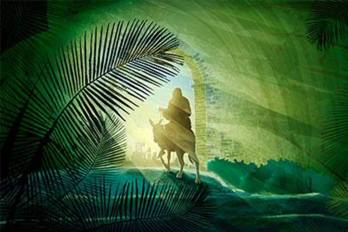 The main focus of Matthew’s Passion account we just heard is the royalty of Jesus. Christ rode into Jerusalem on a royal donkey just like King David and King Solomon (1 Kgs. 1:38) had done. But Matthew doesn’t focus on Jesus’ royal greatness or magnificence. Instead, Matthew focuses on King Jesus’ innocence. Matthew points us to King Jesus “the Innocent.”
 Jesus has arrived in Jerusalem. The Priest has come to the Temple. The Prophet has come to Mt. Zion. The King has come to His city. But most importantly the Lamb of God has come to His altar, where He would in five days breathe His last and pour out His blood for you (Pr. Wolfmueller). This is your Lord’s Passion, done and completed for you. Amen.
 Or my favorite, the boy standing in the middle of the room with his eyes closed tight. (To my great shame, I learned closing your eyes doesn’t make you invisible when I was in fourth grade.) Silly kids.
 Jesus stood in the middle of people who have been looking for a reason to kill Him for almost His entire ministry (Mk. 3:6). Today, Christ declares Himself to be no less than Almighty God. When He declares Himself to be the great I Am, Jesus announces that He is the One who is Lord over all things, and the One who always was, always is, and always will be, the One who spoke to Moses from the burning bush, the One who led their ancestors through the Red Sea on dry ground, the One whom Isaiah saw in the Temple.
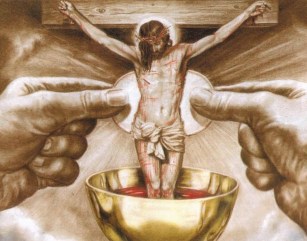 All of that is hidden so that you do not have to face it. It is hidden so that you do not need to hide.

You must be logged in to post a comment.