Today, at Christ the King, we had our first Stewardship Sunday. This sermon is slightly shorter for that reason. The presentation/catechesis on Biblical Stewardship will be available later.
Luke 10:23-37
23 Then turning to the disciples he said privately, “Blessed are the eyes that see what you see! 24 For I tell you that many prophets and kings desired to see what you see, and did not see it, and to hear what you hear, and did not hear it.”
25 And behold, a lawyer stood up to put him to the test, saying, “Teacher, what shall I do to inherit eternal life?” 26 He said to him, “What is written in the Law? How do you read it?” 27 And he answered, “You shall love the Lord your God with all your heart and with all your soul and with all your strength and with all your mind, and your neighbor as yourself.” 28 And he said to him, “You have answered correctly; do this, and you will live.” 29 But he, desiring to justify himself, said to Jesus, “And who is my neighbor?”
30 Jesus replied, “A man was going down from Jerusalem to Jericho, and he fell among robbers, who stripped him and beat him and departed, leaving him half dead. 31 Now by chance a priest was going down that road, and when he saw him he passed by on the other side. 32 So likewise a Levite, when he came to the place and saw him, passed by on the other side. 33 But a Samaritan, as he journeyed, came to where he was, and when he saw him, he had compassion. 34 He went to him and bound up his wounds, pouring on oil and wine. Then he set him on his own animal and brought him to an inn and took care of him. 35 And the next day he took out two denarii and gave them to the innkeeper, saying, ‘Take care of him, and whatever more you spend, I will repay you when I come back.’ 36 Which of these three, do you think, proved to be a neighbor to the man who fell among the robbers?” 37 He said, “The one who showed him mercy.” And Jesus said to him, “You go, and do likewise.”

In the name of Jesus. Amen.
Too often, when we hear the summary of the Law, “Love the Lord with all your heart, soul, mind, and strength. And love your neighbor as yourself,” we see it as setting up an order of operations. First, love God; then second, love neighbor so long as it doesn’t conflict with loving God. That is the attitude the priest and the Levite had in the parable.
According the laws of Moses, they needed to protect themselves from becoming unclean. If they helped the man in the ditch, they might defile themselves by touching a dead person and not be able to do their priestly functions. They are essentially saying to themselves, “I feel bad for this poor guy. I will pray for him. But if I go over there and help him, I won’t be able to do the sacrifices or declare people clean and free from sin. And I have been called by God to be faithful in those works. So, if I go help this guy, I might become unable to do those things, I will be unfaithful to God.”
The priest and Levite were convinced that they couldn’t help their neighbor because they had a higher obligation to love God. Too often, we think the same way.
We avoid people who are addicted to drugs or alcohol because Scripture tells us to avoid the appearance of evil (1 Thess. 5:22), and we don’t want to tarnish our reputation as a good Christian by being around people who have vices. When people are cruel and angry because they have been absolutely broken, we avoid them because they bring out the worst in ourselves. However, we should be going out of our way to love and befriend them and earn their trust. But we don’t do that because we think we have a higher duty to God to keep ourselves righteous so we try to maintain a safe distance from people who might make us to become unrighteous and jaded.
But one of the things Jesus shows us in the parable of the Good Samaritan is this misunderstanding between loving God and loving our neighbor. This parable is a nice explanation of what we are told in 1 John 4:20 which says, “If anyone says, ‘I love God,’ and hates his brother, he is a liar; for he who does not love his brother whom he has seen cannot love God whom he has not seen.” Love of God and love of neighbor are never in conflict with each other. God wants us to show our love for Him by loving our neighbor.
We have called today “Stewardship Sunday,” and we have had a lot of focus on what God’s Word has to say about our tithes and offerings. And this text has something to say about our giving to the church as well. Just as loving our neighbor does not conflict with loving God, loving God does not conflict with loving our neighbor either.
I might be wrong on this, but I would venture to guess that the prevailing attitude about giving to the church is seen as fulfilling the first of the two great commandments – to love God. And very often, we think giving to the church is not seen as fulfilling the second – to love our neighbor. At least, this is a common accusation of the world against the church, and I don’t think we are immune to those accusations.
Maybe, you have seen different threads on social media that pop up from time to time which basically say, “If money is the root of all evil, why do they keep asking for it in church?” Never mind the fact that they aren’t quoting Scripture correctly. The verse (1 Tim. 6:10), says, “The love of money is the root of all kinds of evils…”
But also, the world will say that Christians are hypocrites because giving to the church means they don’t care about the hungry and poor. They’ll say that Christians are so busy loving God by giving money to the church that they are refusing to love their neighbor. But there is no conflict between the two.
Scripture says that all have sinned and fallen short of the glory of God. Every neighbor you come into contact with is a sinner. And what do sinners need most? Even if they are naked and starving, sinners’ greatest need to hear the Gospel. They need to hear the Word preached. They need the Sacraments. They need to be pointed to Jesus Christ, the Lamb of God who takes away the sin of the world. In other words, they need the Church.
So, Christian, see what you are doing when you give to the church. You are doing exactly what the Good Samaritan did in the parable. You are providing for the continual care of those whom Christ has redeemed. Remember, the Good Samaritan gave the innkeeper money to care for the robbed man and promised to return and pay off any expenses that weren’t covered by his initial two denarii.
After the parable concluded, Jesus asked the lawyer, “Who proved to be a neighbor to the man who fell among the robbers?”And the lawyer rightly responded, “The one who showed him mercy.” And Jesus said, “You go, and do likewise.”
Have mercy and compassion on your neighbor by making sure that they have the blessing of seeing what you see and hearing what you hear. Make sure they have a place where they can go to hear of Jesus. Where they can have their wounds bound up by Christ’s absolution. Where they can have the oil and wine of the Sacraments poured on their sinful scars. Where they can recover in the inn of the church.
Christian, you go, and do likewise. Do this, but don’t ever draw strength and assurance by how well you have loved your neighbor. Instead, draw strength to love your neighbor by how God Himself has loved and cared for you.
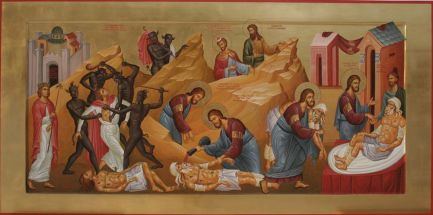 Because, first and foremost, the parable of the Good Samaritan is a picture of what Jesus has done for you. Jesus, and Jesus alone, is the Good Samaritan who has compassion. He left His throne in the glory of heaven to become your neighbor. He risks His own safety while scoundrels and robbers are roaming about. He stops to give you aid. He pours on you oil and wine. He gives up His own comfort and convenience to bring you to the inn of the holy Christian Church. And Jesus sets up an all-expenses-paid stay there promising to return. Jesus is the one who has and continues to show you mercy. Amen.
The peace of God, which surpasses all understanding, will guard your hearts and minds in Christ Jesus. Amen.
Additional thoughts on the text that were removed from the sermon:
You can’t do something to gain an inheritance. All Scripture shows that God’s people do not inherit eternal life by doing something. As our Epistle Text (Gal. 3:15-22) said, the inheritance of eternal life has always and will always come through the promise of God. The lawyer knew this. He knew exactly what he must do to have eternal life. Love God perfectly and love his neighbor perfectly which is exactly how Jesus Himself sums up the Law (Mt. 22:34-40). Jesus tells the lawyer, “Bingo! Do this, and you will live.”But Jesus might just as well have said, “Yup. Go to hell.”
And the lawyer gets it. He sees how he is stuck in his sin. The Law has exposed him for the wretched sinner that he is. The Law has left him scared and confused because he doesn’t know the Gospel. He wants an out and clamors for a loophole. He asks, “Well, who is my neighbor? Whom should I love?”
But every Sunday school student knows the answer. “Who is my neighbor?” Everyone. “Whom should I love?” Everyone and without fail. But Jesus doesn’t tell the parable to answer the question, “Who is my neighbor?” Jesus tells the parable to change the question to get the answer He wants. The point of the parable is not to teach us to love everyone. Scripture teaches that all over the place but here, not in this parable.
Instead, Jesus tells the parable because He wants to show the lawyer and you hope. Jesus wants to show you what God mercifully does for you. He wants your eyes to see and your ears to hear the Gospel.
 32 And they brought to him a man who was deaf and had a speech impediment, and they begged him to lay his hand on him. 33 And taking him aside from the crowd privately, he put his fingers into his ears, and after spitting touched his tongue. 34 And looking up to heaven, he sighed and said to him, “Ephphatha,”that is, “Be opened.” 35 And his ears were opened, his tongue was released, and he spoke plainly. 36 And Jesus charged them to tell no one. But the more he charged them, the more zealously they proclaimed it. 37 And they were astonished beyond measure, saying, “He has done all things well. He even makes the deaf hear and the mute speak.”
 Groaning, however, is an involuntary response to being hurt or wounded. Every time the New Testament uses this word ‘groan’ it is from sorrow or suffering because of sin. And, in the New Testament, only four things groan – creation groans, believers groan, the Holy Spirit groans, and Jesus groans twice.
 And He no longer groans in pain when He does it. The price has been paid. Your forgiveness has been purchased and won on the cross.
 10 “Two men went up into the temple to pray, one a Pharisee and the other a tax collector. 11 The Pharisee, standing by himself, prayed thus: ‘God, I thank you that I am not like other men, extortioners, unjust, adulterers, or even like this tax collector. 12 I fast twice a week; I give tithes of all that I get.’ 13 But the tax collector, standing far off, would not even lift up his eyes to heaven, but beat his breast, saying, ‘God, be merciful to me, a sinner!’ 14 I tell you, this man went down to his house justified, rather than the other. For everyone who exalts himself will be humbled, but the one who humbles himself will be exalted.”
 The parable does teach that the worst of sinners can go to heaven. We know this, but unfortunately, we can grow a little numb to this. But the main reason Jesus tells this parable is to destroy any self-righteousness and contempt we would have against other sinners.
 Dear saint, you look there too. Look to the cross. Look to the blood of Jesus shed for you on Calvary. Look to His death. Look to His resurrection. Look to His ascension. And know that Jesus promises that all of that is for you.
 Three times the English word ‘gifts’ came up in this text, but in Greek, Paul uses two different words that get translated as ‘gifts.’ Twice the Greek word is χάρισμα (which is singular and the plural is χαρίσματα – I’m going to try to be grammatically correct through the sermon). Χάρισμα is where we get our word ‘charismatic.’ Inv. 4, “there are varieties of gifts/χαρίσματα,” and in v. 9, he mentions the “gifts/χαρίσματα of healing…” But in v. 1, Paul uses a different word that gets translated as ‘spiritual gifts’ or ‘spiritual things.’
 According to our text (v. 4-7), these various gifts are given through the Holy Spirit, but the Holy Spirit doesn’t ever work alone; instead, the entire Trinity is involved. These various gifts are given by the Spirit; the varieties of service are given by the same Lord, Jesus Christ, the Son; and the varieties of activities are empowered by the same God (think Father) who empowers them all in everyone. We don’t determine what gift we receive, it’s up to our Triune God. And God will provide whatever we need to fulfill our Christian duty to our neighbor.
 Do you believe in Christ’s death and resurrection for the forgiveness of your sins? Do you trust that His blood has covered all your iniquities and transgressions? If so, praise God! Then ask, “What is my vocation/station in life? What am I called to do right now?” “What do I need now as a mother?” “What do I need now as a husband?” “As a child?” “A student?” “A customer?” “A citizen?” God has called you to those vocations and He won’t leave you in a lurch. He will give you the gifts you need. In every moment of every day, you have a particular relationship to someone else, so you are called to be God’s representative in that moment. So, ask God to give you what you need to fulfill that vocation.
 This reduction was, of course, not legally binding. The rich man could have simply said, “Hang on everyone. I fired that guy before he lowered your debt. You still owe the original amount.” But that isn’t the character of the rich man. Instead, the whole town is singing the praises of the rich man because he is so generous. And the rich man isn’t willing to harm his reputation as a merciful guy. So, what does the rich man do in the parable? He tells the fired, scoundrel of a manager, “Dude, you’re shrewd. You knew I’d rather be known as a merciful person rather than hold on to my wealth. And by your shrewdness, you’ve helped yourself.”
 Now, Jesus is absolutely clear, “You cannot serve God and money.”It can’t be done. If you trust in money, you do not trust God. So, repent of your love of money.
 The only thing that matters for your salvation is what Christ has done and completed for you upon the cross. Even when you are stingy and fail to be generous with what God has given to you, God was not. He gave what was most valuable to Him for your salvation. God, in His mercy, gave Jesus to die upon the cross for you. Don’t trust in your stewardship of what God has given you. Instead, trust in Christ’s giving of Himself completely for you and for others. Amen.
 Out of that conversation came creation, and most importantly, out of that conversation came the creation of humanity. We get to hear that conversation in Gen. 1:26 where the Triune God says, “Let Us make man in Our image, after Our likeness.” It was so, and it was good – very good.
 One of the most amazing things is that God even gives His prophets a seat and a voice in this council. You remember when God was going to destroy Sodom and Gomorrah, and Abraham speaks up and gets God to agree to not destroy the cities if ten righteous people are found there (Gen. 18:22-33). Or, when God is going to destroy the Israelites for making the golden calf, Moses speaks up in the council and says, “God, if You go down and destroy them, the Egyptians will say that You only brought them out of slavery to destroy them.” And God relents of the disaster He had said He would bring on the people (Gen. 32:1-14).
 Now, Jesus has ascended to the right hand of the Father. Today, your Savior is talking with the Father, your Creator, and with the Holy Spirit, your Sanctifier. And do you know what they are talking about? They are talking about you and the cross. They are talking about how Jesus won your salvation there. How His blood shed there made a place in heaven for you forever. And the Holy Spirit is there, translating your prayers and interceding for you with groanings too deep for words (Ro. 8:26). The Holy Spirit whispers into your ear that you are an adopted child of God and heir with Christ. And you respond by crying, “Abba, Father” (Ro. 8:12-17).
 Our English word ‘desolation’ contains the word ‘solo,’ and that gives a sense of what ‘desolation’ means. Adam and Eve went solo. Rather than trusting God, they went solo and trusted the devil’s lie bringing sin, death, condemnation, and desolation into the world.
 Look at what Jesus, God in the flesh does – notice the verbs. He calls the disciples. Jesus directs the crowd to sit down. He takes the bread. Christ gives thanks for the bread. He breaks the bread. He gives the bread to the disciples to set before the people. Jesus blesses the fish. He gives the fish to the disciples to set before the people. And Jesus watches them all eat until every last one of them is satisfied. Jesus continues to do this for us today.
 19 Therefore whoever relaxes one of the least of these commandments and teaches others to do the same will be called least in the kingdom of heaven, but whoever does them and teaches them will be called great in the kingdom of heaven. 20 For I tell you, unless your righteousness exceeds that of the scribes and Pharisees, you will never enter the kingdom of heaven.
 Sure, you aren’t Lady Macbeth yelling at the blood of Duncan to wash off your hands, but you are guilty of murder before God. You have been angry with others. You have called others, “Fool.” You have held grudges. You have refused to ask your neighbor for forgiveness. And Jesus goes on to the other Commandments as well – lust is adultery and fornication, gossip is perjury, etc.
 The Law should never be allowed to access into your ‘How do I stand before God?’ room, your ‘Am I good enough to go to heaven?’ room, your ‘Does God love me?’ room, your ‘Does God think I am a good person?’ room, or your ‘assurance of salvation’ room. The Law should never be allowed to enter those rooms because Jesus has made you as good and as righteous and as perfect as He is.
 And behold, there came a voice to him and said, “What are you doing here, Elijah?” 14 He said, “I have been very jealous for the Lord, the God of hosts. For the people of Israel have forsaken your covenant, thrown down your altars, and killed your prophets with the sword, and I, even I only, am left, and they seek my life, to take it away.” 15 And the Lord said to him, “Go, return on your way to the wilderness of Damascus. And when you arrive, you shall anoint Hazael to be king over Syria. 16 And Jehu the son of Nimshi you shall anoint to be king over Israel, and Elisha the son of Shaphat of Abel-meholah you shall anoint to be prophet in your place. 17 And the one who escapes from the sword of Hazael shall Jehu put to death, and the one who escapes from the sword of Jehu shall Elisha put to death. 18 Yet I will leave seven thousand in Israel, all the knees that have not bowed to Baal, and every mouth that has not kissed him.”
 Listen again to Elijah’s response, “Listen God, I’ve been very jealous for You. I’ve done what You have commanded. But Your people have forsaken Your covenant. They have thrown down Your altars. And they have killed Your prophets with the sword. I’m the only faithful one left, and they are out to kill me as well.” Elijah’s response makes it sound like God had lost and that Baal had won. His answer makes it seem like no rain had fallen, and as though God had failed.
 God will continue to defeat His enemies by raising up faithful believers from the offspring of His enemies. Scripture doesn’t promise that the Jezebels of our day will fall before our eyes. In fact, it is very likely that the voices of Jezebel will continue to grow stronger in our culture and society.
 To get an understanding of this, we are going to start by considering what happened in our Old Testament text (Gen 50:15-21) where we heard about what happened between Joseph and his brothers after their father has died. Joseph’s brothers were afraid that Joseph would punish them because of all the wrong things they had done.
 But, Christian, this passage of Scripture is telling you that there is something even better in store for you than the end of your suffering – whatever has caused it. Paul writes in 1 Cor. 15:19, “If in Christ we have hope in this life only, we are of all people most to be pitied.” Dear saint, when you suffer, you do not simply look to the end of your pain. Instead, you are to look to the glory that is to be revealed to you. And, in fact, all of creation is groaning for this as well.
 Dear saints, the same is true of you. In Christ, God has done all the work required to give you your glory. And the day is coming when you will hear your heavenly Father’s voice, praising you for the work He has done in you (Mt. 25:21).
 Pastorsamwise
You must be logged in to post a comment.