The Last State – Sermon on Luke 11:14-28 for the Third Sunday in Lent

Listen here.
[Apologies for the poor quality of this recording, we had some known technical issues.]

Luke 11:14-28

14 Now he was casting out a demon that was mute. When the demon had gone out, the mute man spoke, and the people marveled. 15 But some of them said, “He casts out demons by Beelzebul, the prince of demons,” 16 while others, to test him, kept seeking from him a sign from heaven. 17 But he, knowing their thoughts, said to them, “Every kingdom divided against itself is laid waste, and a divided household falls.18 And if Satan also is divided against himself, how will his kingdom stand? For you say that I cast out demons by Beelzebul. 19 And if I cast out demons by Beelzebul, by whom do your sons cast them out? Therefore they will be your judges. 20 But if it is by the finger of God that I cast out demons, then the kingdom of God has come upon you. 21 When a strong man, fully armed, guards his own palace, his goods are safe; 22 but when one stronger than he attacks him and overcomes him, he takes away his armor in which he trusted and divides his spoil. 23 Whoever is not with me is against me, and whoever does not gather with me scatters.

24 “When the unclean spirit has gone out of a person, it passes through waterless places seeking rest, and finding none it says, ‘I will return to my house from which I came.’ 25 And when it comes, it finds the house swept and put in order. 26 Then it goes and brings seven other spirits more evil than itself, and they enter and dwell there. And the last state of that person is worse than the first.”

27 As he said these things, a woman in the crowd raised her voice and said to him, “Blessed is the womb that bore you, and the breasts at which you nursed!” 28 But he said, “Blessed rather are those who hear the word of God and keep it!”

In the name of the Father and of the Son and of the Holy Spirit. Amen.

These first few Sundays in Lent have a strong focus on spiritual warfare. And here Jesus is teaching us very pointedly that there is no neutral ground spiritually – there is no spiritual Switzerland. Christ says, “Whoever is not with Me is against Me, and whoever does not gather with Me scatters.”In other words, if you are not in league with Jesus and fighting againstthe devil, you are fighting with the devil.

To strengthen and encourage us in the battle, Jesus tells two short parables in this text. The first parable (in v. 21-22) describes the new reality in this world. And we have to understand this first parable because it lets us know the playing field. Jesus says, “When a strong man, fully armed, guards his own palace, his goods are safe; but when one stronger than he attacks him and overcomes him, he takes away his armor in which he trusted and divides the spoil.”

We heard about the Fall a few weeks ago. Adam and Eve brought sin into the world by rebelling against God and believing the devil rather than their Creator. When Adam and Eve fell, the devil entered his palace and the kingdom of darkness began. Satan now owned them and everyone who would be born from them – that is all of us. The armor of the devil that Jesus talks about is our sin, our guilt, and our shame. And, according to Jesus, the devil trusts in that armor. Satan thinks that because your sin and guilt is so great that he is immune from invasion and attack. He thinks his palace is impenetrable and that you are safely in his possession forever.

But Satan is wrong. Jesus, the stronger man, has stormed the devil’s castle. Christ attacked him and overcome him. Your Savior has taken away the armor that the devil thought protected him, what the devil trusted, what he thought would always be there – this is the most important part of the parable. Jesus has removed your sin, guilt, and shame which was the devil’s armor. And the devil is now weak and extremely vulnerable.

But the spiritual battle is still ongoing. The demons are defeated but they still fight against us even though they have no power and no armor. And this is what Jesus addresses in the second parable (v. 24-26). Jesus says that when a demon has gone out of a person – in other words, when someone becomes a Christian, when a person is Baptized, when they are given the gift of faith in Christ and have the Holy Spirit – that demon passes through waterless places seeking rest because it has been expelled. The demon doesn’t like that. The demon would rather be connected to that person.

Now, I need to make a quick distinction between demon possession and demon oppression. In the Gospels, we often see people who are actually possessed by demons. In cases of demonic possession, demons live inside that person and can make them mute (like in this text), throw people into fires (Mk. 9:22), or cut themselves and make them live among the tombs (Mk. 5:2-5). That is demonic possession. But just because someone isn’t possessed by a demon does not mean that they are not influenced or oppressed by demons. The main point is that you are either going to be influenced by a demon or the Holy Spirit.

So, most of you became Christians when you were baptized. The Holy Spirit came and removed the demons and their oppression from you. And those demons wander around seeking rest, but they find none. So, they come back to you, the house from which they were cast out. If that demon finds you swept and put in order, it will come back and bring seven more demons even more evil than itself and the last state is worse than the first.

So, here is the picture Jesus gives, Christian. When you came to faith, Christ drove the demons away from you, but those demons have had their eye on you ever since. They have been watching you to seek reentry. If the demon comes back and finds your house clean and (as Jesus says in the same context in Mt. 12:44) empty, it moves back in and throws an evil, sinister party, and again the last state is worse than the first.

Remember, you are either with Jesus or with the devil and demons. There is no neutral ground. Christian, as you live out your faith and devote yourself to God’s Word, Satan and the demons have no power over you. Jesus, the stronger man is with you. The Holy Spirit has filled you and the demons cannot stand the presence of His holiness. But, if you stop filling yourself with God’s Word, if you neglect the work of the Holy Spirit, you can evict Him. You can fall away. Beware and repent.

The most effective strategy, in fact the only strategy, the devil has against you is to make you think that you don’t need Jesus and His blood shed for the forgiveness of your sins. And the way that the devil does this is to harden your conscience against God’s Word. So, guard your conscience, and actively work to soften your conscience so that when you hear God’s Word, you are driven to your Savior’s mercy and grace.

Let me give you an analogy to make this point. The last few weeks, we’ve finally had temperatures above freezing. Compared to the temperatures that we had in January and February what were in the -20’s, it feels really nice. So now, when the thermometer hits 38°, our bodies are ready go out without coats, or at least much lighter coats. In the Spring 38° is glorious. But when August comes and we are used to the heat of summer, 38° makes bodies feel bitterly cold. Your conscience is similar.

Imagine each of the Commandments as a thermometer, and for this example, let’s take the 5thCommandment, “Thou shalt not murder.” Instead of numbers marking the side of the 5thCommandment thermometer, there are different sins that all fall under the 5thCommandment. Way up at the top you have a mark for genocide. A little blow that is a mark for mass murder. A little below that you have a mark for murder, then punching. And because Jesus teaches us that hatred for our neighbor is the same as murder (Mt. 5:21-22) you have a mark for that way down toward the bottom. You get the idea?

Now, all of those sins – from genocide all the way down to anger – all of them make us guilty before God. We need the shed blood of Jesus to cover all of those sins, and know, Christian, that you have that. But you still have to fight against your sinful nature in this life.

So, just think with me here, where does your conscience register on the 5thCommandment thermometer? Maybe, you are somewhere between the marks of punching and anger. The devil and the demons are at work tempting you to harden your conscience. But they don’t tempt you straight to commit genocide. Instead, they tempt you just a little higher than you already are. They tempt you to more anger. They tempt you to punching and violence. And once they have you there, they tempt you to harden yourself a little more, to go up another little step. And they do this with all the Commandments – with adultery and lust, with stealing, and lying.

But you, Christian, you need to be constantly working to soften your conscience. Let me switch to the 3rdCommandment about keeping the Sabbath holy. You’re a Christian, so going to church is simply what you do each Sunday morning. The devil isn’t going to come straight at you and say that going to church isn’t important at all. Instead, the devil will work like this:

Let’s say that one Sunday you were very legitimately sick, so you don’t go to church, but you feel bad about it in your conscience. The devil is right there telling you, “You don’t need to feel bad. You were sick, and it’s better to not risk getting other people sick. So, don’t feel bad. You listened to the sermon later, and it was boring anyway.” And so, you decide to put that little feeling of guilt and loss away. The devil has just hardened you a little bit. So, when a couple of months go by, and you wake up with a headache – something that isn’t going to get passed around to anyone else – the devil will tempt you to skip church again. A little more hardened. Then, you have that family reunion and nothing bad happened when you skipped church because of your headache – God didn’t send a bolt of lightning to smite you. And the Bible says that family is important, so you skip for that. Hardened again. The devil’s goal is to make going to church seem like one option among many options so that being in God’s house becomes nothing more than a matter of choice so that your last state is worse than the first.

Repent. Now, I do have to say that it’s not as though you should carry around guilt for missing church when you have the flu and try to do penance or something like that. No. Jesus loves you. He has disarmed the devil. He has removed your guilt, and Christ forgives you all of your sin. He remembers your sin no more. What I am saying is this: don’t give the devil a foothold. Resist his temptations to harden your conscience.

You do that by memorizing the Ten Commandments and meditating on them. Consider each of them and what Jesus says about them in the Sermon on the Mount (Mt. 5-7). In this way, your house, which is your heart, does not remain empty. Rather you are filled with the Holy Spirit through the study, consideration, and meditation of God’s Word. In this way, may your last state be better than the first. Amen.

The peace of God, which surpasses all understanding, will guard your hearts and minds in Christ Jesus. Amen.

The Second & Third Commandments: God’s Name and Word

Listen here.

In the name of the Father and of the Son and of the Holy Spirit. Amen.

Last week, we began our journey through the Ten Commandments with the 1stCommandment, “Thou shalt have no other gods before Me.” It is important for us to remember there that God is giving us the gift of Himself as our God. He wants us to fear, love, and trust Him above all things. He wants us to let Him, and Him alone, be our God because He has promised and given us His steadfast love and mercy.

Tonight, we consider the 2nd and 3rd Commandments which completes what is usually called the “first table” of the Law.

Before I get into the 2nd and 3rd Commandments, I want to mention something about how the Ten Commandments are numbered. Scripture gives us the Commandments twice (Ex. 20:1-17and Dt. 5:6-21). If you simply took all the things that God said in those texts, you would probably come up with at least eleven commandments (if not twelve commandments). But in Exodus 34:18and a couple other verses (Dt. 4:13& 10:4), you see that God calls them the Ten Commandments (lit. ‘Ten Words’). When God gives the Commandments in Deuteronomy, the commandments about coveting – house; wife, workers, cattle, etc. – are reversed, so we know that the way we number them doesn’t matter too much.

The most important thing is to have ten of them and make sure all God’s words are included. The way we Lutherans have them ordered works nice because the first three deal with our love for God and the last seven deal with our love for our neighbor.

One more thing before we get into the 2ndCommandment: When we think of sin, we think some sins are greater than others. Our conscience (which is good, but we have to remember that our conscience is fallen and doesn’t always work the way it should), our conscience will tell us lying isn’t as bad as stealing which isn’t as bad as murdering. A lot of times, our conscience doesn’t even register sins against the first three Commandments – even though it should. Hopefully, this sermon will convict us and help us to be more mindful of our sins against God so that we cry out to Him for His mercy and forgiveness won for us by Jesus on the cross. And I pray that this sermon will show us what great gifts we are given in the 2ndand 3rdCommandments.

The 2nd Commandment
Thou shalt not take the Name of the Lord thy God in vain; for the Lord will not hold him guiltless that taketh His Name in vain.

What does this mean?
We should fear and love God so that we do not curse, swear, conjure, lie, or deceive by His Name, but call upon Him in every time of need and worship Him with prayer, praise, and thanksgiving.

In the 2ndCommandment, God gives us the gift of His name to use in prayer.

God does not want us to misuse His name this is very true. The Jews were so careful about God’s name that they wouldn’t even speak His name. And too often we think that if we don’t go around saying, “Oh my God,” all the time that we have kept this Commandment. We are wrong.

God does not want us to misuse His name, but He does, in fact, want us to use His name properly.

When I was in Bible school, I somehow got the responsibility of keeping the pop machine in the men’s dorm stocked. The year was coming to a close, and I was asked to teach another student how to do it so he could take over the following year after I graduated. The pop was stored in a closet that was locked and had a sliding door. As I was showing him the process, we went to get more pop, but the door had gotten jammed in the tracks. I hefted and jerked and pulled, but I couldn’t get the door to open. I was getting really frustrated.

This little guy (he was from a foreign country) stepped in between me and the door and said, “In the name of Jesus,” right before he yanked on the handle. I remember thinking to myself, “This poor guy. God doesn’t care about a door that is guarding pop.” But do you know what? The door opened. And I was convicted. Here was a need, minor as it was, and his little prayer was answered.

Here’s the point. God wants you to use His name. God wants you to call on Him whenever you face trouble, and He wants you to use His name to praise Him whenever you have joy.

I would encourage you to make it a habit that when you have a need – no matter how big or small it is – to at least pray, “Lord, have mercy.” God hears that prayer and answers it. And whenever something good happens, pray, “Thanks be to God.” Both of these help you use God’s name correctly.

The 3rd Commandment
Remember the Sabbath day, to keep it holy.

What does this mean?
We should fear and love God so that we do not despise His Word and the preaching of the same, but regard it as holy and gladly hear and learn it.

In the 3rdCommandment, God gives us the gift of His Word which makes us holy.

Sabbath means ‘rest.’ That is why that day is called the Sabbath because God rested from His work in creation. And holy means ‘set apart.’

The main word, the main focus, in this Commandment is ‘holy.’ If simply resting was the main thing in this Command, then taking a nap makes you holy or sleeping in on Sundays and missing church would be a good work. Some Christians will take this Commandment to mean that you shouldn’t put gas in your car on Sunday so businesses will stay closed, or some will say that you should not mow your lawn on Sunday because you are doing work. But resting and not working is not the point of this Commandment. If it is, pastors are constantly breaking this Commandment because, of course, they only work on Sundays.

The main point of this Commandment is rather to set apart a day for holy things. As Christians, we keep this Commandment on Sundays instead of Saturdays (when it originally was) because we weekly celebrate the Resurrection of Jesus.

The most holy thing we have is God’s Word. 1 Timothy 4:4-5says that everything is made holy by the Word of God and prayer. So in this Commandment, God wants you to set apart, to make holy, a day where He makes you holy through His Word.

Jesus did many miracles on the Sabbath day because He came to restore what sin has broken in this world. He made people holy and whole by a simple Word from His mouth. Jesus still does this today. He invites you to come here and hear His Word which makes you holy.

As His people, may we repent of our lack of prayer and our indifference toward His Word. And may we honor His name by receiving what He freely gives us – His mercy and forgiveness won on the cross. Amen.

The peace of God, which surpasses all understanding, will guard your hearts and minds in Christ Jesus. Amen.

Yes, Lord – Sermon on Matthew 15:21-28 for the Second Sunday in Lent

Listen here.

Matthew 15:21-28

21 And Jesus went away from there and withdrew to the district of Tyre and Sidon. 22 And behold, a Canaanite woman from that region came out and was crying, “Have mercy on me, O Lord, Son of David; my daughter is severely oppressed by a demon.” 23 But he did not answer her a word. And his disciples came and begged him, saying, “Send her away, for she is crying out after us.” 24 He answered, “I was sent only to the lost sheep of the house of Israel.” 25 But she came and knelt before him, saying, “Lord, help me.” 26 And he answered, “It is not right to take the children’s bread and throw it to the dogs.” 27 She said, “Yes, Lord, yet even the dogs eat the crumbs that fall from their masters’ table. 28 Then Jesus answered her, “O woman, great is your faith! Be it done for you as you desire.” And her daughter was healed instantly.

In the name of the Father and of the Son and of the Holy Spirit. Amen.

I told you at the beginning of the service, but do you remember what this Sunday is called? Yes, Remember Sunday (in Latin it is called ‘Reminiscere’). In the Call to Worship (Introit) we asked God to remember His mercy and His steadfast love (Ps. 25:6), and we asked God to not remember our past sins (Ps. 25:7). This is the form and shape of prayer. We ask God to remember His good and gracious promises to us, and we ask God to not remember our sins so that He will not be angry with us and reject our prayers. As an example of prayer, we have before us this Canaanite woman.

The woman is not part of the people of God. She was a Canaanite, a pagan who was involved in occult worship, and this is likely why her daughter was severely demonized. James 4[:7], says, “Resist the devil and he will flee from you.” It isn’t stretching the text at all to connect this woman’s Canaanite identity to her daughter’s terrible, horrific situation. Canaanites weren’t resisting the devil; they were dabbling in demonic stuff.

This woman knows that the demon oppressing her daughter is evil and that Jesus can help her. So, she prays. Jesus and the Syrophoenician WomanShe prays because she remembers that the God of Israel promised to deliver His people from the devil, which is why she addresses Jesus as the Son of David – to remind Him of His promises. And she remembers that she doesn’t deserve Jesus’ help because of her sins, so her prayer is, “Have mercy on me.”

She comes to Jesus in prayer, and what does your Savior do? He ignores her. He doesn’t answer her a word. But does she go away? Does she stop praying? No! She persists because she knows her trouble. She walks by faith and not by sight. She keeps praying because she knows that Jesus is the one who answers prayer. She prays so fervently that the disciples pray against her, “Send her away.”

So, Jesus answers the disciples, not this woman, “I was sent only to the lost sheep of Israel.” Now, at least this woman knows two things: First, she knows that Jesus has heard her prayer. And second, she knows that Jesus knows who she is – a Canaanite and not an Israelite, not part of God’s people. She continues to persist in prayer. She kneels down before Jesus and says, “Lord, help me.” And finally, she gets her own word from Jesus, “It isn’t right to take the children’s bread and throw it to the dogs.”Yes, Jesus called her a dog.

This looks to us like a terrible insult. It looks horrible, racist, and sexist. If you did this today, it would go ‘viral,’ and your reputation would likely be ruined. But in faith, this woman takes the insult. She says, “Yes, Lord.” In other words, “If You, Jesus, Son of David and Messiah, if You call me a dog, I’ll take it. I’ll be a dog. Go ahead and treat me like a dog. Just give me what the dogs get. I’m a dog, but dogs get crumbs. And a crumb is enough. Yes, Lord.”

Now, Jesus praises her faith. “O woman, great is your faith! Be it done for you as you desire.” And her daughter was healed instantly.

Here’s the thing. God insults you as well. The Bible calls you worse than a dog. God in His Word calls you a sinner. He says that you deserve His wrath and anger. God says that you don’t deserve anything good from Him because you have rebelled against Him and hate Him. But here is what faith does. Faith believes that word from God. Faith clings to God’s declaration that says you are a sinner.

Faith says, “Yes. Yes, Lord. I am a sinner.” But faith doesn’t stop there either. Faith says, “Yes, Lord. I am a sinner. But, Jesus, You have said, ‘I came not to call the righteous, but sinners’” (Mt. 9:13). Faith says, “Lord, treat me like you treat sinners.” In other words, “Remember Your mercy and steadfast love. Don’t remember my sin.”

Boone, today you are Baptized. Boone, though you were a sinner, Christ has died for you and risen for you. Today in your Baptism, Jesus has clothed you with Himself (Gal. 3:27). Christ connected His Word to water and washed you clean making you His child and heir (Gal. 3:7, 9). So, Boone, Jesus has given you a word to remember, a word to cling to. Always cling to that Word. Remember His love and mercy for you. When you sin, have the boldness to ask Jesus to be what He says He is, the Savior of sinners.

The Table of GodBoone, and all of you, be bold in your prayers. Even when it seems that God is distant and ignoring you, He hears you. He loves you. Jesus has died and risen for you and is even now interceding for you before His Father in heaven (1 Jn. 2:1).

Know also that Jesus doesn’t only let you have the crumbs that fall from His table. He has given you a seat at His table. He invites you now to come to His table to receive the Bread of Life from heaven – His very Body. Come and receive His Blood given and shed for you for the forgiveness of all your sins. Amen.

The peace of God, which surpasses all understanding, will guard your hearts and minds in Christ Jesus. Amen.

The First Commandment: Your God

Listen here.

In the name of the Father and of the Son and of the Holy Spirit. Amen.

The First Commandment: “Thou shalt have no other gods before Me.” What does this mean? “We should fear, love, and trust in God above all things.”

Everyone has a god. The pagans surrounding and living in Israel worshipped Baal, Moloch, and others. The Greeks had many gods – Zeus, Poseidon, Apollo, etc. Today, Hindus worship Vishnu, and Muslims worship Allah. These pagan religions all give names to the false gods they worship, but even people who are atheists, people who believe there is only stuff, have a god. Their god just happens to be stuff; Ro. 1:[24-25] says they worship the created rather than the Creator. Atheists give god-like attributes to matter – they say it has always existed and controls everything. And Paul concludes in Php. 3:[19], “Their god is their belly.” When the true God is not worshipped or recognized, something – an idol, or another false god – always fills that void.

Idolatry is what sinners do. And even as Christians, we need to be aware that our hearts quickly turn to idols. We heard how quickly God’s people turned to idols in our Old Testament lesson (Ex. 32:1-35). Just like them, we grow impatient with God and doubt His promises. Rather than trusting God to provide for us, we trust our money. Rather than trusting God’s mercy and faithfulness, we trust our good works. An idol isn’t only a statue that you bow down to, an idol is anything you fear, love, or trust more than God which is why the explanation to the 1stCommandment is an extremely helpful tool to diagnose ourselves. Anything you fear, love, or trust more than God is your idol.

So, let’s consider each of these.

First, fear. We are to fear God above all things. Too often, we think that fearing God is an outdated notion. But Jesus says in Mt. 10:28, “Do not fear those who kill the body but cannot kill the soul. Rather fear Him who can destroy both the soul and body in hell.” The punishment for ignoring and breaking God’s commands is eternity in hell. But fearing God does not mean that we forget the rest of the Bible – especially the Gospel. We remember that Christ suffered the wrath and punishment of God that we deserve when He died on the cross.

Here is a helpful analogy about fearing God: Imagine that you are driving along in your car, and you worried about your finances, worried about your marriage, and worried about the huge drifts on the roof of your house. All these thoughts are swirling around in your head while you are stopped at a light. Suddenly, someone jumps into the passenger seat holding a gun and says, “Drive now! I’ll tell you where to go.” You frantically follow their directions fearing for your life. You are shaking, crying, and terrified, but you follow those directions to the letter. All the things you were worried about are suddenly gone, and you aren’t worried about anything except this lunatic in your passenger seat. After a few frantic minutes, you muster up the courage to ask, “What do you want with me? I’ll give you anything.” And the passenger says, “I don’t want anything from you. There’s an assassin after you, and I’m here to protect you.” Now, you aren’t afraid of anything, you are simply relieved. When you fear nothing but God, who alone is to be feared, the Gospel tells you that He is the God who has come to save you.

We are to fear God, and we are to love God above all things. Love of God does not come naturally to us. Instead, we love ourselves. We seek our own good, desire our own honor, and pursue our own interests. If you want to identify your idols, just think about the things that have kept you from being at a worship service, reading the Scriptures, or praying – those are your idols. Repent.

Repent and remember that God Himself is love, and He demonstrates His love in that while you were still a sinner, Christ died for you (Ro. 5:8). It is this love of God for us that motivates our love for Him and for our neighbor. If you want to be more loving, bask yourself in God’s love for you.

Finally, trust. We are to fear, love, and trust in God above all things. When you are sick, do you trust your doctor to give you good treatment? When you are cold, do you trust your furnace to keep your house warm? When you are hungry, do you trust that you have enough money, and do you trust the grocery store to have food? That’s good. You should.

But you should also look behind your doctor, your furnace, your money, and the store to the God who has provided all of those things. Always remember that God is your heavenly Father who has promised to care for all of your needs – body and soul. He feeds the birds and clothes the grass, and He has fed and clothed you spiritually as well because of what Christ has done. From God alone, you receive all good things, and He has delivered you from all evil. So, trust Him remembering that He has given you a reason to trust Him.

Before God gave the first of these Ten Commandments, He said something important that we too often forget. All the Commandments are prefaced with this statement by God, “I am the Lordyour God, who brought you out of the land of Egypt, out of the house of slavery.” Now, you haven’t been enslaved in Egypt – at least, I don’t think any of you have been. But you have been delivered by God in a more important way.

The Lordyour God is the God who delivered you out of this sinful world. He has brought you out of your slavery to sin. He has already proven Himself to be a faithful, loving, gracious, merciful God by sending His only begotten Son to die for your sins. When He tells you, “Have no other gods before Me,” He is saying, “Let Me be your God, and Me alone. Don’t fear anything else; fear Me. Don’t love anything above Me because I’m behind all good things. Trust Me because I will never fail you and never forsake you.” He is inviting you to let Him alone be your God. He is, in fact, giving you Himself.

So, fear Him alone who has delivered you. Love Him alone who loves you more deeply than you can possibly imagine. Trust Him alone who is trustworthy. And you will never be disappointed (Ro. 10:11). Amen.

The peace of God, which surpasses all understanding, will guard your hearts and minds in Christ Jesus. Amen.

Caught – Sermon on Genesis 3:1-21 for the First Sunday in Lent

Listen here.

Genesis 3:1-21

1 Now the serpent was more crafty than any other beast of the field that the Lord God had made.

He said to the woman, “Did God actually say, ‘You shall not eat of any tree in the garden’?” 2 And the woman said to the serpent, “We may eat of the fruit of the trees in the garden, 3 but God said, ‘You shall not eat of the fruit of the tree that is in the midst of the garden, neither shall you touch it, lest you die.’” 4 But the serpent said to the woman, “You will not surely die. 5 For God knows that when you eat of it your eyes will be opened, and you will be like God, knowing good and evil.” 6 So when the woman saw that the tree was good for food, and that it was a delight to the eyes, and that the tree was to be desired to make one wise, she took of its fruit and ate, and she also gave some to her husband who was with her, and he ate. 7 Then the eyes of both were opened, and they knew that they were naked. And they sewed fig leaves together and made themselves loincloths.
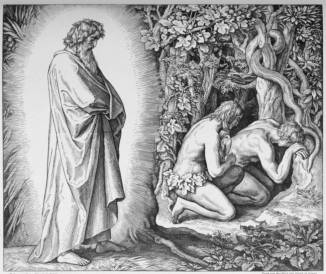
8 And they heard the sound of the Lord God walking in the garden in the cool of the day, and the man and his wife hid themselves from the presence of the LordGod among the trees of the garden. 9 But the Lord God called to the man and said to him, “Where are you?” 10 And he said, “I heard the sound of you in the garden, and I was afraid, because I was naked, and I hid myself.” 11 He said, “Who told you that you were naked? Have you eaten of the tree of which I commanded you not to eat?” 12 The man said, “The woman whom you gave to be with me, she gave me fruit of the tree, and I ate.” 13 Then the Lord God said to the woman, “What is this that you have done?” The woman said, “The serpent deceived me, and I ate.”
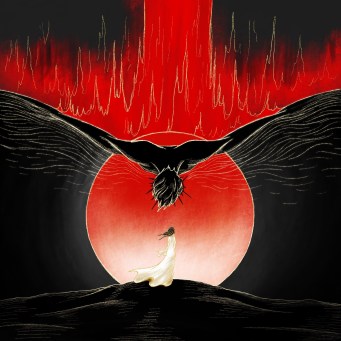
14 The Lord God said to the serpent,

“Because you have done this, Updated Crushing the Serpent's Head Cross
cursed are you above all livestock
and above all beasts of the field;

on your belly you shall go,
and dust you shall eat
all the days of your life.

15 I will put enmity between you and the woman,
and between your offspring and her offspring;

he shall bruise your head,
and you shall bruise his heel.”

16 To the woman he said,

“I will surely multiply your pain in childbearing;
in pain you shall bring forth children.

Your desire shall be contrary to your husband,
but he shall rule over you.”

17 And to Adam he said,

“Because you have listened to the voice of your wife
and have eaten of the tree

of which I commanded you,
‘You shall not eat of it,’

cursed is the ground because of you;
in pain you shall eat of it all the days of your life;

18 thorns and thistles it shall bring forth for you;
and you shall eat the plants of the field.

19 By the sweat of your face
you shall eat bread,

till you return to the ground,
for out of it you were taken;

for you are dust,
and to dust you shall return.”

20 The man called his wife’s name Eve, because she was the mother of all living. 21 And the Lord God made for Adam and for his wife garments of skins and clothed them.

In the name of the Father and of the Son and of the Holy Spirit. Amen.

And, in this way, sin entered the world. Now, instead of running from the devil, Adam and Eve run from God. To really get at this text we need to see how faith is attacked, lost, and restored.

Scripture is clear, “the righteous shall live by faith” (Hab. 2:4), and, “whatever is not of faith is sin” (Ro. 14:23). Adam and the woman had faith in God before the Fall. The faith that they had was created by the promise of God. This is may be a little bit difficult for us to grasp, but, when God created the tree of the knowledge of good and evil and commanded Adam and the woman to not eat of it, He was giving them a promise to believe. God didn’t put the tree of the knowledge of good and evil in the garden so Adam and the woman could choose God or reject God. God put that tree in the garden as a promise. Basically, that tree was God acknowledging that there was evil, and by commanding them to not eat of it was God saying, “There is evil, but I don’t want you to experience or even know what evil is. If you know evil, it’s not going to go well for you. In fact, you are going to die.”

Temptation in the Garden of EdenBut Satan comes along and puts a question into the mind of the woman. “Did God actually say?” This is the one attack of the devil. He always is trying to get us to doubt the Word and promise of God. “Did God actually say, you should not eat of any tree in the garden?” And notice that the woman adds to God’s promise. She says, “We may eat of the fruit of the trees in the garden, but God said, ‘You shall not eat of the fruit of the tree that is in the middle of the garden, neither shall you touch it, less you die.’” God had never said anything about not touching the tree of the knowledge of good and evil (at least, it isn’t recorded for us). Satan is attacking God’s Word, but Adam and the woman have not fallen yet. The serpent sees his opening and tells an outright lie, “You will not surely die! For God knows that when you eat of it your eyes will be opened, and you will be like God, knowing good and evil.”

Now, remember that God had created Adam and the woman in His image – they were already like God, and God declared that they were good. But Satan put before the woman the possibility of becoming more like God and better than they had already been created. It was an outright lie. So, when the woman sees that the tree is good for food, a delight to the eyes, and to be desired to make one wise, she is seeing something that is not true. The devil’s lie has already taken root. In this way Adam and the woman’s faith is attacked.

Now, that faith is lost. The woman looked at the tree and saw that it was to be desired to make one wise. That phrase, right there, is so important as you go about your daily life. To tempt us into sin, the devil gets us to think that God is somehow holding out on us, that He hasn’t given or won’t give us everything we need to live and be happy. It’s a downright, blatant, brazen, barefaced lie. The devil wants us to ignore God’s Word and think that God is holding out on us and limiting our fun by giving us commands. Whenever we fall into sin, it is because we don’t trust that God is good and will give us all good things at the right time. Don’t listen to the devil’s lies.

Unfortunately, the woman does. She takes the fruit, eats it, gives some to her husband who is with her, and he eats. The eyes of both are opened. They had become something more. Now, they knew evil, but it was not better. What had been good, their nakedness, was no longer good. They sew fig leaves together to make themselves loincloths. Their faith is lost.

But now, we will see how beautifully God restores faith. Adam and the woman hear the sound of God walking in the garden, but they hide. They figured that God was coming in order to punish them. But the God who had created the heavens and the earth, the God who had created all the birds of the air, all the fish of the sea, and all the animals of the land didn’t need to come and find them in order to punish them. If God was going to punish them, there is no need to drag this whole thing out. God is not showing up in this text now to punish Adam and the woman. He’s coming to restore what was lost. He is coming to restore faith.

Adam and Eve hide from God.jpgBut even as God does this, we will see the horrific consequences that sin and evil has brought into God’s good creation. God calls to Adam, “Where are you?” God still wants to have fellowship with Adam and the woman even though they have sinned, broken His commandment, and lost their faith. But rather than confessing and repenting of his sin, Adam dodges the opportunity saying, “I hid from You because I was naked and afraid.” So, God gives Adam a second chance to repent, “Who told you that you were naked? Have you eaten of the tree of which I commanded you not to eat?”

But sin has so marred Adam that he dodges this second opportunity. He blames the woman, but ultimately, notice that he blames God, “The woman, whom You gave to be with me, she gave me fruit of the tree, and I ate.“ God gives the woman a chance to repent and asks her, “What is this you have done?“ But the woman doesn’t do much better than Adam, she says “The serpent deceived me and I ate.”

The terrible, horrific consequences of sin are already evident. Adam and the woman pass blame, they don’t protect or care for each other, the whole thing is an absolute mess. They are caught and they don’t return to God in faith asking for His mercy.

Adam and the woman will hear God tell them about the mess they have brought to creation – pain in childbirth, pain in eating, and death. But first things first. God’s first response isn’t to lay into Adam and the woman. The first thing God does is deal with Satan. God doesn’t have a conversation with the devil like He did with Adam and the woman. There, in the Garden, God told Satan that He was coming for him. God would send the Seed of the woman to crush the serpent’s head. And Adam and the woman believe this because, notice, at the end of this text, she is no longer called ‘woman.’ Adam 1 Corinthians 13 7 - Love Bears All Thingsgives her the name Eve. She wasn’t called this at any point before in Scripture. Adam gives her the name ‘Eve’ which means ‘life-giver.’ Here’s how we know faith is restored. Eve was already going to be the mother of everyone who would be born. But Adam, the father of faith, changes her name to Eve because she is the mother of all who would believe in the promised Seed who would crush the serpent’s head.
God promised that He would free Adam, the woman, you, and me from the clutches of sin and death. And, today, we have seen Jesus doing this very thing. Opposed to Adam and the woman, who had no lack – they weren’t hungry – Jesus defeats the devil’s temptations in the wilderness when He was starving after fasting for forty days. Jesus will leave the wilderness and cast out the demons. He will heal, restore, forgive, and resurrect those who sit under the curse. But most importantly, He will suffer God’s wrath against all sin – your sin, my sin, the sin of the whole world – on the cross. He does this because though you are caught in sin, your God is merciful and gracious. He wants you to be caught in His loving arms for all eternity, safe and secure from all evil.

Repent. Believe. Live. Amen.

The peace of God, which surpasses all understanding, will guard your hearts and minds in Christ Jesus. Amen.

Even Now – Sermon for Ash Wednesday

Listen here.

The texts for this evening were Joel 2:12-19 and Matthew 6:16-21.

In the name of the Father and of the Son and of the Holy Spirit. Amen.

In our Old Testament lesson, God called to His people (v. 12-13), “Yet even now, return to me with all your heart with fasting, with weeping, and with mourning and rend your hearts and not your garments. Return to the Lord your God for He is gracious and merciful, slow to anger, and abounding in steadfast love; and He relents over disaster.”

Let’s break this down. “Yet even now.” Those are such beautiful words of Gospel. “Even now.” After everything you have done and left undone. After failing again and again into the same sin over and over. After refusing again and again to do the good God put you there to do for your neighbor. After you have broken trust, broken relationships, broken the hearts of those you should mend, even now, return to the one, true, holy, God.

But repeatedly in Scripture, God’s holy presence is the last place that sinners want to be. Adam and Eve hid from God’s holy presence after they had sinned and realized their nakedness. Standing in God’s holy presence, Isaiah said, “Woe to me, for I am undone.” Jonah fled from God’s holy presence when God called him to preach to Nineveh. Peter asked the holy Son of God to depart from him because he was a sinful man.

Holiness and sin cannot coexist. Just as light destroys the darkness, the brightness of holiness destroys the darkness of sin. But if we think that our sin has forever separated us from God, we are defying the very words of God in this text, “Yet even now, return to Me,” says your Holy God. This returning is repentance.

Return and repent with fasting, weeping, and mourning. Return and repent because the Lord your God is gracious and merciful, slow to anger and abounding in steadfast love.

Repentance has us saying, “Amen,” to God twice. “Amen” simply means yes, truly, absolutely, correct, right. We say “Amen” when God’s Law tells us that we are guilty of sin, when the Scriptures tell us that we deserve God’s wrath and punishment for our sins now, in this moment, and for all eternity. But repentance doesn’t stop there either.

Repentance says, “Amen,” when God speaks His Gospel over us, when God says that we are forgiven for Christ’s sake. That the suffering and death of Jesus has removed our sins as far as the east is from the west.

The first “Amen” is not easy to say. We don’t like to admit our failures and sins. We don’t like to admit that the wages our sin has earned is the bitterness, sickness, and hardships we face in this life. Instead, we blame others for the burdens we bear.

But the second “Amen” isn’t really any easier than the first. The devil and the world scream at us that the sacrifice of Jesus isn’t really enough. Our own flesh even says, “Well, it can’t be so easy as simply believing in Jesus.” But dear saints, that is when we need to say, “Shut up,” to the devil, the world, and our own flesh.

Just as God means it when He speaks the Law to say that your sins harm you and your neighbor, and more importantly that your sins separate you from Him, God also means it when He says that for the sake of Jesus He has forgiven you and blotted out your sins.

Through this Lenten season, we are going to be considering the Ten Commandments, and this will give us ample reasons to weep, lament, mourn, and rend our hearts because of our sin. However, we will also see the great gifts God is giving to us in each Commandment as well. But most importantly, we will see how Jesus has delivered us and calls us, “Even now, return to Me. Return to Me for I am gracious and merciful, slow to anger, and abounding in steadfast love.”

Your God has no pleasure in the destruction of the wicked. Instead He would have you repent. Say, “Amen,” to His Law and to His Gospel. Amen.

The peace of God, which surpasses all understanding, will guard your hearts and minds in Christ Jesus. Amen.

Love Bears All Things – Sermon on 1 Corinthians 13:1-13 for Quinquagesima.

Listen here.

1 Corinthians 13:1-13

1 If I speak in the tongues of men and of angels, but have not love, I am a noisy gong or a clanging cymbal. 2 And if I have prophetic powers, and understand all mysteries and all knowledge, and if I have all faith, so as to remove mountains, but have not love, I am nothing. 3 If I give away all I have, and if I deliver up my body to be burned, but have not love, I gain nothing.

4 Love is patient and kind; love does not envy or boast; it is not arrogant 5 or rude. It does not insist on its own way; it is not irritable or resentful; 6 it does not rejoice at wrongdoing, but rejoices with the truth. 7 Love bears all things, believes all things, hopes all things, endures all things.

8 Love never ends. As for prophecies, they will pass away; as for tongues, they will cease; as for knowledge, it will pass away. 9 For we know in part and we prophesy in part, 10 but when the perfect comes, the partial will pass away. 11 When I was a child, I spoke like a child, I thought like a child, I reasoned like a child. When I became a man, I gave up childish ways. 12 For now we see in a mirror dimly, but then face to face. Now I know in part; then I shall know fully, even as I have been fully known. 13 So now faith, hope, and love abide, these three; but the greatest of these is love.

In the name of the Father and of the Son and of the Holy Spirit. Amen.

If you’re like me, you’re looking for ways to do things more efficiently and make life easier. You’re searching for ways to lessen your burdens. A better system for your workflow. A quicker route from here to there. Ways to make dinner faster. Every mom I know is ready to get out from the burden of folding laundry. Well, a machine called the FoldiMate is for you; it doesn’t come out until late this year, and it’ll cost you about $1,000. We’re always looking for ways to make life easier, be more productive, and most of all to lessen our burdens. While a lot of good has come from technology and machines and processes that lessen our burdens, there are some things that we just have to deal with because some burdens cannot be lessened.

This chapter of Scripture tells us about one area of our lives that will always be hard – loving others. Love isn’t easy. Love is, in fact, work. Love is patient. Love is kind. Love does not envy or boast. Love is not arrogant or rude. Love does not insist on its own way. Love is not irritable or resentful. Love does not rejoice at wrongdoing but rejoices with the truth. Love never ends. These clear words of Scripture obliterate much of what our society calls ‘love’ today.

1 Corinthians 13 7 - Love Bears All ThingsBut today, I want to focus on one phrase from this text about love; it is the first phrase from v. 7, “Love bears all things.” Remember, that the second great commandment is to “love your neighbor as yourself” (Mt. 22:39). Paul writes in Gal. 6:2, “Bear one another’s burdens, and so fulfill the law of Christ.” One aspect of love is to bear another’s burdens. And there is no way to make bearing others’ burdens less burdensome.

I remember when I was in seminary things were pretty hectic during my second year. I had four hours of class every morning, and to keep our finances in order, I worked each afternoon. Sarah and I had been married for about a year and a half, so I was still adjusting to being a husband who wanted to provide for his wife (even though she was the main bread-winner). I would come home tired, have dinner, study my Greek and Hebrew, and write papers. Sarah was pregnant with Elijah, and I knew that, after he was born, I would have to cut back on my hours at work in order to take care of him and keep up with my studies. But I didn’t know how we would make everything work. The stress of it all was weighing down on me. So, one day, I went to one of my professors and I spent the better part of an hour unloading all my worries on him. And do you know what he did? He listened.

He didn’t say much. When he did speak, it was to let me know that he was hearing what I said as I continued to spew about my situation. When I was done, he didn’t give me extra time to turn in homework for his classes. He didn’t tell me about how he went through a similar time in his life. And he didn’t give me advice about how to manage my time better. He didn’t really do anything but hear me out.

So, when I left his office, nothing had changed. In fact, things should have probably been worse because I had taken a precious hour that I could have used for studying. But I left his office feeling better. You know why? Because, in a real sense, he was now carrying some of my burden. He loved me and allowed me to transfer my stress to him.

Maybe, you have had a similar experience – either unloading your own or listening to someone else’s burdens. Maybe you have come away from a conversation with someone who is facing all sorts of difficulties in their life, you come away from that conversation and you feel tired – not physically, but emotionally or spiritually. You feel tired because you are sharing that person’s burdens. This is an act of love that has cost you something, but it has truly helped the other person.

Stress.jpgWhich brings me back to where we started about looking for ways to make life easier. Too often, we try to make our own lives easier by avoiding the Scriptural command to bear one another’s burdens. But this is unloving, and it is, in fact, sinful. I can think of three tricks we commonly use to avoid bearing the burdens of others, but I am sure there are more (if you know more, let me know after the service).

The first trick is to simply avoid being around people. We don’t let people have access to us. And I’m not only talking about avoiding certain people who seem to always be unloading on us. We often go farther and avoid meaningful interactions with others as much as possible. We have schedules that are so full that we are running from one thing to the next. Even though you may be around people every waking moment, there is not really time or occasion for others to have a real conversation with you. So, the first trick is avoidance.

The second trick is, when other people start to tell us their troubles, we may listen for a bit, but then we start telling them our troubles. We interrupt and tell them how bad things are for us. It can almost become a contest about who has the most stress. And this trick is simply building a wall between us and their problems. I’ll talk about myself and my problems so I don’t have to deal with you and your problems. So, the second trick is putting a barrier between us and others’ burdens.

The third trick is the most dangerous because we think it is pious or virtuous. We give advice. We listen for a bit, and then we say, “Have you considered doing this?” Or even worse, we tell them what to think. “You should look at this as an opportunity for God to teach you something.” That may be right and correct and our advice might be really good – which is why we think it is so pious. But don’t miss the point, it deflects their burden from us back on to them. It can leave the person more deflated and more burdened, and we leave the conversation thinking we’ve done something good and loving. But we aren’t bearing their burden. And remember, if they wanted your advice… they would’ve asked for it.

Avoidance, barriers, and advice – all tricks we use to avoid bearing another’s burdens.

Jesus Heals BartimeausWe heard about love in action in our Gospel lesson (Lk. 18:31-43). Jesus encountered blind Bartimeaus (Mk. 10:46). Bartimaeus cries out to Jesus, “Have mercy on me!” Jesus pauses on His important trek up to Jerusalem, where He is going to save the whole world. He stops to listen to Bartimeaus asking him, “What do you want me to do for you?”Bartimeaus says that he wants to receive his sight. And Jesus doesn’t start talking about Himself and the problems He is about to face even though Jesus’ burden is going to be much more than blindness. And Jesus doesn’t give advice – and if anyone is in a position to give advice it’s Jesus. Jesus simply says, “Receive your sight, your faith has made you well.”By doing this, please note, Jesus recognizes that Bartimaeus’ blindness is bad.

Now, at this point, insert whatever problem you have, or the problems of people who are unloading their burdens on you – high blood pressure, diabetes, cancer, fatigue, depression, being bullied – these things are not natural and are a product of the devil. Unlike Jesus, we can’t simply say the word and make things better. But we can, like Jesus recognize and acknowledge the brokenness in people’s lives and say, “I’m sorry. I’m sorry you’re going through this.” Another way to show love to those who share their burdens with us is to simply listen. Listen, and ask, “How can I pray for you?” Then, pray for them then and there. Pray for them and say, “May Jesus bless you.”

hebrews-12_1-2.jpg
Jesus not only healed Bartimaeus’ blindness, Jesus bears his burden completely. Jesus was on His way to Jerusalem where He would bear all mankind’s burdens, all your sins and iniquities. He would suffer all the consequences of sin in this world as He hung in darkness on the cross. And He carried all those burdens, every last one, to the grave. But He wouldn’t stay there. Because of that, because we await the Resurrection, we know that whatever we suffer in this world is temporary. So whatever burdens you bear – whether they are yours or others’ – they will disappear when our Lord returns.

You see, the love of Jesus has already and continues to bear all things – all your sins, all your iniquities, all your transgressions, all your griefs, all your cares, all your sorrows. And this becomes our focus for the next six weeks. Amen.

The peace of God, which surpasses all understanding, will guard your hearts and minds in Christ Jesus. Amen.


Ready, Set, Go! – Sermon on 1 Corinthians 9:24-10:5 for Septuagesima.

Listen here.

1 Corinthians 9:24-10:5

24 Do you not know that in a race all the runners run, but only one receives the prize? So run that you may obtain it. 25 Every athlete exercises self-control in all things. They do it to receive a perishable wreath, but we an imperishable. 26 So I do not run aimlessly; I do not box as one beating the air. 27 But I discipline my body and keep it under control, lest after preaching to others I myself should be disqualified.

1 For I do not want you to be unaware, brothers, that our fathers were all under the cloud, and all passed through the sea, 2 and all were baptized into Moses in the cloud and in the sea, 3 and all ate the same spiritual food, 4 and all drank the same spiritual drink. For they drank from the spiritual Rock that followed them, and the Rock was Christ. 5 Nevertheless, with most of them God was not pleased, for they were overthrown in the wilderness.

In the name of the Father and of the Son and of the Holy Spirit. Amen.

Paul compares the Christian life to a sporting event. They didn’t have the best sport – baseball – in Paul’s day, but they had sporting competitions. The city of Corinth, in particular, hosted a series of games every other year called the Isthmian Games which were the second most famous athletic competition in the world after the Olympics. The events included racing, wrestling, jumping, boxing, javelin, discus, and even poetry. Thousands of athletes would show up to compete in the events, and throngs of people would come to watch. The winners of each competition would end up being famous throughout the Roman Empire and get statues and monuments. isthmean-games-celery-crown.jpg
But the immediate reward, the prize they got right after the competition, wasn’t a gold medal placed around their neck. No, they got a wreath made of dried, withered celery. Yes, celery – that vegetable that is tasteless when you eat it alone but ruins every dish you add it to.

I can just imagine the first guy to win. He ascends the podium while the crowds cheer and receives his celery wreath. He holds it and thinks, “Celery? I get celery? I thought I was competing for a salary.”

To compete in the games, athletes would be required to devote ten months to training. They had to focus their complete attention on their training, give up any bad habits, and even had to give up things that weren’t bad in general but were a hinderance to their training. The competitors had to have the will and self-control to let go of anything that would distract them from winning first place. And when it was time to compete, they had one goal – finishing first.

Paul takes the imagery of those athletes who wholly dedicated themselves to training, running, and winning a perishable wreath of withered celery and says, “You, Christian, should have even more dedication to receive the imperishable prize of forgiveness and eternal life.”

Now, this analogy Paul is using is good and beneficial, but all analogies have their limitations. So, we have to pause for a moment here to make sure everything stays clear.

One limitation comes when Paul says, “all the runners run, but only one receives the prize.” In the Christian race, all believers win the prize. It should go without saying, but I’m going to say it anyway. It isn’t as though only one person will be saved. If that were the case, Jesus wins period and no one else. His perfect life and perfect obedience in thought, word, and deed have never and will never be matched. Not even close.

Another limitation to the analogy is that you aren’t saved because of your work, your training, your dedication, your self-control. This has to be clear – if you don’t get this, you will completely miss the point of this entire text, this sermon, and the whole Bible. Salvation isn’t earned or deserved. You don’t earn eternal life by being better than most people. Getting a “C” in “Morality” doesn’t cut it. You’ve probably heard the joke about two guys (we’ll just say Sven and Ole) who are camping in the forest. Outrun the BearThey see a bear eyeing them and licking its chops. Sven looks over at Ole who is bent over tying his shoelaces. Sven says, “Ole, do you really think you can outrun a bear?” Ole pulls the laces tight, stands up, sniffles and says, “I don’t have to outrun the bear. I only have to outrun you.” Salvation is not like that. You aren’t saved because you are better than most people. You are saved by grace alone through faith alone by Christ alone.

But here is the point Paul ismaking in these verses. You can fall away. Salvation can be lost. And if you don’t take salvation seriously, you are like an athlete who shows up for a race but has no plans of actually competing to win. Paul points to Israel’s ancestors (whom we heard about a little bit in the Old Testament text [Ex. 17:1-7]). Of the six-hundred-thousand men plus women and children who were brought out of Egypt by God’s mighty hand, only two of them – only Joshua and Caleb – got to enter the Promised Land. All of them had been given physical deliverance, physical food, physical drink. But they had also been given spiritual deliverance. They had been given a type of Baptism. They were given spiritual food and spiritual drink directly from Christ who gives water that wells up to eternal life (Jn. 4:13-14; 7:37-38). But with most of them, God was not pleased, and they were overthrown in the wilderness.

Because faith and salvation can be lost and because so many were overthrown in the wilderness, you need to run after the prize of eternal life. Discipline yourself. And that doesn’t mean that you give yourself a spanking or something like that if you sin. No, discipline yourself in a way that keeps you from running headfirst into sin.

If you know that you are prone to falling into sin when you go to that certain place, when you hang out with that crowd, when you drink too much, or when you surf the internet late at night, have the discipline to refrain, to stay away, from those things. In other words, don’t get lazy about your sin. Practice self-control. Do all of this so that you aren’t running aimlessly, so that you don’t box as one beating the air, or so that you don’t get disqualified. This text is exhorting, urging, prompting, and prodding us to good works and to live as Christians.

But with all that said, I need to confess something. The more I am told to do a certain thing, the less I want to do it. It is too easy to look back on how I’ve failed in the past. My failures and sins easily haunt me, and it is tempting to give up. Maybe you have the same problem. That is what Paul is addressing in this text. He wants to focus us on the imperishable prize so that we keep working, keep striving, and keep pressing toward it.

The Bible is constantly pushing us forward toward the prize, but we are too often looking back at our past sins and failures. And those sins and failures get us down and discouraged so that we are tempted to give up even trying. We can’t do that.

So, what’s the answer? What will motivate us to do good works and live as Christians? Don’t look back at your failures and sins. Forget them. Know that God has forgiven your sins through Jesus’ cross, death, burial, and resurrection. In Isaiah 43:25, God says, “I am He who blots out your transgressions for My own sake, and I will not remember your sins.” Or Jeremiah 31:34 where God says, “I will forgive their iniquity, and I will remember their sin no more.”

Because God has forgotten your failures, you don’t need to dwell on them either. Paul uses similar language in Philippians 3:13–14. That passage is in your Scripture insert. Listen to this: “Brothers, I do not consider that I have made it my own. But one thing I do: forgetting what lies behind and straining forward to what lies ahead, I press on toward the goal for the prize of the upward call of God in Christ Jesus.”

Your past failures and sins are just that. They are in the past, and they are forgiven and died for by Christ. You have received the entire forgiveness of all your sins, and you are about to receive the very Body and Blood of Christ, given and shed for the forgiveness of your sins. Believer, every promise of Scripture lies before you. The eternal party, the never-ending feast of God lies before you. It is a feast of rich food, a feast of well-aged wine, of rich food full of marrow, of aged wine well refined. There, God will swallow up death forever; and the Lord God will wipe away tears from all faces (Is. 25:6-8).Augustine on 1 Corinthians 9_25.JPG

Listen to what Christ Himself says is your goal, your prize from Revelation 2-3: To the one who conquers, God will grant to eat of the tree of life, which is in the paradise of God. The one who conquerors will not be hurt by the second death. The one who conquerors will be clothed in white garments, and Jesus will never blot his name out of the book of life but will confess his name before God the Father. The one who conquerors will be made a pillar in the temple of God. And the one who conquerors will sit with Jesus on His throne (Rev. 2:7, 11, 3:5, 12, 21).

Christian, this is your goal, your prize, your imperishable wreath. And it is worth running for. Ready? Set. Go! Amen.

The peace of God, which surpasses all understanding, will guard your hearts and minds in Christ Jesus. Amen.

The Lamp & the Darkness – Sermon on 2 Peter 1:16-21 for the Sunday of the Transfiguration of Our Lord

Listen here.

2 Peter 1:16-21

transfiguration-icon16 For we did not follow cleverly devised myths when we made known to you the power and coming of our Lord Jesus Christ, but we were eyewitnesses of his majesty. 17 For when he received honor and glory from God the Father, and the voice was borne to him by the Majestic Glory, “This is my beloved Son, with whom I am well pleased,” 18 we ourselves heard this very voice borne from heaven, for we were with him on the holy mountain. 19 And we have the prophetic word more fully confirmed, to which you will do well to pay attention as to a lamp shining in a dark place, until the day dawns and the morning star rises in your hearts, 20 knowing this first of all, that no prophecy of Scripture comes from someone’s own interpretation. 21 For no prophecy was ever produced by the will of man, but men spoke from God as they were carried along by the Holy Spirit.

In the name of the Father and of the Son and of the Holy Spirit. Amen.

Peter, James, and John saw Jesus do many amazing things. Just think back on the sermons from the last few weeks. They were there when Jesus (according to John), “manifested His glory” by turning water into wine (Jn. 2:11). They saw Jesus touch a leper, and, instead of the disease spreading from the man and infecting Jesus, the cleanness of Jesus spreads to the man and his leprosy was gone (Mt. 8:1-4). They heard Jesus speak a word to heal a centurion’s paralyzed servant (Mt. 8:5-13). They were in a boat that was being swamped by the winds and the waves, and Jesus tells that storm to knock it off resulting in a great calm (Mt. 8:23-27). Peter, James, and John would see Jesus feed the masses, give sight to the blind, and raise the dead.

But, when Peter looks back on everything that Jesus did, and when Peter wants to let people know the truth of the Christian faith, Peter points the people to whom he wrote this letter to the Transfiguration. There on the holy mountain, Peter says he saw the power, the coming, and the majesty of Jesus with his own eyes. The Transfiguration is the greatest manifestation of the deity of Jesus. It is where Jesus’ divine nature, which He always had, shines through His human nature showing that He is God of God, Light of Light, very God of very God.

The truth that God Himself came down to die and rise again to save all mankind from sin is not some cleverly devised myth. It is rooted in historical fact. Peter was there. He saw with his own eyes. Peter’s own ears heard God the Father preach a very important but very brief sermon, “This is my beloved Son, with whom I am well pleased. Listen to Him” (Mt. 17:5).

So, we could summarize v. 16-18 here as Peter saying, “Listen up. Our preaching of God coming down to rescue us from sin and death is not some myth or fairy tale. We preach Jesus as the Savior of the world because we saw His glory and power and majesty. We preach Jesus because we heard the very voice of God from heaven when we were with Jesus on the holy mountain of Transfiguration.”

And the rest of this text, which is where we are going to focus most of our attention, is the meaning, the take-away, of why the Transfiguration is still important for us today. And the reason might surprise you.

Normally, we think of the Transfiguration as mainly showing us the glory of who Jesus is. The Transfiguration certainly does do that. But listen to Peter’s conclusion: Verse 19, “And we have the prophetic word more fully confirmed, to which you will do well to pay attention to as to a lamp shining in a dark place, until the day dawns and the morning star rises in your hearts.”

The Transfiguration of Jesus does show the glory of Jesus, but even more so, according to this text, the Transfiguration shows us the glory of the Bible. Peter says here that it is better for you to have the Scriptures than for you to have been there with Jesus, Peter, James, John, Moses, and Elijah. It is better for you because the Scriptures, every last verse, show you of God’s great love for you. The shining face and dazzling clothes of Jesus point us to the shining and dazzling lamp of the Scriptures that shine in a dark place.

So where is this dark place? We might think that the lamp of the Scriptures shines in the darkness of this world. The Bible certainly does talk about the world being full of darkness and sin. In the first chapter of the Gospel of John, John writes that in Jesus was life, and “the life was the light of men. The light shines in the darkness, and the darkness has not overcome it” (Jn. 1:4-5). That passage of Scripture says that the light of Jesus defeats the darkness of this world. Or consider Psalm 119:105, “Your Word is a lamp to my feet and a light to my path.” There, the Scriptures give a picture of the light of God’s Word giving us direction in this dark world so that we don’t stumble or go the wrong way.

But Peter seems to be saying something different here. He says to pay careful attention to the Scriptures as “a lamp shining in a dark place until the day dawns and the morning star rises” – now catch this – “the morning star rises in your hearts.”

Dark HeartYou see, it’s not just the world and things outside of you that are a dark place. Your heart also has a darkness that needs the light of God’s Word. Peter doesn’t use the normal word for ‘dark’ here. In fact, the word that gets translated here as ‘dark’ is the only time in all the Scriptures where this word gets used. When I looked Greek the word up, the first definition is ‘squalid’ which is a word I don’t think I’ve ever used in normal conversation. So, I looked up ‘squalid’ and it means this, ‘foul and repulsive from a lack of care; neglected and filthy.’

Here is the picture: Sinner, your heart and my heart is a filthy, murky, dark place. Peter says that we do well to pay attention to the Word of God shining in the filthy, dirty, neglected, dark place of our hearts.

Many celebrities and influential people have been saying for a long time, “Follow your heart.” It sounds nice. It sounds good. But it is totally unscriptural. Jeremiah 17:9 says, “The heart is deceitful above all things, and desperately sick.” Or maybe you have seen the little cartoon, it floats around social media from time to time. The picture is of a small child standing before Jesus and offering Jesus a red heart that looks like a nice valentine saying, “It’s all I have.” And Jesus is reaching out to take it replying, “It’s all I ever wanted.” That isn’t the picture that the Scriptures give us. It would be better if that heart were the color of dung. And Jesus says, “I’ll take that filthy, desperately sick thing from you and give you a new heart” (Ez. 36:26).

But back to Peter’s picture of the Scriptures shining like a lamp in the squalid (there, now I’ve used it), dank, neglected, filthy darkness of our hearts. We need the clear lamp of the Bible to shine through the dark places of our heart.

We walk around in a dark, dirty, and ugly house. We have all sorts of temptations within ourselves to sin. Whether it is more money, a better relationship, an image of something pleasant to look at, a bigger house, or accolades from others, we are tempted to think that those things will bring us happiness. And we are willing to do whatever it takes, whatever sin is necessary, to grab on to those things. But, when we pay attention, the lamp of the Scriptures shines in the darkness of our heart, we see – we clearly see – that those things are filthy. We see that those things are not worth comparing to the greatness of the treasures of God’s promises.

So, pay attention here because I’m going to read a long passage of the Scriptures to shine some of their light in your heart. It comes just a few verses before our text today. 2 Peter 1:3–11 (turn there if it will help you follow along) “[Christ’s] divine power has granted to us all things that pertain to life and godliness, through the knowledge of him who called us to his own glory and excellence, by which he has granted to us His precious and very great promises, so that through them you may become partakers of the divine nature, having escaped from the corruption that is in the world because of sinful desire. For this very reason, make every effort to supplement your faith with virtue, and virtue with knowledge, and knowledge with self-control, and self-control with steadfastness, and steadfastness with godliness, and godliness with brotherly affection, and brotherly affection with love. For if these qualities are yours and are increasing, they keep you from being ineffective or unfruitful in the knowledge of our Lord Jesus Christ. For whoever lacks these qualities is so Light shining in darknessnearsighted that he is blind, having forgotten that he was cleansed from his former sins. Therefore, brothers, be all the more diligent to confirm your calling and election, for if you practice these qualities you will never fall. For in this way there will be richly provided for you an entrance into the eternal kingdom of our Lord and Savior Jesus Christ.”

This is what the Scriptures do for you, believer. They shine in your heart to give you faith, virtue, knowledge, self-control, steadfastness, godliness, brotherly affection, and love.

Dear saints, don’t be blinded by neglecting your Bible. You have been cleansed from your former sins. Grow and abound in the godly qualities that are yours through your God and Redeemer, Jesus Christ. Amen.

The peace of God, which surpasses all understanding, will guard your hearts and minds in Christ Jesus. Amen.