Unseen, but Not Away – Sermon on John 16:16-22 for the Fourth Sunday of Easter

Listen here.

John 16:16-22

16 “A little while, and you will see me no longer; and again a little while, and you will see me.” 17 So some of his disciples said to one another, “What is this that he says to us, ‘A little while, and you will not see me, and again a little while, and you will see me’; and, ‘because I am going to the Father’?” 18 So they were saying, “What does he mean by ‘a little while’? We do not know what he is talking about.” 

19 Jesus knew that they wanted to ask him, so he said to them, “Is this what you are asking yourselves, what I meant by saying, ‘A little while and you will not see me, and again a little while and you will see me’? 20Truly, truly, I say to you, you will weep and lament, but the world will rejoice. You will be sorrowful, but your sorrow will turn into joy. 21 When a woman is giving birth, she has sorrow because her hour has come, but when she has delivered the baby, she no longer remembers the anguish, for joy that a human being has been born into the world. 22 So also you have sorrow now, but I will see you again, and your hearts will rejoice, and no one will take your joy from you.”

Alleluia! Christ is risen!
He is risen indeed! Alleluia!

In the name of Jesus. Amen.

We’re still in Easter season. We’re still celebrating the resurrection. But this text takes us back to the night Jesus was betrayed. And these words from Jesus in our Gospel text are important for us Resurrection folk to remember – especially in times of suffering. To get at this, we are going to weave back and forth through this text because Jesus weaves back and forth talking about suffering and joy.

Christ tells His disciples that in “a little while” they are going to endure suffering, but that suffering will only last a second “little while.” Then, they will have joy that no one will be able to take from them. So, recognize that Jesus tells the disciples about two distinct “little whiles.”

The first “a little while” refers to the short amount of time that takes place between the time Jesus speaks these words to the time when they will no longer see Jesus. For most of them, they no longer see Jesus once He is arrested. For Peter and John, it’s a little after that. After this first “little while,” comes the second “little while” when the disciples won’t see Jesus anymore because He is dead, buried, and sealed behind the stone in the tomb. And during this second “little while” they have sorrow, weep, and lament.

Now, we need to recognize just how profound and unique the disciples’ suffering was. While Jesus was away from them between Good Friday and Easter, their suffering was quite unique. A major reason the disciples’ sorrow was so pointed and painful is not only did they lose Jesus, their leader and friend, even more importantly, they lost hope that salvation was even a possibility.

Remember the two disciples that Jesus meets on the road to Emmaus Easter afternoon (see Lk. 24:13-35)? Jesus meets them and asks them what they are talking about, but they don’t recognize Him. They’re surprised this stranger hasn’t heard about everything going on in Jerusalem. So, ironically, they tell Jesus about Jesus. How He was mighty in deeds and words before God and all the people, but the chief priests and rulers delivered Him up to be crucified. Then, they say something very important, and what they say reveals how painfully sorrowful they are. They say, “We had hoped,” (and the grammar suggests that their hope is now gone), “We had hoped that He was the one to redeem Israel.” In other words, their hope was that Jesus would save them, but they don’t hope for salvation anymore because, in their minds, He is dead and is in the tomb for good. They thought that Jesus’ death was the end of salvation rather than the thing which accomplished their salvation. So, do you see the sorrow they were enduring?

Now, back to our text here from John, Jesus tells the disciples, “You will weep and lament and be sorrowful, but your sorrow will turn to joy.”

Jesus compares this sorrow the disciples experienced to a woman in labor. There is no denying the pain and anguish of a woman in labor. And, you mothers, Jesus knows the pain you have in labor because He is the one who said that a woman’s pain in childbirth would be greatly increased after the Fall (Gen. 3:16). But Jesus compares the suffering of the disciples to a woman in labor because of what comes after that suffering. After a mother has delivered the baby – and remember this is according to Jesus – she no longer remembers the anguish because that pain is replaced and swallowed up by joy. Joy that a child has been born into the world.

Jesus doesn’t say that a mother’s memory is erased, and she totally forgets the pain she just experienced. Jesus doesn’t say that she doesn’t have any pain while she recovers – that is not what Jesus says. Instead, her anguish is swallowed up and replaced by the joy that she now has a child to love and cherish.

Jesus compares the disciples’ suffering to the suffering of a mother in labor because of what comes at the end of that suffering. In other words, the sorrow and complete loss of hope that the disciples had while Jesus was in the tomb was painful and real. But that sorrow was swallowed up in joy when they see Jesus after the Resurrection. And the sorrow and lamenting and weeping they had during those days wasn’t worth comparing to the joy that the Resurrection brings them.

This is the main thing Jesus is teaching us in this text. Sorrow and suffering is temporary for you, Christian. 

What Jesus says in these verses applies first to the disciples and the sorrow they had between Good Friday and Easter. But these words of our Lord are also written for us Christians whenever we have sorrow. That little while of sorrow that the disciples experienced mirrors the sorrow that we experience. Our sorrows are a microcosm of theirs. 

The major difference between the disciples’ sorrow and our sorrow is that they endured their sorrow without any hope. That is not our experience. Even though we have real, painful sorrow in this world, we have sorrow with hope that the sorrow will end and turn to joy just as theirs did.

Notice very specifically what Jesus tells the disciples. First, the period of time of sorrow will be only “a little while.” Now, I don’t want in any way to minimize the suffering of the disciples while Jesus was in the tomb. In fact, I don’t think we can compare any suffering we have to what they went through. But we also know that their sorrow, as profound as it was, only lasted a couple days. Jesus was buried just before sunset on Friday and was seen by the disciples Easter evening.

The same is true for us. Jesus has been unseen for a long time. Since His ascension, Christians have endured all kinds of suffering, persecution, pain, and distress. But the sufferings of this present time are not worth comparing with the glory that is to be revealed to us (Ro. 8:18).

Again, note specifically that Jesus says their sorrow is that they won’t see Jesus because He is, “going to the Father.” He doesn’t tell them that He is going away; He just tells them that they won’t see Him because He is going to the Father. The same is true for us now.

Jesus has now ascended to the Father and is where the God the Father is. In other words, He’s everywhere. Remember what Jesus says at the end of Matthew’s gospel (Mt. 28:18-20), “All authority in heaven and earth has been given to me…. And behold, I am with you always, to the end of the age.” So, yes, He is unseen, but He hasn’t left us. Jesus isn’t gone from us. In fact, Jesus is nearer to us than we can possibly know. 

So, let’s try to bring this all together. There is no denying that Christians suffer in this life, but we can be comforted even in the midst of suffering because of what Jesus says in this text.

First of all, when you suffer, you don’t have to put on a brave face and say things like, “I know other people have it worse than I do.” No. No matter how great or small, call suffering what it is – suffering. In the midst of sorrow, pain, and anguish, we can call all of that what it is – it is suffering and not something that God ever intended you to experience.

And yet, God promises that He will use that suffering for your good because God works all things together for good for those who love Him and are called according to His purpose (Ro. 8:28). 1 Cor. 10:13says that we do not suffer any “temptation that is not common to man. But God is faithful and will not let you be tempted beyond your ability, but with the temptation He will also provide the way of escape, that you may be able to endure it.” So, even though our suffering is unpleasant at the time, it is through that suffering that God chastens us, keeps on track, draws us to Himself, and teaches us to be dependent on Him.

Christian, God sent Jesus to die and rise again for you, and He counts every hair on your head. God cares about the details. He knows your sorrow and suffering, and He is paying attention to it. And Christ is with you even in that suffering. Jesus promises that He is with you with all authority to the end of the age. He will bring you through it. And when He returns, that suffering will be eternally replaced with joy.

So, in the midst of your suffering, know that those around you are suffering too. Don’t think that some people are suffering more or less than you. We don’t know what kind of suffering others are going through, but we do know that they are suffering what is common to man (1 Cor. 10:13).

So, have some sympathy for others. Life is hard on everyone. Maybe that person is being a jerk because his mother just died or she is fighting with her husband or their parents are neglecting them. A little sympathy for others and a willingness to make excuses for someone else’s bad behavior can go a long way toward a more peaceful and loving world.

Ultimately, dear saints, whenever you suffer, know that Jesus is with you. He is crucified and risen for you. Though you do not see Him, He is with you in every trial and tribulation. He will bring you through it. You are God’s children now. He has not abandoned you. And when He appears you shall be like Him. Your suffering will end and be replaced with joy that no one will be able to take from you.

Alleluia! Christ is risen!
He is risen indeed! Alleluia!

Amen.

The peace of God, which surpasses all understanding, will guard your hearts and minds in Christ Jesus. Amen.

Made to Lie Down – Sermon on Ezekiel 34:11-16 for the Third Sunday of Easter

Listen here.

Ezekiel 34:11-16

11 For thus says the Lord God: “Behold, I, I myself will search for my sheep and will seek them out. 12As a shepherd seeks out his flock when he is among his sheep that have been scattered, so will I seek out my sheep, and I will rescue them from all places where they have been scattered on a day of clouds and thick darkness. 13 And I will bring them out from the peoples and gather them from the countries, and will bring them into their own land. And I will feed them on the mountains of Israel, by the ravines, and in all the inhabited places of the country. 14 I will feed them with good pasture, and on the mountain heights of Israel shall be their grazing land. There they shall lie down in good grazing land, and on rich pasture they shall feed on the mountains of Israel. 15 I myself will be the shepherd of my sheep, and I myself will make them lie down, declares the Lord God. 16 I will seek the lost, and I will bring back the strayed, and I will bind up the injured, and I will strengthen the weak, and the fat and the strong I will destroy. I will feed them in justice.”

In the name of Jesus. Amen.

Alleluia! Christ is risen!

He is risen indeed! Alleluia!

Today, we could add:

Alleluia! Christ is our Shepherd!

He is our Shepherd indeed! Alleluia!

Repeatedly, Scripture gives us the picture of God being our Shepherd and us being His sheep. It came up in all three readings today – epistle (1 Pet. 2:21-25), Gospel (Jn. 10:11-16), and this Old Testament lesson, but it comes up all over the place. I’ve seen it suggested that this shepherd-sheep metaphor is the most common way Scripture describes our relationship to God. I couldn’t verify that, but it certainly is common throughout both the Old and New Testaments. Now, sheep are probably the most desperate, vulnerable, weak, prone to wander, and defenseless creatures in all of creation. So, this imagery isn’t meant to be flattering, but that’s ok. We’re Christians and don’t need to be flattered. It isn’t meant be a complement, but it is meant to be comforting. 

My fellow sheep, we have all lived down to the reputation of sheep. And, God be praised, Jesus has no expectation of us beyond being His sheep. He has no expectation that you figure out how to provide for yourself, to take care of yourself, or even to defend yourself. Sheep don’t run fast or kick hard. Sheep don’t have sharp teeth to bite back or a stinky musk to spray at their attackers. Nothing. Sheep have one defense, and that is their shepherd. God does not expect us to be anything more than a sheep, and, God be praised, He desires nothing more than to be our Shepherd.

Deep down, we all know that we are helpless and unable to do anything for ourselves, and that is probably why the sheep-shepherd imagery is so often used for comfort in times of trouble. It’s probably why Psalm 23 is so often used at funerals. Sometimes, when families are picking out texts for a funeral, they’ll ask me, “Would Psalm 23 be a good text to use? It seems so common at funerals.” Yes, of course it is a good text. Some things, no matter how often you hear them, don’t get old. Hearing your spouse or children say, “I love you,” doesn’t get old. Neither should the comforting picture of God, and specifically Jesus, being our shepherd because the Good Shepherd lays down His life for the sheep.

We love to hear the many ways that Psalm 23 describes how God provides for us as our Shepherd. He provides so that we have no want, leads us beside still waters, restores our souls, leads us in paths of righteousness for His name’s sake, and defends us from all evil even as we walk through the valley of the shadow of death. And you probably noticed that I skipped over one phrase in there. But you are smart people, and if you noticed the title of the sermon at the bottom of your Scripture insert, you realize that phrase is what I am going to focus on today. Psalm 23:2 says, “He makes me lie down in green pastures.” And, just so you know, that phrase, “makes me lie down,” wasn’t a fluke we heard it again in this text from Ezekiel where God says, “I Myself will be the Shepherd of my sheep, and I Myself will make them lie down.”

Sure, we understand that we are sheep. We need to be protected from dangerous wolves, lions, and bears. But does God really need to make us lie down? Aren’t we capable of doing that? Can’t we just let gravity take over and lie down? Why does God need to make us lie down?

Apparently, to lie down and rest, is even beyond the capability of a sheep of God to do. Sometimes it might be because we are bored being a sheep. Sometimes it is because we are foolishly curious. Sometimes it is because we get afraid and run from the danger, but in running from that danger, we leave the protection of our Shepherd.

In fact, our inability to lie down might be the greatest danger that we face. Peter says in our epistle lesson, “You were straying like sheep, but have now returned to the Shepherd and Overseer of your souls.” Here, Peter depicts our main problem is us going astray and leaving our Shepherd. God making us lie down is the solution. Our biggest danger is walking away from the flock and from the care of our Shepherd. So, Christ, our Good Shepherd, makes us lie down. And this is remarkable when you think about it.

The world tells us to fear all sorts of things. When you watch the news, it’s all about fear. One of the heads of a major news network this past week was caught saying that his network intentionally put the most dire, bleak news in front of their viewers in an effort to get higher ratings. He actually used the phrase, “If it bleeds it leads.” In other words, the more violent, fearful a news story is, it’s more likely to be put in front of you. The guy even talked about how he caught himself hoping that the COVID death toll ticker they kept on the screen for their viewers, he hoped that it would go higher so the station would get better ratings. Thankfully, he admitted feeling bad about it. Pray for him. Hopefully, the Holy Spirit will continue to use his conscience to bring him to repentance and faith in Christ.

But this is what the world does; the world preaches fear. Fear the virus. Fear global warming; oh, wait, it’s ‘climate change’ now, right? Fear terrorists. Fear Iran, China, North Korea, Russia. Fear riots. Fear the other political party. Fear fascists. Fear anti-fascists. Fear gun violence. Fear the government taking away your Second Amendment rights. Fear immigrants. Fear the national debt and deficit spending. Fear. Fear. Fear. They all do it – CNN, Fox, it doesn’t matter. Because the world does not have the protection Jesus, the Good Shepherd, they mock and ridicule Christians if they don’t join them in their fear.

My dear, fellow sheep, yes, we need to be vigilant and aware of what is going on around us. All of those things are predators like wolves, bears, and lions that threaten the flock, but those are not things to be afraid of. Not when we have Jesus as our Good Shepherd. Instead, those are the things we should bring to our God in prayer.

And I do want to be clear; this isn’t at all to say that you should do nothing when it comes to any of those things. Do what you can. Work, write, vote, engage, and be the change that this world needs. But as you do all of that, remember none of those things are worthy of your fear – not if your Good Shepherd is risen from the dead and is watching over you. And He is.

Instead, dear sheep, recognize that leaving the promises of the Gospel is the greatest danger we face. It is when we leave the Gospel promises and the care of our Good Shepherd that we fall into sin and are incredibly vulnerable to becoming lunch to all sorts of things in this broken, fallen world. If a sheep was smart, the thing that sheep would do is stay close to its shepherd. But since we aren’t that bright, our Shepherd makes us lie down. 

And when we have been scattered, when we have wandered into the valleys and caves of the wolves, when the days of clouds and thick darkness leave us cowering in fear, God searches for us sheep and seeks us out. He brings us into His church and feeds us with the good pasture of His Word. Because that is what God does. He seeks the lost. He brings back the strayed. He binds up the injured. He strengthens the weak.

This is exactly what Christ has done. Jesus has sought you out. He Himself bore your sins in His body on the tree, that you might die to sin and live to righteousness. By His wounds you have been healed. Your Good Shepherd laid down His life for you. He laid in the tomb, and now He is risen and lives forever to be your Good Shepherd.

Come now to His altar where He prepares a table for you even as you continue to live in a fallen world. Today, He brings you close to Himself. He makes you lie down so He can feed you, defend you, protect you, heal you, and deliver you. He has won the victory. So, come. Be made to lie down.

Alleluia! Christ is risen!
He is risen indeed! Alleluia!

Amen.

The peace of God, which surpasses all understanding, will guard your hearts and minds in Christ Jesus. Amen.
A Strange Congregation – Sermon on Ezekiel 37:1-14 for the Second Sunday of Easter

Listen here.

Ezekiel 37:1-14

1 The hand of the Lord was upon me, and he brought me out in the Spirit of the Lord and set me down in the middle of the valley; it was full of bones. 2 And he led me around among them, and behold, there were very many on the surface of the valley, and behold, they were very dry. 3 And he said to me, “Son of man, can these bones live?” And I answered, “O Lord God, you know.” 4 Then he said to me, “Prophesy over these bones, and say to them, O dry bones, hear the word of the Lord. 5 Thus says the Lord God to these bones: Behold, I will cause breath to enter you, and you shall live. 6 And I will lay sinews upon you, and will cause flesh to come upon you, and cover you with skin, and put breath in you, and you shall live, and you shall know that I am the Lord.” 

7 So I prophesied as I was commanded. And as I prophesied, there was a sound, and behold, a rattling, and the bones came together, bone to its bone. 8 And I looked, and behold, there were sinews on them, and flesh had come upon them, and skin had covered them. But there was no breath in them. 9 Then he said to me, “Prophesy to the breath; prophesy, son of man, and say to the breath, Thus says the Lord God: Come from the four winds, O breath, and breathe on these slain, that they may live.” 10 So I prophesied as he commanded me, and the breath came into them, and they lived and stood on their feet, an exceedingly great army. 

11 Then he said to me, “Son of man, these bones are the whole house of Israel. Behold, they say, ‘Our bones are dried up, and our hope is lost; we are indeed cut off.’ 12 Therefore prophesy, and say to them, Thus says the Lord God: Behold, I will open your graves and raise you from your graves, O my people. And I will bring you into the land of Israel. 13 And you shall know that I am the Lord, when I open your graves, and raise you from your graves, O my people. 14 And I will put my Spirit within you, and you shall live, and I will place you in your own land. Then you shall know that I am the Lord; I have spoken, and I will do it, declares the Lord.”

Alleluia! Christ is risen!
He is risen indeed! Alleluia!

In the name of Jesus. Amen.

Ezekiel had an odd call to preach to a strange congregation. God brought Ezekiel out by the Spirit into the middle of a valley. It was full of bones, lots of bones. And these bones were dry – very dry. This congregation, maybe we could call it Dry Bones Lutheran, they weren’t loving their neighbor. They weren’t shining the love of Christ to the world. They weren’t improving day by day. They were just lying there, dead and dry.

Then God asks Ezekiel the question: “Son of man, can these bones live?” What kind of question is that? When God asks something like that, what answer can you give? Ezekiel goes the safe route, “O Lord God, You know.” That’s as secure of a reply as you can give.

Well, God gives Ezekiel a call to preach to this strange congregation. “Prophesy over these bones, and say to them, ‘O dry bones, hear the word of the Lord.’” It’s an odd call. How many times did Jesus say after His sermons, “He who has ears, let him hear”? But here, God calls Ezekiel to preach to a congregation of bare bones that don’t even have ears.

“O dry bones, hear the word of the Lord. Thus says the Lord God to these bones: Behold, I will cause breath to enter you, and you shall live. And I will lay sinews upon you, and will cause flesh to come upon you, and cover you with skin, and put breath in you, and you shall live, and you shall know that I am the Lord.”

The sermon is preached. And God’s little sermon appears to be working. There is a rattling. The toe bone connected to foot bone to ankle bone to shin bone to knee bone to leg bone to hip bone to back bone to rib bone to shoulder bone to neck bone to head bone. Now hear the Word of the Lord!

But wait a second. Bones are connected, sinews hold together, muscles have grown, and skin covers. But there is still no breath, no spirit, no life. Wasn’t the sermon supposed to be done? Well, not yet. God has more for Ezekiel to preach. “Prophesy to the breath.”

Now, pause here for just a second. In Hebrew, the word for ‘wind’ and ‘breath’ and ‘spirit’ is all the same word. Ten times in this text, that word comes up. Seven times, it is translated as ‘breath.’ In v. 9, it’s translated as ‘wind.’ But back in v. 1 and again in v. 14, it is translated as ‘Spirit’ referring to the Holy Spirit. But, again, it’s all the same word. And I think, I could be wrong, but I think there is a sense here that God is calling Ezekiel to preach a sermon to the Holy Spirit. “Prophesy, son of man, and say to the Spirit, ‘Come from the four winds and breathe on these slain that they may live.’” In other words, it could be something like, “Holy Spirit, come from the four winds and spirit (as a verb) on these slain, that they may live.”

Ezekiel preaches, and after this second sermon is preached, what do you know? God’s Word works. The Spirit comes into these lifeless bodies that just a couple moments before had been bones, dry bones. Now, they live, and they are an exceedingly great army.

Finally, God tells Ezekiel exactly what was going on. The army is the entirety of God’s people. They were complaining that their bones are dried up and they are cut off. But God promises that He will open their graves and raise them up causing life to come into them. He will bring them into their own land. He will put His Spirit into them, they will live, and they will know that God is the Lord. He promises to do this. He is faithful, and He will do it (1 Thes. 5:24).

Now, this lesson from Ezekiel is fulfilled in our Gospel lesson (Jn. 20:19-31). That first Easter evening, the disciples are all huddled together. They aren’t in a valley, but in the upper room. Sure, they aren’t dry, dead bones, but they are as good as dead because of their fear.

We know they were already afraid of suffering the same fate that Jesus suffered because Jesus said that if they persecuted Him they would be persecuted as well (Jn. 15:20). They know that Pilate had Jesus’ tomb sealed because the religious leaders were worried that the disicples would steal Christ’s body and claim that He had risen (Mt. 27:62-66Jn. 20:19). But even worse, they have heard that Jesus is alive. That might have been their biggest cause of fear because they had all abandoned Jesus when He was betrayed. They weren’t with Him during His trial and crucifixion. They don’t know what a resurrected Jesus means for them. Maybe He’s mad and is coming after them for their failure. You don’t want a Guy who can walk out of the grave as your enemy.

But then, Jesus enters the room even though the doors were locked. And what does He do for this little congregation dead in fear? He shows them His hands and side as He preaches, “Peace be with you.” That little band of dry, dead disciples come together to see Christ’s wounds and become glad. But at this point, they’re still like those bones, muscles, sinews, and skin that come together in Ezekiel. But they still have no life, no spirit.

So, Jesus has more to preach to them. And the second sermon starts the same as the first, “Peace be with you. As the Father has sent Me, even so I am sending you.” Jesus breathes on them. Christ spirits them. He gives them the Holy Spirit, just like in Ezekiel’s second sermon. But we have to pause a moment first. When Jesus says He is sending the disciples just like God the Father had sent Him, what does He mean? What are they to do?

Because God sent Jesus to do a lot of things. God sent Jesus to earth to be both God and Man. God sent Jesus to live a perfect life of obedience. God sent Jesus to preach and teach. God sent Jesus to do miracles. And most importantly, God sent Jesus to be the once-for-all sacrifice for sins. God sent Christ to be the Lamb of God who takes away the sin of the world (Jn. 1:29). God sent Jesus, who knew no sin, to be sin (2 Cor. 5:21). God sent Jesus to die on the cross for our sin and rise again for our justification (Ro. 4:25). God sent Jesus to do all of that, but Jesus isn’t saying that He is sending the disciples to do any of those things. 

That’s why Jesus gets very specific after He tells the disciples that He is sending them just as the Father had sent Him. These disciples are sent, just as Jesus had been sent, to do something very specific. Jesus says, “If you forgive the sins of any, they are forgiven them; if you withhold forgiveness from any it is withheld.”

God had sent Jesus to proclaim God’s mercy and forgiveness, and that is what Jesus is saying that He is sending the disciples to do. Jesus sends them out with the Holy Spirit to forgive sins. And this call is given, in the first place to these apostles (‘apostle’ is the term Jesus uses when He says, “I am sending you,” it’s lit.“I’m ‘apostle-ing’ you.”). And this call is extended to pastors who carry on the apostolic ministry. But this call even extends to all Christians who have been given the Holy Spirit and confess the name of Jesus.

So, what does this all mean? When we consider this Old Testament lesson and its fulfillment in our Gospel reading, what do we learn?

First off, as a pastor, that text from Ezekiel has always been comforting to me. It shows that God’s Word will always accomplish what God sends it to do. No matter how dead a congregation seems to be, God will work through His Word to bring about more than you or I could ever imagine. And just to be clear: I haven’t ever thought you are just a valley of dry bones. You were served well and faithfully by those who came before me. But even if you were nothing more than a bunch of dry bones, God’s Word working through the power of the Holy Spirit is effective to breathe life into you.

But let’s go even beyond that. Know that God has caused you to live. God has come and proclaimed the peace of Christ’s forgiveness to you. When Jesus preaches twice to the disciples, “Peace be with you,” I think the peace that we should think of is the peace of Christ’s forgiveness because that is the peace that Christ gives to all of us dry-bones sinners. Christ has given you the Holy Spirit. And Christ has also called you to be forgivers and proclaimers of that same peace in this world.

So, when people come to you and tell you about their problems, when they complain because they feel the weight of their sin, give them Christ’s peace. Proclaim that same peace to them. It doesn’t matter if they are worried about their kids, their health, their finances, their marriage, the state of the country, whatever it is, you can proclaim, “Peace be with you.” And point them to the cross. Point them to what Jesus has done to forgive them of their sins. You can do this because Jesus has called you to do so.

You see, Jesus Himself is part of the army that God has raised up. Christ became a member of those bones that seemed defeated. He went to the grave defeated. But, of course, He was raised alive, victorious over the death. And Christ has gone before you proclaiming peace to this fallen world full of sin. So, follow after Him proclaiming that same peace and forgiveness in His name.

Then watch as God raises dead, dry bones. Watch as God puts His Spirit within those who were dead in sin and know that He is the Lord. He has spoken and He will do it.

Alleluia! Christ is risen!
He is risen indeed! Alleluia!

Amen.

The peace of God, which surpasses all understanding, will guard your hearts and minds in Christ Jesus. Amen.

Looking in the Wrong Place – Sermon on Mark 16:1-8 for the Resurrection of Our Lord

Listen here.

Mark 16:1-8

1 When the Sabbath was past, Mary Magdalene, Mary the mother of James, and Salome bought spices, so that they might go and anoint him. 2 And very early on the first day of the week, when the sun had risen, they went to the tomb. 3 And they were saying to one another, “Who will roll away the stone for us from the entrance of the tomb?” 4 And looking up, they saw that the stone had been rolled back—it was very large. 5And entering the tomb, they saw a young man sitting on the right side, dressed in a white robe, and they were alarmed. 6 And he said to them, “Do not be alarmed. You seek Jesus of Nazareth, who was crucified. He has risen; he is not here. See the place where they laid him. 7 But go, tell his disciples and Peter that he is going before you to Galilee. There you will see him, just as he told you.” 8 And they went out and fled from the tomb, for trembling and astonishment had seized them, and they said nothing to anyone, for they were afraid.

Alleluia! Christ is risen!
He is Risen indeed! Alleluia!

In the name of Jesus. Amen.

Jesus is out. Risen from the grave. The One who was crucified; who was stricken, smitten, and afflicted (Is. 53:4); who had all the sins of the world laid upon Him (Is. 53:6); who suffered God’s wrath for all of those sins; He is risen. The resurrection proves that God has accepted the death of Jesus in your place. The price for your sins has been paid. You do not need to be held accountable for any of your sins when Christ returns on the Last Day. Christ is the Lamb of God who takes away the sin of the world. Guess what? That means your sin, whatever sin it is, your sin is included. He bore your sins to the cross, to death, and to the grave. Now, that grave is empty.

It’s the greatest story ever because it’s true. The Resurrection is no “fake news.” It wasn’t fabricated by men who were out to get rich. The preachers of this Good News were persecuted, exiled, and even killed for preaching it. The resurrection of Jesus is one of the most provable events in history. There are hundreds of books and days’ worth of podcasts that I could point you to. Just ask me after the service. I just want to make sure you know this. The historical evidence for Christ’s resurrection is out there for anyone to learn, and it is undeniable.

Most of you are here today because you do believe that Jesus rose from the dead. But if, for some reason, you are here today and deny Christ’s resurrection from the grave, it is only for one of two reasons. Either you aren’t familiar with the evidence, or you do know the evidence, but you ignore it and continue denying it because you want to continue in some sinful habit or lifestyle. And you know that because Jesus is risen, you will have make a change and begin to take Jesus very seriously. But you don’t want to do that.

If that’s the case, I beg and plead with you. The pleasures of this life will never give you the peace and joy that the forgiveness of Jesus will give you. And, deep down, you already know that those sins don’t satisfy. Christ has died for whatever sins you are holding on to and forgives you for those sins. So, repent. Consider the evidence and believe because if you won’t believe, I have to be honest with you, if you won’t believe, you will have Jesus, the Son of God who defeated death, you will have Him against you. And you are without excuse.

Ok. To the Resurrection. And I’m going to add some details from the other three Gospels. If you want the references, I can print this sermon off for you after the service. Just ask me. Early that first Easter morning the women arrive at the tomb to finish the burial and embalming customs because there wasn’t time to finish it all on Friday. Joseph of Arimathea and Nicodemus had begun the work of embalming Jesus’ body back on Friday (Jn. 19:38-42). Now, these women are back to finish their work for the dead. They didn’t know the One who died had finished off death. And when they arrive at the tomb, the Gospel of Luke tells us that they find two angels (Lk. 24:4).

According to Matthew’s Gospel, the first angel was outside of the tomb and was sitting on the stone that had sealed Jesus’ grave (Mt. 28:2). That first angel tells them, “Do not be afraid, for I know that you seek Jesus who was crucified. He is not here, for he has risen, as He said. Come, see the place where He lay” (Mt. 28:5-6).

So, the women go into the tomb and find the second angel which is what we have recorded here in Mark. The second angel tells them nearly the same thing. “Do not be alarmed. You seek Jesus of Nazareth, who was crucified.” I need to make a quick comment here. The grammar of that statement is so important. The angel doesn’t say that the crucifixion is just some event that happened to Jesus in the past. Instead, the angel says that Jesus is the one who is and remains the Crucified One. But, even though He was crucified, death didn’t stop Him.

So, allow me to give a loosey-goosey translation/interpretation of what the angel says there in v. 6. “You seek Jesus of Nazareth, the Crucified One. But crucifixion can’t keep Him down. He bounced right out of His death. See the place where they laid Him.” And the women look at the place where they had seen the crucified, dead Jesus laid. And what do they see? According to John’s Gospel, they say saw the cloths that had covered Jesus lying there neatly folded (Jn. 20:6b-7). In other words, Jesus made His bed before He left to tomb. Kids, note that. If you want to be like Jesus, make your bed and tidy up after yourself! 

I want to tie all of this back to the first words of Scripture you heard this morning in our call to worship from Lk. 24:5 where the angel asks the women, “Why do you seek the living among the dead?” One more grammar point. The angel asks, “Why do you seek the Living One (singular) among the dead ones (plural)?” In other words, the women were looking in the wrong place.

They were looking for the Crucified One in the place of dead ones. But Jesus, the Crucified One, is God. And when God dies, He doesn’t stay dead! Jesus had told them this would happen. No less than three times (Mk. 8:319:30-3210:32-34), Jesus told His disciples that He would die and rise again. These women had come to the tomb with their spices to finish embalming a dead guy who wasn’t there anymore. They were looking in the wrong place.

I want to bring this idea, this concept to today. If the past year of virus and pandemic has taught us anything, I hope it has taught us this: Don’t look for health, hope, security, or safety in anything in this fallen world. The dangers of sin and death that surround us are more than we realize. And if you are looking for hope and life in anything but the crucified and resurrected Jesus, you’re looking in the wrong place.

Hope and life are only found in Jesus, the Crucified and Risen One. Because of what Christ has done, nothing can harm you. The resurrection is what helps us understand Psalm 91 which says, “He who dwells in the shelter of the Most High will abide in the shadow of the Almighty. He will deliver you from the snare of the fowler and from the deadly pestilence…. You need not fear the terror of the night, nor the arrow the flies by day…. [When you make the] Lord your dwelling place – the Most High your refuge, no evil shall be allowed to befall you, no plague come near your tent. He will command His angels concerning you to guard you in all of your ways…. When you call to [God], [He] will answer [you]. [He] will be with [you] in trouble; and will rescue and honor [you]. With long life [God] will satisfy [you] and show [you] [His] salvation.” 

Dear people loved by God, everything in this life will fail you. Politicians, scientists, experts, and doctors are all good gifts from God, and we do thank God for them. But they cannot give you the life and peace and security that Jesus gives.

So, when you feel the guilt and weight of your sin, don’t go looking for deliverance from your works and efforts. Look to the cross where Jesus died for those sins.

And when you are afraid, unsure, or uncertain about the present or the future, look to the empty tomb and nowhere else. Christ is risen. Death has been swallowed up in victory. Death’s victory and sting is gone forever (1 Cor. 15:54-57).

Christ is risen. Your Redeemer lives. And at the last He will stand upon the earth. You will see Him for yourself. And through faith in Jesus, the Crucified and Risen One, you will live forever with Him.

Alleluia! Christ is risen!
He is Risen indeed! Alleluia!

Amen.

The peace of God, which surpasses all understanding, will guard your hearts and minds in Christ Jesus. Amen.

The Easter Angel – Sermon on Matthew 28:1-7 for the Easter Vigil

Listen here.

Matthew 28:1-7

Alleluia! Christ is risen!
He is risen indeed! Alleluia!

In the name of Jesus. Amen.

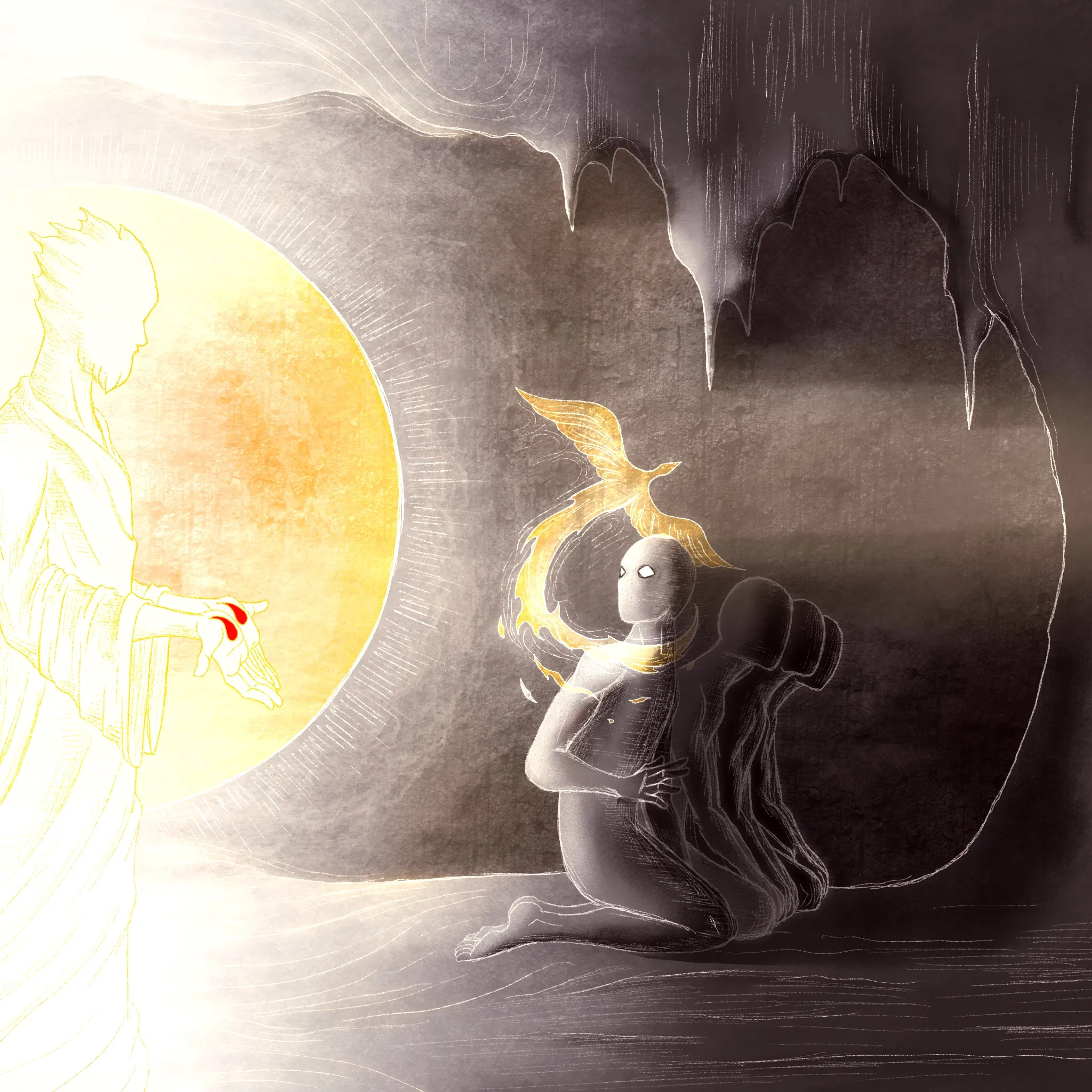
The angel caused the earthquake that Easter morning. Our translation says, “there was a great earthquake, for an angel of the Lord descended from heaven” (Mt. 28:2), but it should probably be, “becausean angel of the Lord descended.” The earth shook because the angel caused it to. And it isn’t the quake that moves the stone. The angel rolls it away after the quake then sits on it.

This angel is quite the character. We don’t know his name, but he certainly is a rabble rouser. He has the appearance of lightening and clothing white as snow.

This flashy, showy angel doesn’t sit on the stone because he is tired. Angels don’t get fatigued like we do. He sits there to mock the stone and the tomb that it had sealed. You could almost say that he’s dancing on the grave. But with a different meaning than we usually give to that phrase. He’s dancing on the grave of death.

It would have taken several strong, well-bodied people to roll that stone away. You’ll hear in tomorrow’s Gospel reading from Mark (16:3) that the women were concerned about who was going to move it for them when their plan is to return to the tomb and finish preserving Jesus’ body. Their plans had to change. But for this angel, that stone was puny and totally insignificant. The angel just tosses it aside. It wasn’t capable of keeping Jesus in the grave, and the angel sits on it to show how inconsequential the attempts were to keep Jesus dead.

The guards are terrified by all of this and rightly so. They trembled just like the ground. Their armor, swords, and training were nothing in the presence of this angel. They became like dead men. As they lay there on the ground, they were probably glad that this electrified angel hadn’t sat on them.

But then, Matthew mentions the women. They arrive to this dominant display of angelic power, and the angel tells them, “Do not be afraid,” even though there is no mention of them being fearful. The women had been scared previously. Scared to tears after the death of Jesus. But the time for weeping is over. Psalm 126:5 says, “Those who sow in tears shall reap with shouts of joy.” For these women, and for all believers in Christ, the harvest has come.

Our time of sowing tears is finished. Jesus lives. It is time to gather in the crop of resurrection joy. Because Jesus is risen, our mouths are filled with laughter and our hearts with cheer. The angel sits on that stupid, weak, trivial stone because nothing can stop the victory parade of life.

Jesus had gone weak as a newborn lamb to the cross, but there He stripped the devil of all his strength. The trickster serpent has been tricked. On Good Friday, Satan was tempted just like Eve was in the Garden. The devil saw the forbidden fruit that hung on the tree of Calvary. He took it and ate. But now his belly bursts, and he is the one who has to hide.

He is done, finished, defeated. The devil has no accusations left. He threw all his accusations at Christ, and Jesus has answered for all of them. So now, when Satan tries to accuse you, all you have to do is point him to Christ, and his mouth is silenced. He has no allegations left for you because Jesus has died to take them all away, and Christ is risen to show they are nothing.

Did Satan think that a rock and some guards could keep Jesus dead? Maybe, but this resurrection angel, and all the angels, laugh at the thought. It would be easier to fit the oceans in a styrofoam cup or to ride a unicycle to Pluto than to keep God in the grave.

God wouldn’t let what is His be stolen. He takes it back. He takes back Adam and Eve. He delivers Noah and his family. He frees the whole people of Israel from slavery. He restores to Himself Ezekiel and that valley of dead, dry – very dry – bones. He restores the fortunes of Zion and exalts over them with loud singing. He pulls His people safely from the burning fiery furnace and walks with us in every trouble.

God does all of this because Christ has bought and paid for you on the cross. The devil has no claim – none whatsoever. Satan got what he thought he wanted. He took a bite out of God. The devil bruised His heel by putting Him to death. But Jesus has crushed his head. Jesus died, but He lives.

Every day of our lives now, let’s join this rambunctious angel in mocking sin, death, and the devil. Daily don the robes of righteousness that Christ has given you in your Baptism (Gal. 3:27). Daily let the God-given light of salvation shine through you (Mt. 5:14-16).

The grave is open. It couldn’t hold Jesus. It won’t hold your loved ones who have departed with the sign of faith. And It won’t hold you either.

We don’t know this rambunctious resurrection angel’s name. But one day, God be praised, we will. Amen.[1]

Alleluia! Christ is risen!
He is risen indeed! Alleluia!

The peace of God, which surpasses all understanding, will guard your hearts and minds in Christ Jesus. Amen.

[1] This sermon was adapted from Rev. David Petersen of Redeemer Lutheran Church, Ft. Wayne, ID.

I Thirst – Sermon on John 19:28 for Good Friday

Listen here.

In the name of Jesus. Amen.

In Hosea 11:1, God says, “When Israel was a child, I loved him, and out of Egypt I called My son.” But it didn’t take long for that beloved child to start whining. Even though God had displayed His might and power to protect and deliver His people through the plagues He sent upon Egypt, three days after crossing the Red Sea the people came to the bitter waters of Marah (Ex. 15:22-26). They grumbled against Moses saying, “I thirst! What are we going to drink?”

Well, God acted for His son, Israel. God showed Moses a log and told him to toss it into those bitter waters. Moses did, the bitter water became sweet, and the thirst of Israel, God’s son, was quenched.

About one month later, God’s son, Israel, again said, “I thirst.” They had come to a place where there was no water. This time the whining was worse. The son grumbled again saying to Moses, “Why did you bring us up out of Egypt, to kill us and our children and our livestock with thirst?” But God, their loving Father, still provided. He told Moses to take his staff and strike a rock. And from that rock came water for God’s son, and his thirst was quenched again.

Tonight, Jesus, on the verge of death, cries out, “I thirst.” Jesus is God’s true, beloved, faithful, obedient Son. Jesus is the true Israel. Christ had never whined or complained no matter how hard or bitter things got for Him. He was everything that the nation of Israel wasn’t. Yet, when Jesus, the only-begotten Son of God, cries out to His Father, “I thirst,” God doesn’t move a muscle. God doesn’t jump to action.

You remember the parable of the rich man and Lazarus (Lk. 16:19-31). As he is there in torment, the rich man begs for a drop of water from Lazarus’ finger. Like that rich man, Jesus gets nothing to drink. Not even one drop.

When Jesus cries, “I thirst,” it is because He is truly parched. Jesus is true God and also true Man. He actually was thirsty. But even more than needing water for His dehydrated mouth, Jesus’ thirst is to do His Father’s will (Jn. 4:34). Christ thirsted for your salvation so that you can be God’s child. Only Jesus can truly say, “As a deer pants for flowing streams, so pants my soul for You, O God. My soul thirsts for God, for the living God” (Ps. 42:1-2a). Jesus thirsted in your place.

We thirst for things that are momentary and trivial. We thirst for the attention and approval of others. We thirst for our own glory, our own wealth, our own safety, our own selfish desires. But no matter how much we drink from the cup of our sins, our thirst is never satisfied there. That is why Jesus went to the cross. He went there because of your sin. He went to the cross to atone for your sinful thirsts.

That is why, it pleased God to do nothing for Jesus as He thirsted on the cross. It was God’s will for Jesus to drink from the bitter cup of wrath so that you could drink the sweet, living waters that Jesus gives which well up to eternal life (Jn. 4:14).

There was no water from the rock for Jesus because He was the Rock. According to 1 Cor. 10:4, Christ was the Rock that was struck in the wilderness for God’s people to drink. It happened in the wilderness for Israel, God’s son, and it still happens for you today, believer. Jesus was struck with a spear and out of that dead Rock hanging on the cross came the water and blood which give eternal life.

Jesus thirsted. He died. He rose again. And He is ascended and is now seated at God’s right hand. But Christ still thirsts. Even today He thirsts, and His thirst is for your salvation. He thirsts for you to be forgiven and receive His righteousness. Jesus’ thirst is to eternally satisfy your thirst.

So, Jesus, your Savior, invites you, “If anyone thirsts, let him come to me and drink. Whoever believes in me, as the Scripture has said, ‘Out of his heart will flow rivers of living water’” (Jn. 7:37-38).

May we drink from Him, our crucified and risen Lord and Savior. Amen.The peace of God, which surpasses all understanding, will guard your hearts and minds in Christ Jesus. Amen.

A Mandate & a Meal – Sermon on John 13:1-15, 34-35 for Maundy Thursday

Listen here.

John 13:1-15, 34-35

In the name of Jesus. Amen.

Tonight is the night when Jesus was betrayed into the hands of evil men, but the plan had already been put into motion. The money had been counted and put in Judas’ pocket on Tuesday of Holy Week. That day, Satan entered into Judas Iscariot through a love of money (Lk. 22:3-6), and he agreed with the chief priests and officers to hand Christ over to them.

This is probably why we do not have any record of what Jesus did on Wednesday of Holy Week. Jesus probably didn’t do much that day. After Jesus entered into Jerusalem on Palm Sunday, He would enter the city and preach and teach publicly in the Temple. The Gospels record that these public appearances and teaching happened Sunday, Monday, and Tuesday. But there is no record of anything happening on Wednesday.

It is very possible that Jesus didn’t even enter into Jerusalem on Wednesday because He knew the plot. If He had entered into Jerusalem on Wednesday, He would be arrested. It is also probably why He didn’t appear to have a plan on where He and His disciples would celebrate the Passover. Jesus isn’t just a guy who doesn’t like to make plans. His plan was to keep the plan secret. The whole thing is carefully and deliberately orchestrated so that Judas can’t betray Jesus until He is ready.

It isn’t until sometime on Thursday that Jesus sends only two disciples, Peter and John, to find a certain man carrying a water jar, follow him into the house he enters, and tell the master of the house that Jesus would like to eat the Passover there (Lk. 22:7-13). So, until they get to that upper room, only Jesus, Peter, and John know where they will be that Thursday night. Again, Jesus orchestrates all of this so that Judas can’t betray Him secretly. Judas only betrays Jesus when Christ dismisses him to do it.

And Jesus times His betrayal so that He can give His Church a new commandment or ‘mandate’ (which is why tonight is called ‘Maundy Thursday’) and a meal.

The very same night Jesus was betrayed, our Lord washed His disciples’ feet. This foot washing isn’t a Sacrament. There is no word or promise of forgiveness attached to washing feet. This washing was, in a sense, a parable acted out. By serving His disciples in this way, Jesus is showing how He wants them and us to serve and love one another.

Foot washing was a common thing in those days. Anyone who was going to be a guest at a banquet would have their feet washed even if they had just bathed. The walk from one house to another would make a person’s feet dirty and dusty enough to need another washing. But the task of foot washing was always reserved for the lowest servants. A disciple would do many different chores for the rabbi he was following, but foot washing was never one of them. But here, in a beautiful reversal, Jesus, the Rabbi, the Teacher sent from God, and in fact God Himself in the flesh, humbles Himself to do the lowest of tasks for His disciples.

At this point in the supper, all twelve disciples were still there. Judas had not yet left to betray Jesus. So, yes, our Lord washed the feet of Judas and served His betrayer in this way. This foot washing was an act of vulnerability and intimacy. In this washing, Jesus takes their faith and, in return, gives them His righteousness and cleansing.

Judas does not benefit from this, but Jesus still does it for him. Judas rejected the righteousness of Jesus in place of the thirty pieces of silver. Later, Judas will reject forgiveness too. After the crucifixion, Judas seeks atonement in remorse and self-judgment, but he didn’t find it there.

With this foot washing of all the disciples including Judas, Jesus gives us an example that teaches us a very important lesson, and that lesson is this: Love isn’t always easy or clean. Love can often be one-sided and unanswered. Just because you love someone and do selfless acts for them does not mean they will love you in return. And know that you aren’t greater than Jesus. If His love was rejected and repaid with betrayal, yours will be too.

Yet, still Jesus would have you, His disciples, His Christians, love your enemies as you have been loved by Him. Bear one another’s burdens. Forgive and serve one another. That is this new commandment, this new mandate, that Jesus gives. Which, again, is why today is called Maundy Thursday.

But because you do and will fail in this mandate that Jesus gives, Maundy Thursday is more than that. It is the night that Jesus mandates and gives you a meal. Tonight is the night in which Jesus was betrayed, and Judas isn’t the only culprit. Even the disciples who do love Jesus fail Him, but He does not fail them. That is why Jesus gives the disciples more than a mandate. He also leaves them the enduring, continual gift and meal of His living Body and Blood.

We have considered Baptism the past several weeks in our Lenten services, and Baptism is who we are as Christians. In Baptism, we are given God’s name (Mt. 28:19), we are begotten as His children (Jn. 3:3-8), and we are clothed in Christ (Gal 3:27). Baptism defines who we are.

And the Lord’s Supper is what we do because it is what Jesus has given us to do. We are to eat and drink in remembrance of Jesus (1 Cor. 11:23-25) and whenever we celebrate the Lord’s Supper, according to Scripture, we proclaim His death until He comes (1 Cor. 11:26). In the Lord’s Supper, Jesus promises that we receive the forgiveness of sins. Is there anything more Christian than receiving Christ’s forgiveness?

When Jesus calls us to eat and drink in remembrance of Him, He doesn’t mean, “Do this while you think fondly about Me and what I did for you a long time ago.” Instead, this remembrance is about faith. Faith recalls and clings to what Jesus did and still does with this bread and cup. According to what Jesus says, this bread is His Body which was broken upon the cross for you, and this cup is His Blood which was shed for you. In faith, we celebrate the Lord’s Supper believing that all of this pertains to us and to our salvation.

Jesus’ death happened nearly 2,000 years ago on a cross outside Jerusalem, but the fruits of that redeeming death are given both before and after. Jesus gives His disciples His Body and Blood even before He makes the sacrifice. And He continues to give the same gifts in every congregation where two or three are gathered. His gift is not bound by time or place.

Both of these things go together – the mandate and the meal, the washing of feet and the Lord’s Supper. They are faith and love in action. With the sacrifice of His body and blood, Jesus loved them. And when He washed their feet, Christ showed them how to love each other as they place their trust in Him.

So, dear saints, follow Christ’s example and do as He has done to and for you (Jn. 13:15). Your Savior became your servant.

And know that when you come to this altar, to this table, you are, in fact, serving the world. The world benefits from you coming here to receive the true Body and Blood of Jesus. This Sacrament drives back the forces of darkness because in this meal, Jesus’ death in the place of sinners is proclaimed (1 Cor. 11:26). Here, Jesus comes to you as a Man, alive and out of the grave. He puts His Body and Blood into you to crucify you to the world and the world to you (Gal. 6:14). As you receive this meal and do this in remembrance of Him, you celebrate His victory over sin, death, and the devil. And those around you will benefit from this. As you are fed and strengthened in your faith, you will go back into the world knowing that God has forgiven you for the sake of Christ.

And, then, when you fail to be the servant Jesus calls you to be, when you fail to love as you have been loved, run back to Jesus. He is always ready to give you another washing and another serving.

Dear saint, you are declared by Jesus to be clean. Your Lord and Savior is here to be your Servant and clean you again. Come and receive what He gives you for your cleaning, for your comfort, for your strengthening. Amen.

The peace of God, which surpasses all understanding, will guard your hearts and minds in Christ Jesus. Amen.

Passion Miracles – Sermon on Matthew 26:1-27:66 for Palm Sunday

Listen here.

Matthew 26:1-27:66

In the name of Jesus. Amen.

The seven sayings of Jesus on the cross are the most important words spoken in all history. We have considered them in the past, and we will hear them again on Friday. But Jesus isn’t the only member of the Trinity speaking during the crucifixion. God the Father speaks too, but not audibly. Instead, the Father speaks through the miracles that take place while Jesus is on the cross, and we are going to give our attention to those today.

The first miracle is the darkness. In the Gospel of Mark, we are told that Jesus was crucified, nailed to the cross, at the third hour (Mk. 15:25), which would be about 9 AM. Then, the Gospels tell us that there was darkness from sixth hour until the ninth hour. In other words, that darkness lasted from noon until 3 PM when Jesus died.

Now, Matthew says this darkness was over “all the land” (Mt. 27:45). The interesting thing there is that the word ‘land’ can mean portions of a country. But most of the time, the word there means the entire earth. Matthew uses it in both senses throughout his Gospel. It could be that this darkness was localized to the region surrounding Jerusalem where Jesus was crucified, but it could have been much more than just that – even the entire earth.

This darkness was not a solar eclipse. Jesus was crucified at the time of the Passover which means there would have been a full moon, and a solar eclipse can only happen at a new moon. Plus an eclipse only lasts minutes, not hours. We also know that this darkness wasn’t the result a bunch of thick, dark clouds gathering. A Greek historian named Phlegon of Tralles, who was born shortly after Jesus’ death, records what he calls an eclipse. He wrote that it became night at noon so that the stars even appeared in the heavens. Now, Phlegon wasn’t a Christian. He might not have even been aware of the Gospels recording this same event. But the dating of his account matches up precisely with the timing of the crucifixion. Today, secular scholars have tried to come up with an explanation for this darkness Phlegon mentions, but they can’t. No astronomical or meteorological explanation can be made, but the historical accounts aren’t denied either.

This darkness happened because of God. God has the authority to turn off the sun if He wants to. Over and over in Scriptures, darkness is a sign connected with God’s judgment and anger over sin. Remember the ninth plague of darkness over the land of Egypt (Ex. 10:21-22). For three hours during the crucifixion, this darkness covered the land.

So, what was going on here; what was God the Father saying with this darkness? Well, Jesus had taken upon Himself the sins of all humanity, and God’s judgment was laid upon Christ (Is. 53:6). Think of all the sins you just heard about: treachery of Judas, the cowardice of Pilate, the blasphemy of the chief priests, the malice of the crowds. All those heinous sins were all placed upon Jesus.

But it was more than that too. The murder committed by Cain, the hard-heartedness of Pharaoh, the continual unbelief of the Israelites, the pagan practices of the inhabitants of Canaan, the adultery of David, every bit of sin in the world up to that point was all placed on Jesus. All the sins that have happened since: the sins of Nero, Hitler, Stalin, bin Ladin, and every other wicked, evil person were laid upon Jesus. Your sins were there too: your anger, lust, pride, gossip, lies, and covetousness. And all the sins that are still to happen in the future. All of it was there in that moment on Christ as He hung on the cross.

All of those sins angered God. He noticed them and was angry because of them. But know this. God only let the darkness of judgment fall when those sins were laid upon Christ and were no longer yours. So, between noon and three on that Good Friday, Jesus took all of those sins. Christ Himself bore your sins in His body on the cross, and by His wounds you are healed (1 Pet. 2:24). That’s why Jesus says from the cross, “It is finished” (Jn. 19:30). His redemption for every sin of every person who has ever lived and will ever live was paid in full. Jesus suffered the punishment of God for it all.

The second miracle was the tearing of the curtain in the Temple. The curtain was thick and heavy, so it was no coincidence that it tore from top to bottom. For hundreds of years, that curtain stood as a barrier between God and all of humanity. Only the priest could go behind that curtain into God’s presence on the Day of Atonement. Remember that both the Tabernacle and the Temple served as copies of heaven (Heb. 8:59:23; Ex. 25:9). So, for generations, that curtain preached a sermon to God’s people that said, “Heaven is off limits to you.” But when the high priest would go in behind the curtain on the Day of Atonement, that yearly event preached another sermon. A very different sermon. That sermon preached that access to heaven would come, but only through a substitute.

So, when that Temple curtain tore from top to bottom, what was God saying? God was saying that you who were once far off have been brought near by the blood of Christ (Eph. 2:13). God is pleased with you now. He loves you, and heaven is open to you because of Jesus’ death.

The third miracle was the earthquake. The same historian I mentioned earlier, Phlegon, he wrote about this earthquake too. And he wrote about it in Nicaea which is almost 700 miles away from Jerusalem. It’s hard to say for certain what this earthquake means – especially because there is another earthquake Easter morning (Mt. 28:2). But remember how the Pharisees wanted Jesus to rebuke the people who were crying out, “Hosanna,” as He rode into Jerusalem? Jesus answers them, “If these were silent, the very stones would cry out” (Lk. 19:36-40) It could be related to that. It could be a sign that God had redeemed all creation by the death of Jesus (Ro. 8:21-23). We can’t say for sure why the earthquake happened. But creation noticed and responded to both the death and resurrection of Jesus.

Finally, the fourth miracle is that many of the saints were raised. We heard how Matthew mentions that these risen saints walked around after Jesus’ resurrection and appeared to many (Mt. 27:52-53). What this shows us is that death is no longer the enemy it was before the death of Jesus. God can raise the dead in an instant. Jesus has paid the price. Disease, death, violence, virus, plague, and pandemic are no longer your enemy. They are all defeated by Christ. 

Dear saints, these miracles prove that you have nothing to fear. Christ has paid the price for your sins. God is on your side. He is risen, and so will you. Your King has come with righteousness and salvation (Zech. 9:9). He has spoken peace to you (Zech. 9:10). Return, you prisoners of hope; return to God, your stronghold (Zech. 9:12).

Christ has humbled Himself for you to death – even death on a cross (Php. 2:8). At the name of Jesus every knee will bow and every tongue confess that He is Lord.

So, yes, “Hosanna! Hosanna to the Son of David! Hosanna in the highest!” Ride on Jesus. Ride on and save us. Welcome to Holy Week. Amen.

The peace of God, which surpasses all understanding, will guard your hearts and minds in Christ Jesus. Amen.
Infant Baptism – Sermon for Midweek Lent 5

Listen here.

Do children also believe? Are they rightly Baptized?

The Baptism of infants is pleasing to Christ, as is proved well enough from His own work. For God sanctifies many of those who have been baptized as infants and has given them the Holy Spirit. There are still many people even today in whom we perceive that they have the Holy Spirit both because of their doctrine and life. It is also given to us by God’s grace that we can explain the Scriptures and come to the knowledge of Christ, which is impossible without the Holy Spirit [1 Cor. 12:3].

For this reason let everyone value his Baptism as a daily dress [Gal. 3:27] in which he is to walk constantly. Then he may ever be found in the faith and its fruit, so that he may suppress the old man and grow up in the new…. [I]f anyone falls away from the Christian life, let him again come into it. For just as Christ, the Mercy Seat [Ro. 3:25], does not draw back from us or forbid us to come to Him again, even though we sin, so all His treasure and gifts also remain. Therefore, if we have received forgiveness of sin once in Baptism, it will remain every day, as long as we live. Baptism will remain as long as we carry the old man about our neck.

Martin Luther’s Large Catechism

In the name of Jesus. Amen.

Many times, we Lutherans (along with Roman Catholics and others) are accused of doing something that is not biblical when we Baptize infants. Some well-meaning Christians will say, “The Bible never records an infant being Baptized.” And I have to admit that is correct. There is no verse that says, “Little two-week-old Bobby was Baptized,” or, “Timmy was Baptized as an infant.” The snarky side of me would like to point out that nowhere in Scripture does a woman explicitly receive the Lord’s Supper. If we would deny a child the gifts that God gives in Baptism just because there is no explicit mention of an infant being Baptized in Scripture, should we deny women the Body and Blood of Jesus? No!

Even though the Bible does not have a record of an infant being Baptized, the Scriptures certainly do imply that babies were Baptized. Look again at our first lesson (Act. 2:37-41). Peter has preached his great Pentecost sermon and closes with the horrific words of the Law, “Know for certain that God has made [Jesus] both Lord and Christ, whom you crucified.” The people are terrified, cut to the heart, and ask, “Brothers, what shall we do?” Peter answers, “Repent and be baptized every one of you in the name of Jesus Christ for the forgiveness of your sins, and you will receive the gift of the Holy Spirit,” now listen closely, “for the promise is for you and for your children.” In other words, the gift of forgiveness and the Holy Spirit is for the people there and for their children. That doesn’t mean that their children get the promise eventually when they grow up. The natural reading of that text is that Baptism is for the people there and for their children and babies. Peter could have limited it to people who were of a certain age, but he didn’t.

Later, in Act. 16, there are two entire households that are Baptized. First the household of Lydia (Act. 16:11-15), and later the household of the Philippian jailor (Act. 16:25-34 esp. v. 31-33). Remember that in the time of the New Testament, the life expectancy wasn’t that much longer than normal, child-bearing years, and they didn’t have the methods of birth control that we do. Also, children were much more valued back then. It is highly unlikely that neither Lydia, who was a seller of purple goods (Act. 16:14), nor the Philippian jailor had households without any children.

And remember, when Jesus gives the gift of Baptism to the church as the method of making disciples, He says, “Make disciples of all nations (ἔθνος, ‘ethnicities,’ ‘all types of people’) by Baptizing them in the name of the Father, Son, and Holy Spirit” (Mt. 28:19). If Jesus wanted to limit who is eligible to be Baptized, He would have made a limit there, but He didn’t.

Now, very briefly (I don’t want to spend much time on this because it is an absurd thought process): We know that “all have sinned and fall short of the glory of God” (Ro. 3:23). Our Psalm tonight (Ps. 51) teaches us that we are brought forth in iniquity and in sin did our mothers conceive us (Ps. 51:5). Still, some people teach that God does not hold babies accountable for their sins until they reach some sort of ‘age of accountability’ (which isn’t a biblical term anyway). But just use a little logic: If God isn’t going to punish young children for their sins until they reach a certain level of understanding of their sins, then abortion and infanticide would be evangelistic tools. God forbit it! Enough on that thought.

Back to what Peter says in Act. 2:38-39, some will say that Peter requires things to be done sequentially. First, you have to repent, then you can be Baptized. Or first you have to believe and only after you believe then you can be baptized. First of all, salvation isn’t a three-step program. But also notice that argument implies that babies cannot believe, which is not in line with what Scripture teaches – not at all. The overwhelming teaching of Scripture is that babies can and do believe.

I included an insert in your bulletin tonight titled, “Infant Faith in the Scriptures.” For anyone watching or listening, I’ll include links to it in the description (click here). And I would like us to quickly walk through it.

First, let’s start with Ps. 71:5-6. “For you, O Lord, are my hope, my trust, O Lord, from my youth. Upon you I have leaned from before my birth; you are he who took me from my mother’s womb. My praise is continually of you.”

One of the reasons this is such a great place to start is the variety of vocabulary used to describe a child. The verses start by saying that the Lord is my hope and trust ‘from my youth.’ In English, we use the word ‘youth’ for a very wide range of ages. Sometimes, churches have ‘youth group’ for middle-school through high school. East Grand Forks has ‘youth soccer’ for preschool through sixth grade. The Hebrew word translated as ‘youth’ here has a wide range of meaning too. One of the nice things about Hebrew poetry is that it’s very repetitive, and the repetition helps us see how expansive the term is. So, in v. 5 God is the object of hope and trust for the psalmist from his youth, and notice in v. 6 how it gets specific. The psalmist has leaned on God from before his birth. He recognizes that God was the one who brought him from his mother’s womb, and he continually (i.e. from before his birth and throughout his youth) praises God.

Those verses are very instructive, but let’s turn to the New Testament, and specifically what Jesus teaches about the faith of children. To do that, we need to understand some of the vocabulary of the Greek New Testament. In English, we have lots of words for a kid: infant, baby, toddler, tyke, little one, child, youth. Greek does the same. I’ve included five words (there are more) that deal with children. And I put them in different colors so they pop out in the verses that follow. Let’s quickly go through and define them:

βρέφος (brephos) – very small child; baby; infant; unborn baby in the womb

παιδίον (paidion) – a child below the age of puberty; it’s maybe the most basic words for ‘child,’ but it has a wide range of ages that it can apply to.

μικρός (mikros) – ‘little one’; one who is small; it’s even used to describe Zacchaeus

νήπιος (nēpios) – a very young child; infant; a minor not yet of legal age

θηλάζω (thēlazō) – v. ‘to nurse’; can also be used as a noun meaning ‘one who nurses’

So, let’s go through the verses on that sheet. First, Luke 18:15-17 which is the same account as our Gospel lesson tonight (Mk. 10:13-16). Now, to be fair, Mark only uses the word παιδίον when he records this, but that’s why I used Luke’s account here. According to Luke, the doctor, people are bringing even their βρέφος (infants) to Jesus to be blessed by His touch. The disciples didn’t like it, but Jesus says, “Let the children (παιδίον) come to me, and do not hinder them, for to such belongs the kingdom of God. Truly, I say to you, whoever does not receive the kingdom of God like a child (παιδίον) shall not enter it.” Jesus here plainly says that the kingdom of God belongs to children to παιδίον – and notice that includes infants, βρέφος. And if we say that the kingdom belongs to children apart from faith, we are going to end up in a very bad place theologically.

Next passage, Matthew 18:1-6: The disciples want to know who is the greatest in the kingdom of heaven. Jesus brings a child (a παιδίον) into their circle and says, “Truly, I say to you, unless you turn and become like children (παιδίον), you will never enter the kingdom of heaven. Whoever humbles himself like this child (παιδίον) is the greatest in the kingdom of heaven. Whoever receives one such child (παιδίον) in my name receives me, but whoever causes one of these little ones (μικρός ‘little guys’ and notice what Jesus says next) who believe in me to sin, it would be better for him to have a great millstone fastened around his neck and to be drowned in the depth of the sea.” According to Jesus, children, even little ones believe in Him.

Next verse, Matthew 21:15-16: This is after Jesus has entered into Jerusalem on Palm Sunday to the shouts of “Hosanna!” The chief priests and scribes get furious when they see all the things Jesus is doing, and they see children (παιδίον again) crying out, “Hosanna to the Son of David!” They want Jesus to get them to quiet down by asking, “Do you hear what these are saying?” And Jesus responds, “Yup! Have you never read,(then He quotes Ps. 8:2) “‘Out of the mouth of infants (νήπιος) and nursing babies (θηλάζω) you have prepared praise’?” Right praise of God is only possible through faith (Ro. 14:23b).

Chugging right along, Matthew 11:25-27: Jesus praises His heavenly Father, “I thank you, Father, Lord of heaven and earth, that you have hidden these things from the wise and understanding and revealed them to little children (νήπιος infants); yes, Father, for such was your gracious will. All things have been handed over to me by my Father, and no one knows the Son except the Father, and no one knows the Father except the Son and anyone to whom the Son chooses to reveal him.” God is more than capable of hiding things from the wise and understanding and able to reveal the things of faith to the infants.

Two more, 2 Timothy 3:14-15: Paul tells pastor Timothy, “Continue in what you have learned and have firmly believed, knowing from whom you learned it.” Pause for a second: remember from the previous verse, who does the teaching and revealing? God does. Continue at v. 15 “and how from childhood (βρέφος from ‘infancy’) you have been acquainted with the sacred writings, which are able to make you wise for salvation through faith in Christ Jesus.” Since his infancy, and maybe even before his birth (as we’ll see in a minute), Timothy was acquainted with the sacred writings, the Scriptures, through which God makes even infants wise for salvation through faith in Christ Jesus.

Finally, we see this actually happen in our final passage, Lk. 1:1541: This is about John the Baptizer. In v. 15, the angel Gabriel announces to Zechariah that he will have a son, that’s John. And that John will, according to v. 15, “be filled with the Holy Spirit even from his mother’s womb.” Later on in v. 41, Mary visits Elizabeth, John’s mother and Mary’s relative. When Mary got to her house and greeted Elizabeth, the baby (βρέφος the pre-born baby, John) leaped in her womb. Elizabeth goes on to say that pre-born John leaped precisely at the sound of Mary’s greeting, which, if I remember rightly, was shalom, ‘peace.’

With that text in particular, we see that babies can hear in the womb. But even more importantly, that the Word of God, that proclamation and greeting of God’s peace, is effective to give the Holy Spirit and create faith even for pre-born babies. So, all you dads and moms, take note. Read the Scriptures to all your children, even before they are born. God works through His Word.

So, Scripture teaches that children, infants, and even pre-born babies can have faith. So, if someone objects to infant baptism based on the idea that infants can’t believe, they are arguing against Scripture.

And we can admit that it’s difficult to know how babies believe. How can infants who can’t talk or express themselves believe? But that’s the miracle of faith. How can any sinner, dead in their sin believe? Faith is always a gracious, life-giving gift of God (Eph. 2:8-9).

Think back to what we’ve covered the past five weeks and see what Scripture says that Baptism does: Baptism saves (1 Pe. 3:21). It forgives sins (Act. 2:38). Baptism delivers from death and the devil (Col. 1:13). It gives the new begetting from above (Jn. 3:35-6). In Baptism, God joins you to Jesus’ death and resurrection (Ro. 6:3-11) and clothes you with Christ (Gal. 3:27). And nowhere does Scripture limit that work. All sinners, even infants, need God to do those things. And, God be praised, God promises that Baptism does all of these things, and God cannot and does not lie. So, continue believing what God has done for you in your Baptism.

I want to close with the second paragraph from the Large Catechism in your bulletin:

“For this reason let everyone value his Baptism as a daily dress [Gal. 3:27] in which he is to walk constantly. Then he may ever be found in the faith and its fruit, so that he may suppress the old man and grow up in the new. [I]f anyone falls away from the Christian life, let him again come into it. For just as Christ, the Mercy Seat [Ro. 3:25], does not draw back from us or forbid us to come to Him again, even though we sin, so all His treasure and gifts also remain. Therefore, if we have received forgiveness of sin once in Baptism, it will remain every day, as long as we live. Baptism will remain as long as we carry the old man about our neck.”

Even though we can (and, sadly, some do) walk away from the faith and deny the benefits of their Baptism, God remains faithful to His promises (2 Tim. 2:13). Those promises are always there for you to return to. Live in those promises trusting what God has done for you through your Savior, Jesus Christ. Amen.

The peace of God, which surpasses all understanding, will guard your hearts and minds in Christ Jesus. Amen.

An Eternal Redemption – Sermon on Hebrews 9:11-15 for the Fifth Sunday in Lent

Listen here.

Hebrews 9:11-15

11 But when Christ appeared as a high priest of the good things that have come, then through the greater and more perfect tent (not made with hands, that is, not of this creation) 12 he entered once for all into the holy places, not by means of the blood of goats and calves but by means of his own blood, thus securing an eternal redemption. 13 For if the blood of goats and bulls, and the sprinkling of defiled persons with the ashes of a heifer, sanctify for the purification of the flesh, 14 how much more will the blood of Christ, who through the eternal Spirit offered himself without blemish to God, purify our conscience from dead works to serve the living God. 

15 Therefore he is the mediator of a new covenant, so that those who are called may receive the promised eternal inheritance, since a death has occurred that redeems them from the transgressions committed under the first covenant.

In the name of Jesus. Amen.

The first ten verses of Hebrews 9, which lead up to this text here, describe the décor of the Tabernacle, how it had a Holy Place with a golden lampstand, the table, and the Bread of the Presence. Beyond the Holy Place was the Most Holy Place, the Holy of Holies, where there was an altar of incense and the Ark of the Covenant covered in gold.

Inside the Ark was a golden urn holding some of the manna, Aaron’s staff which had budded, and, most importantly, the tablets of stone on which was written the Ten Commandments. Standing over the Ark were the golden cherubim overshadowing the mercy seat which was the exact place where God said He would meet with His people. Only high priest could enter that Holy of Holies, and he only went in one day each year – the Day of Atonement. The high priest would actually go into the Holy of Holies three times that day. First, he would enter to fill the place with the smoke of incense creating a smoky barrier between himself and God’s holiness. He would enter a second time to offer the blood of a bull for his own sins. And finally he would enter, to sprinkle the blood of a goat on the Ark for the sins of the people. 

Now, there are all sorts of details that we could go into, but for the sake of time today, we’re going to focus on the blood of the goat that was sprinkled on the Ark and the tablets of the Ten Commandments that were inside the Ark. The blood of that sacrifice created a barrier between God’s Law inside the Ark and the people outside the Tabernacle. That blood, according to God, was what was required for sins.

To get an idea of what was happening on the Day of Atonement, I’d like to give you a picture from a friend of mine. Imagine a huge stone wall before the presence of God in heaven. Every time you sin, a chisel etches into that rock recording how you have broken God’s Commandments. Every time you covet the things that God has not given you, tink, tink, tink, your sin is engraved in heaven. Every time you gossip, spread rumors, or speak poorly of your neighbor, tink, tink, tink. Every time you take was is not yours, hold back something that could help your neighbor, or act selfishly or ungenerously, tink, tink, tink. Every lustful thought, every filthy word, every unchaste deed, tink, tink, tink. Every ounce of your anger is recorded there on that wall, every time you disobey your parents or rebel against the authorities God has placed over you.

This is the record of sins against your neighbor, but your sins against God cry out even more. Missing church, despising God’s Word, neglecting your prayers, and fearing and loving and trusting in everything but God, all of this comes before the Father and cries out for justice and punishment. This is the accusing work of the Ten Commandments, they accuse us, and you and I stand guilty.

Now, it doesn’t really matter if you feel guilty. You are guilty. And in fact, if you aren’t concerned about those sins, that’s additional marks against you. When a convicted criminal has no remorse or feelings of guilt for the sins for which he’s guilty, it is good and right for the punishment to be harsher.

What the high priest was doing when he entered into the Holy of Holies on the Day of Atonement was offering the blood of a goat for the sins of the people. Every year the blood of that sacrifice preached to the people that God accepted the death of another in their place. But the problem was that it was that blood, that sacrifice, needed to be annually refreshed and touched up with another sacrifice. So, every Day of Atonement, the high priest would go through all of it again.

But now, our text would have us imagine that Jesus, our Great High Priest, has come, not into the Tabernacle, but into the heavenly courtroom. Jesus still has the holes in His hands, feet, and side. And Jesus carries a bowl full of blood, but it isn’t the blood of a goat. Instead, it is His own blood, drained from His body as He suffered and died on the cross. He takes that blood to this massive stone wall with the chiseled record of all of your sins, and He covers the whole wall with His blood. All those marks are smeared with His blood. And now, when the Father looks there, the record of your sin is gone. instead, God sees the blood of Jesus, and not one bit of the evidence of your sins is visible. Every sin is died for. Everything you have done that deserves God’s punishment has been covered by the blood of Jesus.

That’s the picture of this text. Look again at v. 12, “[Jesus] entered once for all into the holy places, not by means of the blood of goats and calves but by means of His own blood, thus securing an eternal redemption.” Your sins are forgiven, and the perfect righteousness of Jesus is given to you. And this transaction happened, not in a tent made by hands. Instead, this transaction took place once for all eternity in the reality of the heavenly courtroom, the temple not made with hands.

Jesus took your place. He endured the wrath of God that you and I deserve. Because He did this, He secured an eternal redemption for you. His sacrifice, His shed blood, is presented before God the Father who, according to Jesus in our Gospel lesson (Jn. 8:42-59, see v. 50), is the Judge, and God Himself declares you to be not guilty. Because of what Jesus, your Savior, has done, you have an eternal redemption. And, according to Jesus, as you keep and believe His Word, you will never taste death (Jn. 8:52).

Now, the text plainly says that you have an eternal redemption. Unending, ceaseless, endless – it’s an eternal redemption. But there is another statement here that shows the extent of this redemption. Look again at v. 13-14 and, as you hear this, think back to the sacrificial worship of the Old Testament, “For if the blood of goats and bulls, and the sprinkling of defiled persons with the ashes of a heifer, sanctify (make holy) for the purification of the flesh, how much more will the blood of Christ, who through the eternal Spirit offered Himself without blemish to God, purify our conscience from…” Now, look carefully at what the text says here. “How much more will the blood of Christ, purify our conscience from dead works.”

You would expect the text to say that Jesus’ blood purifies our conscience from ‘sin’ or ‘iniquities’ or ‘transgressions,’ but it doesn’t say that. The text could have said that because that is also true. The blood of Jesus purifies you from every sin that troubles your conscience. But it says that it purifies your conscience from dead works. What are those?

We know that our sins alienate us from God and make God angry with us. But we think that the opposite is true, that God is pleased with us because of our good works. We wrongly think that a few good works here and there earn us brownie points with God. No. Nothing helps us but the blood of Jesus. His sacrifice on the cross cleanses us even from our good works which are, according to this text, dead works.

Our sinful flesh is stuck on the wrong idea that we can cleanse ourselves from sin by making up for those sins by doing good works. That is a dangerous place to be. We cannot atone for our sins. The only hope we have for a clean conscience is the blood of Jesus. He died for your sins, and He died for your dead works that will never make up for the ways in which you have failed.

Because Jesus has offered Himself as the sacrifice for our sins, He is the mediator of a new covenant which He instituted in His Last Supper. When you come in a few minutes to this altar, Jesus gives you that blood which wipes away your sins. The blood that the priests offered in the Old Testament was sprinkled on the altar, but Jesus is about to fill you His life-giving blood.

Christ now invites you to come and receive this eternal redemption, and you will receive the promised, eternal inheritance. Come and receive so that you may have a purified, clean conscience now and through eternity. Amen.

The peace of God, which surpasses all understanding, will guard your hearts and minds in Christ Jesus. Amen.