James 1:22–27
22 But be doers of the word, and not hearers only, deceiving yourselves. 23 For if anyone is a hearer of the word and not a doer, he is like a man who looks intently at his natural face in a mirror. 24 For he looks at himself and goes away and at once forgets what he was like. 25 But the one who looks into the perfect law, the law of liberty, and perseveres, being no hearer who forgets but a doer who acts, he will be blessed in his doing.
26 If anyone thinks he is religious and does not bridle his tongue but deceives his heart, this person’s religion is worthless. 27 Religion that is pure and undefiled before God the Father is this: to visit orphans and widows in their affliction, and to keep oneself unstained from the world.
Alleluia! Christ is risen!
He is risen indeed! Alleluia!
In the name of Jesus. Amen.
Today, we’re going to start by going back to the basics. On Wednesday, our confirmation students had their last lesson for the year which was a review of the two main teachings of the Bible – Law and Gospel. As your pastor, Law and Gospel is what you have called me to do. I’m constantly evaluating if a passage is teaching Law, Gospel, or both. In my conversations with you, I try to determine where and when to apply Law or Gospel. While I’m writing sermons, I try to find the right balance of Law and Gospel. But it’s been a while since we’ve gone back and specifically defined what Law and Gospel are. So, it’s time to do it again, and I apologize if this seems elementary to you.
Basically, the Law is what God requires of you. The Law tells you that if you do not do what it demands or if you do what it forbids, you deserve nothing but God’s wrath and punishment. The Gospel, on the other hand, tells you what God has done for you. Specifically, the Gospel tells you that God has removed His anger, wrath, and punishment from you because of what Christ has done by His death and resurrection. Properly distinguishing Law and Gospel is what makes a theologian, and as a Christian there is enough for you to consider there for your entire life.
But let’s go a little further. The first Lutherans give a nice summary about how the Law actually has three “uses.” In other words, the Law is a tool that does three things. These “uses” are pictured 1) as a curb, 2) as a mirror, and 3) as a guide.
The Law is used as a curb to keep both Christians and non-Christians from committing sin. Think of when you are driving and take a corner too sharply. Your tire hits the curb which bounces you back onto the road. It’s good that the curb does that, but you don’t want to hit the curb too often because it’s bad for your tires. The Law is like that too. When you do wrong and get punished, it hurts and isn’t pleasant, but it gets you back on the path. This is why Christians support appropriate punishment when laws are broken. A thief can repent of his sins and be forgiven before God, but that doesn’t mean he should escape jail time or not have to restore what has been stolen. Those punishments help preserve order in society. So, that’s the first use of the Law – a curb. And it’s important to remember that this first use of the Law is for both believers and unbelievers.
I’m going to wait for a moment on the second “use” of the Law and skip to the third “use” of the Law is as a guide. This “use” of the Law is only for Christians. Christians are fully forgiven for the sake of Christ. We are free from the accusations of the Law (Ro. 3:19, 6:14). But that doesn’t mean that we throw out the Law. No, Christians still need the Law to guide us as to how we live in love toward God and our neighbor. The Law guides us in our love and shows us how to love.
So, back to the second “use” of the Law. The second “use” of the Law is as a crystal-clear mirror which exposes our sin and drives us to Jesus who takes away the sin of the world (Jn. 1:29). The Law is used as a mirror for sinners which means that it is for both Christians and non-Christians. Those who are not Christians need to have their sin exposed by the perfect reflection of the Law so that they repent and believe in Christ. And Christians need this too. As long as we live in this fallen, broken world, Christians will still be sinners. We are forgiven and righteous before God, but our old, sinful nature still clings to us. So, we need the mirror of the Law to expose that sin and run back to Christ. And the end of Romans 7[:14-25] makes that very clear.
So, with all of that in mind, we can now turn our attention to our text here from James. This text, at first glance, sounds like all Law – all Law and no Gospel. We are, according to this text, to be doers of the Word and not hearers only. If we only hear the Word and do not do it, we deceive ourselves, and our religion is worthless. This should convict us because it is Law. Too often we fall into the trap of wrongly thinking that our sins don’t really matter before God, that His forgiveness means that He gives us a wink and a nod when we sin. This text should blast that idea out of your head. That is not the case. Repent. If that is your attitude toward sin, you are a hearer and not a doer. You are deceiving yourself, and your religion is worthless.
But, at the same time, this text isn’t only Law. Notice how these verses from James start. “Be doers of the Word… if anyone is a hearer of the Word and not a doer.” Notice James’ vocabulary. It would have been one thing if James had said, “Be doers of the Law and not hearers only… if anyone is a hearer of the Law and not a doer….” If that is what the text said, we should abandon the Lutheran understanding of salvation and call Lutheran doctrine heresy. But James doesn’t say that. He doesn’t use the word ‘law’; he uses the word ‘word.’ The Holy Spirit inspired James to call us Christians to be doers of the Word which includes both Law andGospel. Notice how James continues:
“If anyone is a hearer of the Word and not a doer, he is like a man who looks intently at his face in a mirror. He looks at himself and goes away and forgets what he was like.” Notice how James, again inspired by the Holy Spirit, now uses a synonym for the Word to conclude his analogy about the mirror. “But the one who looks into the perfect law, the law of liberty, and perseveres, being no hearer who forgets but a doer who acts, he will be blessed in his doing.” There, James equates “the Word” with the “perfect law, the law of liberty.” The two are synonymous.
And, to top it off, the Greek word that gets translated as ‘perfect’ there is very important. The root is τελος which means ‘end, completion, or goal.’ The root can be used as several different parts of speech. Possibly, the most famous use of this root is just before Christ dies on the cross and cries out, “Τετέλεσται” or “It is finished” (Jn. 19:30). And just so you know: in the ESV’s translation of the New Testament, of the 34 times the word ‘perfect’ shows up, 31 of them have τελος as the root.
So, when James talks here about the perfect law, the τελος law, the law of liberty – which again is the Scriptures, the Word, both Law and Gospel – James is talking not just about the Law and what God demands of you. James is also talking about the Gospel which is what Christ has done for you.
It would be legitimate to translate the phrase there in v. 25 “the perfect law” as “the completed law.” Jesus perfectly kept the Law for you, in your place. Christ said, “Do not think I have come to abolish the Law or the Prophets,” in other words the Scriptures, “I have not come to abolish them but fulfill them” (Mt. 5:17). This τελος law of liberty declares that Christ’s perfect obedience is credited to your account through faith (Ro. 4:2-5). This law of liberty invites you to look into the mirror of the Scriptures and see yourself as God sees you – both as a sinner and also as righteous and blameless before Him through faith in Christ.
In other words, it isn’t just the Law that serves as a mirror exposing your sin. The Gospel is a mirror too. See in that mirror of the Gospel what Christ has made you. He says in that law of liberty that He has removed your sins from you as far as the east is from the west (Ps. 103:12). He has redeemed you. He has justified you. He has made you holy. You are a Christian. You are God’s perfect and blameless child. God declares that you are righteous. Don’t just hear that. Live it!
Christian, your religion, isn’t worthless. It is of infinite, eternal worth. Do the Word, the perfected, completed law of liberty, which is a mirror that reflects the fact that you are a child of God, at peace with God, and righteous before God – all for the sake of Christ. See that reflection of yourself in the mirror of God’s Word.
Today is Mothers’ Day, and we rejoice in the gift that mothers are for us. Everyone here has a mother, and it is good and right in the sight of God to honor your mother. Call her. Thank her for what she has done for you. And, if necessary, forgive her for any of her failures.
And, you Christian moms, see yourself as God sees you. You care for those that God has given to you. You feed, clothe, protect, defend, encourage, and comfort the children God has given you. And whenever you do that, you are being the very hands and feet of God on this earth. Do you always do it perfectly and with a willing and happy heart? Probably not. But you are still serving your children and home. And when you recognize how you fall short, repent, and know that because of Christ’s forgiveness you stand before God pure and undefiled. You are a forgiven, redeemed, righteous Christian woman, you are that excellent wife in Proverbs 31[:10-31] by God’s declaration (Mt. 25:34-40).
Dear saints, continue to live as doers of the Word and not hearers only. Live in repentance. Live in the faith and perfection that God has given you for the sake of Christ. Look into the perfect, completed law, and God will keep you unstained from the world.
Alleluia! Christ is risen!
He is risen indeed! Alleluia!
Amen.
The peace of God, which surpasses all understanding, will guard your hearts and minds in Christ Jesus. Amen.
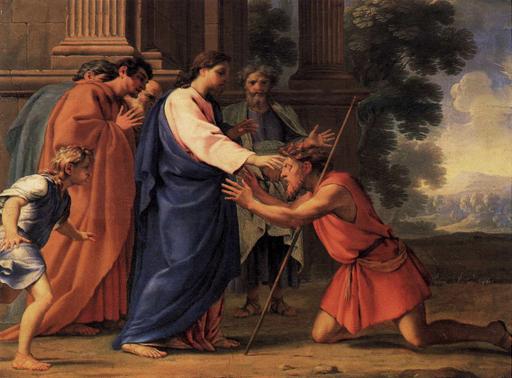 35 As he drew near to Jericho, a blind man was sitting by the roadside begging. 36 And hearing a crowd going by, he inquired what this meant. 37 They told him, “Jesus of Nazareth is passing by.” 38 And he cried out, “Jesus, Son of David, have mercy on me!” 39 And those who were in front rebuked him, telling him to be silent. But he cried out all the more, “Son of David, have mercy on me!” 40 And Jesus stopped and commanded him to be brought to him. And when he came near, he asked him, 41 “What do you want me to do for you?” He said, “Lord, let me recover my sight.” 42 And Jesus said to him, “Recover your sight; your faith has made you well.” 43 And immediately he recovered his sight and followed him, glorifying God. And all the people, when they saw it, gave praise to God.
 Joshua lead God’s people marching around those thick, fortified walls for six days, and on the seventh day, the people shouted and “the walls came a-tumbilin’ down.” Afterward, they burned the fallen rubble and reduced the city to ashes.
 On the cross, Jesus did everything for your salvation. On the cross, Jesus won the victory over sin, death, and the devil. But God delivers what Jesus did on the cross to you here and now. God delivers the mercy, grace, life, and salvation of Jesus through the preaching of His Word (Ro. 10:17), through your Baptism (Ro. 6:3-11), and through the Lord’s Supper (Lk. 22:14-20). God brings His holy deliverance to you through all those things, and as you receive those gifts of God through faith, you are saved.
 First, love is a beautiful summary of the Law, but that one word, love, does not replace the Law. Many people will say that since we have these two great commandments to love God and love our neighbor that we don’t need the rest of the Law. But that is false. Just because you think you are motivated by love does not mean that you are doing the right thing. We are so fallen that sometimes we try to pit love against the Commandments. Love is never an excuse to sin or an excuse to overlook sin. Instead, the Commandments define the shape of love, which is the second point about the Law.
 But, Christian, you know the answer. In fact, you have been taught this and have believed it for so long that you hardly think about it too much. But it is the most amazing thing. Jesus is man, born of His mother. And Jesus is God, begotten of His Father before all worlds. Jesus is man so that He can die, and He is God so that His death can be an atoning sacrifice for our sins.
 This reduction was, of course, not legally binding. The rich man could have simply said, “Hang on everyone. I fired that guy before he lowered your debt. You still owe the original amount.” But that isn’t the character of the rich man. Instead, the whole town is singing the praises of the rich man because he is so generous. And the rich man isn’t willing to harm his reputation as a merciful guy. So, what does the rich man do in the parable? He tells the fired, scoundrel of a manager, “Dude, you’re shrewd. You knew I’d rather be known as a merciful person rather than hold on to my wealth. And by your shrewdness, you’ve helped yourself.”
 Now, Jesus is absolutely clear, “You cannot serve God and money.”It can’t be done. If you trust in money, you do not trust God. So, repent of your love of money.
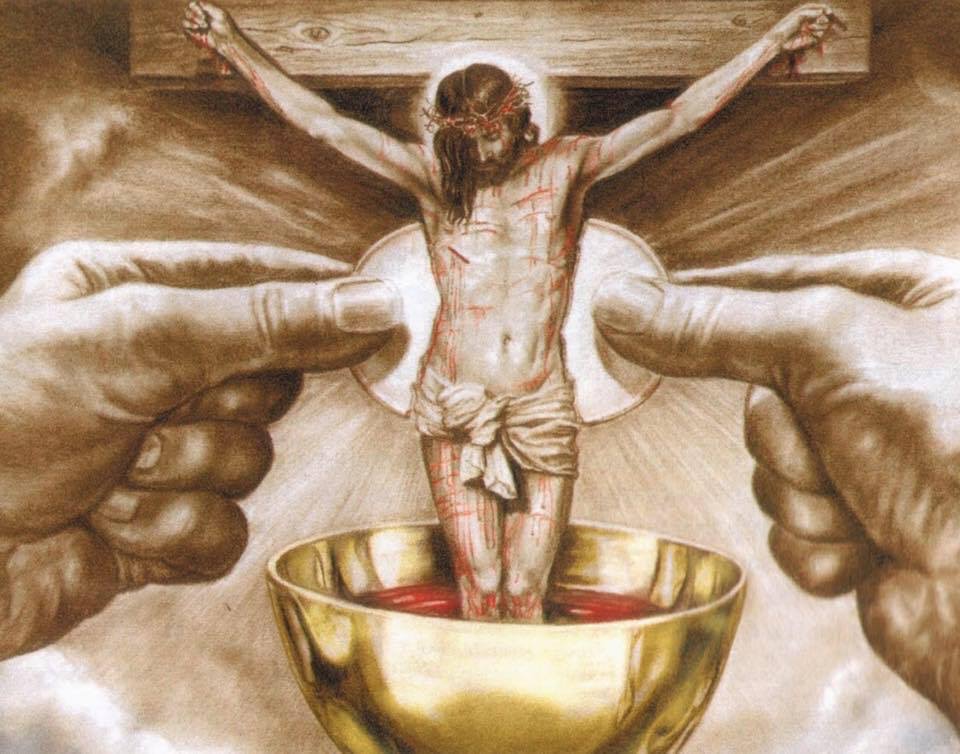 The only thing that matters for your salvation is what Christ has done and completed for you upon the cross. Even when you are stingy and fail to be generous with what God has given to you, God was not. He gave what was most valuable to Him for your salvation. God, in His mercy, gave Jesus to die upon the cross for you. Don’t trust in your stewardship of what God has given you. Instead, trust in Christ’s giving of Himself completely for you and for others. Amen.
 Out of that conversation came creation, and most importantly, out of that conversation came the creation of humanity. We get to hear that conversation in Gen. 1:26 where the Triune God says, “Let Us make man in Our image, after Our likeness.” It was so, and it was good – very good.
 One of the most amazing things is that God even gives His prophets a seat and a voice in this council. You remember when God was going to destroy Sodom and Gomorrah, and Abraham speaks up and gets God to agree to not destroy the cities if ten righteous people are found there (Gen. 18:22-33). Or, when God is going to destroy the Israelites for making the golden calf, Moses speaks up in the council and says, “God, if You go down and destroy them, the Egyptians will say that You only brought them out of slavery to destroy them.” And God relents of the disaster He had said He would bring on the people (Gen. 32:1-14).
 Now, Jesus has ascended to the right hand of the Father. Today, your Savior is talking with the Father, your Creator, and with the Holy Spirit, your Sanctifier. And do you know what they are talking about? They are talking about you and the cross. They are talking about how Jesus won your salvation there. How His blood shed there made a place in heaven for you forever. And the Holy Spirit is there, translating your prayers and interceding for you with groanings too deep for words (Ro. 8:26). The Holy Spirit whispers into your ear that you are an adopted child of God and heir with Christ. And you respond by crying, “Abba, Father” (Ro. 8:12-17).
 19 Therefore whoever relaxes one of the least of these commandments and teaches others to do the same will be called least in the kingdom of heaven, but whoever does them and teaches them will be called great in the kingdom of heaven. 20 For I tell you, unless your righteousness exceeds that of the scribes and Pharisees, you will never enter the kingdom of heaven.
 Sure, you aren’t Lady Macbeth yelling at the blood of Duncan to wash off your hands, but you are guilty of murder before God. You have been angry with others. You have called others, “Fool.” You have held grudges. You have refused to ask your neighbor for forgiveness. And Jesus goes on to the other Commandments as well – lust is adultery and fornication, gossip is perjury, etc.
 The Law should never be allowed to access into your ‘How do I stand before God?’ room, your ‘Am I good enough to go to heaven?’ room, your ‘Does God love me?’ room, your ‘Does God think I am a good person?’ room, or your ‘assurance of salvation’ room. The Law should never be allowed to enter those rooms because Jesus has made you as good and as righteous and as perfect as He is.

You must be logged in to post a comment.