Note:
The last Sunday in October is the day when most Lutheran churches (and other churches for that matter) will remember the Reformation. This coming Thursday, October 31st will mark the anniversary of five-hundred-two years ago when Martin Luther posted his 95 Theses on the door of the Castle Church in Wittenberg Germany. This event was just the beginning of what would take place over the next few decades which is the rediscovery of the Gospel that God saves us by grace alone, through faith alone, on account of Christ alone.
This isn’t a day when we thank and praise Luther. No. Instead, we thank and praise God for using sinful people who are faithful to the Scriptures to call us back to the eternal truths of God’s Word so that we repent of our sins and believe the Gospel. May we, as God’s people, be faithful to the life-giving Word of God.
Romans 3:19-28
19 Now we know that whatever the law says it speaks to those who are under the law, so that every mouth may be stopped, and the whole world may be held accountable to God. 20 For by works of the law no human being will be justified in his sight, since through the law comes knowledge of sin.
21 But now the righteousness of God has been manifested apart from the law, although the Law and the Prophets bear witness to it— 22 the righteousness of God through faith in Jesus Christ for all who believe. For there is no distinction: 23 for all have sinned and fall short of the glory of God, 24 and are justified by his grace as a gift, through the redemption that is in Christ Jesus, 25 whom God put forward as a propitiation by his blood, to be received by faith. This was to show God’s righteousness, because in his divine forbearance he had passed over former sins. 26 It was to show his righteousness at the present time, so that he might be just and the justifier of the one who has faith in Jesus.
27 Then what becomes of our boasting? It is excluded. By what kind of law? By a law of works? No, but by the law of faith. 28 For we hold that one is justified by faith apart from works of the law.
In the name of the Father and of the Son and of the Holy Spirit. Amen.
This text is centered around righteousness and justification. There is one Greek root in this text that is used ten times in this text and gets translated as righteous, righteousness, just, justified, and justifier. When you look at the text in the Greek, that root word is constantly popping up. It’s harder to see in English because of the various ways it gets translated (which overall, I think are good and helpful; it just is a little more hidden in English). Anyway, the sermon is going to be centered around the second sentence of v. 25, “This was to show God’s righteousness, because in His divine forbearance He had passed over former sins.”
So, to begin: Imagine that you have been caught after robbing a bank and are in a courtroom being tried for robbery, shooting a security guard, and fleeing police. The prosecution has presented a monumental case against you. They presented security footage from inside the bank with a clear picture of your face. Witnesses who were there all pointed to you as the one who demanded the money and fired at the security guard. The attorney produced the gun you used which was registered to you and had your fingerprints all over it. The police identified that it was your car that fled the scene. Bank records show that you deposited the exact amount of cash that was stolen into your own account, and the serial numbers of the bills match the numbers taken from the bank. They even produced text messages of you bragging to your friend about how you took the money and escaped. Every bit of evidence points to your guilt.
Now, you stand before a judge who is about to announce the verdict. Nothing you could say will change the facts. You did it, and nothing can excuse what you have done. It doesn’t matter that the reason you stole the money is that you lost your job and needed to feed your family.

You have taken what was not yours. You harmed and endangered others in the process. But you stand before the judge and say, “I am sorry, and I need forgiveness.”
Imagine that the judge, after considering all the evidence says, “I find the defendant not guilty.” He pounds his gavel, your handcuffs are removed, and you are free to go.
The whole courtroom would erupt. The prosecutors would shake their heads. The witnesses, the security guard’s family, and police would be enraged. The judge would probably soon be facing impeachment. That verdict of innocence would be seen as a travesty of justice because that is precisely what it is.
The fact is that this scenario had played out countless times through history – or at least scenarios very much like it. Moses murdered an Egyptian and fled his punishment; yet, God used him to lead Israel out of slavery in Egypt. Samson was a womanizing braggart, but God used Samson to deliver His people from their enemies, the Philistines. And think of David. David used the power and influence God had given him as king to commit adultery, steal another man’s wife, and, in an act of total cowardice, to murder that man by the hands of another. But, when David is confronted by his many and great sins and confesses them, the prophet Nathen simply forgives him and says, “The Lord has put away your sin” (2 Sam. 12:13).
Imagine being Uriah’s father. Your son is dead; his wife was violated and stolen. And the man who did it is simply forgiven? It is egregious, scandalous, shocking, and abhorrent.
I’m going to change gears, so please stay with me. One of the most common criticisms of Christians and Christianity today is people who say that God’s wrath against sin is unjust. Unbelievers will say things like, “How can you believe in a god who destroys all but eight people in a flood, rains down fire and sulphur on Sodom and Gomorrah, and condemns all humanity for eating a piece of fruit?” Unbelievers typically think that the wrath of God is unrighteous and unjust. But it isn’t just unbelievers who think this way.
In fact, God’s kindness and mercy is so prominent in the Scriptures that, when we see God being nice and patient, we start to think that is how He should act. Then, when God is angry, wrathful, and demands death as a punishment for sin, well, we get uncomfortable with that.  I have to confess, as I was doing my devotions this week, even when I had this sermon running through my mind, I got uncomfortable with some of the punishments God commanded for certain sins. But God does not owe us an explanation for His anger and wrath.
The reason God doesn’t owe us an explanation for His anger and wrath is given in this text. It is probably one of the verses you know by heart Ro. 3:23, “for all have sinned and fall short of the glory of God.” We all believe that, but it doesn’t have the bite that it should. We have a tendency to turn the phrase, “all have sinned,” into a trite and simple, “Nobody’s perfect.” And the phrase, “fall short of the glory of God,” what does that mean? It doesn’t sound so bad. Maybe, if we have fallen short, maybe we got kinda close.
Well, first of all “have fallen short” is a slightly weak translation; the word there means ‘lack.’ We lack the glory of God. But still, what’s the big deal? Are we supposed to have an equal amount of God’s glory? Did Adam and Eve match God’s glory before they fell into sin? Well, God did create us in His image, but even still we are the creature and do not and could match or equal the glory of our Creator.
To lack the glory of God means something different. And we can be thankful that Romans tells us what this means back in Ro. 1:23. There, Paul describes our fall into wickedness and sin, and he makes this statement we, “exchanged the glory of the immortal God for images.” We lack the glory of God because we knew about God’s glory – it had been given to us in nature and creation, it had been given to us in our conscience before we fell into sin – and though we knew it, we traded it away for idols. Our sin is that we would rather find our contentment and joy and fulfillment in the things God has given us than in God Himself. We took what should be our greatest joy and happiness and exchanged it for trinkets and crumbs.
This is a silly analogy, but… Imagine you gave your grown child a new house, a fancy car, and got him an easy, secure, high-paying job in a stable company. But imagine that your child went and traded every last bit of it away for one of those packets of salt that you can get at Culver’s so he could sprinkle it over his scrambled eggs. As egregious and wasteful as that would be, it still pales in comparison to us exchanging the glory of the immortal God for our sinful desires.
God’s wrath and anger against sin are assumed in the Scripture. And God doesn’t need to explain His punishment of our deep and damnable sins. But this text does say that God did need to explain something else. God did find it necessary to show, explain, and manifest His righteousness, but not because of His anger against or His punishment of our sin. Instead, God needed to manifest and show His righteousness because of His mercy.
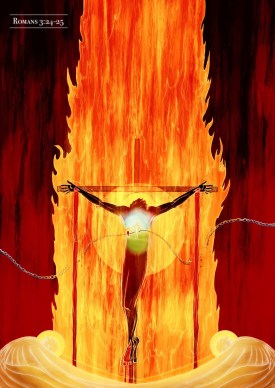 Remember, I told you that this sermon was going to be an explanation of that sentence in v. 25, “This was to show God’s righteousness, because in His divine forbearance He had passed over former sins.” What is it that showed God’s righteousness in giving us mercy? Nothing but Jesus Christ. Nothing but Jesus shedding His blood and dying on the cross. Nothing but Jesus being our propitiation – the atoning sacrifice, the mercy seat, the place where God forgives us and meets with us sinners.
Jesus’ death in our place, His suffering for our sins, shows God’s righteousness and proves that God is just when He justifies us and declares us innocent through faith in Jesus.
Think back to that analogy of the judge declaring you innocent of robbing the bank. Imagine that, as the judge was being questioned to be impeached, he said, “Yes, all the evidence pointed to guilt. But trust me, I’m going to make it all right. I’m going to repay everyone who lost money in the robbery. I’m going to completely heal and restore the security guard who was shot. I’m going to take away all the fatigue of the police who chased him. I’m going to remove every last fear of all the people who were put in danger. Everything will be put back to right.”
Christian, Jesus has removed your sin and has put everything back in its proper place. C. S. Lewis expresses this in a beautiful analogy in The Lion, the Witch, and the Wardrobe with the character that represents Jesus, Aslan the lion. “Wrong will be right, when Aslan comes in sight. At the sound of his roar, sorrows will be no more. When he bares his teeth, winter meets its death. And when he shakes his mane, we shall have spring again.” Jesus has done all of this and more on the cross, and it will again be manifested when He returns in glory.
Dear saints, God has justly proclaimed and declared that you are righteous and just in His court because of Christ. Because of what Jesus has done, you are justified. This means you are exactly what you ought to be in God’s sight by His verdict of innocence. You are holy, perfect, and just through God-given faith in Christ. When He looks at you, God does not find the tiniest speck of sin in you. He sees you and treats you as completely and wholly worthy. He does this not because you are sinless or without guilt. No, He does this because of the perfect completeness of Christ’s finished work on the cross.
This is all of God’s just mercy. It leaves no room for us to boast. For this, may God alone be praised, now and forever. Amen.
The peace of God, which surpasses all understanding, will guard your hearts and minds in Christ Jesus. Amen.

 First, love is a beautiful summary of the Law, but that one word, love, does not replace the Law. Many people will say that since we have these two great commandments to love God and love our neighbor that we don’t need the rest of the Law. But that is false. Just because you think you are motivated by love does not mean that you are doing the right thing. We are so fallen that sometimes we try to pit love against the Commandments. Love is never an excuse to sin or an excuse to overlook sin. Instead, the Commandments define the shape of love, which is the second point about the Law.
 But, Christian, you know the answer. In fact, you have been taught this and have believed it for so long that you hardly think about it too much. But it is the most amazing thing. Jesus is man, born of His mother. And Jesus is God, begotten of His Father before all worlds. Jesus is man so that He can die, and He is God so that His death can be an atoning sacrifice for our sins.
 10 “Two men went up into the temple to pray, one a Pharisee and the other a tax collector. 11 The Pharisee, standing by himself, prayed thus: ‘God, I thank you that I am not like other men, extortioners, unjust, adulterers, or even like this tax collector. 12 I fast twice a week; I give tithes of all that I get.’ 13 But the tax collector, standing far off, would not even lift up his eyes to heaven, but beat his breast, saying, ‘God, be merciful to me, a sinner!’ 14 I tell you, this man went down to his house justified, rather than the other. For everyone who exalts himself will be humbled, but the one who humbles himself will be exalted.”
 The parable does teach that the worst of sinners can go to heaven. We know this, but unfortunately, we can grow a little numb to this. But the main reason Jesus tells this parable is to destroy any self-righteousness and contempt we would have against other sinners.
 Dear saint, you look there too. Look to the cross. Look to the blood of Jesus shed for you on Calvary. Look to His death. Look to His resurrection. Look to His ascension. And know that Jesus promises that all of that is for you.
 She prays because she remembers that the God of Israel promised to deliver His people from the devil, which is why she addresses Jesus as the Son of David – to remind Him of His promises. And she remembers that she doesn’t deserve Jesus’ help because of her sins, so her prayer is, “Have mercy on me.”
 Boone, and all of you, be bold in your prayers. Even when it seems that God is distant and ignoring you, He hears you. He loves you. Jesus has died and risen for you and is even now interceding for you before His Father in heaven (1 Jn. 2:1).
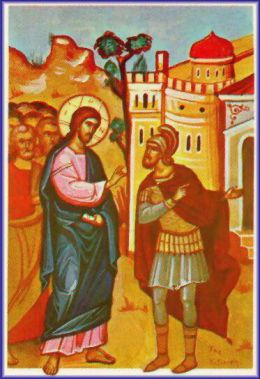 5 When he had entered Capernaum, a centurion came forward to him, appealing to him, 6 “Lord, my servant is lying paralyzed at home, suffering terribly.” 7 And he said to him, “I will come and heal him.” 8 But the centurion replied, “Lord, I am not worthy to have you come under my roof, but only say the word, and my servant will be healed. 9 For I too am a man under authority, with soldiers under me. And I say to one, ‘Go,’ and he goes, and to another, ‘Come,’ and he comes, and to my servant, ‘Do this,’ and he does it.” 10 When Jesus heard this, he marveled and said to those who followed him, “Truly, I tell you, with no one in Israel have I found such faith. 11 I tell you, many will come from east and west and recline at table with Abraham, Isaac, and Jacob in the kingdom of heaven,12 while the sons of the kingdom will be thrown into the outer darkness. In that place there will be weeping and gnashing of teeth.” 13 And to the centurion Jesus said, “Go; let it be done for you as you have believed.”And the servant was healed at that very moment.
 Hell is the place where people are given over to their anger. It is full of people whose pride has lead them to think that God owes them something because they are so good and righteous or because they belonged to the right club or had the right lineage. But they are wrong and so they are in torment stewing in their anger against God and there is no relief or release. All of that is the gnashing of teeth. So, when Jesus speaks of what hell will be, He gives a picture of darkness, sorrow, and anger.
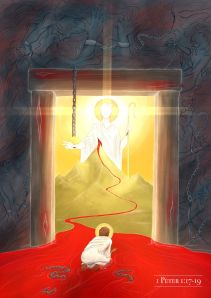 He couldn’t do it because he didn’t have the strength or authority. The centurion’s truest strength was his submission and faith that Christ’s authority far surpassed his own. So, the centurion in faith and hope asks Jesus to merely speak the word, and his servant is healed at that very moment.
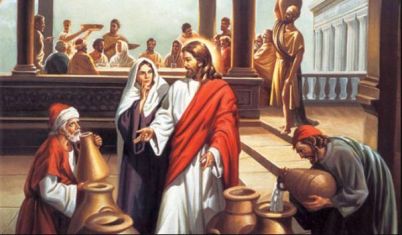 6 Now there were six stone water jars there for the Jewish rites of purification, each holding twenty or thirty gallons. 7 Jesus said to the servants, “Fill the jars with water.”And they filled them up to the brim. 8 And he said to them, “Now draw some out and take it to the master of the feast.”So they took it. 9 When the master of the feast tasted the water now become wine, and did not know where it came from (though the servants who had drawn the water knew), the master of the feast called the bridegroom 10 and said to him, “Everyone serves the good wine first, and when people have become drunk, then the poor wine. But you have kept the good wine until now.” 11 This, the first of his signs, Jesus did at Cana in Galilee, and manifested his glory. And his disciples believed in him.
 Jesus tells the servants to fill the jars with water, and they fill them up to the brim. And, at Jesus’ command, they take some of it to the master of the feast. The master tastes it, and it isn’t water anymore. It is wine. The master didn’t know. The guests didn’t know. Only Jesus, Mary, the servants, and the disciples know that this had been water miraculously turned into wine.
 But, dear saint, that is precisely the point. God is willing to give His gifts and mercy anyway. This isn’t a license to go on and sin because God will forgive you anyway. In fact, you are to abhor what is evil and hold to fast to what is good. Love one another. Outdo one another in showing honor (Ro. 12:9-11). And do all of that as you remember that God gives better than you deserve or appreciate.
 32 So likewise a Levite, when he came to the place and saw him, passed by on the other side. 33 But a Samaritan, as he journeyed, came to where he was, and when he saw him, he had compassion. 34 He went to him and bound up his wounds, pouring on oil and wine. Then he set him on his own animal and brought him to an inn and took care of him. 35 And the next day he took out two denarii and gave them to the innkeeper, saying, ‘Take care of him, and whatever more you spend, I will repay you when I come back.’ 36 Which of these three, do you think, proved to be a neighbor to the man who fell among the robbers?” 37 He said, “The one who showed him mercy.” And Jesus said to him, “You go, and do likewise.”
 Christ has come to find you. He has bound up your wounds. Jesus has poured out His healing, life-giving blood for you. Jesus nurses you in your brokenness. He has ascended into heaven and has promised to come back and pay for everything you need.
 This miracle, on the other hand, is odd. It’s dirty. Maybe, you even find it disgusting. Jesus takes a deaf man who has a speech impediment off to the side. He sticks His fingers into wax-filled ears. God in the flesh spits (apparently, Jesus wasn’t taught how to give a proper wet-Willy). Christ literally seizes, not just ‘touches,’ the man’s tongue. And then, Jesus looks up to heaven. Sighs. And says, “Ephphatha,” which means,“Be opened.”
 Jesus had come to be the Lamb of God who takes away the sin of the world, not to be the audiologist who takes away the deafness of the world. Jesus had come to give eternal life through His death and resurrection, not to give a voice to the voiceless.
 Yes, Jesus sighs and acts. He gets involved with us even though it hurts Him. He cannot help Himself. In His love and mercy, He gets bound up in the mess we make and that others have made for us. He gets entangled in our sin. In fact, He becomes sin so that we might become the righteousness of God (2 Cor. 5:21).
 Jesus says, “Judge not,”and our fallen, twisted, evil, amoral society latches on to these words like stink on poo. If an unbeliever loves any words of Jesus, it is probably, “Judge not.”
 Know this: No one will thank you from hell for remaining silent about their sin on earth. And God forbid that they curse you from hell for remaining silent about their earthly sin.
 God loves you from His very heart. God gives you real mercy. He loves the good and bad, the greatest and the least. He loves the sinner who strives to be merciful but fails, the hardened drug lord who doesn’t care about his sin, and He even loves you. In His mercy, God doesn’t simply get frustrated with your hypocrisy and ignore it.
 Pastorsamwise
You must be logged in to post a comment.